
 Jose Bispo Clementino Dos Santos, aka Jamelao (1913-2008), played old-school gafiera jazz -- swinging samba, but with an unusual, almost un-Brazilian twist. He was also closely associated with the fabled Mangueira samba school, and recorded regularly from the late 1950s through the dawn of the 21st Century... Here's a quick look at his work (most of which is still out of print... though a few gems have made it into the digital era...)
Jamelao "A Voz Do Samba" (Warner, 2002)
A three-CD box set (also for sale as single discs) that outlines Jamelao's work across the decades... It's a fine, comprehensive look at his career, and it's packed with some mighty fine music.
Jamelao "O Eterno Mangueirense" (Revivendo, 2004)
Jamelao "Noventa Anos Do Samba" (Tumi Records, 2005)
Jamelao "O Samba Em Noite De Gala" (Continental Records, 1958) (LP)
Jamelao "Escolas De Samba" (Continental Records, 1958) (LP)
Jamelao "O Samba E Bom Assim: A Boite E O Morro Na Voz De Jamelao" (Continental Records, 1959) (LP)
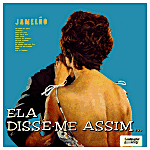 Jamelao "Ela Disse-Me Assim..." (Continental Records, 1959) (LP)
This is an LP-era collection of various 78s recorded earlier in his career, with a variety of bandleaders such as Severino Araujo, et. al.... It's a mixed bag: some of the songs are super-schmaltzy, redolent with drippy string arrangements and gooey saxophone, though several of the big-bandy singles really swing! "Como Ela E Boa," "Ela Esta Presente" and "Ha Sempre Um Que Fica" are standouts among the uptempo numbers, but even some of the slow boleros are fun as well. It's all classic material, for sure!
Jamelao "Desfile De Campeas: Jamelao E Escolas De Samba" (Continental Records, 1960) (LP)
Jamelao "Jamelao E Os Sambas Mais" (Continental Records, 1961) (LP)
Jamelao "Canta Para Enamorados" (Continental Records, 1962) (LP)
Jamelao "Sambas Para Todo Gosto" (Continental Records, 1963) (LP)
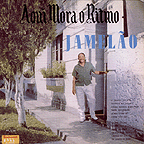 Jamelao "Aqui Mora O Ritmo" (Warner/Continental Records, 1964)
Swinging samba, but with an unusual, almost un-Brazilian twist. The punchy, big band-ish horn charts have a density that's similar to Stan Kenton and other highbrow jazzmen of the 'Fifties; Jamelao's vocals have a throatiness that has more in common with Cuban guaracheros such as Cascarita and Beny More than with homegrown heroes like Dick Farney or Lucio Alves. Jamelao's affinity for muscular, jazzy arrangements would remain constant throughout his life, but this is a fine example of his work in the first half of the '60s. Recommended!
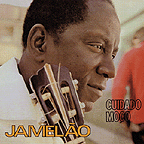 Jamelao "Cuidado Moco" (RCA, 1969) (LP)
Once again, an interesting mix of intimate samba and schmaltzy, bombastic big-bandish vocals. This was Jamelao's first album after a six year hiatus, and ably showcases his affection for the archaic vocal style of the "radio singers" of the 1940s and '50s... Indeed, he even covers artists such as Tito Madi and Lupicinio Rodrigues, whose heyday had been years earlier. Old-fashioned, but entirely enjoyable -- similar to early work by Jair Rodrigues.
Jamelao "Jamelao" (Continental Records, 1970) (LP)
Jamelao "Interpreta Lupicinio Rodrigues" (Continental Records, 1972)
Jamelao "Jamelao" (Continental Records, 1974) (LP)
Jamelao "Os Melhores Sambas Enredos '75" (Continental Records, 1974) (LP)
Jamelao "Jamelao" (Continental Records, 1975) (LP)
Jamelao "Samba-Enredo: Sucessos Antologicos" (Continental Records, 1975) (LP)
Jamelao "Folha Morta" (Continental Records, 1977) (LP)
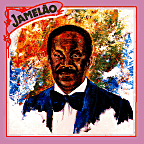 Jamelao "Jamelao" (Continental Records, 1980) (LP)
(Produced by Manoel Barenboim & Paulo Ribeiro)
This later effort is a bit too lush and over-the-top for me, although Jamelao certainly gives it his all. Although the arrangements are a bit much (standard-issue overdo-it-for-the-old-guy big bandy orchestrations...) of note is the participation of pianist Fats Elpidio, whose work in the confines of the pre-bossa nova pop-orchestral scene often yielded pleasant surprises. There's some of his characteristic quirkiness and nimble plunking at play here as well, although he is mostly in the background, as much overwhelmed by the too-eager brass section as Jamelao himself. Severino Araujo is credited as an arranger, but it's hard to tell how much influence the old-timers had on the final outcome -- most of the tracks sound a bit rushed. This album is worth checking out, I suppose, but it doesn't really stick to your ribs.
Jamelao "Mangueira, A Super Campea" (Continental Records, 1984)
Jamelao "Recantando Magoas -- Lupi, A Dor E Eu" (Continental Records, 1987)
Jamelao "Minhas Andancas" (RGE, 1994)
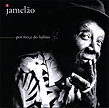 Jamelao "Por Forca Do Habito" (Som Livre, 2000)
An unusual album, to say the least. Jamelao is a samba old-timer, whose career dates back to the 1940s, and who helped popularize and define the Carnaval samba-cancao style, as well as compose many of the best-known themes of the Mangueira samba school. Here, though, he takes a Tony Bennett-ish turn, with sinuous, though sometimes sluggishly heavy horn arrangements and a sleek pop vocals styling. Certainly not what I expected when I spotted this album, and not entirely to my tastes, but certainly very intriguing. If you're looking to explore a very different avenue of Brazilian pop, check this out. Might make a nice compliment to Dick Farney's stuff, for example.


