If so, this website is for you... I'm DJ Joe Sixpack, and this is part of my friendly, opinionated Guide to Hick Music, where I try and make sense of the Nashville pop phenomenon. I've been a country fan since the 1970s, with a tilt towards the twangy stuff, but an open mind and a good ear for sharp songwriting wherever I find it. I may be a hick music traditionalist, but I'm not too snobby about it, and I've logged a lot of hours checking out the slick stuff that's at the top of the charts... 'Cause ya never know, even those phony-baloney, prefab country superstars can get things right every now and then. This section is mostly geared towards folks like myself, people from the alt-country side of the street who might also want to check out what's going on in Nashville, and maybe make find a few fun discoveries...
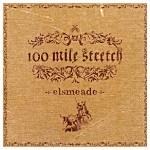 100 Mile Stretch "Elsemeade" (Self-Released, 2008)
Rugged country-rock -- a mix of indie-roots and Skynyrd-ish bar-band booziness, marked by an exaggerated vocal (and musical) twang. This Southern-based band is led by two songwriters, Scott Murchison and J. G. Spencer, who lay it on a little thick, but seem to have their hearts in the right place.
The Josh Abbott Band "Scapegoat" (Winding Road Records, 2009)
The Josh Abbott Band "Brushy Creek EP" (Pretty Damn Tough Records, 2009)
A 4-song EP...
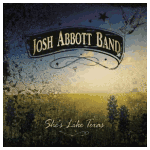 The Josh Abbott Band "She's Like Texas" (Pretty Damn Tough Records, 2010)
A "red dirt" Texas band that's verging on the bigtime, The Josh Abbott Band got close enough to rattle the brass ring with this one: the single "Oh, Tonight" narrowly missed the bottom end of the Top 40. This disc is certainly more commercial-sounding than their debut... more is sure to come!
Mack Abernathy "Different Situations" (CMI Records, 1988)
Mack Abernathy "Fire On The Line" (Hombre Records, 2007)
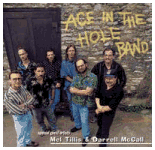 Ace In The Hole Band "Ace In The Hole Band" (Texas World Records, 1995)
George Strait's old band -- well, two of them, steel player Mike Daily and bassist Terry Hale, along with some other dudes -- laying down their first full-length album, a couple of decades after those distant days when they cut a few singles with George as their frontman. Texas indie will never die!
Roy Acuff -- see artist profile
 Roy Acuff, Jr. "Roy Acuff, Jr" (Hickory Records, 1970) (LP)
(Produced by Wesley Rose & Roy Gant)
Wow. Ouch. I mean, I don't want to be mean just for the sake of being mean, but I guess a little bit of Acuff goes a long way, and I think Roy Senior may have used most of the glamor and magic up in his own long career. Roy, Jr. had a pretty thin, underwhelming voice -- I guess he was shooting for a Bill Anderson/Hank Locklin kind of thing, but this album just lacks spontaneity or spark, and the youth-culture touches don't really put it over the top. Probably the most interesting aspect is that there are four John D. Loudermilk songs on there (including a really embarrassing rendition of "Lament Of The Cherokee Reservation Indian") as well as a couple by newcomer Mickey Newbury, and two by Bobby Bond. But mostly, this was clearly a vanity record, with pretty perfunctory accompaniment by the studio crew at dad's record label. Oh, well. Diehard Loudermilk fans might want to check it out...
Roy Acuff, Jr. "California Lady" (MGM-Hickory Records, 1974) (LP)
(Produced by Wesley Rose & Roy Gant)
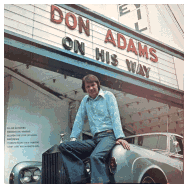 Don Adams "On His Way" (Atlantic Records, 1973) (LP)
(Produced by David Paul Briggs)
The lone album, I believe, of this semi-rootsy country crooner from rural Greenfield, Ohio, which was also the hometown of country star Johnny Paycheck. Adams broke through in '67 with a modest hit on an indie label, and landed a spot in Paycheck's band, but it never quite clicked for Adams as a solo artist. This major label debut was well-produced and pretty satisfying I like the loping honkytonk numbers, including the opening track, "I'll Be Satisfied," although it only barely cracked into the Top 100, followed by a handful of non-album singles that also fizzled on the charts. Adams was best with a backbeat; there are also a few slower ballads where he sounds kind of Hank Locklin-esque, but these just underscored his limitations as a singer. Among the backing musicians are a couple of other Paycheck pickers, notably steel player Doug Jernigan and fiddler Paul Justice; Paycheck himself contributes brief liner notes and good wishes. Not an earthshaking album, but certainly worth a spin. Adams and his brothers also recorded an album as "The Boys," with Jernigan and other members of the Paycheck band; they later played together at regional "opry" venues and the like.
Kay Adams -- see artist discography
Trace Adkins -- see artist profile
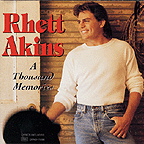 Rhett Akins "A Thousand Memories" (Decca Records, 1995)
(Produced by Mark Wright)
An okay debut album from a Georgia-born softcore honkytonker, much of which has a rock-oriented sound ("young country," as they called it in the early '90s...) that derives some of its poetic pretensions from pop-roots rockers like John Mellencamp and Bryan Adams. The ballads are terrible, but on more rompy-stompy honkytonk tunes, Akins is pretty likable. This album has his first hits, and oddly enough the ones that did best were the more uptempo, rootsy ones, notably "That Ain't My Truck" and "I Brake For Brunettes." The success of twang over crooning isn't the only thing that was backwards with Akins' career: he also got more twangy on later albums, rather than the usual pattern of losing one's roots as time goes on, and album sales beckon. So, in an interesting twist for twangfans, this first record actually isn't his best... Though it's still certainly worth checking out.
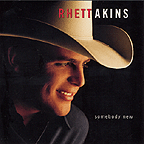 Rhett Akins "Someone New" (Decca Records, 1996)
This album had its iffy moments, but even with the glossy "young country" production, Akins still has an inherent, deeply ingrained likability. Akins ain't the world's greatest singer, but like, say, Hank Locklin, he has a knack for turning his shortcomings into an asset: his voice stands out, and when he falters, it makes him sound genuine and sincere. Similarly, the material is lightweight, but likeable, though some of it's pretty lackluster. You don't have to think too much about an upbeat tune like "K-I-S-S-I-N-G," but that's just part of its charm; and a song like "Every Cowboy's Dream" is also admirably dopey and old-school. Worth a spin!
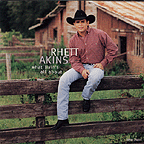 Rhett Akins "What Livin's All About" (Decca Records, 1998)
(Produced by James Stroud)
Y'know... I just find this guy to be kinda down-to-earth and unpretentious. For starters, there's the album art -- none of this "I'm-country-but-I'm-not-a-hick" fashion plate posing for this '90s cowboy -- nope, here's Akins hanging out in a barn, propped up on a rail fence, the way they used to do back in the 'Forties and 'Fifties, projecting an unapologetically backwoods image, and ya gotta respect that, especially considering how glossy and antiseptic Top Country has gotten in recent years. Musically, I'll admit that this isn't the strongest set ever, but his feel for singing fast numbers is pretty nice. Akins might want to shy away from the slow stuff, but when he gets to just belt 'em out, he's pretty fun. His main strength is his sheer sincerity; when he hits an anthemic chorus, you're with him all the way. This disc kind of tanked out on the charts, but I think part of the problem might have been the choice of singles -- I would've gone with the uptempo tunes, such as "Happy As We Wanna Be" or "She's Got Everything Money Can't Buy" instead.
Rhett Akins "Friday Night In Dixie" (Audium Records, 2002)
Rhett Akins "Down South" (Self-Released, 2009)
Rhett Akins "People Like Me" (BNA Records, 2010)
Alabama -- see artist profile
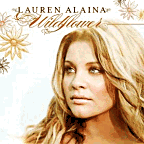 Lauren Alaina "Wildflower" (Mercury Nashville, 2011)
(Produced by Byron Gallimore)
Absolutely dreadful, and completely phony. The debut album by (yet another) American Idol contestant... She's one of those dreadfully unsubtle Idol singers, wailing away inside some impenetrable fortress of studio-generated wall-of-sound production, a soulless mound of pop-hook cliches, with no margin of error or room for genuine feeling. Bleah. It's an approximation of better music -- Sheryl Crow, etc. -- but so perfectly crafted and unoriginal it's really rather disheartening. How many of these records can they make? And why?
Buddy Alan -- see artist profile
Jason Aldean "Jason Aldean" (Broken Bow Records, 2005)
(Produced by Michael Knox)
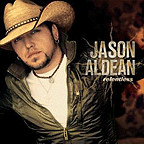 Jason Aldean "Relentless" (Broken Bow Records, 2007)
(Produced by Michael Knox)
A new kid in Nashville, Georgia-born Jason Aldean has a tall order following up his first album, which scored a #1 chart hit with the rollicking "Hicktown." I'm not sure the lead single on this new disc, "Johnny Cash" has quite the same mojo, but the neo-Southern rock crowd will probably dig it, and I'm pretty sure I ain't the target audience anyway. One thing that stands out about Aldean, and I think this is a real strength, is that he has a modest voice and doesn't try to overreach and get all Tim McGraw-ed out about it. Even though the songs have the same pop trappings as many other post-millennial Top Country acts, Aldean doesn't go over the top all that often, and this low-key approach allows his native drawl to come out: I'm more convinced that he's a genuine good ol' boy than I am of over half the current Top 40 hat acts. He also sings with conviction -- even with all the wailing guitars, Aldean cuts through and brings it home, especially on the slow songs. For my money, ballads like "Do You Wish It Was Me" and "Grown Woman" are the best things on here. It's not my cup of tea, but I think he's worth keeping an eye on...
Jason Aldean "Wide Open" (Broken Bow Records, 2009)
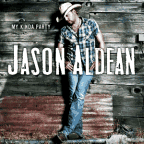 Jason Aldean "My Kinda Party" (Broken Bow Records, 2010)
(Produced by Michael Knox)
Is it even possible for a mainstream Nashville country dude to start an album anymore without stuffing in one of those super-fake nostalgia songs about their good old, small-town childhood home? Apparently not. Aldean has about fifty of them on this album, starting off with "Tattoos On This Town," a poppy tune filled with ringing guitars and prefab sentiment; far worse is his geefy attempt at rapping on "Dirt Road Anthem." Oh, well. We all make mistakes, right? It's how we learn and grow. Later on, though, things pick up: on "Church Pew Or Bar Stool," he feels stifled by the small-town vibe (although he immediately defends the folks back home from snobby city folk on "Fly Over States..." By the way dude: could you make up your mind? Small towns, love 'em... or leave 'em?) Top 40 fans might also enjoy his bombastic power ballad duet with Kelly Clarkson, "Don't You Wanna Stay." Overall, I'd say this ain't my cup of tea, but I guess Aldean is doing okay on the charts... I guess it's just one of those times I can honestly say I just don't get it.
 Jason Aldean "Night Train" (Broken Bow Records, 2012)
Daniele Alexander "First Move" (Mercury Records, 1989)
Daniele Alexander "I Dream In Color" (Mercury Records, 1991)
(Produced by Harold Shedd)
Gary Allan "Used Heart For Sale" (MCA Nashville, 1996)
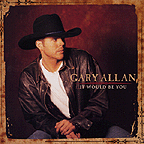 Gary Allan "It Would Be You" (MCA/Decca Records, 1998)
(Produced by Mark Wright & Byron Hill)
Neotrad country that dips a bit too deeply in the brainy, "high-concept" songwriting that has become all the rage in Nashville over the years. The first coupla tunes here are good examples: Allan's voice is great and he's able to project real emotion into the lyrics, but the songs are just too darn sluggish and take forever for the setup to fall into place. Then, he whips out a fine, bouncy honkytonker like "Don't Leave Her Lonely Too Long," or a drinkin' tune like "I've Got A Quarter In My Pocket" that show us that this kid can loosen up and play something lighter and less sluggish than the tinkly-piano ballads the Nashville labels like to push onto radio. There's an Eagles-ish air to Allan's work, which is okay at times, a bit drippy at others. As a debut disc from the heart of Music City, though, it really shows promise... Stay tuned!
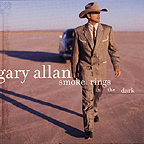 Gary Allan "Smoke Rings In The Dark" (MCA Nashville, 2000)
(Produced by Tony Brown & Mark Wright)
Still slick, but with his sound smoothing down into a Raul Malo/Mavericks-y croon (on tunes like the title track and his big, booming cover of Del Shannon's "Runaway")... He still pulls out some hard country soul, particularly on old-fashioned weepers like "Don't Tell Mama," but about half of these tunes are really terrible. Another sad example of how the gap has become between the "good" songs on a typical Nashville album, and the cheesy ones. Still, I'd way rather listen to a Gary Allan album than anything by most of his contemporaries.
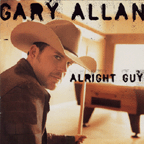 Gary Allan "Alright Guy" (MCA Nashville, 2001)
(Produced by Tony Brown & Mark Wright)
Mostly pretty overproduced; his honkytonk spirit gets buried under a mountain of big Nashville wall'o'sound geetars, keyboards'n'organs, and booming, super-slick drums... Still, he covers Pat Green on the title song and Jim Lauderdale's "What's On My Mind," so despite the goopy pop arrangements, Allan's still got his hick thang goin' on. From a hard country perspective, though, this is a skippable album.
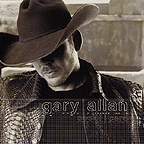 Gary Allan "See If I Care" (MCA Nashville, 2003)
A great, no-nonsense neotraditional honkytonk album, with strong, convincing vocals and straightforward arrangements -- plenty of fiddle and steel, and a nice, heavy masculinity on even the sappier, slower numbers. Allan is a hard country singer who apparently has not lost his way amid the increasingly high-tech, drearily high-concept Nashville of today. Even taken as background-music radio pop, this disc holds up pretty well -- there isn't a single song on here that would make me wanna change the channel, and that's almost unheard of with any contemporary country offerings. The disc opens with a rompin', stompin' drinking song ("Drinkin' Dark Whiskey") and closes with a nice duet with Willie Nelson, crooning away on a cover of Jesse Winchester's "A Showman's Life." I hope Allan can keep this up -- 'cause right now he's right up there with Alan Jackson and George Strait as a true-country hero. And this is a mighty fine record, all things considered.
Gary Allan "Tough All Over" (MCA Nashville, 2005)
Gary Allan "Living Hard" (MCA Nashville, 2007)
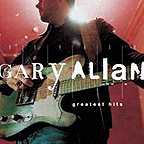 Gary Allan "Greatest Hits" (MCA Nashville, 2007)
(Various Producers)
Of the current crop of Top 40 hat acts, Gary Allan stands out as a superior singer, able to coast atop the lavish modern production and sound natural and sincere -- the guy really knows how to sing a song. This best-of collection is a perfect introduction to his work, gathering all the biggest hits (and adding a couple of new singles so fans will have to pick it up...) For the most part, his twanger side is left off this set, but even so it's worth checking out, particularly if you like Alan Jackson or other neotradders who can still tap into county's old-school vibe. If you want to hear Allan sing honkytonk, you should track down his old albums (particularly 2003's See If I Care) but if you just want the radio hits, rolled up together in one neat package, then this is a mighty useful disc. The new songs, "A Feeling Like That" and the uptempo "As The Crow Flies," fit right in -- maybe slicker than some of us might want, but still pretty darn good. Allan's the real deal: a country craftsman who should be around for a long time to come!
Gary Allan "Get Off On The Pain" (MCA Nashville, 2010)
 Gary Allan "Set You Free" (MCA Nashville, 2013)
(Produced by Gary Allan, Greg Droman, Jay Joyce & Mark Wright)
He was so much cooler fifteen years ago. The subtle allegiance to hard-country twang that drew me towards Allan's work in the 1990s seems to be pretty much gone: this is a glossy, overly-controlled, soulless pure-pop set. Technically "country," in the modern Nashville sense, but about as far away from true twang as you can get, full of shimmering, multi-textured electronics and lyrics that are a little too lofty and formulaic for me. Oh, well. Of course, the album hit #1 right away: I am not the target audience for this one.
Susie Allanson -- see artist discography
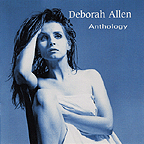 Deborah Allen "Anthology" (Renaissance Records, 1998)
Her initial chart entries were "duets" with countrypolitan crooner Jim Reeves, whose death in 1964 didn't prevent the RCA label from releasing singles for decades to come. A trio of these tunes kicks off this disc, with Allen's Parton-esque vocals engulfed by a barrage of slightly piercing (and entirely egregious) string arrangements. She swiftly emerged as a solo singer, at her best fronting perky synth-a-billy hits like "I've Been Wrong Before" and a whole host of drippier Flashdance-y followups. This is a pretty comprehensive retrospective of her work on RCA, Capitol, and the Giant imprint... Maybe not the greatest hick music ever, but her fans will be thrilled to track this disc down...
Deborah Allen "Trouble In Paradise" (Capitol Records, 1980) (LP)
Deborah Allen "Cheat The Night" (RCA, 1983) (LP)
Deborah Allen "Let Me Be the First" (1984)
Deborah Allen "Telepathy" (1987) (LP)
Deborah Allen "Delta Dreamland" (Giant Records, 1993)
Deborah Allen "All That I Am" (1994)
Deborah Allen "The Best Of Deborah Allen" (Curb Records, 2000)
Deborah Allen "Hands On" (Southbound Sound, 2003)
Deborah Allen "Memphis Princess" (Renaissance Records, 2006)
Harley Allen "Across The Blueridge Mountains" (Folkways Records, 1983)
Harley Allen & Mike Lilly "Suzanne" (Folkways Records, 1985)
A sweet bluegrass set, featuring Red Allen's son, Harley, who would later go on to be a successful Nashville songwriter. This is a nice album, not dazzling, but heartfelt and relaxed, and obviously drenched in the tradition. There are some more folkie, "progressive" touches that hint at his future directions, but mostly this is pretty stripped-down and traditional sounding. Worth checking out.
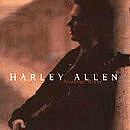 Harley Allen "Another River" (Mercury Records, 1996)
(Produced by Carson Chamberlain & Dirk Johnson)
Not bad! Songwriter Harley Allen -- who wrote or co-wrote every song on this album -- has a smoothed-out honkytonk pop approach that sounds very much like Rodney Crowell or even Marty Stuart: impassioned but still rootsy, with a tremulous, emotive edge that pulls you in, but can get a little whiny at times. His lyrics are fairly dense (I'd be hard-pressed to recall a single chorus off the entire album) but it's balanced out by a no-nonsense twangitude that keeps the music on an honest, even keel. Consistently listenable and fairly solid... If you like Rodney Crowell, you'll love this.
Harley Allen "Live At The Bluebird Cafe" (American Originals, 2001)
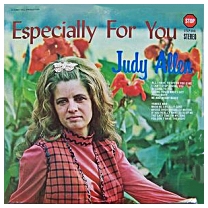 Judy Allen "Especially For You" (Stop Records, 1972) (LP)
One of those lost, orphan albums of the early '70s... Ms. Allen actually had her chart hits a little later on, in 1978, with a brief mid-1970s stint on Polydor, but apparently those Back Forty singles weren't enough to persuade the label to put out a full album of her work... Perhaps someday she'll get a full retrospective set, combining these songs with the later stuff? Maybe... who knows?
Rex Allen -- see artist discography
Rex Allen, Jr. -- see artist discography
 The Almost Brothers "The Almost Brothers" (MTM Records, 1986) (LP)
The Amazing Rhythm Aces -- see artist discography
Bill Anderson -- see artist discography
John Anderson -- see artist discography
 Keith Anderson "Three Chord Country And American Rock & Roll" (Arista Records, 2005)
(Produced by Jeffrey Steele & John Rich)
One of the lesser entries in the Big & Rich postmillennial "Muzik Mafia" ouvre. The B&R formula tends to wear thin easily to start with -- how many fake-rowdy, phony-sounding, would-be roughneck anthems with hook-laden, squeaky-clean, alt-metal rock riffs do we really need to hear, anyway? -- but Anderson's modest vocal talent only serves to underscore the poverty of the style. It's just too friggin' slick and cynically conceived for me, and the songs are so baldly prefab and desperate to lay claim to the Southern rock audience while still sounding as safe and antiseptic as an old REO Speedwagon album. To his credit, Anderson does manage to sound a little more organic and legitimately grounded in country tradition than Big & Rich do, but then, once you're willing to give the guy the benefit of the doubt on the production end of things, you run up agains his so-so voice. He may have written a hit for Gretchen Wilson ("The Bed"), but he'll have to come up with something a little stronger than this to get me on board.
Keith Anderson "C'Mon!" (Sony Records, 2008)
Liz Anderson -- see artist discography
Lynn Anderson -- see artist discography
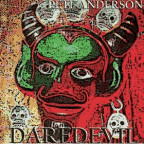 Pete Anderson "Daredevil" (Little Dog Records, 2004)
Guitar slinger Pete Anderson, best known as Dwight Yoakam's longtime lead guitarist and producer, cuts loose and kicks back on this fine, twangy set of original instrumental tunes. Anderson's tone is gentle and measured, his soundscapes lulling and lush, his leads tart and tasteful, as he mixes lounge-y exotica with West Coast twang and a smidge of funky electronica... Previous solo outings had seemed a bit frantic and forced, but this one sounds classy and calm -- It's a good listen, particularly for folks who dig instrumental music to begin with, although the last few tracks on the disc are kind of nondescript... Nice to hear that the fella who helped sculpt Yoakam's multi-layered modern twang kept some of the good stuff in reserve for himself as well... Worth checking out.
Jessica Andrews "Heart Shaped World" (Dreamworks Records, 1999)
(Produced by Byron Gallimore)
Jessica Andrews "Who I Am" (Dreamworks Records, 2000)
(Produced by Byron Gallimore)
Jessica Andrews "Now" (Dreamworks Records, 2003)
(Produced by Byron Gallimore, James Stroud & Billy Mann)
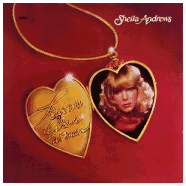 Sheila Andrews "Love Me Like A Woman" (Ovation Records, 1979) (LP)
(Produced by Brien Fisher)
Things never completely clicked for Sheila Andrews -- she had a handful of chart entries between 1978-80, but no hits big enough to break her into the big time. It might have just been because she was on an indie label that didn't have enough juice to promote all its artists, or maybe her throaty, soul-tinged vocals were a little too far ahead of the curve -- she sounds a lot like Ashley Judd, K. T. Oslin and Lacy J. Dalton, '80s gals who took over the Top 40 with a mix of slick production and rootsy singing, but several years after Andrews took her shot. Anyway, this debut disc includes her first three chart songs, including the mildly scandalous "Too Fast For Rapid City" and "What I Had With You," a nice duet with Joe Sun. This is probably too glossy for most traditionally-oriented twangfans, but worth checking out if you're into the early '80s country sound.
Sheila Andrews "Love Sick" (Ovation Records, 1980) (LP)
Sheila Andrews "Crystal Tears" (Brylen Records, 1982) (LP)
 Lisa Angelle "Lisa Angelle" (Dreamworks Records, 2000)
(Produced by Andrew Gold & Lisa Angelle)
Extremely pop-oriented material. Angelle's voice is the most interesting thing here, a husky, burnished rumble that reminds me of Rosanne Cash and Mary Chapin Carpenter. But the songs are dreadful, ranging from made-for-Oprah emotional handwringing tunes to dramatically flat, would-be "rowdy" material such as the "Daddy's Gun" and "Kiss This." The bouncy, uptempo single, "I Wear Your Love," is okay in a "Passionate Kisses" kinda way, but there's nothing else on the album that I found of equal interest.
 Tony Arata "Changes" (MCA/Noble Vision Records, 1986) (LP)
(Produced by Don Tolle)
This was the first album by Top Forty songwriter Tony Arata, a native of Savannah, Georgia who headed out for Nashville and eventually became an inductee in the Songwriters Hall Of Fame. Although Arata had marginal success as a recording artist, he flourished as a composer, placing several songs with stars of the 1990s top country scene, most notably the "The Dance," which was the second #1 single for Garth Brooks, back in 1990. Arata is backed on this album by a solid Nashville crew, including Sonny Garrish, Terry McMillan, Don Potter, Mark Casstevens, Gary Prim on piano, and a young James Stroud on drums.
Tony Arata "Way Back When" (Little Tybee Records, 2005)
Tony Arata "Such Is Life" (Little Tybee Records, 2005)
 Area Code 615 "Area Code 615" (Polydor Records, 1969) (LP)
(Produced by Kenneth Buttrey, Elliot Mazer & Area Code 615)
A funky, rootsy set of all-instrumental jams by several studio musician heavyweights, including then-ubiquitous superpickers such as fiddler Buddy Spicher, banjoist Bobby Thompson, steel player Weldon Myrick and Mac Gayden on guitar, with Charlie McCoy tootling on the harmonica. It's a loose, good-natured session, with these Nashville virtuosi obviously having a good time jamming together, dipping into bluegrass, baroque pop, and plenty of Southern-style, Muscle Shoals-y rhythm'n'rock. They cover several Beatles songs, perhaps the best of which is a steel-drenched "Hey Jude," take passes at Otis Redding and Bob Dylan, and Thompson plunks out an oddly slowed-down version of "Classical Gas." Some of the most inventive moments come with their covers of traditional bluegrass tunes, perhaps most surprising is on "Lil' Maggie," where Gayden plays some heavy electric guitar, flirting at the edges of the acid rock/proto-metal sound of the time, and Charlie McCoy gets into some gritty Chicago blues riffs ala Little Walter. Who knew he had it in him?? It helps to be a fan of instrumental music to get into this one, but it is a nice chance to hear some Nashville cats let their hair down and play a little rock'n'soul.
 Area Code 615 "Trip In The Country" (Polydor Records, 1970) (LP)
(Produced by Area Code 615)
The second AC album feels more forced, less like a laidback jam session and more like an in-studio concoction. There's still certainly diversity: from the big, bright, brash pop-orchestral update of Bill Monroe's "Scotland" that opens this album, to the spacey proto-prog of "Stone Fox Chase," the group moves into a few tracks of outright easy listening, ala Mantovani, and finishes up Side One with a clunky acid-rock number by Mac Gayden called "Gray Suit Men." Their country roots are largely obscured between the Southern-rock electric riffs and the flowery muzak, with the banjo or fiddle drifting out of the haze from time to time, though the best tracks have more of a Muscle Shoals feel than a Nashville tinge. The core group is essentially the same, with the addition of pianist David Briggs, and the set list is almost all original material, in contrast to the covers-heavy first album. But it's pretty kitschy and easy listening-ish, with only one track, Weldon Myrick's robust instrumental, "Welephant Walk," to satisfy twangfans. After this, Mac Gayden took the 615 rhythm section of Kenny Buttrey and Wayne Moss, and founded the rock band Barefoot Jerry, which continued the country-meets-soul vibe going... On this album you can sense their impatience, from the sterile, multi-tracked feel of the songs to the album-art footnote that reads, "Ding Dong The Code Is Dead?" Farewell, too, to the Goodlettesville String Sextet, and to this chapter in country-billy crossovers.
Eddy Arnold -- see artist discography
Rick Arnold "The Real Duke Of Hazard" (Self-Released, 2010)
Later recordings from a fellow who had some (very) modest chart action 'way back in 1989... Kinda fun to hear him keeping the commercial sound of the time alive.
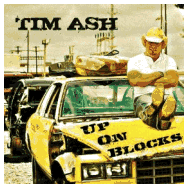 Tim Ash "Up On Blocks" (A&M Productions, 2013)
(Produced by Tim Ash)
Independently produced, wannabee-Top 40 country-pop, tilting towards the "rowdy dudes" end of the spectrum. Ash lays a lot of the same cards and strikes a lot of the same poses as the bigtimers, reminding listeners of guys like Keith Urban on the mellow end and, I dunno, Montgomery Gentry on the more bubbadelic side of things, particularly on songs like "Beertropolis" and "Tattoos, Tractors, Tanktops, And Trucks." This album didn't really capture my imagination, but that doesn't mean Mr. Ash won't become the next big thing in Nashville. I'm certainly no bellwether or commercial success!
Leon Ashley - see artist discography
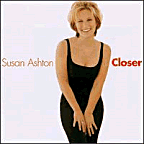 Susan Ashton "Closer" (Capitol Records, 1999)
Hmmm. A contemporary Christian singer's big bid for commercial country success, after a decade-long career as a star at the top of her original niche market. Her bright, poppy sound, courtesy of producer Emory Gordy, Jr., has a pleasantly dated sound, but her evangelical Christian reputation may have held her back in the charts. Most of these songs are romantically themed, though the single, "Faith Of The Heart," was a bit preachy. Not bad, but probably not strong enough to break away from her old scene, and not religious enough to please her old fans.
Ernest Ashworth - see artist discography
Asleep At The Wheel - see artist discography
Chet Atkins - see artist discography
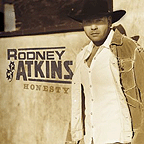 Rodney Atkins "Honesty" (Curb Records, 2003)
(Produced by Ted Hewitt, Justin Niebank & Rodney Atkins)
Formulaic Guy-Country pop... The title track opens the album, a shameless weeper about a couple on the rocks, followed by a bunch of cookie-cutter country-pop, many of the songs using awkwardly-placed Big Words, so that we know he's not just some dumb hick singer. I guess he's trying to be a cross between Toby Keith and Lyle Lovett; not sure it's really working for him, but I could see Atkins growing into a more effective, soulful performer. Right now he seems pretty prefab and flimsy: his voice isn't enough to compensate if the production on the song doesn't work for you, and mostly the songs are pretty predictable and trite.
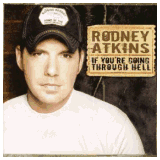 Rodney Atkins "If You're Going Through Hell" (Curb Records, 2006)
Good ole boy sloganeering is taken to hew heights on this Atkins album, which opens with "These Are My People," in which the downsizing of the American dream is sold as a positive virtue in need of a singalong anthem. Here, the nostalgia-laced middle-American small town that crowds the Country charts is a graveyard of dreams: when the kids in town grew up, nobody got a good job, nobody moved anywhere, they all got thrown out of college after partying a whole bunch, but now they are as happy as can be with their limited horizons and lowered expectations. Shouting matches at Little League games and pounding back a few cold ones at the local tavern count as life's little blessings or, as the chorus goes, "it ain't pretty, but it's real." Ah, okay. So, all those elitist snobs who got a college degree aren't "real" Americans, like all the C-minus average bubbas in your mythical settle-for-less small town. Gotcha. I dunno; personally I find this a little depressing and also offensive: it's not the Middle America I grew up in, and it's not the American dream I remember. Even with a bad economy and a sour political scene, do we really have to celebrate mediocrity and failure? Whatever happened to having faith in America making us better and lifting us up? I mean, look, I know this is just another would-be country hit that's being dumb on purpose because someone, somewhere decided that that's what the country audience should be into, but I've been listening to country music for forty years, and I'm getting tired of all these phony-baloney fake-redneck anthems. It's just not culturally authentic, and it's getting old. Really, really old. On the other hand, if you like this kind of stuff, this album will not disappoint: "Man On A Tractor," "About The South," "Cleaning This Gun"... All pretty much what you'd expect. Sorry, Nashville, I'm just not buying it.
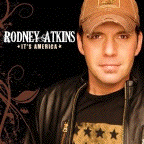 Rodney Atkins "It's America" (Curb Records, 2008)
(Produced by Ted Hewitt & Rodney Atkins)
Pretty cool, for Top Forty. In fact, I'd say Rodney Atkins has really arrived as a singer. He sounds robust, confident, in control, and pretty funny, too. There's plenty of Nashville formula, to be sure -- small-town chest-thumping, soulful sensitive-guy stuff, and the title track, which is one of those would-be national anthems that you either love or you don't. Where he really hits his stride is on the goofy, manly-man honkytonk novelty songs: "Friends With Tractors" is fun, and "Fifteen Minutes" is a gas, a funny song with a great chorus: "I gave up smokin', drinkin' and wimmin last night/it was the worst fifteen minutes of my life..." Great stuff, worthy of Tracy Byrd, Mark Chesnutt or Toby Keith. If you like bubba-oriented Nashville hits, this disc is pretty good.
 Rodney Atkins "Rodney Atkins" (Curb/Crackerbarrel Records, 2010)
(Produced by Ted Hewitt & Rodney Atkins)
This disc is a reissue of Atkins' 2006 album, If You're Going Through Hell, along with two new tracks, the 2009 single, "Farmer's Daughter," and "More Like Your Memory," which is exclusive to this release. The opening track, "These Are My People," one of those faux-redneck chest-thumpers, is discussed at great length above. Sigh.
Rodney Atkins "Take A Back Road" (Curb Records, 2011) (LP)
Rodney Atkins "Caught Up In The Country" (Curb Records, 2019) (LP)
Atlanta "Pictures" (MCA Records, 1984) (LP)
Atlanta "Atlanta" (MCA, 1984) (LP)
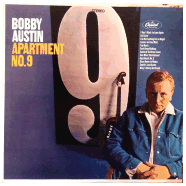 Bobby Austin "Apartment No. 9" (Capitol Records, 1967) (LP)
(Produced by Fuzzy Owen)
Singer Bobby Austin was a longtime member of the West Coast country scene... He moved to LA in the 1950s and played local club dates before landing a job playing bass in Wynn Stewart's band -- he also played with Buck Owens and Tommy Collins, and probably everyone else in Bakersfield at the time. Austin had his own moment in the spotlight with the success of "Apartment No. 9," a 1966 single that originally came out on the independent Tally label, and came close to cracking the Top 20, peaking at #21. That success led to a couple of LPs on Capitol Records, and while his later singles never did as well, Austin laid down some nice, rootsy recordings that stand up pretty well over the years. This first album is his best, with powerful debts to Buck and Merle Haggard, sticking to a generally downtempo mode with pretty familiar-sounding backing. About half the songs were Austin originals, rounded out by a couple of Haggard tunes, a Wayne Walker oldie, and of course "Apartment No. 9," which was written by Johnny Paycheck. All in all, a decent if understated set of honkytonk ballads. Worth a spin!
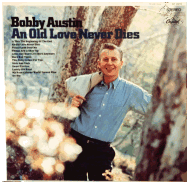 Bobby Austin "An Old Love Never Dies" (Capitol Records, 1968) (LP)
(Produced by Fuzzy Owen)
A lesser entry in the Bakersfield ouvre, though worth checking out, I suppose. There's some good material, and solid backing by an unnamed but very West Coast-y band, but the sad truth is, Austin's vocals are a pretty hard sell. He's singing very much in the style of his old boss, Wynn Stewart, but even Wynn is an acquired taste and Austin doesn't quite hit the right
Bryan Austin "Bryan Austin" (Capitol, 1994)
 Chad Austin "Chad Austin" (Asylum Records, 2000)
I'm sorry, but country stars just don't get to be named "Chad." They don't. Sorry, dude, but what were you thinking? Way too yuppie and Wall Street. Anyway, despite the country-club first name, here's an amiable also-ran... His voice is a little unusual and lacks oompf, while the material and execution are all just so-so. Some okay shuffle tunes, though, like "Shows Ta Go Ya," but nothing that made a dent in the charts... Will he be back for more? Hmmm... I guess time will tell.
 Darlene Austin "Holding On" (SSW, 2000)
Dreadful, synthy, soul-y country from the 1980s... Reminiscent of K. T. Oslin, the Judds and stuff like that... I think this CD is a collection of her singles from 1982-87, all of which were strictly Back Forty material. Doesn't do much for me, but I imagine there'll be some diehard fans out there who'll be glad to see this stuff in print again. A couple of songs, "I'm Gone Beat You to the Truck" and "Sunday Go to Cheatin' Clothes" are relatively rootsy and upbeat, but mostly this is tinkly-keyboards material, very much "of its time," and not material that ages well. If you want, you can order it directly from the artist.
 Sherrie Austin "Words" (Arista Records, 1997)
At first glance, the chirpy, vivacious, Australian-born Sherrie Austin seems like a breath of fresh air, but the thrill doesn't last. Her debut album opens with a twisting, Tanya Tucker-ish rebel-rock snarl ("Lucky In Love"), a mood that's somewhat sustained on the next track... And then it all goes to pot when the overly-obvious, issue-y, femme-oriented ballads kick in. Too many of those, and too many useless, distracting production touches slathered atop the uptempo tunes, which is where Austin may be at her best. Of her albums, this is probably the best, but still there's nothing on here that I'd need to come back to.
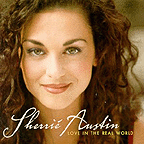 Sherrie Austin "Love In The Real World" (Arista Records, 1999)
Austin has a reedy, thin voice, which I guess could pass for a young Tanya Tucker or Rachel Sweet, if it weren't for her lack of ooompf in the clinch, and the generic sexy/come-on quality of the lyrics. The phony virginal lure of "Never Been Kissed" is kinda icky (and the song is really just teenieboppish bubblegum pop, worthy of Debbie Gibson, Pebbles and their ilk... ) Even a song like "Little Bird," which starts off with a promising Texas shuffle backbeat, devolves into hackneyed, blaring rock guitar riffs. And then those damn power ballads kick in! (Including one recycled from the last album... yeesh.) Austin's marginally cute, but definitely a second stringer.
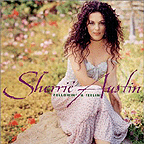 Sherrie Austin "Followin' A Feelin' " (Madacy Records, 2001)
(Produced by Will Rambeaux)
This disc opens with a bland cover of Dolly Parton's classic, "Jolene," then slides sideways from there. When Austin just sings, it's okay, but as soon as the songs get high-concept or take on an overly-obvious "common touch" (playing up to the harried, late-for-the-bus, working class hero inside us all...) things get kinda yawnsville. For the most part, this album just seems overly intellectualized, overly calculated and tres formulaic. Songs like "In Our Own Sweet Time" and "Back Where I Belong" function okay as glitzy '80s-ish pop, but as country...? Nope. I can't think of a single song on here, really, that caught my sincere interest.
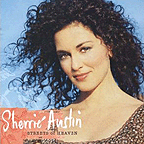 Sherrie Austin "Streets Of Heaven" (Broken Bow Records, 2003)
The title track -- a shameless weeper about a little girl dying and going to heaven -- is the album's highlight. The rest of this album is pretty vapid... Embarrassingly so, actually. It's like hearing the daily diary of some would-be poet in junior high put to music, with appallingly blunt, simplistic lyrics and lame turns of phrase that I'm sure she thought were the bee's knees when she first wrote 'em. And, yes, Austin (co)wrote all but one of the songs on here. So she's prolific... good for her. Too bad she's not also a little more skillful. Poppy, formulaic rock-drenched Nashville nothingness.
Gene Autry -- see artist discography
Hoyt Axton -- see artist profile
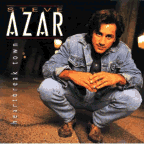 Steve Azar "Heartbreak Town" (Polygram/River North Records, 1996)
(Produced by Joe Thomas, with Steve Azar & A. J. Masters)
Aggressively generic country-rock with a little bit of a Southern rock/honkytonk vibe... Azar's a pretty poor singer, though, and while he seems enthusiastic, the material is really weak and the arrangements and studio backup are uniformly sterile and unexciting. On the opening track, "I Never Stopped Lovin' You," I charitably thought, oh this kinda sounds like the Mavericks... But it was downhill from there, and this disc swiftly got on my nerves. Since Azar wrote all but one of the songs on here, I suppose this could be viewed as a sort of glorified songwriter's demo, but even then, there's nothing on here that stood out, or that I'd want to hear again, whether by Azar or some other artist. Pass.
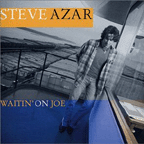 Steve Azar "Waitin' On Joe" (Mercury Nashville, 2002)
Although he flopped the first time around, Azar came back a few years later and scored a big hit with this album's opener, "I Don't Have To Be (Until Monday)," a catchy, cute ode to the power of playing hooky from work... The rest of the album tilts towards softer, sappier ballads, but there's also some twang in there, and Azar, with his modest, moderate vocal presence, may stand out from the flock of blustery, too-slick modern Nashvillers... The single is great, that's for sure.
 Steve Azar "Indianola" (Dang Records, 2007)
 Steve Azar "Slide On Over Here" (Ride Records, 2009)
 Steve Azar "Delta Soul, Volume One" (Redeye Records, 2011)
Commercial Country Albums - Letter "B"


Hick Music Index