
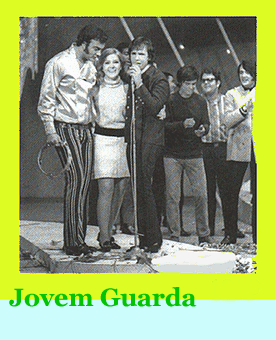
Brazilian rock'n'roll first hit in the late '50s, at roughly the same time as the beginning of the bossa nova boom... For the most part, the early roqueiros were looked down on, and rock was seen as an inferior North American import that only "kids" could like. Naturally, the music persisted, and found a home in the long-lived television show, Jovem Guarda, which was hosted by the charismatic vocalist, Roberto Carlos. Numerous bands flocked under its banner, and thousands of viewers tuned into the show with the same intense loyalty as shows such as American Bandstand and Ready, Steady Go enjoyed in the USA and England.
Jovem Guarda pop (also known as ie-ie-ie, once the Beatles hit...) was justifiably seen as a cutesy, prefab creation of the international record industry, which was eager to capitalize on the potentially lucrative South American youth culture, as it had in the U.S. and Western Europe. Most of the bands weren't that good, and their best material came from cover versions of foreign pop songs. Still, it was out of this early, commercialized teen scene that the hippie-ish tropicalia movement arose, blending psychedelic rock with the previously-separate bossa nova and samba traditions, along with a subversive new brand of often-surrealistic cultural politics. Despite the greater celebrity (and cultural relevance) of the tropicalia innovators, many of the ie-ie-ie groups persisted well into the 1970s, although most gradually devolved into soft pop outfits, rather than take up the more radical rock stylings of the early-70s counterculture. Here's a quick look at some of the high points (and low) of the Jovem Guarda scene...
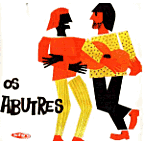 Os Abutres "Os Abutres Atacam" (1968) (LP)
A totally enjoyable frat rock-ish band, with some nice rave-ups and British Invasion-styled harmonies. Mostly, though, they have a peppy rockabilly-garage vibe that's in pleasant contrast to the swarms of jovem guarda pop stars who covered American rock, but never quite "got" it. These guys, who did a lot of work on radio and TV, definitely did "get" it. A fun record, with lots of twangy electric guitars. Very cute.
Jerry Adriani - see artist discography
Cleide Alves "Twist/Hully Gully/Cleide Alves" (RGE, 1964) (LP)
This singer appeared on the first Renato E Seus Blue Caps album, and recorded one other album, in 1970...
Angels "Serie Bis: Jovem Guarda" (EMI, 2000)
Eduardo Araujo - see artist discography
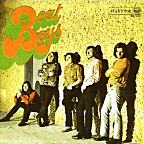 The Beat Boys "Beat Boys" (RCA-Brazil/Lion Productions, 1968) (LP)
Although they were actually from Argentina, the Beat Boys made their names on the 1960s Brazilian rock scene, backing the great innovators of the psychedelic-oriented tropicalia scene -- Gilberto Gil and Caetano Veloso -- as they embraced electrified, American-style rock music. Along with bands such as Roberto Carlos' RC7 and the more notorious Os Mutantes, the Beat Boys were a go-to band if you wanted a hard-edged, solid garage-psych rock backing, and they appeared anonymously on several key tropicalia recordings. This is a reissue (with bonus tracks) of their own full-length release from 1968... You might read elsewhere how this disc is some kind of mind-blowing, hard-psych acid rock Rosetta stone; I think that's kind of an exaggeration... What this is, though, is an unusually cohesive Brazilian garage rock record by a band that was more professional-sounding and grittier than most of the other groups exploring the same music at the time. In the '60s, Brazil didn't have much history with greasy, grimy, longhaired rock music, and there wasn't a big back bench for them to draw on, so a band like The Beat Boys stands out at the front of the pack. If you want to hear a prime example of Brazilian "beat" music, with stylistic debts to melodically oriented groups such as the Beatles and the Standells (and maybe the Seeds, at the freakier end of their spectrum...) this is an album worth tracking down. Some fun songs, too!
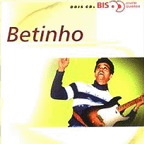 Betinho "Serie Bis: Jovem Guarda" (EMI, 2000)
Although he was one of the earliest Brazilian rockers (with one song, "Enrolando O Rock," apparently dating back to 1954), Betinho was hardly one of the most vigorous artists working in the style... His approach was pretty strictly novelty-oriented, with songs filled with sound effects like roosters crowing, etc., and it didn't take long for Betinho to abandon backbeats altogether... Most of the material in this too-generous 2-CD set is actually soft pop vocals or novelty/lounge instrumentals... A few moments of fun, but overall pretty marginal.
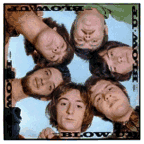 Blow Up "Blow Up" (Caravelle, 1969) (LP)
The first full-length album by this dynamic hippie-era rock band, formerly known as The Black Cats... These guys cited the Bee Gees as influences; you can also hear traces of sophisticated but hip pop bands such as the Rascals in their work -- and certainly The Zombies, since they cover "Time Of The Season" here (in English, unfortunately -- I would have loved to hear that song em Portuguese!) Blow Up (named after the Antonioni film) later toughened up their sound and became more of a hard-rock group, but this earlier, twee-er stuff is fun, too. Definitely one of the more vigorous rock bands of the jovem guarda era!
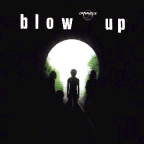 Blow Up "Blow Up" (Caravelle, 1971) (LP)
A pretty groovy hippie rock album, with plenty of stylistic influences, running roughly from the country-folkier side of the Byrds to a more heavy rock sound with little bursts of Cream-ish power chords and more jittery stuff that seems more Brit-Mod influenced. It's pretty cool, even on the songs where they sing in English. Apparently these guys had several changes of line-up and in addition to these two albums they also released a few singles, as late as '77... They certainly seem like good candidates for a best-of reissue disc!
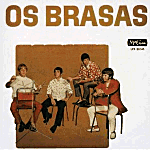 Os Brasas "Os Brasas" (Musicolor/Warner, 1968) (LP)
Fun Beatles-y/Herman's Hermits-ish rock-pop that fits comfortably into the jovem guarda sound, but with hints of grungy garage roots. Apparently guitarist Luis Vagner was in this band, well before his days as a samba-rock and reggae pioneer -- he co-authored many of these songs, which, other than a weird cover version of the "Davy Crockett" theme, are pretty cool, at least by contemporary Brazilian standards. There are lapses into some pretty syrupy ballads, and little of the fieriness of their handful of singles, but this is certainly a disc worth tracking down.
Celly Campello - see artist discography
Tony Campello - see artist discography
Os Carbonos "Serie Bis - Jovem Guarda" (EMI/Copacabana, 2000)

Mainly sluggish, mid-tempo teeniebopper ballads, recorded between 1969-81, well after the real Jovem Guarda boom. Although there are plenty of potentially interesting cover tunes ("Bus Stop," "Mellow Yellow," Arthur Adams' "Anna"...) none of the performances are very exciting... this is basically the Brazilian equivalent of the kind of oldies band you'd hear at a country fair up here in the States... Of note, though, is their version of "Never Never," by Uruguay's Los Shakers, which is still pretty rinky-dink, but noteworthy because of the pan-Latin American link.
Os Carbonos "Selecao De Ouro" (2007)
Wanderley Cardoso - see artist discography
Jean Carlo "Serie Bis: Jovem Guarda" (EMI, 2000)
Erasmo Carlos - see artist discography
Roberto Carlos - see artist discography
Ronnie Cord "Serie Bis: Jovem Guarda" (EMI, 2000)


Other Brazilian Styles
Main Brazil Index
