Hello! This page is part of an opinionated overview of Celtic and British folk music, with record reviews by me, Joe Sixpack... This is not meant to be taken as a "definitive" resource, but rather as a record of some of the music which has caught my interest. I am always looking for more good music to explore, so your comments and suggestions are welcome.
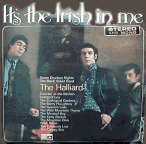 The Halliard "The Irish In Me" (Society/Saga Records, 1967)
A super-early (and presumably super-rare) album featuring singer-guitarist Nic Jones in a three-piece Celtic folk band. It's not earth-shattering trad, but it's sung and played with great enthusiasm; the tracks where Jones takes the lead are the most compelling, and worth checking out if you are a devoted fan... Endearing, though not particularly resonant
The Halliard/Jon Raven "The Halliard/Jon Raven" (Broadside Records, 1968)
A split LP, with the Halliard on several tracks, and singer Jon Raven on others, with Nic Jones backing him. This second Halliard album has apparently been reissued on CD, but I suspect that edition, too, is rather hard to find.
Gerry Hallom "Travellin' Down The Castlereagh" (Fellside Records, 1981) (LP)
Gerry Hallom "A Run A Minute" (Fellside Records, 1984) (LP)
(Produced by Paul Adams)
A lovely album, with Surrey, England's Gerry Hallom taking up the mantle of singer Nic Jones, in more ways than one... There's a profound vocal and stylistic similarity, with Hallom perhaps not as forceful a guitarist, but with the same loping rhythms and sly approach to melody, and a familiar-feeling collection of songs. That, plus Hallom's playing with one of Jones' old cohort, Pete Coe, who accompanies him on dulcimer, along with Jez Lowe, who also adds some vocals. The repertoire in rich with Australian and Kiwi story-songs, including a "Casey At The Bat"-style recitation called "How McDougal Topped The Score," which kind of gets in the way of the music, but is a fine tale, nonetheless. A great record, and certainly worth tracking down if you like the style.
Gerry Hallom "Old Australian Ways" (Fellside Records, 1989) (LP)
(Produced by Paul Adams)
Once again, fans of Nic Jones ought to love this album, with Hallom playing and singing very much in a Jones-ian style, and Nic Jones himself singing on four tracks... A great set of Australian folk songs, with stories about ranching and mining and whatnot, all well-framed by acoustic guitar and emphatic vocals. Wonderful to hear Jones singing as well -- both lead and harmony -- although I guess he was unable to play guitar. Jez Lowe also chimes in on a few tracks... All in all, a very strong album, with a Penguin Eggs feel, albeit through a down-under filter. Highly recommended!
Gerry Hallom "Undiscovered Australia II" (Musica Pangaea, 1996)
Gerry Hallom "On The Periphery" (EMI/William Boyd Music, 1997)
David Hammond "I Am The Wee Falorie Man: Folk Songs Of Ireland" (Tradition Records, 1959)
David Hammond & The Clancy Brothers "Irish Folk Song Favorites" (Madacy Records, 1995)
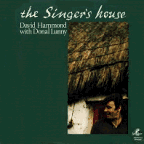 David Hammond & Donal Lunny "The Singer's House" (Mulligan's Music, 1978) (LP)
A nice set featuring an obscure Irish singer from Belfast... Hammond's reedy voice has that half-tinny, half-craggy leprechaun tone that can, with the right backing, be a real treat. Well, you don't get much better musicianship than that of Donal Lunny, Kevin Burke, Jackie Daly, and their pals... This is quite a nice record; if the copy I found hadn't been a wee bit warped (rats!) I'd still have it today. Several lovely tracks on here, notably "The Flower Of Sweet Strabane" and a few of the slower, more sorrowful numbers. Anyone know more about this fellow?
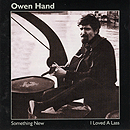 Owen Hand "Something New/I Loved A Lass" (World Serpent Records, 1999)
Born in Ireland, but raised in Edinburgh, singer-guitarist Owen Hand was part of that city's '60s folk boom, an early contemporary of Bert Jansch and Brits like Davy Graham. This CD reissues two of his albums on the Transatlantic label, Something New (1965) and I Loved A Lass (1966), which are said to have been prized for years by Britfolk collectors. The first album is, as Hand points out in the new liner notes, pretty standard earnest-folkie fare, at least in retrospect. It reflected Hand's club and pub shows of the time, and is full of American-style social protest songs -- lots of civil rights material (with the British twist of addressing South African apartheid as well as Mississippi murders...) The performances aren't necessarily that remarkable, but it's a fine album by the standards of the time, leaning more towards the Eric Andersen end of the spectrum. He includes a couple of nice Tom Paxton covers, along with several songs by two homegrown songwriters named Mo Japes and Cyril Tawney; Owen also tackles a tune by Archie Fisher, who was apparently his patron at the time. The debt to Fisher became more pronounced on the second album, which concentrates on Scottish folk material, and is much lovelier than the protest stuff. Nice and understated, with solid renditions of many classic ballads. The contrast between the two albums also anticipates the tectonic shifts in the British and Celtic folk scenes that would come with the decade's end, with a renewed emphasis on trad material and innovative guitar work. Recommended.
 Johnny Handle "Stottin' Doon The Waal" (Topic Records, 1963) (LP)
 Johnny Handle "The Collier Lad" (Topic Records, 1975)
 Mick Hanly & Michael O'Donnell "Celtic Folkweave" (Polydor Records, 1974) (LP)
(Produced by Donal Lunny)
A collaboration between Irish troubadour Mick Hanly and guitarist Micheal O Domhnaill, who was to go on to become a founding member of the Bothy Band... Hanly and O'Donnell (as he was credited on this early album) toured together at the time as a duo called Munroe...
 Mick Hanly "A Kiss Early In The Morning" (Mulligan's Music, 1976)
(Produced by Donal Lunny & Michael O'Domhnaill)
Following a stint with future Bothy Band guitarist Michael O'Domhnaill (touring together in a band named Monroe), guitarist and songwriter Mick Hanly recorded a lovely pair of albums for the esteemed Mulligan label... This is his first solo album, an utterly gorgeous set of traditional songs drawn from Colm O Lochlainn's Irish folk folio, More Irish Street Ballads. These ten delicate, sparingly arranged tracks feature gorgeous, flowery guitar work by Hanly, along with contributions by a number of esteemed Irish musicians, including Paddy Glacklin on fiddle, Triona Ni Domhnaill, Donal Lunny and Matt Molloy. It's a great lineup, top-flight younger musicians making great music -- Hanly favors pretty melodies and sweet playing. On balance, this is probably Hanly's best album, or at least the most consistent... As I Went Over Blackwater (reviewed below) has several individual songs that are more striking, but this album plays better from start to finish. Simply delicious... and highly recommended!
 Mick Hanly "As I Went Over Blackwater" (Mulligan's Music, 1980) (LP)
(Produced by Donal Lunny)
Sweet stuff from a fella from Limerick, Ireland -- in fact, one of my favorite modern trad-folk albums. I'm afraid this lovely set of Irish ballads may be a bit hard to find, as are most of Hanly's records, but it's certainly worth the search. It features several tastefully rendered tradional ballads, as well as what may be the definitive version of Colm Sand's "Every Circumstance," one of my favorite modern trad-folk tunes. Also, for a waggish glimpse into modern pub culture, check out the a capella "Scourge Of The Nation," which laments the growing prevalence of TV screens in Ireland's once-gabby local taverns. A warm, understated album, well worth tracking down.
Mick Hanly "Still Not Cured" (WEA, 1987)
(Produced by Mick Hanly)
Worth noting: between his solo albums, Mick Hanly had a stint with the Irish "supergroup" Moving Hearts, appearing on their 1982 album, Live Hearts.
 Mick Hanly "All I Remember" (Ringsend Road Records, 1989)
(Produced by Donal Lunny)
This later album finds Hanly more in a contemporary, contemplative singer-songwriter mode, opening with a brisk, surprisingly full-on country number, "Still Haven't Managed," and then devolves into droopy folk-pop stylings. I prefer his traddier side, but as these things go, this is a fine set. Also features his version of the song, "Past The Point Of Rescue," which American country star Hal Ketchum took to #2 in the Billboard charts... (Bet that helped subsidize a few nice, relaxing afternoons on the Galway coast!)
Mick Hanly "Warts And All" (Round Tower Records, 1991)
(Produced by Arty McGlynn)
Mick Hanly "Happy Like This" (Round Tower Records, 1994)
(Produced by Mick Hanly)
Mick Hanly "Live At The Meeting Place" (Doghouse Records, 1998)
(Produced by Mick Hanly)
Mick Hanly "Wooden Horses" (Doghouse Records, 2000)
(Produced by P.J. Curtis)
Mick Hanly "Wish Me Well" (Doghouse Records, 2004)
(Produced by Declan Sinnott)
Mick Hanly "Free To Run" (2008)
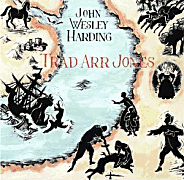 John Wesley Harding "Trad. Arr. Jones" (Zero Hour, 1999/Appleseed, 2001)
A curious and thoroughly charming tribute to the work of elusive English trad-folker, Nic Jones. Initially, when you hear this folk-rocking power-popster tackle these songs, you may shake your head and wonder what's the point -- Jones had already done them so wonderfully, and Harding's best intentions may seem a bit daft. But repeated listenings bring out the charm. For one thing, this is all such great material, a canny distillation of the off-kilter folk stories that Jones specialized in. Star-crossed lovers follow their hearts and are slain by jealous husbands, drown in raging rivers, and die of broken hearts while their love is away at sea. Harding's delivery is admirable as well -- many of these songs are from Jones' impossible-to-find early albums, and will be unfamiliar to most folks. However, Harding approaches the material with the same richly melodic, reflective style that Jones had developed late in his career, which in many cases rather offsets the briskness of the original, early '70s recordings by Jones. Harding puts his own stamp on the songs, unraveling each story with a sense of wonder and freshness, so that the casual listener will be drawn in... He sings each line with with feeling and attention to the meaning of the words, a performance style which has, sadly, grown out of fashion of late. Until recently, this record has been rather hard to find, since the Zero Hour label went out of business about a week after this came out. The Jones legacy has been undone, however, by a recent reissue on one of America's most earnest new folk labels. The Appleseed edition adds a few new tracks -- clompy Celtic rock versions of four Jones classics, performed by Harding's playful new side project, The Minstrel In The Galleries. Highly recommended.
Mike Harding "A Lancashire Lad" (Trailer Records, 1972) (LP)
A mix of music and spoken word...
Roy Harris "The Bitter And The Sweet" (Topic Records, 1971) (LP)
(Produced by Dick Swettenham)
Features the three founding members of the band Muckram Wakes, John Tams, with Roger and Helen Watson, with Roy Harris on vocals and guitar...
Roy Harris "Champions Of Folly" (Topic Records, 1975) (LP)
With Martin Carthy on guitar...
Roy Harris "By Sandbank Fields" (Topic Records, 1977) (LP)
Roy Harris "The Rambling Soldier -- Life In The Lower Ranks: 1750-1900" (Fellside Records, 1979) (LP)
Roy Harris "Utter Simplicity" (Fellside Records, 1985)
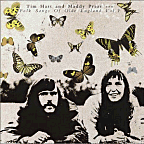 Tim Hart & Maddy Prior "Folk Songs Of Old England, v. 1" (Mooncrest Records, 1968)
The early roots of Steeleye Span... Hart and Prior started their professional career as a folk-club duet in 1966. On this, their first recording, their banjo-guitar-vocals sound is a bit plain, and nowhere near the grand melodic resonance of their later work with Steeleye Span. The songs, however, are thoroughly enchanting, and it's nice to hear Prior's voice at its most youthful... Also, the understated delivery is charming and effective. Definitely a few notches above similar folkie-purists of the time, and you can tell Maddy Prior is just waiting to bust loose...
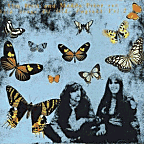 Tim Hart & Maddy Prior "Folk Songs Of Old England, v.2" (Mooncrest Records, 1971) (LP)
Of a piece with the first volume, although with perhaps a touch more maturity. Another great collection of odd olde English ballads, and a nice glimpse of greater things to come. Recommended!
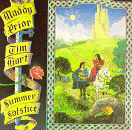 Tim Hart & Maddy Prior "Summer Solstice" (Mooncrest Records, 1968) (LP)
Quite lovely. This was the first Hart-Prior "solo" album made after the formation of Steeleye Span, and it makes good use of both the available talent and their increased skill as studio producers. There are several glorious songs on here, including the playful, bawdy "Three Drunken Maidens" and "Bring Us In Good Ale." Prior's vocals on "I Live Not Where I Love" are every bit as haunting as the song itself, and the rest of this album is quite fine as well. One of her best.
Frank Harte "Dublin Street Songs" (Topic Records, 1967) (LP)
Frank Harte "Through Dublin City" (Topic Records, 1973) (LP)
Frank Harte "And Listen To My Song" (1976) (LP)
Frank Harte "Daybreak And A Candle-End" (1987)
Frank Harte & Donal Lunny "1798: The First Year Of Liberty" (Hummingbird Records, 1998)
Frank Harte & Donal Lunny "My Name Is Napoleon Bonaparte: Traditional Songs On Napoleon Bonaparte" (Hummingbird Records, 2001)
Frank Harte & Donal Lunny "The Hungry Voice: The Song Legacy Of Ireland's Great Famine" (2000)
Frank Harte "Dublin Street Songs/Through Dublin City" (Hummingbird Records, 2004)
A CD reissue of his first two albums...
Frank Harte "There's Gangs Of Them Digging: Songs Of Irish Labour" (Hummingbird Records, 2007)
Martin Hayes "Martin Hayes" (Green Linnet Records, 1993)
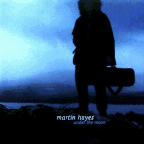 Martin Hayes "Under The Moon" (Green Linnet Records, 1995)
One of Ireland's most soulful fiddlers, Hayes is also one of the most striking exceptions to my "no instrumentals" preference. Under The Moon is a stunning solo work -- just him and his fiddle, and thirteen absolutely beautiful, moody tunes, arranged by Hayes with a delicate, profoundly melodic sensibility. This is a record that you can play on quiet days -- not sappy New Age stuff, just really, really nice. I can't recommend it highly enough. The duet album with guitarist Dennis Cahill is also quite lovely, only slightly less magical than the solo material. Also highly recommended.
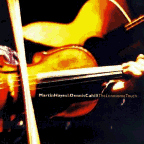 Martin Hayes & Dennis Cahill "The Lonesone Touch" (Green Linnet Records, 1997)
This duet album with guitarist Dennis Cahill is also quite lovely, only slightly less magical than Hayes' solo material. Also highly recommended!
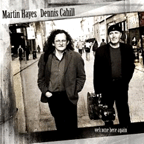 Martin Hayes & Dennis Cahill "Welcome Here Again" (Compass/Green Linnet Records, 2008)
With over a decade under their belts as a creative team, the Irish duo of Martin Hayes and Dennis Cahill return with another set of subtle, elegaic fiddle-guitar instrumentals. It's moody, mournful and utterly entrancing - one of the most interesting aspects of their style is how unobtrusive and unassuming Cahill is as an accompanist for Hayes' masterful violin work. Guitarists are often expected to come up with some sort of flashy flourish, but Cahill seems utterly content to play a strictly supporting role. Of course, this sets the tone for all their work, music that doesn't dominate or assault your ears, but does provide a rich, rewarding experience. If you've ever felt turned off by stereotypical Celtic instrumentals -- all those hyperactive jigs and reels -- give Hayes and Cahill a shot. They find the soulful, melodic core of the music and linger there, in the hurricane's calm eye, just drinking it all in.
Hedgehog Pie & Tony Capstick "His Round" (Rubber Records, 1971) (LP)
The first of several folk albums by BBC celebrity and humorist Tony Capstick, backed here by an early edition of the Northumbrian folk-rock band, Hedgehog Pie.
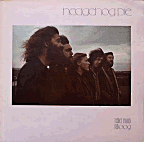 Hedgehog Pie "Hedgehog Pie" (Rubber Records, 1975) (LP)
(Produced by Geoff Heslop & Rick Kemp)
If you love the sound of mid-'Seventies Steeleye Span, with their loping, clompy electric bass and amplified mandolin, you might really enjoy this album. This plucky Northumbrian band were produced by Steeleye's producer, Rick Kemp, and he certainly left his stamp on this record... Although the female lead singer Margi Luckley isn't really a Maddy Prior clone, some of the vocal harmonies are quite familiar, and the bass-mandolin arrangements are almost dead ringers for the Steeleye sound. Naturally there are lapses into shaggy folk-prog tedium, and Ms. Luckley's vocals on the more lyrical numbers can be irritatingly lofty and overly-folkie (in the Judy Collins-ish sense of the word...) But the more traditional and more upbeat numbers are quite nice -- certainly if you're a fan of that scene, this is a must-hear record, to give you a fuller sense of what was going on elsewhere in the UK. Apparently the band went on for several years with various changes in line-up and style; this early album is said to be one of their best.
Hedgehog Pie "The Green Lady" (Rubber Records, 1975) (LP)
Hedgehog Pie "The Wonderful Legend Of The Lambton Worm" (EP) (Rubber Records, 1976)
A very limited-edition EP of four songs based on a local legend of a dragon-like monster living underneath a remote English village. Haven't heard it myself - anyone have a copy they want to send me? ;-)
Hedgehog Pie "Just Act Normal" (Black Crow, 1978)
After a major shakeup, the band reformed to include singer-guitarist Dave Burland, who had mostly done solo acoustic-style material before this... Again, haven't heard it, but I sure am curious.
Hedgehog Pie "Live!" (Blue Guitar Records, 2003)
Hemlock Cock And Bull Band "All Buttoned Up" (Topic Records, 1981) (LP)
(Produced by Steve Heap & The Cock & Bull Band)
Later shortened to just "The Cock And Bull Band," a name under which they released a subsequent album, Eyes Closed And Rocking, in 1985.
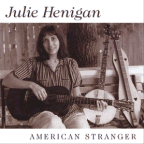 Julie Henigan "American Stranger" (Waterbug Records, 1997)
One of those charming, out-of-the-way, low-key albums that can only be found in the cottage industry backroads of the folkie scene. An American multi-instrumentalist (dulcimer, banjo and guitar), Henigan also has a lovely voice and an appreciation for the calmer, more modest aspects of old-country music. A devotee of some of the best UK and Celtic revivalists, such as Mick Hanly and Len Graham, most of her repertoire is traditional, but this album also includes a few original tunes which match the sweetness of her source material. A modestly wonderful little record -- recommended!
Corrina Hewat "My Favourite Place" (Foot Stompin' Records, 2004)
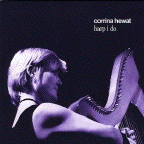 Corrina Hewat "Harp I Do" (Big Bash Records, 2008)
An innovative album of solo Celtic harp compositions... I still find the instrument itself a bit too prissy-sounding, but this is as fine a set of modern tunes as you'll ever hear. Scottish harpist Corrina Hewat is perhaps best known for her work with the "folk orchestra" known as Unusual Suspects... Here, you can enjoy her music in its purest, simplest form. Many of these tunes are originals, and all the tracks will be sure to delight harp music fans.
 Fay Hield "Looking Glass" (Topic Records, 2010)
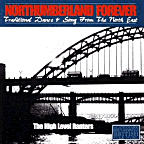 The High Level Ranters "Northumberland Forever: Traditional Dance And Song From The North East" (Topic Records, 1968) (LP)
A fine set of tunes from England's Northern provinces, lively accordion-led music with a distinctive regional charm. This edition of the band featured vocalist Johnny Handle, fiddler/pipers Colin Ross and Forester Charlton, guitarist Tom Gilfellon, and Alistair Anderson on concertina... This was the first album from this long-lived ensemble, and it features remarkable musicianship, particularly given the relatively rudimentary development of the British/Celtic folk scene at the time. A special treat is the inclusion of the Northumbrian small pipes, an instrument that is quite distinctive and (to my ears) quite lovely. This set may be a bit stark for some, but it's the real deal and it'll knock you over if you give it half a chance. Recommended.
The High Level Ranters "High Level" (1971)
The High Level Ranters "A Mile To Ride" (Trailer Records, 1973) (LP)
(Produced by Bill Leader)
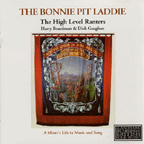 The High Level Ranters "Bonnie Pit Laddie" (Topic Records, 1975) (LP)
Coal mining is a subject that holds a continuing fascination for UK folkies, both as folklore and as a political topic fit for all upstanding class-conscious lefties. (The Thatcher-era miner's strike was one of the last great British labor struggles of the 20th Century... Scotland's gruff-voiced Dick Gaughan, who contributes several excellent performances to this disc, revisited the miner's plight on a couple of albums that came out in the mid-1980s.) At any rate, this is a fine album, featuring a celebrated Northumbrian ensemble anchored by Alastair Anderson on concertina, along with Johnny Handle, Colin Ross and Tommy Gilfellon. Gaughan growls his way through a couple of songs and Lancashire's Harry Boardman sings on a couple others -- the whole album is nice, with goofy, sprightly, humorous songs and lots of that oddball Celtic musical charm. I thought this record would sound really dry and academic, but was pleasantly surprised at how fun it was. Definitely worth checking out!
The High Level Ranters/Martyn Wyndham-Read "English Sporting Ballads" (Broadside Records, 1977) (LP)
A split album; Nic Jones performs on some of the Martyn Wyndham-Read tracks...
(The New) High Level Ranters "The New High Level Ranters" (Topic Records, 1982) (LP)
Hoghton Band "An Evening With Hoghton Band" (Fellside Records, 1980) (LP)
Hoghton Band "The Pride Of Lancashire" (Fellside Records, 1981) (LP)
Hoghton Band "...Plays Your Requests" (Fellside Records, 1985) (LP)
 Steve Holloway "Next Stop, Seelie Court" (Self-Released, 2003)
Lots of squeaky fiddle and flute with rollicking, rumpa-ta-tumpa-ta bodhran playing by drummer Holland. Not earth-shattering or anything, but a nice indie album.
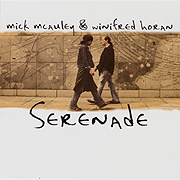 Winifred Horan & Mick McAuley "Serenade" (Compass Records, 2005)
Solas may have disbanded some time ago, but the popular Irish-American supergroup continues to cast a long shadow on the contemporary Celtic folk scene... Here is about the bazillionth Solas solo/spinoff project, a typically virtuosic collaboration between fiddler Winifred Horan and accordionist/piper/guitarist Mick McAuley. It's a sweet set, mostly instrumental with an ofttimes sugary feel and plenty of dazzling musicanship... There's a bit much of the jigs'n'reels, jigs'n'reels repetitiveness to it, although the vocal numbers break things up a bit. I could live without their overly-languid cover of Neil Young's "After The Gold Rush," although McAuley's lovely, soulful performance on "Adieu Sweet Lovely Nancy" is an album highlight. Certainly, if you're a Solas fan to begin with, this disc'll do you no harm. Worth checking out.
 Horslips "Happy To Meet, Sorry To Part" (RCA/Oats Records, 1972) (LP)
The debut record of the groundbreaking Irish folk-rock band, Horslips, whose forays into rock-celt crossovers set the stage for groups such as Wolfstone, et. al. This first album was more acoustic, and more overtly "folk" than most of what followed -- later releases would reveal a much stronger rock influence.
Horslips "The Tain" (RCA/Oats Records, 1973) (LP)
Horslips "Dancehall Sweethearts" (RCA/Oats Records, 1974) (LP)
Horslips "The Unfortunate Cup Of Tea" (RCA/Oats Records, 1975) (LP)
Horslips "Drive The Cold Winter Away" (1975) (LP)
Horslips "The Book Of Invasions: A Celtic Symphony" (DJM Records, 1976) (LP)
Horslips "Horslips Live" (1976) (LP)
Horslips "Aliens" (1977) (LP)
Horslips "Tracks From The Vaults" (1977) (LP)
Horslips "The Man Who Built America" (1978)


Horslips "Short Stories/Tall Tales" (1979) (LP)
Horslips "The Belfast Gigs" (1980) (LP)
Horslips "Roll Back" (Horslips Records, 2004)
Horslips "Dearg Doom" (Horslips Records, 2007)
A four-song remix EP, with mixing by Metisse and Ear2Ear (...whoever they were!)
Horslips "Greatest Hits" (K-Tel Records, 1996)
 The House Band "The House Band" (Topic Records, 1985) (LP)
The House Band "Pacific" (Topic Records, 1987) (LP)
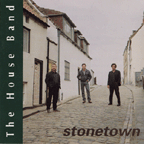 The House Band "Stonetown" (Harbourtown, 1991/Green Linnet, 1992)
The third album by the powerhouse trio of Chris Parkinson (melodeon), John Skelton (flutes, whistles and percussion) and ex-Battlefield guitarist Ged Foley, who also plays some wicked Northumbrian "smallpipes." In some ways this album is a bit dry and almost severe, but mostly it's soulful and compelling. Lots of well-chiseled trad, and a few surprises from out in left field, notably a very effective cover version of Elvis Costello's "Sunday's Best." The second half of the disc has an overabundance of shrill, somewhat grating pipe tunes, which may test the endurance of all but the most hardy and devoted of trad fans... But overall this is a noteworthy and admirable album.
The House Band "Word Of Mouth" (Green Linnet Records, 1993)
The House Band "Groundwork" (Green Linnet Records, 1993)
A best-of set drawn from their first two albums, originally on the Topic label, with a couple of newer tunes thrown in as well... Nice stuff!
 The House Band "Another Setting" (Green Linnet Records, 1994)
A fine, rich set of subtly evolved trad instrumentals and interesting vocal tunes. It's hard to put one's fingers on exactly what's unique and compelling about the House Band's sound, but, well, there it is. They just sound different, and they also sound great. There's a smoothness and relaxed quality to their work that's quite a pleasure... Their approach is new, but the music is firmly rooted in tradition, and while there's no overt poppification or other crossover shenanigans, there's no mistaking the modernity of their music. Oh, blah blah blah. Just give the disc a spin: it's definitely worth checking out. Roger Wilson joins the quartet on violin and vocals; a fine addition to the tightly-knit trio of Foley, Parkinson and Skelton.
The House Band "Rockall" (Green Linnet Records, 1996)
The House Band "October Song" (Green Linnet, 1998) (*)
 The House Devils "Irish Folk -- Adieu To Old Ireland" (ARC Music, 2009)
Robust, hearty Irish folk music in the style of classic trad bands such as Planxty, the Bothy Band and even cheerful old-timers like the Clancy Brothers. A nice, strong album with good material -- this Manchester-based UK band is tapped directly into the deep wellspring of high-energy live performances that make the Celtic tradition so compelling and vital... Definitely worth checking out!
Hunter Muskett "Every Time You Move" (Decca Records, 1970) (LP)
Spacy, jazzy, ofttimes rather gooey, psychedelic folk-pop from the British trio of Chris George, Terry Hiscock and Doug Morter, with a healthy brace of amorphous, starry-eyed folk meanderings which only occasionally lapse into "trad" territory, but by and large owe more of a debt to post-trad types such as Nick Drake, Bert Jansch and, around the edges, soft rockers Like Graham Nash. This album is both alluring and a bit too much of a "guilty pleasure," though listeners in search of British folk-freak material of authentic hippie-era vintage will find this one a wellspring of "new" music. They often sound like Pentangle at an acid party, without the clarity of focus but in the same musical range. A few tunes go to far for me, but much of this album is quite nice and relaxing.
Hunter Muskett "Hunter Muskett" (Bradey's Records, 1973) (LP)
Ashley Hutchings - see artist profile