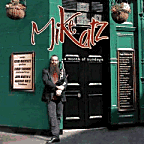
 Mike Katz "A Month Of Sundays (Temple Records, 2004)
Solo work from Mike Katz, piper with the Battlefield Band...
Trad & Folk
Artists and Albums
Hello! This page is part of an opinionated overview of Celtic and British folk music, with record reviews by me, Joe Sixpack... This is not meant to be taken as a "definitive" resource, but rather as a record of some of the music which has caught my interest. I'm always looking for more good music to explore, so your comments and suggestions are welcome.
This is the first page covering the letter "K"
Mike Katz "A Month Of Sundays (Temple Records, 2004)
Solo work from Mike Katz, piper with the Battlefield Band...
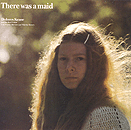 Dolores Keane "There Was A Maid" (Claddagh Records, 1978) (LP)
(Produced by John Faulkner & John Wood)
She looks so stern on the album's cover, yet the music is so gorgeous! Emerging in the late 1970s from County Galway, Dolores Keane (1953-2026) swiftly established herself as one of Ireland's best interpreters of traditional song, recording first as a member of the trad-folk group De Dannan, and from then on as a solo artist. Keane, who had a a lovely voice that retained a hint of majestical, historic menace -- a primal, undeniable evocation of something deep within the Irish spirit. These early recordings, which feature sympathetic but somewhat minimal backup instrumental accompaniment, aren't quite as incandescent as the Broken Hearted I'll Wander and Sail Og Rua albums reviewed below... Still, it's great stuff. The CD liner notes don't list the artists in the Reel Union band; her then-husband, singer John Faulkner, wrote the liner notes, but I'm not sure if he also played on this album. At any rate, this is certainly worth picking up, particularly if you are already one of her fans.
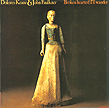 Dolores Keane & John Faulkner "Broken Hearted I'll Wander" (Green Linnet Records, 1979) (LP)
(Produced by Philip Begley, P. J. Curtis & Huw Thomas)
As a young'un in the late 1970s, singer Dolores Keane was just a bit on the squeaky side; as she attained old-timers status in the '90s, she took on a slightly leaden gravity. But in between, at the peak of her powers, she could not be beaten. These collaborations with multi-instrumentalist John Faulkner are like glittering, precious gems among the firmament of a trad scene that was heading towards overly-elaborate, crossover production. Keane's voice is so gorgeous, and Faulkner's accompaniment so tasteful and compelling, that this album is simply irresistible.
 Dolores Keane & John Faulkner "Farewell To Eirinn" (1980) (LP)
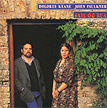 Dolores Keane & John Faulkner "Sail Og Rua" (Green Linnet Records, 1984) (LP)
Another gorgeous set from Faulkner and Keane... This album, with its tenatative addition of one (single) electronic instrument has a slightly less mystical tone, but both albums are highly, highly recommended.
 Dolores Keane "Dolores Keane" (Alula Records, 1988)
 Dolores Keane "Lion In A Cage" (Alula Records, 1989)
 Dolores Keane "Solid Ground" (Alula Records, 1993)
 Dolores Keane & Rita Eriksen "Tideland" (Kirkelig Kulturverksted, 1996)
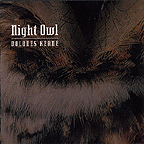 Dolores Keane "Night Owl" (Alula Records, 1998)
Keane and Faulkner are back, with another stately set, that overall feels a bit listless and stuffy, but still has an elegance and gravity to it reminiscent of their early albums. This isn't her best work, but it's still pretty solid; June Tabor fans might like this one.
Dolores Keane "May Morning Dew" (Am Cheoil, 2004)
Dolores Keane "The Best Of Dolores Keane" (Shanachie Records, 1997)
Dolores Keane "Where Have All The Flowers Gone: The Very Best Of Dolores Keane" (Dara Records, 2003)
The Keane Family "Muintir Chathain" (Gael Linn Records, 1985) (LP)
Yup! That's Dolores and her kin... Singing some real-deal Gaelic folk music!
Sarah & Rita Keane "Once I Loved" (Claddagh Records, 1969)
Traditional Irish and English songs from sisters Sarah and Rita Keane, of Galway, the aunts of singers Dolores Keane (above) and Sean Keane, who branched out into more contemporary folk-pop. The Keanes have also recorded together, as a family group.
Sean Keane "Gusty's Frolics" (Claddagh Records, 1975) (LP)
The first solo album by Dublin-born fiddler Sean Keane, best known as a member of the Chieftains... Not to be confused with the singer, Sean Keane, a member of Galway's fabled Keane family whose career turned more towards contemporary folk music...
Sean Keane & Matt Molloy "Contentment Is Wealth" (Green Linnet Records, 1985)
Sean Keane "Jig It In Style" (Claddagh Records, 1990)
Sean Keane, Matt Molloy & Liam O' Flynn "The Fire Aflame" (Claddagh Records, 1993)
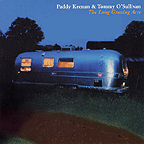 Paddy Keenan & Tommy O'Sullivan "The Long, Grazing Acre" (Compass Records, 2003)
A very lovely, very fine, mostly-trad album, with mild dips into contemporary folk songwriting and a warm, modern production style. Irish piper Paddy Keenan has a long and illustrious career in the tradlands -- well known for his work with the Bothy Band and numerous other projects -- and here he teams up with newcomer Tommy O'Sullivan, whose chunky guitar work adds both muscle and suppleness to the mix. What's perhaps most striking about this album is the textural depth to the production, the duo embraces what is best about new studio technology while making no concessions to bland "crossover" concepts. This music is captivating, inspiring and pure... recommended!
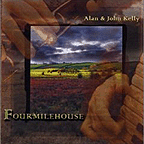 Alan & John Kelly "Fourmilehouse" (Compass Records, 2002)
One of those pleasant few albums that are able to get me past my persistent disinclination towards Celtic instrumental music. The Kelly brothers, Irish natives who have played about in various bands, have a deft, swinging lightness to their playing, and are obviously simpatico in that way that sometimes only siblings can be. The emphasis here is on melody and lilt, and I'm sure that other folks like myself, who often find jigs and reels to be repetitive and maddening, will find themselves drawn in by this highly listenable trad set.
Stan Kelly "Liverpool Packet: Songs Of The Great Seaport" (Topic Records, 1958) (7")
(Produced by Dick Swettenham)
Leftie folkie Leon Rosselson accompanies Liverpool local Stan Kelly on this maritime outing, a strictly folkloric six-song EP that includes a version of the Liverpudlian classic "Maggie May," as well as "The Young Sailor Cut Down In His Prime," and shanty or two. Also on board is the otherwise obscure Geof Rose, though I'm not sure which instruments he played... Mr. Kelly (full name: Stan Kelly-Bootle) was a pioneering British computer scientist with an abiding interest in music and local boosterism; he is also known for starting Cambridge University's Saint Lawrence Folk Song Society, way back in 1950.
Stan Kelly & Leon Rosselson "Songs For Swinging Landlords To" (Topic Records, 1961) (7") (EP)
(Produced by Dick Swettenham)
Kelly gets top billing, but the partnership is made plain, as is their political bent... This four-song EP rails against landlords and other money-grubbers...
 Stan Kelly "I Chose Friden! Songs For Cybernetic Lovers" (1963) (LP)
Born in the 1920s, Mr. Kelly trained to become a computer scientist in the 1950s... whatever that looked like! I imagine some of the specific details in this album of Kennedy-era computer-science lampoons might be a bit obscure to modern listeners, though the overall flow of humor might have some recognizable themes. Haven't heard it yet, but I am quite curious!
 Stan Kelly/Various Artists "O Liverpool We Love You" (Xtra Records, 1969) (LP)
A civic booster songs-and-sounds concept album organized by folksinger Stan Kelly, and produced for the fans of the local Liverpool football club. Go... um, er... local sports team!!
 Kempion "Kempion" (Broadside Records, 1977) (LP)
Keith Kendrick - see artist profile
 Kentigern "Kentigern" (Topic Records, 1978) (LP)
This Scottish group grew out of the band Tinkler Maidgie, joined by former Battlefield Band-er John Gahagan and fiddler Jimmy McGuire... Kentigern stayed together through 1982, but only released this one album...
 The Kerries "The Kerries" (Major Minor Records, 1967) (LP)
A short-lived trad band that featured singer Gibb Todd, who also recorded some solo stuff a few years later...
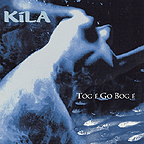 Kila "Tog E Go Bog E" (Green Linnet Records, 1999)
This band was hailed as the super-duper, super-fab super-future of Celtic music, but frankly, I find these "Afro-Celt" world beat crossover tunes to be a bit irritating... It's long on drive and momentum, short on melodic arc, and singer Ronan O'Snodaigh's raggamuffin/dancehall reggae-inflected vocal style (plus the actual tone of his voice) are also a bit grating. I just find the whole project too self-consciously clever and tedious, and even with Afro-Brazilian-tinged tunes like the title track (which means "take it easy" in Gaelic), I still feel like this is music I've heard elsewhere, even if they weren't singing in this particular language. Anyway, this didn't work for me. The folks who like Kila, though, seem to go totally koo-koo for them, so what do I know?? Feel free to explore it, but don't come running back to me saying that I didn't warn you.
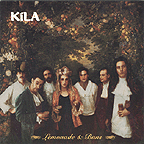 Kila "Lemonade & Buns" (Green Linnet Records, 2000)
I'll concede that this disc is more relaxed and listenable than the last (where they really seemed to be trying too hard...) But it's also kind of cloying and fake-hippie goopy, as well... Inventive and groundbreaking, perhaps, but still not my cup of tea.
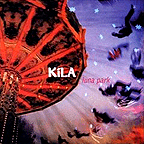 Kila "Luna Park" (Kila Records, 2003)
This album is arguably their most accomplished, or at least their smoothest, and -- thank goodness! -- Ronan O'Snodaigh has toned down his ragamuffin-reggae-by-way-of-Bulgaria vocals, at least on some of the tunes. Still, I find their approach to be pretty tiresome: innovation is fine, but I also like to enjoy what I'm listening to. This is just too dense, cluttered and tacky for me.
Pat Kilbride "Rock & More Roses" (Temple Records, 1995)
Pat Kilbride "Undocumented Dancing" (Green Linnet Records, 1992)
Pat Kilbride "Loose Cannon" (Green Linnet Records, 1995)
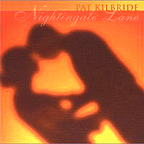 Pat Kilbride "Nightingale Lane" (Temple Records, 2002)
A beautiful album of traditionally-oriented modern folk songs, mostly written by veteran Celtic musician Pat Kilbride, an on-again/off-again member of Scotland's trad supergroup, the Battlefield Band. This is a sweet album, with plenty of first-rate cittern and guitar work. The only (very mild) missteps are covers of a couple of Gerry Rafferty and Nanci Griffith tunes, contemporary folk tunes that stand out a bit too much from the other, more trad sounding tunes. On the whole, though, there's nothing to complain about here... It's a very nice, very listenable record. Lovely!
Louis Killen - see artist profile
Paddy Killoran "Back In Town" (Shanachie Records, 1977) (LP)
Archival recordings of Irish fiddler Paddy Killoran, who hailed from Ballymote, County Sligo. This is pretty old-school, foundational stuff...
William Kimber "The Art Of William Kimber" (Topic Records, 1974) (LP)
David Kincaid "The Irish Volunteer" (Rykodisc Records, 1998)
David Kincaid "The Irish-American's Song" (Haunted Field Music, 1998)
Andrew King "The Bitter Harvest" (World Serpent Records, 1999)
Andrew King "The Amfortas Wound" (World Serpent Records, 2004)
Philip King & Peter Browne "Rince Greagach" (Gael Linn Records, 1981) (LP)
King's Galliard "Morning Dew" (Irish Folk, 1976) (LP)
A Dutch band from the 1970s that specialized in Celtic music, King's Galliard released several albums and held its own at various music festivals... I'm not sure, but this might be their first album...
King's Galliard "Rocky Road To Dublin" (Delta Records, 1991)
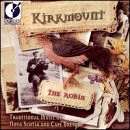 Kirkmount "The Robin: Traditional Music Of Nova Scotia And Cape Breton" (Dorian Records, 1997)
Fairly sugary fiddle-harp'n'cello classical-Celtic instrumentals from the sibling trio of Alex, Sam and Simeon Bigney, who at the time were riding high having won a talent contest on the Prairie Home Companion radio show. Didn't really wow me, but it's pretty enough, I suppose.
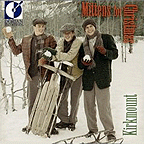 Kirkmount "Mittens For Christmas" (Dorian Records, 2001)
More substantive, more classically inclined, and somewhat milkier than their previous album... Again, it didn't do much for me, but for those enamored of, say, the Mark O'Connor/Edgar Meyer/Yo-Yo Ma folk-classical crossovers, an album might be a real delight.
John Kirkpatrick - see artist profile
Kornog "Kornog" (1983)
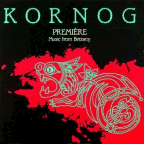 Kornog "Premiere: Music From Brittany" (Green Linnet Records, 1983) (LP)
A live album from one of the finest bands of the French Breton trad revival... This brisk, bold album captures them in fine fettle on a lively American tour...
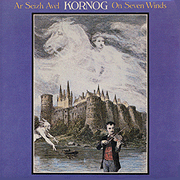 Kornog "Ar Seizh Avel (On Seven Winds)" (Green Linnet Records, 1985) (LP)
Simply gorgeous. Kornog were one of the leading bands in the Celtic revival in France... Sure, several of the members are actually from Scotland, but who's keeping track? At any rate, this album completely defies the tradition of piercing shrillness in Celtic music, introducing a melodic grace to its instrumental tracks while retaining a traditionalist edge. It also has several of the most gorgeous vocal performances I've ever heard in the genre, such as "Helen of Kirkconnell" and "The Shuttle Rins". If you've ever tried to get into Celtic music before, but felt trapped between shrill bagpipes and wimpy New Age arrangements or "River Dance" kitsch, then allow me to recommend this beautiful album to you as a more appropriate starting place. One of my all-time favorites.
 Kornog "Kornog IV" (1987)
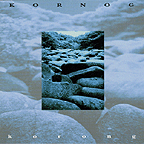 Kornog "Korong" (Green Linnet, 2000)
After more than a ten year lapse, this outstanding French (Breton) Celtic band is back, with an album that picks up exactly where the last one left off. I'm not normally that into Celtic instrumentals -- jigs, reels and airs -- but Kornog has always displayed a liveliness and melodic grace that set the band at the pinnacles of the Celtic music scene, with an interplay of fiddle and flute that is particularly dynamic and appealing. Perhaps the most distinctive aspect of the Kornog's sound, though, is the beautiful voice of Scottish native, Jamie McMenemy. McMenemy has lost none of the rich sonorousness which marked their early albums, or the dreamy, evocative breathiness that makes him one of the most captivating singers in the folk-trad scene today. Simply gorgeous. This is an album that's been a long time coming, and is highly recommended.
More Celtic/Brit Folk Albums -- Letter "L"


Main Celtic/Brit Index
Main World Music Index
