Luiz Eca - see artist discography
Eden-Stell Guitar Duo "Samba! - Brazillian Music By Villa Lobos/Assad/Gnattali/Bellinati" (Docker Records, 2004)
Acoustic guitar duets by Mark Eden and Christopher Stell, covering classic pieces by Villa Lobos and others...
Edgard & Os Tais "Musical Com Tok O Pilatragem" (Beverly, 1971)
Ednardo - see artist discography
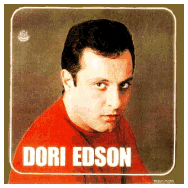 Dori Edson "Dori Edson" (RGE, 1968) (LP)
A notable songwriter in the jovem guarda teen-pop scene, Antonio Dorival Angiolella (akaDori Edson) is most identified with his musical partnership with singer Marcos Roberto, and his association with TV host Roberto Carlos, whose musical program was the center of the Brazilian teenyboper rock scene. Edson flourished in the late '60s, placing songs with artists such as Eduardo Araujo, Os Caculas, Jerri Adrani and Erasmo Carlos, who recorded his song, "O Tremendao." Edson was most successful as a composer, and this appears to have been his only solo album, although he also recorded a few singles and EPs as well.
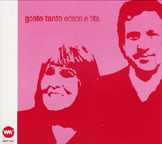 Edson & Tita "Gosto Tanto" (Whatmusic, 2003)
This duo consists of singer/guitarist Tita and her longtime musical partner, composer/keyboardist Edson Lobo (not to be confused with the great Edu Lobo...), who co-founded the Trio Camara in the early 1960s. This is a mellow, latter-day bossa set, with assistance from Brazilian elder Joao Donato, who plays piano on most tracks. I honestly can't say I'm all that thrilled by Tita's vocals, or by the reserved, conservative arrangements that back her up -- this is all a little too low-key and sedate for me, although I can see how folks could get into it. Not sure about the provenance of these recordings -- unlike other albums on the Whatmusic label, this actually might not be a reissue, in which case the modern feel of the sessions would make a lot of sense. This album doesn't suck, but it also didn't move me.
Edson & Tita "Partiu Do Alto" (Whatmusic, 2005)
Edson & Tita "Novidade De Vida" (Whatmusic, 2005)
Edu Da Gaita "O Mago Da Gaita" (Revivendo, 2003)
Brazilian harmonica playing, old school.
Mauricio Einhorn - see artist discography
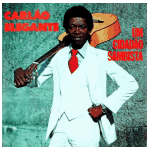 Carlao Elegante "Um Cidadao Sambista" (CBS, 1979) (LP)
The lone album by carnaval puxador (float singer) Carlao Elegante, a highly regarded musician who was the winner of the 1976 Rio carnaval samba competition. Elegante also acted in film and on TV, but apparently neither career completely clicked... He also backed several well-known musicians such as Elizete Cardoso, Ivone Lara and Noca Da Portela in the early '70s, although I'm not sure which of their albums he performed on...
Eliane Elias - see artist discography
Elizabeth "Serie Bis: Jovem Guarda" (EMI, 2000)
Cassia Eller - see artist discography
Elomar - see artist discography
Fats Elpidio - see artist discography
El Son 7 "Brasilia Jovem..." (Studio, 1968)
An odd and random "jovem guarda" set from a band led by saxophonist "Edson," with a guitarist called Mozart and a couple of singers identified only as Marcos and Taky. The repertoire is mostly North American standards ("Love Is A Many Splendored Thing," etc.) a couple of odd rock-ish covers, such as "Ode To Billy Joe" and what seem to be a few original tunes. No info about these guys, though...
Denise Emmer - see artist discography
Embalo Trio "Embalo Trio" (RCA Victor, 1965) (LP)
Engenheiros Do Hawaii - see artist discography
E O Tchan - see artist discography
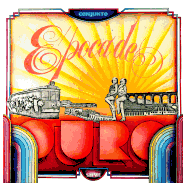 Epoca De Ouro "Epoca De Ouro" (Continental, 1975)
(Produced by Reginaldo Bessa & Julio Nagib)
A landmark album of the choro revival, with guitarist Cesar Feria leading a dazzling sextet that also features mandolin player Deo Rian, and the ubiquitous Dino 7 Cordas, with guest appearances by choro elders such as clarinetist Abel Ferreira and cavaquinho player Canhoto. The repertoire includes classics by Jacob do Bandolim and Heitor Villa Lobos, as well as more modern tunes by Chico Buarque and Paulinho da Viola. Great stuff, with the perfect mix of nostalgia and lilt... This album is noteworthy for the way they linger on the melodies, in contrast to the galloping, racecar style that many other choro revivalists sometimes adopted -- this is sweeter and more lyrical, often evoking the sentimental feel of Portuguese fado. It's also quite lovely -- highlights include Candido Pereira da Silva's "O No" and "Saudacoes," by Otavio Dias de Moura. Recommended!
 Epoca De Ouro/Various Artists "Cafe Brasil" (Teldec, 2001)
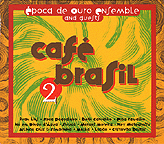 Epoca De Ouro/Various Artists "Cafe Brasil, v.2" (Warner, 2003)
Nunes Ernandes "Homem De Ninguem" (Soma, 1975) (LP)
(Produced by Guta Graca Mello)
>
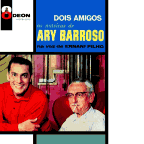 Ernani Filho "Dois Amigos: As Musicas De Ary Barroso Na Voz De Ernani Filho" (EMI-Odeon, 1963)
Syrupy, florid, romantic vocals, very much a throwback to the bolero-influenced "radio singers" era, with lush orchestrations and moderate tempos. Some songs have a little more punch to them than others, but mostly this is a pretty low-key, easy-listening-y record. This is a tribute to samba-cancao composer Ary Barroso, who is pictured on the cover, but may or may not be the pianist whose notes occasionally drift to the fore.
Tete Espindola - see artist discography
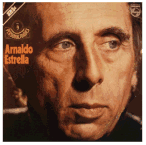 Arnaldo Estrella "Personalidades" (Philips, 1976) (LP)
For a glimpse into the appeal of the much revered Brazilian classical composer, Heitor Villa-Lobos, several solo piano pieces on this delightful retrospective might come in handy. Estrellas was a modern classical pianist from the 1940s and '50s, who trained with Stojowski... this collection highlights him performing short pieces of various Brazilian composers, including one by Radames Gnattali. Estrella has an engaging, bouncy style. The only irksome moments come with some symphonic performances on the second disc that simply ring of irritating modernism of the ilk that has lost its bite as the decades have passed. Otherwise, this is pretty groovy. Recommended.
Arnaldo Estrella "Antologia Da Musica Erudita Brasileira, v.5" (Tratore, 2005)
Arnaldo Estrella & Mariucchia Iacovino "Leopoldo Miguez: Sonatas Opus 14 Em La Maior" (Atracao, 2003)
Arnaldo Estrella "...Plays Villa-Lobos" (Masterclass, 1967)
Chico Evangelista & Jorge Alfredo "Bahia Jamaica" (RCA Victor, 1981)
(Produced by Luiz Mocarzel & Antonio Carlos de Oliveira)
Eva/Evinha - see artist discography
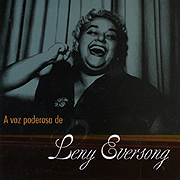 Leny Eversong "A Voz Pondersosa De Leny Eversong" (Som Livre, 2002)
Brassy, big-bandish vocals from the tail-end of the pre-bossa '"radio singer" era... This retrospective gathers twenty tracks from her albums on the Copacabana and RGE labels from 1956-60, kicking off with an almost slavishly Ella Fitzgerald-ish, English-language version of "Mack The Knife," which gives you a sense of Eversong's general stylistic range. She gets more thunderous (and sings in Portuguese) for most of the other songs, and delves into some pumped-up cha-cha-cha pop and even some rock-tinged material... It's interesting to hear music that's so forceful and different than most Brazilian pop, but in all honesty, when she starts to really belt it out, it's actually pretty hard to take. This collection does justice to Eversong's career -- and she was a big star at the time -- but the style is probably not for most listeners.
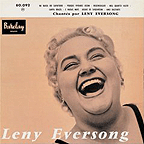 Leny Eversong "Barclay Sessions" (Sunnyside Records, 2006)
World travel is a funny thing: "radio singer" Leny Eversong was best known in her native Brazil for singing North American romantic standards in English, but in the late 1950s when she decamped to France, she recorded several sessions of Brazilian tunes, all sung in Portuguese. Coming just before the bossa nova craze, her style is very different from the "Brazilian music" most folks know; it was even quite atypical for the Brazilian music of the time -- Eversong wasn't particularly into singing the samba, and even when she did cover material by composers such as Ary Barroso and Herivelto Martins, she recast it in a romantic light. Indeed, a lot of this sounds like the slow, slushy boleros that dominated Latin American pop at the time, filtered through American-style cabaret singing... This disc collects material from a 10" LP from 1958, Chantes Par Leny Eversong, and an accompanying EP originally issued on the French Barclay label. The band backing her up were uncredited, but expert is that it included Fafa De Lemos on violin and Chiquinho do Acordeon on accordion... My guess is, the audience for this is pretty limited: I have a hard time getting into it, even though I know a little bit about the historical context it was made in. But, you could see for yourself... it's certainly a different sound!
Leny Eversong "A Grande Leny Eversong" (Revivendo, 2005)
Leny Eversong "Grandes Vozes" (EMI, 2008)
Leny Eversong "Introducing Leny Eversong" (MCA-Coral, 19--?) (LP)
With bandleader/Arranger Neal Hefti...
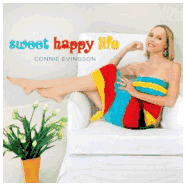 Connie Evingston "Sweet Happy Life" (Minnehaha Music, 2012)
A North American view on the bossa nova revolution of fifty years past. Singer Connie Evingston bounds through these bright, perky English-language bossa nova covers, featuring translated lyrics by Norman Gimbel, who translated numerous Brazilian hits into English during the 1960's bossa nova boom. This album is sweet and cheerful, but maybe a little too brisk and one-dimensional. It's cool to see Gimbel get honored for his work, but the original subtlety and elegance of Tom Jobim and the other great bossa nova composers seems a little lost in the mix. Still, Evingston brings a lot of energy to these recordings that recalls the exuberance of the earliest bossa recordings, and cuts through the decades of formalism and stuffiness that followed. A nice treat for English speakers who want to get a whiff of what these songs were about, and not just how they sounded.
Exaltasamba - see artist discography
(Conjunto) Explosao Do Samba - see artist discography
Exporta Samba "Reuniao De Bacana" (Kelo, 1980) (LP)
Exporta Samba "Gabinete Do Partido Alto" (Kelo, 1981)
Exporta Samba "Lotacao Esgotada" (Copacabana, 1982)
Exporta Samba "Valeu A Experiencia" (Copacabana, 1987)
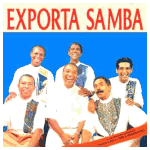 Exporta Samba "Exporta Samba" (CID, 1993)
(Produced by Harry Zuckerman & Esdras De Sousa Pereira)
(Arrangements by Jorjao Carvalho)
This long-lived bamba band tries their hand at '90s-style pop-samba, but with enough rootsiness to make it okay. The opening tracks are the glossiest, but as you get deeper into the album, their acoustic side comes out more clearly, with cavaquinho and bandolim sharing space with light synths and electric bass, framing a robust, cheerful vocal chorus... These guys are traditionalists like Grupo Fundo Quintal trying out the sound of modern bands such as E O Tchan; the guest appearances by Dona Ivone Lara and Zeca Pagodinho, however, are good indications of their connection to a deeper, older samba tradition. Not an earthshaking album, but mellow and pleasant... Definitely worth a spin.
Exporta Samba "40 Anos De Uma Reuniao De Bambas" (Tratore, 2006)
Exporta Samba "Exporta Samba" (Tratore, 2008)