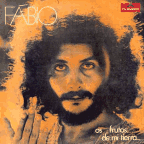
 Fabio "Os Frutos De Mi Tierra" (Polydor, 1970) (LP)
Spacy, starry-eyed folk rock (there's even a Cat Stevens cover!) from this little-known Brazilian hippie pop singer. Some of this is fun in an archival, nostalgia time-capsule kind of way, although very little of it is really that satisfying to listen to: his vocals aren't always great, and the music often meanders. Some great folk-freak noodling, though, as well as some boring attempts at straight pop songwriting. Not a gem, but still a nugget. Fabio was also mildly infamous for recording a 1968 single called "LSD" ("Lindo Sonho Deliriante") which did not make it onto this album.
Fabiola "Luz Da Mim" (PPA, 1983) (LP)
Fafa - see "De Belem, Fafa"
Raimundo Fagner - see artist profile
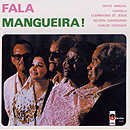 Fala Mangueira! "Fala Mangueira!" (Odeon, 1968) (LP)
A magnificent old-school samba album. It's a little difficult to know just where to file this one... "Fala Mangueira" is actually the album title, but while five of the greatest traditional samba artists of the 1960s and '70s share the stage, as it were, on this disc, they are all performing together, taking turns singing the leads on longer medley tunes. At any rate, if you want to hear Odete Amaral, Nelson Cavaquinho, Cartola, Clementina De Jesus and Carlos Cachaca all busting loose on a nice set of tunes associated with (and about) Cartola's famous samba school, then check this disc out. The arrangements and performances are all first-rate, and this has a really nice, friendly feel. Recommended!
Fred Falcao "Imparceria" (Tratore, 2007)
Fred Falcao "Voando Na Cancao" (Saladesom, 2011)
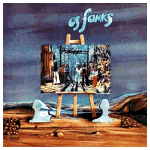 Os Famks "Os Famks" (Continental, 1975) (LP)
Formed in the late 1960s, Os Famks was initially a family band, with several brothers in the Cataldo family and some friends... They backed rock-oriented artists such as Ze Rodrix and had members coming in and out of other bands for years, but didn't record their first single until 1974 and only released two albums before morphing into the soft-rock band Roupa Nova in the '80s.
Os Famks "Famks" (EMI-Odeon, 1978)
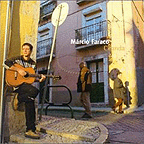 Marcio Faraco "Ciranda" (Universal/Blue Thumb Records, 2000)
Gentle acoustic pop from a Brazilian expatriate living in France, this has traces of early Joao Bosco, Edu Lobo and Chico Buarque (who Faraco worked with in the 1980s, and who joins him for a duet on the title track)... For a more North American reference point, think -- perhaps -- of early Bruce Cockburn material: soft at the core, but not overly cloying. These bossa-derived ballads are pretty easy on the ears, and while your attention may drift a bit, there's nothing on here that will make you cringe in terror. An artist with a smooth voice and a light touch.
Marcio Faraco "Interior" (Universal, 2003)
Marcio Faraco "Com Tradicao" (Universal, 2006)
Marcio Faraco "Um Rio" (Le Chant Du Monde, 2008)
Marcio Faraco "Invento" (Universal, 2009)
Marcio Faraco "O Tempo" (Le Chant Du Monde, 2011)
Ruy Faria & Carlinhos Vergueiro "So Pra Chatear" (Rob Digital, 2005)
A "solo" album from Ruy Faria, former lead singer of the fabled vocal group, MPB-4, his first album after leaving the quartet in 2004.
Vital Farias "Vital Farias" (Polydor, 1978) (LP)
Vital Farias "Taperoa" (CBS-Epic, 1980) (LP)
Vital Farias "Sagas Brasileiras" (Polygram, 1982) (LP)
 Vital Farias/Elomar/Geraldo Azevedo/Xangai "Cantoria 1" (Kuarup, 1984) (LP)
Beautiful, relaxed live acoustic recordings by this informal foursome from the Brazilian Northeast... The more upbeat numbers echo Gilberto Gil's acoustic improvisations, while the quieter numbers seem to draw on the Latin American "new song" movement... At any rate, these are gentle, stately performances, and well worth checking out.
 Vital Farias/Elomar/Geraldo Azevedo/Xangai "Cantoria 2" (Kuarup, 1985) (LP)
Vital Farias "Do Jeito Natural" (Polygram, 1985)
Vital Farias "Ao Vivo E Aos Mortos Vivos" (Discos Vital Farias, 2002)
Dick Farney - see artist discography
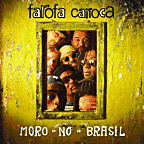 Farofa Carioca "Moro No Brasil" (Universal, 1998)
(Produced by Farofa Carioca & Carlos Beni)
This contemporary samba-soul band is most notable for the presence of future solo star Seu Jorge... Much less so for the music itself, which is a generic, hyperactive update of the Brazilian funk sounds of yesteryear -- it lacks any semblance of subtlety or grace, and reminds me of Earth Wind & Fire or Ed Motta, more than P-Funk or Bootsy. It's the manic pace that really turns me off, as well as the wall-of-sound production style, which has a forced, artificial feel to it, and seems rushed and not very heartfelt. Seu Jorge knew what he was doing when he shifted gears and got out of this band. They kinda sucked.
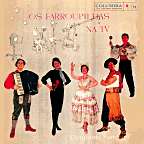 Os Farroupilhas "Os Farroupilhas Na TV" (Columbia, 1960) (LP)
Formed in Porto Alegre in the late 1940s, this perky group (aka Conjunto Farroupilhas) starred on the regionally-based Radio Farroupilha and on Brazilian TV during the first bloom of the bossa nova movement. Although they were known in part for their popularizing of various "regional" styles, they also tackled plenty of bossa material as well. This album has several nice bossa covers, including "O Pato" (complete with duck quacks at the end), "Samba De Uma Nota So" and "Dindi," all sung with such a brazen commercial appropriation that they are utterly charming. There are also several international songs -- one in French, one in German, another in Italian, a swinging Perez Prado-style cha-cha-cha number and a really silly-bad English-language rendition of "When The Saints Go Marching In." It's all sung with great gusto by a tight, modest-sized male-female chorus, with punchy arrangements: if Mitch Miller came from Sao Paulo, this is what his music would have sounded like. I never would have suspected how appealing this group would be -- indeed, where I find Quarteto Em Cy and the MPB4 to be rather irritating and bland, this band was pretty fun.
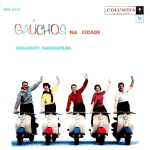 Os Farroupilhas "Gauchos Na Cidade" (Columbia, 1960) (LP)
Another goofy, giddy mix of regional styles and 'Fifties-ish pop vocals, with some tracks sounding like Brazilian Doris Day recordings, others like a toned-down version of northeastern traditional material, and a few German-language tracks thrown in for good measure. The German immigrant (Boys From Brazil?) population doesn't often overtly factor into Brazilian popular culture: this is one of those rare instances where it does. BTW - love the photo of them riding mo-ped scooters on the album cover! This edition of the group included Ina Bangel, Tasso Jose Bangel, Alpheu de Azevedo, Danilo Vital de Castro, and Estrela d'Alva Lopes de Castro (who also went simply by "Estrella"),
Fausto Fawcett "Fausto Fawcett E Os Robos Efemeros" (Warner, 1987) (LP)
Fausto Fawcett "Imperio Dos Sentidos" (Warner, 1989) (LP)
Fausto Fawcett "Fausto Fawcett E Falange Moulin Rouge" (1993)
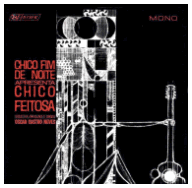 Chico Feitosa "Chico Fim De Noite" (Forma, 1965) (LP)
A swinging little bossa album with some wild, intricate arrangements, courtesy of the innovative Forma label vibe, as interpreted by Oscar Castro-Neves and his band. Feitoso is best known as a composer, popular with the MPB elite, but this is his one and only solo album in a long musical career. At first blush, I was put off by his deep, Barry White-ish vocals, but a closer listen reveals him as a masterful singer, with great tonal control, subtle phrasing and inherent charisma. This is quite a good record from this era, and sorely in need of reissue. Highly recommended.
Chico Feitosa "Um Banquinho, Um Violao" (Seven Music, 2001)
Chico Feitosa "Nas Margens Geste Chao" (2010)
David Feldman "O Som Do Beco Das Garrafas" (EMI, 2005)
Romeu Feres "Tardes Orientais" (Odeon, 1957) (LP)
 Paula Fernandes "Ao Vivo" (Universal-Brasil, 2011)
Carlos Fernando & Toninho Horta "Qualquer Cancao: A Musica De Chico Buarque" (Dubas, 1994)
An homage to songwriter Chico Buarque with vocalist Carlos Fernando, of the band Nouvelle Cuisine joined by guitarist Toninho Horta.
Abel Ferreira/Various Artists "Os Brasileiros Na Europa" (Odeon, 1958) (LP)
In the late 1950s, a number of Brazilians toured Europe with tremendous success. Here, Abel Ferreira plays clarinet with a compact lineup of Pernambuco do Pandeiro's forro/choro band, including Sivuca on accordion; the vocal group Trio Irakitan is also included on this album.
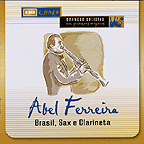 Abel Ferreira "Brasil, Sax E Clarineta" (Discos Marcus Pereira/EMI-Brasil, 1976) (LP)
Beautiful, soulful, gently textured readings of old choro tunes written for the saxophone and clarinet, including several songs written by Ferreira himself. An early master of the style, reedman Ferreira brings a richness and sensitivity to these songs that really makes this album stand out... The guitarist known as Dino 7 Cordas accompanies him, with contributions by Raul de Barros and Orlando Silveira. Recommended!
Abel Ferreira "20 Selecionadas" (2007)
Abel Ferreira "Chorando Baixinho" (2007)
 Djalma Ferreira & Seus Milionarios Do Ritmo "Drink" (Drink Discos, 1958)
A goofy lounge act, committed to record, with various instruments being used to imitate animal noises -- pigs, ducks, chickens, etc. -- in sort of a Spike Jones/Hoosier Hotshots/Slim & Slam kinda vibe, but inside the context of the pre-bossa Brazilian nightclub scene. It looks like this album came out on the same label as Celso Murillo's more highminded samba-jazz records, and was attached to the Drink nightclub. I wouldn't say this is a record you have to kill yourself to track down, but it is good goofy fun. What it's really notable for it the presence of several '60s heavyweights -- Ed Lincoln on organ (along with bandleader Ferreira, who also played something called a "solovox"); singer Miltinho chimes in as well -- I think he also sang on the Celso Murillo records.
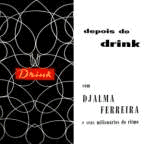 Djalma Ferreira & Seus Milionarios Do Ritmo "Depois Do Drink" (Drink Discos, 1959) (LP)
More of the same: this record has more cover tunes and less of Ferreira's original material, mixing standards by Cole Porter, etc. with some Brazilian originals. The band's interesting, though, with Ed Lincoln and Djalma Ferreira joined by guitarist Waltel Branco and drummer Helcio Milito, who became one of the key players on the Brazilian jazz scene. Again, not a killer album, but a cool historical footnote.
Djalma Ferreira "The Brilliance Of Djalma" (D. F. Records, 19--?) (LP)
Apparently at some point (in the early '60s? There's no date on this album...) Ferreira had a gig in Las Vegas, where he recorded this self-released album of all-original material, with a backing band that included North American jazz bassist Red Callendar and Brazilian guitarist Laurindo Almeida, in an ensemble of more obscure American players. Several tracks were co-written with jazz critic Leonard Feather (which is kind of cool) and Ferreira plays a variety of keyboard instruments -- Hammond organ, harpsichord and piano -- and is credited with the arrangements for the small combo stuff. Anyone know when this came out...??
Nelson Ferreira/Various Artists "20 Super Sucessos - Historia Do Carnaval" (Sony, 1999)
Nelson Ferreira/Various Artists "Carnaval: Sua Historia, Sua Gloria -- CD 1" (Revivendo, 2007)
This series explores the music of 1930s carnaval composer Nelson Ferreira, who worked in a variety of styles, but is best known for the manic, mile-a-minute frevo, which he favored. There's a lot of fast-tempoed material here, with appearances by several stars of the old-school samba-cancao era... The sound quality is lamentably poor (perhaps due to the scarcity of good masters?) but the material has profound historical importance. On a few tracks you can hear Ferreira himself sing, and these are a real treat. A nice window into a lost era of Brazilian partying -- lively, exuberant music bursting with good cheer.
Nelson Ferreira/Various Artists "Carnaval: Sua Historia, Sua Gloria -- CD 2" (Revivendo, 2007)
Nelson Ferreira/Various Artists "Carnaval: Sua Historia, Sua Gloria -- CD 3" (Revivendo, 2007)
Nelson Ferreira/Various Artists "Carnaval: Sua Historia, Sua Gloria -- CD 4" (Revivendo, 2007)
Nelson Ferreira/Various Artists "Carnaval: Sua Historia, Sua Gloria -- CD 5" (Revivendo, 2007)
Nelson Ferreira/Various Artists "Carnaval: Sua Historia, Sua Gloria -- CD 6" (Revivendo, 2007)
In this volume, Ferreira sings on "Come-E-Dorme" and a delightfully relaxed "Cabelos Brancos"; also several tracks featuring Carlos Galhardo, Gilberto Alves, a lively Carmen Miranda-esque samba from Marlene, and one by the Orquestra de Frevos de Jose Menezes.
Veronica Ferriani "Veronica Ferriani" (Tratore, 2007)
Veronica Ferriani & Chico Saraiva "Sobre Palavras" (Boranda, 2009)
Manfredo Fest - see artist discography
The Fevers - see artist discography
Filo "Filo" (Chantacler, 1978) (LP)
Fino Collectivito "Fino Collectivito" (Dubas, 2007)
Aecio Flavio "Tributo A Chico Buarque" (Bemol)
Aecio Flavio "O Melhor Da Noite" (Philips, 1964) (LP)
 Flenks "Flenks" (Visom, 2000)
A jittery set of hyperactive rock instrumentals by a trio of musicians who worked extensively as backup for MPB stars such as Caetano Veloso and the late Cassia Eller. Sort of a discomforting mix between Steve Vai and the Meters, with just a smidge of Brazilian-ness in the margins. Not my cup of tea.
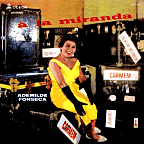 Ademilde Fonseca "A La Miranda" (Odeon, 1958) (LP)
The first full-length LP from this fabled chorinho singer... Fonseca got her start years earlier, performing with choro bandleader Benedito Lacerda and releasing several hit singles in the early 1940s, during the tail end of the samba-cancao era. Here she pays tribute to the great Carmen Miranda (who had died a few years before this record was made, in the far-away United States...) Here Fonseca sings classic samba-cancao songs with the same upbeat lilt as Miranda, including many Miranda-esque tounge-twisters and chatty asides. It's not as wild or as magical as the original recordings, but it's still classy and fun, even with the slightly fusty orchestrations... Worth checking out.
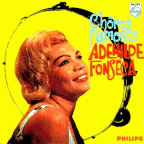 Ademilde Fonseca "Choros Famosos" (Philips, 1960) (LP)
An unusual album, in that choro music is primarily an all-instrumental form (when it includes vocals, it's called "chorinho...") This album, released well after her professional heyday, opens with an uptempo remake of her first big single from 1942 (a zingy cover of Carmen Miranda's old hit, "Tico Tico Na Fuba") and then Fonseca dips into more sedate material, alternating romantic ballads with the perkier chorinhos... The faster songs keep the traditional choro instruments -- flute, guitar, bandolim, some brass -- but the ballads include bigger, goopier orchestrations. So, it's sort of hit or miss. But the nice stuff is really nice -- a groovy blast from the past from a long-forgotten and quite endearing performer.
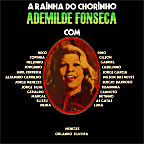 Ademilde Fonseca "A Rainha Do Chorinho" (Top Tape, 1975) (LP)
(Produced by Jorge Countinho)
Revisiting her classic catalog with an all-star cast of '70s session players, Fonseca musters up some of her old power and pep, although on most the album, her age is evident: she's still a nimble singer and able to bounce around in the melodies the way she used to, but her voice is itself not as supple or sweet as it once was. A nice nostalgia piece, but the old recordings are better, even with all the great new acoustic backing. Includes one song, "Titulos De Nobreza (Ademilde No Choro)" that was written by Joao Bosco and Aldrir Blac especially for her; the opening track, Martinho da Vila's "Choro Chorao" is quite nice, as is the slower "Meu Sonho." Sadly, though, I didn't enjoy this album as much as I hoped. Performers include Abel Ferreira on clarinet, flautists Altamiro Carrilho and Copinha, Canhoto, Wilson Das Neves and others...
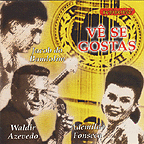 Ademilde Fonseca/Waldyr Azevedo/Jacob Do Bandolim "Ve Se Gostas" (Revivendo)
Prime choro tracks by three stars of the choro genre. These 1942-1955 recordings feature bandolim master Jacob Do Bandolim, cavaquinho whiz Waldyr Azevedo, and vocalist Ademilde Fonseca performing in separate recordings, and all in their prime. Fonseca's voice may be a little songbirdish at times, but every track on here is a delight... highly recommended!
Ademilde Fonseca "20 Selecionadas" (Eldorado, 2000)
Celso Fonseca - see artist discography
 Zila Fonseca "Zila Fonseca" (Columbia, 1955) (LP)
Don't know much about Ms. Fonseca... She started her career performing on Radio Tupi back in the 1930s, and eventually recording a handful of 1940's samba-cancao singles in the style of Carmen Miranda, and put out a couple more records a decade or so later... It's nice stuff; I'd say the '50s recordings have more resonance and depth, but the '40s tracks (which were collected on LP at one point) are pleasant as well.
Zila Fonseca "Sambas Da Saudade" (Columbia)
Zila Fonseca "Sambas Da Saudade, v.2" (Columbia, 1958)
I like these later recordings... She's still imitating (and covering) Carmen Miranda, but she's doing it as a more mature and more mellow performer... I like her voice, and the pop-vocals-y arrangements are nice. Definitely worth a spin.
Claudio Fontana "Serie Bis: Jovem Guarda" (EMI, 2000)
Claudio Fontana "Selecao De Ouro: 20 Sucessos" (EMI, 2002)
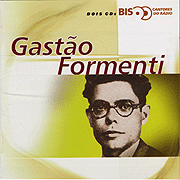 Gastao Formenti "Serie Bis - Cantores Do Radio" (EMI-Brasil, 2000)
Antique recordings from the era of pre-bossa nova "radio singers." Nearly half the tracks on this 2-CD set are from the 1920s, and most of the others are of '30s vintage. Although there's some samba influence, these tracks tilt towards acoustic ballads and romantic interpretations along the lines of Cuba's Antonio Machin and Miguel Matamoros rather than dance tunes. It's a nice slice of old-world Brazilian pop that's unfamiliar to modern ears... nice stuff! Highly recommended!
Gastao Formenti "Noite De Encanto" (Revivendo, 2007)
Gastao Formenti "Quadros Musicais" (RCA Victor, 1959) (LP)
14 Bis - see artist discography
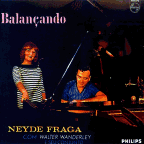 Neyde Fraga & Walter Wanderley "Balancando Com Walter Wanderley" (Philips, 1964) (LP)
(Produced by Alfredo Borba)
A fun set from singer Neyde Fraga (whose career spanned back to the early 1950s: anyone know if her pre-LP stuff is available anywhere?) backed here by organist Walter Wanderley and a biggish band that sometimes widens the sound from the normal Wanderley modality. Fraga is a very appealing singer, performing here with a lightness, lilt and intimacy that's quite different from her later, brasher big band work on Continental. I suppose that shows her range: in either mode, she sounds great. Wanderley's presence is definitely felt as well; his trademark dit-dit-dit organ riffs thread through all the songs, but mostly he tones it down and plays it cool. Definitely worth checking out.
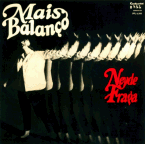 Neyde Fraga "Mais Balanco" (Continental, 1965) (LP)
A swinging set, featuring lively, inventive, upbeat, big band-y dance tunes with some serious jazz chops throughout. Not sure who was in the band, but the bandleaders and arrangers are Erlon Chaves and Francisco de Moraes, and they really deliver the goods. So does Ms. Fraga -- in terms of timbre and tonality she might not have the greatest voice, but her phrasing is superb and she is a very playful and nimble performer. Teresa Brewer and Anita O'Day come to mind... The arrangements are a gas, too, particularly on some of the more inventive tracks, such as "Onda Quebrando" and "Posto Seis," which have great, fluttering flute riffs. Definitely worth tracking down!
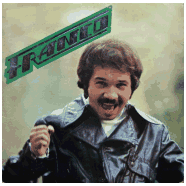 Franco "Franco" (Continental, 1978) (LP)
The former bass player for the jovem guarda '60s rock band Os Brasas, Franco Scornavacca cut a wide swath in Brazil's 1970's "samba rock" scene, as a session player, producer and in this case as a solo artist. I think this may have been his only solo album (anyone know for sure?) and is considered a classic of the genre, with tracks that include perennial favorites such as "Bloco Maravilha" "Como?" and "Fazer Molho Na Cozinha." Backing Franco is his Os Brasas bandmate, guitarist Luis Vagner as well as saxophonist Hector Costita and Branca Di Neve, a fellow samba-rock also-ran who recorded a couple of albums around the same time. Funky stuff -- definitely worth a spin! (Note: three of Franco's sons, Kiko, Leandro and Bruno -- formed the pop band KLB.
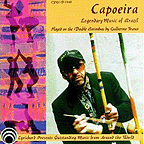 Guilherme Franco "Capoeira: Legendary Music Of Brazil" (Lyrichord, 1998)
A cool instrumental album featuring the eerie and hypnotic sounds of Brazil's unique martial arts form, capoeira dancing. Franco, a solid percussionist with a strong jazz pedigree (who also spent a couple of years in Jorge Ben's band), is the inventor of the double berimbau, which is the main lead instrument on this album. Perhaps a bit more boing boing boing-ing than the average bear is looking for, but nonetheless this is a compelling album, and well worth checking out. Excellent percussion, and a very traditional (non-fusion) sound throughout. Recommended.
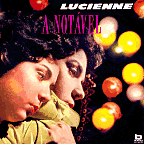 Lucienne Franco "Lucienne -- A Notivel" (Barclay, 1959) (LP)
(Produced by Altamiro Carrilho)
Popular in the 1950s, before the advent of the bossa nova, singer Lucienne Franco was apparently a protege of samba composer Ary Barroso and guitarist Luiz Bonfa (each of whom contribute songs to this album.) This set is very much in the syrupy, romantic tradition of the pre-bossa "radio singers," with a heavy influence from the South American bolero, with Franco's husky voice well-suited to the style. It's a little too corny and operatic for my tastes, but listeners with deeper interests in pop vocals nostalgia might really dig it. Features arrangements from bandleader Severino Filho, as well as a couple of his compositions, and a couple credited to producer Altamiro Carrilho.
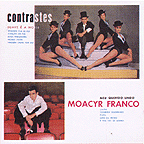 Moacyr Franco "Contrastes" (Copacabana, 1962) (LP)
(Produced by Nazareno De Brito, arrangements by Pachequinho)
The first album by singer and humorist Moacyr Franco... Deliriously over-the-top, cornball pop-romantic vocals, mixing some old-fashioned samba-cancao with other Latin dance styles, boleros and just plain kitsch. Lots of surging string arrangements and big, Mario Lanza-esque vocals, as well as some swingin', upbeat cha-cha-cha-ish mambo material, blurring the lines with the chugga-chugga-chugga of old-school samba music. Franco was a pretty competent performer, even if this is probably too antiquated and square-sounding for most modern listeners. Worth checking out, though, if you're into pre-bossa MPB.
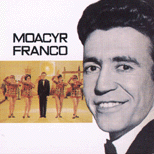 Moacyr Franco "Moacyr Franco" (Copacabana, 1963) (LP)
(Produced by Nazareno De Brito, arrangements by Pachequinho)
Still more corny pop-romantic vocals, with heavy, almost oppressively syrupy string arrangements dominating the first side of the album. On Side Two, however, the album opens up with more stylistic variety, dipping into muscular big band sounds and various frantic novelty-song approaches, including the Mexican harps on "Que Sera De Ti" and the faux-Japanese shrillness of "Kata Ai." It's silly and strained, but kind of fun in a weird way. Mostly this would have to qualify as mere kitsch, but Franco was obviously putting his all into it, so that's gotta count for something...
 Moacyr Franco "Para Sempre" (EMI, 2004)
Walter Franco - see artist discography
Edson Frederico "...E A Transa" (RCA, 1975)
Pianist and bandleader Edson Frederico worked with some of the MPB uppercrust -- Vinicius de Moraes, Elis Regina -- but recorded sparingly under his own name. This disc includes the funk-dance track, "Bobeira," which became a collector-nerd holy grail...
Edson Frederico & Orquestra Metalurgica Dragao de Ipanema "Musica Pra-Pular Brasileira" (Polydor, 1980) (LP)
Edson Frederico "...Plays Maranezi" (1995)
A songbook collection showcasing the work of composer Erineu Maranesi
Frederyko - see artist discography
Dorinha Freitas "A Voz De Dorinha Freitas" (RGE, 1961) (LP)
As Freneticas - see artist discography
(Grupo) Fundo Do Quintal - see artist profile
 Funk Como Le Gusta "Roda De Funk" (ST2, 2000)
Fans of Venezuela's Los Amigos Invisibles may find kindred spirits in this Sao Paulo-based funk outfit... Funk Como Le Gusta specializes in horn-heavy groove tunes that are reminiscent of War and Tower of Power back in the day... There are also homegrown touches as on the Tim Maia-styled soul crooning of "Olhos Coloridos" and the cumbia flavored "Funk De Bamba," as well as a dash of ska and axe flavoring. A little smooth for my tastes, but worth checking out. Soul and funk fans will probably love this!
Funk Como Le Gusta "FCLG" (ST2, 2005)
Funk Como Le Gusta "Remixes" (ST2, 2005)
With DJ Patife, DL Cuca and Cosmonautics.
Funk Como Le Gusta "Special Edition (Box Set)" (ST2, 2005)
A box set with three albums: Roda De Funk, FCLG and Funk Como Le Gusta Remix.
Funk Como Le Gusta "Ao Vivo" (DVD) (ST2, 2007)
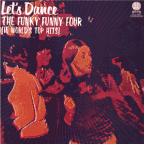 The Funky Funny Four "Let's Dance: 16 World Top Hits" (Young Records, 1971) (LP)
A cheapie-label bubblegum rock cover band, doing English-language versions of songs such as "Chirpy Chirpy Cheep Cheep," "Put Your Hand In The Hand" and "It Don't Come Easy." Improbably, the "band" featured some prog-psych heavyweights, including Liminha and Dinho, at the time the bassist and drummer for Os Mutantes, as well as guitarist Lanny Gordin. Who knew?
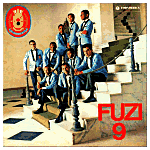 Fuzi 9 "Fuzi 9" (Todamerica, 1970) (LP)
Authentic, though semi-inept pop-funk with slight psychedelic tinges, apparently recorded by a bunch of guys who were enlisted in the army at the time... Although I'm sure this qualifies as a genuine "samba soul" lost nugget, you have to admit that the rhythm section is kinda wobbly, the horns are off-key, and the organ soloist is a little ragged, as are the group vocals. But once you get past all that, this album does have its charms. Mostly, I think, this is notable for the presence of bandmember Carlos Dafe, who went on to record several soul albums in the '70s and '80s. Not sure what he was up to between this group and his solo stuff...