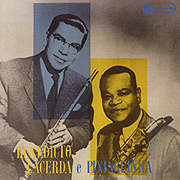
 Benedito Lacerda & Pixinguinha "Benedito Lacerda E Pixinguinha" (RCA Camden, 1966) (LP)
Some of the finest and most dazzlingly pure choro instrumentals by two masters of the genre, flautist Benedito Lacerda and multi-instrumentalist Alfredo Da Rocha Viana Filho, better known as Pixinguinha. This album of vintage recordings was first compiled in 1966, reviving classic melodies such as "1 x 0," "Naquele Tempo" and "Andre De Zapato Novo" for a generation that had since moved on to the charms of bossa nova and the pop-jazz hybrids of MPB. The original allure of these zippy tunes comes through loud and clear, though -- these tracks were recorded between 1946-50 (though many of the compositions are much older) and feature both performers at the peak of their powers. There's plenty of overlap between this disc and other Pixinguinha retrospectives, but there's something nice about hearing the music as it was first revisited by the Brazilians of the bossa nova era. Also, this is a very strong presentation, with a lean, compact selection of songs that wastes no time bringing out the best music the style has to offer. Highly recommended!
Benedito Lacerda "Minha Flauta De Prata" (Revivendo, 2005)
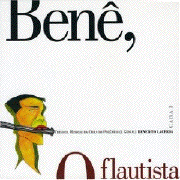 Benedito Lacerda/Various Artists "Bene, O Flautista" (Maritaca, 2008)
A stunning 4-CD set covering the career of fabled Brazilian flautist Benedito Lacerda (1900-1958), who is best known for his work with saxophonist and choro pioneer Pixinguinha, but who also recorded profically with many of the greatest samba stars of the 1930s and '40s. This collection includes many of his most famous recordings, including a flurry of dazzling duets recordings from the 1940s that included lively, definitive versions of instrumental duets with Pixinguinha, as well as classic samba-cancao tracks from Francisco Alves, Silvio Caldas, Carlos Galhardo, Carmen Miranda, Mario Reis and other stars of the 1930s, as well as numerous recordings of Lacerda's own bands, Grupo Gente Do Morro and Velha Guarda de Almirante. Some of the greatest treasures come from the Grupo Gente recordings (an entire disc's worth!) that often feature Lacerda singing, as well as taking the lead on his flute. The sound of his pixielike piping laces through all these recordings, and is remarkably familiar to anyone who has delved into the music of this era -- nice to finally put a name to the face, as it were! There is significant overlap between this set and other recent reissues -- notably the CD reissue of RCA's old Lacerda-Pixinguinha LP -- but you'd be hard pressed to find any music fans who will complain about the duplication. Personally, I could listen to this stuff for days on end. Just start off with the jaw-dropping "1 x 0," perhaps the best-known Pixinguinha tune, and you will be in awe of Lacerda's technical skill and soulfulness. This beautiful, compact box set includes a capacious, chatty, authoritative booklet that gives background on all the songs, steers you towards more modern versions, and provides much-welcome biographical sketches of dozens of Lacerda's collaborators -- bandleaders, composers, guitarists, percussionists, singers -- that will help fill in a lot of gaps in ones general knowledge of the early 20th Century Brazilian music scene. A great, great box set -- highly recommended!
Genival Lacerda - see artist discography
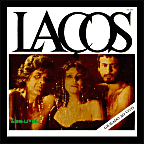 (Quarteto) Lacos "Concerto Show -- Gravado Ao Vivo" (Som Livre, 1976) (LP)
A wide-ranging, energetic live show, featuring Luiz Eca on piano, and a sharp-edged, alert jazz ensemble, backing vocalist Claudia Versiani. The repertoire is mainly composed of solid, mid-'70s MPB, but with a distinct jazz edge to the performances, ranging in tone from near-free jazz and fusion to a pleasantly updated version of the uptempo style practiced in the bossa days. Marcos Paulo (apparently a popular Brazilian actor?) also contributes some dramatic spoken word pieces atop brooding musical backing from the band, Claudio Caribe, Helio Delmiro, Luizao and Marcio Montarroyos, who were probably the "real" Quarteto Lacos. Also included are poems by Ruy Guerra and others -- the musical elements are more compelling, but the poetry is a nice change of pace. In some ways this is a slightly odd album, but overall it's rather strong; a good indicator of the vibrancy and power of the 1970s Brazilian music scene.
Lady Zu "A Noite Vai Chegar" (Philips, 1977) (LP)
Lady Zu "Femea Brasileira" (Philips, 1979) (LP)
Lady Zu "Number One" (Abril, 2002)
Nubia Lafayette - see artist discography
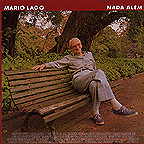 Mario Lago/Various Artists "NADA ALEM" (tribute album) (Som Livre, 1991)
Guest performers abound in this heartfelt tribute to velha guarda poet-actor-songwriter Mario Lago, whose professional career began in the 1930s, when samba cancao stars such as Atualfo Alves, Carmen Miranda, Mario Reis and Orlando Silva recorded his early hits. The songs have a very distinctive feel to them; Lago certainly had a "sound," which I suppose could be typified as not-too-lachrymose saudade, a romantic sense of longing and sadness... Although Lago is pictured on the album cover, I don't think he actually performs on the disc -- no matter, with elegant performances by Gal Costa, Paulinho Da Viola, Nelson Goncalves, Ivone Lara and Raphael Rabello, this tribute disc has its share of talent... Most of the arrangements are cheesy, but some are real gems, particularly Costa's reading of the title track, "Nada Alem."
Mario Lago/Various Artists "90 Anos" (Revivendo, 2003)
Guilherme Lamounier - see artist discography
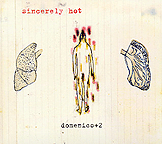 Domenico (Lancellotti) +2 "Sincerely Hot" (Pingpong Records, 2003)
An atypical band, seeking an atypical audience, this trio was known a year earlier as Moreno Veloso +2, gaining widespread praise in Brazil and abroad for an alluring mix of indie rock, electronica and modernized MPB. Part of their acclaim came from the presence of Moreno himself, son of the mega-superstar Caetano Veloso, who showed much of his father's adventurous musical spirit and relaxed performance style. But, having established itself as a "world music" band to content with, the Plus Twos went ahead and followed the ultrademocratic game plan they'd set out with at the start, to have each of the band members record a disc under their name... This time around, it's drummer Domenico's turn, and the shift in musical direction is quite remarkable... This album boasts a pronouncedly modern, American-style tilt towards brash, bright electronic pop and indierock motifs worthy of any critic's darling out of Seattle, Portland or Chicago. The band dips into some softer, textured melodies that borrow from the bossa nova stylebook, but for the most part the point seems to be to make sure that we can see that the kids in Brazil are keeping up with hipsters in the rest of the world. This disc may not have the same mellow, mystic allure as their debut, but it's still pretty darn good, and consistently engaging. Worth checking out!
(See also: the +2 discography page.)
Domenico Lancellotti "Cine Prive" (Malintenti Dischi, 2011)
Ivor Lancellotti "Cantador De Rua" (EMI-Odeon, 1986) (LP)
Ivor Lancellotti "Ivor Lancellotti" (1990)
Ivor Lancellotti "Ivor Lancellotti" (Dabliu, 2000)
Ivor Lancellotti "Bolero Eterno" (2004)
Ivor Lancellotti "Em Boas E Mais Companhias" (Dubas, 2010)
Dona Ivone Lara - see artist discography
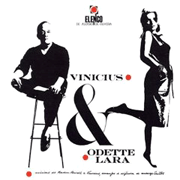 Odette Lara & Vinicius De Moraes "Vinicius + Odette Lara" (Elenco/Polygram, 1963) (LP)
Bossa nova with a playful edge. Poet/songwriter Vinicius De Moraes, sort of a bossa beatnik, is teamed up with actress Odette Lara, who acquits herself quite well in the role of Brazil's Brigitte Bardot. Vinicius' vocals are whisper-y, conversational and penetrating, and Lara's are appropriately lush and sultry -- on duets, their voices don't always mesh, but since they mostly trade off on the songs, it doesn't matter much. Features the tune, "Berimbau", which is credited with helping re-popularize the twangy folk instrument of the same name. Strong arrangements and solid delivery make this one well worth checking out.
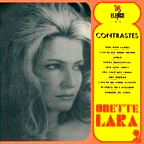 Odette Lara "Contrastes" (Elenco, 1966) (LP)
There may be a reason why actress Odete Lara is seldom mentioned when the greats of the bossa nova generation are recalled... In all honesty, it may mostly be because she didn't really have all that great a voice. The arrangements are vintage Aloysio Oliveira/Maestro Gaya Elenco label bossa-pop, but all the studio talent assembled behind her couldn't save this album from foundering under the weight of Lara's sluggish, lumpen vocals. It's not exactly awful... it just doesn't measure up that well to all the stellar music that was being recorded in Brazil around the same time.
Lazzo "Viver, Sentir E Amar" (Pointer, 1983) (LP)
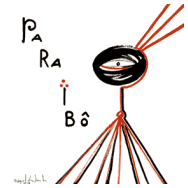 Hugo Leao Filho "Paraibo" (Shadoks, 1978/2009)
(Produced by Padua Carvalho & Hugo Leao)
A groovy, chaotic semi-psychedelic rural rock outing from a guy who was in Ze Ramalho's circle of friends, and previously played lead guitar in the early-'70s Brazilian rock band The Gentlemen... Leao was asked by poet Antonio de Padua Carvalho to help put some of his poems to music, and the result is pretty cool. This is similar to work by Lula Cortes and Ze Ramalho from around the same era, though more cohesive and listenable that Corte's albums, less interested in annoying listeners just for the sake of annoying them. A nice mix of electric and acoustic, regional and rock'nroll, with impassioned vocals that manage not to sound corny or melodramatic. Definitely worth a spin! (Originally recorded in 1978, this was reissued in 2009 by Shadoks Music.)
Nara Leao - see artist discography
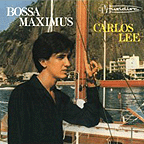 Carlos Lee "Bossa Maximus" (Musidisc/Whatmusic, 2002)
A reissue of an obscure early '60s disc of mysterious provenance... Singer Carlos Lee is a bit of a cipher -- apparently no one from the old Musicdisc label has any recollection of him or of this recording's original release... And yet, here it is. He was, admittedly, a mediocre talent, though this has a certain period charm to it, with a blend of breezy, bopping bossa nova and the more serious-minded MPB of Chico Buarque and Edo Lobo. There's a whiff of early Jorge Ben in there as well, along with a big dose of the slushy romantic styles of the late-'50s radio singers. A mixed bag, but kind of a cute look back at the amateurish, small-potatoes end of the Brazilian pop spectrum...
Rita Lee - see artist page and Os Mutantes
Legiao Urbana - see artist profile
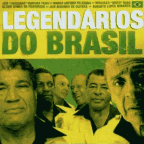 Legendarios Do Brasil "Legendarios Do Brasil" (EMI, 2006)
Not quite what you'd expect. I figured these music be a bunch of velha guarda acoustic samba old-timers -- elders of various carnaval escolas... But instead it's a group of retired soccer players -- Jairzinho, Marcos Antonio Feliciano, Hercules Ruas, et. al. singing mostly all together, but occasionally crooning solo. They're up for a good time, but none of them are particularly good vocalists, and the poppy arrangements are dubious as well -- a bit slick, and a bit slack. Didn't do much for me.
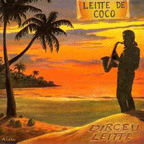 Dirceu Leitte "Leitte De Coco" (Caju/Milestone, 1993)
A delicious and inventive modernization of the classic choro sound, inflected with a sleek jazz bounce, as well as a taste of the music of the Brazilian Northeast. Saxophonist Dirceu Leitte, of the group Choro So, leads this fine ensemble, which includes, among others, guitarists Dino 7 Cordas and Raphael Rabello, drummer Wilson Das Neves, and veteran choro mandolinist Deo Rian. The set presents the music as neither a museum piece nor as a slick, smooth jazz appropriation of this old Brazilian instrumental style -- rather, it's a lively, vital, fun update... And a nice record to tap your toes to!
Leleo "Se Quiser Tem" (Dubas, 2008)
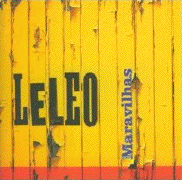 Leleo "Maravilhas" (Acid Jazz, 2008)
(Produced by Leleo & Lucas Marcier)
Perfect summertime tunes from this Brazilian guitarist-producer. The first song I heard off here, "Ferias," is a real doozy, a sly, sexy samba-pop song which mixes the funky tropical vibe of Jorge Ben's best early-1970s work with a great approximation of the classic roots reggae of the Bob Marley era -- heavy syncopation, doubled guitar lines, and plenty of soul. It's a celebration of summertime and idleness, freedom and relaxation, with Leleo's nasality exaggerated by vocal processing -- a heady brew of unusual sounds, all coalescing into an irresistible, perfect Brazilian pop tune. I rushed to get the CD after seeing the "Ferias" video, and am pretty pleased with the rest of the record. About half the album is too clubby for me, but the songs I like are pretty groovy, reminiscent of the best of the '70s samba-funk scene. Definitely worth checking out.
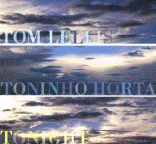 Tom Lellis & Toninho Horta "Tonight" (Adventure Music, 2008)
(Produced by Tom Lellis & Toninho Horta )
Brazilian jazz legend Tonininho Horta and North American crooner Tom Lellis get mellow on a sweet set of bossa nova-flavored, English-language tunes, drawn mainly from the American standards songbook, along with several Horta-Lellis originals, and a fine rendition of Tom Jobim's "Dindi." Lellis tackles evergreens by Harold Arlen, Hoagy Carmichael, George Gershwin, Cole Porter, Vincent Youmans and others. It' a nice set, with a decidedly Sinatra-esque vibe (as heard in the inclusion of "Fly Me To The Moon"). For his part, Horta plays some delicious, beautiful acoustic guitar that is both marvelously restrained and wondrously complex. Lellis' piano work fills out the sound, providing a larger, warmer sound than you'd imagine from just two people. This album comes fifteen years after their first collaboration, 1993's Mountain Flight, and gives an even more intimate glimpse into their collaborative process. Smooth jazz, pop vocals and bossa fans will dig this one.
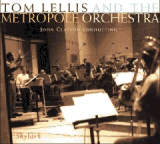 Tom Lellis & The Metropole Orchestra "Skylark" (Adventure Music, 2009)
Sinatra-esque vocalist Tom Lellis, backed by the Netherlands Metropole Orchestra, inserts a couple of Brazilian composers -- Toninho Horta and Tom Jobim -- into an album of orchestral pop/jazz ballads, alongside North American jazz composers such as Hoagy Carmichael, Chick Corea and Herbie Hancock, as well as trio of his own original tunes. It's not really my kinda vocals music, but it's very solid for the style: if you liked the Sinatra-Jobim sessions, you might want to check this out.
Fafa Lemos - see artist profile
Sonia Lemos "...Sua Viola Enluarada" (Philips, 1968) (LP)
Sonia Lemos "Domingos" (Continental, 1975) (LP)
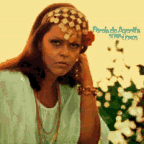 Sonia Lemos "Perola De Agonita" (Continental, 1976) (LP)
The sound is right: 1970s-era Afro-Brazilian samba-roots pagode, featuring many of the fabled session players of the time such as Waldir and Dino 7 Cordas, along with a hefty dose of percussion and those great, keening vocal choruses. I'm not super-wowed by Lemos' vocals -- she sings a little flat and it might get on your nerves after a while. But overall, this is a very solid album, and certainly worth checking out if you love the acoustic samba sound of Beth Carvalho, Martinho Da Vila and Clara Nunes.
Sonia Lemos "O Amor Seja Bem-Vindo" (Polydor, 1978) (LP)
Lenine - see artist profile
Leno / Leno & Lilian - see artist profile
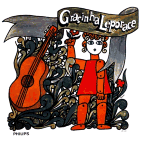 Gracinha Leporace "Gracinha Leporace" (Philips, 1968) (LP)
A nice set of stately, standard-issue bossa-era ballads, the lush, orchestral pop vocals that gradually gave way to the more eclectic, jazz-tinged MPB of the '70s. Gracinha was Sergio Mendes' wife, and recorded with him on his albums (as well as with some other artists...) On this solo album, she proves herself a solid artist, a strong stylist, if not an entirely magical performer... Oscar Castro-Neves provides the arrangements, giving a craftsmanlike feel to this set of from '60s stalwarts such as Ronaldo Boscoli, Vinicius de Moraes, Carlos Lyra, Edu Lobo -- oh, and Tom Jobim, of course. Can't forget about him!
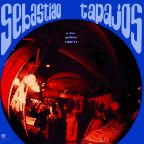 Marcello Lessa & Paulinho Tapajos "Viola Violao" (Dabliu, 2004)
A sweet, light set, blending gentle acoustic sambas with flowery modern MPB, ala Chico Buarque... The music, the style and the harmonies are reminiscent of the samba-pop duo of Antonio Carlos & Jocafi. Might be a little too flowery for some, but there are lots of nice touches as well. Definitely worth a spin!
Marcello Lessa & Paulinho Tapajos "Par Ou Impar" (Kuarup, 2006)
Chaim Lewak "Para Ouvir Amando, v.3" (Copacabana, 1959)
Chaim Lewak "Recordando A Italia" (Copacabana, 1959)
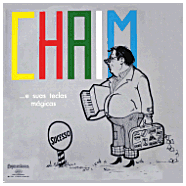 Chaim Lewak "...E Seus Teclas Magicas" (Copacabana, 1960) (LP)
A nice, brisk set of simple, down-to-earth nightclub instrumentals spotlighting pianist Chaim Lewak and an unidentified (but quite competent) ensemble providing elegant, economical backing. Lewak distinguishes himself from other pianists of the era by not overindulging in pure schmaltz -- the opening tracks have a bounce to them that's suggestive of George Shearing or Marty Paich. Things slow down in the second half, but there's still a nice spark here that gives this a little lift... Overall this is still an "easy listening" album, reflective of the pre-bossa Rio nightclub scene and might not hold the interest of many modern listeners, but a certain set of lounge enthusiasts might get into it. The repertoire is a mix of American jazz and standards -- stuff by Benny Goodman, Sammy Kahn -- and non-Brazilian Latin dance stuff, as well as several originals credited to Pedro Santos. Anyone know who played the percussion, guitar, etc. on this one?
Lia De Itamaraca "A Rainha Da Ciranda" (Tapecar, 1977) (LP)
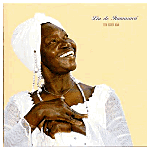 Lia De Itamaraca "Eu Sou Lia" (Rob Digital, 2000)
Unruly, captivating, raw regional music from a Pernambucan singer who sticks to the old-fashioned way of making music... These songs (many of which, it must be admitted, sound an awful lot alike...) are maracatus and cocos de roda, with heavy, wobbly rhythms and off-kilter, stripped-down accompaniment on percussion and a single, quirkily honking horn. Lia (aka Maria Madalena Correia do Nascimento) has been making music for years and has a lot of the same tenor and gravitas as Clementina de Jesus or Dona Ivon Lara, but this music is just a little bit weirder and more wild than their traditional sambas... Probably not for everyone, but very traditional-sounding and definitely worth checking out.
Lila "A Madrugada Na Voz" (Columbia, 1961) (LP)
Dalva de Oliveira's sister, backed by Luiz Astor. The repertoire includes songs by Djalma Ferreira, Ed Lincoln, Britinho and others...
Lilian / Lilian Knapp - see artist profile
Marina Lima - see artist discography
Paula Lima "Diva Paulista" (Mr. Bongo Records, 2002)
Paula Lima "Paula Lima" (Universal, 2003)
Paula Lima "E Isso Ai!" (Universal, 2005)
Paula Lima "Sinceramente" (Indie, 2006)
Walmir Lima "Esta Tudo Bem" (CBS, 1976) (LP)
Samba composer Waldir Lima is perhaps best known for writing several 1970's samba-raiz hits, notably Beth Carvalho's hit, "Dindinha Lua" (co-written with Joao Rios) and "Ilha De Mare," which was recorded by Alcione.
Walmir Lima "Walmir Lima" (Kelo Music, 1980) (LP)
Walmir Lima/Various Artists "Sambas De Roda De Salvador" (K-Tel/EMI/Master Music, 1983) (LP)
(Produced by Walmir Lima, Gabriel O'Meara & Milton Manhaes)
On this roots samba album Walmir Lima was the bandleader and occasional lead singer. Others, including several percussionists, also sing lead, folks with nicknames such as Beijoca, Edinha da Bahia, Elane, Giba, Rico Medeiros, Sarabande, and Serginho... it's a lovely, barebones samba album, with a very 'Seventies sound, and very heavy on the percussion. Sounds pretty sweet!
Ed Lincoln - see artist discography
Arto Lindsay - see artist discography
Claudio Lins "Um" (Velas, 1999)
An album by the son of composer Ivan Lins and actress Lucinha Lins... Pretty schmaltzy romantic stuff, mostly.
Claudio Lins "Cara" (Biscoito Fino, 2009)
Ivan Lins - see artist discography
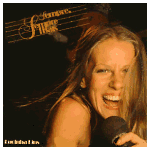 Lucinha Lins "Sempre, Sempre Mais" (Philips, 1982) (LP)
Singer Lucinha Lins was married to MPB/jazz composer Ivan Lins and sang on all his major records of the 1970s, as well as on numerous other artists' albums, but she recorded only sparsely under her own name. In the early '80s she shifted gears and took up an acting career, which has led to many roles in dozens of telenovelas and films.
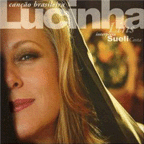 Lucinha Lins "Cancao Brasileira: Lucinha Interpreta Sueli Costa" (Biscoito Fino, 2002)
A well-crafted set of MPB ballads, which should appeal to fans of Gal Costa and Maria Bethania's cabaret-oriented style. Lucinha is backed here by pianist Gilson Peranzzetta and his ensemble. Rio-born songwriter Sueli Costa was a favorite of slick '70s performers such as Simone, Joanna, Ney Matogrosso, Fafa de Belem, Maria Bethania, and -- one would assume -- Joao Bosco, especially since she collaborated often with Aldir Blanc. Costa recorded sparingly in the late 1970s; this affectionate tribute should help bring her music to the attention of a new generation of MPB fans.
 Little Joy "Little Joy" (HPI/Rough Trade, 2005)
(Produced by Noah Georgeson)
A collaboration between Rodrigo Amarante (of the Brazilian indiepop band Los Hermanos) and Fab Moretti of the Strokes, with additional vocals from Binki Shapiro... It's an English-language album, but I'll forgive Amarante... just this once!
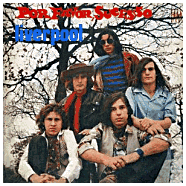 Liverpool "Por Favor Sucesso" (Equipe, 1969) (LP)
A genuinely groovy mod-psych rock record with echos (naturally) of the British scene, specifically stuff like late-edition Yardbirds and various post-Invasion Brit bands... There's also a distinctly Brazilian air to many songs: Gilberto Gil's stuff from '68 comes to mind, but not that much of the wacky self-indulgence of Os Mutantes and their followers. Anyway, this is very diverse, very fun, and very much worth checking out. Definitely a notch or two above most Brazilian "nuggets" albums of similar vintage. Recommended! (Reissued on CD and LP by Shadoks Music)
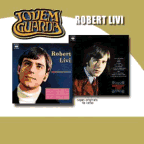 Robert Livi "Serie Jovem Guarda: Apaixonado/Robert Livi" (Sony-Columbia, 2000)
A 2-CD reissue of two old jovem guarda albums, Apaixonado and Robert Livi
Lobao - see artist discography
Valeria Lobao "Chamada" (Tenda Da Raposa, 2011)
Ary Lobo - see artist discography
Edu Lobo - see artist discography
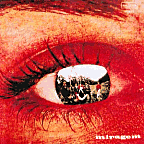 Os Lobos "Miragem" (Top Tape, 1971) (LP)
A cool mix of styles - jangly pop-psyche, denser, jazzier proggish art-rock and bouncy, piano-led music-hall shuffles, reminiscent of The Kinks, with a touch of shimmering Byrds-iness in there as well. The alternating male-female vocals invite comparison to Os Mutantes... Personally, I like these guys better: their artistic output is more consistent and they seem a little less full of themselves (although there are a few similarly sluggish, spaced-out moments as well... Goes with the territory, I guess...) Overall, a great hippie-era relic! At least one bandmember, Dalto, went solo later in the 1970s...
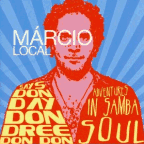 Marcio Local "Says Don Day Don Dree Don Don: Adventures In Samba Soul" (Luaka Bop Records, 2009)
(Produced by Mario Caldato, Jr.)
Contemporary Brazilian funk and soul, from a Rio native who carries the torch of samba-soul pioneers such as Tim Maia and Wilson Simonal... There's a touch of the cooler, funkier, sexier Jorge Ben in there as well, but mostly that sound is in the mix; there are some great arrangements (courtesy of Beastie Boy producer Mario C, who in recent years has returned to Brazil and joined the simmering local hip-hop/samba scenes...) but the vocals are pure Simonal, a husky, schmaltzy style that is popular in Brazil, but may be hard for many North Americans to get into. This is a musically creative record, and in terms of keeping true to the traditions of 1970s/80s Brazil soul, it's also very authentic. Definitely worth checking out -- if you like this, you'll also want to check out Maia, Simonal and Maia's nephew, Ed Motta.
Marcio Local "Samba Sem Nenhum Problema" (Universal, 2009)
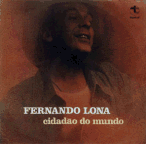 Fernando Lona "Cidadao Do Mundo" (Tapecar, 1977) (LP)
Soft pop, with a northeastern regional flair, including a few dips into more traditional baiao/forro music. The opening tracks are awful, but the deeper you go into the album, the better it gets. Ultimately, he's a bit like Edu Lobo, an ornate but tuneful MPB pop stylist. Doesn't really wow me, but I can see where this would have appealed to folks at the time, especially those in search of representatives of a modern regional culture. All the songs were written or co-written by Lona, with arrangements by old-timer Leo Peracchi.
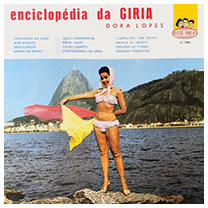 Dora Lopes "Enciclopedia Da G’ria" (Mocambo Records, 1957-?) (LP)
A veteran of Brazil's "radio singers" scene composer Dora Lopes de Freitas (1922-1983) wove a career through multiple eras of Brazilian popular music -- the golden era which began during the Great Depression and lasted through the 1940s, the bossa nova years, and the roots samba resurgence of the early 'Seventies. Like many artists of the earliest era, Lopes' first works were only available on 78s (and the bulk of her performances were doubtless never recorded) with her first long-play album came well after she had established herself as a popular composer. This bossa-era album was released in several different editions, notably an early 'Sixties edition with a groovy on-the-beach-in Rio cover photo... which is the version I lean towards. According to MPB historian Tarik de Sousa, Lopes remained a relatively obscure figure, even though she worked with many notably stars, and left behind a respectable body of work over the course of several decades.
Dora Lopes "Minhas Musicas E Eu" (Copacabana, 1965) (LP)
Although she later embraced the roots-samba sound of the early 1970s, this mid-'60s pop vocals/bolero set is fairly torturous, with impassioned, overly-emotive vocals and a fairly piercing, busy orchestrations. The drippy piano, the sharp-edged string arrangements, the intrusive horns... It doesn't really work for me, though there may be listeners more attuned to orchestral pop and pure emotive schmaltz who could get into it more than I did.
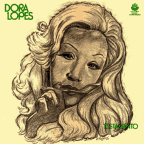 Dora Lopes "Testamento" (RGE, 1974) (LP)
(Produced by Chil Deberto & Jose Toledo)
An awesome set of roots-samba, '70s-style, with earthy, evocative vocals and solid musical backing. Ms. Lopes is the sort of exhortatory singer who really stirs up her band, and she summons a whirlwind on some of these songs... There's a strong wave of saudade and regret that flows through here, but also a vibrancy and power that's similar to the best of the pagode samba of this era. If you like Clara Nunes, Clementina De Jesus and Ivone Lara, you'll want to add this gal to your list as well. Overwrought at times, but generally pretty rootsy and real... Plus, she wrote or co-wrote all of the songs! The backing band included a panoply of rootsy musicians, though as with many 'Seventies-era samba albums the players aren't exactly household names outside of Brazil, despite their immense talent. The lineup included a core group called Os Embaixadores do Samba, augmented by various guitarists, steel player Angelo "Poly" Apolonio (here on cavaquinho), Mario Casale (piano), cuica player Alaor de Mora and various others. Nice stuff.
Dora Lopes "Esta E Minha Filosofia" (Tapecar, 1976) (LP)
Nei Lopes & Wilson Moreira "A Arte Negra De..." (EMI, 1997)
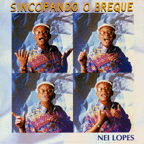 Nei Lopes "Sincopando O Breque" (CPC-UMES/El Dorado, 1999)
Latter-day samba cancao with fairly posh, sometimes big band-ish arrangements. Lopes is one of those Brazilian old-timers whose career effortlessly spans the decades; here he's joined by another veteran sambista, drummer Wilson Das Neves, in a nice, lightly swinging set of songs, all written by Lopes himself. Sweet stuff, a little old-fashioned, but nice nonetheless.
Nei Lopes/Various Artists "De Letra E Musica" (Velas, 2001)
Nei Lopes "Celebracao" (Rob Digital, 2003)
Nei Lopes "Partido Ao Cubo" (Rob Digital, 2005)
Luiz Loy "...E Sua Juventude Musical" (Odeon, 1962) (LP)
Bossa-jazz pianist Luiz Loy, backed by bass player Roberto Bandeira, Bude (flugelhorn), Dagmar (trumpet), Flavinho (baritone saxophone), Meirelles (tenor saxophone and flute), and Zinho on drums...
Luiz Loy "Luiz Loy Quinteto" (RGE, 1966) (LP)
Luiz Loy "Chico Buarque De Hollanda Instrumental" (RGE, 1967) (LP)
Luiz Loy "Balanco Pra Frente" (Odeon, 1968) (LP)
Renata Lu - see artist profile
Romero Lubambo - see artist profile
Ana Lucia "Colecao As Divas" (?)
Ana Lucia "Canta Triste" (RGE, 196-?) (LP)
Vera Lucia "Vera Lucia" (Philips, 196-?) (LP)
A "radio singer" ballad gal, covering some samba and bossa material, including songs by Luiz Bonfa, Carlos Lyra, and Joao Roberto Kelly, with fairly staid backing by the band of Carlos Monteiro de Sousa.
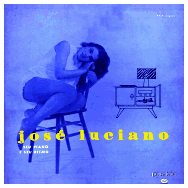 Jose Luciano "Seu Piano E Seu Ritmo" (Copacabana, 1957) (LP)
Negligible dance-band instrumentals from Fortalezan pianist Jose Luciano and his combo... Sort of a Harry James-meets-Edmundo Ros kind of thing. The repertoire's a mix of Brazilian compositions (including some by Luciano, as well as nightclub regular Djalma Ferreira...) along with Tin Pan Alley material such as Cole Porter's "So In Love" and Sammy Fain's "Love Is A Many Splendored Thing." Generally pretty syrupy and schmaltzy, with a dash of big band oomph amid the flowery, flashy riffs. I'm mildly interested to find out who the electric guitarist was, but honestly this isn't music you need to spend a lot of time on.
Pedro Luis E A Parede - see artist profile
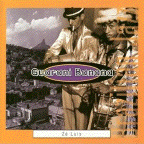 Ze Luis "Guarani Banana" (Malandro, 1999)
An accomplished saxophone player who has toured on the road with Caetano Veloso and other giants of Brazilian MPB, Ze Luis moved to New York City, where he is firmly in the middle of the Big Apple's Braz-Jazz revival. Joined by others on the NYC scene, such as Mauro Refosco, Romero Lubambo and Paulo Braga, Luis has put out his own solo album, a mainly-instrumental jazzfest which ranges from muscular Latin jazz reworkings of bossa standards to lighter, dreamier numbers that are reminiscent of Milton Nascimento's Clube da Esquina days (notably "Winds From Africa"). It's not my entirely my cup of tea, but for the territory, this ain't bad.
Ze Luis/Paulo Braga/Nilson Matta "Green Heart" (New Orbita, 2007)
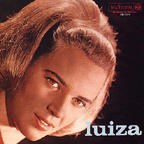 Luiza "Luiza" (RCA, 1964) (LP)
A nice, mid-1960s pop-bossa album featuring blonde-haired Luiza Silveira Fonseca (who I'd never heard of before) and pretty sharp arrangements by Moacir Santos, backed by an anonymous band, presumably culled from the bossa-era jazz camp. Luiza's voice is pretty nice, though perhaps a little too perfect and smooth, in a manner reminiscent of French chanson singers. Overall, a lovely little record that seems to have dropped off the radar over the years. Worth checking out.
Nonato Luiz - see artist profile
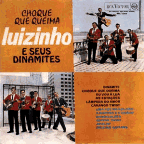 Luizinho & Seus Dinamites "Choque Que Quiema" (RCA Victor, 1964) (LP)
Twangy, surfy/garage-y rock; rough-edged stuff from the jovem guarda era. Luizihno "got" American-style rock... but just barely! Nonetheless, the shakiness of these performances is a big part of their charm... This is undeniably authentic teenster rock, with lots of energetic lead guitar work and several fun songs. Pretty cool little relic.
Luli & Lucina "Luli E Lucina" (1979) (LP)
Luli e Lucina "Amor De Mulher/Yorimata" (Nosso Estudio, 1982) (LP)
Gooey, amorphous, flowery folky stuff, with a kind of new age-y feel -- gentle, static acoustic guitar and noodly vocals. Lucina was, once upon a time, one of the singers in Grupo Manifesto. I'm afraid this disc doesn't do much for me.
Luli e Lucina "Timbres & Temperos" (Som Da Gente, 1984) (LP)
Luli e Lucina "Porque Sim, Porque Nao?" (Leblon, 1991)
Luli e Lucina "Elis & Elas" (Leblon, 1995)
Luli e Lucina "25 Anos" (Dabliu, 1996)
Alcyvando Luz "Fala Moco" (Tapecar, 1980)
(Produced by Alcyvando Luz)
Moacyr Luz - see artist discography
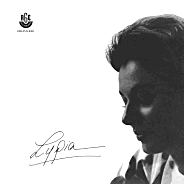 Lygia "Lygia" (Copacabana, 1964) (LP)
A good album from the bossa nova days, drawing equally on the influences of the small bossa-jazz trios and larger studio orchestrations of the time... A well-connected Brazilian socialite, Lygia de Freitas Valle herself may have been an underwhelming vocalist -- I think this was her only album -- but the talent backing her is impressive, and gives this album a solid, satisfying, though somewhat corny sound. Maestro Lindolfo Gaya, Rubens ("Pocho") Perez and jazz pianist Manfredo Fest all provide arrangements on various tunes, as does guitarist Paulinho Nogueira and the popular Zimbo Trio. No producer credit is given, but I think Nogueira was the driving force behind this album, and it's a pretty strong set. Nice repertoire, solid musicianship, classy, clear production and an adequate singer, all combined with being in the right place at the right time... This album remains a rarity, but it's emblematic of its era and definitely worth a listen.
Carlos Lyra - see artist discography
Kay Lyra "Influencia Do Jazz" (Video Arts, 2004)
The jazz-oriented debut of singer Kay Lyra, daughter of fabled bossa composer, Carlos Lyra. This was released in Japan, and so far hasn't seen release in the States...
Kay Lyra "Kandagawa" (2007)