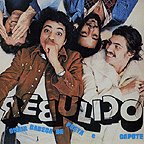
 Odair Cabeca De Poeta "Rebulico" (RCA, 1979) (LP)
(Produced by Renato Correa)
Lyricist Odair Tadeu de Freitas, along with his band Capote (featuring guitarist Vincente Barreto) crafted an at-times uneasy blend of rock, funk and northeastern baiao and forro. Taken from the Brazilian standpoint, as an extension of traditionally-inclined styles, this is pretty wild stuff. But viewed through the filter of North American rock and funk, it's pretty goofy-sounding and clumsy. Still, Odair was one of the most important Northeastern rockers to follow in the path laid down by Alceu Valenca, and this record actually sounds more interesting than most of the Valenca albums I've heard to date. Didn't rock my world, but it's worth checking out.
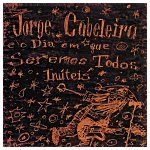 Jorge Cabeleira "E O Dia Em Que Seremos Todos Inuteis" (Sony/Manguenitude, 1994)
An underwhelming, noisy, busy-sounding alt-rockish manguebeat set... Sounds sort of generic and flatly produced... Lots of noise, but little direction. Anyway, it didn't do much for me.
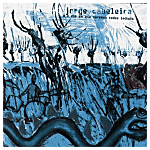 Jorge Cabeleira "Alugam-Se Asas Para O Carnaval" (Sony, 2001)
A typically eclectic manguebit mix of loud, guitar-heavy alt-rock and mellower, more melodic indie-pop, with plenty of regional Brazilian influences, and a smidge of weirdo-folk psychedelia as well: fans of Os Mutantes, Nacao Zumbi or Pato Fu might dig this as well. This record was a little too grating for me to get into; it's conceptually interesting, but not something I'd want to listen to over and over again. Perhaps the most unusual track is the bluesy, Black Crowes-ish "Rock Do Diabo," with a slashing slide guitar and jam-band vibe that's unlike the rest of the record, or, indeed, like most Brazilian rock. Worth checking out if you're into challenging, difficult, modern Brazilian rock.
Cabruera "Cabruera" (Alula Records, 2002)
Cabruera "O Samba Da Minha Terra" (Nikita Records, 2004)
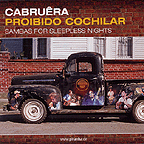 Cabruera "Proibido Cochilar: Sambas For Sleepless Nights" (Piranha Records, 2005)
A reshuffled version of their O Samba Da Minha Terra album... A dense, challenging, lively, irritating, inventive, noisy, amazing blend of regional Brazilian styles (such as forro and coco, along with creatively appropriated rock, rock-funk and tweaky acid-rock-samba... As on their earlier albums, Cabruera touch bases with contemporary manguebeat bands such as Pato Fu and Nacao Zumbi, as well as older psychedelic/samba pioneers such as Novos Baianos, who also mixed rootsy regional sounds with hard-edged "American"-style rock'n'roll... This is a little too aggressive and Red Hot Chili Peppers-ish for me, but in between the slamming testosterone injections, there's some really cool, surprisingly subtle experimental musicmaking... Definitely worth checking out!
Carlos Cachaca - see artist discography
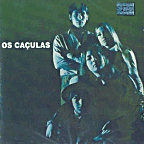 Os Caculas "Os Caculas" (RCA, 1969)
One of the numerous Brazilian "nuggets" from the hippie era... This particular album starts out as more or less a set of perky sunshine pop with pert pop arrangements around an earnest female-led vocal chorus with a Mamas & Papas kind of feel. Midway through they stir things up a bit with the mildly (and pleasantly) psychedelicized "A Moca Do Karmann Ghia Vermelho," which has some grinding electric guitars and slightly more aggressive vocals. Then they revert to their mellow folk-pop vibe, with other album highlights including a cover of the Youngbloods "Get Together" (rendered in Portuguese as "Aconselhar E Facil") and the moderately funky closing track, "Meus Pes Descalcos Vao Pisando As Ruas Do Mundo." Not a super-duper psychedelic gem or anything, but cute and fun to groove out to, in a kitschy kinda way.
Wilson Cafe "Coracao De Tambor" (Dabliu, 2001)
Wilson Cafe "O Tempo E A Mare" (Dabliu, 2004)
Caito "En Bossa Y Algo Mas" (Vedette, 19--?)
An Argentinian does bossa nova... and more!
Caju & Castanha - see artist discography
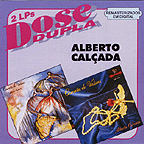 Alberto Calcada "Cascata De Valsas" (Warner-Continental, 1958)
Sedate easy listening, with a regional flair... Not unlike, oh, say, Sardinian folk albums produced for a tourist market in Europe... This is professionally crafted, but ultimately quite dull, with little variation from song to song. These two albums of Brazilianified waltzes were re-released as a single CD in the "Dose Dupla" series.
Alberto Calcada "Cascata De Valsas, v.2" (Warner-Continental, 1959)
Adriana Calcanhotto - see artist discography
Luiz Caldas - see artist discography
Sylvio Caldas - see artist discography
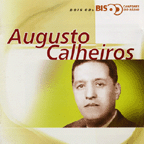 Augusto Calheiros "Serie Bis - Cantores Do Radio" (EMI-Brasil, 2000)
One of the first major stars to hail from Brazil's rural-identifed Northeast, Calheiros was originally in the 1920s group known as Turunas da Mauriceia, along with Luperce Miranda (later a mainstay of Carmen Miranda's band). His nordeste roots may partly account for the comparative roughness of Calheiros' vocals, as opposed to the smoother Carioca and Paulista singers of the '30s and '40s. He was also a bit older than many of his contemporaries - this collection tracks his career from the mid-1930s up to the 1955, just before he passed away in '56. The arrangements are a little stiff, but still this is nice stuff, with a slightly different flavor than many of the other collections in this series of pre-bossa recordings.
Augusto Calheiros "...E Os Turunas Da Mauriceia: A Patativa Do Norte" (Revivendo, 2007)
Aline Calixto "Aline Calixto" (Warner, 2008)
Aline Calixto "Tudo Que Sou" (Warner, 2009)
Aline Calixto "Flor Morena" (Warner, 2012)
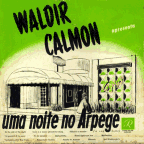 Waldir Calmon "Uma Noite No Arpege" (Long Play Radio, 1956)
A souvenir album for one of the seven bazillion nightclub performers roaming around Rio in the pre-bossa nova era. This LP features two bouncy, album-length medleys of Brazilian sambas, Cole Porter dance tunes, mambos by Xavier Cugat and Perez Prado, and even a choro tune credited to Bola Sete ("To De Snooker"). Sure, it's a corny performance, but not as cheesy as you might imagine... in fact, I wouldn't mind having this combo playing in the background of the next bar I go to...
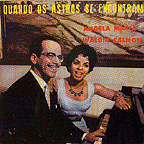 Waldir Calmon & Angela Maria "Quando Os Astros Se Encontram..." (Copacabana, 1958)
Angela Maria "Quando Os Maestros Se Encontram..." (Copacabana, 1957)
Reissued on CD as a twofer by EMI, these '50s albums represent a different type of Brazilian pop -- not samba, not bossa, not MPB -- not even plain pop vocals, which were common at the time... Nope, this has the sound of a full-on MGM or Broadway musical... outlandish orchestral swells, swooping vocals -- and it's pretty damn good! Vocalist Angela Maria's career continued on at least into the 1990s (!) but I have no idea how well she was able to hold her own in the changing tides of style. She certainly had as good a voice -- if not better -- than most of the highly vaunted vocalists of the MPB era. The songs are Brazilian originals, including a few from well-remembered composers such as Dorival Caymmi, Pixinguinha, and Ary Barroso -- but mostly this is forgotten musical turf. A note of caution: the second album, with organist Calmon, has some instrumental touches that may make loungecorers giddy, but which might scare the rest of us. Mostly, though, this rocks.
Waldir Calmon "Sua Orquestra, Conjunto E Piano" (Revivendo, 2003)
Waldir Calmon "Samba No Arpege" (Revivendo, 2004)
Four long medleys of samba-cancao oldies...
Camafeu De Oxossi "Camafeu De Oxossi" (Philips, 1968) (LP)
Ely Camargo - see artist discography
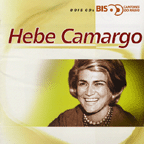 Hebe Camargo "Serie Bis - Cantores Do Radio" (EMI-Brasil, 2000)
Movie actress and TV personality Hebe Camargo came in at the tail end of the pre-bossa nova pop era, and a couple of things set this collection apart from the others in this series. One is the sound quality - the work on here dates from 1952-67, and in general has bright, clean punchy production. Then there's the material, which more overtly tilts towards North American sensibilities, in particular towards big band and straight pop vocals -- for example, the first disc starts off with a brassy cover of Bob Merill's "Mambo Italiano", and other latin dance tracks pepper the set list. She also dips into rock-tinged girl-group-ish trills, yet with a reserved classiness typical of "grown up" pop vocals of the era. Camargo has a nice voice, too -- clear, confident and full of good humor. Worth checking out!
Hebe Camargo "Sem Limite" (Universal, 2003)
A 2-CD set
Hebe Camargo "Hebe E Convidados" (Universal, 2002)
Hebe Camargo "Pra Voce" (Universal, 2002)
Hebe Camargo "As Mais Gostosas Da Hebe" (2007)
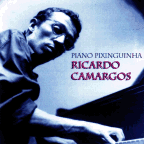 Ricardo Camargos "Piano Pixinguinha" (Velas, 1995)
Delightful solo piano performances, not just of antique compositions by the great choro composer Pixinguinha, but of a dozen or so long-lost, never before recorded Pixinguinha pieces that Camargos discovered while conducting research in the national archives in Rio de Janeiro. Choro music lends itself well to the piano -- it brings out the connections to ragtime and early jazz -- plus it just sounds great. Lovely stuff, clearly from a different time and place, and fully evocative of its era. Recommended.
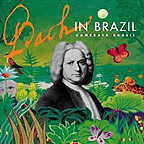 Camerata Brasil "Bach In Brazil" (EMI-Varig Brasil, 2000)
Brazilian choro music, bent in the service of baroque and classical music. It's a pretty nice fit, though at times the repetitive choro instrumentation threatens to descend into mere perkiness (a hazard of the genre...) Still, the mix of music is nice, with compositions by Heitor Villa-Lobos, Radames Gnattali and J.S. Bach alongside tunes by Abel Ferreira, Pixinguinha and other choristas. This didn't totally floor me, but it's pretty nice.
Celly Campello - see artist discography
Tony Campello - see artist discography
Candeia - see artist discography
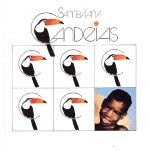 Candeias "Sambaiana" (Mediterraneo, 1976)
A European jazz band with a serious Brazilian jones... Originally released in Spain, this has been reissued on CD and is one of those "groove" records the acid-jazz folks get all worked up about. I haven't heard it yet, but I'll let you know when I do...
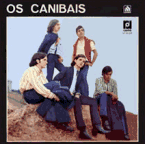 Os Canibais "Os Canibais" (Mocambo, 1967)
Tentative, amateurish jovem-guarda rock... Considering their name I expected some badass garage rock, but instead it's more of a Herman's Hermits/Searchers/Turtles vibe, purposefully tame, musically unchallenging, but perhaps slightly more charming because of the band's unpolished, clumsy performances. Plus, they were from Rio, not Sao Paulo, and everyone knows Cariocas can't rock... Intriguingly, the last three tracks are pretty decent... I halfway suspect the band got better as the sessions came to a close(!) Not a real nugget in the wham-bam kinda way, but a slice of history nonetheless... The group was around for a while, and recorded several singles; in 1970 they momentarily morphed into a band called Bango, and recorded another full album, which I think may be reviewed around here as well.
Vinicius Cantuaria - see artist discography
Capital Inicial - see artist discography
(Banda) Capote "Banda Capote" (1996)
I'm not sure, but I think this is the same Brazilian band fronted by pop-funkster Odair Cabeca (listed above...) I haven't heard this album, and I'm not sure when it really came out... But I am quite curious.
Ana Caram - see artist discography
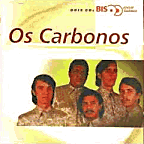 Os Carbonos "Serie Bis - Jovem Guarda" (EMI/Copacabana, 2000)
Mainly sluggish, mid-tempo teeniebopper ballads, recorded between 1969-81, well after the real Jovem Guarda boom. Although there are plenty of potentially interesting cover tunes ("Bus Stop," "Mellow Yellow," Arthur Adams' "Anna"...) none of the performances are very exciting... this is basically the Brazilian equivalent of the kind of oldies cover band you'd hear at a country fair up here in the States... Of note, though, is their version of "Never Never," by Uruguay's Los Shakers, which is still pretty rinky-dink, but noteworthy because of the pan-Latin American link.
Os Carbonos "Selecao De Ouro" (2007)
Os Carbonos "So Samba!" (Beverly, 1973)
Elizeth Cardoso - see artist discography
Leonel Jose Cardoso/Leonel Do Trombone "Samba E Balanco" (Copacabana, 1954) (LP)
Wanderley Cardoso - see artist discography
Os Caretas "Historia Dos Sambas Enredo: 1932-1975" (Polydor, 1975)
Usually samba de enredo albums are collections of the best carnaval songs, issued as souvenirs from the various samba schools which had competed or won in a given year. This one, however is a collection of famous or winning songs, drawn from five decades of competitions, and performed by one band (the studio band Os Caretas, who did a series of generic souvenir albums in the 1970s). The survey includes famous songwriters such as Noel Rosa, Cartola, Ze Keti and Candeia, as well as dozens of more obscure writers. Musically, this is quite pleasant, though also quite static -- the arrangements (percussion, cavaquinho, cuica, chorus) are unvaried from track to track. Of course, it's a sound that's hard to find fault with, so sonic homogeneity may not be a problem for many.
Carioca E Sua Orquestra "Classicos No Samba" (RCA Victor, 1961) (LP)
Classical music, played in Brazilian big band/samba gafieria style... This group included pianist Fats Elpidio playing on several tracks, and Laerte tickling the ivories on the rest, Paulo Moura is one of many horn players, with most of the group going by first names or nicknames... I'll sort it out eventually.
Carioca (Ronaldo Leite de Freitas) - see artist discography
Os Cariocas - see artist discography
Carlao "Carlao" (1981)
Antonio Carlos (& Jocafi) - see artist discography
Erasmo Carlos - see artist discography
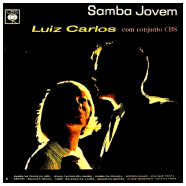 Luiz Carlos "Samba Jovem" (CBS, 1965) (LP)
A fun set from a third-tier performer who actually could have (or should have) been more famous... Although the album title (and songwriter credits) hint at this being a jovem guarda-style rock record, the music is mostly jazzy, Vegas-tinged samba-pop similar to what Jorge Ben and Wilson Simonal were doing at the time, bouncy -- upbeat material with velvety crooner vocals. The backing band (anonymously billed as "Conjunto CBS") is talented but a little too slack, while Carlos is a compelling singer, with a broad, warm voice, and a swinging sensibility. While the music isn't dazzling, it's still a cheerful snapshot of the times. I can't find much biographical info on this guy, although I am curious about the jovem guarda connection: there are a couple of songs written by Renato Correia (of the Golden Boys) and five more by TV host Erasmo Carlos: were they relatives? Anyone know? Anyway, if you like Jorge Ben's earliest albums, you'll enjoy this, too.
Roberto Carlos - see artist discography
Ze Carlos "Vamos Nessa" (CID, 197--?) (LP)
(Produced by Aramis Barros)
One of the great Brazilian session players, guitarist Jose (Ze) Carlos was a ubiquitous presence on countless albums, particularly during the peak of the 1970s MPB scene... Here he is backed by several of his studio-pro contemporaries, including the duo of Jaime Alem & Nair in the vocal chorus, along with Lilian Knapp (formerly of the teen-pop duo of Leno & Lilian. This album also features arrangements by Maestro Cipo, Ivan Paulo & Geraldo Vespar...
Ze Carlos "Passo A Passo" (Mixhouse, 2000)
These soft-jazz instrumentals, featuring guitarist Ze Carlos, are not my cup of tea. Not particularly "Brazilian" sounding, either. Folks more in the Pat Metheny/Kenny G swing of things might enjoy this, though.
Ana Carolina - see artist discography
Joao Carolino "Umbanda" (Nortson Records, 1977) (LP)
A rootsy camdomble album recorded at Studio Cruzeiro Do Sul, an esoteric indie label that also released a long string of singles by Silvio Santos, as well as an album by the prog-rock band Terra...
Altamiro Carrilho - see artist discography
Cartola - see artist discography
Beth Carvalho - see artist discography
Daniel S. Carvalho "Brazilian Rhythms For Dancers, Vol. 1" (Self-released, 2004)
Four prime tracks of instrumental batucada drumming...
Delcio Carvalho "Canto De Um Povo" (Polydor, 1980) (LP)
Delcio Carvalho "Amar E Sofrer" (Paralelo) (LP)
Delcio Carvalho "A Lua E O Conhaque" (Eldorado, 2002)
Delcio Carvalho "Inedito E Eterno: Roda De Samba" (Rob Digital, 2003)
Delcio Carvalho "Inedito E Eterno: Acustico" (Rob Digital, 2003)
Delcio Carvalho "Inedito E Eterno: Encontros Musicais" (Rob Digital, 2003)
Delcio Carvalho "Profissao Compositor" (Rob Digital, 2007)
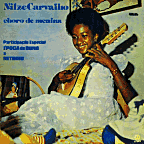 Nilze Carvalho "Choro De Menina" (CID, 1980) (LP)
A remarkable and beautiful choro album recorded by pre-teenage cavaquinho prodigy, Nilze Carvalho... I'm not sure how old she was when this disc was recorded, but judging from the picture on the cover, it couldn't have been much more than twelve years old, or so... And she is a stunning musician, not merely in a technical sense, but also for the depth and emotion she is able to infuse into her performances. Accompanying her is one of the premiere choro revival groups, Epoca de Ouro, and this is one of their best works as well. The arrangements are both lively and inventive, particularly with the use of percussion. There's none of the static feel or formalism of, say, Joao Nascimento's albums, but rather a lot of give and take between the precocious soloist and her backing back, and lots of creative, joyful playfulness. This is a wonderful set -- her first album, I believe.
Nilze Carvalho "Chorinhos De Ouro, v.4" (BMG, 1992)
Nilze Carvalho "Chorinhos De Ouro, v.7" (CID, 2005)
Nilze Carvalho "Estava Faltando Voce" (Rob Digital, 2005)
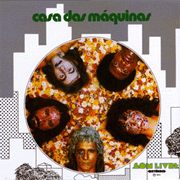 Casa Das Maquinas "Casa Das Maquinas" (Som Livre, 1974) (LP)
The first album from a rock band that came out of the ashes of two groups, The Clevers and Os Incriveis. This is a prime example of mid-1970s Brazilian rock mimicking the trends up North, in the good old U. S. of A. This is an almost perplexingly diverse offering, kicking off with the KISS-ish heavy rock of "A Natureza," sliding next into a prog-psychedelic recitation tune worthy of tropicalista Tom Ze. The hard-rock side of their work gets lost for a few tunes as the band slides into a soft-rock sound, more in line with the AOR ("album oriented rock") that dominated the American charts at the time... Plenty of bands come to mind: Procol Harum, Three Dog Night, The Isley Brothers, maybe a dash of Cheap Trick or Styx. For a comparison in the Brazilian sphere, late-vintage Os Mutantes comes to mind, when the band had settled into its pop-prog mode. And, yeah, if you like those old Mutantes records, you'll want to check this out as well. It's a surprisingly strong offering, if a bit cheesy at times. Worth checking out!
Casa Das Maquinas "Lar De Maravilhas" (Som Livre, 1975) (LP)
Casa Das Maquinas "Casa De Rock" (Som Livre, 1976) (LP)
Casa Das Maquinas "Ao Vivo Em Santos" (1978-ish) (LP)
Apparently, there's also this pirate LP that captures the band live, in 1978. No info on the album's provenance, etc.
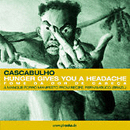 Cascabulho "Fome Da Dor Da Cabeca (Hunger Gives You A Headache)" (Piranha Records, 1998)
An interesting mix of manguebeat and forro from this inventive group out of Recife. They stick to their Northeastern roots throughout, although the introduction of rock and rap elements is pretty smooth and effective. A little less aggressive and overblown than contemporaries such as Chico Science or Lenine, these guys have less punch, but sound more subtle. This album didn't blow my mind, but I liked it and think it's definitely worth checking out.
Cascabulho "E Caco De Vidro Puro" (Atracao, 2003)
Cascadura "#1" (1997)
Cascadura "Entre!" (1999)
Cascadura "Promo" (2002)
Cascadura "Vivendo Em Grande Estilo" (Tratore, 2004)
Cascadura "Bogary" (Tratore, 2006)
Cascatinha & Inhana -- see artist discography
Casquinha (Da Portela) "Casquinha Da Portela" (Luanda, 2001)
Cassiano -- see artist discography
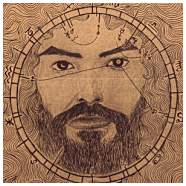 Marinho Castellar "...E Banda Disritmia" (1980)
A kooky collision of hippiedelic, difficult-listening folk-freak indulgence and undefinable regional Brazilian influences... This starts out with a fairly straightforward, sweet-sounding acoustic number, and just gets weirder and weirder and more challenging and odd. The male-female vocal tradeoffs bring Os Mutantes to mind, but this never gets as loud as they do, or strays as far from a central style. Lots of Nana Vasconcelos-y percussion and headphone-oriented fillips drift in and out of most songs -- goofy guitar riffs, a triangle here and there, doo-wahh choruses, just because -- anchored by delicate, folkish songwriting and gentle vocals. Is Castellar undercutting himself with all the distractions? Maybe, but he manages to make the mishmash listenable and pleasant, so I'd say not. Some songs may get on your nerves, but the album itself is delightfully weird and definitely worth a spin!
 Lindomar Castilho "Lindomar Castilho" (Arcano Records, 1978) (LP)
(Produced by Osmar Navarro & Osmar Zan)
This appears to be a set of Spanish-language versions of romantic songs originally recorded in Portuguese, all of them in a soft, gooey Latin-pop style, with a little bit of a Mexican ranchera flair (at least to my ears...) It's pretty goopy stuff, brega, as they say, but I still had to give it a shot, since it was recorded in Brazil. I regret it. No idea whether the Portuguese version (if there was one) had different, more Brazilian-sounding arrangements, though Castilho was primarily considered a bolero singer. Though a quite popular recording artist with albums dating back to the early 'Sixties, Castilho's career was precipitously cut short in 1981 when he murdered his ex-wife and tried to kill her partner, and was subsequently sentenced to a lengthy prison sentence. (Apparently he made a comeback though...)
Mario Castro-Neves -- see artist discography
Oscar Castro-Neves -- see artist discography
Casuarina "Casuarina" 2005 (Biscoito Fino, 2005)
Casuarina "Certidao" 2007 (Biscoito Fino, 2007)
Casuarina "MTV Apresenta Casuarina" (Sony Music, 2009)
Casuarina "MTV Apresenta Casuarina" (Sony Music, 2009) (DVD)
Casuarina "Trilhos/Terra Firme" (Warner, 2011)
Catui "Catui" (Terra Nova, 1987) (LP)
 Pericles Cavalcanti "Baiao Metafisico" (Trama Records, 1999)
An impressively diverse, warmly engaging set which starts out with a slightly modernized version of the classic 1930's samba cancao sound, and moves into light pop-funk reminiscent of Gilberto Gil's early '70s work, quiet acoustic numbers that recall Caetano Veloso's softer side, and a few glitzy jazz-tinged tracks that are closer to the contemporary dance scene. Cavalcanti has a very pleasant voice, and a nice way around a melody -- all but two of the songs on here are his original compositions; the other tracks include the aptly-named "Caleidoscopico," a Herbert Viana song, and a fine Portuguese-language cover of Bob Dylan's "It's All Over Now, Baby Blue," translated by Cavalcanti and Caetano. All in all, this is an album well worth checking out... Definitely recommended!
Pericles Cavalcanti "Blues 55" (Tratore, 2004)
Pericles Cavalcanti "O Rei Da Cultura" (Tratore/DeleDela, 2007)
Nelson Cavaquinho -- see artist discography
Danilo Caymmi -- Dorival's son. see artist discography
Dori Caymmi -- Dorival's other son. see artist discography
Dorival Caymmi -- Father to Danilo, Dori and Nana Caymmi. see artist discography
Nana Caymmi -- Dorival's daughter. see artist discography
Henrique Cazes - see artist discography
Cazuza - see artist discography
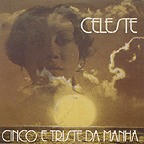 Celeste "Cinco E Triste Da Manha" (Tapecar, 1978) (LP)
A competent, though un-enthralling, version of the dominant MPB sound of the mid-1970s... Originally from Bahia, Celeste Vanuchi had a nice enough voice, and sounds like a fair approximation of Gal Costa. What this album lacks, however, is the radical spark that set MPB's pioneers apart from their imitators. This disc is noteworthy, however, for the inclusion of several songs by an up-and-coming composer named Djavan, who at the time was barely on the radar. This is probably one of the first records to feature cover versions of his work. Again, it's nice enough, and not in any way an unpleasant record... I'm not sure there's anything here I need to come back to, though...
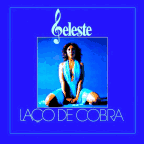 Celeste "Laco De Cobra" (Odeon, 1979) (LP)
(Produced by Renato Correa & Geraldo Vespar) (LP)
Thick, jazzy MPB arrangements drape around Celeste's husky vocals which, again, can charitably be compared to Gal Costa... Mostly, though, it's a little difficult to listen to: the music is too glossy and fusion-y for my tastes, while her vocals are kind of rough and grating... and when the two extremes meet, they create a sense of pure melodrama and bombast. This album's a rarity, but it's not really my cup of tea. Some one more devoted to slick, syrupy '70s MPB might really dig it, though. Notably, this includes two early songs written by the great Rosa Passos, "Procura-se," and "Saudade da Bahia."
Celeste "Celeste" (Selo Pentegrama, 1983) (LP)
<
- #
-
>
Geysa Celeste "Historia De Un Amor" (Inspiracao, 19--?) (LP)
A native of Minas Gerais, radio singer era vocalist Geysa Celeste started out in a popular regional family act with her sister Dina, who billed themselves as Duo Celeste. The sisters moved to Sao Paulo, where they performed on radio and cut their first 78s, while also providing backup for many of the better-known stars of the northern music scene. Geysa set out on a solo career after her sister married, and performed in popular films and soap operas, as well as her ongoing radio career, and as a recording artist who cut innumerable singles and roughly ten albums, spread out over a number of record labels.
Geysa Celeste "Cierro Mis Ojos" (Cartaz Discos, 19--?) (LP)
(Produced by J. Milton Rodrigues)
Geysa Celeste "Amor E Misterio" (Continental, 1965) (LP)
(Produced by Diogo Mulero aka Palmeira)
Geysa Celeste "Boleros: Quiereme Mucho" (Tropical, 1970) (LP)
Geysa Celeste "Boleros: Quiereme Mucho" (Chantacler, 1972) (LP)
(Produced by Bob Farina & Reynaldo Maziero)
Geysa Celeste "Boleros" (Tropicana, 1973) (LP)
Geysa Celeste "Cielito Lindo" (Tropicana, 1975) (LP)
Vicente Celestino - see artist discography
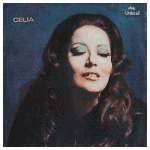 Celia "Celia" (Continental, 1971) (LP)
A fascinating album by a slightly subpar singer... Celia was one of the "festival" singers of the early 1970s who made her debut on television shows and in live, competitive festival performances. Her debut album features a wealth of talent as well as a very strong, very contemporary repertoire. Songs by up-and-coming composers such as Nelson Angelo, Ivan Lins, Joyce and Lo Borges are framed by the unmistakable kaleidoscopic pop of arranger Rogerio Duprat. It's a funny record, though: Celia's performances on the first third of the album are often pretty awkward -- bad, even. But as the record drifts into more of a psychedelic rock mode, she seems to relax a bit and on the final tracks, she's quite appealing... Maybe she just got more comfortable in the studio as the sessions went on? Anyway, there's some stuff on here that's good, some that's a bit wobbly, even a little embarrassing, like the faux-orgasmic "Blues," which opens the album on an unfortunate, burlesque-flavored note. The psychedelic/tropicalia elements include electric guitar by cult fave Arthur Verocai, who is also credited as an arranger, along with Duprat and Jose Briamonte. Certainly worth checking out!
 Celia "Celia" (Continental, 1972) (LP)
Hey, look: she recorded another album with Arthur Verocai, this time with him as the main conductor/arranger. A pretty hip repertoire on this one, with songs from Nonato Buzar, Erasmo Carlos, Ze Rodrix, Marcos Valle, Arthur Verocai and other up-to-date artists of the era, with Verocai conducting and providing arrangements. Bu the way, anyone out there know more about Celia? It looks like she had a few other albums, but it's hard to say for sure. Anyone know what her full name was?
Cerebro Eletronico "Pareco Moderno" (Tratore-Phonobase, 2008)
Electro-tinged, folky indie rock... Fairly amorphous and spacey; didn't really grab my imagination, but it sounded mellow and easy on the ears...
Chico Cesar - see artist discography
Silvio Cesar - see artist discography
 CeU "CeU" (Six Degrees/Urban Jungle, 2006)
Fluid, honeyed samba-synth-soul, in the same tradition as other Six Degrees Brazilian crossover divas such as Bebel Gilberto and Cibelle. Originally released on a Brazilian indie label, Urban Jungle, this is a smooth set of modern pop-electronica, impressively packed with over a dozen original compositions, and just two cover tunes, one by Joao Bosco and one by reggae legend Bob Marley. Hailing from Sao Paulo, CeU ably represents the unrepentant pop sentiments of the city's musical scene, and while few of these tracks stand out as the kind of song that will get stuck in your head all day long, the album itself is quite lovely, a disc that you can leave in the stereo for weeks on end and never tire of... Definitely worth checking out. (Note: if you like this album , you should also check out her work with the experimental pop ensemble, Sonidos.)
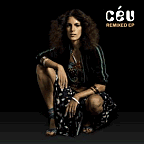 CeU "CeU Remixed" (EP) (Six Degrees Records, 2007)
(Originally produced by Beto Villares & CeU. And then, y'know... remixed.)
A nice remix set by Brazilian pop-tronica singer CeU, who hails from Sao Paulo and gathers many of that rock-oriented big city's finest young performers into her crew. Some of you may have noted that I am not the world's biggest fan of or expert in clubby dance music and electronica, nor am I generally all that into remix projects -- most times, I think the artists probably got it right the first time. That being said, this EP (which is commercially available only as an electronic download) has a nice feel... Several dubby tracks take remixing back to its reggae roots, and CeU's vocals, drifting atop and in between whatever soundscapes her producers concoct, carry you along in a variety of settings. Her debut album, where these songs originally appeared, has a stronger, more cohesive pop edge, but this is a nice chill-out disc. Worth checking out.
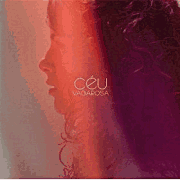 CeU "Vagarosa" (Six Degrees Records, 2009)
(Produced by Beto Villares, Gustavo Lenzo, Gui Amabis & Ceu)
Wow. This one's a doozy. I've been getting more and more tapped into CeU, particularly in her role as the "face" of the newly invigorated Sao Paulo pop scene. Not only is she pals with some of the most creative young musicians in Brazil, but she's a singularly appealing vocalist in her own right; her tone is pleasant, and her phrasing is decisive and strong. This record floored me, though. Indeed, I had trouble getting past the second track, "Cangote": it took me almost a week to quit hitting the rewind button, because I kept getting tingles each time I heard it. It's a rich, fresh mix of styles, a heavy dub reggae, mixed with Brazilian harmonics and some tweaky melodic elements, particularly some Arabic-flavored lead organ and mellotron riffs that bring to mind the Ethiopian groove of Mahmoud Ahmed. It's such a cool song. So totally cool. The track that follows, "Comadi," also shows a strong familiarity with the best classic Jamaican dub, although this time with a ska-like uptempo vibe. Maybe Sly & Robbie never got to cut a session with Gal Costa back in the day, but if they had, it might have been this good. Anyway, a whole album in this reggae stylee would have been fine by me, but the tracks that followed were equally rich and rewarding, blending samba, jazz, bossa nova, indie rock and more dub in an entirely satisfying, confident mix. Along for the ride are Sao Paulo scenesters such as Gui Amabis, Curumin and Beto Villares, as well as a number of guest performers, including old-time soul star Luiz Melodia, who is surprisingly good in his duet cameo. Although there's still some of the sexy, mellow electronica cool of CeU's labelmate Bebel Gilberto in the mix, these guys have gone way past the chill-room club mix mentality, and they're making some of the most adventurous yet sensuous music modern music coming out of Brazil today. I think you'll really like this record.
CeU "Caravana Sereia Bloom" (Six Degrees Records, 2012)
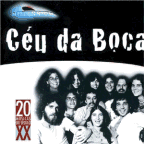 Ceu Da Boca "Serie Millennium" (Universal Records, 2002)
A best-of collection featuring tracks off the albums Ceu Da Boca (1981) and Baratotal (1982), originally released on the Polygram label. Features choral versions of songs by Gilberto Gil, Lula Queiroga, Luiz Eca, and others.
 Ceu Da Boca "A Arte De" (Universal Records, 2002)
Ditto.
Ceu Da Boca "Ceu Da Boca" (Philips, 1981) (LP)
Ceu Da Boca "Baratotal" (Philips, 1981) (LP)
Chapeu De Palha "Flor Amorosa"
Chapeu De Palha "Choro, Samba E Gafieira" (Radio MEC/Rob Digital, 2003)
Charlie Brown, Jr. - see artist discography
Erlon Chaves - see artist discography
Gilvan Chaves "10 Polegadas" (Mocambo, 1956) (LP)
Gilvan Chaves "Encantos Do Nordeste" (Columbia, 1958) (LP)
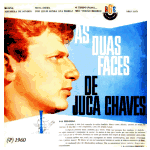 Juca Chaves "As Duas Faces De Juca Chaves" (RGE, 1960) (LP)
Humorist Jucas Chaves, originally known for his written satire, uses an archaic, stripped down musical style, the modinha, to deliver his wry asides. It's an entertaining, unusual sound, but if you listen to an entire album, it all starts to sound the same. Chaves was hardly a great singer, and he plays this up to maximize the comedic effect... Which is all very well and fine, but you have to keep in mind that this album is more about word play than it is about music. An interesting cultural curio, though!
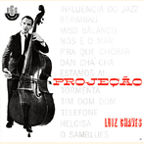 Luiz Chaves E Seu Conjunto "Projecao" (RGE, 1963) (LP)
Swank, nightclubby big band versions of recently-minted bossa nova standards, with bassist Luiz Chaves and pianist Hamilton (Amilton) Godoy, of the Zimbo Trio. This is well-performed, though unoriginal -- still, it's a good example of how high-class Ellingtonian jazz motifs filtered into the Brazilian scene. Like Ellington, Chaves straddled the classical, jazz and pop worlds, although modern listeners may find his approach little more than competent and professional. The tinkly piano work by Hamilton Godoy is the most distracting element, otherwise this has some nice moments, in a "Harlem Nocturne" kinda way; Chaves and Godoy went on to co-found the long-lived Zimbo Trio.
Chiclete Com Banana - see artist discography
China "Um So" (EMI-Cardume, 2006)
A 6-song EP of contemporary rock, some of it playfully punky, some of it tempered by Brazilian bossa, and some of it kind of mellow and Calexico-ish. Worth checking out.
Maquinhos China/Various Artists "RODA DE SAMBA DE PARTIDO ALTO" (Cedro Rosa, 2009)
(Produced by Virginia Carvalho)
Four younger artists -- backed by a cast of thousands -- recreate the funky, joyful vibe of the classic "partido de alto" albums of the roots-samba revival of the 1960s and '70s. Led by percussion and cavaquinho, singers Maquinhos China, Renatinho Partideiro, Serginho Procopio and Tiago Mocoto move jovially through a set of songs that recall the heyday of bands such as Os Originais do Samba, with surprisingly little in the way of modern, contemporary musical ornamentation. If you like the old style sound, you might really enjoy this loose, funky album.
Chiquinho Do Acordeon - see artist discography
Chocolate Da Bahia "Chocolate Da Bahia" (Som Livre, 1977) (LP)
Chocolate Da Bahia "Barraca Do Chocolate" (Som Livre, 1977) (LP)
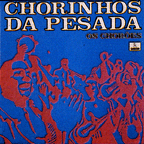 Os Choroes "Chorinhos Da Pesada" (Serie Choro -- Grandes Solistas) (Odeon, 1971) (LP)
A disappointing set of modernized choro music, churned out and given a glitzy, slightly Vegas-y, big-bandish sheen. This jazz/gafieira supergroup included flautist Altamiro Carrilho, trombonist Raul De Barros, clarinetist Abel Ferreira, pianist (and grise eminence) Radames Gnattali and others... Lots of instrumental talent, but the tone of the album is a too brisk and prefab, a bit too controlled. Didn't work for me, at least.
Choronas "Atraente" (Paulus, 2005)
Choronas "Convida" (Paulus, 2005)
Choronas "O Brasil Toca Choro" (Tratore, 2008)
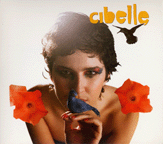 Cibelle "Cibelle" (Six Degrees/Ziriguiboom, 2003)
Mellow soul-electronica vocals with rich, multi-textured arrangements courtesy of producer Apollo 9 (known for his work on the Caipirissima collection). Cibelle, who previously worked with the Yugoslavian expatriate Suba, emerges here as a singer of note: her silken tones dance gently inside the rhythms, while the music itself is imaginative and engaging, a cut above the usual club mix murk. This is soft stuff, unapologetically easy listening, but quite lovely all the same, with contributions by old-timers such as singer Johnny Alf, samba-funkster Joao Parahyba (of the '70s soul band, Trio Mocoto), and a slew of younger Sao Paulo club kids. If you're in search of a pretty-sounding, alluring set to lower your blood pressure by, this dreamy disc may be be for you!
Cibelle "The Shine Of Dried Electric Leaves" (Six Degrees/Ziriguiboom, 2006)
Cibelle "About A Girl" (EP) (Six Degrees/Ziriguiboom, 2007)
Cibelle "Green Grass" (EP) (Six Degrees/Ziriguiboom, 2007)
Cibelle "White Hair" (EP) (Six Degrees/Ziriguiboom, 2008)
Cidade Negra - see artist discography
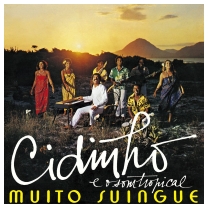 Cidinho "Muito Suingue" (Phillips, 1980) (LP)
(Produced by Paulo Debetio)
Soft-centered pop-funk, with a restrained jazz fusion influence... The complex, cosmopolitan musical influence isn't too surprising since composer Sergio Paulo Valle co-wrote most of this material... The backbeats bring Tim Maia's funk to mind; the warm vocals (and shrill female chorus) conjure up Jorge Ben's work, and the rolling piano adds a whiff of glossy, lounge-y jazz, as well as a fair dose of Cuban-style salsa, sort of like a Brazilian version of Cuba's Irakere. It's slick, but not bad; not bad at all. Eliana Pittman guests on one track, "Amor Proibido," while guitarist Luiz Vagner and singer Maria Vera each appear on several other songs. (See also: Cidinho Texeira)
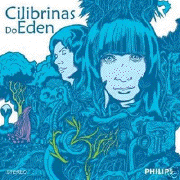 Cilibrinas Do Eden "Cilibrinas Do Eden" (Philips, 1973) (LP)
A stunning psychedelic-rock reissue from the vaults of the Brazilian tropicalia scene... This is cool acid rock album from Rita Lee, of the band Os Mutantes, singing here with her friend Lucia Turnbull and (as was common in her early solo career) some help from her buddies in the Mutantes bands. Turnbull is a cipher to me -- outside of this album, I know very little about her -- but this album is a real dazzler, one of Lee's grittiest and most impressive rock records, better than pretty much anything she did with her '70s solo band, Tutti Frutti. It features Brazilian cult classics like "Ainda Bem (Bad Trip)" and some of the wickedest electric guitar work of her career. This album was built around an electrifying performance at the 7th International Song Festival, in 1972 -- a live concert single (also included here) led to a studio recording, all of which is pretty striking. The album's original liner notes make nods towards Alice Cooper and the subversive hard rock of the era, and unlike the 1970s Mutantes and Tutti Frutti albums, this disc doesn't tilt as heavily towards a commercialized, stadium-rock sound, sticking instead to the more piercing, disturbing end of the glam/hard-rock/psychedelic spectrum. It's pretty cool, if not entirely the kind of record you'd want to relax to at home. If you can track it down, this is definitely worth snapping up.
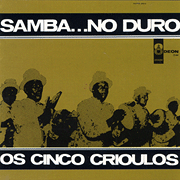 Os Cinco Crioulos "Samba... No Duro" (Odeon, 1967) (LP)
Simple and simply irresistible acoustic sambas, with a quintet that features Nelson Sargento, Elton Medeiros, Jair do Cavaquinho, Mauro Duarte and Nescarzinho do Salgueiro, some of the most talented samba revivalists of the post-bossa era. The percussion is catchy, the melodies sweet, the vocal coros is only a few voices in harmony (as opposed to the large group chorus that became part of the '70s pagode style), and the songs are all great. This one's a keeper.
 Os Cinco Crioulos "Samba No Duro, v.2" (Odeon, 1968) (LP)
Pure gold. If anything, the group had improved upon its sound by this second album... Dominated by lively cavaquinho riffs and an overall ebullience, this disc is a real gem. Highly recommended!
Os Cinco Crioulos "Series Do Raizes" (EMI, 2000)
A compilation of this fine acoustic samba band's early work, including plenty of material from the Samba... No Duro album. Sweet stuff -- recommended!
Leonardo Cioglia "Early Years" (Quizamba Music, 1995)
Leonardo Cioglia "Bean Oil In A Pot" (Quizamba Music, 1999)
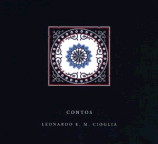 Leonardo Cioglia "Contos" (Quizamba Music, 2008)
(Produced by Leonardo Cioglia)
Swank, mellow, self-produced jazz from bassist Leonardo Cioglia, a Brazilian-born expatriate now living in New York... I don't hear as much of a Brazilian influence on this disc, but it's pretty solid for fans of "smooth jazz" -- strong, confident playing throughout. It's not totally my cup of tea, but it's quite good for the genre. If you like this, you can also check out his band, Zabumbatuq...
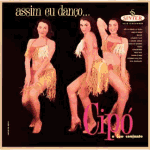 Cipo E Sua Orquestra "Assim Eu Danco" (Sinter, 1952) (LP)
Snoozy orchestral dance music, with a teeny dash of Brazilian gafieira and a much larger debt to Cuban rumba music... The sometimes lugubrious horn arrangements owe perhaps more to North American big bands than to the Brazilian composers (Ary Barroso, et al) whose work gets the big blanding-down. In addition to bandleader/saxophonist Cipo, there are some heavy hitters from the pre-bossa nova era, including trombonists Lord Astor and Edson Maciel... On Side Two things perk up a bit, with a little samba rhythm creeping in, and a few intriguingly jazzy leads kicking in, as on "Pra�a Onze" and "Comigo E Assim." Mostly, though, this isn't a very inspiring album -- for better material of the same vintage, check out Trio Surdino and Mestre Zaccarias...
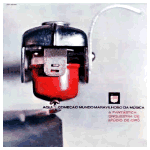 Cipo E Sua Orquestra "Aqui Comecao Mundo Maravilhoso Da Musica" (Imperial Records, 1964) (LP)
Billed as "A Fantastica Orquestra De Studio De Cipo": mostly a set of standards and oldies from up North: "Caravan," "That Old Black Magic," "Harlem Nocturne," "My Funny Valentine," that sort of thing, not done in a particularly "Brazilian" style. Cool album cover, though: that's a close-up of an old turntable stylus touching the edge of a vinyl LP.
Cipo E Academia De Samba Imperial "Ritmo Espetacular" (Imperial, 1965) (LP)
Cipo And His Authentic Rhythm Group "Brazilian Beat" (London, 1965) (LP)
Claudia - see artist discography
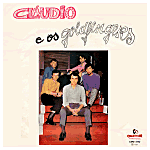 Claudio E Os Goldfingers "Claudio E Os Goldfingers" (Chantacler, 1967) (LP)
Earnest but often lethargic late-'60s jovem guarda, with echoes of Roberto Carlos' RC-7, especially the meandering electric organ of bandleader Claudio de Souza, whose playing doesn't really work most of the time, but is still a charming reminder of the era. The repertoire includes some originals and some covers of '60s pop hits ("Goldfinger," for example) but nothing that'll knock your socks off... Not a great record, really, and not as teenybopper super-cute as other stuff from the time, but worth checking out if you're hardcore into the style.
Luiz Claudio - see artist discography
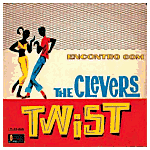 The Clevers "Encontro Com The Clevers - Twist!" (Continental, 1963) (LP)
A solid surf/instrumental rock set by the band that later changed its name to Os Incriveis... Later, in a move worthy of Don Kirshner or Phil Spector, the labels put together a new group called The New Clevers, and issued several albums under that name... But this was the real, original band, and they were pretty good. If you like the whole Cliff Richards/Shadows sound, you'll probably get a kick out of this as well.
Clube Do Balanco "Samba Incrementado" (Spin Music/MCD, 2004)
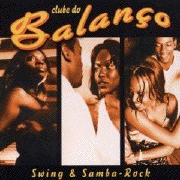 Clube Do Balanco "Swing & Samba-Rock" (Spin Music/MCD, 2005)
This was recommended to me by a reader... and it's pretty cool! This Sao Paulo-based ensemble pays homage to the smooth Brazilian soul-samba sound of the 1970s, picking up where artists such as Jorge Ben, Banda Black Rio and Tim Maia left off. And they get the style completely right: this is smooth, mellow party music, perfect for a relaxing evening on a steamy, summery dance floor. The grooves are sweet, the rhythm is gentle but persistent, and the vibe is just right. Plus, they are amazingly well-connected: guest performers include Brazilian pop and funk icons such as samba-funkster Bebetos and Marku Ribas, jovem guarda legend Erasmo Carlos, Seu Jorge and a host of younger soul-funk-triphoppers like Max De Castro, Paula Lima and Wilson Simoninha, each seamlessly mixed into the band's groovy party vibe. If this sounds like it's up your alley, trust your instincts: it's really quite good!
 Os Cobras "Os Cobras" (Copacabana, 1960)
Smooth, danceable dinner jazz from an all-star cast: guitarist Waltel Branco, Ed Maciel and Moacyr Silva on horns, samba percussionist Paulinho and some splashy piano playing by Chaim Lewak... Not sure if there was any connection between this combo and the Os Cobras jazz band listed below, tough I suppose it's possible, even though there's no overlap in the personnel. Also, these guys were much more mainstream and pop-oriented... But they also had a nice, smooth sound with a lightly swinging bounce. Paulinho's samba crew gets to cut loose on one track, where the cuica solos at the start of "E Bom Assim," though for the most part it's straight jazz-combo arrangements, with the percussion buried in the mix. Pretty listenable and sweet, though not very groundbreaking. On the light side, but pleasant and worth a spin.
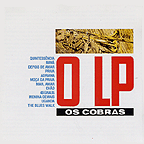 Os Cobras "O LP" (RCA, 1964) (LP)
(Produced by Roberto Jorge)
An all-star Brazilian jazz band, featuring hot-shot players such as Milton Banana, Tenorio, Jr., Raul De Souza, Paulo Moura and J.T. Meirelles. Like many of the Brazilian jazz albums that actually are jazz albums, this is more jazz than "Brazilian"... With the exception of a cover of Clifford Brown's "Blues Walk" (which was a favorite standard in Brazil), these songs are all homegrown compositions... yet they sound like straight-up hard jazz from the 'Fifties, early 'Sixties era. This album is notable both for the calibre of talent in the band, but also for the weight of their playing -- this still isn't my cup of tea, but I like it better than the tinkly, hyperactive cabaret style which predominated in the bossa nova years.
Codo - see artist discography
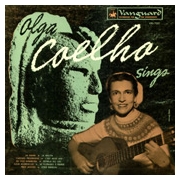 Olga Praguer Coelho "...Sings" (Copacabana, 1952) (LP)
An early star of Brazilian radio, Olga Praguer Coelho (1909-2008) was a soprano vocalist and guitarist who made the scene with the cultural elite of Europe and Brazil, and was an artistic ambassador to continental Europe and the United States, notably performing at the 1936 Berlin Olympics and playing a Carnegie Hall gig at the behest of Aaron Copland, where she showcased Heitor Villa-Lobos' "Bachianas Brasileiras." For over a decade, Praguer Coelho was the lover of classical guitarist Andres Segovia and she lived in the United States for many years, returning to Brazil in the '70s where she resumed her radio career. In addition to these two albums, she recorded over a dozen 78s between 1929-1942, but doesn't seem to have done any studio work past the 1950s.
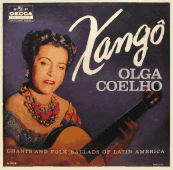 Olga Praguer Coelho "Xango: Canciones Folkloricas De America Latina" (Decca Records, 1959) (LP)
A selection of songs from several country, with about two thirds of them being from Brazil. This is an odd album, or at least one that will sound unfamiliar to most fans of mainstream Brazilian music -- Praguer Coelho's refined, operatic approach to Latin American folkloric material is a bit songbirdish, and initially her soprano trills made me think I'd discovered a Brazilian Madame Castafiore, but further exploration made me soften a bit... Her Spanish-influenced guitar work is pretty solid. Still... this is a little hard to take, if we're really being honest.
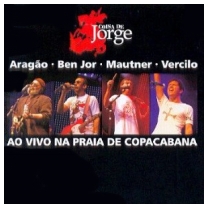 Coisas De Jorge "Ao Vivo Na Praia De Copacabana" (EMI, 2007)
Funny concept: for musicians with the same first name -- Jorge Aragao, Jorge Ben, Jorge Mautner and Jorge Vercilo team up for a concert album. Not sure if they perform together, but for now I'll add this as a "band." If I track this one down, I'll let you know how it sounds.
Colera "Tente Mudar Amanha" (Ataque Frontal, 1985)
Brazilian hardcore punk, circa 1985. The inner label says something about "introducing Suburbio Geral..." Their lead singer, perhaps? Anyone know more about these guys?
Gerson King Combo - see artist discography
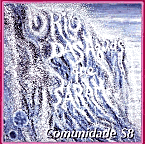 Comunidade S8 "O Rio Das Aguas Que Saram" (1977) (LP)
Painfully earnest chamber-folk Christian psychedelia, with a mix of hurdy-gurdy-esque acoustic swirliness, flat, sombre male vocals, counterpoised with a keening female soprano, and an almost unvarying musical approach from track to track. Religious messages are laced throughout, which may account for the overly-serious tone ("S8" stands for "salvation eternal...") A countercultural relic, to be sure, but I didn't find it that interesting: the arrangements are dreary and monotonous, reminiscent of the madrigal moments of old Os Mutantes albums, but without the rock vibe to cut through the classical pretensions. Apparently this group, and its evangelical ministry are still around, decades after their formation in the late 'Sixties... This was their first LP.
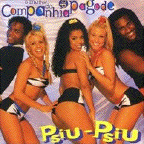 Companhia Do Pagode "Psiu Psiu: O Melhor Do Companhia Do Pagode" (Polygram/Mercury, 1998)
A perfect example of the degradation of "pagode" music from the richly-layered acoustic sambas of the 1970s into the more stripped-down, popped-up, commercialized dance style of the 1980s and '90s. The artwork says it all: a couple of dorky guys in casual, polyester-y outfits, flanking three scantily-clad young women, whose tight-fitting swim clothes seem designed primarily to show off their tushies and midriff. The image is tacky, although the music is appealing, in a bland, brainless kind of way. If you put this stuff on, you'll find yourself tapping your toes and nodding your head... But while it works as simple pop music, it's not even exciting enough to count as a guilty pleasure. This best-of set includes several live tracks... It's all okay, inoffensive but unchallenging.
 Onias Comenda & Edinho Marundele "Eu, Bahia" (Philips/Fontana, 1972) (LP)
An interesting album of berimbau and Orixa-related percussion by two players I've never heard of before. Each artist takes one side of the LP -- Marundele (whose real name was apparently Edson Emerete de Sant'Anna) is the drummer, and his side is dynamic and intense, running through rhythms from Angola and their Brazilian permutations. Similarly, berimbau master Onias Camardelli plays capoeira music from Angola and Bahia, as well as improvisations of his own creation. Some of it is spooky and haunting, some of it seems kind of static and same-y. I don't think the average fan of Brazilian pop would get much out of this, but for cultural scholars and capoeira students, this album would be a goldmine.
Edson Conceicao "Quen Tem Fe, Nao Sai!" (CBS, 1977) (LP)
Edson Conceicao "Ai E Que Voce Se Engana" (CBS, 1978) (LP)
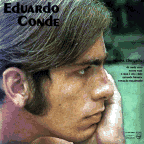 Eduardo Conde "Minha Chega" (Philips, 1969)
A schmaltzy pop-bossa album from a modestly talented singer who went on to a long career as a television actor. Conde apparently was a member of the Conjunto 3D, which also featured a young Beth Carvalho as its "girl" singer. I wouldn't say this album is super-special -- the arrangements are distinctive for being a bit cluttered and manic; Conde himself is kind of a corny, emotive crooner, and also a bit generic. This is okay, but it's nothing to get too worked up over. Of note are a couple of songs written by Arthur Verocai, who has gone on to become something of a cult artist over the years...
Eduardo Conde "Certas Cancoes Ao Vivo" (LP)
Eduardo Conde "Intimo" (Dabliu, 1998)
Eduardo Conde "Pra Falar De Amor" (2007)
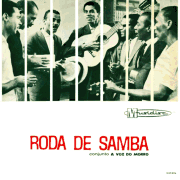 Conjunto A Voz Do Morro "Roda De Samba" (Musidisc, 1965) (LP)
This exquisite acoustic album was a foundational touchstone for the traditional samba revival of the 1960s, featuring contributions from master sambistas Jair Do Cavaquinho, Elton Medeiros and bandleader Ze Keti, along with newcomer Paulinho Da Viola, who solos on a couple of songs. It's a beautiful album and a great debut for Da Viola, a joyful, stripped-down session, with each artist trading lead vocals from song to song, round-robin style. All the performances, all the songs, all the melodies and choruses are rich with history and finesse: these guys set the bar pretty high for anyone who would follow. Note: Keti apparently wasn't on this album, although he appears on later Voz Do Morro releases -- the record is no less rich and rewarding for his absence, though. A wonderful album -- highly recommended!
Conjunto A Voz Do Morro "Roda De Samba v. 2" (Musidisc, 1965) (LP)
Conjunto A Voz Do Morro "Roda De Samba v. 3" (RGE, 1966) (LP)
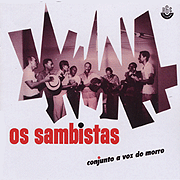 Conjunto A Voz Do Morro "Os Sambistas" (RGE, 1966) (LP)
Holy. Cow. If you want to talk about Brazilian music rosetta stones, check this one out. An early samba revival group featuring Jair Do Cavaquinho, Ze Keti, Elton Medeiros, Nelson Sargento and an up-and-coming Paulinho Da Viola, along with the lesser-known Anescar, Oscar Bigode and Jose Cruz... It's a ton of talent in a tightly focussed, thoroughly joyful acoustic samba set with songs sung in praise of the samba schools and slums, with bright, melodic arrangements and a richer sonic texture than many albums of similar vintage. Moreover, it's a ringing proclamation heralding the entry of Da Viola into the Brazilian pop scene... the stuff that history is made of! Snap this up if you get a chance.
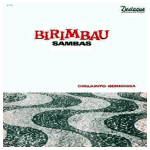 Conjunto Bembossa "Berimbau Sambas" (Destaque, 1964) (LP)
Meh. Haphazard, rinkydink lounge-jazz performances of a bunch of early '60s bossa standards, performed with varying levels of enthusiasm and/or proficiency. Some of the differences are so pronounced (good saxophone, versus bad) that I kind of wonder if this album sandwiches together different sessions recorded at different times. Anyhow, I wasn't wowed by this one. Half of the tracks are perky, though the other half seemed kind of sloppy and by-the-numbers, not to mention, pretty corny. I did like their version of "Lamento Da Lavadeira," which closes the album. Hey... does anyone know who was in this group?
Conjunto Explosao Do Samba - see artist discography
Conjunto Folclorico De Bahia "Viva Bahia!" (Philips, 1968) (LP)
 Conjunto Garra Brasileira "Sucessos Contagiantes Em Ritmo De Samba" (Som Livre, 1974) (LP)
A fun album notable for including one of the earliest Djavan recordings... I'm not sure when this album came out in Brazil -- I found it on an Uruguayan pressing -- but I believe it was recorded in 1973 and released in '74. Anyway, there's one track on here that features Djavan singing on a fairly generic pop-samba track, "Porta Aberta," which was previously a hit for Luiz Ayrao. It's a nice song, as are the rest of the tracks on here -- warm, standard-issue early '70s pagode samba, with various vocal soloists and some fun tracks featuring a full chorus, and some funky electric guitar riffs and an overall easy listening-ish vibe. Recommended!
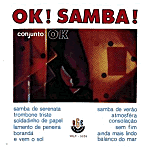 Conjunto OK "OK! Samba!" (RGE, 1964) (LP)
(Produced by Walter Arid)
A pretty swinging set of pop-balanco and samba, with a sharp band led by organist Walter Arid, with a modest brass section alongside a nightclub bossa combo, and a perky, all-male vocal chorus. Some of this sounds goofy and poppy, but there are also undertones of the sophisticated MPB being championed by artists such as Edu Lobo and Chico Buarque (with three songs here written by Marcos Valle...) There's even some straight up jazz on songs such as "Consolacao" that holds up to anything being done by the bossa trios of the same era. Apparently this group hung together for several years, and later recorded under the name of Som Okey 5. This is a good album, with strong performances in a variety of styles -- definitely worth checking out.
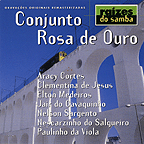 Conjunto Rosa De Ouro "Rosa De Ouro, v.1" (EMI-Odeon, 1965) (LP)
Conjunto Rosa De Ouro "Rosa De Ouro, v.2" (EMI-Odeon, 1967) (LP)
Conjunto Rosa De Ouro "Raizes Do Samba" (EMI Brasil, 2000)
As part of their excellent "Raizes do Samba" reissue series, EMI has collected both these old albums on one CD. An all-star ensemble including Paulinho Da Viola, Clementina De Jesus, Elton Medeiros, Jair do Cavaquinho and Nelson Sargento... so how could you go wrong? These acoustic sambas are intensely rhythmic, though light on percussion, and heavy on vocals and guitars. When recorded in the mid-'60s, this music was a deliberate throwback; what's modernized about it is the smoothness of performance and production. Mighty nice stuff.
Conjunto Sambacana "Sambacana" (Odeon, 1964) (LP)
Conjunto Sambacana "Conjunto Sambacana, v.2" (Odeon, 1968) (LP)
Conjunto Sambacana "Conjunto Sambacana, v.3" (Odeon, 1969) (LP)
Conjunto Sambacana "Conjunto Sambacana, v.4" (Tapecar, 1971) (LP)
Conjunto Sarau "Cordas Novas" (Rob Digital, 2003)
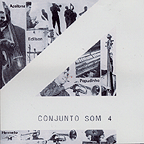 Conjunto Som 4 "Conjunto Som 4" (Continental, 1964) (LP)
A rather bland jazz session featuring Hermeto Pascoal and cohorts Edilson (drums), Azeitona (bass) and Papudinho (trumpet). Although the compositions are from contemporary Brazilian bossa songwriters (all the usual suspects), the sound is pure North American jazz, indistinguishable from their cool Stateside contemporaries, except for the inferior, unexciting performances. This album doesn't stack up well compared to Hermeto's infinitely more soulful Quarteto Novo sessions of a few years later. This is a dull, slow-going, pale imitation of American jazz.
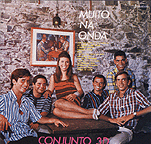 Conjunto 3D "Muito Na Onda" (Odeon, 1967) (LP)
This 1967 album features some of the earliest recorded work of samba superstar Beth Carvalho, who was the "girl" singer in this pop vocals/jazz band, as well as pianist Antonio Adolfo. They're aiming for a swinging Sergio Mendes/Young Holt Trio-style hipness, and in many ways are more successful here than many of their contemporaries. Carvalho sounds either hampered or hesitant on many of the tunes; she's paired up with a couple of fairly unremarkable male vocalists... But on some songs she shines, particularly on "Patruira Samba" (the lone Adolfo composition on an album packed with North American pop and jazz standards such as "When The Saint's Go Marching In," Cole Porter's "Night And Day," Herbie Hancock's "Watermelon Man," etc.) and on an early Gilberto Gil composition, "Roda," which is also a highlight of the album. The English-language material is uniformly unsuccessful, but there's still an adventurous air here that hits the mark on a few songs. Adolfo went to form the band Brazuca, which took this formula further (and abandoned the attraction to cover tunes...) while Carvalho, of course, went on to become one of the biggest stars of her generation... This is an interesting prelude and/or historical footnote to her career! (See also: Trio 3D.)
Gerson Conrad & Zeze Motta "Gerson Conrad & Zeze Motta" (Som Livre, 1975) (LP)
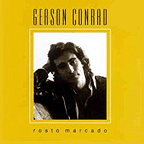 Gerson Conrad "Rosto Marcado" (Warner, 1981) (LP)
A solo album by one of the founding members of the seminal Brazilian glam/tropicalia band, Secos & Molhados, which also featured singer Ney Matogrosso. This is pretty slick, AOR-ish stuff, and it falls prey to many of the stylistic shortcomings of the time -- slow, fusion-y arrangements, soft-funk basslines, tinkly keyboards, and an overall strained wimpiness. There is a vocal similarity to Caetano Veloso, though -- Conrad was from Sao Paulo, but he has a soft, Bahian delivery. Anyway, this is pretty cheesy, though also inoffensive and listenable... nothing to struggle too hard to track down, unless you're really, really into the ornate pop stylings of the late '70s/early '80s MPB scene. Amazingly enough, this was one of only two albums Conrad released after the breakup of Secos, although his partner Ney Matogrosso had a very long and successful solo career.
Baby Consuelo/Baby Do Brasil - see artist discography
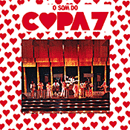
 Copa 7 "O Som Do Copa 7" (Top Tape, 1979) (LP)
One of the sleeker bands from the "Black Rio" soul movement, Copa 7 were looser than the better-known Banda Black Rio and funkier than most of the soul singers that dominated the '70s scene. They were also more identifiably building from a samba background, but layering it with tight horn and keyboard arrangements, similar to Earth Wind and Fire. The Copa 7 took their name from an earlier jazz band led by J.T. Meirelles, although as far as I know there were no direct links between the two groups -- maybe it's just the "copasetic" pun that occurred to both bands? Either way, this is a pretty cool record, with some solid funk and soul performances, and a few lapses into softer disco-pop instrumentals. The influences of bands such as the Bar Kays, KC & The Sunshine Band and Brazil's Tim Maia can readily be heard on this disc, a long-time collector's item, and certainly worth looking for, if you're into the style.
 Copa 7 "O Som Do Copa 7, v.2" (Top Tape, 1980) (LP)
A fine follow-up to their first album, maybe a bit tougher and more muscular, but still drenched in solid, funky rhythms and sharp, American-style funk and R&B. These guys really were several steps ahead of most of their competition. Recommended!
The Copacabana Municipal Orchestra "Carnival In Rio: 1965" (Kapp Records, 1965) (LP)
This record was a lot more fun -- and somewhat less earthy -- than I had expected. The opening notes of a brass-and snare drum marching band made me cringe in anticipation of some brisk police association-type recording, but soon a more engaging pop-rock undercurrent set in, imbuing these "prize winning songs of the Carnival in Rio" with a groovy exploitation-music feel, weaving prefab, Beatles-y ye-ye teenybopper rock riffs into reasonably robust street samba rhythms. It feels resolutely fake and manufactured, but it a good way. None of the musicians are identified by name, though the "Copacabana Singers And Chorus" included a few perky gal singers who were probably recruited straight off the Jovem Guarda TV show, as well as what seems to be a real samba drum bloco driving things along. Though the album title implies that these were songs drawn from the annual samba school parades, the modest liner notes inform us that these songs came from some sort of songwriting contest, but again, it's a little dubious. The set list is peppered with tunes like "Mulata Ye Ye Ye" and "Garota Monokini," songs I strongly doubt were originally blasted off of parade floats, or even featured in any of the actual MPB songwriting contests. A few tunes were composed by Lobo de Oliveira and other by pianist Joao Roberto Kelly, whose career swayed between serious samba-jazz and kitschy exploitation. There also seems to be some "ringers" by old-school samba composers that may have actually been part of that year's celebrations... Whether there was a Brazilian edition of this album, I'm not sure, though I'm reasonably confident this was actually recorded in Brazil. At any rate, I thought it was a fun, goofy album, one that doesn't really fit in the established tracks of the contemporary Brazilian scene(s) and in some ways is even more fun as a a result.
Copinha E Seu Conjunto "...Interpretam Os Sucessos Do Pixinguinha" (Philips, 1961) (LP)
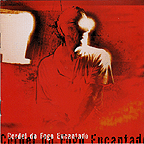 Cordel Do Fogo Encantado "Cordel Do Fogo Encantado" (Rec Beat, 2001)
(Produced by Nana Vasconcelos)
Experimental Brazilian rock, seemingly equally influenced by manguebeat artists such as Nacao Zumbi and the dadaist tropicalismo of Tom Ze. Heavy on the percussion, this disc drifts and ambles, avoiding rock guitar cliches and has a certain fresh playfulness to it, with spaced-out, Allan Ginsburg-ish poetic lyrics. It's a bit meandering, not melodically that satisfying, or filled with overt pop hooks, but it's still interesting to know that there is this sort of searching, difficult-listening avant-ish pop being made in Brazil. Producer Nana Vasconcelos's guiding hand is easily felt on this far-ranging set; he also plays percussion on most tracks. Kinda sounds like Quinteto Violado after a particularly long night, with a slight hangover, but still up for some more fun.
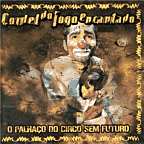 Cordel Do Fogo Encantado "O Palhaco Do Circus Sem Futuro" (Rec Beat, 2002)
(Produced by Cordel Do Fogo Encantado, Ricardo Bolognini & Boguinha Dub)
More of the same; an unusual sonic excursion, certainly different than most Brazilian pop, and worth checking out, if you want to go a little on the wild side. Their first album might be slightly better, but either disc will hit you about the same.
Cordel Do Fogo Encantado "MTV Apresenta..." (Trama Records, 2005)
Nando Cordel - see artist discography
A Cor Do Som - see artist discography
 Corisco E Seu Conjunto "Viva O Ritmo!" (RCA Camden, 1962) (LP)
(Arrangements by Francisco Moraes)
Pretty swinging dance material, kitschy but fun. Bandleader Corisco led several versions of his Sambaloucos ensemble over the years, specializing in covers of Brazilian and non-Brazilian pop hits of the day... This early album features Hamilton Godoy on piano, Haroldo do Monte (guitar) and Dirceu Sim›es de Medeiros (drums), playing an intriguing blend of Cuban-style son and Brazilian samba; some serious musicians playing pretty ephemeral music. Doesn't really stick to your ribs, but it's fun nonetheless, at least in small doses.
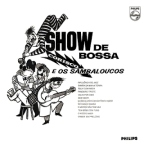 Corisco E Os Sambaloucos "Show De Bossa" (Philips, 1963) (LP)
(Produced by Alfredo Barbe)
Pretty sedate easy-listening samba/bossa instrumentals from a competent but uninspiring band led by percussionist Waldemar Marchetti (aka "Corisco") along with Zimbo Trio pianist Hamilton Godoy... Only occasionally did anything leap out at me: a few berimbau boing-boings, a riff or two that showed some spark of life... But otherwise, this was just too sleepy for me. Didn't float my boat.
Corisco E Os Sambaloucos "Outro Show De Bossa" (Philips, 1963) (LP)
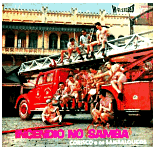 Corisco E Os Sambaloucos "Incendio No Samba" (Philips, 1965) (LP)
Kitschy, whimsical pop instrumentals, samba and samba-jazz played in a Herb Alpert-ish vibe. These might be top musicians banded together on this project, but the music is too goofy for me...
Corisco & Os Sambaloucos "Sucessamba!" (Philips, 1965) (LP)
Corisco "...E Os Brasaloucos" (Continental, 1967) (LP)
Corisco and his crew seem even less focussed here than usual, kicking off with a truly bizarre, truly bad cover of the Beatles' "Sgt. Pepper," and moving into a mostly-shrill, mostly-clattersome set of cover tunes, including clunkers such as "I Was Kaiser Bill's Bat Man" and a fun, slightly samba-fied version of "Music To Watch Girls By." There's rock-era kitsch value, to be sure, but the only song on here that really stands out is the twee, upbeat jovem guarda tune, "Uni-Duni-Te," with an enthusiastic group vocal and plenty of jangly guitars. Mostly, though, this is overly-obvious pop-sploitation covers stuff and doesn't hold up outside of the novelty value.
Cornelius "Santa Fa" (RCA Victor, 1976) (LP)
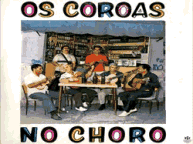 Os Coroas No Choro "Os Coroas No Choro" (RGE, 1985) (LP)
The bouncy instrumental style of choro legend, Pixinguinha, brought into the modern age. Nary a synthesizer or string section to be heard here; just the lilt of the cavaquinho and guitar. Okay, so after about five songs in a row, this may start to sound repetitive, but it's such a great sound, it's really hard to complain... Sweet stuff!
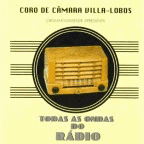 Coro De Camara Villa-Lobos "Todas As Ondas Do Radio" (Eldorado/CPC-UMES, 2000)
One of the more unusual Brazilian artifacts you'll come across... As near as I can figure, this is a liver performance by a nostalgia oriented, glee club-type organization whose goal was to recreate the experience of listening to Brazilian regional radio back in its heyday of the 1940s and '50s. There's a wide variety of styles, ranging from regional music (mostly from the Northeast) and old-fashioned samba-cancoes to tonier material such as Brazilianified versions of Bach vocal works, and a few modern MPB tunes. (Oddly enough, there are no Villa-Lobos compositions included in the repertoire... which was kind of a disappointment!) Anyway, I kept my copy just for its novelty value, but I'm not sure it would have much appeal to the casual listener... It is an odd little record, though!
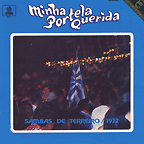 Coro Dos Compositores Da Portela "Minha Portela Querida -- Sambas De Terreiro: 1972" (Odeon, 1972) (LP)
A splendid set of Carnaval compositions from the Portela samba school's 1972 lineup. Paulinho Da Viola, Candeia, Monarco and Garoto are among the better known soloists in this set; other artists include Wilson Bombeiro, Casquinha, Carlos Elias, Joaozinho da Pecadora and Norival Reis. It's a lot like the annual souvenir albums that come out from the Carnaval competitions, except with much better sound quality and a sense of unity and joyfulness that's quite a delight. Lively and engaging, and a lot of fun!
Djalma Correa "Biafro" (Philips, 1978) (LP)
 Djalma Correa "Viva Brasil" (Philips, 1979) (LP)
Djalma Correa "...E Banda Cauim" (Barclay Records, 1984) (LP)
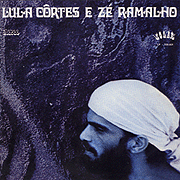 Lula Cortes & Ze Ramalho "Paebiru" (Rozenblit/Mocambo, 1974) (LP)
Northeastern rock pioneer Ze Ramalho plays various instruments on this aggressively experimental pysch/prog/avant rock album, backing Lula Cortes of the Brazilian psych band Satwa... For many, this is a lost treasure of Brazilian acid rock; I just found it to be tremendously irritating and jaggedly textured. If your taste in jazz tilts towards improvisational "free jazz," where constantly pushing against the envelope is an end in and of itself, then this album might be a real treat... Personally, I like a little more melody. (So I'm square; sue me, daddy-o.) This is an interesting historical relic, I suppose, but I far prefer the spacey folk-rock of Ramalho's first few solo albums...
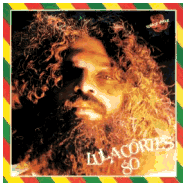 Lula Cortes "Rosa De Sangue" (Rozenblit, 1980) (LP)
Through prolonged exposure, I have to say I'm not a huge fan of Lula Cortes' work, but this is certainly his best album, and the most musically satisfying. He works through a wide variety of styles, starting with a modern forro fusion reminiscent of Gilberto Gil's Refazenda album, gets into some disjointed folk, reggae and rock, as well as an intriguing Indian classical vocal song, "Bahjan: Oracao Para Shiva," and some tweaky psychedelic disco. Interesting stuff, and worth checking out, though it might not totally stick to your ribs.
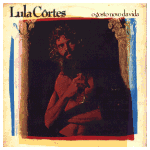 Lula Cortes "O Gosto Novo Da Vida" (1981) (LP)
One: If you want me to like your record, don't use the soprano saxophone. Two: don't use it... a lot. This is an odd, discursive, languid album, with Cortes basically talking, sometimes half-singing, over a sparse, fusion-ish sound bed -- formless synths, loping electric bass, some guitars, and that f___ing soprano sax. The songs themselves are inconsistent and lopsided, lazily realized with irregular bursts of life -- a generic rock solo, and little dash of forro, some brief flurry of psychedelic intensity -- and then it lapses back into soft-pop tedium. It's artsy, but it's not very good. I mean... Well, no... it's just not very good. Seriously. There's not a single song on here that I'd want to hear again.
Alaide Costa - see artist discography
Ana Costa "Meu Carnaval" (Zambo Discos, 2005)
Ana Costa "Novas Alvos" (Zambo Discos, 2009)
Carmen Costa - see artist discography
Gal Costa - see artist discography
Yamandu Costa - see artist discography
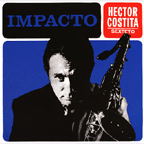 Hector Costita Sexteto "Impacto" (Som Livre, 1964)
A solo album by jazz saxophonist Hector Costita, an Argentine-born artist who moved to Brazil at the height of the bossa nova scene and worked with many of the era's best musicians, including Dick Farney, Sergio Mendes and Elis Regina, as well as more hardcore jazz players, such as Luiz Chaves, Hamilton Godoy and Hermeto Pascoal.
Hector (Costita) "O Fabuloso Hector" (RGE, 196-?)
 Couro, Cordas & Cantos "Couro, Cordas & Cantos" (1983)
Deliciously spacey, ripely indulgent, satisfyingly melodic hippie-rock with a strong folkie streak running through it. I don't know anything about the band or its origins, but I do like the record. Sort of like a more pop-oriented Quinteto Violado, perhaps mixed with early Sergio Sampaio? At any rate, a genuine lost gem, well deserving of reissue.
Fabiana Cozza "Samba E Meu Dom" (Bandeirantes, 2004)
Fabiana Cozza "Fabiana Cozza" (Tratore, 2007)
Fabiana Cozza "Quando O Ceu Clarear" (Brazilmusica, 2008)
Maria Creuza - see artist discography
Teresa Cristina - see artist discography
Arlindo Cruz - see artist discography
 El Cubanito E Sua Orquestra "Caliente" (Musidisc, 1959-?) (LP)
Cuban dance music, filtered through a Brazilian lens... Though this orchestra basically retains the original form of the rumba/cha-cha style, it's often with a poppish/big band feel, a bit less sharp and challenging than the real deal from Cuba or Puerto Rico. That said, "El Cubanito" had a fine voice, at times belting out robust vocal blasts ala Beny More, though also capable of taking a softer, sleeker tone, as on the song "Ave Maria Lola," which also has a stronger, earthier arrangement. A lot of instrumental tracks on here are well, which skirt the edges of the easy listening or ballroom dance albums. Anyone know who El Cubanito was? Or if, as seems quite possible, there were actually more than one singers on this album...?
El Cubanito E Sua Orquestra "Sarava Umbanda" (Studio Hara/Musidisc, 1974) (LP)
(Produced by Nilo Sergio)
Wait... He also did a macumba album? I am very intrigued. Not a lot of info on this guy, though the fact that this was released on Musidisc (as well as its successor, Studio Hara) suggests that this actually was the same guy. Almost all of the songs are credited to "Girassol" -- including one called "Sarava Seu Girassol" -- though it's not clear if that refers to a specific composer, or perhaps to the Cabloco Girassol, which recorded an album or two of its own around this time...
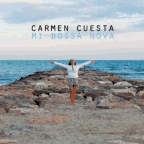 Carmen Cuesta "Mi Bossa Nova" (Tweety Records, 2011)
(Produced by Carmen Cuesta & Chuck Loeb)
Romantic singer Carmen Cuesta, an expatriate of Madrid now living in New York, expresses her passion for the bossa nova sound of the 1950s and '60s, with sensitive, elegant covers of classics by Antonio Carlos Jobim, Ronaldo Boscoli and Luiz Bonfa. The sound is rich and multi-textured, bridging the gap between the early bossa style and more modern "smooth jazz" production. Cuesta had originally wanted to translate the songs into Spanish, but discovered the Jobim estate now only allows artists to record his work in the original Portuguese, which she sings eloquently, though with the clarity and precision of a well-versed non-native speaker... She contents herself with a pair of her own Spanish-language compositions, "Tormenta" and "Jobim," a tribute to the genre's master composer... All in all, a sweet album which should pull fans of modern jazz back towards the rich heritage of Brazil's most sensuous music. Recommended!
Fernanda Cunha "O Tempo E O Lugar" (2002)
Fernanda Cunha "Dois Coracoes" (2004)
A tribute to singers Johnny Alf and Sueli Costa...
Fernanda Cunha "Brasil Canada" (On Request, 2005)
Fernanda Cunha & Ze Carlos "Zingaro" (2007)
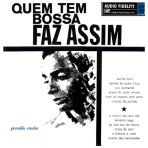 Geraldo Cunha "Quem Tem Bossa Faz Assim" (Audio Fidelity, 1966) (LP)
A sweet, sleek bossa nova album from composer Geraldo Cunha, apparently backed by the Sambalanco Trio, but often simply accompanied only by a lone acoustic guitar. It's a lovely, musically agile, intelligent and very playful set. Only about a third of the songs are Cunha originals; the rest include a mix of standards (Jobim, et. al.) and stuff by more obscure artists such as Naya Sampaio and the guitarist called Tuca. This as Cunha's only full-length release, which is a pity, because it really is a gem from this musically rich era. Long overdue for reissue!
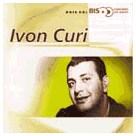 Ivon Curi "Serie Bis - Cantores Do Radio" (EMI-Brasil, 2000)
Pretty corny stuff from a Mina Gerais native who specialized in Franco-European material in the 1940s, and turned to nordeste roots towards the end of the '50s. His blend of bouncy forro rhythms and chanson showiness probably won't capture your fancy, but then again, who knows? I found this to be negligible, although I guess it's an interesting footnote to the development of forro as a mainstream style.
Ivon Curi "Meus Melhores Momentos" (RCA, 1957) (LP)
Ivon Curi "Farinhada A Francesa" (EMI-Brasil)
Ivon Curi "Maxximum" (2007)
Ivon Curi "Farinhada A Francesa" (Revivendo, 2007)
Ivon Curi "Sua Melhor Epoca" (2010)
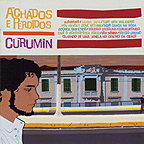 Curumin "Achados E Perdidos" (Quannum Records, 2005)
This disc opens with "Guerreiro," a thunderously sexy, slinky, cool, irresistibly catchy pop-funk samba that recalls Stevie Wonder's grooviest work from the early 1970s... That sweet funk vibe is echoed on "Tudo Bem Malandro," which also uses a full, fat-toned keyboards to create a thumping funk beat -- Curumin's debt to Wonder is made explicit in his English-language cover of Wonder's "You Haven't Done Nothing," which rounds out the album's soft, sensual opening set. From there, more contemporary hip-hop and Brazilian pop influences kick in, and the record starts to lose some of its momentum, becoming more a collection of songs than a cohesive artistic statement. There's a little bit of a patchwork, kitchen-sink feel to the second half of the album, but this lack of cohesion also indicate's Curumin's searching, innovative creativity. A Sao Paulo native (whose given name is Luciano Nakata Albuquerque), Curumin makes a point of opening his album up to guest performances by off-the-radar locals; as is often the case, Sao Paulo's music scene offers a grittier, edgier alternative to the sleek elegance of Rio and the party-down sambas of Bahia... Of the many Brazilian artists who have melded funk, soul and samba over the last four decades, Curumin stands as one of the most fluid and accomplished. Sadly, the entire album isn't as funky as the opening numbers, but those few tracks go a long way towards establishing him as a contemporary pop artist worth keeping track of... While savoring the songs on here that get my toes tapping, I'm definitely looking forward to Curumin's next record!
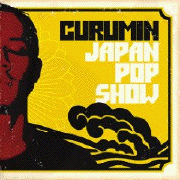 Curumin "JapanPopShow" (Quannum Records, 2008)
(Produced by Curumin, Gustavo Lenza & Lucas Martins)
Brazilian music has always been about the mixing of cultures and styles, and Luciano Nakata Albuquerque, aka Curumin, is a young Brazilian of mixed Spanish-Japanese ancestry who exemplifies this tradition of diversity. As on his previous album, Curumin shows mastery of a wide variety of styles, mainly from the continuum of soul, funk and hip-hop, but with distinct touches of Brazilian samba-pop and different stripes of rock in the mix as well. JapanPopShow is far more cohesive and consistent album than 2005's Achados E Perdidos, moving from one pop style and era to another while keeping an even keel -- the songs all sound different, but they are all good within the separate sounds. For old-schoolers (like me) the album's gem is the song "Compacto," an irresistible samba-funk tune on a par with Jorge Ben's great works of the 1970s, a hummable and seductive ultimate cruising tune. Other standout tracks include "Caixa Preta," which opens with rock guitars and settles into a slippery, funky vibe, and the dubby, trip-hoppy "Dancando No Escuro." The album encompasses various styles of funk, soul and hip-hop, edging into the more hyperactive modern-day "baile funk" scene, but staying thankfully closer to the sultry grooves of yesteryear. Guests include fellow Brazilian pop experimentalist Lucas Santtana, samba-funk elder Marku Ribas and the American hip-hop duo Blackalicious, who join Bay Area rapper Lateef the Truthspeaker on the song "Kyoto." Curumin's savvy mix of styles is another strong example of how the youthful, ever-modern Sao Paulo scene is setting itself on a par with other major pop movements, absorbing influences and creating new sounds that will inspire similar creative bursts across the globe. Definitely worth checking out!
 Curumin "Arrocha!" (Six Degrees Records, 2012)
 Cynara E Cybele "Cynara E Cybele" (Columbia Records, 1968) (LP)
(Produced by Helcio Milito, arrangements by Dori Caymmi)
A fairly sedate, even monotonous, bossa-orchestral outing from two of the gals in Quarteto Em Cy... The good news is they don't indulge in any of the vocal gymnastics of the quartet, but these duets and Dori Caymmi's overly-studious arrangements are a bit dreary. A strong repertoire, mixing classics by Lamartine Babo and Noel Rosa with newer material by Caymmi, Chico Buarque, Marcos Valle and others... But by and large this album doesn't really come alive -- maybe it was just because the folks at Columbia were too fusty to really get what was going on at the time? Anyway, this is worth checking out, but don't get your hopes up too high.
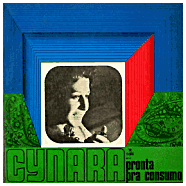 Cynara "Pronta Para Consumo" (Elenco, 1969) (LP)
(Produced by Helcio Milito, arrangements by Ruy Faria)
A very cool album! This was recorded in 1968, when Cynara was still a member of the Quarteto Em Cy (she went solo that smae year) but it has very little of the Quarteto's trademark musical tropes -- indeed, it's a much brighter, fresher sound overall. Fans of Rogero Duprat's kooky classical-meets-psychedelic tropicalia production will want to check this out: he didn't do the arrangements, but Ruy Faria's work is slavishly imitative of Duprat, in a way that many fans of this era's music will find both pleasant and amusing, although surprisingly not all that intrusive.A hefty chunk of the songs are by Sidney Miller, and a couple were cowritten by Cynara and Faria, who was at the time her husband. Amid youthful, vivid pop arrangements, Cynara emerges from the Quarteto's long shadow and reveals a singer deserving of wider fame, fame which sadly would elude her as a solo artist. Still, great record. Definitely worth tracking down.