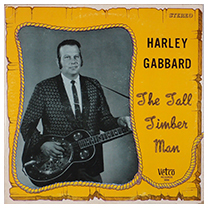
 Harley Gabbard "The Tall Timber Man" (Vetco Records, 1971-?) (LP)
Dobro player Harley Gabbard (1935-2003) was born in West Harrison, Indiana and started out playing guitar in various hillbilly and bluegrass bands, switching to dobro later in life. Gabbard performed at the Grand Ole Opry and the Wheeling Jamboree; he also toured with The Osborn Brothers, The Goins Brothers and also with Jimmie Skinner, who contributed this album's liner notes. Along with Aubrey Holt, Gabbard was a founding member of the Boys From Indiana bluegrass band, starting that band a few years after cutting this solo album. Alas, no info on the backing musicians here.
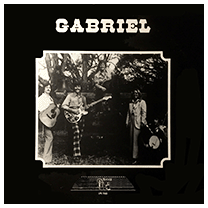 Gabriel "Gabriel" (Herald Records, 1975-?) (LP)
(Produced by Carlton Brown)
Though they were self-proclaimed Christian evangelicals, a fair chunk of the material this Baton Rouge bluegrass band recorded was secular, including covers of "Fox On The Run" and "Rocky Top," an Arlo Guthrie tune, "Washington County," and the nominally religious mainstream country hit, "Baptism Of Jesse Taylor." They also embraced more contemporary Christian twang, including a song called "The Outlaw," from born-again folk-rocker Larry Norman, as well as two Ken Munds songs, "Brush Arbor Meeting" and "God'll Do The Changing." Although they were from Louisiana, Gabriel recorded this session at a studio in Brookhaven, Mississippi... The lineup included Mike Clark (mandolin), Murray Clark (banjo) Candy Cole (piano), Dennis Smith (guitar) and Mark Worthen on bass... Not entirely sure when this came out, but it looks like a mid-'Seventies release.
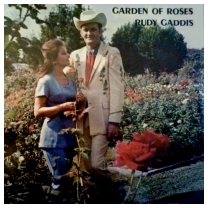 Rudy Gaddis "Garden Of Roses" (Custom Sound Studios, 19--?) (LP)
Way back in 1955, Texas native Rudy Gaddis (1926-2006) recorded an Atomic Age hillbilly novelty single for the Starday label called "Uranium Fever," as well as this album's title track, "Garden Of Roses" which was originally released as a 78, way back in 1954, on a Lone Star indie label called Liberty Records. The arrangement was a rehash of Hank Williams' "Kawliga," with Gaddis' vocals strongly recalling those of Hank Snow, and the single was one of a handful he released over the years. This album seems to be his only full-length release... It's all original material recorded several years later (though I'm not quite sure when...) and the Rudy Gaddis pictured on the cover looks pretty durn middle aged... It looks early '70s to me, but the tracks may have been recorded much earlier...
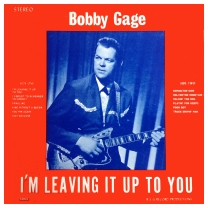 Bobby Gage "Leaving It Up To You" (R & G Record Productions, 196--) (LP)
(Produced by Joe Saia)
A very private pressing from an East Coast bar-band singer working his way through a bunch of melodic country standards of a late '50s/early '60s vintage, stuff like "Fraulein," "Wolverton Mountain" and "King Without A Queen." No date on this album -- I'm guessing 1964 or '65, but it coulda been a couple of years earlier -- or later, either way. Anyway, Gage and his band weren't all that great, but they sure were authentic. If you wanna hear what a country covers artist sounded like in Boston, circa '65, this album's worth a spin. Not sure if Gage recorded other albums, but he did play at various clubs in Massachusetts at least through the 1980s, when he was fronting a band called The Countriaires. Anyone have more info about this guy?
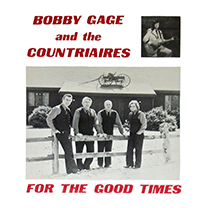 Bobby Gage & The Countriaires "For The Good Times" (R & G Record Productions, 19--?) (LP)
(Produced by Roger Baker & John Penny)
A much later edition of the Bobby Gage show, an undated album that looks like a late 'Seventies or early' 80s offering. A whole bunch of cover tunes, with most performances credited to Bobby Gage, a couple to the Countriaires band, and others to bandmembers Joe White, Leslie Gage and Lisa Gage (who I assume were Bobby Gage's teenage kids). Looking at old New England entertainment listings, The Countriaires seem to played a fair number of gigs in the 'Eighties, though possibly the band formed several years earlier... The group included Bobby Gage on rhythm guitar and vocals, Earl Blank (keyboards), Don Millard (guitar), Herbie Sands (drums), Warren Smith (saxophone), and Joe White on bass, with the Gage kids singing solo on one song apiece. Bobby Gage may have made other records, but these are the two albums I know about for sure.
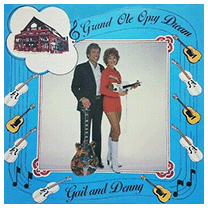 Gail And Denny (Secord) "Grand Ole Opry Dream" (Full Circle Records, 1982-?) (LP)
(Produced by Van Barker & Bobby Bradley)
A middle-aged couple from the rural suburbs near Seattle, Washington, Denny and Gail Secord both came from musical families, with Ms. Secord's parents not only playing in local bands but also running a bar called the Wagon Wheel, while Mr. Secord's dad was a popular dancehall fiddler. The Secords led their own band for many years, with backing from locals such as fiddler Jerry Critchfield. They first formed a group called Country Express back in 1976 when they were living in Port Ludlow, with her fiddling prowess (and super-fab go-go boots!) as the main attraction. In 1981 they won a talent contest sponsored by the National Grange Association, and not long after that traveled to Nashville to record this album, with backing by guitarist Greg Gilbraith, Hal Rugg on steel guitar, pianist Mike Shrimpf, and others. They played some standards, with a hefty dose of tuneful heartsongs by Hank Snow and his generation -- "You're The Reason," "It Don't Hurt Anymore," "Bumming Around," "Time Changes Everything" -- as well as instrumental showcases such as "Chime Bells," "Draggin' The Bow" and "Orange Blossom Special." The title track, "Grand Ole Opry Dream," may have been an original. The Secords continued to perform locally for many, many years, with Ms. Secord retiring in 2009 (but Denny continuing to play) and their son, Denny Secord Jr., later forming his own group, the Luck of the Draw Band.
 Rob Galbraith "Nashville Dirt" (Columbia Records, 1970)
Originally with a background in R&B and soul, Rob Galbraith was a fixture in late 1960s/early '70s Nashville scene, working as a session musician and producer, notable for his work with country superstar Ronnie Milsap in the '70s and '80s, and for producing several albums for the musically eclectic cult favorite Larry Jon Wilson. This was Galbraith's first solo album, a mix of rock, soul and country that reflects the musical diversity bubbling under the surface of Music City's countrypolitan monolith; in 1972 he recorded an album with songwriter Dennis Linde, in the semi-rootsy rock band called Jubal. Galbraith's efforts as a recording artist weren't commercial triumphs, and he found more success behind the scenes, notably as co-owner of a music publishing company formed in partnership with Ronnie Milsap.
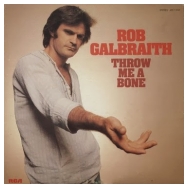 Rob Galbraith "Throw Me A Bone" (RCA, 1976)
(Produced by Rob Galbraith)
This one's more of a horn-rock/white soul album, but again, that does show some of the musical diversity bubbling underneath the surface of Nashville's country music monolith...
 Rob Galbraith "Too Long At The Fair" (Tri-State Records, 2004)
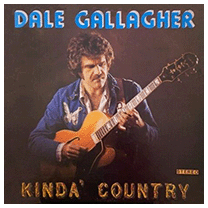 Dale Gallagher "Kinda Country" (Dale Records, 1977) (LP)
An all-original set of (kinda) country tunes by Hazlehurst, Mississippi's Dale Eugene Gallagher (d. 2018) a local amateur musician whose day job was as a basketball coach and phys ed teacher. Not a lot of info about him online; apparently he also played bass in a band led by a guy named Al Hurt, who also had a similarly low profile. One of the songs on this album, "Lord Knows I Tried," was on an earlier split single that came out in 1975 on the Jackson, Mississippi-based Suede Records, with Gene Baker billed on the single's flipside, probably the same Eugene Baker who plays piano on this album.
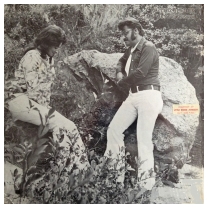 Patty Gallagher & The Showdowners "By Request" (Little Richie Records, 197--?) (LP)
(Produced by Bob Hale)
Ms. Gallagher was identified with the Denver, Colorado country scene throughout the entire 1970s... I'm not sure when this album came out, though the boys in the band look pretty darn "Seventies" to me, so I'll go out on a limb and guess this was recorded around 1975-76... It includes some original material, notably "She Goes Runnin' Round" by bassist Wil Karl and "My World Is Sittin' Tipsy" by Gallagher. She gets top billing, though an awful lot of the spotlight gets shed on Gary Courtney, who's pictured with her on the cover; other band members include guitarist Gary Courtney and steel player Harley Brendal. To be sure, this is not a top-notch production, even for the indiebilly genre, but it is the kind of record you can get to love just for it's sheer authenticity and undisguised flaws. Also, when they burst into an uneven lounge-funk riff on their version of "Crawdad," it's a real hoot. The original songs are pretty charming, though like the rest of the record, they're a little clumsily laid out. It's fun stuff, though... definitely locals!
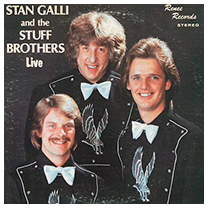 Stan Galli & The Stuff Brothers "Live" (Renee Records, 1981) (LP)
(Produced by Bud Compte & Ernie Kucera)
As some of you may know, I am not a big fan of the "make fun of old album covers" music website subgenre... I think it's an exceptionally feeble form of humor, inherently mean-spirited and more revealing of the author's limitations than those of their targets. That being said, this one's a doozy. I mean, first off, wow, look at the hair, then, wow, look at those vests, and also, wow, who calls their group "The Stuff Brothers"? Besides which, why does bandleader Stan Galli look kinda like Eric Idle, while that other guy looks so much like Steve Zahn? Is that Steve Zahn?? Anyway, this album actually is about as scary as it looks... Not entirely country, though there is definitely some twang in the mix, including covers of the Gatlin Brothers' "All The Gold In California" and Tom Paxton's "Wasn't That A Party," which sounds like an old Moe Bandy song, but isn't. They also shoehorned in Elvis Presley and Buddy Holly medleys at the ends of each side fo the album, which I guess is kind of country-adjacent. It turns out Stan Galli -- who grew up in Duluth and later settled in Omaha -- was actually a veteran music performer, having played drums in a rather nutty Minneapolis lounge band called The Links, backing brothers Jim and John Link, who also mixed contemporary pop and country hits as well as rather strained novelty material. (The Links, by the way, looked even scarier than the Stuff Brothers, with one sibling perpetually pop-eyed and overly cheerful, and the other looking very much like a BMOC jock-bully type. But their records were kind of cool, in a kooky kinda way...) At any rate, Mr. Galli recorded several albums with The Links in the first half of the 1970s, but left the band sometime before 1978 and set out on his own, though apparently emulating the same basic formula with a new trio which included Mark Beckwith on bass, drums and guitar, and John Seleski playing banjo, bass, and lead guitar. This is a deeply flawed album, with manic performances of okay material, punctuated by two truly awful comedy bits, one being a version of Joe Dolce's then-hit, "Shaddap You Face," in which Mr. Galli goes to great lengths to provide his own Italian-American bona fides, but also bizarrely ties it to the elevation of Polish cardinal Karol Jozef Wojtyla to become Pope John Paul II, which apparently was a great shocker to some people of Italian descent. Anyway, that stereotype-laden performance is nothing compared to the sheer, abject misery of the bit on the flipside called "OB-GYN," in which a male "doctor" discusses his work, and is just plain gross. I was drawn to this disc because it was recorded at the Renee Records studio in David City, Nebraska, which was a locus for regional country (and polka) artists, and I guess the album lives up to its promise, in that it was an authentic document of a working lounge band of the era... But still, yikes.
 Bob Gallion "Out Of A Honky Tonk" (Bear Family Records, 2000)
Nice one. Kentucky-born, Ohio-raised Bob Gallion (1924-1999) was an odd kind of honky-tonker -- sometimes he sounded like Mickey Gilley, with a strong hint of Ernest Tubb's vocal roughness thrown in for good measure, other times he employed some Hank Williams twang. Though a little untamable (this disc is full of late '50s efforts to frame him in a "pop" or rockabilly context), Gallion had a very comfortable presence and a swinging feel to his work. This album gathers together all of Gallion's work for the MGM label, much of it co-written with his songwriting partner, Luke McDaniel, who was given a Bear Family retrospective of his own. Like a lot of early country stars, much of Gallion's recording career was limited to singles; he later moved to the Hickory label, where he released another string of fine hard-country singles, and eventually a full LP, which is listed below. Gallion also moved around a lot, going from gig to gig -- early on, he was a cast member of the "WWVA Jamboree," though he also enjoyed a stint on "The Louisiana Hayride" and worked as a country deejay in the 1960s. In 1968 Gallion met singer Patti Powell and recruited her as a member of the WWVA cast; they remained musical partners at least up through the mid-1980s. Anyway, this Bear Family set is a really good collection of cool classic country, with its toes just dabbling in the rockabilly and teen-pop tides. Special treats: Gallion's 1959 version of the Patsy Cline hit, "This Should Go On Forever," and the pathos-heavy divorce saga, "You Take The Tables, I'll Take The Chairs." Recommended!
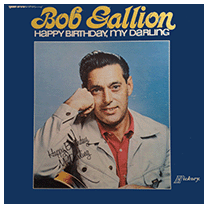 Bob Gallion "Happy Birthday, My Darling" (Hickory Records, 1971) (LP)
(Produced by Johnny Erdelyan & Wesley Rose)
Though signed to the Hickory label in the early 1960s, Gallion didn't get a full LP of his own until 1971... Most of the songs are his originals, including a couple co-written with Earl Sinks, while other tracks were penned by the likes of Harlan Howard, John Loudermilk, one by Lee Emerson (who wrote "I Thought I heard You Calling My Name") and even a couple by Helen Carter, of the fabled Carter Family line. No info on backing musicians, alas, though this album seems to have been cobbled together from various singles recorded over the course of the 'Sixties.
Bob Gallion & Patti Powell "Together And Alone" (B&P Records, 1975-?) (LP)
Gallion's longtime duet partner, Georgia-born Patti Powell had kind of a Loretta Lynn-meets-Kitty Wells hyper-rural vibe... She landed a spot on the "WWVA Jamboree" program in Wheeling, West Virginia, arriving as the protege of honkytonk songwriter Bob Gallion, who met her while working as a deejay in Atlanta, back in 1968. She started on the show around 1970 or '71 and the two performed on the Jamboree both as solo artists and as a duo, and they toured together at least up through the mid-1980s. Typically their records were mostly duets, with Gallion taking a few solo numbers, although she also recorded a solo album in 1971... made up of covers of songs written by Bob Gallion!
Bob Gallion & Patti Powell "Greatest Hits" (Gusto Records, 1978) (LP)
(Produced by Tommy Hill & Mike Stone)
Though the songs overlap with earlier releases on singles and LPs, I think these are re-recorded versions, since the liner notes provide the names of a particular Nashville studio crew -- Jim Baker on steel guitar, Hayward Bishop (drums), Jack Eubanks (lead guitar), Tommy Hill (rhythm guitar), Tommy Jackson (fiddle), Bunky Keels (piano) and Hank Strzelecki on bass. Bob Gallion sings solo on over half the album, while Patti Powell accompanies him on four duet tracks.
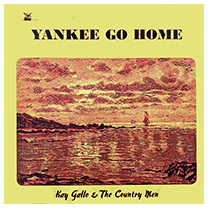 Kay Gallo & The Country Men "Yankee Go Home" (Big-E-Nuff Records, 197--?) (LP)
(Produced by Kay Gallo, Richard N. Gallo & Denny Hardesty)
Nicknamed "the sweetheart of the Ponderosa," Mrs. Gallo was born in West Virginia but moved out to California where she married and raised a family... (The liner notes inform us that she had four grandchildren by the time this album was recorded...) In 1967 she got a gig singing at a place in Pomona called the Ponderosa Club, though it's not clear when this album was recorded -- it could have been many years later. Anyway, this is definitely a "private" release, with backing by local musicians such as guitarist Warren Flock, Jess Owen on steel, bassist Lucky Shanon (sp?) and Carl Walden on keyboards and rhythm guitar.
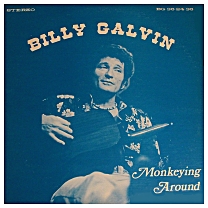 Billy Galvin "Monkeyin' Around" (Audio Media Records, 1975-?) (LP)
(Produced by Mike Stone & Billy Galvin)
A comedically-themed album from a guy who started out in Nashville doing bar gigs at Roger Miller's club in the early 1970s. Galvin later moved into television, becoming the producer of the "Country Standard Time" and "Music City Tonight" variety shows, along with countless one-off specials, including several projects developed with producer Jim Owens. The album title is a reference to the novelty number "Signifyin' Monkey," which leads the album off... He also covers "She's Acting Single (I'm Drinking Doubles)," "Every Time You Touch Me I Get High" and (frighteningly enough) a version of Olivia Newton John's "I Honestly Love You." I'm not sure when this one came out, but it must have been close to the beginning of his career, not long after he came to Nashville in '72. Apparently super-picker Phil Baugh sat in on these sessions, though no other musicians are identified in the liner notes...
 (Johnny Galvin &) The Pioneers "By Request" (Fathom Records, 197--?) (LP)
(Produced by Kearney Barton)
The Pioneers were a honkytonk band from Oak Harbor, Washington (just north of Seattle) led by guitarist Andy Stevens, who is credited as arranger on this album. They're backing local lad Johnny Galvin, who sings a couple of his own originals, "I Tell Myself A Lie" and "Secret Meeting Place," in addition to a full course of Johnny Cash and Merle Haggard tunes, some Hank and Buck, and (of course!) a version of "Green Green Grass Of Home." Galvin released another album on Fathom, with more of his originals.
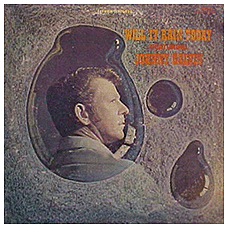 Johnny Galvin "Will It Rain Today" (Fathom Records, 1975-?) (LP)
(Produced by Johnny Galvin)
Great, mopey, broken-hearted honky tonk hard country, with delightfully forlorn vocals. West Coast legend Tommy Collins wrote some cheerful liner notes for this album, recalling some gigs he played with Galvin up in the Pacific Northwest, so that certainly got my attention. Although Collins talks about playing at a bar in Oregon, it looks like Johnny Galvin was actually from around Spokane, Washington... This album is mostly cover songs, but with some tasty choices, such as the Bonnie Owens song, "Somewhere Between," which was on a Merle Haggard album in 1967... There's also another inevitable rendition of "Me And Bobbie McGee," as well as three originals written by Galvin.
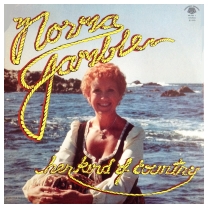 Norma Gamble "Her Kind Of Country" (Pentagon, 1979) (LP)
(Produced by Alan L. Dote)
Ms. Gamble was a singer from Santa Clara, California (near San Jose) who wrote most of the songs on this album, with one credited to producer Alan L. Dote, and a couple co-written by Anna Pierce. The liner notes say she played gigs in Vegas and Reno, though overall this seems like a pretty "private" private-press album.
 The Gamblers "Start It All Over Again" (Grenadier Records, 1983-?) (LP)
(Produced by Bob McCracken & Tom Soares)
A surprisingly strong, independently-produced pop-oriented country album by a band from Fall River, Massachusetts... This album features a wealth of well-crafted original material and strong performances by the band, all well framed by the slick-but-not-too-slick production, which really was on a ready-for-radio level. The only weak link is from the band's female singer -- who like the rest of the band is unidentified in the liner notes, but sings lead on several songs, and is not quite on the same level as the rest of the band. Overall, though, this seems like a band that really coulda-shoulda made it. Oh, well -- go figure! Not sure of the release date - some folks say the "late '70s," though one source says 1983, and the catalog number might suggest a 1977 release. Any info would be welcome!
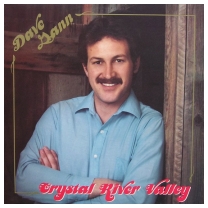 Dave Gann "Crystal River Valley" (CMC Records, 1985)
(Produced by Mark Macgruder)
A picker-singer from Grand Junction, Colorado... I haven't heard this one, but I'm curious. It looks like it would be more of a folk album, although he does have a song promisingly titled, "Willie Sings With Everyone But Me," which I'm gonna add to my list of Willie Nelson tribute songs...
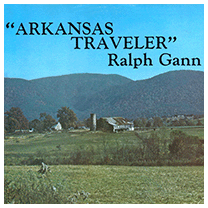 Ralph Gann "Arkansas Traveler" (MRC/Major Recording Company, 1981) (LP)
(Produced by John Major)
A pretty obscure set from Virginia, with singer Ralph Gann backed by several guys in the orbit of the MRC label. It's mostly cover tunes, though one track, "You Can't Tell Who To Trust" was penned by Mr. Gann. alongside Top Forty chestnuts such as "Statue Of A Fool," Marty Robbins' "You Gave Me A Mountain," Larry Gatlin's "Broken Lady" and the slightly hipper "Tulsa Time." The band included keyboard player Juggy Donovan, Mike Dorsey (bass), Danny Ennis (lead guitar), Roy Ledford (drums) and steel guitar by Bill Shanholtzer... Some of these guys played on other MRC sessions, including with the Maryland group, Jeanie C & Country Caravan; after Jeanie Class left the band, Mr. Gann became the group's lead singer in the mid-'80s, and was the featured singer on Country Caravan's 1985 album, Proud To Be An American.
Gene Rockwell Gant "Makin' Sweet Music" (Morrhythm Records, 19--?) (LP)
(Produced by Gene R. Gant & Cliffie Stone)
According to the liner notes from producer Cliffie Stone, Gene Gant made the country-rock scene in LA around 1967 and paid his dues playing at all the right nightspots -- The Palomino, Nashville West, The Sundowner and The Playboy Club. He also did a little film acting, but "went back to the Midwest" at some point, and though we're not told where in the Midwest he was from, some of his earliest singles came out on label in Michigan. All but three of these songs are Gene Gant originals, with two of the remaining songs co-written by Cliffie Stone's kid, Steve, in partnership with Chris Roberts, and the third one composed by pickers Jimmy Bryant and Don Lee, along with some guy named Michael Tableporter. (At least two of these tracks were previously recorded for the Hollywood-based Public Records label around 1968-69, and released under the name Gene Rockwell. The versions here seem to be reissues of the original tracks. Also of interest are the contributions of (future) 'Seventies soft-pop legend David Gates, who helped arrange the material.) There's no date on this LP, but a banner on the back proclaims it to be a "DIGITAL RECORDING," which is something labels were mostly tripping out on in the early 'Eighties. If I had to take a swing at it, I'd guess this came out sometime around 1982-1983. Many years later, Mr. Gant self-published a memoir called Lifted from Despair: A Story of Miracles, which I assume was a religious/spiritual narrative... He moved around a lot and devoted himself to the printed word, writing poetry and a few books, editing, etc. He finally married and settled down in Sun City, Arizona, with his wife Connie, who once worked as a piano player at the Disneyland amusement park. As far as I know, this was his only full album, though there's a whole string of singles dating back to the early 'Sixties.
 Bill Gardner "First Time Around: Songs Of The Country" (Studio 40 Studios, 1981-?) (LP)
Country ballads and a bit of West Coast twang, with covers of stuff like "Crazy," "From A Jack To A King," "Funny How Time Slips Away" and bouncier tunes like "Rollin' In My Sweet Baby's Arms" and Buck Owens' "Hello Trouble." The record label was from Denver, Colorado, so I imagine that Gardner was also from thereabouts...
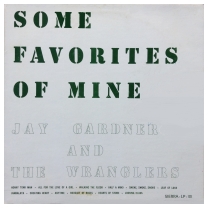 Jay Gardner & The Wranglers "Some Favorites Of Mine" (Sierra Records, 19--?) (LP)
A Utah local, Jay Gardner was the program director for country stations KSOP, in Salt Lake City, and led a band which was apparently made up of some other station members. Here, he's playing country standards such as "Cheating Heart," "Jambalaya," "Smoke, Smoke, Smoke That Cigarette," Johnny Horton's "Honky Tonk Man" and "All For The Love Of A Girl," with musical backing that includes a little bit of flashy, note-happy guitar playing (by Mr. Gardner?) along with pretty primitive rhythmic backing on bass and drums. The choice of an Ernest Tubb tune is pretty apt, since Gardner had a rather simple vocal style as well... There's no artwork on the back cover, and not much info on the disc, either. All the songs are country standards, though there is one tune, "Looking Glass" without any songwriter credit that might be an original... And there's no release date, either, of course, though I'm gonna say 1963 or '64, since that's when the band was mentioned in a few local newspapers, playing gigs like cattlemen conventions and whatnot. Not really a great record, but certainly authentic and raw, and charming if you're into the whole digging-amateur-musicians aesthetic.
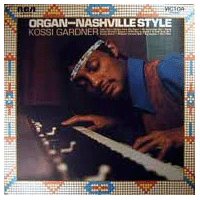 Kossi Gardner "Organ, Nashville Style" (RCA Victor, 1970) (LP)
(Produced by Chet Atkins)
Instrumental kitsch from session player Kossi Gardner (1941-2009), a native Nashville organist who ensconced himself in the city's jazz scene and had a rather eclectic career. In the 1960s he toured with top jazz players such as David Newman and Sonny Stitt, then worked his way into the Nashville studio network when he returned to Tennessee. These two albums reflected his connections to the hometown country music industry, though later he dabbled in disco and composed a few tunes recorded by band such as Shalamar. Not sure how much appeal these discs will have to country fans in the post-countrypolitan decades, but you never know.
Kossi Gardner "Plays Charley Pride" (RCA Victor, 1972) (LP)
(Produced by Ronny Light)
Though Gardner's jazz organ is the primary lead instrument, there's plenty of top Nashville talent backing him, folks like David Briggs, Johnny Gimble, Lloyd Green, Dave Kirby, Grady Martin, Pete Wade and the like... Plus, a Charley Pride tribute album? Heck, yeah!
Fern Garner "Sings Her Favorite Songs" (Soundisc Records, 1975) (LP)
(Produced by Junior Bennett & Bill Pursell)
Independent twang from Mrs. Fern Garner-Sibila (1927-2023) a middle-aged Ohio gal with a bright, youthful voice. Ms. Garner fully embraced the countrypolitan and "sunshine country" sounds of the early 'Seventies, recording one full album with producer Junior Bennett which was used to generate a string of singles over the next several years. (Almost all of the songs on this LP were later released as singles; two songs -- "Leave" and Garner's own composition, "Stark County Belle" -- seem to have been recorded earlier with producer Bill Pursell, and came out on the Lanco label, possibly as early as 1970.) She was a longtime resident of Massillon, Ohio, in Stark County, right next door to Canton, and performed at live venues and on television shows both locally and nationally, and according to her obituary she even made it onto the Grand Ole Opry in Nashville. This appears to have been her only album, and while it has its flaws, overall it's pretty appealing, very much in the same vein as 'Seventies stars such as Lynn Anderson, Donna Fargo and Connie Smith.
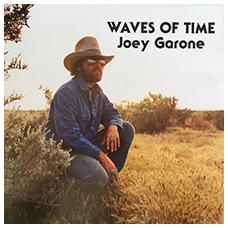 Joey Garone "Waves Of Time" (1981) (LP)
You'd be forgiven for thinking (as I did) that this is an old indie-twang album, what with Mr. Garone pictured on the cover, clad in denim, sporting aviator glasses and several massive turquoise rings, and of course a cowboy-ish Panama hat... But in fact, this is a really weird, sorta-folk/sorta-rock album, full of bizarre, rambling lyrics and strange, possibly drugged-out preoccupations and obsessions galore. It's not a country album -- consider this fair warning -- but for folks who enjoy kooky, outsider-art bizarro records, this one's a doozy. The opening track, "Gasoline Junkies," isn't quite the earnest critique of our petrochemically propelled populace that you'd expect, but rather an opening salvo for a very odd album, with Garone musing authoritatively about UFOs, including the ones he says he's seen with his own eyes. Despite this album being pirated and sampled by numerous interwebsters, its origins remain obscure -- there's no discographical info on the album itself, or even a mention of where Garone was living when he made it. (Off the grid, perhaps? In a tinfoil-lined shack?) It's possible that the low-level notoriety of this LP inspired the character of nightclub singer Joey Garone in the 2009 feature film, "Once More With Feeling," but that's mostly just me speculating in the absence of fact. Anyone out there have real info about this guy? If so, I'd be much obliged!
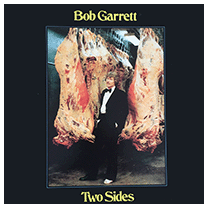 Bob Garrett "Two Sides" (Pacific Music & Publishing Company, 1980) (LP)
(Produced by Jim Bastin & John Pearson)
A crude, sometimes-country comedy album backed with ditties such as 'Think I'll Become A Narc," "You Can't Write No Hit Song If It's Dirty," "You Can Take Love And Shove It Up The North End Of A Gila Monster Headin' South," and "Whadya Say About Hittin' The Hay?" Some songs, obviously, will not have weathered the changing mores of the times, such as the album's opener, "Fold-Out, Teenage Queen Of Puberty" (yikes) and "Girl With A Tattoo," an ida that would have still sounded exotic in 1980... Not a ton of information about Bob Garrett to be found... He wrote all the songs on this album, and claimed to have been the coach of the short-lived Tucson Sky professional volleyball team, which itself may have been a bit of a joke, and later the director of America's Olympic volleyball team, though I couldn't find any documentation of that latter claim. (He may also be the same Bob Garrett who's known as "the fakest coach" in boxing, another title that I cannot confirm or deny, mostly because I don't care about sports.) Anyway, this is crude, transgressive humor , worthy of fellow travelers such as Chinga Chavin or Montezuma's Revenge. I ordered a copy from the quarter bin of my local Record Hut, and it was supposed to get FedEx-ed to my office, but it never arrived.
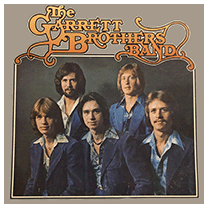 The Garrett Brothers "The Garrett Brothers Band" (Karavan Records 1977) (LP)
(Produced by Jerry Abbott, Jerry Hudson & The Gairrett Brother Band)
A family band from Billings, Montana this group featured three brothers, bassist Darrell Gairrett, steel player Jim-Bob Gairrett and John Gairrett (1956-2006) on guitar, with a fair-sized backing band whose membership evolved over the years. First formed in 1968, the band built up a strong regional fan base through the 1980s, breaking up at the decade's end, with brother John getting a day job and moving to Salt Lake City, Darrell going into ranching, and Jim-Bob moving to Nashville and a successful career as a Top Forty country music sideman. Along the way they made a few records, including this LP which was cut in Texas, with their Montana-based band augmented by pianist-producer Jerry Abbott, who ran the Pantego Sound Studio. The Gairretts don't seem to have written any songs themselves on this album, though they cover stuff by Curt Massey, Kenny Seratt and Dan Fogelberg, as well as a serviceable version of Jimmy Buffett's "Margaritaville." About half the are songs credited to a Acuff-Rose staff writer, "L. Steele" -- who may have been the prolific Lois Roberts Steel, best known for the 'Fifties hit, "Ivory Tower" -- suggesting that they were able to make records partly by acting as a demo band for established songwriters. At any rate, they were a pretty solid-sounding group, with crisp, no-nonsense arrangements and a decent amount of twang. (Note: the group's name seems to have been spelled "Garrett" in the band name, although this was definitely the same gaggle of Gairretts as below.)
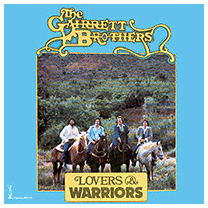 The (Gairrett) Brothers "Lovers And Warriors" (Black Gold Records 1981) (LP)
(Produced by Billy Stull & Norman Petty)
"...and warriors??" WTF? Oh, well, whatever. I dunno what all that warrior jazz was about, but this disc finds the Gairrett Brothers once again down in Texas, and once again workshopping songs by established composers. In this case, it's songwriter Milton Carroll, who contributes four songs including the goofy-sounding title track. However, the band asserts its own creative voice as well, with several songs penned by John Gairrett, as well as others by Brad Maule, Billy Stull, and Scott Vaughn. (Perhaps also worth noting: Maule and Vaughn worked together on an earlier project, Scott Vaughn's 1976 solo album, which was also produced by Norman Petty, so they were probably not part of the Gairrett Brothers hometown crew...) The band broke up in the late 'Eighties, though they staged a few reunions over the year, including a stint where they simply called themselves "The Outfit" after John W. Gairrett passed away in 2006. The Gairrett Brothers also backed British country singer Jan Holly on one of her albums in the late 'Seventies... They spelled their family name correctly on this cover, but I'm keeping the two albums together, just for simplicity's sake.
 Roy Garrett & Linda Elaine "You're Looking At Country" (Ashland Records, 1982-?) (LP)
(Produced by Dick Casper)
As promised, straight-up country stuff from a long-running Texas duo... Not sure what their early career was like, or when they started out, but Elaine and Garrett seem to have played locally nonstop for several decades: they played Willie Nelson's annual picnic in 1987, and years later around 2006-2008 were headliners at the Cross Timbers Opry, a little mom'n'pop musical revue in rural Stephenville, a tiny town west of Forth Worth. They are backed by a group called the Stealer Country Band, which was led by guitarist Glen Flemming. This may have been a "pick up" band, as Flemming's main gig was leading a group called Rolling Country, which is perhaps best known as the house band at a honkytonk called Belle Starr's; various members of the ever-changing lineup of Rolling Country also found work backing top forty stars with national profiles. The lineup here included Glen Flemming on lead guitar, G. W. Logan (bass), Joe Long (steel guitar), Cecil Tippett (drums) and "Kenny" on rhythm guitar (no last name provided.) There's no date on this album, but their cover of John Anderson's 1981 hit, "Could You Catch A Falling Star" suggest a release date around 1981 or '82.
Pat Garrett -- see artist profile
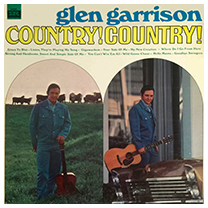 Glen Garrison "Country! Country!" (Imperial Records, 1967) (LP)
(Produced by Scott Turner)
An ex-rockabilly rebel-gone-West Coast country singer and session guitarist, Harold Glen Garrison (1942-1971) adopted a sound stylistically and vocally very much like Buck Owens, and released two major-label LPs at the height of the Bakersfield Sound. Garrison only placed two songs chart in the Top 100, including "Goodbye Swingers," off this album, which peaked out at #72 on the Billboard charts. He was born in Searcy, Arkansas and moved out the California, where he played in Wynn Stewart's band before pursuing his own solo career. Despite the lack of commercial success, this is still fun stuff, and if you dig vintage Buck Owens, there's no reason not to turn up the volume on this album, as well... Even ol' Buck agreed: he wrote the liner notes, opining on the differences between Hollywood and Nashville country. Garrison died young, passing away in Joy, Arkansas just a few years after these albums came out... He certainly seems like an artist ripe for reissue, though, particularly if anyone wanted to collect his earlier rock'n'roll records, which for years have only been available on some far-flung rockabilly comps.
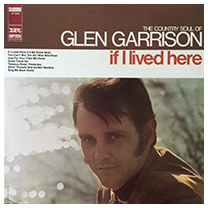 Glen Garrison "If I Lived Here: The Country Soul Of Glen Garrison" (Imperial Records, 1968) (LP)
(Produced by Scott Turner)
Ray Garrison & Windy City Country "Ridin' In" (Windy City Country Records, 197--?) (LP)
(Produced by Gary Loizzo & Dave McCormick)
Mostly a country covers band, Windy City Country was perhaps taking a little liberty with their band name, as they were actually from the Chicago suburb of Justice, Illinois, officially designated as a "village," and located a few miles inland, along the Des Plaines River. Plenty of well-trod classics on here -- "Night Life," "Statue Of A Fool," "Poke Salad Annie," "Margaritaville" even "Orange Blossom Special" and "Tumbling Tumbleweed." There's at least on for sure original, Ray Garrison's "Devil In A Bottle," and another, called "Train Song," which is cryptically credited simply to "Currier." The full band included Eddie Byrd on lead guitar, Joe DeVera (drums) Ray Garrison (guitar and vocals), Tom Keith (keyboards), and Dave McCormick on bass, with several of the guys given spotlights as lead singers on various tracks. Intriguingly, Eddie Byrd is credited as soloist on a couple of tracks such as "Orange Blossom Special," which of course is a fiddle tune; Dave McCormick was active elsewhere on the Chicago country scene, also playing bass in Don Barnett's band, the Nu-Jays, and recorded on at least one of their albums. Also of interest is that this session was recorded at Pumpkin Recording Studio, in nearby Oak Lawn, which was run by Gary Loizzo, formerly the lead singer for the pop-rock band The American Breed. A real Windy City affair, after all!
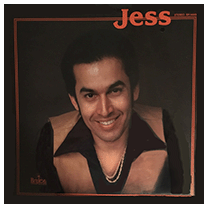 Jess Garron "Jess" (Brylen Records, 1982) (LP)
(Produced by Charlie Fields)
Solid early '80s pop-country, including a mildly bilingual Spanish-English tune, "Lo Que Sea," a modestly successful single that cracked the country Top 40 in 1979. It's one of four tracks on this album written by Garron under his given name, Roberto Ruiz, accompanied by four songs credited to producer Charlie Fields and a couple random others. Garron's bio on the back says he was born in San Juan, Puerto Rico, but grew up in Chicago, which is where he built up his musical cred, including a stint with a soul band called Crosstown Express in the mid-1970s The backing is from an all-star Nashville studio crew, including folks like Carol Lee Cooper, Gregg Galbraith, Sonny Garrish, Doug Jernigan, Dale Sellers Bruce Watkins, et. al.
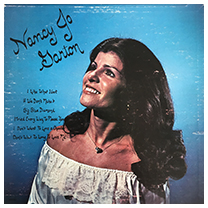 Nancy Jo Garton & Ken Holiday "Ken Holiday/Nancy Jo Garton" (G Bar Records, 1978) (LP)
(Produced by Ken Holiday)
This looks like a split LP - him headlining on one side, her on the other -- although it's all from the same recording session. Holiday and Garton were from Depew, Oklahoma, where they co-owned the G-Bar Ranch, a name they also used for their own short-lived indie label. Like many regional artists, they made the trek to Nashville to record, and cut this album at Jack Clements' studio, with a big cast of studio superpickers, including the Jordanaires on backup vocals. Nancy Jo Garton had apparently a regional radio hit with a cover of the country/R&B oldie, "Big Blue Diamonds," but her success was strictly local -- no Billboard action for these singing Sooners... Still, I like it. Mr. Holiday had one of those gangly voices that makes an unlikely match for a recording session but winds up sounding authentic and sincere -- I'm thinking of folks like Dick Feller and Deadly Ernest -- and he picked more novelty-oriented material to match his vocals. Ms. Garton was the stronger singer in the "normal" sense -- derivative, perhaps, but not bad. She starts out sounding like mainstream country-pop gals such as Lynn Anderson or Donna Fargo, but by the end of her side, she's solidly in a Dolly Parton mode, trilling her little heart out. One assumes it's her busting in on the end of Side One, to belt out a duet with Holiday on "I'm Mad In Love With You." In addition to this LP, they also released at least one single under Garton's name, distributed by the folks at NSD in Nashville.
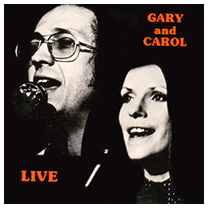 Gary & Carol "Live" (Licorice Records, 1975) (LP)
(Produced by Gary Nieland)
A quintessential 'Seventies lounge act, featuring the duo of Gary Nieland (vocals, drums) and Carol Van Nordstrand (vocals, bass and organ) in a live set recorded April 17-18, 1975 at a Salem, Oregon venue called the Keg & Platter. The repertoire spans pop and soul songs such as "I Honestly Love You," "For Once In My Life" and "Mustang Sally," counterbalanced by a hefty chunk of country tunes, including Act Naturally," "Oh Lonesome Me" and "Stand By Your Man." None of it's really all that good -- Van Nordstrand is planted firmly in the spotlight, though Nieland was the better singer -- but it's also not all that awful. Just a couple of reasonably talented locals, living the dream.
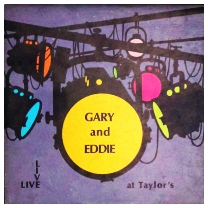 Gary & Eddie "...Live!" (Carousel Productions/Cartay Records, 1972-?) (LP)
(Produced by Don Weyand)
No. Way. No frickin' way. Okay, well, let me back up a little... This is a funky (as in kinda clunky) live album recorded at the fabled Taylor's Supper Club, a Denver, Colorado nightclub that also ran its own record label and released a few LPs like this one. So here's the "no way" part: the duo of Gary and Eddie, though not fully identified on the album's liner notes, were actually two kids from Fort Worth, Texas named Eddie Johnson and Gary Morris... Yes, that Gary Morris, the guy who later moved to Nashville and became one of the cheesiest and most successful of the 1980s pop-crossover country ballad singer of the synthy-tinkly piano era, and who recorded one of the earliest hit versions of "Wind Beneath My Wings." Johnson and Morris formed a duo in 1969 and played regular gigs at Taylor's for the next five years -- this album is probably circa 1972, with a brace of late '60s/early '70s hits such as "Snowbird," "Never Ending Love," "Gentle On My Mind" and the inevitable run-throughs of "Proud Mary" and "Me And Bobby McGee." The album is just two long tracks of live performances, with no grooves between the song... It's a lively show, though the guys get kind of goofy with their vocals and seem more like a Kingston Trio-ish folk act at times... They are joined on a few tunes by gal singer Teri Hernandez, who the liner notes say was a teenager at the time, and who has two solo numbers, on "Snowbird" and "Crazy Arms..." Dunno what she did later on. The Gary and Eddie duo broke up when Morris moved to Nashville, where he plugged away for several years until his 1981 breakthrough. Eddie Johnson stayed in Colorado and also played in the singing-policemen band, The Lawmen -- he later formed an act with that band's leader, Bo Cotrell and has been in a string of bands over the years. But here is where it all began.
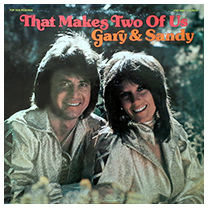 Gary & Sandy "That Makes Two Of Us" (Top Ten Records, 1977) (LP)
(Produced by Jerry Fuller)
Though Gary Raffanelli and Sandy Selby were both decent singers, this is a majestically terrible album, 'Seventies easy listening disco-pop kitsch at its apex, a gooey, bombastic set of would-be soft-pop hits, helmed by veteran producer Jerry Fuller, who also wrote about half the songs. Despite the presence of country pickers like Glen Campbell and Billy Walker, the twang influences are mostly theoretical, overshadowed by swelling string arrangements courtesy of Larry Mahoberac and Sid Feller. This seems to be a songwriter's demo with Fuller working out some pop-related ideas -- devotees of so-bad-it's-still-bad '70s schmaltz might dig it, though for most twangfans this one's a record you can skip. Some background info: Gary and Sandy were from the SF Bay Area -- Raffanelli grew up in Richmond; Selby was from Berkeley -- and they formed their duo in 1973, moving up to Lake Tahoe for casino gigs and later to Reno, where they held down a nineteen-year residency at the Reno Hilton. Their act went through a lot of permutations, eventually forming an ABBA covers band called Abbacadabra. So... now you know.
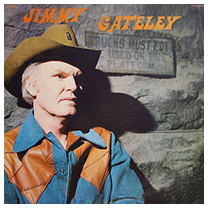 Jimmy Gateley "Jimmy Gateley" (Westwood Records, 1980) (LP)
(Produced by Frank Evans, Dave Lindley & Billy Troy)
Born in Springfield, Missouri, Jimmy Gateley (1931-1985) was a successful Nashville songwriter who composed hits for Bill Anderson, Sonny James and Webb Pierce. He was in Anderson's band, the Po' Boys, for several years and recorded some singles under his own name for Chart Records, ABC-Dot, Decca and other labels, but never quite clicked as a solo artist, and later became a gospel artist. This album features all original material and was recorded on the independent Westwood label, which was briefly a home for a slew of older Nashville stars who had been left behind during Nashville's big shift in the 'Seventies. He's got a pretty solid crew backing him, including studio pros such as guitarist Greg Galbraith, Sonny Garrish and Jim Baker playing pedal steel, and Buddy Cannon on bass.
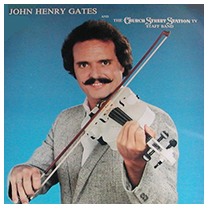 John Henry Gates "...And The Church Street Station TV Staff Band" (1984-?) (LP)
(Produced by Pat Holt & Glenn Longacre)
Florida fiddler John Henry Gates did some session work in the Orlando area, and appears to have been employed in the house band for Church Street Station, a long-running country television program that generally showcased famous Top Forty artists from Nashville. This souvenir album was recorded mostly in Nashville, with backing by studio pros such as Phil Baugh, Buddy Emmons and Dave Kirby, although Canadian-born pianist Glenn Longacre was also part of the Orlando contingent, having moved to Florida in 1981, where he later set up his own recording studio and did a lot of advertising work in addition to recording local artists. The repertoire on this album includes jazz standards as well as country tunes; several cajun-flavored tracks like Link Davis's "Big Mamou" and "Diggy Liggy Lo," and of course a version of "Orange Blossom Special."
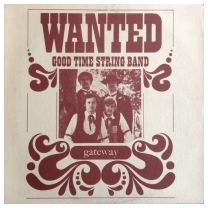 Gateway "Wanted: Good Time String Band" (Whacks Jawburz)
(Produced by Tom Reynolds)
Goofy independently produced folk music... Not as twangy as the stuff I'm into, though they do mix in a bit of bluegrass pickin'... They cover stuff like "Rocky Top," Jack Tempchin's "Peaceful Easy Feeling," John Stewart's "Cody," and the lovely "I'm Going Home," which was written by Fred Geis of the Kingston Trio. There's also a bunch of original material, notably the title track, "Good Time String Band," which extols the virtues of joyfully making music and the super-goofball medley of "People Poems" which is pretty much the album's showcase song. This didn't really resonate with me, but as indie-twang from Indianapolis goes, this is probably worth knowing about. (BTW, the album art is really confusing, but the band's name was Gateway - the credits read: "All songs arranged by Gateway..." and then give all their names. There's also a more modern group called the Good Time String Band up in Maine, but they're a different band.)
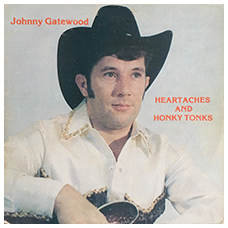 Johnny Gatewood "Heartaches And Honky Tonks" (Kash Records, 198-?) (LP)
(Produced by Sonny Deaton & Phil Harris)
Honkytonker Johnny Gatewood was born in Independence Missouri and played in the Kansas City area, as well as touring in various country road shows during the '60s and '70s. He later settled down in tiny, rural Inman, Kansas (just north of Wichita) and for many years played shows in the nearby towns of Hutchinson and Salina. For this album he traveled to Nashville to get studio pros like steel player Doug Jernigan to back him Somewhere I heard that this was his second album, and that the first one was also recorded in Nashville, though I haven't been able to confirm that info yet; he also released several singles, though I don't have all of that info either.
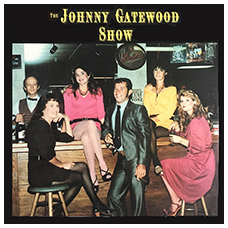 Johnny Gatewood "The Johnny Gatewood Show" (Horse Shoe Records, 1986) (LP)
(Produced by Mike Frazier & Johnny Gatewood)
I kinda dig the country album covers that picture the artists in bars... Sometimes they tell you a lot about the musicians or their fans, and the kinds of places they called home. I'm not sure which (if any) of the gals posed with Johnny Gatewood were in his band, though it's possible they all were: the liner notes credit the band as
Dell Daugherty on steel guitar, Roger Enns (steel), Maxine Gatewood (harmony vocals), Shirley Gatewood (bass), Diane Jackson (vocals), Allen Jones (banjo), Susie Schrag (drums), Tom Swofford (vocals) and Joe Wieneman on fiddle. It's cool that this was an all-local crew, as opposed to his previous pilgrimage to Nashville... The Jimmy Gatewood Show performed regularly in central Kansas throughout the mid-to-late '80s, as seen in numerous 1984-88 show notices in local papers from Hutchinson and Salina. On the back cover, Gatewood gives an address in Sterling, Kansas, which like Inman was a little north of Hutchinson. Alas, no mention of which bar they were in.
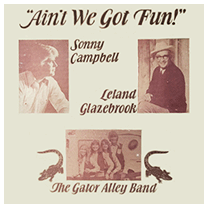 The Gator Alley Band/Various Artists "AIN'T WE GOT FUN!" (Sounds Fantastic/Q-95 Records, 1979) (LP)
(Produced by Stephen Beck & Sonny Campbell)
This country compilation was sponsored by a local radio station in Decatur, Illinois, Q-95... which amazingly enough remained a country station for over four decades after this set was recorded in the Summer of 1979(!) The featured artists included producer Sonny Campbell, who performs six songs, and Leland Glazebrook, who is featured on four others, with two more tracks featuring The Gator Alley Band, a family group which included sisters Dawna, Debbie and Dina Nelson, as well as Dwayne Nelson on bass. The house band seems to have been made up of producer Stephen Beck, who provided the string arrangements, Sonny Campbell on guitar and vocals, Roy Clayton (keyboards and saxophone), Dave Knowles (rhythm guitar), Harry Marshall (drums), Mike Sparth (steel guitar), and Charley Wilson on bass. Although this may have been the only record featuring Campbell and Glazebrook, the Nelson family definitely kept at it, recording the album below a few years later, simply billing themselves as Gator Alley.
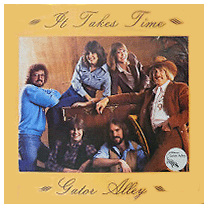 Gator Alley "It Takes Time" (Gator Alley Records, 1982) (LP)
(Produced by Gator Alley & Leon Reeder)
This Midwestern band featured three sisters -- Dawna, Debbie and Dina Nelson -- who wrote most of the songs on the album, backed by Dwayne Nelson on bass, steel guitar by Don Kates and lead guitar by Jerry Fitzpatrick. The album was recorded at Creative Audio studios, Champaign, Illinois and features liner notes by radio deejay Jerry Brock of WCCR, 1540-AM. The title track was previously included as one of two songs on the Q-95 compilation above...
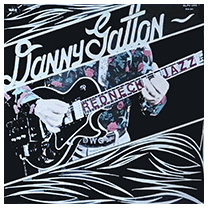 Danny Gatton "Redneck Jazz" (NRG Records, 1978) (LP)
(Produced by Bob Dawson & Danny Gatton)
Though hardly strictly country himself, hotshot guitarist Danny Gatton (1945-1994) definitely wanted the world to know he was not twang-averse, forging a country/jazz/blues/rockabilly hybrid style he called "redneck jazz." This early album featured Danny Gatton playing guitar, banjo and pedal steel, along with major input from fellow picker Evan Johns (later of Evan Johns & The H-Bombs) who plays lead guitar on one track, and sings on three. Also onboard are pedal steel luminary Buddy Emmons (guesting on one track), drummers Rick Davis and Dave Elliott, Bob Hancock (rhythm guitar), John Previti (bass) and Roy Buchanan's early 'Seventies vocalist Chuck Tilley, singing lead on a couple of tunes, including his own composition, "Sailin' On." [Note: this was Gatton's first album released under his own name, though he previously recorded the Danny & The Fat Boys album, American Music, which came out in 1975.
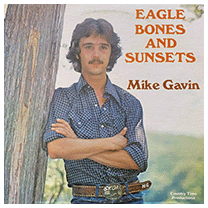 Mike Gavin "Eagle Bones And Sunsets" (Country Time Productions, 1979-?) (LP)
(Produced by Mike Bishop & John Miller)
A bit of a mystery disc, recorded at John's Recording Studio in Russellville, Arkansas by a young twang auteur named Mike Gavin, who wrote and performed all the songs, with help on the arrangements by a fellow named Darel Snodgrass. Gavin sings and plays rhythm guitar, backed by Mike Bishop on drums, Danny Herbert (bass), Dean Porter (lead guitar), Dave Massey (banjo), Tonette Rodgers (backing vocals), George Scrivner (mandolin) and Billy Dale Sexton on steel guitar. There's no date on the jacket or disc, though I have seen some folks pegging this as a 1979 release... Likewise, there's little biographical info on Mike Gavin to be found, though several of the musicians have interesting profiles... Darel Snodgrass started playing professionally at an early age, and worked at various Ozark oprys, including a theme park called Dogpatch USA, which was based on the Lil' Abner newspaper cartoon strip; he later went into public radio, working both as a show host and station manager. Steel player Billy Dale Sexton was perhaps the most prolific artist of this group: he also had a background in various regional "oprys," though he shifted his focus into the southern gospel scene where he became an accomplished songwriter as well as performing in several groups, notably an early 'Seventies gig with The Hemphills. Mike Gavin's info remains a bit more elusive, though he seems to have kept at it for a long time, releasing at least one other album, Restless Heart (below) years later in 1993. As always, any info is welcome!
Mike Gavin "Reckless Heart" (1993) (cassette)
Not sure, but this may have been a cassette-only release... Gavin was apparently aiming at a Top Forty sound, though he also found time for some regional themes, as on the song "I Love These Ozark Hills."
 Mac Gayden "Skyboat" (ABC Records, 1976) (LP)
(Produced by Buzz Cason & Mac Gayden)
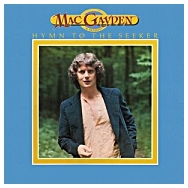 Mac Gayden "Hymn To The Seeker" (MCA Records, 1976) (LP)
(Produced by Mac Gayden)
Session guitarist Mac Gayden played on Dylan's Nashville Skyline and led the Nashville-based jam bands Area Code 615 and Barefoot Jerry... Although he plays banjo and mandolin (somewhere in the mix), there's not a lot of twang on this spacey, spiritual set of disco-tinged white funk, some of it quite monotonous. Didn't do much for me, sorry to say.
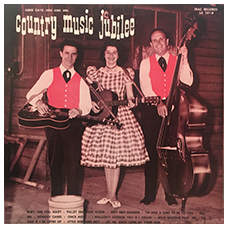 Abbie Gaye, Ken And Mel "Country Music Jubilee" (Trac Records, 1964) (LP)
(Produced by Stan Anderson)
The bluegrass-y trio of Abbie Gaye, Ken Stephens and Mel Johnson are perhaps best known for their stringband parody of the Buck Owens song, "Tiger By The Tail," which they recorded for Starday Records in 1965 as "I've Got A Polecat By The Tail." This album is less novelty-oriented, filled with earnest covers of bluegrass classics by Jim Eanes, Flatt & Scruggs and Bill Monroe, along with a few gospel tunes and a zippy rendition of "Ruby Are You Mad." There are also several songs credited to "M. Johnson," who I think was Mel, and these seem to be originals or his adaptations of traditional material. This may have been the first LP issued by Trac Records, a label based in Fresno, California -- I could find very little info out about these folks online, so I'm not sure if they were a California-based band or not... At any rate, it's nice stuff. Resolutely old-fashioned, these plainspoken performances harken back to the heartfelt, no-frills styles of artists such as Molly O'Day or Wilma Lee and Stoney Cooper.
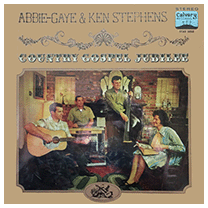 Abbie-Gaye & Ken Stephens "Country Gospel Jubilee" (Calvary Records, 1971-?) (LP)
(Produced by Stan Anderson)
An all-gospel offering from these rootsy Californian twangsters... The liner notes inform us that Ken Stephens was originally part of a country music brother act, The Stephens Brothers, out of Hamilton, Ohio. The group broke up, though, when his kid brother got drafted, and Stephens soon moved out West with his wife, singer Abbie-Gaye sometime in 1961. (Her name is hyphenated here, but not on their previous album a few years earlier.) They first tried their luck in LA, then landed a job hosting a TV show in Fresno, called Country Music Jubilee, which hit the air in 1964. Their old trio partner Mel Johnson also chimes in, as well as steel player Densel Perry, who we're informed joined the act in November, 1970, making this maybe more of a '71 kind of record?
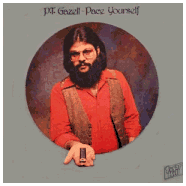 P. T. Gazell "Pace Yourself" (Sugar Hill Records, 1978) (LP)
Another odd one: Johnny Paycheck's harmonica player Phil Gazell fronts a studio band that includes Jerry Douglas playing dobro and Ricky Skaggs on mandolin, in a mostly-bluegrass set, with some dips into sentimental Antbellum-style material, a few Irish jigs, and a little bluesy swing. Originally from Oconomowoc, Wisconsin, Gazell moved to Lexington, Kentucky in the late '70s, where he cut this album with the cream of the crop of new-generation newgrass musicians. He mostly blows the harp but also sings on a tune or two: the CD/MP3 reissue includes some twangier bonus tracks with an Asleep At The Wheel feel to them. Not bad! And is sure is interesting to hear the harmonica in a bluegrass context...
 Arthur Gee "Arthur Gee" (Tumbleweed Records, 1970) (LP)
This review is more of a warning sign, I guess. Apparently from Kitchener, Ontario, Canada's Arthur Gee is another one of those weird, eclectic 'Seventies obscuro artists who get lumped in with "country rock" music just because there's some banjo or pedal steel somewhere in their mix. But really, this is a far-flung, spaced-out experimental rock album with proggy and psychedelic folk leanings... If you're into the harder core of '70s experimentalism, this record could be cool... He dips into mellower, Emmitt Rhodes-y territory, but a lot of this is pretty challenging, in more of a Kingdom Come pop-blender style. But if you're looking for a missing Chris Hillman folk-rock album, this ain't it.
 Arthur Gee/Arthur Gee-Whizz Band "City Cowboy" (Tumbleweed Records, 1971) (LP)
This album is slightly more twangy and a lot more accomplished than Gee's self-titled debut, also edgier with passages that evoke some of the choppier prog and freak-folk of the era. It's mostly spacey and playful, but there are a few abrupt curves into harder "boogie rock" material that have an unexpected severity that suggests pre-punk and avant-rockers such as Alice Cooper or demos-era Devo. A little bit of twang and a few semi-pastoral passages, but this ain't the country-rock gem you might expect from the album title. If you're a twangfan, consider yourself forewarned. This is probably best celebrated as weirdo-obscuro experimentalism, but there are some more accessible tracks as well, such as the rocker "Green Countryside," although a bunch of the spacier stuff seems ripe for modern-day tributes, ala Vashti Bunyan.
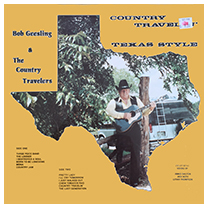 Bob Geesling & The Country Travelers "Country Travelin', Texas Style" (Star Trail Records, 1984) (LP)
(Produced by Bill DeJarnatt)
A real country old-timer, Bob Geesling is probably best remembered as co-composer of the song "The Heart You Break May Be Your Own," which Patsy Cline recorded back in 1956. His own recording career goes back at least as early as 1955, when he cut a fabulously twangy gospel single; he was also known for his work in Tiny Colbert's band, a true-Texas outfit that cut several sizzling discs way back in the late 1940s and early '50s. This late-life album showcases a half-dozen originals by Geesling, including "The Last Generation," one of his fab 'Fifties gospel tunes, and "I Destroyed A Soul," which previously came out as a Star Trail single back in the late '70s. He also covers one of Tiny Colbert's postwar oldies, "Pretty Lady," a jaunty tune that dates back to 1949. Bob Geesling and his wife, drummer Nita Geesling, owned a music store in Denison, Texas, about an hour north of Dallas on the "Texoma" state border. The Geeslings are joined by several locals on this album, including Leon Elliot on banjo, bassist Jack Noth and Luther Thompson playing mandolin and steel guitar, as well as guest vocalist James Shelton, who does a darn good George Jones imitation. Lots of great material on here, one strong song after another, with Geesling's own "I'll Cry Tomorrow" being perhaps my favorite track on the album. Mr. Geesling seems to have been born in either 1931 or '32, and since passed away, although I couldn't find out exactly when.
The Geezinslaw Brothers -- see artist profile
Charles G. Geller "Cornerstone" (1972) (LP)
Perhaps the most country-sounding album by Christian folk troubadour Charles G. Geller, a long-ish haired guy who had a "folk concert ministry" in Baton Rouge, Louisiana. This album was recorded in late 1972, and includes several original songs that have religious themes, though he also covers secular hits such as "City Of New Orleans," "Good Time Charlie's Got The Blues," "I Believe In Music" and "Song Sung Blue." Mr. Geller recorded several similar albums -- some seem more pop-oriented, while others delve much deeper into his religious vibe.
 The Gems/The Nashville Sound '70s "Dream Baby And Other Country Hits" (RCA Camden, 1971) (LP)
(Produced by Bob Ferguson, Ethel Gabriel, Chuck Seitz & Roy Shockley)
This is one of those quickie-cheapie anonymous-band truckstop albums that flooded the bins in the 1960s and '70s, although in this case, the band wasn't as completely anonymous as those playing on the smaller, non-major label records. The Gems were the full-time backing band of Nashville star Jim Ed Brown, anchored in the early 'Seventies by steel player Hank Corwin and lead guitar picker Earl Erb. The band's name was a take on Brown's own name -- Jim's Gems, get it? -- a play on words that also provided the title of one of his late '60s albums. Anyway, the Gems were for real, although I think there were a few RCA studio ringers on this disc as well, guys like Bunky Keels and Jerry Shook. Anyway, it's a legit "solo" album by a working Nashville band. Likewise, the Nashville Sound 70s vocal group -- Dianne Hines, Dottie DeLeonibus, Richard Law and Ronnie Drake -- were also part of Brown's entourage, originally singing on his TV show, starting in 1970. The songs include covers of a few big "sunshine country" hits, along with a bunch of other obscuro tunes that were probably written by some of the musicians themselves.
The Gems "The Gems" (1980-?) (LP)
(Produced by Dan Gant)
Sometime around 1975, '76, there was a big shakeup in Jim Ed Brown's band, though steel player Hank Corwin stuck around and led the band for a few more years... This album features Corwin anchoring a new crew including Bruce Osborn (lead guitar), Ed Chambliss (drums), Jerry Braswell (bass), Tim Atwood (piano) and Tom Rutlege (banjo, rhythm guitar) and I'm guessing this was an early '80s lineup, just since they look so much like Alabama or the Oak Ridge Boys. Porter Wagoner wrote the liner notes for this album and is pictured on the back with the band, sitting in front of a giant mixing board, so possibly he produced the album as well. Eventually he poached some of these guys for his own band, notably Hank Corwin, who then played with Wagoner for several years. This disc has a lot of cover tunes, and possibly a couple of originals, although it's hard to tell, since there are no composer credits...
Gene & Debbe "Hear And Now" (TRX Records, 1968) (LP)
(Produced by Dan Gant)
The Nashville duo of Gene Thomas and Debbe Neville had their biggest success as '60s pop artists, although they dabbled with country and there's definitely an element of twang in the mix as well. They seem to have been pals of songwriter Mickey Newberry -- in addition to several songs written by Thomas, they recorded a couple of Newberry's early tunes, as well as one by John D. Loudermilk and a few others. Thomas had some commercial successes as a songwriter, and remains a cult fave for some retro-pop fans. There's also a generously programmed reissue CD on the Sundazed label that gives a pretty full picture of their career.
Gene And Joe & The Valley Troubadours "Sing Favorite Songs" (Seneca Records, 1965-?) (LP)
A brother duo who modeled themselves after bluegrass legends Reno & Smiley, Gene and Joe Winebrenner formed their first band in 1963. Early on, they won a local talent contest in Seneca, West Virginia, where they caught the attention of their idols... Reno & Smiley! The brothers were invited to join the cast of a local country program, "The Big Valley Barn Dance," on station WSVA-TV, in Harrisonburg. I'm not sure where they were from originally, but the Winebrenners certainly moved around a lot, as many country musicians did in the old days, finding berths at several radio and television stations over the years.
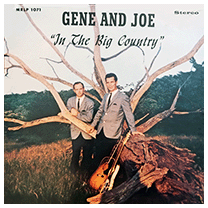 Gene & Joe "In The Big Country" (Major Label Records, 19--?) (LP)
(Produced by John Major)
A more country-oriented album here, recorded for John Major's label in Waynesboro, Virginia sometime in the early 'Seventies. It's nice mix of original material (about half the album) and covers, including old-school honkytonk and heartsongs from folks such as Wiley Walker and Hank Williams, as well as a couple of newer, West-er, Coast-ier songs from Merle Haggard. The Winebrenners were living in Burlington, West Virginia when they cut this disc, and were backed by their band, The Country Kings, though alas the liner notes don't provide any names for the musicians.
 General Store "Off The Shelf" (Ripcord Records, 1979) (LP)
(Produced by Blaine Allen & Ellis Miller)
Another Ripcord offering. This band from Seattle, Washington seems kind of rock-oriented, but twangy. The lineup featured Carlos J. Dominguez on bass, Brian Dunn (synthesizer and mellotron), Allan T. Flaa (lead guitar and steel), David Philip Haynes (drums), and Judy Walker on piano and vocals.
 Gentle Ben "Gentle Ben" (Loggerhythm Records, 1980-?) (LP)
(Produced by Jim Flannigan & John Austin)
This country-rock band from Boise, Idaho split its album between (mostly) cover songs on Side One and original material on Side Two... Keyboard player Bill Truitt wrote most of the material, with drummer Dennis Carrasco penning a couple of tunes. In addition, they delve into stuff by Dylan ("Billy The Kid"), Mickey Gilley ("Don't The Girls All Get Prettier At Closing Time") and Willie Nelson ("Bloody Mary Morning," "Me And Paul") with guitarist Mark Lucas adding some rock-flavored licks throughout. There was another band called Gentle Ben active around the same time, but they were from Cincinnati, Ohio and had no connections to these guys.
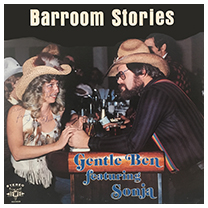 Gentle Ben - Featuring Sonja "Barroom Stories" (Jewel Recordings, 1981-?) (LP)
(Produced by Junior Bennett)
Strangely enough, I believe this Gentle Ben was an entirely different group than the Idaho band listed above. These folks were from Cincinnati, Ohio, led by the main songwriter Ben Nielsen, his wife Sonja and fiddler Junior Bennett, who produced the album. Their sound is fleshed out with help from steel player Dale Wagner, and the Jewel label's Rusty York, who sits in on banjo and dobro. Overall, this one didn't wow me... The band is pretty clunky and clompy, aiming for an outlaw country/boogie rock sound... real-deal bar-band stuff, but not the best I've heard. The cover songs include a belabored version of Tompall Glaser's infamous "Put Another Log On The Fire," recast as a "Tramp"-style bickering couple song, with the Nielsen's dishing out jabs at one another in what I guess was a chance to, ahem, liberate the song from its agitprop male chauvinist origins. Worth a spin, but not as much fun as I'd hoped.
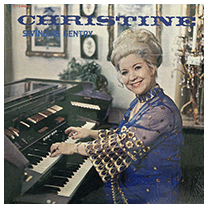 Christine (Gentry) "Swinging Gentry" (197-?) (LP)
(Produced by Neil Hemphill & Esther Johnson)
It might be a bit of a stretch lumping this one in with all the country records -- lounge organist Christine Lovelace Gentry (1920-2009) had a lot of old-school pop music in her quiver, chestnuts like "Sweet Georgia Brown," "Somewhere My Love," Earl Grant's "Swinging Gently" and the perky pop-gospel tune, "Put Your Hand In The Hand Of The Man From Galilee." But there are an awful lot of country tunes as well: "For The Good Times," "Green Green Grass Of Home," Hank Locklin's "Send Me The Pillow That You Dream On," even a hillbilly oldie from Zeke Clements called "Just A Little Bit Of Loving," all performed on the Baldwin Pro-200, with accompaniment by drummer Sonny Harris and Lloyd Honeycutt on guitar. According to the liner notes, Ms. Gentry put in her hours in Vegas, in New York City, San Francisco and abroad, but Birmingham was her hometown, where she hosted a weekly TV show and played the local dinner clubs. This album also includes one of her own originals, a gospel number called "I'm Talking To Jesus." She had several other albums, including some which may have recycled material off this album, and others. This is certainly one of her more "country" records, though... Apparently she was one of Sam Phillips's cousins as well!
Gordon Gentry "Life's Railway To Heaven" (19--?) (LP)
Not a lot of info about this one. Gordon G. Gentry (1927-2002) was an old-school county gospel singer from Loxahatchee, Florida, near Palm Beach, who recorded several albums and performed locally with a group called the Gospel Strangers, which also included mandolin player Fran Gentry, who I think was his daughter. I'm not sure when any of these albums were made, though the Gospel Strangers performed regularly at the Florida Folk Festival during the early 1990s. Mr. Gentry also appears to have been the host of an evangelical lecture program, God's Miracle Hour, which he broadcast on shortwave radio.
The (Swingin') Gentry Singers "Pop Goes The Country" (Hickory Records, 1966) (LP)
(Produced by Wesley Rose)
I think this was a "band" album by the Gentry Singers, a Nashville studio group modeled on the Anita Kerr Singers, and led by Sharon Gentry. They did a lot of session work, particularly for the Hickory label, and a few singles also came out under Sharon Gentry's name. The repertoire is typical cheapo-label, fake-band fare, mostly oldies by Hank Williams, Don Gibson, Marvin Rainwater, etc., including a version of the Everly Brothers classic, "All I Have To Do Is Dream." Not sure who produced this, but the sessions were conducted by John Cacavas, with an eye towards the same pop-country crossover market that had been tapped by Ray Charles and Patti Page.
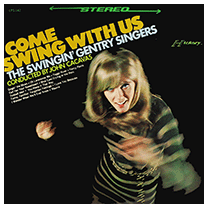 The (Swingin') Gentry Singers "Come Swing With Us" (Hickory Records, 1967) (LP)
(Produced by Nick Firth)
I guess "swinging" was their thing! Easy listening country... just as you like it. Maybe.
 Lowell George "Thanks, I'll Eat It Here" (Warner Brothers, 1979)
(Produced by Lowell George)
One of the great lost albums of the 1970s! The late, great Lowell George was lead singer of the roots-rock/funk-jazz superband, Little Feat... On this solo outing, he let go of Little Feat's rougher edges, in favor of a mellower, more conventionally "pop" sound. The album covers blues, country and soulful rock -- plus, it's jam-packed with fun, enjoyable songs. My favorites include the mariachi-flavored "Cheek To Cheek," his versions of Rickie Lee Jones' "Easy Money," and the old Ann Peebles soul ballad, "I Can't Stand The Rain," as well as a great remake of the Little Feat classic, "Two Trains..." Heck, the whole album is great. Also includes a couple of mournful acoustic numbers that are some of the most melancholy tunes I know: "20 Million Things To Do" and "Find A River." I'm happy to report that this record is back in print at last... You should really snap this one up!
Buzz Gertson - see Buzz Goertzen
Tom Ghent "Tom Ghent" (Tetragrammaton Records, 1969) (LP)
(Produced by Jill Gibson, Armin Steiner & Eirik Wangberg)
In the mid-1960s, Rhode Island coffeehouse folkie set sail from the shores of Provincetown and washed up like driftwood on the beaches of Greenwich Village, making the scene with folks like Dylan, Ochs and Paxton, even singing harmony on Joan Baez's version of "The Night They Drove Old Dixie Down." He also recorded his debut album on the eclectic but ill-fated Tetragrammaton label, which folded the following year, but which may actually have been a pretty good fit for Ghent's hard-to-characterize musings. This disc is an odd combination of slightly dreadful, folk-tinted pop vocals and scattered forays into folk-country... Similarly, there's a curious hodgepodge of LA-based studio talent, with Marty Paich providing arrangements, and various Wrecking Crew types anchoring the session, notably Al Casey playing acoustic guitar and dobro (notably on the novelty twang tune, "Sour Grapes") along with Mike Deasy playing lead guitar, Larry Knechtel (piano), Joe Osborn (bass), Earl Palmer (drums), and The Blossoms providing backing vocals. I wouldn't exactly call this a "country" album, but it's close enough for an era when Glen Campbell hits such as "Wichita Lineman" and "Gentle On My Mind" rose ascendant over the musical landscape. There's also a Nilsson-like, Tom Chapin-esque feel to a lot of this record, for what it's worth. But if any of this sounds intriguing, this album is probably worth tracking down.. It might not be my cup of tea, but it could be your shot of espresso.
Tom Ghent "Yankee's Rebel Son" (Kapp Records, 1971) (LP)
(Produced by Gene Eichelberger & Norbert Putnam)
At the urging of Kris Kristofferson and Shel Silverstein, Tom Ghent moved to Nashville and quickly found work as a studio musician as well as success as a Music City songwriter. Nat Stuckey rang up a modest 1970 hit with Ghent's song "Whiskey, Whiskey," which peaked at #31 on the Country charts. That was enough of a Music City calling card to merit the recording of this album, which was packed with top Nashville talent, including a bunch of the Area-615 A-team, including David Briggs, Jerry Carrigan, Charlie McCoy and Norbert Putnam, as well as esteemed pickers such as Billy Sanford and dobro/steel player Ben Keith. Definitely more twangy than his earlier folk stuff, and worth checking out though obviously not a record that made Tom Ghent a household name.
Tom Ghent "All Strings Attached" (Sutherland Records, 1983) (LP)
Davey Gibbs "...And His Country Hoppers" (RCA-Camden, 1962) (LP)
Nicknamed "The Country Kid," Davey Gibbs was a bluegrass-influenced bandleader from Kingston, Ontario who formed his band in the late 1940s, and kept on truckin' right through the days when he cut these albums. This one has a slightly fusty song selection, but was pretty country and robust -- the band featured a pedal steel player, standup bass, fiddle, guitars... Not sure how extensively his discography was, but this is pretty solid material!
Davey Gibbs "Mister Hoedown" (RCA-Camden, 1963) (LP)
 Richard Gibbs "No Use To Grieve" (Malinda Records, 19--?) (LP)
Ultra-forlorn, booze-soaked 1960's honkytonk from an unknown Louisiana singer, on an album I've only heard of courtesy of the Waxidermy website... This is kinda like the album that No Show Jones would have made if old George had gone down an indie path or been even more forthcoming about his drinking problem(s). The title track is a glorious mega-bummer about a divorced and down-on-his-luck dad, while other songs deal more explicitly with the themes of alcohol abuse, including the crushingly harsh "Drinkin' Spree," in which the narrator gets his ass royally kicked in a bar fight, which is illustrated in grim, explicit detail, but with a jaunty little lilt, with just the sort of bemused detachment you'd expect from someone who was drunk enough to stay conscious during the ordeal. This is a really good record: any chance the uber-collectors who have it (or Mr. Gibbs himself) could reissue it sometime? Love to hear the rest!
 Terri Gibbs "Totally Terri" (Tem Records, 1982) (LP)
(Produced by Billy Arr & Mike Kirby)
Originally a demo-y souvenir set from her days playing dinner clubs in Augusta, Georgia, this album quickly resurfaced once Gibbs hit the Top Ten and crossed over in the the pop charts. Plenty of lush countrypolitan tunes with a definite rural edge, though also some real rough, abrupt spots in terms of the arrangements and mix, as well as some ongoing showboating from the local studio band. Still, she had a very pleasant voice, and it's instructive to hear how strong she sounded even before Nashville got ahold of her. Tem Records was a short-lived indie label, with Georgia-based producer Mike Kirby being its other major artist.
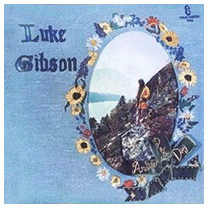 Luke Gibson "Another Perfect Day" (True North Records, 1972) (LP)
(Produced by Gene Martynec, Bill Seddon & Chris Skene)
A lovely folkie album with country roots from Canadian songwriter Dave (Luke) Gibson who was a veteran of a couple of Toronto psych-rock bands, Kensington Market and Luke & The Apostles (where he picked up his stage name). In the early 'Seventies he apparently decided to drop out of the rock scene for a while and explore a mellower musical approach for a while. This mellow, contemplative acoustic-based set features excellent musicianship all around, including a young Bruce Cockburn on guitar, his former bandmate Gene Martynec, and some particularly sweet fiddling by Lenny Solomon. Perhaps a little far afield from our focus on country-based twang, but it's a really fine album, worthy of your attention. Fans of Jonathan Edwards, or perhaps even of Nick Drake, might really dig this. Recommended.
Marshall Gibson "I Can't Forget" (Lincoln Jamboree Records, 19--) (LP)
(Produced by Wayne Sexton)
A singer and piano player, Marshall Gibson was a member of one of the later editions of Joel Ray Sprowls' country revue, the Lincoln Jamboree, located in Hodgenville Kentucky. There's no info about him online, and no date on the disc or the album art, though it looks like it might have been early/mid-1980s(?). The repertoire is mostly classic country covers, though Marshall wrote the title track, "I Can't Forget." He's joined here by Carlton Noel on steel, Charles Durham (drums), Jack Lewis (bass) and Ronnie Benningfield (backup vocals), as well as Darrell Tubb on lead guitar. (Tubb is also a dobro and steel player who worked in numerous regional country and bluegrass bands over the years, right up into the 2010s, when he helped anchor the house band for the Corydon Live jamboree, in Corydon, Indiana.)
Bobby Giles "Never Gonna Roam" (BG Records, 19--?) (LP)
(Produced by Jerry Abbott)
Contemporary Christian music, with a Texas country spin. This was recorded at Jerry Abbott's studio, Pantego Sound, in Arlington, Texas with a studio band that included Jerry Abbott on keyboards, pedal steel player Junior Knight, guitar picker Jerry Metheny and backup singer Sally Gardner, who also played on plenty of secular indie sessions. All the songs are originals written by Giles, though they seem to have primarily spiritual themes, and few nods towards country conventions. Kinda reminds me of 'Seventies stuff from John Denver at times, though with a little more country bite.
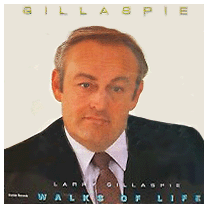 Larry Gillaspie "Walks Of Life" (Daven Records, 1989) (LP)
(Produced by Pat Holt & Johnny Howard)
A twenty-nine year veteran of the Davenport, Iowa police department, Larry Earl Gillaspie (1945-2020) penned the song "Little Blue Knight" to pay homage to his fellow officers. The song was released as a single, and as one of several originals on this album, which Mr. Gillaspie recorded during a trip to Nashville. He had a long history making music: in the 1950s he was in a high school band called The Townsmen, and much later in life he organized a church group called the New Life Christian Singers. Unfortunately, the musicians backing him on this album aren't identified, though presumably they were some Music City hired guns; the backing vocals are credited to the Sudi Baker Singers, who seem to have been an offshoot of the late '70s chorus that Nashville producer Mike Figlio employed as the "Bach Ahp Singers."
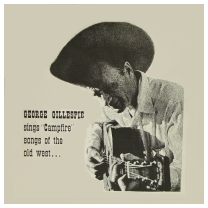 George Gillespie "...Sings Cow Camp Songs Of The Old West" (Thorne Records, 19--?) (LP)
Hardcore, old-fashioned cowboy and western songs sung by a dude wrangler and ranch hand from Scottsdale, Arizona. Pretty much the real deal.
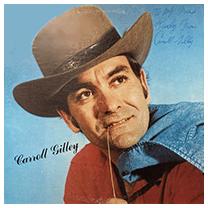 Carroll Gilley "...And The Southern Comfort" (Teardrop Records, 1976) (LP)
(Produced by Foy Lee)
A relative of piano thumper and bar owner Mickey Gilley (and by extension, of Jerry Lee Lewis and evangelist Jimmy Swaggart), nephew Carroll Gilley also cut a few tracks way back in the early 'Sixties but is best known for leading his band Southern Comfort through much of the "Urban Cowboy" era. He frequently shared the bill or collaborated with Mickey Gilley, though much like how Mickey Gilley sounded a lot like Jerry Lee, Carroll Gilley was rather imitative of his uncle Mickey, covering many of the same songs and sharing a lot of the same vocal tone. He did write his own material as well: most of the songs on Side One of this album (his first?) are credited to Carroll Gilley, with one other, "Let Me Keep Your Love" composed by Jimmy Velvet, who also used producer Foy Lee's publishing company. There are no producer or musician credits on this album, though an autographed copy I found gave clues to at least some of the lineup -- Carroll Gilley played piano, of course, while the other three fellers, pictured on the back included a guy named Edward Allen, someone named Bill and another guy I think was called Mark. Additional info would be welcome.
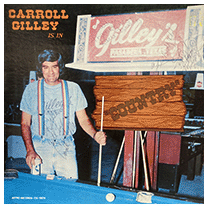 Carroll Gilley "Carroll Gilley Is In Gilley's Country" (Astro Records, 1979) (LP)
This album was recorded on Mickey Gilley's own label, based in Pasadena, Texas... Alas, once again, no info about the backing band.
Carroll Gilley "The Terrace Presents Carroll Gilley" (Teardrop Records, 1980) (LP)
Carroll Gilley "Carroll Gilley" (Axbar Records, 1984) (LP)
Larry Donn Gillihan "Thank You Music Lovers" (Shelby Records, 1976) (LP)
A rockabilly rebel from Arkansas, Larry Donn Gillihan (1941-2012) cut a few singles back in the late 1950s and early 'Sixties, just enough to cement his reputation as a rock pioneer, then like many of the kids from his generation he moved away from his greasy-kids-stuff roots for a while and reemerged in the 'Seventies as a combination retro-rocker and country artist. He cut several albums as "Larry Donn," and found a belated audience of rockabilly revivalists... On this album he digs more deeply into country material, with covers of Hank Williams, Wayne Raney and Harold Dorman, edging into swamp rock and rocker territory with tunes from the likes of Roy Orbison and Tony Joe White, and even a cover of CCR's "Proud Mary," to round things out.
Jimmie Dale Gilmore - see artist discography
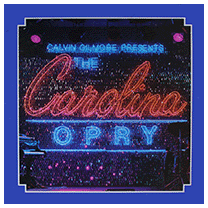 Calvin Gilmore/Various Artists "Calvin Gilmore Presents: The Carolina Opry, v.1" (Candock Records, 1987) (LP)
(Produced by Calvin Gilmore & Jim Rhodes)
A souvenir album of one of the many mom'n'pop "opry"-style variety shows that dotted the landscape over the years... This one was out of Surfside Beach, South Carolina and featured bandleader Calvin Gilmore along with a group that includes Steve Templeton, Janet Smith and others. This one seems to be more of a "band" record, rather than a compilation - many of the same artists play on various tracks. I also think Gilmore may have gone on to become a gospel artist...
 Calvin Gilmore/Various Artists "Calvin Gilmore Presents: The Carolina Opry, v.2" (Candock Records, 1988) (LP)
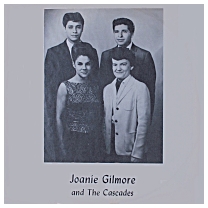 Joanie Gilmore & The Cascades "Joanie Gilmore And The Cascades" (Gil-Key Records, 1965-?) (LP)
(Produced by R. M. Caskey)
An ultra-DIY set from 1960's Topeka, Kansas, with cool, Wanda Jackson-ish vocals by Ms. Gilmore. By the way... Anyone out there have a copy they could lend me?
Johnny Gimble - see artist discography
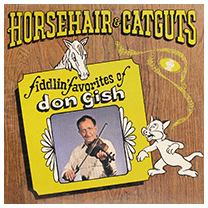 Don Gish "Horsehair And Catguts: Fiddlin' Favorites Of Don Gish" (American Heritage Music Corporation, 1973) (LP)
(Produced by American Heritage Music Corporation)
Another one of those fiddling albums, this time in "the Canadian style," apparently. Mr. Gish was a championship fiddler who competed in Washington state and throughout the Pacific Northwest... He helped found the Idaho Oldtime Fiddlers Association though he was living in Oregon when he made this album. He was accompanied by locals Don Bonar on banjo, Joyce Bonar (accordion), Lyle Powell (guitar), Jim Thomas (guitar), and multi-instrumentalist Bill Yohey just playing mandolin this time around.
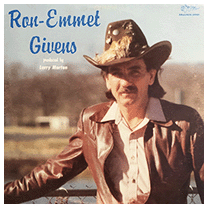 Ron-Emmet Givens "Ron-Emmet Givens" (Prairie Dust Records, 1981) (LP)
(Produced by Larry Morton & Gene Rice)
I couldn't find out much about this guy, outside of the liner notes on this album... His name was Ronald Emmet Givens (which he didn't always hyphenate) and he was born in Missouri but grew up in Arkansas, and he worked all over the map before apparently landing in Nashville, where he recorded this album, with backing by a bunch of Music City studio pros. He had some sort of professional arrangement with songwriter Ann J. Morton (who I believe owned the Prairie Dust label) and recorded several of her songs on this album, including "Life Without You," which she also sings on... Givens seems to have settled in Nashville and was listed doing some shows there in the mid-1980s, though after that the trail grows cold.
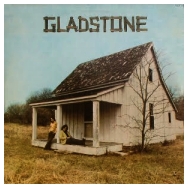 Gladstone "...From Down Home In Tyler, Texas, USA" (ABC, 1972) (LP)
A soft-sounding Southern rock set, with a healthy undercurrent of twang. This band was a rainmaker project for producers Robin Hood Brians and Randy Fouts, whose Brians Studio was a focal point for local artists in and around Tyler, Texas. Apparently this record was released twice, the first time with the Tyler Texas title, and then again, with different album art as just plain old "Gladstone." They had an almost-Top 40 single with "A Piece Of Paper," but the mojo wasn't quite there for mainstream success... Apparently Mike Rabon, formerly of the pop band The Five Americans, was hooked up with this band, after his earlier country-rock efforts with the band Choctaw, though after this he bailed on the music business and went back to school.
 Gladstone "Lookin' For A Smile" (ABC, 1973) (LP)
(Produced by Robin Hood Brians & Randy Fouts)
Nice mellow stuff, particularly the skillful pedal steel by Bobby Tuttle... Admittedly, this is a pretty uneven album, pulled in several directions stylistically, ranging from some pretty nice cosmic-cowboy stuff and mostly-mellow Southern rock, to more "epic" guitar rock (as on the album's closer, a lazy, hazy stoner anthem called "Here Comes That Feeling'," which also features some nice harmonica by Mickey Raphael...) There are a couple of Michael Rabon songs on here, including a remake of "Texas Sparrow," which was originally part of his Choctaw album. I don't think he was on this record, though, unless he was playing under some alias... There's only one really big, hard-edged Southern rock song on here, "Dixie Woman," which I didn't like, but I imagine is a cult favorite for the genre. Mostly, this is a pretty mellow album, and I enjoy the softer steel-drenched stuff. Worth a spin. (BTW: anyone know if the Tom Russell who sang backup on here is the same guy as the Texas singer-songwriter folkie, who was in Texas around this time? Just curious.)
The Jim Glaser Singers "Old Time Christmas Singing" (Starday Records, 1961-?) (LP)
Jim Glaser & The Americana Folk Trio "Just Looking For A Home" (Starday Records, 1962-?) (LP)
 The Jim Glaser Singers "Country Spectacular Live From The Stage In Nashville" (Wyncote Records, 1964-?) (LP)
Tompall Glaser - see artist discography
Glasgow - Lord - Woods "Rock'N' Chair" (1979) (LP)
(Produced by Danny Glasgow, Bill Woods & Mike Lord)
The folk-country trio of Danny Glasgow, Mike Lord and Bill Woods were apparently from California -- some folks say Northern California, but I'm guessing they're really from around LA, since one song on this album is called "Salt Creek," which is a popular beach in Orange County. Not a lot of info on these guys, though.
 Dawn Glass "Sunshine And Lollypops" (R. C. Records, 1976) (LP)
A perennial second-stringer, Louisiana's Dawn Glass was a regional performer, doing concerts and TV shows in the Shreveport area while trying to make it on the national level. She recorded a few singles on a variety of labels, including ABC-Paramount, and Chart Records, and was signed by Columbia Nashville in the 1967, but as far as I know this was her only album. It was released on the Waco, Texas RC label, though perhaps the most interesting thing about this album is that all but two of the songs were written by Ann J. Morton, who was herself at the time an aspiring country musician. (I wrote to Ms. Morton to ask about the connection, and she said she had pitched some songs, including "Sunshine And Lollypops," to Glass and she wound up recording several others... One of these, "Kentucky Boy," was previously recorded as a single on Chart Records in 1973.) Even better, this is a nice record. Ms. Glass was an appealing vocalist, with a bright rural twang that strongly resembled that of Loretta Lynn, and while a couple of tracks on here sound less well-rehearsed than they could have been, mostly this is pretty solid musically speaking. A strong song selection as well, with a lot of stuff that should be of interest to any of Ann Morton's fans -- there's also a swell version of Ray Griff's "Pour A Little Water On The Flowers" that kicks off Side Two. All in all, definitely worth a spin!
 Glass Hammer "On Our Own" (Crescent Hill, 1979)
Although they went on to become famous as a prog-rock powerhouse, Nashville's Glass Hammer first album spotlighted them as a '70s sunshine-y soft-rock band with a penchant for pop-twang similar to the stuff Mac Davis had been recording years earlier... There's a plain country vibe here, but it comes amid perky pop and disco, it feels pretty tongue-in-cheek... The "rebel shout" lyrics in the opening track sound satirical, and likewise, covers of Steve Goodman's "You Never Even Call Me By My Name" and Kenny Rogers' "We've Got Tonight" seem to underscore a Southern rocker's sense of irony or distain towards mainstream country, while their real creative mojo was somewhere else. I've seen this cited as a country-rock gem, but I'm not quite buying it...
 Don Glasser & Lois Costello "Don And Lois Play Country And Western Their Style" (Cha Cha Records, 197-?)
A ballroom danceband/lounge duo from Chicago doing a country set... Despite this being his fourth album, bandleader Don Glasser really seems to have been conflicted about how to present himself -- the front cover pitches this as a duet act, Don and Lois, but he takes top billing on the back, albeit with an odd permutation of his own name, which is spelled "DON GLASSer," as if he was considering shortening the surname to make it sound more showbiz, but couldn't quite pull the trigger on it. Pretty goofy. As near as I can tell, Glasser normally played old-school post-big band dance music, but "went country" on this album, covering a lot of legit country hits, stuff like "Release Me," "San Antonio Rose," There Goes Everything," "For The Good Times," et.al. with a tilt towards songs that were standards in the early 'Seventies, notably "Help Me Make It Through The Night" and "Snowbird," which place this one at least as late as 1970. Super-minimal liner notes, which give a label address in Chicago, and imply that the Don Glasser Orchestra had gigs in New York and Dallas, but sadly do no give any info about the backing band or producers.
 Jeff Glaze "Where No One Else Has Been" (Cloud Records, 1973) (LP)
(Produced by Jeff Glaze & Tim Ramsey)
I mean, just... yeah, wow. This record is just so what it is. Groovy, yet also kinda square-sounding pop-folk ballads from the middle-high hippie era -- or perhaps you'd call it sunshine countrypolitan, depending on how you look at it. It's all written and crooned by Jeff Glaze (1941-2023), a slightly middle-aged sounding guy from Arizona who started out as a rocker in the early 'Sixties, and later moved to California, where he started his own deejaying company in 1977. These songs are gooey and ripe with unintentional kitsch, though it grows on you. Mr. Gaze quickly takes on kind of a Hoyt Axton-ish tone, with a little hint of Don Williams in the mix -- that hip older-guy, is-that-your-Dad, kinda vibe that some singers had back in the 'Seventies. To be sure, this album is pretty over the top, packed with groovy orchestral ballads, all originals with Jeff Glaze on banjo and guitar, backed mainly by chamber music instruments, including several horns and two violins, along with bass and drums. This was recorded in Phoenix, Arizona, at the fabled Audio Recorders studio, although there's no biographical info on the album cover, so I'm not sure where Mr. Glaze was from, exactly. He might have been cooler than we think, though, since he thanks someone named Bruce Phillips in the liner notes, and it's perhaps not too far-fetched to imagine this coulda been Wobblie folk legend, U. Utah Phillips. If so, any friend of Utah Phillips is a friend of mine, figuratively speaking. I think most twangfans and record geeks would approach this one as a (great) work of Swingin' Seventies kitsch, but it's an appealing album as well. Has no one reissued it yet?? Seriously? No?
 Glenda & Timm "On Stage" (Shiloh Productions, 1981) (LP)
This duo from Colorado Springs, Colorado wore their musical hearts on their sleeves... but they sure did have good taste in stuff to play. There are a bunch of cover songs, with a heavy, heavy debt to the Emmylou Harris repertoire, including songs such as "Feelin' Single, Seein' Double," "Too Far Gone," "Leavin' Louisiana In The Broad Daylight," "Two More Bottles Of Wine" and "One Of These Days..." (*whew!*) There are also some some classic Patsy Cline material and a few interesting late '70s countrypolitian/country-pop songs, such as "Somebody's Knockin'," "Wildfire" and "Waiting For The Time To Get Better."
 Glendale Train "Glendale Train" (Point Five Art & Design, 1981) (LP)
(Produced by Glendale Train)
Presumably this Wisconsin-based band took its name from the song by the New Riders Of The Purple Sage... They had an unusual, far-flung mix of country, rock and bluegrass, ranging from hippie twang of "This Ole Cowboy" to the new wave-ish power-pop of "What Will It Take." They had two lead singers, and while the dude, J. D. Cunningham, was fine for the genre, I have to confess that singer Theresa Sanders kind of got on my nerves -- the timbre of her voice, along with the folkie, Joan Baez-ian phrasing doesn't fit in with what the rest of the band sounds like. At best, I found it distracting... Regardless, this is an interesting, ambitious set of all-original indie-twang, and certainly worth a spin if you're digging deep into the crates.
 Billy Glenn & Texas Sand "Back To Hard Country" (Sidewinder Records, 19--?) (LP)
(Produced by Billy Glenn)
Great band name, Texas Sand. Dunno much about this fella from Edinburg, Texas... The liner notes tell us he's a latino whose family were migrants, and he seems to have moved to New Mexico by the time he started his musical career. I'm not 100% sure, but I think this is probably the same Billy Glenn who recorded several singles for Calvin Boles' New Mexican indie label, Yucca Records, probably some time in the 1960s. His band here included fifteen-year old Rodger Glenn on drums, bassist Mae Green, and steel player Larry McCurtry, with additional help from several Albuquerque locals, including Chuck Back on guitar, Red Herron (fiddle), Corliss Nelson (fiddle) and Vivian Hernandez on backing vocals. As fas as I know, this was his only album, and while it opens a bit wobbly, it grows on you. Glenn had an unusual voice, with a bit of Hank Locklin's thin, timorous tone, but the band is solid and the vibe is old-school, heartfelt hard country. Twangfans in search of soulful authenticity may wish to give this one whirl.
Darrell Glenn "Crying In The Chapel" (NRC/National Recording Corporation, 19--?) (LP)
(Produced by Ivan Miles & Boots Woodall)
 Darrell Glenn "Down Home Dobro" (Laurel Records, 1976-?) (LP)
(Produced by Bob Henry & Monte Stephens)
Some fancy picking from a seventeen-year old kid named Darrell Glenn Henry, backed by a band called Cast Iron Country, which included steel player Charlie Finger. Not a lot of info about this guy, though I'm pretty sure he's not the same artist who recorded singles for Columbia Records and the Longhorn label, way back when.
 Howdy Glenn "I Can Almost See Houston" (Indian Head Records, 1978) (LP)
(Produced by Euel Mills, Rue Barclay & Howdy Glenn)
Although he nicknamed himself as "Mr. Houston" -- presumably after the title track of this album -- singer Howdy Glenn was from Southern California and made his name singing in clubs and contests around Los Angeles and San Bernardino. This album is packed with original material, mostly songs credited to Ray Willis and Tom Willis, with tasty titles such as "Lucy, Ain't Your Loser Looking Good," "I'm Here To Drink It All," "Has Been Honky Tonk Queen," and "Who Makes A Wino's Bed." There's along with a cover of cover Tom T. Hall's "Old Dogs, Children & Watermelon Wine," which was a staple of his live show...
 Rick Glenn "...And The Texas Aliens" (RGA Records, 1985) (LP)
(Produced by Larry Staffen, Miles Granfield, Rick Glenn & Mike Solie)
It's possible that there were some genuine Texans in this band, but if so, they made their home in sunny San Bernardino, California, where they played regularly in the early '80s at venues such as the now-defunct Mule Lip Saloon. The album is mostly cover songs, well-chosen stuff from folks like Guy Clark, Billy Joe Shaver and Gary P. Nunn, with some swing material ala Asleep At The Wheel in the mix as well. There are also three original songs, two by bandleader Rick Glenn -- the Willie Nelson-styled "A Rose That Lasts A Lifetime" and "Long Distance Lady" -- as well as one written by bassist Debbie Duschel, a SoCal native whose parents, Jean Davidson and Johnny Duschel, played in a number of high-profile West Coast bands in the '50s, including the Bob Wills band, and on Cliffie Stone's TV show. She sings lead on several songs, including a version of the Judds' "Girls Night Out," and a very Wheel-ish version of "Bump Bounce Boogie." It's hard to gauge the strength of the musicians from this recording -- it's okay, but a little flatly produced, and they may have had more oomph as a live band. Nonetheless, this is another nice document of a hard-working local band from years gone by, and the the original material is all pretty good.
 Tony Glenn "Grandpaw's Raising" (Hardware Music, 1983) (LP)
(Produced by Al LeDoux, Paul Goldberg & Gary Laney)
A prolific songwriter with work dating back to the 1970s, Tony Glenn Bessire was a farm kid who grew up around a series of feedlots and ranches in Kansas, Oklahoma and Texas managed by their dad, who eventually settled down in Ulysses, Kansas, a tiny town in the southwestern corner of the state, near Dodge City. Along with his brother Mick, he formed a band called Ulysses Hardware, named after the store their dad owned and ran for nearly forty years. They worked regionally in Colorado and Texas, cut an album in 1976, then disbanded when Mick Dessire went to college and Tony Glenn headed for Nashville. Along the way he did some rodeo riding and met future Top Forty star Chris LeDoux, who recorded several of Bessire's tunes, including "Call Of The Wild," "The Lights Of Amarillo," "Navajo Wrangler." Bessire also worked with New Mexican twangster Jake Brooks, who pitches in on this album. Most of the tracks are Tony Glenn originals, with the other songs written by Jake Brooks and Terry Smith, including gems such as "All I Know About Rodeo," "Skoal Between Her Teeth" and "Once Around Heaven," "Twice Around Hell," and "Interstate Forty," a song that should resonate with a bunch of folks around the country.
Tony Glenn "Summer Thunder" (American Cowboy Songs, 1984) (LP)
(Produced by Al LeDoux & Paul Goldberg)
This disc was recorded in Nashville with a bunch of studio pros -- Jimmy Capps, Mark Casstevens, Steve Chapman, Hal Rugg, Buddy Spicher, et.al. -- and is once again packed with Tony Bessire originals. He also recorded at least one later album in the digital era, 2001's Tailgate Party, and seems to have followed Jake Brooks down to Texas, where they continued to write and record together.
 The Glory Gang "Nice Guys Finish First!" (BOC Records, 1982-?) (LP)
(Produced by B.J. Carnahan & Gene Reasoner)
A country-gospel featuring several members of the house band at BOC's Audioloft recording studios, as well as guys who were in various "oprys" in the orbit of Missouri's homegrown country scene. At the time, drummer Perry Edenburn and steel player Myron Smith were in Chuck Watkins' Ozark Jubilee show, while bassist Brad Edwards and pianist Gene Reasoner were working on numerous projects with Grandpa Jones and his wife Ramona; guitarist Stan Friend worked with several of these guys on this and other albums. The album is also noteworthy for the abundance of original material, written by Mills Caraway, Don Hulse and Steve Shotts, who are listed simply as "performers," which probably meant they were singing their own songs with backing from the studio band.
 Lonnie Glosson "The Living Legend" (Rimrock Records, 1982-?) (LP)
(Produced by Wayne Raney)
A late-life recording by Arkansas native Lonnie Glosson, one of the major stars of the postwar, pre-rock'n'roll hillbilly country era. Glosson partnered up with singer Wayne Raney after Raney split with the Delmore Brothers, and the Glosson-Raney duo developed a propulsive sound, buoyed by their chugging harmonicas and an aggressive guitar style that presaged the rock sound by several years. Along with others, they helped define the dynamic, edgy style of their label, Starday Records. That being said, both Glosson and Raney were never my favorites fo the hillbilly and hillbilly-boogie era, with Glosson in particular striking me as a bit static, stylistically speaking. According to Prague Frank, this album draws on sessions from 1960s that were previously leased to Starday, though the tracks on here mostly went unissued... That's understandable: these are pretty laidback recordings, mostly Glosson blithely strumming his guitar, and occasionally tootling on the harmonica, but not the cannonball-country chugga-chuggers Glosson was known for... Starday put those tracks out as singles. What's on this disc might fit into the various waves of folk-scene revivals where authenticity was prized above all else, but may be slow-going for many country fans. The other big disappointment is that, if you just look at the front cover, you'd think this was an LP called Lonnie And Wife Ruthie, and that Mrs. Glosson would be on here as well: she's not -- it's just him performing solo. Oh, well. Fans of old-old-school country gospel and sentimental songs will appreciate the revivalism of this disc, but it's not really an earthshaker.
 Jess Glover "50 Years Of Old Time Fiddlin' " (Pioneer Records, 1984-?) (LP)
(Produced by Dave Cole & Charles Harding)
A pretty straightforward set of classic fiddle tunes, sawed out by Texan Jess Glover, with backing by Charles Harding on guitar, bassist Scott McGriff, and Bill Schuller on guitar. Mr. Glover was born in Greenbrier, Arkansas in 1918, and moved to El Paso after serving in World War Two. There's no date on this disc, but from the looks of it, it's probably a mid-1980s affair; another album released on the Pioneer label came out in '84.
The Goads "You Can Do It" (Goad Ministries, 1980-?) (LP)
A family band Piqua, Ohio who presented themselves as a Christian group, but unapologetically dipped into secular Top Forty material from both the country and pop charts. This included some crypto-religious tunes and optimistic ditties that could be interpreted as dialogues with deities, tunes like "Let Me Be There," "You Are So Beautiful" and Andrew Gold's "Thank You For Being A Friend." This is only one of many, many albums released by the band, and seems to have been their second album, after which they steadily went in a more explicitly contemporary Christian/southern gospel direction...
Buzz Goertzen - see artist discography
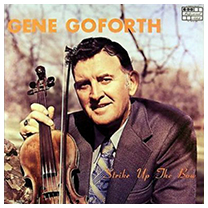 Gene Goforth "Strike Up The Bow" (Professional Artist Records, 19--?) (LP)
An old-timey/traditional fiddler from Shannon County, Missouri, Gene Goforth (1921-2002) worked as a heavy machinery operator in Saint Louis while also playing down-home music at the highest level. He toured with fellow Ozarkers such as Dub Crouch and Norman Ford, as well as nationally famous bluegrass auteur John Hartford, with whom he recorded an album in the 1990s. The Goforth family, including his father Josh and brother Cecil, was deeply enmeshed in the musical culture of the regions and had connections to bluegrass stars such as fiddler Kenny Baker and fellow Missourians, The Dillards. If you're looking for sincerity, authenticity and soul, this disc's for you.
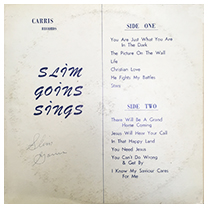 Slim Goins "Sings" (Carris Records, 1971-?) (LP)
Super-rough country gospel with a delightfully amateurish edge. Carris Lee Goins (1909-2000) was, as far as I can tell, born in South Carolina but settled down around Baltimore, Maryland for most of his life. He started writing music decades ago, with copyrights going back at least as far as 1945, with some songs on this album written around 1971. His earlier work, including some songs that got recorded, was at least partly secular material, though this is all gospel. Although the record label bears his first name, Goins performed under the nickname "Slim," while song credits and later song publishing were usually as "C. L. Goins." As mentioned earlier, he was really on the rough side, a clunky but compelling guitarist and ukulele strummer, and an equally unusual-sounding vocalist. There are strong hints of Hank Snow and Ernest Tubb in there, though with an alluring lack of finesse; you can start getting all into his timbre, but the phrasing gets a little odd. I mean that in a good way. Anyhoo, this is about as authentic a "real person" artist as you'll ever hear. Alas, there's little information about Goins and his career, much less his life outside of music, and this low-budget LP is about as barebones as possible, just the album title and song names on the front cover, and a blank white back cover. The inner labels offer little else, although some Carris singles provide an address in Baltimore, presumably Goins's home. (Footnote: a reader got in touch to share some memories of Mr. Goins, who was his Sunday school teacher in the early 'Seventies, teaching the kids music at the Tabernacle Baptist Church in Essex, MD, an unincorporated part of east Baltimore.)
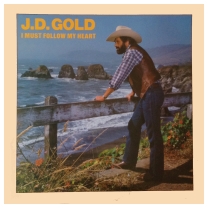 J. D. Gold "I Must Follow My Heart" (Sun Song Records, 1986) (LP)
(Produced by John D'Andrea & Carmine Rubino)
Jovial, uptempo indie country from Southern California singer J. D. Gold. Most of the songs are credited to I. Rettig, which I thought must have been Gold's real name, but apparently it was actually Iona B. Rettig... At any rate, the songs are pretty good, even with the gallumphing, wannabee-commercial arrangements, synth-ish '80s stuff that places Gold in the same range, stylistically, as Moe Bandy or folks like that. There are rueful drinking songs ("Life Of The Party," one of two songs not written by Rettig) and a couple that explore ambivalent feelings about California's fabled Golden State mythos... I don't recognize most of the players on here, other than steel player J. D. Maness, but the musicianship is all pretty solid. There are a few rough edges, to be sure, but overall this is a nice indie effort.
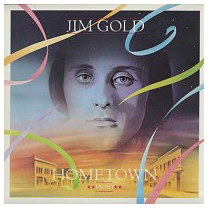 Jim Gold "Hometown Hero" (CBS-Tabu Records, 1978) (LP)
(Produced by Mike Theodore & Dennis Coffey)
Songwriter Jim Gold struck it big in the early '70s with his sunshine-y pop band Gallery (known for the hit "I Believe In Music") but struggled to recreate that magic in later years. He dabbles in country-rock twang on this album -- I was drawn to pedal steel and mandolin listed in the credits -- but ultimately it winds up being more of a stylistic affectation rather than a commitment to the style. So, I guess I'm listing this one more as a warning to twangfans -- now you don't have to spend that dollar in the cheapie bin -- although fans of 'Seventies pop and AOR will probably find a lot to enjoy on this diverse disc. One interesting note was how much some of the guitar tones on a few tunes resembled early Dire Straits... guess it was just the technology of the times, or something.
 Gold Rush "First Strike" (Gold Rush Records, 1981) (LP)
(Produced by Billy Oskay & Rob Perkins)
Amazingly enough, this bluegrass quintet from Portland, Oregon was not the same group as the Gold Rush below, who hailed from Colorado. Portland's Gold Rush featured Greg Baker on fiddle, Hugh McClellan (guitar, piano), Bob Misley (banjo), Monte Trautman (bass), and Loren Wolfford (mandolin, guitar). Wolfford contributes two original songs -- "Cowboy Clothes" and "New Log Cabin Home On The Hill" -- to an eclectic mix that includes Peter Rowan's pothead anthem, "Panama Red," as well as material by Bill Monroe, Townes Van Zandt, and Bob Wills. Misley and Trautman each add a tune to the mix, and the group re-works a few older, traditional songs as well, including the album's closer, a version of "Mama Don't Allow," which gives them all a chance to solo on an instrument or two. Dunno if these fellas recorded anything else, though I'm sure any confusion between the band name(s) didn't help... Pretty straightforward progressive grass, with a Hot Rize-ish feel, though also with a slightly jittery, galloping feel.
 Gold Rush "West Wind" (Bare Records, 1981) (LP)
(Produced by Jim Ransom)
The first(?) album by this eclectic band out of Elizabeth, Colorado. Some originals and lotsa cover tunes, including some tasty picks from the 'Seventies scene, such as Jim Silvers' "You Gotta Let All The Girls Know You're A Cowboy" and Paul Craft's "Midnight Flyer." The originals include "Distemper" by mandolinist Charlie Provenza and the title track, "West Wind," by bassist Larry Fries. Various bandmembers previously worked with producer Jim Ransom during his tenure with the Biscuit City label; at this point they were an all-guy group, though they later added fiddler fatale Suzanne Roberts, who recorded with them on their next LP.
 Gold Rush "Strikin' It Rich" (Bare Records, 1982) (LP)
(Produced by Gold Rush & Pete Dockendorf)
A lively, inventive set of progressive bluegrass, with clear country touches... This energetic, ambitious band from Elizabeth, Colorado had plenty of talent, notably fiddler Suzanne Roberts, dobro guitarist Al Goll and mandolin picker Charles Provenza, who floats off on Grisman-inspired solos on a tune or two, including the track, "Alturas," which is credited to him but sounds an awful lot like one of those old DGQ songs. There's a wealth of original material on here, including seven songs written by bassist Larry Fries, who often cedes the spotlight to guitarist/lead vocalist Jerry Magnetti. Some of these tunes are a little overwritten, tapping into the poetical streak in '70s progressive 'grass, but that's cool: this record is well-crafted and well-produced, and holds up well against other albums in the style, evoking in particular the spirit of fellow Coloradans Hot Rize. There's also a nice cover of the Dickey Betts song, "Blue Sky," reworked with a nice acoustic feel. Most of these guys went on into a variety of other bands and projects... The liner notes say that this was their second album, although I haven't been able to track down the first one yet...
 Gold Rush "Headed South" (Blue Moon Records, 1983) (LP)
(Produced by Roger Fortner)
 Gold Rush Junction "Volume One" (Omeda Records, 1978) (LP)
(Produced by W. M. Copenhaver, Dumpy Rice and Harry Urschel)
A twangband from Dayton, Ohio, or thereabouts, recorded at Rusty York's Jewel Studios in Cincinnati... The band consisted of a main quartet with Arlis J. White (lead vocals, guitar), his son Mike White on drums, Terry Burke on bass, and Mike Copenhaver (lead guitar), with additional backing by York cohorts Dumpy Rice on piano and acoustic guitar and Chubby Howard playing steel guitar. The material is apparently all originals, including songs such as "The Homesick Hillbilly Blues," "I Just Don't Care" and "The Last Drink For This Evening." According to the liner notes, the group first recorded with York back in 1968 (presumably there's a single or two out there?) and though their name coincides with the name of a country music venue in Pigeon Forge, Tennessee (later the site of Dolly Parton's Dollywood amusement park) it's not totally clear if they were connected to the park -- I haven't found any info that indicates this was the case.
 Roxanne Goldade "20 More Miles To Go" (Track Records, 1977) (LP)
(Produced by Peter Bentley)
A teenaged pop-country hopeful from Alberta, Canada, starting at age seven, Roxanne Goldade was a child performer on a TV show based in Calgary, and cut this album when she was fourteen years old. The record has "big" sounding production, matched by Roxanne's forceful, emotive vocals, and although she undeniably sounds very young, there's still a confident, Anne Murray-esque feel to her singing, a brash, cheerful wholesomeness. Most of the songs are originals, credited to either Roxanne Goldade or Agnes Goldade -- the song "Mama Take My Hand" was also released as a single... Some of the tracks were recorded in 1975, others in '77, and on the earlier songs she sounds much, much younger. I wonder if she made more recordings... Anybody out there know more about this gal?
 The Goldcoast Singers "Here They Are!" (World Pacific Records, 1962) (LP)
(Produced by Richard Bock & Riece Hamel)
A prescient set of political satire from the Kennedy era, recorded live at the San Francisco State Folk Festival in 1962. This isn't a "country" record, per se, but since the Greenwich Village folk scene so quickly coalesced around the New Left, the biting satire of the Ed Rush/George Cromarty duo stands out, particularly its insightful (and pointed) lampooning of the Civil Rights Movement. In one deft, catchy chorus of the uptempo "Peace Corps Rejects," they critique the white, liberal Ivy League college students who became Freedom Riders in the South, as well as the NAACP for putting them in danger, and questioned the effectiveness of civil disobedience as a tactic: "We come on the Greyhound bus/thirty-seven of us/the NAACP paid our fees/put in in jail/don't accept bail/integrated buses will set the South free..." The song reflects an extremely brief moment in time when satirists could poke fun at these campaigns, though events such as the March On Washington and the passage of the 1964 civil rights bill, as well as the numerous bombings and lynchings that were given national attention soon made the Civil Rights Movement a sacred icon in mainstream, middle America. This record was also remarkable for its early criticism of America's involvement in Viet Nam (at the time still limited to a small number of "advisors" on the ground) with biting songs such as "The Royal Laotian Cha-Cha-Cha" and "Please Mr. Kennedy," which dealt more broadly with the Cold War and the draft. The best-known song on this album is "Plastic Jesus," a cheerful critique of consumerized and hypocritical religiosity and evangelicism. Although they had some of the same level of wit and bite as Phil Ochs, the duo's career was cut short when Cromarty was drafted in '63. He reemerged a decade later with an innovative and influential album of new acoustic music entitled Grassroots Guitar; I'm not sure what Rush went on to do, musically, if anything. [Footnote: the song "Please Mr. Kennedy" was revived -- in altered form -- in the Coen Brothers film, "Inside Lloyd Davis," where is was remade into a calypso-rock novelty number about nuclear war. Indeed, the Coens gave credit to the Goldcoast Singers... as well they should! Finally, a note to any potential future reissue labels: The Goldcoast Singers were also included on a World Pacific compilation LP called Hootenanny Saturday Nite! performing a song called "Gunga Din," a Rudyard Kipling adaptation which does not appear on this album, though it did come out as a single, as did a couple of other non-album tracks. Hint, hint.]
 Billy Golden "Country Music's Golden Boy" (Starday Records, 1968-?) (LP)
(Produced by Don Pierce)
Alabama honkytonker Billy Gene Golden (1938-2003) got his big break when he landed a slot on what was then called the "WWVA Big Country Jamboree." He appears to have been a cast member at the time he cut this album, as well as several singles, including some tracks that are on here as well. A bunch of it looks like original material, though there are covers songs as well. Versions of Wynn Stewart's "It's Such A Pretty World Today" and the George Jones 1967 hit "Walk Through This World With Me" place this disc sometime around 1968 or so. Not sure how far his career went -- there's not much of a trail after the early 'Seventies. Mr. Golden seems to have moved to the Mohave Desert at some point, passing away in Bullhead City, Arizona, near the border with California.
The Golden Country Singers "The Nashville Album: Million Sellers" (Premier Records, 1963-?) (LP)
Country covers by one of many anonymous, in-studio "bands" put forth by the New York City-based budget label. No date or musician credits on this one, though it seems to be of early- or mid-1960s vintage, with most of the songs -- like Claude King's "Wolverton Mountain" and Marty Robbins' "Ruby Ann" -- coming from 1962; one song, "Cold And Lonely," was a hit for Kitty Wells in '63. The entire album was re-released on the Coronet label (with no band name) as Country And Western Million Sellers, though alas still with no indication who the musicians were...
The Golden Country Singers "Nashville's Top Hits" (Premier Records, 196--?) (LP)
With covers of "Gentle On My Mind" and "Wichita Lineman," this seems to be more of a 1968-69 release, though most of the other songs are country oldies... The band remains anonymous (and mostly theoretical) though the later date makes it more plausible that there was some connection between this "group" and the early '70s album by Golden Country Nashville Singers, below...
The Golden Country Nashville Singers & The Golden Pickers Orchestra "Songs From The Great Hit Musical Tom Sawyer" (Golden Records, 1973) (LP)
(Produced by Ralph Stein)
A country children's record; looks pretty iffy. The original stage production was composed by sibling songwriters Richard M. Sherman and Robert B. Sherman (best known for their work on Chitty Chitty Bang-Bang and Mary Poppins) and adapted for this LP by Sid Frank. The story is narrated by Early Williams, who I think is the same guy as country songwriter Ervin Williams.
 Kaye Golden "The Golden Touch" (Music Industries Incorporated/MIC Records, 1972) (LP)
(Produced by Bud Billings)
A Nashville hopeful who apparently had a gig at Roger Miller's motel-based King Of The Road nightclub around the time this record was made, back in December, 1971. It's not a songwriter's demo set, though: all the songs are covers, including Kris Kristofferson's "For The Good Times" and "Help Me Make It Through The Night," Ray Stevens' "Everything Is Beautiful," "Country Roads" and "The Night They Drove Old Dixie Down" by the Band.
The Golden Voyage "The Golden Hits Of Country Music" (1981-?) (LP)
This early '80s cover band plays versions of a couple of dozen hits, mainly stuff from the '60 and '70 such "Crazy" and "Thank God I'm A Country Boy," as well as oldies by the Carter Family and Hank Williams. The most contemporary tracks seems to be a cover of Dallas Frazier's "Elvira," which was a hit for The Oak Ridge Boys in '81. This nondescript set was recorded at Bradley's Barn in Nashville, and though I assumed the band was made up entirely of nobodies, it turns out it was led by pianist Little David Wilkins, a songwriter and Music City session player who made some mid-'Seventies albums that were actually pretty good.
 The Golden West Wranglers "Lazy B Chuckwagon: Chuckwagon Suppers And Western Show At Heritage Square" (Golden West Records, 1983) (LP)
(Produced by Al Ehlers)
A dude ranch band from Golden, Colorado, featuring Al Ehlers on mandolin and fiddle, Dennis Bailey (banjo, guitar and dobro), Gary Davis (8-string guitar), Jim Dunham (emcee) and Lynn Campbell (bass and 12-string guitar). It's all western-style cowboy music, sung with plain, simple arrangements.
Joe Goldmark -- see artist discography
 Annie Golightly "The Many Faces Of Annie Golightly" (Injun Records, 1979) (LP)
(Produced by Smokey Montgomery)
Texas native Anna Mack Milford Smith, aka Annie Golightly (1931-2012) was a singer, author, club owner and real-deal cowgal who was famous for taking part in the six-month long Great American Cattle Drive, riding from Fort Worth Texas to Montana, back in 1995. Born in ultra-rural Dial, Texas -- north of Pecan Gap -- she migrated to Fort Worth where she became part of the local country scene, eventually opening a music club that she ran up until 1988, when she largely retired from the music business. Though I'm not entirely sure of her first nations heritage, Ms. Golightly had a Native American image, and was unfortunately nicknamed "the singing savage," in keeping with her equally uncomfortable label name. She worked with Texas twang old-timer Smokey Montgomery for many years, cutting at least one single with his help, 1971's "The Vanishing Breed," which also came out on Injun Records. She joined here by several Fort Worth country stalwarts -- steel player Maurice Anderson, Billy Grammer on harmonica, bassist Marc Jaco, with producer Smokey Montgomery chiming in on banjo. Though the album kicks off with a cover of "Grandma's Feather Bed," most of the songs are her own originals.
 Larry Good "Good N' Country" (Pearce Records, 1969-?) (LP)
(Produced by John Pearson)
Originally from Kansas City, singer Larry Good (1932-2010) slowly gravitated towards Nebraska, where he recorded several albums for the local Renee Records label and was eventually inducted into that state's Country Music Hall of Fame. He also worked as a professional minor league baseball player, playing in the orbit of the Chicago Cubs farm teams, but devoted himself full-time to music after his athletic career petered out. In later years Good created his own label, Lari-Jon Records and started up a live music venue called The Nebraskland Opry. Although he also recorded some rockabilly singles in his youth, his was his first album, recorded for the fabled Kansas City-area Pearce label
 Larry Good & The Good Times "Half-Alive At The Sahara" (Rene Records, 197-?) (LP)
The liner notes tell us of Larry Good's erstwhile baseball career and his switch to music "when his playing days were over." They also inform us that Good had been leading his own band for eight years by the time this album came out, though as with most releases on the Rene/Renee label, there's no date on the disc. It's a pretty compact band backing Larry Good here: drummer John Cline, bassist Jim Eaves and guitarist Tommy Dawn, who was apparently a country deejay from Omaha on his days off. (If there were any additional musicians provided by the label, they aren't mentioned on the jacket...) I'm not sure if this was actually a live album, but you can certainly see how this could be a strong set for a country lounge band back in the 'Seventies... It's all pretty safe material, and none of it original as far as I can tell, stuff like "Okie From Muskogee," "Sally Was A Good Old Girl," "Proud Mary," "White Lightning," a Johnny Cash medley, etc. The band is introduced by deejay Ralph Wayne, of station KTTT in Columbus, Nebraska.
 Larry Good & Dalton Fuller "A Bit Of Country With A Touch Of Brass" (Rene Records, 197-?) (LP)
(Produced by Bud Comte & Bill Palensky)
When these two midwestern honkytonkers bumped into one another while cutting their respective albums at Bud Comte's studio in David City, Nebraska, someone came up with the idea of collaborating on a country-big band hybrid record. So a year later Dalton Fuller's band, the Nebraska Playboys hooked up with several regional jazz players -- Marty Grubbs on clarinet and saxophone, Bill Palensky (trumpet), Jack Seckman (trombone), Allen Valish (trombone), Brad Wesely (trumpet) and Dennis Wesely on piano -- crafting brassy renditions of western swing and country oldies. This album also seems to have been the inspiration for his long-running regional TV show, "Country With A Touch Of Brass," which ran for several years in the Nebraska market.
 Larry Good "...And Some Damn Good Friends" (Renee Records, 197--?) (LP)
(Produced by Bud Comte & Eric Kucera)
I'm afraid I'm coming at Larry Good's career a little backwards, starting out with this later album and the Dalton Fuller collaboration above, which may not be his strongest efforts. Although his true-country bona fides aren't in question -- great song selection, outside of Bobby Bare's "Marie LeVeau" -- but he certainly sounds a bit depleted on many of these tracks. There are obvious echoes of Johnny Paycheck, and by implication, Merle Haggard, and while Good's rugged, old-guy vocals ooze authenticity, if we're being honest, he sounds a little too rough around the edges. The band's okay, not great, but okay, with contributions from album co-producer Tom Campbell (on fiddle and lead guitar), someone simply identified as "Jackie" on steel guitar, Henry Guererro (drums), Gina Kavanaugh (piano), Mick Kovar (bass), Don Muzney (banjo, fiddle and guitar), and Bob Pasenault on drums. Along with a slew of well-chosen covers, the set includes three Larry Good originals: "As Long As You Need Me," "Fast Moving Freight Train," and "Money Troubles." This is certainly worth checking out, though I'm maybe a little more curious about his early stuff.
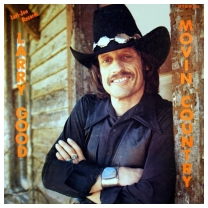 Larry Good "Movin' Country" (Lari-Jon Records, 1979-?) (LP)
This indie album includes a bunch of original songs, including two by Midwestern honkytonker Larry Good, two more by Charlie Craig and a couple by old-timer Redd Stewart... This album came out on Good's own private label, Lari-Jon, which also released a few discs by other artists, including Kevin Cline, Bill Eagle and Kent Thompson. This may have been Larry Good's last album, though I'm not 100% sure about that... (Thanks to the KCLawrencevinyl blog for background info on this one...)
 The Good Old Boys "Pistol Packin' Mama" (United Artists/Round Records, 1976) (LP)
(Produced by Jerry Garcia)
Longhaired hippie bluegrass at its finest... The presence of the Dreadful Grate's Jerry Garcia as the album's producer ensured a wide listenership among certain segments of the rock scene, and (at least up here in Northern California) fairly wide distribution of this 'Seventies classic... Good thing, too: this record's pretty damn satisfying. Pure, twangy, all-acoustic truegrass that stretches into country material such as Joe Maphis' "Dim Lights, Thick Smoke," Johnnie And Jack's "Ashes Of Love" and Al Dexter's "Pistol Packin' Mama," alongside bluegrass standards such as "Toy Heart" and new stuff like "Glendale Train." The picking is solid from start to finish -- mandolinist Frank Wakefield was well-liked by many on the bluegrass scene, but recorded only sparingly -- his duet with banjoist Don Reno, on "Banjo Signal," is a real scorcher, and the rest of the album, with some sweet licks on the fiddle from Chubby Wise, sizzles as well. Recommended!
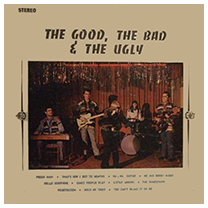 The Good, The Bad & The Ugly "The Good, The Bad & The Ugly" (Dominion Records, 1969) (LP)
(Produced by Jury Krytiuk)
An eastern Canadian trio made up of steel player Mickey Andrews, Gerry Hall on guitar, Randy McDonald playing bass, along with a few assorted friends, from the looks of the cover. In the late 'Sixties, they were the house band at a fabled Toronto music hall called The Horseshoe Tavern, and they backed Stompin' Tom Connors when he first played there, in 1968 and '69. They also backed Stompin' Tom on his first LP for the Dominion label, a success that led to Connors starting his own label, Boot Records, in partnership with producer Jury Krytiuk. The band also recorded an album of their own, a mix of oldies and twangy instrumentals, with a little bit of rock in the mix; "Proud Mary" and "Games People Play" next door to "That's How I Got To Memphis" and "Me And Bobby McGee." A fine snapshot of a successful Canadian bar band, working at the upper end of the country music food chain.
The Good, The Bad & The Ugly "...At The Horseshoe Tavern" (Vintage Records, 197--?) (LP)
(Produced by Art Snider)
A live album, with producer Art Snider chiming in on piano, and liner notes from Stompin' Tom Connors
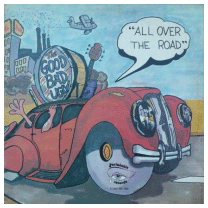 The Good, The Bad & The Ugly "All Over The Road" (Periwinkle Records, 1973) (LP)
(Produced by Art Snider)
This edition of the band included Mickey Andrews on dobro and steel guitar, Patti Burns (drums), Jerry Hall (lead guitar) and Randy MacDonald on bass... The band also apparently did a soundtrack album a few years later, for something called Dream On The Road, though I haven't really tracked that one down yet...
 The Good, The Bad & The Ugly "The Good, The Bad & The Ugly" (Mercury Records, 1970) (LP)
(Produced by Huey P. Meaux & Inez Foxx)
Different group than the Canadian band listed above; less country, though there are some connections worth pursuing. This bluesy Southeast Texas trio included Bubba Goode, Joe Pipps and Kenny Yetman, who came from around Beaumont and Port Arthur... The band's main songwriter, Joe Pipps, continued to work with producer Huey P. Meaux and later recorded an album with him on the Crazy Cajun label.
The Good Times "Country Rock Music" (1976-?) (LP)
A hyper-local country covers band from Pekin, Illinois playing pop and country covers, mostly early 'Seventies stuff like "Day Dreams About Night Things," "I Believe In Music," "Kentucky Woman," "Please Mister Please," and the like. The quartet included three guys and one gal, Bill Lohnes, Kurt Milkereit, Bill Wilcox and Jackie Wilcox, though the liner notes don't say who played which instruments, or if there were studio musicians involved. One song, "Jodi," may have been an original, though there are no composer credits anywhere on the album.
Tony Goodacre - see artist discography
The Al Goodman Orchestra & The Nashville Country Singers "Country And Western" (Compose Records, 196--?) (LP)
An orchestral/easy listening bandleader with a career spanning back to the 1940s, Al Goodman started out in the 78 era, though this poppy set of country covers seems to have been recorded as an actual LP, with contemporary early 'Sixties covers such as "Battle Of New Orleans" and "Four Walls" rubbing shoulders with older oldies like "Candy Kisses" and "Walking After Midnight" and "Your Cheatin' Heart." No idea who the individual members of this edition of the Nashville Country Singers were, but it seems to have been the same studio-creation "group" that was credited on a couple of dozen pop and country cheapo albums, most of them released on the Mountain Dew label, an imprint owned by the same company as the lesser-known Compose Records.
 The Al Goodman Orchestra & The Nashville Country Singers "Country And Western Songbook" (Compose Records, 196--?) (LP)
This album seems to be of a similar vintage as the one above, with the tip-off being their cover of Claude King's "Wolverton Mountain," which was a hit in 1962.
 The Goodman Family "I'm Too Near Home" (Sims Records, 1963) (LP)
(Produced by Russell Sims & Tom Sparkman)
Howard "Happy" Goodman (1921-2002) led one of the most popular Southern Gospel groups of the 1950s and '60s, the Goodman Family, made up of eight siblings, and Happy's wife, Vestal Goodman. A native Alabaman, Mr. Goodman formed the band back in the 'Forties, and like many gospel groups, the lineup shifted from time to time as various members joined other bands, or pursued their own goals -- around the time these early albums came out, the group was entering its peak, hosting their own television shows and touring nationwide. This was their first album, featuring the classic lineup that became a southern gospel powerhouse, aided by some veteran country pickers -- including Willie Ackerman (drums), Walter Haynes (guitar), Autry Inman (bass), and David Jones (piano) -- working as the Sims label's studio crew in Nashville. These Music City ringers give some tracks a bouncy hillbilly twang, a more rural, country feel than many other white gospel records of the era, though the Goodmans certainly knew how to delve into hymns and churchy jubilee numbers as well.
The Goodman Family "Its A Wonderful Feelin' " (Sims Records, 1965) (LP)
Steve Goodman - see artist discography
 Joy Goodnow "The Joy Of Country" (Major Record Company, 1974-?) (LP)
Wilmington, Vermont's Joy Goodnow (1938-2021) was a longtime fixture on Boston's 1970s country scene, singing with the John Penny Band and others, before recording a handful of singles and two LPs over the course of the decade. Her career is a little hard to map out very clearly, though she seems to been part of the New England scene at least through the mid-1980s, and sang lead for a series of groups. She later married and moved to Oklahoma, then to Texas, where she performed at some local events, including singing country gospel in the Stone Cross Country at her local congregation in the Red River Cowboy Church, in Burkburnett, TX.
 Joy Goodnow "Joy Goodnow" (TNT Records, 1976) (LP)
(Produced by Tom Dishaw)
 Dennis Goodrich "A Busy Body" (Liz-De Records, 1973-?) (LP)
(Produced by Betty Goodrich & Dennis Goodrich)
A really low-rent, generic-looking self-released record from an aspiring songwriter from Lorain, Ohio. Although he booked studio time at the Rite Records studio, I guess Mr. Goodrich didn't want to spring for full graphics, instead opting for a plain white background with plain black text on both the front and back covers. He also didn't want to pay for any retakes: the rather charming liner notes that explain that one of the songs has a glitch in it due to a sound engineer's flub, but that Mr. Goodrich decided to leave it in, to be "honest with you the record buying public." We appreciate that. The songs are all Dennis Goodrich originals, though sadly there's no information about the backing musicians or who actually produced the sessions. There's also no date, though the copy I saw had "72" handwritten on it; a string of singles including some of these songs also came out, with some sources placing these seven-inches starting around 1971, and Mr. Goodrich may have recorded some stuff later in the 'Seventies.
 Jim Goodrich "Country Magic" (Gold Star Records, 1983) (LP)
(Produced by Nick St. Nicholas)
Recorded in Minneapolis, Minnesota, this was a set of all-original material from Jim Goodrich, who was originally from Waterloo, Iowa... Goodrich was a Navy veteran who spent a lot of time playing guitar onboard the nuclear submarines he served on. He's backed her by a group packed with unfamiliar names -- pedal steel player Mike Cass, Kurt Jones (drums), Dan Lund (lead guitar), John O'Gorman (rhythm guitar), Nick St. Nicholas on bass, and a gal named Yolanda singing backup. I honestly don't know much more about this fella, but it's a cool little record.
 Bill Goodwin "Walk Through This World With Me" (Arc Records, 1966) (LP)
This fella was an American artist, although he was backed by a Canadian band. Originally a rocker from Colorado, songwriter Bill Goodwin made a go of it in Nashville in the early 1960s, and recorded a string of singles on various labels, though as far as I know this was his only album, mostly cover songs, but also some originals. Alas, I don't know who was in the studio band...
 Dick Goodwin "I Miss You So" (PBK Records, 1968-?) (LP)
A fairly obscure singer from Camden, Arkansas who played in a local band called the Lazy River Boys, Richard E. Goodwin wrote the title track and released it as a single in 1968, alone with another song, "In My Own Familiar Way," which unfortunately is not also included here, though there may be a couple of other originals on this album. The rest of the tracks are covers of classics by artists such as Bill Anderson, Eddy Arnold Carl Belew and Hank Williams, including tunes like "Am I That Easy To Forget," "City Lights," "Green, Green Grass Of Home," and "Welcome To My World." Goodwin is backed by Larry Cartwright on bass, Glen Harris (fiddle), John Hughey (steel guitar), Bo Posey (drums), Albert Prince (lead guitar), and Zane Raney (Wayne Raney's son) also on drums. This appears to be Goodwin's only album, and was perhaps the sum of his musical career... The liner notes inform us that he played once in 1967 at a venue called the "North Louisiana Hayride" (perhaps a spin-off of the official Hayride?) though I haven't found evidence of any other shows, or other recordings.
 Goose Creek Symphony "Est. 1970" (Capitol Records, 1970)
(Produced by Ritchie Hart, Floyd Ramsey & Tim Ramsey)
This longhaired Arizona ensemble started off with a wild mix of goofy country clompers, disjointed hillbilly psychedelia, old country gospel numbers, and plenty of good, old-fashioned '70s style boogie rock. Their debut album is pretty cool -- veering off in various directions, with gems in all the categories mentioned above, and many songs that creep through the stylistic margins. A weird, but relatively cohesive record that is pleasantly emblematic of its times. Experimental, eclectic and filled with chaotic good humor and energy -- definitely worth checking out!
 Goose Creek Symphony "Welcome To Goose Creek" (Capitol Records, 1971)
(Produced by Goose Creek Symphony)
Unfortunately on their second album, the band chose to pass their country side off as a Hee-Haw-ish hick-hoedown joke, hamming it up on all the overtly hillbilly tunes, while concentrating their "serious" efforts on the more acid-laced rock numbers and feedbacky guitars. Still an interesting, eclectic album, but it's sad that the country stuff simply doesn't hold up. After a while they settle into a smooth groove that sounds an awful lot like Garth and Rick and Levon and all the boys from The Band.
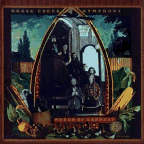 Goose Creek Symphony "Words Of Earnest" (Capitol Records, 1972)
(Produced by Goose Creek Symphony)
Perhaps their best album, this shows a much-welcome slide back into a more heartfelt country mode, an increased affinity to rootsy sound of The Band, more coherent attempts at serious psychedelicized songwriting, and some goofy stuff to balance it out, including a cover of Janis Joplin's "Mercedes Benz" and several druggy celebrations which make explicit mention of all the tokes, hits and trips it took to get this album together. Interesting cultural artifact and a pretty good record, to boot! Recommended.
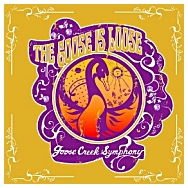 Goose Creek Symphony "The Goose Is Loose" (Bo Records, 2007)
A new album from this still-active hippie-era experimental country/rock jam band from Arizona -- in this case, it's a 2-CD set taken from a 1994 reunion concert. Haven't heard it yet, but I'm quite curious. (There's more info at the band's website: www.goosecreeksymphony.com )
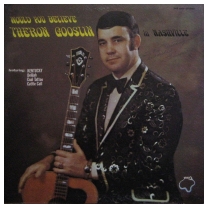 Theron Gooslin "Would You Believe" (Viper Records, 19--?) (LP)
(Produced by Darrell Glenn & Thomas Wayne)
A Kentucky native, singer Theron Gooslin had a regular gig playing at the Continental Inn in Lexington, Kentucky during the 1970s. On this album he hammers hard on regionally-themed tunes like "Coal Tattoo" and "Kentucky," along with a bunch of country covers -- "Cattle Call," "Green Green Grass Of Home, "Six Days On The Road," "Is Anybody Going To San Antone" and "Ring Of Fire." No info on when this one came out, though it looks early '70s -- maybe '72 or '73?
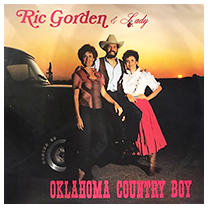 Ric Gorden & Lady "Oklahoma Country Boy" (Prosodia Records, 1983) (LP)
(Produced by Larry Benson & Gary Duggan)
Dunno much about this Norman, Oklahoma trio, although I guess they were going for kind of a Tony Orlando & Dawn/Dave & Sugar kinda look here, with "Lady" being Gorden's wife Cherie and her sister, Marilyn Woodard... They could just as easily named the band Ric Gorden & Larry, though, since the studio band included lead guitar by Larry Kent and keyboards by studio owner Larry Benson... Anyway, Ric Gorden had been a modestly successful song and jingle writer before recording this album, and really made a go of it, getting local airplay on KOMA and other stations, and even heading out to LA to try and rustle up some major label interest. This is a very commercially-oriented album, with plenty of 'Eighties-style tinkly keyboards, strings and slightly saccharine vocals. The Gordens eventually decamped to Guthrie, Oklahoma where in 1997 they opened an antique store and crafts gallery, which remained open well into the 2010s. Not sure if they still play music or not...
 Dave Gordon "Natural Causes" (Vetco Records, 1978) (LP)
(Produced by Lou Ukelson)
Cincinnati folksinger Dave Gordon and his then-wife, Kay Gordon, recorded several albums in the late '70s and early '80s, perhaps the best-known of which is this uptempo, country-flavored set recorded for the bluegrass indie, Vetco Records. It includes two great, Dr. Demento-ready, Larry Groce-esque novelty songs, a tall tale about spending gone wrong entitled "The Mad Consumer" and the giddy, malaprop-laden "You Getting Bothered Doesn't Marry Me," one of the most cheerful scary-stalker songs ever recorded, and an old favorite of the KFAT crew. Their other album were a little too mainstream folkie for me, but I crack up every time I hear "You Getting Bothered" -- it's a pretty durable novelty song.
 Kris Gordon "New Songs And New Writers" (CGM Productions, 19--?) (LP)
A song-poem set from a custom label in Saint Louis, Missouri. Apparently this features singer Kris Gordon singing the lyrics of numerous unknown "poets" -- too numerous and too obscure to catalog right now. This album came with a plain white back cover and includes no recording info, nothing about the studio or producer, or the musicians involved. Also, no date, alas, though your guess is as good as mine. I would guess sometime in the mid-1970s, just from the look of it.
 Luke Gordon "Picture Show" (World Artists Productions, 1983) (LP)
(Produced by Dick Hawkins & Luke Gordon)
A former '50s honkytonker from Quincy, Kentucky who was a regular on the Old Dominion Barn Dance and other country revues, Luke Gordon cut several singles for Starday, as well as albums on L&C Records and MVM. He's probably most familiar to cratediggers from various budget-label releases on cheapo labels such as Coronet and Spin-O-Rama, albums that often paired him with other artists, to fill out the disc. Despite this dubious legacy, he was a pretty decent singer, as this late-vintage indie album demonstrates.
 Luke Gordon "...Sings Dark Hollow And Other Classic Numbers" (BACM, 20--?) (CD-R)
A fuller reading of Gordon's career can be found on this generously-programmed CDR from Europe...
 The Gore Brothers "...And Cool Water" (Gore Brother Records, 1978) (LP)
(Produced by Don Caldwell)
Lubbock, Texas siblings Gary and Ron Gore were veteran players on the Lone Star folk and bluegrass scene who formed their own band, Cool Water, in the 1970s. Their repertoire is what could be described as "progressive" bluegrass, though with distinct traces of outlaw country and old-school coffeehouse folk. This is a nice record, with strong performances by Ron Gore on mandolin and banjo plunking by Bruce McBee; the electric bass playing by Gary Gore feels like a poor fit, even lackluster at times, though I'm not sure if it's one of those "new to the studio" DIY things, or maybe he just wasn't that comfortable playing electric. Overall, this is a strong record for the '70s indiebilly scene, and definitely worth checking out. Includes covers of Dylan's "Knocking On Heaven's Door" and the newly-minted "Song For The Life," by Rodney Crowell, as well as a couple of Gary Gore originals, "Our Love Can't Be," and the hippie-ish "Hope In The Country," which sings the praises of the rural life.
 Charlie Gore "...Sings Hymns Most Requested" (Lake Records, 1967-?) (LP)
A hard-country honkytonker from the post-war, pre-rockabilly era, Charlie Gore recorded for King Records back in the day, and was a well-known regional performer, particularly around Cincinnati and Dayton, Ohio. He was born in Champmansville, West Virginia and was an early 'Fifties cast member of The Midwestern Hayride, which was hosted by TV station WLW, Cincinnati. Mr. Gore was still a Hayride regular decades later when he cut this gospel album, which was produced and promoted by his bass player Steve Lake, a Franklin, Ohio native who also organized live country music shows at his Chautauqua Park venue. The backing band was called the Country Swing Masters, with Charlie Gore on lead vocals, along with Junior Dison (drums), Bob Hamilton (tenor vocals), Wendy Hargraves (steel guitar), Steve Lake (bass), and Jim Parsons playing lead guitar. These guys were regular at Chautauqua Park, though the time frame's a little unclear. There's no date on the disc, but it looks like it may have come out around 1967, which fits in with newspaper show notices around from the late '60s and early '70s featuring Gore and the band. Likewise with the instrumental showcase below, which may have been the Jim Parsons "solo" album mentioned in the liner notes as still being in the works.
 Charlie Gore "...Presents The Swing Masters" (Lake Records, 1967-?) (LP)
A "band album," featuring the pickers in Charlie Gore's group The Country Swing Masters. This may have been the solo album by guitarist Jim Parsons mentioned in the liner notes of Gore's gospel LP listed above. That album was to be called Wildwood Flower, and a version of that tune is included here, along with other standards such as "Buckaroo," "Orange Blossom Special," and "Orange Blossom Special," as well as a version of the George Jones hit, "She Thinks I Still Care," and one called "Jim's Boogie," which was presumably a Parsons original.
 Charlie Gore "Absolutely Free" (BACM, 20--?) (CD-R)
Rarities and early works, courtesy of the uber-collector label known as the British Academy Of Country Music...
 Charlie Gore "Charliehorse" (Prairie Dust Records, 1981) (LP)
(Produced by Larry Morton)
I don't think this guy -- Charles S. Gore -- is the same as the hillbilly twangster from the 1950s, but it could be. This album, recorded on Ann J. Morton's Prairie Dust label, with a backing band that included Pat Corn (electric guitar), Charlie Gore (dobro and pedal steel), Larry Morton (acoustic guitar), John Probst (piano) Chuck Sanders (bass), and Terry Waddell on drums.
The Gosdin Brothers "The Sounds Of Goodbye" (Bakersfield International/Capitol Records, 1967)
Long lost amid the cavernous Capitol vaults, the 1968 debut of the Gosdin Brothers -- future country superstar Vern Gosdin and his brother Rex -- was recorded after their shift from straight-up bluegrass into the world of folk-rock. This is a genuine lost gem from the early California country-rock scene. While many mainstream country artists who tried to approach rock music and the youth culture during the hippie years often sounded hopelessly like fish out of water, the Gosdins were perfectly at ease. Although they were country boys tried and true, the Gosdin's psychedelic bona fides were pretty impeccable: they played in bluegrass bands with Chris Hillman, then hooked up with Hillman's Byrd buddy Gene Clark on his early solo career during the Summer Of Love. When they got their own shot at a solo career, they came out with an album that was surprisingly adventurous and electrified, with superpicker Clarence White laying down some delightfully noodly billy-delic folk-rock riffs. Re-released on CD with extra material... see below.
 The Gosdin Brothers "Sounds Of Goodbye" (Ace-Big Beat, 2003)
This CD reissue jumbles up the track order of the original LP, but adds a bunch of extra material that kinda makes up for it. Even though I've been a big Vern Gosdin fan for years (his later solo work is fantastic), I was really surprised by how much I got into this record... It's goofy, heartfelt and fun. Not merely a nostalgic curio, but actually a fine set of music. Check it out!
 Bobby Gosh "Bobby Gosh" (Polydor, 1971) (LP)
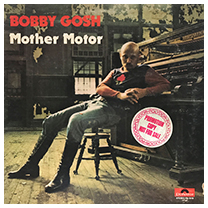 Bobby Gosh "Mother Motor" (Polydor, 1972) (LP)
(Produced by Bobby Gosh)
Well, this one sure looks like it would be a hidden country-rock gem, but it's really more on the pop side of things, in an early '70s experimental/clompy roots-rock kind of way. Songwriter Bobby Gosh came to rock music from an old-school Pop background: as a teen, he backed singer Kitty Kallen and later worked with Paul Anka writing and demo-ing songs in his Brill Building/Tin Pan Alley years. As a solo artist, Gosh seemed like a pretty unlikely hitmaker, with his rough, limited vocals, but here he found a stylistic niche in the roots-boogie rock sound -- the opening tracks sound like Dr. Hook songs, and indeed, Gosh had one of his biggest hits the following year, when that band recorded his song, "A Little Bit More" into the Top Ten. There is some overt country-rock on here, particularly the twangy "Butterfly Mind," which showcases session picker Eric Weissberg on pedal steel, playing in that kind of chunky hippie-country steel style popularized by Jerry Garcia. Eventually Gosh settles into a sort of soul-roots sound, reminiscent of Leon Russell, though much rougher vocally and musically. There's not a lot of twang on here, but if you're into the '70s roots-pop thing, this one's definitely worth a spin.
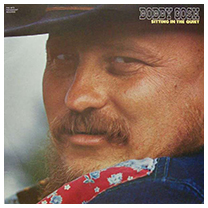 Bobby Gosh "Sitting In The Quiet" (Paramount Records, 1973) (LP)
(Produced by Lynn Barkley)
This album features Gosh's own versions of two of his biggest hits, "A Little Bit More" and the theme to the movie, "Bang The Drum Slowly." Dunno how country-sounding any of this is, but it might be worth a spin.
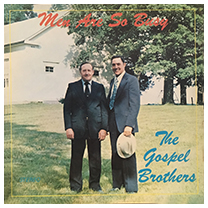 The Gospel Brothers "Men Are So Busy" (MMP/Mountain Music Productions, 1973) (LP)
(Produced by W. A. Masden)
Awesome, super-twangy country gospel from the duo of Willard Crase and J. C. Reliford, two resolutely old-fashioned country boys from Kentucky. This is very much in the style of the Louvin Brothers, though perhaps with a more rough-cut edge. Heavenly, if you ask me.
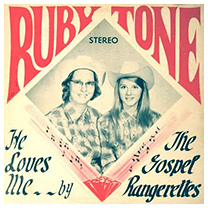 The Gospel Rangerettes "He Loves Me" (Rubytone Records, 19--?) (LP)
An adorable mother-daughter duo from Portland, Oregon. Elizabeth Van De Venter (1928-2009) and her teenage daughter Karen are backed by guitar picker B. F. "Lucky" Mason and fiddler Reverend Roy Sims. Most of the songs were composed by Mrs. Van De Venter, with some additional tunes coming from the Gaithers and Rambos, as well as one called "When The Storm Passes," written by Mosie Lister of the Statesmen Quartet. Mrs.Van De Venter was not a professional musician, and in the liner notes even demurs about her own guitar work, while Mr. Mason was a multi-instrumentalist from Tennessee who played banjo, bass, lap steel and mandolin, and who hosted a long-running "Shut In Club" radio show on KVAN, Portland. Mr. Sims also played several instruments and was a former rodeo rider who switched to circuit rider, evangelizing up in Alaska for a couple of years, and presumably in the Pacific Northwest as well.
The Gospel Rhythm-Aires/The Singing Harris Family -- see artist profile
The Gospel Quartet "Sacred Country Music" (Coronet Records, 196-?) (LP)
A budget label set which probably is a reissue of previously released material, with the provenance purposefully obscured, with a suspiciously generic band name. Sure enough, a little poking around and you may find that this is actually a set from the Sunshine Boys Quartet, which originally came out in 1960 as The Word, on Starday Records. The Sunshine Boys were originally from Macon, Georgia, and recorded under a few different names; another one of their alter-ego names was the Johnson Brothers, which they used for several other budget-label releases. At any rate, this is good stuff, livelier-than-usual southern gospel, with a little bit of bounce.
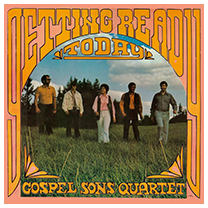 The Gospel Sons Quartet "Getting Ready Today... Movin' Out Tomorrow" (Vanco Records, 197--?) (LP)
Slightly over-the-top southern gospel by a vocal group from Vancouver, Washington. The liner notes provide no information about the musicians' names, who produced the album, or where these guys were from, but fortunely I know how to google things, and a little bit of poking around revealed that the quintet included baritone Stan Kirschenmann, lead singer Don Smith, Terry VanderStoep (tenor), Jerry Watson (bass), and Stan's wife, Bobbi Kay Kirschenmann... one of those unfortunate gals who got stuck in a gospel group with a masculine and super-generic name that they just couldn't possibly change, even though she sings (nicely) on several songs. Still unknowable is who backed them: Vanco was a subsidiary of Ripcord Records, so most likely this session was helmed by Ripcord's in-house gospel producer Ellis Miller, who typically handled the gospel artists on Vanco and Ripcord's various one-off boutique imprints. Anyway, this album opens with a brash, punchy, aggressively modernized pop-country arrangement on the title track, Joe Hatfield's "Getting Ready Today," and though things get toned down quickly after that, there are still some unusual and adventurous touches sprinkled throughout the rest of the album, as well as some slightly dreary, churchier-sounding songs in the mix. Definitely some country pickin' in there as well, with some twangy guitars and sweet pedal steel riffs -- again, I'd guess these musicians include Ripcord's usual suspects, such as guitarist Gene Breeden, et.al. A ton of tunes from the repertoires of top gospel stars such as The Rambos, The Hemphills, Bill Gaither, and Laverne Tripp... so a top-flight set of tunes to pick from, even if some of the performances get a bit goofy. The group was first formed in the late 'Sixties when the guys met in Bible school, and became a real touring group starting in 1971. They had their own musical ministry and canvassed the Pacific Northwest in their own bus, though after three decades they called it a day, retiring the band in 2001 when Don Smith was facing some health problems. The the original quintet reunited in 2010 and performed together for another five years; after Smith and the Kirschenmanns left, a new quartet took up the mantle in 2016, though I'm not sure how long they kept going. Apparently the Gospel Sons recorded ten albums(!) both as the Gospel Sons and as the Gospel Sons Quartet.
The Gospel Sons "Love Him So" (Vanco Records, 197--?) (LP)
The Gospel Sons "Get All Excited" (Vanco Records, 197--?) (LP)
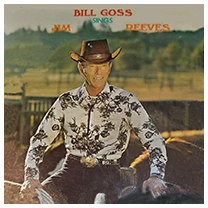 Bill Goss "...Sings Jim Reeves" (Ripcord Records, 1980) (LP)
(Produced by Blaine Allen & Gene Breeden)
A nice, low-key tribute to country crooner Jim Reeves, sung by a real-deal West Coast Okie. Bill Goss was born in Coweta, Oklahoma, but came out to California when he was a child, way back in 1936 during the Dust Bowl. Initially the Goss family lived in a tent, while his mother worked picking fruit, and later picked cotton. Goss grew up in the San Joaquin Valley, near San Jose, and it was here that he started out as a live performer, including a regular slot on Culver City radio station KFVD. Years later he moved up north, and was apparently living in Eugene, Oregon when he cut this album, which features backing by the Ripcord studio section: Blaine Allen (bass and rhythm guitar), Danny Breeden (drums), Gene Breeden (lead guitar), and Geno Keyes on piano and strings. It's mostly pretty charming, with a few rough edges... Although this album was a tribute record to his idol, country crooner Jim Reeves, Mr. Goss also released at least one single on Ripcord which included an original song, "My Divorce Day," with a cover of "Adios Amigos" as the flipside. According to Goss's bio, he composed "My Divorce Day" with Reeves in mind, and had successfully pitched the song to Reeves just before his death. Jim Reeves had told Mr. Goss he intended to record the song, but fate intervened, and after Reeves' plane crashed, the song sat on the shelf until Goss cut his single in 1980. Only one thing wrong about this album: it only includes cover songs, and leaves "My Divorce Day" out. Darn it.
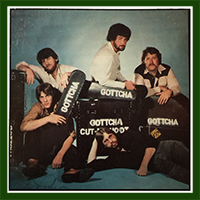 Gottcha "Gottcha" (Gottcha Records, 1983) (LP)
(Produced by Maurice Bittick & Jeff Smith)
This band, also known as Jim Ponder & Gottcha, was from Conroe, Texas, a northern suburb of Houston. Their music had a country base, but they added some questionable pop/lounge touches, with saxophones and keyboards, but no pedal steel and a little fiddle on just one song. In this case, the collision of styles could get a little torturous, but to their credit, the group did have a sound that was truly their own. Not necessarily my cup of tea, but they were distinctive.
 Jim Gough & The Cosmopolitan Cowboys "There Ain't Another Place Like Texas" (Tophand Records, 1984) (LP)
(Produced by Jim Gough & Bill Holland)
Lone Star-themed country and western swing from an Austin-based actor who appeared in films such as Urban Cowboy and Places In The Heart, as well as multiple appearances on the TV show, Walker, Texas Ranger. Not surprisingly, with his rich Texas timbre, Jim Gough has found a lot of in commercials as well as reading audio books (Zane Grey, anyone?) and as a vocal coach for those wishing to pass as Texan. He led his western swing band, the Cosmopolitan Cowboys, for several decades and cut this album -- all songs about Texas -- with the twin fiddles of Ernie Hunter and Bob White, pedal steel legend Herb Remington, along with Bill Dessens (guitar, fiddle and steel guitar), Obie Jones (drums), and Pete Schotz on bass. As far as I know this was his only album, though he performed regionally for many years, including appearances as western-themed events such as recreations of historic cattle drives and the like.
 David Grace "Lover, Fighter, Wild Bull Rider" (Independent Records, 19--?) (LP)
(Produced by Clyde Potts & Bill Grace)
A pleasantly rough-edged, back-to-basics country set, with covers of several Merle Haggard songs, along with some Waylon & Willie outlaw material, and a slightly odd cover of Moe Bandy's "Bandy The Rodeo Clown" (isn't that kind of, um, a rather specific reference?) Anyway, I'm not 100% sure, but I think David Grace was a rodeo rider himself, or at least he looks pretty comfortable posing by the stocks inside the pen pictured on the front cover... He may also be the same musician David Grace who was performing at various rodeo events as recently as 2011-12, though this particular album seems to be pretty unknown. Also mysterious are the musicians backing him -- the back cover had a very simple, blocked out template with a giant blank rectangle in the middle which (I'm just guessing) was supposed to have some kind of personalized liner notes, but maybe somebody missed their deadline? Anyhoo, Mr. Grace had a deep, manly voice -- believably country, though his delivery is pretty stiff. The band were good as well, though nothing dazzling. As far as I can tell the songs were all covers with the possible exception of "Sunday Kind Of Feeling," which is a throwback to the early 'Seventies-era countrypolitan stud-muffin songs about getting laid in the morning; it may be the material covered under the "D&B Publishing" notice below the otherwise uncredited song titles. No date on this disc, either, though it sure looks early '80s, possibly late '70s. The only other clue is a credit for a western wear shop in Prentiss, Mississippi, which apparently provided Mr. Grace's jeans, boots, and big old brass buckle. Not an earthshaking album, but definitely down to earth.
 Charlie Gracie "The Fabulous Charlie Gracie" (Blackjack Records, 1981) (LP)
(Produced by Graham Baker & Raoul Reniers)
A latter-day recording by first-generation rockabilly pioneer Charlie Gracie (1936-2022) a Philadelphia native who kicked off his career in the early 'Fifties, and enjoyed fleeting stardom in the decade's waning days. Like many rockabilly artists, he bridged the worlds of country and R&B, and found a receptive audience among European fans of American rock'n'roll. This album, which came out on a Belgian collector's label, features Mr. Gracie backed by a contemporary (1981) combo including British steel player B.J. Cole, Roger Cover (bass), Freddy Lee (piano), and drummer John Tuck, along with a small horn section. It's mostly rock stuff, but there are some legit country tunes such as "I'm Movin' On" and "I Love You So Much It Hurts," enough twang to get my attention.
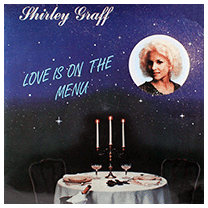 Shirley Graff "Love Is On The Menu" (Award Records, 1983) (LP)
(Produced by Johnny Maggard, Mark Moseley & Ray Pennington)
Not a ton of info about this Maryland gal, though she seems to have been a protege of producer Ray Pennington, who also cut some singles tracks with her that were not included on this LP. This album come out of sessions at two different Nashville studios, made with a mix of studio pickers that included Buddy Emmons, Doyle Grisham, Hoot Hester, Bunky Keels, Dave Kirby, Hargus Robbins, Dale Sellers, and others... This seems to have been marketed exclusively in Europe, probably as some kind of tax write-off, and despite the high-power studio crew, there doesn't seem to have been much of a full-court press backing her career after this came out. Ms. Graff also cut a few singles for the K-Ark label, but she remains a pretty obscure figure.
Gary Graham "Margate Resort Presents The Gary Graham Show" (Century Records, 1971-?) (LP)
Not a lot of information about New Englander Gary Graham, who led his spunky, slightly jittery combo through their gig at the Margate Four Seasons in Laconia, New Hampshire. Very minimal liner notes, which just barely provide details about the band, including a band photo that matches them with their instruments: Gary Graham on rhythm guitar and vocals, backed by Bob Allen (bass), Beverly Berlin (vocals), Steve Edwards (guitar) and Keith Wagner on drums. Their set list was remarkably full of the biggest country-lounge hits of the early 'Seventies, including warhorses such as "Daddy Sang Bass," "Gentle On My Mind," Proud Mary," "Polk Salad Annie," "Me And You And A Dog Named Boo," "Snowbird," and others. A couple of surprising entries, such as the James Taylor song "Anywhere Like Heaven" (which was the flipside of "Fire And Rain" single) and a Johnny Cash medley, though this set was really basically all-hits-all-the-time. No other info on these folks, though this appears to have been their only record.
 Ginger Graham "Rough Around The Edges" (Tri-Sound Records, 1984-?) (LP)
(Produced by Eric Baragar & Ginger Graham)
A live set with Canadian folk/country singer Ginger Graham, who shows an affinity for good material in his repertoire, including several outlaw anthems and Jerry Jeff Walker covers -- "Up Against The Wall, Redneck Mother" "London Homesick Blues," and "Why Don't We Get Drunk"; Hoyt Axton's "Boney Fingers"; John Prine's "Please Don't Bury Me," and a couple from Arlo Guthrie ("Hobo's Lullabye" and "Coming Into Los Angeles"). All good stuff. There's also some Canadian content, including Graham's originals "A Thousand Words To Say I Care," "Hand Me Down My Walking Cane," and "Just A Country Boy From Old St. Kitts," as well as two more from Bruce Good, "Special Kind Of Girl" and "I Just Want To See You Tonight." The lineup is pretty sparse, with Ginger Graham on guitar and vocals, along with banjo player Allan Penrose and Tony Vani tootling on harmonica. He also had an early '80s single with an Arlo-esue novelty number, "Monday Night Football," which isn't included here.
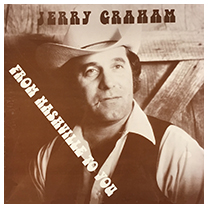 Jerry Graham "From Nashville To You" (1980) (LP)
(Produced by Eddy Fox)
Assuming it's the same guy, I think Jerry Graham was the longtime host of the United States Air Force's Country Music Time transcription disc service, where he interviewed and presented numerous country artists. Here, Mr. Graham's in the spotlight himself, recording at the Marty Robbins Studios in Nashville, with backup musicians that included Dolly Fox and Melba Montgomery(!) doing backup vocals, Dave Kirby on electric guitar, and Larry Sasser playing steel... Quite a lineup, especially for a diehard Melba Montgomery fan like yours truly!
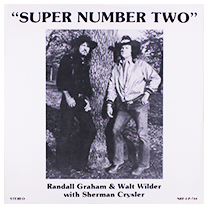 Randall Graham, Walt Wilder & Sherman Crysler "Super Number Two" (CMM Records, 19--?) (LP)
(Produced by Ralph Davis, Kevin McManus & Walt Wilder)
This would appear to be a Nashville songwriter's demo disc, with vocal contributions from three dudes who kinda knew one another, but not well enough to come up with a band name. Sherman Crysler was the son of songwriter/empresario Gene Crysler, and Mr. Crysler contributes brief liner notes briskly praising his son and his pals, as does outlaw star David Allan Coe. Walt Wilder (aka Earl Walter Rodden, 1936-2013) was an Oklahoma native and Vietnam veteran who had been kicking around Nashville since the 'Sixties, and was apparently a fixture at Tootsie's lounge, and a relatively successful songwriter. He worked with the elder Mr. Crysler for much of that time; they also collaborated on Wilder's 1974 solo album, Ode To Country Music. Several "usual suspect" studio musicians are also on here, including Willie Rainsfield, Leon Rhodes, and Jerry Shook.
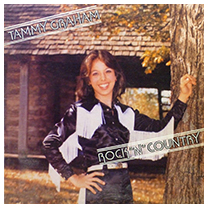 Tammy Graham "Rock 'N' Country" (Twin Cities Records, 19--?) (LP)
(Produced by Harold Bradley & Bobby Bradley)
In the early 1980's Tammy Wynette Graham, a teenaged piano-player from Little Rock, Arkansas went to Nashville, where she cut this private-press LP as a demo set. She was working with a top producer of the classic Nashville Sound era -- in addition to producing, Harold Bradley plays lead guitar, rhythm, mandolin, banjo and synths(!), with an A-list crew including fellas like David Briggs and Buddy Harman, steel players Lloyd Green, Sonny Garrish and Hal Rugg, as well as Hank Strzelecki on bass... As the title implies, it's mostly a set of country and rock oldies, stuff like "Johnny B. Goode" and "Whole Lotta Shakin' Goin' On," as well as "Jambalaya" and "Blue Kentucky Girl" on the country side of things. There's one short track credited to Graham at the end of Side One, "Tammy's Boogie," and a couple of tracks by other composers that may have been original to this album. Graham made it to the majors, eventually, recording a self-titled album for Arista in 1997.
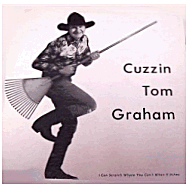 Cuzzin Tom Graham "I Can Scratch Where You Can't When It Itches" (Cuzzin Records, 1983) (LP)
Songwriter Tom Graham carved a niche for himself in the early-1980's Austin scene performing kooky novelty songs delivered in a musically awkward style that I assume is half-intentional, playing up his own limitations as a vocalist, as a form of corn-pone humor. Like a lot of comedy, it may not appeal to everyone. The themes and the music can sound strained, but he does have some good gags. With songs like "Never Ask a Computer about Love," "I'm In Love With My Mother-In-Law," and "Put Back On Your Makeup Baby," this album has plenty to recommend it to fans of wacky comedy and hick-humor. He's backed on this album by a small band of Austin locals...
Cuzzin Tom Graham "Two Step Waltz" (Cuz Records, 1985) (LP)
More corn-pone humor, including tracks such as "When You Love An Ugly Person Everything Is Beautiful," "The They Done Took Away My Government Check Blues" and "The Two-Step Waltz."
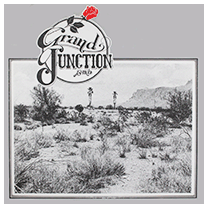 The Grand Junction Band "The Grand Junction Band" (More-Onn Records, 1981) (LP)
(Produced by Steve Diamond & Gary Rowles)
A bluegrassy alterna-twang band from Bend, Oregon. These guys covered country oldies like "Rocky Top" and "Ghost Riders In The Sky" as well as country rockers such as CCR's "Bad Moon Rising," adding a snare drum into the mix, along with the acoustic instruments. The group included Bill Hardin on drums, Michael Jacobs (mandolin), Tim O'Haver (bass), Jim Stanton (banjo), guitar player Jerry West. I suspect several of the songs on this album are originals, although I couldn't find composer credits to confirm who wrote what... As far as I know, this was their only album, though a different group, the Grand Junction Country Band, was formed in Australia back in 1973 and released a few records as well.
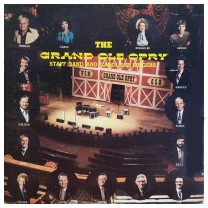 The Grand Ole Opry Staff Band & The Carol Lee Singers "The Grand Ole Opry" (Woodsmoke Records, 1980) (LP)
I guess this was some sort of house band for one of the Opry's regular venues during the early '80s... The group included Nashville studio pros such as Sonny Burnette, Jimmy Capps, Weldon Myrick and Leon Rhodes, with vocals by a group called the Carol Lee Singers. Hey man, a paycheck is a paycheck!
 The Grand Ole Opry Staff Band & The Carol Lee Singers "Showtime" (Woodsmoke Records, 1983) (LP)
Plenty of cover tunes, including some fun singalong songs such as "Take Me Back To Tulsa" and "I'm My Own Grandpa." And if you've ever wanted to hear superpickin' steel player Weldon Myrick step in front of the mic and sing, check him out on their version of "Even Tho." Lots of instrumentals, as well!
 The Grand Poo-Bah Beaner Band "It Must Be A Breakdown" (Rising Star Records, 1976) (LP)
(Produced by Chuck Chapman)
Basically a decent "progressive" bluegrass band from the Kansas City area, with Byrds-y harmonies and a repertoire that spanned from traditional material to more rock-pop oriented stuff such as covers of Dylan's "I Shall Be Released," "Friend Of The Devil" by the Dead, and Gordon Lightfoot's "Early Morning Rain." The vocals aren't great, but the picking was fine, particularly Jan Carlson's banjo, and some sweet mandolin riffs on their version of "Somewhere Over The Rainbow," which is an album highlight. On their version of "Cold Sailor," they give Kansas a little shout-out, which is cute. No original material on here, as far as I can tell, but some nice picking.
 John Grant "Fate Of A Rodeo Cowboy" (CIS Northwest, 1981) (LP)
(Produced by Mike Connolly & David L. Knapp)
Real-deal rodeo cowboy music from central Oregon. I'm not sure if Mr. Grant actually competed in rodeos, but he and his band certainly played on the bandstands in the regional rodeo circuit for many years. Grant originally called his group "Big John & The Rednecks," but updated his vibe and renamed the band John Grant & The Western Revue sometime around 2005... Since then this album has been retroactively available under that name. Anyway, this is a set of mostly original material penned by Grant; his second album, Cowboy's Paradise, is all originals. The songs are good and the band is solid, though it has to be admitted that Grant himself is not the strongest vocalist -- although he hits some Waylon-esque tones, his voice is fairly thin and he frequently teeters on the edge of falling out of tune, particularly in his lower register and on the slower tunes. Still, it's an impressive set of original material, with backing by fiddler Jo Booser, bassists Larry Brown and Tom Knapp, drummer Tom Love, and pedal steel player Tom Wills, who adds some of the album's best licks, filling in a lot of the space left by the lack of a lead guitar. Overall, a better-than-average private presser, definitely worth a spin.
John Grant "Cowboy's Paradise" (1987) (LP)
Tom Grant & The Nashville Sounds "The Nashville Country Club Proudly Presents..." (Nashville Country Club, 19--?) (LP)
Not to be confused with the smooth jazz pianist, singer Tom Grant was a Wisconsin native who led a house band in Milwaukee at a club called Nick's Nicabob, and later found a slot in an obscure Indiana-based venue called the Nashville Country Club. He eventually made it to Nashville, signing to Republic Records in 1979, where he landed two singles in the Billboard charts, though he may be better known as a member of the band Trinity Lane. Although his solo career didn't really take off, Grant stuck around and worked on several Nashville-based TV shows, including TNN's 'Eighties-era "Nashville Now" and "The Ralph Emery Show," on NBC. This album was recorded during his Indiana days, with a band called Nashville Sounds, which included Darrel Young on bass, Larry Young playing lead guitar, Billy Powell on steel, and Dale Greene thumping the drums. Apparently future star Steve Wariner also apprenticed in the band at some point, though I don't think he plays on this album.
 Mickey Grasso "Rip It Up" (CMS Records, 1977-?) (LP)
(Produced by Bebe Allen)
Independent Minnesota twang, with about half the songs written by singer Mickey Grasso or by his pals, along with covers of songs like Neil Diamond's "Sweet Caroline," John Hartford's "Gentle On My Mind" and Freddie Hart's "Easy Lovin'," and of course the rockabilly classic, "Rip It Up." The most promising song title would be Grasso's own "Good Manly Cry." Before recording this album, Grasso performed on the short-lived North Country Shindig program, broadcasting from Cloquet, Minnesota.
 Grateful Dead "Workingman's Dead" (Warner Brothers, 1970)
(Produced by Bob Matthews, Betty Cantor & Grateful Dead)
Well sure, maybe this isn't a proper "country" album, but what with Jerry Garcia's later involvement in Old & In The Way, and the overall backwoods vibe of this album, it's certainly a major link from the hippie rock scene into the world of country and folk. Plus, it's one of the Dead's best (and most accessible) albums, recorded when they were at their poppy peak. A classic album, with a big old Appalachian streak running right through it. Totally worth checking out.
 Grateful Dead "American Beauty" (Warner Brothers, 1970)
(Produced by Grateful Dead & Steve Barncard)
Their best, or certainly their most accessible early album, with many of the band's best-known songs. The track song titles alone are emblems of the undulating heart of hippie culture: "Box Of Rain," "Ripple," "Sugar Magnolia," "Candyman," "Truckin' " and -- of course -- "Friend Of The Devil." The country-roots influence is strong here as well, in a more cohesive and captivating way than on later albums. A highwater mark for hippie rock and early alternative country.
Grateful Dead "Reckoning" (Arista Brothers, 1981)
I'm not like a huge, runaway Dreadful Grate fan, but anyone coming at them from a country/bluegrass perspective might want to give this one a shot. This live acoustic double album was a welcome departure from their endless string of studio and bootleg jam-band recordings, a more highly focussed, concise reading of their old work, combined with truly sweet, respectful covers of canonical folk classics such as "Dark Hollow," "Deep Elem Blues," Elizabeth Cotton's "Oh Babe It Ain't No Lie," and even a vigorous run-through of the country oldie, "The Race Is On." The clarity and cohesion of these performances may be a surprise to detractors who thought the Dead could only be truly grokked by zonked-out, drugged-up, cultlike fans... and a pleasant reminder of the band's bluegrass and jugband roots. They actually knew their stuff! Definitely worth a spin.
 Austin Gravelding "Self Made Man" (GWP Records, 1970) (LP)
(Produced by Andy Wiswell)
Oddball early 'Seventies folk-pop poetics from a songwriter out of Ithaca, New York who was working in roughly the same hard-to-categorize terrain as Lee Hazelwood, not still folk, not quite pop, maybe a little bit country. Owned by an entrepreneur named Jerry Pursell, GWP was the same odd, idiosyncratic, short-lived label that put out a series "Astromusical House" records that capitalized on the hippie-era astrology craze -- with one full LP devoted to each sign of the zodiac... So if you knew someone who was a Taurus, or a Libra, or a Sagittarius, or whatever, you could buy them "their" album -- or better yet, you could buy one for everyone in the family! This might not ring a bell for you young'uns, but trust me: for a while they were everywhere, and doubtless helped create the revenue stream that enabled Pursell to also sign unlikely artists such as Gravelding.
 Austin Gravelding "Restless Winds" (GWP Records, 1971) (LP)
(Produced by Andy Wiswell)
Though honestly still kinda painful to listen to, this second album has a fuller, less folkish sound, with assertive pop arrangements on a few tracks, and more distinct country motifs on others, in particular a pretty good hippie-rock steel player, and some decent banjo picking on a track or two. Unfortunately none of the backing musicians are identified, so who knows... right? Still a bit too gooey and meandering for me, but fans of freak-folk or soft rock, etc., might get a kick out of this stuff.
 Pete Graves "Pete 'Bumming Around' Graves Sings Good Country Music" (Hoss Records, 1974) (LP)
(Produced by Ray Lawrence)
If you dig simple, uncomplicated country stuff in the classic postwar, 1940s/'50s style, then this album's for you. This set, recorded by an amiable old coot named Pete Graves (ne Lawrence Arthur Graves, 1926-2009) has a nice, goofy feel, good old-fashioned hillbilly country that knows not to take itself too seriously. Pete Graves was born in Indiana, but moved at age ten to Oregon, where he grew up to work in the timber industry and eventually co-owned a logging company along with his brothers. This album was recorded in Los Angeles and features nine original songs he wrote, including his best-known composition, the breezy, irresistible "Bumming Around," originally a big country hit for Jimmy Dean in the early 1950s, and later a pop crossover when Dean Martin covered it in 1967. The other songs are less well-known, but they share the same easygoing, uncomplicated novelty rhyming structure and simple, stripped-down approach to songwriting. Unfortunately they didn't think to identify the musicians, though it's a pretty solid band behind him, also taking a straightforward, no-nonsense approach to the music; mostly likely these were younger guys from the Southern California scene, but whoever they were they took the music seriously and weren't just going through the motions. Nice stuff.
 Duane Gray "Call This Day Gray" (EJ Records, 1986) (LP)
(Produced by Duane Zaloudek & Eddie Joy)
Here's one that's got a more-interesting-than-usual back story... Duane Zaloudek (aka Duane Gray) was a reasonably well-known abstract and modernist painter of the post-WWII era who also moonlighted as a country singer, leading a for-real twangband in New York City during the early 1980s. Born in Oklahoma back in 1931, he grew up in Oregon and moved around quite a bit, including a stint in the Air Force during the Korean War. Zaloudek's musical roots go back to his school days in the late 1940s, when he sang topical folks songs at labor union rallies, though he'd upped the ante and formed his own country band by the time he moved to New York. In his late-1960s heyday, Zaloudek produced a series of maybe-not-so-abstract, erotically charged geometric paintings that were said to extol the Tibetan tantric yoga practice known as karmamudra, though the seemingly drab, sketchy artwork on this album cover is perhaps more reflective of the more minimal approach his work took in later years. At any rate, this has an interesting song selection: you've got your traditional cowboy stuff like "Red River Valley," some classic country hits such as Eddy Arnold's "Make The World Go Away" and Ernest Tubb's "Waltz Across Texas," a more modern songs by Terry Allen, Billy Joe Shaver, and a couple of Zaloudek originals, "Call This Day Gray" and "Sally Hit And Run." Generally speaking, this is a pretty solid set, though his likeness (or debt) to fellow artsy-fartsy twangster Terry Allen makes Gray's exaggerated drawl and seeming musical dilettante-ism feel like it's a bit too on the nose. Regardless, though, this is a pretty good album. The backing band included Rick Hozza on guitar, Slats Kluge (piano), Loren Robert Kluge (backing vocals) and Sprocket J. Royer playing bass; Hozza and Zaloudek also collaborated with Tom Wesselmann, a fellow modern artist who also enjoyed playing country music. As far as I know, this is the only "Duane Gray" album.
 Norva Gray "I've Got The Time To Spend With You" (Corene Records, 19--?) (LP)
(Produced by Norva Gray & Devere Anderson)
Singer-pianist Norva Gray was born in Des Moines, Iowa and worked regionally for several decades, with a day job as a self-employed music teacher. He's backed here by steel player Devere Anderson (1944-2007) who owned a music shop in nearby Indianola. The liner notes reference Gray's gig at a hotel piano bar, but sadly doesn't tell us where the venue was located... While in his twenties, Gray performed on a local television show, and also played gigs at various hotels, conventions and other venues. He later moved to Arizona and became a music teacher at a charter school in Gilbert, AZ. The repertoire on this album is mostly country, with tunes by Floyd Cramer, Tom T. Hall, Eddie Miller, Kris Kristofferson, Willie Nelson and Marty Robbins, as well as dips into pop material by Frankie Carle and Tony Bennett. The title track, "I've Got The Time," was written by Mr. Gray, and is the only original on the album.
 Roy Gray "Don't Give It Up" (C'n'G Music, 1988) (LP)
(Produced by Curt James & Frank Anderson)
Rockabilly pop-twang from Sacramento, California -- retro, Elvis-y stuff with a slick, post-Stray Cats style reminiscent of Chris Isaak, another San Joaquin Valley local who was still coming up in the regional Northern California scene at the time... Though this album has a contemporary sound, Gray also got into full Elvis imitator mode when he wanted to, just as bohunky and hip-twisty and uhn-uhh-huh as you please. Dunno much about this guy, but I think he was still playing gigs well into the 2010's.
 Jack Grayson "A Loser's Night Out" (Koala Records, 1981) (LP)
(Produced by Lou Bradley, Jack Grayson, Bob Morris & Bernie Vaughn)
Singer Jack Grayson released one sleek, slinky rockabilly-pop single back in 1959, and reemerged in the early '70s with the first of several singles that appeared in the country Back 40 over the next decade or so. His biggest hit was his cover of the Percy Sledge oldie, "When A Man Loves A Woman," which went to #18 on the Country charts... Grayson wasn't a particularly impressive vocalist, working mainly in a light style of Nashville Sound retro... It's a little hard to place his similarities, but after a while I figured Hank Locklin was a good match. This isn't earthshaking material, but it's nice in a nostalgic way: perfectly competent examples of slickly produced, low-end early '80s country-pop, with kind of a whiteboy soul/rock oldies feel. Basically, if you felt like you were running short of Joe Stampley albums, Jack Grayson was there to fill the void. It might be nice to see a cross-label retrospective of his work someday, covering the major label stuff as well as the indie records. As far as this album goes, I have to confess I find myself to the album's closing number, "Mr. Music Director." Old habits die hard.
 Jack Grayson "When A Man Loves A Woman" (Koala Records, 1981) (LP)
 Jack Grayson "Jack Grayson Sings" (Joe-Wes Records, 1982) (LP)
(Produced by Bernie Vaughn & Jack Grayson)
This album appears to include re-recordings of several of his older hits ("A Loser's Night Out," "When A Man Loves A Woman," etc.) though it might also be a compilation album, drawing on his earlier albums... The liner notes mention that this was recorded at the Koala studios. At any rate, it's okay stuff... Commercially oriented pop-country, with uneven vocals and slick production. I could live without all the saxophone, though.
 Rudy Grayzell "Let's Get Wild" (Starday Records, 19--?) (LP)
This custom pressing seems to have been a reissue of 'Fifties-era material from Texas rockabilly pioneer Rudy Grayzell -- ne Rudolph Paiz Jimenez (1933-2019) -- whose sizzling singles have been reissued on Bear Family and other collector labels. I'm not sure if there were any more contemporary (1960s) tracks on here, but regardless, it's great stuff.
 The Great Divide "Visions" (Starr Records, 1989-?) (LP)
(Produced by Mark A. Hoyt)
An eclectic folk/bluegrass/twang set by a band from Muncie, Indiana and nearby Parker City, in the eastern end of the state. The group was originally made up of four guys -- Ron Beach, Ric Dwenger, Pete Evans, and John Hoyt -- a quartet that first formed in 1979; that same year guitarist Ron Beach also cut an album with a bluegrass band called The Shady Grove Stringband. Alas, though we know the members of the band, the liner notes don't also inform us what instruments they played... guess you can't have everything!
 Great Speckled Bird "Great Speckled Bird" (Bearsville Records, 1970) (LP)
(Produced by Todd Rundgren)
Canadian folk-pop icons Ian & Sylvia Tyson "went country" on this experimental album, which featured musical assistance by blues-roots guitarist Amos Garrett and steel player Buddy Cage, as well as the Bearsville label's own "wrecking crew" of guitarist Jim Colegrove, piano player Jeff Gutcheon and drummer N.D. Smart, who formed the band Hungry Chuck in 1971, just as Great Speckled Bird was running out of steam... Only briefly in print, this is considered by many to be a landmark album from the early years of the country-rock genre. It's eclectic, to be sure, but if we're being completely honest, it's also kinda rough going, particularly in the vocals. It's admirable that they were pushing their own creative boundaries, but while Ian & Sylvia may have had it going on as far as the coffeehouse scene went, they come off kind of screechy on a lot of this album. Let's call it "challenging," and leave it at that.
 Great Speckled Bird "You Were On My Mind" (Columbia Records, 1972) (LP)
Great Speckled Bird "Great Speckled Bird" (197-?) (LP)
(Produced by Tom Dotson & Craig Rousch)
Not to be confused with the East Coast country-rock band that backed Ian & Sylvia in the early '70s, this obscure Colorado trio included drummer Greg Eden, bassist Steven Wilcox, and guitarist/singer Fred Walking (aka Rattlesnake, who wrote most of the songs.) They were perhaps more of a rock-oriented bar band, playing surf songs and rock originals, apparently with no "country" instruments such as fiddle, banjo or pedal steel. Not sure what year this came out -- some sources say 1973, but the band's portrait on the front cover definitely looks like more of a late-1970s thing, with post-feathered hair and aviator glasses. According to the liner notes, they group had been playing together for five years when they recorded this album: the music was recorded live at the Rialto Theater in Florence, Colorado and Pueblo Mountain Park in Beulah, CO, on September 1st and 2nd, and one of the shows was the band's fifth anniversary concert. Anyone out there have more info about these guys?
 The Great White Possum String Company "The Great White Possum String Company" (Professional Artist Records, 1977) (LP)
(Produced by Parvin Tramel)
Formed at the start of 1976, this bluegrassy band took their name from an early, pioneer-days nickname for Kansas City... According to the liner notes, they met at a KCMO music shop called the Possum Trot Pickin' Parlor, which was defunct by the time this album came out, and played local festivals and fairs. Lead singer Don Hupp lived in nearby Olathe, Kansas, and the other members -- Gary Gray (banjo), Bill Norton (bass), Mark Pusell (lead guitar), and Tony Rodriguez (fiddle and mandolin) -- were from Kansas City and environs, augmented by fiddler Kirk Brandenberger, of Kirksville, Missouri, in the northern end of the state. As far as I know this was their only album, and has them trotting their way through a mix of bluegrass and stringband standards like "Make Me A Pallet On Your Floor," contemporary bluegrass numbers from J. D. Crowe and Tony Rice, country standards and folk-rock tunes such as Gene Clark's "Tried So Hard."
 The Greater Chicago Bluegrass Band "The Greater Chicago Bluegrass Band" (Fargo Records, 1975) (LP)
 The Greater Chicago Bluegrass Band "Est. 1973" (Fargo Records, 1980) (LP)
(Produced by Bill Landow & Greg Trafialo)
 Greater DeKalb Area Municipal Footstompin' Ensemble "Culture From The Cornfields" (Hybrid Records, 19--?) (LP)
(Produced by Andy Waterman)
Dunno much about this one, just whispered rumors from frightened men with broken minds who tried to crack the mysteries of the universe, in defiance of the will of the gods. Oh, wait... where was I? Oh, yeah, right... The Footstompers! These guys were a popular polka/booze band from DeKalb, Illinois who also cut at least one album as The Footstompers, and were local faves for over four decades. This edition of the band included Oscar Forsman (accordion), Dave Guzzardo (banjo), Bev Naiditch (washboard and spoons), and Rick Peterson on tuba, moving through a dizzying mix of oldies, polkas, mazurkas, jazz and blues. Lots of fun, if you can track it down!
 The Greathouse Brothers "Going Home" (Programme Audio Records, 1979) (LP)
(Produced by Mike Bouse & Dave Scott)
Though the sound was bluegrassy, the set list is eclectic, with covers of Paul Craft's "Midnight Flyer," Rodney Crowell's "Home Sweet Home Revisited," Dolly Parton's great weeper, "Put It Off 'Til Tomorrow" and even the kooky, cornball "Medals For Mothers." This progressive-meets-high lonesome quintet featured siblings Jack Greathouse on banjo and Roy Greathouse playing guitar, along with Jerry Butler (mandolin), Joe Hyatt (fiddle) and Kenny Schartiger on bass. The Greathouse family seems to have had roots in the northern end of West Virginia, though I think both brothers had moved to Ohio... Roy Greathouse gives a contact address on this album in Akron, and was performing locally at least as recently as 2018. In addition to the bluegrass and country standards, there are also a couple of originals credited to Roy Greathouse, once called "Smokin'," and the other one "Scratchin'." A little plodding, perhaps, but nice stuff.
 Country Al Green "It Seems Like Only Yesterday: The Music Of Ken Smith" (Spartan Records, 1972) (LP)
(Produced by Rocky Stone)
A New England artist on a Boston label, Country Al Green sang country ballads in the style of Eddy Arnold and Hank Locklin -- smooth, croony stuff with a deep sentimental vein. All the songs were written by his pal, a guy named Ken Smith, and his ouvre taps into the rich, rewarding tradition of country weepers of the 1940s and '50s. The songs may be better than the performances -- though Green ends up as a likeable figure, the anonymous backing band do sound a bit lax and even awkward at times. Overall, though, a swell album for fans of old-school Nashville Sound music who might be looking for some records that are a little more obscure and off the beaten track. Includes laudatory liner notes from Dick Curless.
 Bobby Green "In The Country With Bobby Green" (MajLin Records, 19--?) (LP)
Country gospel singer Bobby Green was born in Bentonville, Arkansas, though this album was released on a label from Escondido, California... Anyone know much about this guy?
 Brownie Green "Apple Blossom Time" (Stoneway Records, 1977) (LP)
(Produced by Gene Meyers)
A latter-day set from a country music old-timer... According to the liner notes, Brownie Greene performed at the Grand Ole Opry way back in the 1930s, and worked with Hank Locklin during WWII (and sings in the Locklin style himself...). He also recorded a tune called "Apple Blossom," released as a single back in 1970 with backing by the Harden Trio, which is where this disc gets its title. To be honest, Mr. Green sounds pretty old on this album, and doesn't have a very dynamic vocal range, though the music is pretty uptempo, and assertively aims for a mid-'Seventies neotrad-meets-country pop sound. This may have been his only album, though he cut a few singles on various labels. Alas, the backing musicians on this album aren't identified, though it's a good bet they were guys from the Texas-based Stoneway label's usual cast of characters. Not sure if Brownie Green was from Texas himself, or just recorded this album there...
 Dale Green & The Country Ramblers "Country Green" (Tank Records, 19--?) (LP)
(Produced by Monty Bird & Bob Young)
This UK band hailed from England's short-lived Humberside County, which was adjacent to Yorkshire in the North. The group included Dale Green (lead vocals and guitar), Barry Schiech (rhythm guitar), Ken Wood (bass), Mick Edwards (drums) and Dave Wheelhouse (pedal steel) and had been together for two years before recording this album... The set list was packed with American cover songs, with material by Buck Owens, Freddy Fender, Kris Kristofferson, et. al.
 Griz Green "The West Of Yesteryear" (Sand Records, 1958-?) (LP)
Novelty artist Griz Green sure knew how to lay it on thick... in this biography as well as his music. This nutty little album features Green "singing" and reciting over manic, kooky arrangements, with many of the instruments sped up or distorted for comedic effect and overlaid with sound effects and whatnot. It's supposed to have a western theme, though it's kind hard to track with all the distractions. In the liner notes Green -- who looks like a Gabby Hayes old-timer, but sounds pretty young on the actual recordings -- claims to have been a prospector in Arizona who started writing songs after his dear old companion, a "little brown flop-eared dog named Duke," passed away "in the spring of '54," prompting his to write his first song "Where Ever You Are," in the little pooch's honor. (No doubt Duke died in a mine cave-in or during a blizzard while Griz and Duke were trying to get some medicine to some orphan kids out in the desert, something like that... The song, which was released as a single, is not included here.) The album notes also inform us that Green was a member of the Screen Actor's Guild and supposedly worked as a character actor in various TV shows and feature films, although if he did, it must have been under a different name, since there's no Griz Green listed anywhere in IMDB. That said, the Sand & Sage label did have extensive ties with the Hollywood studios and recorded a number of cowboy singers who were working on westerns in the late 'Fifties and early 'Sixties when the genre was having it's big pop-culture boom, so it's likely that this fella did work as an extra or something, just not under that name. Anyway, the tracks on this record are not exactly the kind of thing that most folks would put on for casual entertainment, although I'm sure many an irony-bent hipster has given it a whirl. Green recorded at least two other albums, though this one has the most explicitly western theme; doubtless the other albums are just as torturous to listen to. No info on the backing musicians, though I imagine they may have included some real country pickers from the sand & Sage orbit.
Larry Green "Countrified" (Onyx Records, 1977) (LP)
(Produced by Pat Costa)
 Country Lee Green "Diesel Made Of Gold" (MCR Records, 1974) (LP)
Solid honkytonk by a fella from Oklahoma City who wrote a bunch of original material for this album... Green started out in his teens, working regionally in the mid-1950s, notably performing on radio station KLPR, which also boosted the careers of fellow Okies such as Tommy Collins and Wanda Jackson... On this uber-indie album he plays mostly his own compositions, including "And They Tell Me You Don't Care," "Diesel Made Out Of Gold," "This Bar Room Is My Home" and "You'll Tear My World Apart."
 Green Mountain Fever "Green Mountain Fever" (Lunker Records, 1981) (LP)
 Sally Dawn Green "This Mother's Child" (Andy Stevens Productions, 1988-?) (LP)
(Produced by Andy Stevens)
A straightforward set of country ballads -- including a hefty dose of the classic Patsy Cline repertoire -- by an otherwise obscure gal from Marysville, Washington. This appears to be very much a private release, with little record of it online, and also little information about Ms. Green, who I don't think was a professional performer. She is backed by producer-arranger Andy Stevens (on bass and guitar), along with Kenny Alvers (lead and steel guitar), Lee Haley (lead and rhythm guitar) and an undetermined cohort of other musicians who are not named in the liner notes. In addition to Patsy Cline oldies such as "Crazy," "I Fall To Pieces," and "Walking After Midnight," she covers classics such as "After The Lovin'," "Fool Number One" and "San Antonio Rose"; it's possible the title track, "This Mother's Child," might be original to this album, though there are no composer credits, so I'm not totally sure... Also no release date, though some sources say it's from 1988, which looks about right, possibly a few years later.
The Green Valley Guitars "33 Country And Western Favorites" (Diplomat Records, 1968) (LP)
One of those anonymous faux "bands" created by low-end cheapie labels to populate the sales racks in the truck stops and dime stores of yesteryear. Lord only knows who the musicians were who cranked out this quick'n'dirty set of generic country tunes, though the monicker was recycled on an album or two by the folks at Diplomat. Thirty-three tracks on one '60s-era LP doesn't offer a lot of time for the band to stretch out, so don't expect any mind-blowing solos or anything. The repertoire is an odd mix of cowboys tunes, mountain music oldies, a smattering of western swing and hillbilly boogie, and maybe even an original tune or two. Hard to tell.
The Green Valley Singers "20 Golden Moments Of Country Music" (Diplomat Records, 19--?) (LP)
Presumably this was the same group that later recorded the Green Valley Guitars album above, or some variation on that them. This disc was probably a combination of two earlier records, as the first ten songs on Side One are more straight country and gospel, while Side Two is populated with cowboy and folk oldies. It's also possible that this was a repackaged version of Diplomat's Lonesome Valley Singers, a "band" that recorded a slew of albums from the mid-'Sixties through the early 'Seventies. I do not feel qualifies to unravel all the mysteries, though, or at least I can't right now. Gotta go mow the lawn.
The Green Valley Singers "Country And Western Hits" (Diplomat Records, 1963-?) (LP)
One of the more questionable set on the Diplomat Records cheapie label... Though bellied as a country record, there's an awfully strong influence from the pop vocal and teenpop sound of the late 1950/early '60s, more of a Gene Pitney/James Darren/Frankie Laine sound than anything else. Sure, there are plenty of legit country songs in the set, including hits such as "Four Walls," "Wolverton Mountain" and Sonny James's "Young Love," but the arrangements are more pop than twang. Also a few western tunes and maybe one or two originals. No songwriting credits, or info on the musicians, alas.
 Norman Greenbaum "Petaluma" (Warner Brothers, 1972) (LP)
(Produced by John Dietrich & Erik Jacobsen)
After making a bundle on his Top-40 pop hit, "Spirit In The Sky," Greenbaum tuned in and dropped out, investing his cash in a chicken farm out in Petaluma, California (which at the time was way out in the boonies...) The quiet life agreed with him, and this goofy little album is one of the hidden gems from the early '70s, featuring some nice assist by Ry Cooder on mandolin and guitar. The title track is great, along with the other enchanting ditties on here.
 Norman Greenbaum "Spirit In The Sky: The Best Of Norman Greenbaum" (Varese Sarabande, 1995)
A strong best-of set, which is only deficient in one regard: his rock stuff takes precedence over the twang of the Petaluma album, from which they pluck a couple of songs, but not nearly enough. Still, if you just want to hear that big, fat rhythm riff from "Spirit In The Sky," well -- here it is!
 The Green-Bo Valley Sound "Eyes Of Faith" (K-Ark Records, 197--?) (LP)
(Produced by John Capps)
Lead singer and songwriter Joe Hicks was a self-taught five-string banjo player from Kentucky whose idiosyncratic style, by his own admission, didn't fit in with the local mountain music scene. He played in several in several small groups before landing a gig in the house band of the Green-Bo Valley Jamboree, a short-lived "opry" venue that started in the summer of 1968, housed in an old barn in rural Boyd Country, but had folded by the time these two albums were recorded in the early 1970s. Hicks memorialized the show by naming his own band after it, and seems to have cut two albums worth of material at the same time during a trip to Nashville. This first album unfortunately doesn't list all the musicians, notably omitting two gals pictured on the cover, one of whom may have been his wife(?) and another gal who looks like she was in her teens or early twenties. Mr. Hicks seems to have been the oldest member of the band, and one of the kids in the picture is probably drummer Mike Hicks (his son?) who played on the other LP. (The folks pictured on this album look much younger than the other, though the catalog numbers are quite close; I think this one is using an older picture, possibly from their jamboree days...) The songs are all originals written by Mr. Hicks, and most had an overt spiritual theme ("Eyes Of Faith," "Railway Station In Life," "Trinity," etc.) though others ("Everybody's Talking But Nobody's Listening," "If You Can't Beat 'Em, Join 'Em,") "Slick Pickin' Chicken") stray from a strictly gospel path. Mr. Hicks seems like he was a real character: other than the albums themselves, though, there's not a lot of information out there about him or the band. Alas, no dates on these discs, though some sources place them as 1970 releases.
 The Greenbo Valley Sound "Mother Earth" (K-Ark Records, 197--?) (LP)
This second Greenbo album seems to have been recorded contemporaneously with the first, though this one has more complete liner notes which give us the name of the folks in the band. In addition to Joe Hicks on lead vocals and banjo, there's Mike Hicks on drums (I assume he's Joe's son?) along with saxophonist Byron Laird, bass player Wayne Lafferty and Ricky Yates on lead guitar. Once again, all the songs are originals, with nine songs by Joe Hicks, two by Laird, and one written by Lafferty. Along with a reprise of the song "Mother Earth" (which was also on the first LP) this includes tunes such as "Coffee Slurper," "Confusion," and "Plant A Tree Of Hope" -- not your usual backwoods fare, for sure!
 Carmen Greene "Love And Life" (Fishmann Records, 1980-?) (LP)
(Produced by John Fisher)
Stunningly bad country-pop sung by a Roumanian gal who had a very thick accent, despite having lived in the United States since 1965... Ms. Greene and her sister Liana originally had a pop act called the Dmitri Sisters which started out entertaining American troops stationed in Germany, then made it to America, where they found nightclub work, including a three-year stint working for the Playboy company's clubs. I doubt country music was her "first language," musically speaking, though they certainly lined up a lot of top Nashville talent for these sessions, including folks like David Briggs, Jimmy Capps, Ray Edenton, Dale Sellers, and the like. Perhaps most intriguing are some original songs credited to Austin, Texas scenester Dee Moeller -- "It's Gone Away," "What's Going On" and "Where You Lay" -- three songs by a well-regarded songwriter whose own career yielded few recordings. Almost all the other tracks were composed by the team of Christina Carroll and Jay B. Loyd, which suggests to me that this was some kind of songwriter's demo. Probably this was never actually released, at least not in the format I found it -- the liner notes are chock full of typos, many of which were hand-corrected on the album jacket. Also a bit odd are pictures on the back cover advertising two alternate versions of this album, one in French, and one in Spanish. If I every find one of those, too, I will let you know.
 The Greene County Boys "Medic Emetics" (19--?) (LP)
A truly oddball, and truly local offering here. This folk-parody set was produced by several (sadly unidentified) medical students in Springfield, Missouri, and sold as a fundraiser for scholarships to Greene County Medical School. Songs on this disc include gems such as "At Your Cervix," "The House Calls Song," "Menopause," and "Pentothal Is A Ball." Although the record came without cover art, a xeroxed insert informs us of two other albums in the series, Borborygmi and Placenta Review which added tunes like "Black And Blue Cross," "Tranquil-Eyes Her," "Thanks For The Referral" and "It Must Be A Virus. Lots of songs about medical billing and financial bureaucracy -- also a bunch of tunes about flatulence and bad breath. Plus le change, and all that.
 Evelyn J. Greene "You Got What It Takes To Take What I Got" (Pledge Records, 1981) (LP)
(Produced by William H. Alexander, Victor Alsobrook & Terry Crisp)
A very-indie country set with some gospel-oriented material and a whole slew of originals, about half of them written by producer William H. Alexander, with several others from Louisiana songwriter Cooper W. Brewer. This looks to be a songwriter's set, with Ms. Greene tapped to demo the material. She remains a mystery, alas -- a lot of Evelyn Greenes in the phone book, as it turns out. Ditto with the unknown musicians backing her, although steel player Terry Crisp seems to have been involved, as this was recorded at Perfect Sound studios, his family business, based in the Atlanta suburb of Smyrna, Georgia, and the best indications are she was from Georgia as well.
 Janet Greene "Country And Spanish Flavors" (CAM Records, 1980-?) (LP)
This is not strictly a country album, but it does have a great back story... Formerly a TV entertainer and lounge singer in Cincinnati and Columbus, Ohio, Janet Greene moved to Long Beach, California after being recruited by John Birch conservatives to become "the right wing Joan Baez," a far-right guitar-strumming siren for the nascent New Right. From 1964-67 Greene (nee Janet Marcum) appeared at press events with her political mentor, Dr. Frederick C. Schwarz and recorded several faux-folk singles with caustic satirical lyrics. She sang at Goldwater rallies, anti-Communist lectures and pro-war demonstrations throughout Southern California, hobnobbing with the Orange County hyper-conservatives who helped propel Ronald Reagan into the governor's mansion and onto the national stage. By the time she cut this album, Greene had abandoned her political persona and was doing supper club gigs in Southern California and Vegas... The liner notes mention painter Jose Nieto, who translated one of the songs into Spanish, and who was also Greene's companion for several years before his death in 1984. This album is mostly covers of country classics such as "Crazy" and "Easy Lovin'," as well as Spanish-language standards such as "Amapola" and "Cucuru Paloma." Several originals are credited to Greene and her collaborators: she wrote "I Am Only One" and "Just For A Little While," while Long Beach country crooner Clarke C. Rohn contributes one called "Secretly," and quite likely backs her on this album. (Thanks once again to the Conelrad website for their informative profile of Ms. Greene's career!)
 Johnnie Greene & His Zane Valley Boys "Twelve Songs" (Zane Records, 196--?) (LP)
There's no date given on this album, but it's old enough that the inner label includes a note, "vocal with string inst. acc.," the kind of thing you'd see on 78s from the 1930s and '40s. This record is more modern than that, though: the liner notes are from deejay Bob Duff, host of the "Country Junction" program on radio station WCIT, a 250-watt microstation in Lima, Ohio, which went on the air in 1959. The repertoire includes songs by Jim Reeves and early stuff by Willie Nelson, so I'm guessing this disc came out during the station's first incarnation, before it began playing Top Forty pop, maybe around 1963-64. Additionally, the Zane Valley Boys cut a string of 45s on the Carroll Records label, which collector websites date as being from 1962, although it's not clear which came first, this album or those singles. Anyway, the Zane Valley Boys played straight-up old school country stuff, covers of hits such as "Fraulein," "Funny How The Time Slips Away" and "Little Ole Dime" and some oldies like Hank Williams's "Cold Cold Heart" and Bob Wills's "San Antonio Rose." The band included Bobby Reber on steel guitar, Kenny Haugh playin lead on an amped-up Spanish guitar, Farrall Walty on bass and Bill Barry on drums. Johnnie Greene also worked as a radio deejay on WOHP, and possibly some other stations as well.
 Johnny Greene "Live At Olive Hill" (Major Recording Company, 1977) (LP)
(Produced by John Major, Gary Major & Joey Davis)
A souvenir album recorded at a Fourth Of July homecoming concert sponsored by the chamber of commerce in Olive Hill, Kentucky, a beensy little place just a few miles east of Upper Tygart. This includes live versions of hits such as "After The Lovin'," "Heard It In A Love Song," and "Margaritaville," as well as outlaw-adjacent material like "Good Hearted Woman" and "Luckenbach, Texas," and even an Elvis Presley medley, all capped off with yet another version of Mickey Newberry's insufferable "American Trilogy." (I still don't understand how Newberry was able to claim copyright over a medley of three old songs, but maybe it's none of my business...) Pretty sure this young fella from Sandy Hook, Kentucky was not the same guy as Ohio's deejay-bandleader Johnnie Greene (above) though the confusion is understandable. The live band included Johnny Greene on vocals, Mike Bennett (drums), David Goode (bass), Jon Hoppe (keyboards), Bobby Ray Petts (guitar) and additional vocals by a gal named Donna Mickey. Dunno how long Mr. Greene led his band, but judging from mu copy's autographs dated January, 1978, he was selling the album at gigs for a while in the late 'Seventies.
Richard Greene - see artist discography
 Smokey Greene "...With Jimmy Hamblin, Al Bain, Gary Blodget" (Green Mountain Records, 1967-?) (LP)
Legend has it that East Coast old-timer Walter George ("Smokey") Greene hosted the first bluegrass festival in New York State, way back in 1972, although by that time he had already been a fixture on the New England country scene for many years. Born in Tinmouth, Vermont in 1930, Mr. Greene settled on the other side of the state line around Glens Falls, New York, taking a day job with the Schuylerville school district, while moonlighting with his band The Green Mountain Boys, opening a music club in 1966, and founding the Corinth, NY music festival, which he ran for over sixteen years. Although seen as a bluegrasser, his musical roots stretched back to an earlier, pre-Monroe-vian era of sentimental mountain songs and blues yodelers such as Jimmie Rodgers and Cliff Carlisle, who were his early idols. In 1946 he briefly landed a gig playing banjo for Slim Clark, though soon after he enlisted in the Air Force, eventually getting stationed in Fairfield, California, where he formed a band and cut his first single, back in 1956. After leaving the military, Greene moved back east and gravitated towards bluegrass music, opening a nightclub in Thompson, NY that became a way station for various musicians during the 'Sixties and 'Seventies. This generic-looking but super-groovy LP seems to have come out in the late 1960s (as seen by the inclusion of "Tippy Toeing," which was a hit for the Harden Trio in 1967). Smokey Greene had a remarkably long musical career, launching a 2015 "farewell tour" that found him still performing locally as recently as 2019... [Thanks to Discogs for their extensive biographical entry on Greene and his career.]
 The Greenfield Hands "Shades Of Country" (Greenfield Records, 1974) (LP)
A longhaired country band from Newton, Kansas (near Wichita). They play country standards, with some original material, such as guitarist Jon Miller's "Sagebrush."
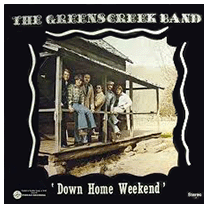 The Greenscreek Band "Down Home Weekend" (Pisgah Records, 1978-?) (LP)
A North Carolina country-rock band with a largely original repertoire, The Greenscreek Band are a genuine enigma -- they played a few shows locally in their hometown of Sylva, NC, in the state's rural Green's Creek region near Asheville, and they recorded this lone album, then vanished from sight. The record seems to be split between original material on Side One, and covers of southern rock and '70s pop hits on Side Two, including tunes like "Sweet Home Alabama" and James Taylor's "Carolina On My Mind." Unfortunately, the LP has minimal liner notes -- the musicians aren't listed and there are no songwriter credits either. Other than a couple of show notices in the local Sylva Herald newspaper from early 1978, I could find little mention of this band online. Anyone out there have insights or info?
 Dean Greer "Dean Greer" (Deville Records, 19--?) (LP)
Yeah, okay, so I know he's not always singing in tune, but hey, I just don't care. A lumber salesman by trade, Dean L. Greer (1934-2019) hailed from West Point, Virginia where he owned his own business, but he made the trek to Nashville to cut this session with an all-star studio lineup: Lightning Chance on bass, Ray Edenton (rhythm guitar), Lloyd Green (pedal steel), Jerry Reed(!) on lead guitar, Hargus Robbins (piano), Pete Wade (lead guitar) and both The Jordanaires and Nashville Edition providing backing vocals. You can get a lot of bang for your buck with a crew like that. Admittedly, the musicians give a solid, professional performance and leave it at that, no extra heroics, but they do sound good. For his part, Mr. Greer is quite earnest and fully committed, and even though he slips now and then, I enjoyed this record. It's twangy and heartfelt, and packed with original material, much of it is a latter-day shuffle style that recalls dudes like Claude Gray or Charlie Walker: why complain? Dean Greer is credited as the songwriter on about half the songs, with several other writers sharing the same publisher, Sandwayne Music, including the equally obscure Buck Dickerson, Danny Denver, Tiny McCloud, and Weedy McCloud, as well as a few folks with different publishers: Larry Coates, Dale Davis and Robert Owens, and even one from Eddie Miller. The tunes aren't all that original, but they're pretty solid, and it's always nice to discover a whole new brace of honkytonk tunes. Not sure when this came out, though it looks like a late '70s/early '80s kinda thing; I tilt towards the 'Eighties on this one. I dug it.
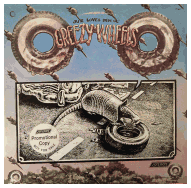 Greezy Wheels "Juz Loves Dem Ol' Greezy Wheels" (London Records, 1975) (LP)
(Produced by Garrison Leykam & Peter Hay)
The first album by this venerable Texas band... an admittedly iffy mix of hippiedelic boogie-rock with a hint of Grateful Dead-ish jam-band-ism, and lots and lots of conga drums. The opening track, "Get My Mind Together," features gruff, swampy vocals by bandleader Cleve Hattersley and has a weird kind of Jerry-Reed-meets-the-Grateful-Dead sound. The next few tracks add female vocals into the mix, provided by Hattersley's sister Lissa and by his wife, fiddler "Sweet" Mary Hattersley, giving the band a passing similarity to Dan Hicks & The Hot Licks. The Wheels enjoyed a long stint as the house band at Austin's fabled Armadillo World Headquarters concert hall, and as a result were lumped in with the indie/outlaw country scene. That connection was borne out more on their second album, but on this debut disc they were way more of a ragged hippie rock band, while taking a few dips into jazzy riffs and regional styles. Take for example the Spanish-Latin tinge of their cover of Willie Nelson's "I Never Cared For You," one of only a few cover tunes on this album. Lissa and Cleve Hattersley wrote most of the original material, with her "Standing In The Light" being an album highlight, particularly with her proto-Lucinda Williams-y vocals. This album is a good document of its times, though less twangy than one might hope... You really gotta be a fan of hippie grove music to get into this one.
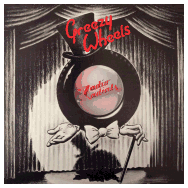 Greezy Wheels "Radio Radials" (London Records, 1976) (LP)
(Produced by Garrison Leykam & Peter Hay)
Perhaps you can mark the moment when Texas country became cooler than Texas rock as falling somewhere between the first and second Greezy Wheels albums: Willie Nelson had ascended to full godhood, and these scruffy jammers went for full-on twang. The album opens with an odd, hybrid reggae-boogie funk tune, but it's track #2 that seals their fate in the outlaw country canon. "Country Music And Friends" is a stone cold classic, with its faux evangelical Christian lyrics paired with an awesome, irresistible chorus (cataloging the best things in life, circa 1976 Austin: "cocaine, country music, and good old Lone Star beer...") while Mary Hattersley's elegant fiddle break provides some truly classy twang. Deeper into the album, the band's Dan Hicks-ishness is cemented on acoustic jive tunes like "Feel Like A Devil," "Heartburn" and "Dirty Old Man" (all with Lissa Hattersley singing lead...) There are still a few clunkers on here, but this album is much smoother and less rock-oriented than their debut, and generally more fun. I don't like all the songs, but it's hard to imagine there ever coming a time in life when I wouldn't get a little jolt playing "Country Music And Friends" just one more time. That's really what makes this album a keeper.
Jim Gregory & Brenda Davis "Somewhere Over The Rainbow" (Country Showcase Records, 1978) (LP)
Guitarist Jim Gregory was born in Oklahoma, grew up in California, and moved to North Carolina as an adult; singer Brenda Davis was his niece and joins him here on this mixed set of pop vocals/standards (on Side One) and country-oriented material, such as "Blue Eyes Crying In The Rain," "Cattle Call" and "Tennessee Waltz" (on Side Two.) Not a lot of info about this one: Mr. Gregory apparently recorded a few singles as well, including one distributed by the NSD consortium in Nashville, though the Country Showcase label (and presumably Mr. Gregory) was from Bailey, NC.
Tommy Gregory "100% Tommy" (TGA Records, 1982) (LP)
(Produced by Herb Clinard)
Aspiring songwriter Tommy Gregory was born 1943 in hyper-rural Ely Hollow, Kentucky, which is basically a cluster of houses on a remote country road located between the tiny towns of Keenox and Flat Lick, or -- by different reckoning, about twenty miles due west of Harlan. As a young man he moved to Louisville, and well... maybe I should just let him tell his own story in their liner notes from this album (credited to Pee Wee King) which are probably emblematic of many of the artists profiled on this website: "...Tommy migrated to Louisville, Ky., and in 1962 worked as an auto mechanic, along with numerous other occupations until 1968, when he was employed by a trucking company also of Louisville. Tommy began writing songs in 1973, and tried with very little success to sell his material to record and publishing companys; his struggle with these record companys has continued for nine years now, and with his own southern drive, and ambitions in music, inspired him, in this year, 1982, to form his own publishing and record company. He writes and performs his own songs, thats why this album is called '100% TOMMY'." Presumably many of the same songs he spent a decade trying to sell in Nashville are included on this album: "Mr. Lawman," "Fancy Cars And Late Night Bars," "Give Me Your Broken Heart One Piece At A Time" and "X-Rated Chevy" are among the many intriguing song titles, though since Mr. Gregory also thanks Pee Wee King's pal, Redd Stewart, "for his information on bridging a song," there's a good chance that they may indeed have been rough-cut gems all those years he was banging his head against the music industry walls. It's not clear where this was recorded, though there's a label address in New Albany, Indiana... This album may have been more of a challenge to record than others, as the musicians include several different sets of bassists (Danny Berry, Bill Kindsbury, Keven Troutman); drummers (Jeff Chanley, Ronnie Cooke, Tommy Richards), and guitarists (Tommy Alexander, Wayne Johnson, Rex Wiseman) along with Tommy Gregory on rhythm guitar, steel player Tommy White, Herb Clinard on fiddle and Redd Stewart credited as helping with the arrangements. But, much to his credit, Tommy Gregory did get it done, and left his musical legacy for all to enjoy... As far as I know, though, this was his only album.
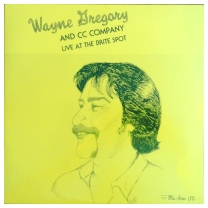 Wayne Gregory "Here I Am" (Soundtech Studios, 1985) (LP)
(Produced by Hal Rugg, Joe Gibson & Milton Blackford)
A Nashville outing from an Arizona bar-band singer... All the songs were written by a fella named Gary W. Allen, and recorded at the Jack Clements studio with Jerry Reed playing acoustic and electric, Lloyd Green and Hal Rugg on steel, Hargus Robbins on piano and Gary Allen singing backup...
Wayne Gregory & CC Company "Live At The Brite Spot" (Flo-Ren Records, 1985)
(Produced by Chris Gussa)
Recorded live in 1985 at The Brite Spot, in Palominas, Arizona... The set list is all cover songs, stuff like "Release Me," Lay Down Sally," "Rose Colored Glasses" and "It's Such A Pretty World Today." His band included Larry Paycheck and Patty Paycheck, with Jimmy Curl on drums.
 Ray Grenfell "Montana Mountain Man" (Vanco Records, 19--?)
(Produced by Gene Breeden & Ray Eldred)
A devotee of old-school country yodelers and balladeers such as Elton Britt, Wilf Carter and Jimmy Rogers, mountain man Ray Grenfell was born in Florence, Montana, in the Bitterroot Valley and was a quintessential Northwesterner, working as a logger, rancher and rodeo rider... even as a boxer and an auctioneer. Mr. Grenfell also recorded a couple of albums later in life, one in the mid-1990s and another around 2002, as well as several singles in the 'Seventies, including a few tunes which are also on this album.
 Bill Gress & Country Blue "Live At Rex's Nite Club" (Glacier Records, 1974) (LP)
High plains country-pop bandleader Bill Gress led the house band at Rex's Nite Club, a watering hole in Kalispell, Montana (in the West end of the state's Flathead Valley, just north of Missoula...) This album has a lot going for it, starting with the tinny, fake-live applause, which sounds like it was stripped from an old Beatles concert. The music is perky, with bouncy guitar riffs and charmingly uneven vocals... Bassist-emcee Gress has a sort of optimistic, can-do style, reminiscent perhaps of Del Reeves, while his sister, "girl" singer Betty Lou Armstrong -- pictured on the cover in provocative though hopelessly outdated go-go boots and midi skirt -- had a slightly folkish sound, equal parts Judy Collins and Donna Fargo. Some groovy chicken-pickin' guitar and really nice pedal steel... All in all, a swell example of a real-live, working country-lounge band in the upper plains states during the "Me Decade" early '70s. Fun stuff!
 Tom Gribbin "Saltwater Gypsy" (Mariner Records, 1981) (LP)
(Produced by David Williamson, Harry Dailey & Tom Gribbin)
Hailing from St. Petersburg, Florida, corporate lawyer-turned-honkytonk-outlaw Tom Gribbin may have paid allegiance to Jimmy Buffett, but he sounds most like Waylon Jennings, growling in a Waylonesque brogue and covering "Waymore's Blues" along with a strong set of mostly-original material in the same mode. Gribbin seems to have been tight with songwriter Danny Flowers, who plays guitar on this album and co-wrote one of the tracks with Gribbin. Also in studio was keyboardist Biff Watson and some other Nashville session players, although this album album wasn't just packed with Music City hired guns. Gribbin wrote or co-wrote five of the songs, and his harmonica player wrote a sixth... Perhaps the biggest surprise is an original reggae song, "Johnny Deepwater," and a cover of the punk anthem "Guns Of Brixton," by the Clash (Gribbin went to England and played some clubs during the early punk era, and came back impressed by the DIY ethos. This album's kind of slick and commercially oriented, but definitely as indie as they come. (Note: this was reissued in the UK as Son Of Lightning with a different track sequence, though the songs are all the same.)
 Tom Gribbin & The Saltwater Cowboys "Useppa Island Rendezvous" (Mariner Records, 1984) (LP)
 Tony 'Jarfly' Griffin "Southbound Train" (Bellaphon Records, 1982) (LP)
(Produced by Wayne Goforth)
Cowboy-ish folk-blues in a Ramblin' Jack Elliott/Townes Van Zandt-ian mode. Griffin was a Californian who got rambling fever and made his way to Nashville, where he got into music and learned to play while hanging out with bluegrassers such as Red Rector and Phil Ledbetter, who he credits with giving him his nickname. Although he learned to play from bluegrassers, this is much more of a folk-roots poet type of album, with several traditional songs along with a bunch of Griffin originals that sure sound like traditional songs. Townes fans, in particular, might really like this one.
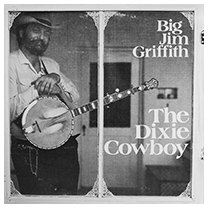 Big Jim Griffith "The Dixie Cowboy" (Sonyatone Records, 1976) (LP)
Down-to-earth, stripped-down old-timey revivalist twang from a Tucson, Arizona college kid who picked banjo and sang, backed by guitarist Dave Luckow and Bob Sayers on fiddle and mandolin. No producer credits, alas.
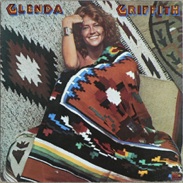 Glenda Griffith "Glenda Griffith" (Ariola Records, 1977) (LP)
(Produced by Don Henley & Jim Ed Norman)
A very, very, very LA in-crowd album with backing by a sizeable portion of The Eagles (Don Henley on drums, Don Felder and Joe Walsh playing guitar and Eagles producer Bill Szymczyk mixing the tracks...) as well as Carole King playing piano on a couple of songs and contributing a song called "Eagle," as well as a whole slew of folks from the Southern California soft-rock/country-rock studio scene in tow: Karla Bonoff, Valerie Carter, Danny Korchmar, J.D. Souther, Waddy Wachtel, et. al. Griffith seems to have been a particular protegee of Danny O'Keefe, recording four of his songs and getting him to back her on one track; she herself contributes two originals to the repertoire. This is mostly a '70 pop record, in a lush, sometimes overripe Carole King/Carly Simon-esque mode, though with enough hints of twang to qualify it for mention here... The songs featuring the Eagles dudes sound very Eagles-y, with specific riffs and production touches that are lifted straight from the Hotel California playbook, just with a gal singing rather than Henley and his peeps. Really, though, I guess this is more of a buyer-beware review: I kept seeing this popping up in country bins and finally had to check it out, but there isn't really much twang on it. Her cover of Marty Robbins' "Don't Worry About Me" spotlights Sneaky Pete Kleinow on pedal steel and has a nice, plinky honky-tonk vibe, though her vocals are underwhelming; some nice steel work on O'Keefe's "Quits," which appropriately enough closes the album out.
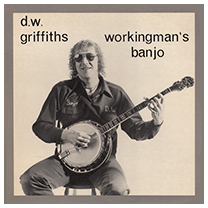 D. W. Griffiths "Workingman's Banjo" (BMA Records, 1978) (LP)
(Produced by D.W. Griffiths, George Eliot & Ron Eliot)
Experimental bluegrass instrumentals by banjo plunker D.W. Griffiths, who hailed from Little Silver, New Jersey. Most of these East Coast pickers are unfamiliar to me, except for Andy Statman, who plays mandolin; Tony Trischka contributes liner notes, in which he speaks of Charles Ives, and hints at how challenging this album might be for many mainstream 'grass fans.
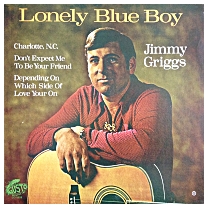 Jimmy Griggs "Lonely Blue Boy" (Gusto Records, 1973) (LP)
(Produced by Tommy Hill)
An interesting mid-period album from Gusto Records, and a nice break from their usual 'Seventies mode of cheapie reissues of trucker tunes and old Starday sessions. This is an odd but ultimately charming set of original material, some of it clunky and some of it reasonably robust, with a mix of would-be countrypolitan and goofy novelty numbers. Objectively speaking, the more emotive numbers are kind of "bad," but they have their charms -- mainly, that Griggs was really putting his heart into the performances. The highlight is probably the topically-themed, moodily apocalyptic "Beginning Of The End," where he comments on the "free love" scene of the early '70s, and wonders aloud what the world is coming to... There are also several decent straight-ahead country numbers, including "Charlotte, North Carolina," an early Gary Stewart song which was the flipside to the single, and one of the strongest tracks on the album, along with "Overloaded Diesel," a Dave Dudley-style saga about a trucker being chased by an angry husband across several state lines. Griggs had previously released several singles on the Boot Heel label and the ready availability of promo copies of this album suggests that Gusto really made a go of getting him in the charts. But for whatever reasons it didn't quite click and he faded from view. The record's worth checking out, though, both as kitsch and as country, and was a noble experiment on the part of the normally rather conservative Gusto label.
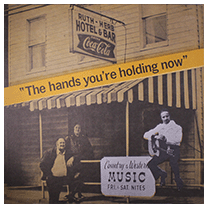 Frank Grill "The Hands You're Holding Now" (Custom Fidelity, 19--?) (LP)
(Produced by David A. Owens)
A singer from Pittsburgh, PA, Frank Grill sang mostly covers -- of George Jones, Marty Robbins, Waylon Jennings, Pee Wee King and others -- as well as two originals that he wrote, "Face In The Mirror" and "We'll Be Together." Among the musicians backing him is Ron Mesing on dobro...
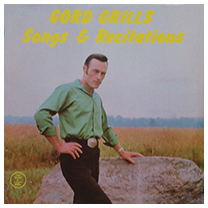 Gord Grills "Songs And Recitations" (Paragon Records, 19--?) (LP)
(Produced by Jack Boswell & Bill Bossey)
Canadian country from Ontario, with lead singer Gord Grills playing guitar, fiddler Carl Elliott, Dusty Stokes on bass, and Joe Aylward on lead guitar; Aylward later recorded as a solo artist... Mr. Grills was a farm kid who grew up around near Workworth, Ontario, and cut his teeth playing country gigs in small town bars 'way back in the early 'Sixties and started this band, the Road Rangers, in 1966. He mixes original material, super-oldies such as "Wreck Of The Old '97," and several recitation numbers, a style you don't hear much of these days... not even back when this album was made!
 Michael 'Bo' Griner "Takin' The Chance" (Blue Horizon Records, 1982-?) (LP)
(Produced by Joe Bob Barnhill & Gene Rice)
Hailing from Quitman, Georgia, singer Bo Griner had been in both secular and gospel bands, had left the music business and come back to it before traveling to Nashville to cut this disc, which is packed with songs he wrote. Although he clearly had Top Forty aspirations, he never really made the leap to Nashville, and headed back to Atlanta, where he played hotels and clubs and whatnot. Several Nashville "usual suspect" studio guys are backing him here, with Hoot Hester and Mark O'Connor playing fiddle, Hargus Robbs on piano, Hal Rugg playing steel guitar... For Top Forty fans, the big wow here is the presence of one song written by a friend of Griner's, future chart-topper Travis Tritt, whose "Spend A Little Time" closes out Side Two of this album, and may actually be the first one of Tritt's compositions to make it onto wax, several years before Tritt himself broke through in 1989. Mr. Griner later moved to St. Augustine, Florida, playing local club dates around Jacksonville and environs.
David Grisman -- see artist profile
 George Gritzbach "Had Your Gritz Today?" (Kicking Mule Records, 1976) (LP)
East Coast blues picker George Gritzbach's played folk and blues clubs throughout Massachusetts and greater New England in the early '70s before recording this fine acoustic album, which is deeply rooted in the "country blues" style of the 1920s and '30s. It's a fine album, similar to the work of contemporaries such as Bob Brozman and Stefan Grossman, though this blues revival work doesn't show the same unique flair of his original material that he'd record on his next album. Acoustic blues fans will want to check this one out, though Americana/alt-country fans might enjoy his later stuff more.
 George Gritzbach "The Sweeper" (Kicking Mule Records, 1979) (LP)
(Produced by David Budries)
Another solid acoustic blues set, mostly of original material, including a few songs that adventure forth into funkier, more inventive blues-Americana territory... The uptempo title track, "The Sweeper And The Debutante" is a lusty, steamy novelty song that recalls David Bromberg's "Sharon," while on the other end of the emotional spectrum, the eerie, spectral "Mr. Fat's Sad Surprise" tells the tale of a rich tycoon meeting up with Death itself, with Gritzbach accompanied by what sounds like the mournful ghost of a tortured oboe. "Long As It's Green" is another nice, good-natured tune, while much of the rest of the record fits right into the straight-and-narrow of the '70s acoustic blues revival. I remember hearing "The Sweeper" on KFAT a bazillion times, back in the goodle days, and enjoyed playing it on the air myself a time or two. Afterwards, Gritzbach went for a heavier, more electrified sound, but this early acoustic set was a real gem.
 George Gritzbach "All American Song" (Flying Fish Records, 1984) (LP)
(Produced by David Budries & George Gritzbach)
A mellow, rather subdued in which Gritzbach strikes a contemplative tone and even tackles some political themes, particularly the issues of nuclear proliferation and the Cold War tensions of the Reagan era. The arms race is most directly addressed on "Talkin' Freeze," a song inspired by the grassroots "nuclear freeze" movement, with an urgency and earnestness that is reprised on "Red Alert." He also sings about economic inequality ("Off The Wall Street Blues"), evolution ("Common Denominator") and ecology ("Creole Chill") as well as love and romance, as of old. The album's most durable song may be the closing number, "Seeds Of Tomorrow," which echoes the political themes explored earlier, but more gently and more subtly. This can be seen as a transitional album -- still anchored in the acoustic rag-and-blues style of his earlier albums -- though it's also a lot more glum and downcast. Even though he's preaching positive social change, Gritzbach sounds kind of low-energy and down in the dumps... I guess looking into the abyss can do that for you. At any rate, although this album isn't as vibrant as his stuff from the '70s, it's still got some good stuff on it, and is certainly worth checking out.
 Larry Groce "The Wheat Lies Low" (RCA-Daybreak Records, 1971) (LP)
(Produced by Richard Larson)
Though he was born in Texas and paid his dues out on the East Coast and the West, singer-songwriter Larry Groce eventually moved to West Virginia in 1972, becoming a mainstay of the state's public radio network, and its acoustic music scene. This was Groce's first album of original material; previously, he had recorded a set of Christian Science hymns, with lyrics by Mary Baker Eddy. It was recorded in LA, with an unidentified group of studio pros, as well as bassist Berke McElvey, the only other musician to get a credit other than Larry Groce. In all honesty, this album is a bit torturous, with Groce captive to many of the dominant folkie/singer-songwriter tropes of the time. The set opens with a jaunty novelty number, "A Woman Indeed," which seems like an attempt to emulate John Prine's mode comedic side, and provides a strong foreshadowing of Groce's future success with 'Seventies hit, "Junk Food Junkie." The rest of the record, however, is dreadfully self-serious folk material, with Groce just another folk dude straining to find profundity and plowing familiar lyrical ruts, notably his callow young-man musings about the nature of women, another twenty-something dude trying to sound worldly and wise. The worst song on the album is one called "Compton," not about the Southern California city, but rather about some stick-figure fictional character of a simple man who mysteriously chose to marry and redeem some gal from a brothel, but who, through thoughtless neglect raises a couple of kids whose lives go off the rails -- his son gets arrested for whatever and the daughter becomes a woman of the night, just like her mom. It's like Paul Siebel's "Louise," on steroids, and frankly a bit embarrassing. Mostly, though, the disc is filled with innocuous acoustic guitar folkie stuff -- several songs about just hanging out and enjoying mellow days doing nothing, and three songs about birds, including Groce's own "Grey Pigeon" (nice) and a cover of Petter Ferrara's "Sad Bird." The album's other cover is a nice version of Bob Dylan's "Girl From The North Country," though the rest of the songs are all Groce's own originals. Towards the end of the album comes another novelty number provocatively titled "God And The Body," which perhaps was a hangover from his Christian Science days, basically a goofy tune about how God did a good job making us and all our working parts. I suppose Groce acquitted himself well on his secular debut -- it's a decent though largely unremarkable album... I think after this he headed back East to drop out in the Appalachian scene, a move that yielded some surprising results.
 Larry Groce "Crescentville" (RCA-Daybreak Records, 1972) (LP)
 Larry Groce & The Currence Brothers "Larry Groce And The Currence Brothers" (Peaceable Records, 1975) (LP)
(Produced by Michael Lietz & C. Randolph Naurt)
Listeners and fans who want to get a sense of Groce's roots music origins might get a kick out of this pleasantly twangy, all-acoustic album... A nice, straightforward set of traditional-sounding bluegrass, with a repertoire that mixed in plenty of "progressive" material, such as Dylan's "You Ain't Going Nowhere," the Johnny Cash oldie, "I Still Miss Someone" and Rodney Dillard's "The Biggest Whatever." The Currance Brothers were a family band from Randolph County, West Virginia who provided solid though unflashy accompaniment for the equally unhurried lead singer... The Jimmie and Lorie Currance Brothers went on to record a few albums of their own, though I think this was their debut LP.
 Larry Groce "Junkfood Junkie" (Warner Brothers, 1976) (LP)
It can be hard not to be considered a "one-hit wonder," especially when your big hit blows up as huge as the title track to this amiable folk-pop outing. The bouncy, deliciously delivered song was a good-natured spoof of the growing "natural foods" movement of the 'Seventies, and it became one of the biggest radio hits of the Bicentennial, as popular with the hippie-hating "straights" as with the longhairs and liberals who if nothing else proved that they could take a joke as well as the next guy. It's funny, though, it never occurred to me, until just now, that Larry Groce might have actually written -- hell, he might even have sung -- other songs besides "Junkfood Junkie," and that he might actually deserve a spot in the '70s hippie-country pantheon. That suspicion is borne out by a cursory Google search which reveals that Groce was the founder of the venerable "Mountain Stage" radio show, which helped give national exposure to many to some of the biggest stars of the budding Americana and Adult-Alt music genre in the 1980s and '90s. Go figure. Heck, maybe some day I'll have to check the rest of this record out!
 Larry Groce "Please Take Me Back" (MC Records, 1977) (LP)
(Produced by Mike Curb)
On what amounted to his major-label swansong, Larry Groce hooked up with hotshot producer Mike Curb for a smooth set of flowery folk-and-twang, backed by an impressive roots music studio crew. Ry Cooder plays on a couple of tunes, along with pedal steel players J. D. Maness and Sneaky Pete Kleinow, fiddler Richard Greene, a couple of guys on loan from the Emmylou Harris Hot Band (Emory Gordy and Glen D. Hardin) with Nick De Caro slumming on accordion... Heck, they even got Melissa Manchester to sing harmony on a tune or two! For me, the most intriguing sideman was banjo picker and backup singer Rob Quist, a veteran of the regionally-based group, the Montana Band, who was probably playing with Groce at the time. Like Quist, Groce preferred the smalltown life, and sings of his happiness in a "Big White House In Indiana," along with other pastoral, rural inclinations. Most of this album is too wishy-washy for me, with pop-folk/singer-songwriter material reminiscent of Harry Chapin and Jim Croce, though the opening track, "Entertainment Nightly," is a satisfyingly twang-filled tune about "a great big star in a little beer joint," who doesn't mind pickin' and singin' far away from the LA and Nashville lights. Other tracks are mildly evocative, but that one's the real winner.
 Jimmie Grokett "Country Lady" (AMI/Tamara Records, 1986) (LP)
(Produced by John Beland & Bernie Vaughn)
This album by Sherman, Texas singer and keyboardist Jimmie Grokett was a side project of erstwhile Flying Burrito brother John Beland, who had earlier produced a single for Grokett's band, Red Horse. There are several songs on here credited to Beland and several obscure cover songs, including a little-known Rodney Crowell song, "The Best I Can." The title track was co-written by Jimmie Grokett and Danny Batchelor of Red Horse, although that seems to be the only original on his part. The massive Flying Burrito Brothers website says this album was "unreleased," but it looks to me like it it went through the whole Nashville custom/indie label process, and was pressed with proper graphics and everything. It was recorded in Hendersonville, Tennessee with several Music City pickers as back-up, and the single, "Country Lady," got a plug in Billboard at the end of the year. Apparently the Red Horse Band also went to AMI and cut an album at the same time, but had parted ways with Grokett before they went into the studio. That must have been fun for Beland, who produced both albums.
 Dewey Groom & The Texas Longhorns "The Last Of The Big Bands" (Longhorn Ballroom, 1966-?) (LP)
(Produced by Dewey Groom)
The Texas Longhorns were a long-lived Texas dance band, led for several decades by producer Dewey Groom. The group's career dates back to the 78 era, when they recorded for Imperial Records and other labels, though most notably for Groom's own Longhorn label, which was a powerhouse for regionally-produced traditional country. This disc is notable for its wealth of original material, including a slew of tunes from singer Clay Allen, who is described on the back cover of Groom's "second in command," as well as one each credited to lead guitar picker George McCoy and steel player Bobby Garrett. The Longhorn label was also the mid-1960s home for hotshot guitarist Phil Baugh, and though he's not in this lineup of the band, this album also features two songs by Baugh's musical partner, Vern Stovall. The music's groovy, but maybe even better are the brisk bios of all eleven guys in the band at the time, telling us both about the family men and the guys who liked to chase after gals, as well as the guys who had careers outside of the band.
 Dewey Groom & The Longhorn Band "Souvenir Album #1" (Longhorn Records, 1978) (LP)
(Produced by Dewey Groom & Jerry Abbott)
This album was made to be sold at Dewey Groom's dancehall, the Longhorn Ballroom, located in Dallas, Texas... This was a much smaller group than the old Longhorns band Groom led in the 1950s and '60s, just six guys who were the house band at the time, including steel player Junior Knight and lead singer Al Harvey, who gets equal billing on the front cover, and was probably the day-to-day leader of the band. Mostly covers tunes, fairly predictable stuff such as "Faded Love," "Jole Blon," "Six Days On The Road" and "Orange Blossom Special."
 Dewey Groom/Various Artists "Longhorn 25th Anniversary Album" (Longhorn Records, 1983) (LP)
(Produced by Dewey Groom & Keith Rust)
Dallas, Texas nightclub owner and country promoter Dewey Groom leads a band of younger musicians on a set recorded in honor of the Longhorn Ballroom's twenty-fifth anniversary. The Longhorn was built in the late 1950s as a home for western swing legend Bob Wills, and Mr. Groom managed it for about a decade before becoming the full owner in 1967. The backing musicians were presumably the early '80s house band, younger dudes who included Buddy Brady on fiddle, bassist Van Crane, Donnie LaValley on steel guitar, piano plunker Kenny Martin, Shane McCauley on drums and lead guitarist Curt Ryle. While Mr. Groom croons on some oldies ("Faded Love," et. al.) he mostly lets the spotlight fall on the young'uns, and this album is packed with original material -- six songs written or co-written by Curt Ryle, including two co-composed with Kenny Martin. They all take turns on vocals, recorded in the studio at Crystal Clear Sounds in Dallas. Not long after this was recorded, Oklahoma-born Curt Ryle headed for Nashville, where he found success as a sideman, songwriter and producer; some of his most successful tunes include "Storm In The Heartland," a mid-1990s single by Billy Ray Cyrus, and several songs recorded by Clinton Gregory.
 Gary Dean Growden "Sunshine On The Rocks" (Little Nashville, 1977) (LP)
(Produced by Don D. Sheets & Joe Edwards)
Except for a cover of Neil Diamond's "Gichy Goomy," this is a set of all original material... And it was recorded in Nashville, too, but not the Nashville you're thinking of... In this case it was Nashville, Indiana, an itty bitty little hamlet just East of Bloomington. Where, apparently, they have country singers! This looks like it might have been a "song-poem" album, with producer Don Sheets and his wife, Marti Mae Sheets, along with other family members and hired hands, playing the music that was "provided" by Gary Growden. The band also includes steel guitar by Joe Tippie and backup vocals by the Marti Mae Singers, led by Ms. Sheets.
 Bart Grubbs "Songs We Sing At Bart's Barn" (Bart's Barn Records, 19--?) (LP)
(Produced by Anthony JP & George Walck)
A memento of an old-time country duo from the Great Depression era of the 1920s and '30s... Bart and Bill Grubbs were a brother act billed as the Harmony Boys, who played at regional talent shows and other live venues in Colorado, Nebraska and the Midwest, at least according to this album's back cover. They don't seem to have left a big footprint, though -- I couldn't find any mention of them online, or even where they were from, though Bart Grubbs and his wife Emelia seem to have been living in the Denver suburb of Longmont, Colorado at the time this album was made. He's backed by an all-local group drawn from Longmont and nearby Wheat Ridge, including members of his family, such as Jim Grubbs on guitar. I'm not sure if the old Grubbs brothers duo ever recorded back in their heyday, though this album is probably a good reflection of their act. Amid sentimental chestnuts such as "Lamplighting Time In The Valley" and "Silverhaired Daddy Of Mine," there are slightly more modern classics such as "Amigos Guitar," and "All For The Love Of A Girl," as well as Freddie Hart's early 'Seventies hit, "Easy Lovin." There are also three newly minted originals by Bart Grubbs, "Birdies In The Treetops," "Walk To The End Of The World" and "What Makes The World Go 'Round." I'm not sure when this family album came out, though it could have been any time from the early 1970s to early '80s, from the look of it.
 Grubstake "Grubstake" (Biscuit City Records, 1977) (LP)
(Produced by Jim Ransom & N.C. Bull)
The acoustic trio of Steve Abbott, Jack Stanesco along with Harry Tuft, who was the owner of the Denver Folklore Center. The three got together in 1972 and worked up an impressively diverse repertoire spanning old-timey music, Celtic folk, gospel, calypso, country and cowboy tunes. It's decidedly on the folkier end of the spectrum, but nonetheless a nice taste of the 1970's Denver scene.
Gib Guilbeau -- see artist profile
 Guilbeau & Parsons "Louisiana Rain" (Ace/Big Beat Records, 2002)
Gib Guilbeau and Gene Parsons were both stalwart members of the Southern California psychedelic country scene, with stints in the Burrito Brothers and the Byrds, as well as numerous other country-rock projects that dotted the landscape back in the 1960s and '70s. This disc gathers a trove of dimly-remembered 1967-70 work on Gary Paxton's independent Bakersfield International label, which served as a fermenting pot of the nascent hippiebilly sound... These guys'll sound instantly familiar to anyone who's grooved to Gram Parsons or the country-era Byrds, with the same whiny, wandering vocals and tentatively twang and slightly constricted pedal steel playing, and -- of course -- guitarist Clarence White anchoring the later sessions. Guilbeau, who had been working as a country and folk singer for over a decade before hooking up with Parsons, wrote almost all of the material and added a cajun flair to many of the songs, also writing plenty of spaced-out, searching lyrics. In country terms, it's not great material (though there are a few catchy tunes), but seen as a stepping stone into the bigger LA country-rock scene, this material is historically quite important. It's also pretty good for what it is -- just 'cause I have trouble getting into this kind of stuff doesn't mean you shouldn't check it out. If you're a Byrds fan, in particular, you're gonna love it.
 Billy Guitar "A Legend In His Time: A Tribute To Jim Reeves" (Mizon Records, 1964) (LP)
(Produced by Mike Larsen)
A straightforward homage to the recently-departed Jim Reeves, with solid and pleasantly twangy backing by an anonymous West Coast band. Presumably no relation to Bonnie Guitar, William Hank Noble (1930-1988) -- aka Billy Guitar -- was born in Raleigh, North Carolina, but moved to Canada in 1949, where he pursued a career in country music, apparently working with Hank Snow for a while. Sometime in the 'Fifties, he moved back to the States, and recorded a string of singles on various indie and major label, mostly working as Hank Noble, and even dabbled in uptempo rockabilly, recording some rock tunes for Decca as "Billy Guitar and His Nighthawks." This disc was recorded in San Diego, California, and according to the liner notes, Mr. Noble had been working in Las Vegas for several years before cutting this album. As far as I know, this was his only full LP, though some of his older tracks may have been anthologized elsewhere.
 The Gularte Valley Knights "Presenting..." (GBR Studios, 1975-?) (LP)
(Produced by Gary Boyd)
A super-obscuro, locals-only band from California's Great Central Valley, this back-to-basics, early '70s set features some guys from Delhi, CA, a tiny town south of Modesto. As far as I can tell, there's no actual place called Gularte Valley; the group takes its name from bassist Rick Gularte and mandolin picker Manuel Gularte, who anchored the band along with lead guitarist John Montgomery, singer Sandy Maule and drummer Dick Warn. Steel guitarist Ivan Ward -- who played on a few Northern California records during the '70s -- also chips in, as well as bass player and pianist Reggie Folks. The repertoire mixes early '70s roots hits like "Polk Salad Annie," "Good Time Charlie's Got The Blues," Ronnie Milsap's "Pure Love" and Billy Swan's "I Can Help" with oldies like "White Lightning" and a little bit of old-school pop-soul, including covers of Nat King Cole's "Mona Lisa" and Gene McDaniels' "100 Pounds Of Clay." There's one original tune, Sandy Maule's "I'm Sorry Too," a nice country weeper that was recorded separately from the rest of the album (maybe he made a solo single?) I'm not exactly sure when this one came out, or how long the band was together... They also recorded at least one single ("Your Cheating Heart" backed with "That's Alright Mama") and the band was still doing gigs like local rodeos and the Mariposa Country Fair as late as 1980 and '81. Also, Sandy Maule seems to have stuck around the Modesto area, and was singing in local bars as recently as 2015. Anyone out there with more info about these guys? I'm all ears!
 Gun Shy "Gun Shy" (Centron Records, 1979) (LP)
A moderately competent bar band from Chico, California, led by guitarist Cliff Mickelson, which as far as I know just made this one record. Mickelson wrote three of the seven original songs on here, including "Sweet Country Living," which is the album's most overtly twangy tune. The record is packed with cover tunes such as "Battle Of New Orleans," "North To Alaska," and "Rocky Top," and these tracks are at odds with the originals by Mickelson, lead singer David William Peck and bassist J. B. Keator. This is both because they veer into a kind of bright, sunshine-pop AOR style, and because they play their own songs with much more vigor and conviction than the cover songs. It really sounds like they were just padding the album out and didn't give a hoot about the oldies. Nothing earthshaking here, but another memento of a locals-only band, this time from California's Central Valley. Guess it also didn't help that some rock band came up with the same band name a couple of years later... Oh, well. Them's the breaks. (BTW - I googled Mickelson and apparently he became some kind of anti-government/anti-CDC conspiracy theorist -- it's too twisty for me to delve into. I'm not sure if he also kept the band going, though he did have a Facebook page up with old pix and whatnot.)
 Gun Shy "Giver" (Centron Records, 1982) (LP)
(Produced by Jan Lucas
Stan Gunn "Two Sides Of Stan Gunn" (Sugar Hill Records, 19--?) (LP)
Stan Gunn was a former rockabilly singer, perhaps best known for his novelty classic, "Baby Sitter Boogie," which he recorded with his brothers Elmo and Leon. Like many rockabilly rebels, Gunn later went country, working the Midwestern country lounge circuit, from Iowa and South Dakota over to the Rocky Mountains and down to Kentucky. He recorded several albums, often emphasizing the theme of his versatility, i.e. his ability to sing both "country" and "pop." Gunn was apparently born in Kentucky, though he moved around a lot, and made Iowa his base of operations for several years, around the time he recorded these records.
 Stan Gunn "Two Sides Of The Stan Gunn Musical Revue" (Y Records, 19--?) (LP)
This album also includes contributions from Elmo Gunn, Leon Gunn and Stan Keeler...
 Stan Gunn "...Sings Town And Country" (Sugar Hill Records, 1974) (LP)
Recording for a label in Springfield, Illinois, crooner Stan Gunn once again "shows versatility" on a set that includes country standards such as "Release Me" and "I'm So Lonesome I Could Cry" with a few "town" pop songs such as "Danny Boy" and "Spanish Eyes," as well as contemporary hits like "Sunday Morning Coming Down." The defining quality of this album seems to be its connection to songwriter Alex Zanetis, a Nashville pro who probably had a few new tunes to promote at the time, leading me to believe that this disc was a publisher's showcase album.
 Hardrock Gunter "Songs They Censored In The Hills" (Seeco Records, 1958) (LP)
A set of mildly risque novelty tunes by hillbilly legend Sidney Louie Gunter (1925-2013), an Alabama native whose hard-driving 'early 'Fifties boogie style was seen as a precursor to the rockabilly explosion of the 1950s. Some of these chestnuts, like "Blood Shot Eyes," "It May Be Silly!" and "Rye Whiskey" were a little bit tame, though others, such as "Right Key But The Wrong Key Hole" and "A Little Bit Ain't Gonna Help Us Much" have an enduring bawdiness. These tracks were reissued on vinyl by the German collector label, Cowgirlboy Records, in the 1990s.
Rock (Hardrock) Gunter "Popcorn Dancing For The Social Set" (Gee Gee Records, 1961) (LP)
Pretty much a straight set of country covers, big hits from big stars such as Red Foley, Marty Robbins and Hank Williams.
 Rock (Hardrock) Gunter "The Music Of Hank Williams" (Heather Records, 1972) (LP)
An homage to honkytonk deity and fellow Alabamian Hank Williams, who was one of Gunter's country contemporaries, back in the early 1950s. By the time he released this LP, Gunter had pretty much retired from the music business, though obviously he still had plenty of twang to swang.
 John Gunter "...The Singing Sheriff: Captive Audience" (Captive Audience, 1980) (LP)
(Produced by Darrell Powell & Rick Smith)
A veteran paratrooper decorated in the Korean War, John Gunter returned to civilian life and became sheriff of Madison County, Indiana. He also developed a sideline as an entertainer, and recorded at least two albums as "the singing sheriff," working with locals from around his hometown of Anderson, IN. This album features a bunch of original songs written by producers Rick Smith and Darrell Powell, though neither songwriter played in the band. The musicians included Larry Agee on steel guitar, Keith Bridges (bass), Danny Daniels (keyboards), Joey Grubbs (drums), Jeff Hardin (fiddle), Randy Melson (lead guitar), Paul Thomas (bass) and Doyle Williams on rhythm guitar... Backup singer Cindy Loewen also co-wrote one of the songs, "I Still Burn The Flame," with Rick Smith. One track, "Truck Drivin' Woman," features lead vocals by Steve Prentice, and was also released under his name; he also performed as part of the folk-rock duo Prentice & Tuttle.
 John Gunter "Old Hymns For A Young Heart" (Captive Audience Records, 1981) (LP)
(Produced by Darrell Powell)
An all-gospel set by "the singing sheriff," with some overlap in musicians, but basically an all-new backing band, notably steel guitarist Rex Thomas. The album was recorded at a studio called The Barn, which was run by Danny Gaither, brother of southern gospel legend Bill Gaither.
 Gustafson "Long Time Layin' Down" (Royalty Records, 1977) (LP)
He was Canadian... looks pretty "outlaw..." But I'm still looking for more info...
 Arlo Guthrie "Alice's Restaurant" (Reprise Records, 1967)
Arlo's first album. If the truth be told, there was a time in my life when I was able to recite "Alice's Restaurant" word for word, even the Don Bowman cover version. But those brain cells are gone now. Probably just as well. Also includes the original, less fun, studio version of "The Motorcycle Song," and several folk-psychedelic songs that aren't all that memorable, although they did reveal the young Mr. Guthrie as a surprisingly mature, self-possessed musician, especially for someone as stoned as he must have been at the time.
 Arlo Guthrie "The Best Of Arlo Guthrie" (Warner Brothers, 1977)
A nice best-of set that includes most of his best-known songs, and a couple of off-the-radar tunes as well. It kicks off with Arlo's sprawling, freakulent shaggy-dog classic, "Alice's Restaurant Massacree," and adds "The Motorcycle Song," the bouncy smuggler's ballad, "Coming Into Los Angeles," and several soulful acoustic tunes such as the mournful "Last Train," "Darkest Hour," and his big hit version of Steve Goodman's "City Of New Orleans." It's a modest set, though, and could be longer -- mostly what I'd like to have added is my other Arlo Guthrie fave, "Hobo's Lullaby," although I guess in an age of digital downloads, that's less of a bummer than it used to be. This is a good introduction to Guthrie's work and probably for most listeners about as much of it as they'll need. Sweet stuff, though.
 Lee Guthrie "The Barroom Star" (Zeta Records, 199--?) (LP)
(Produced by Lee Guthrie & Dee Keener)
An all-original set of hard country tunes from songwriter Lee Guthrie who is seen on the cover posing in front of the "wall of fame" at the bar of the fabled Tootsie's Orchid Lounge in Nashville. He recorded this album outside of Nashville, however, mostly at the Ripcord studios in Washington state, as well as a place in Arkansas (which makes me think that's where he was from... Why else make a record there?) Gene Breeden is one of several guitarists on this album, with Eddy Lane playing steel and Hargus Robbins in on some of the sessions as well. The liner notes allude to Lee Guthrie being "born of a great musical heritage," but they don't specify what that means... Was he a relative of Woody or Jack? Could be, though I couldn't find any info about it online. At any rate, there's plenty of outlaw twang to be heard on here, with songs like "Honky Tonk Music (And Barroom Time)," "You Don't Have To Be From Texas To Be A Cowboy." To which I say, bartender: another round!
 Charles Lee Guy III "The Prisoner's Dream" (Capitol Records, 1963) (LP)
(Produced by Ken Nelson)
A former prisoner who was convicted of manslaughter when he was just sixteen years old, Charles Lee Guy III served time in California's Vacaville state prison along with western swing legend Spade Cooley, who was still alive when this came out and contributed a song called "Cold Steel Bars" to the set list. This was Charles Lee Guy's only album, recorded live in a prison auditorium in December, 1962, with musical assistance from guitarist Joe Maphis, and though Capitol Records plugged this novelty album, it didn't really make much of a wave. Mr. Guy apparently cut a few more tracks in Nashville after he got paroled in '64, but soon moved down to North Carolina to live with his father, and faded into obscurity. Apparently he had further run-ins with the law -- and is the focus of all kind of online speculation from the "true crime" crowd -- before passing away in 2011, at age 73.
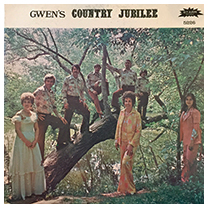 Gwen's Country Jubilee "Gwen's Country Jubilee" (Starr Records, 1973-?) (LP)
(Produced by Jack Casey & Marvin Jones)
Although her group's "jubilee" band name made it sound like Gwen Turner was running her own mini-opry, this was actually an informal, self-contained group that made live appearances at the Mountaineer Opry House in Milton, West Virginia, just on the state line about fifty miles from Cincinnati. The Mountaineer Opry opened in 1972, and Turner's band recorded this album the following year. The liner notes say that Mrs. Turner "gave up a career" to start this band, apparently corralling several friends and acquaintances to start a band, ranging from thirteen-year old singer Sandy Powers to guitarist and aspiring songwriter Bill Wurts, as well as Sue Conley (vocals), Jim Lyons (rhythm guitar), Larry Lyons (bass), and Jim Reed (drums), and Jerry Van Hoose on steel guitar. Around the same time Gwen and her husband "Doc" Turner started something called the Appalachian Country Jubilee, Inc., in their home state of Kentucky, and may have been hoping to create a local venue of their own. The liner notes say that Gwen Turner mostly sang harmony and was reluctant to sing lead; as far as I can tell she didn't have an earlier career as a solo performer, and hadn't recorded anything before this album. Steel player Jerry Van Hoose recorded an album called Steel Memories, and seems to have moved down to Florida. Other than that, this record is a bit of a mystery.
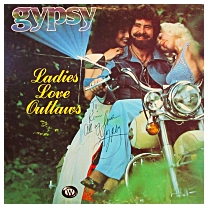 Gypsy "Ladies Love Outlaws" (Worldwide Records, 1979) (LP)
(Produced by R. Copp & Ted Mather)
Vrrrrm! Vrrrrumm!! A solo set by Robert Copp, aka Gypsy, a biker-y dude from Connecticut who sang about Harleys and outlaws, but wasn't strictly a "country" singer. This album includes several of his own songs, including "Highway Gypsy," "I Love You (For Gale)" and "Ladies Love Outlaws" (not the same as the Waylon Jennings hit), as well as "Long Road To Nashville," which was penned by the album's producer, Ted Mather. The album's second side was a live set, with pop vocal covers such as the song "Mariah" (from the musical "Paint Your Wagon") and "The Quest" (from "Man Of La Mancha"). So go figure.
 LOCALS ONLY: This is a guide to independent and off-the-radar country musicians from the 1960s, 1970s and early 'Eighties, including hometown performers working in regional oprys, jamborees, dude ranches, casinos, pizza parlors and lounges. They included longhaired country-rockers, red-dirt outlaws, Nashville hopefuls and earnest amateurs, as well as the more country-oriented artists in the bluegrass and southern gospel fields. Many of these musicians toured nationally or regionally while others were strictly hometown folks. These are the people who are often overlooked in the history books but who contributed their talents, hopes and dreams to the country music world, and the aim of this guide is to keep their memories and their work alive. Comments, corrections and suggestions are always welcome.


