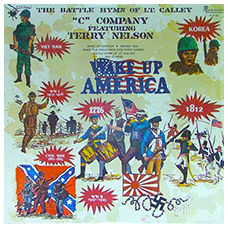
 C Company Featuring Terry Nelson "Wake Up America!" (Plantation Records, 1971) (LP)
(Produced by Shelby Singleton, Clark Bentley & James M. Smith)
Nashville wedged itself into the controversies over the Vietnam War on a number of occasions, perhaps most notably with this patriotic/militaristic album which lauds American soldiers and memorializes our many wars. The album's genesis comes from a very striking novelty song (and unexpected Top 40 hit) called "The Battle Of Lt. Calley," which comes to the defense of Army Lieutenant William Calley, who was courtmartialed and found guilty of murder in the infamous My Lai Massacre of 1968. Terry Nelson was a country deejay from Alabama who voiced the song's recitation, spoken over the melody of the "Battle Hymn Of The Republic." Originally released as a single on a private label, the song became a regional hit and was optioned by producer Shelby Singleton, who re-recorded the track and built this album around it, adding several other songs that delve into America's military psychology. The album came out immediately after Calley's conviction and life sentence, capitalizing on the highly-charged debate over his actions and the atrocities of the My Lai slaughter. Also included are tracks such as "War Baby," "When The Great Men Sign Their Names," "Buffalo Soldiers" and "Til We Bring Our Johnnies Home Again."
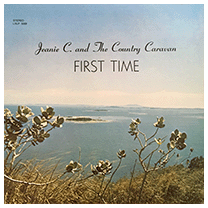 Jeanie C & The Country Caravan "First Time" (Lark Records, 1979) (LP)
(Produced by John Major)
According to the liner notes, this group from Frederick County, Maryland was led by singer Jeanie Class and first formed in 1975. They performed steadily throughout the region, with perhaps the band's high point being its selection to represent the county during Maryland's inaugural ceremonies for President Jimmy Carter. At the time this album came out they were holding down a gig at the Statler Hilton Hotel in Annapolis and like many local bands, seem to have had a shifting lineup over the years. The group recording on this album included Keith Carter on drums, Juggy Donovan (piano), Dale Higgs (bass), Dennis Jackson (drums), Buck Lighthorn (lead guitar), Bill Shanholzer (steel guitar), Bobby Weddle (vocals) and Buddy Weddle on rhythm guitar. Their repertoire included popular hits such as "If I Said You Had A Beautiful Body" and Gene Watson's "Farewell Party," as well as oldies like "Crazy," "Statue Of A Fool" and "Sea Cruise," as well as relatively obscure tunes such as Delbert McClinton's "Two More Bottles Of Wine," which I presume they picked up from Emmylou Harris. Not sure how long Ms. Class stayed with the band, but this disc is a fine legacy; a different lineup, still featuring Buddy Weddle, recorded an album as Country Caravan a few years later, in 1985.
Jeanie C & The Country Caravan "Wicked Eyes And Wicked Lies" (19--?) (LP)
I've only seen this one mentioned in a newspaper profile of the band, written when they did a reunion show in 1999, though thus far the album itself eludes me. Although Jeanie Class left the band not long after recording this album, her brother Buddy kept Country Caravan running for a few more years, also recording another album in 1985 under the band's name, then later renaming it Country Caravan Plus.
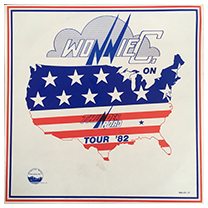 Wonnie C "...On Thunder Road Tour '82" (Mountain Music Records, Inc., 1982) (LP)
(Produced by Jack Eubanks)
Songwriter Wonnie C. Johnson (1945-2013) was a guy from Scottsboro, Alabama who recorded several singles that identify him by his full name, although he's going full stage-name here... This disc was recorded in Nashville with a big, usual suspects crew: steel player Doug Jernigan, Willie Rainsford, Fred Newell, Leo Jackson, Hoot Hester, and The Cates Sisters... Johnson wrote a couple of originals for this album, including "Rodeo Cowboy" and "Trucker's Rhythm" -- there are also some tunes penned by Buck Moore: "I Stood Your Leavin'," "Diamond In The Rough," and "I'm Coming Home, Louisiana." His 1981 single, "Cowboys And Indians Don't Cry," got a small plug in Billboard. This seems to have been his only full album, and other biographical information remains scarce.
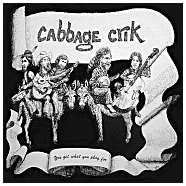 Cabbage Crik "You Get What You Play For" (Kneedeep Records, 1975) (LP)
(Produced by Cabbage Crik)
An adventurous modern bluegrass band from Allendale, Michigan whose repertoire included grassed-up versions of songs by Bob Dylan and Elton John ("Country Comfort") as well as country and western oldies from Hank Williams and Bob Nolan, as well as a blistering cover of Don Reno's "Dixie Breakdown," and a sweeter heartsong ("You're No Longer A Sweetheart Of Mine") also from the Reno & Smiley catalogue. There's also a pair of nice original songs, "Piece Of Ground," by bassist Mark Schrock, and mandolin player Gary Kuitert's "From Michigan To Nashville, Tennessee," another one of those rueful it's-too-hard-to-make-it-in-Music-City tunes. Apparently these guys played together for many years, then branched off into different directions, reuniting in 2009 for a few one-off gigs. This is a nice record, basically straight-ahead bluegrass, but with enough of a country/rock undercurrent that it's worth noting here as well. A nice, unpretentious band with a good vibe.
 Cabbage Crik "Whole Hearted... Half Headed" (Kneedeep Records, 1978) (LP)
(Produced by Cabbage Crik, Craig R. King & Jim Curtis)
Another excellent set from this well-oiled band, with a strong, soulful string-swing undercurrent... Tight harmonies and fluid, playful arrangements set these guys a notch or two above many of their newgrass contemporaries... There's also more original material on this album, and a shift away from country and bluegrass oldies, with the band breezing through tunes like John Sebastian's "Lovin' You" and a version of Jerry Smith's "Truck Stop" which has an almost Mills Brothers-ish vocal arrangement. They also cover a Carson Robison classic, along with tunes written by bandmembers Gary Kuitert and Mark Schrock, as well as one credited to D. F. Lemke (who we would assume is related to guitarist Buck Lemke...?) Overall, a pretty swell album!
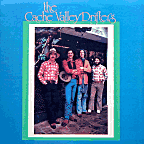 The Cache Valley Drifters "The Cache Valley Drifters" (Flying Fish Records, 1978) (LP)
This popular California bluegrass band mixed modern folk songs from the likes of Kate Wolf with 'grassed-up versions of old country tunes and Tin Pan Alley standards. Mandolinist Bill Griffin was a member of Kate Wolf's band, while the other members were in a variety of off-the-radar groups before joining to form the Drifters. On ther debut, they covered John Prine's "Angel From Montgomery" and Bob Wills' "Roly Poly" alongside Bob Marley's "I Shot The Sherriff" and the folk standard "Columbus Stockade." A fine example of the eclectic spirit of yesteryear.
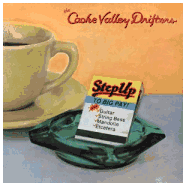 The Cache Valley Drifters "Step Up To Big Pay" (Flying Fish Records, 1980) (LP)
(Produced by Tom Diamant)
Another fun set, with some sweet, melodic picking and a light touch that's nice to hear, even as they deliver some dazzling licks. The repertoire is the real key here, with songs drawn from sources such as Benny Goodman and Louis Jordan from the big band era, folkies like Gordon Bok and John Prine, as well as Tom Lehrer's cowboy satire, "The Wild West Is Where I Long To Be," and a twangy version of the Grateful Dead's "Cumberland Blues," which later made it onto a compilation album of Dead cover songs. A nice album, very reflective of the mellow, eclectic sensibilities of Northern California's folk scene.
The Cache Valley Drifters "Tools Of The Trade" (Flying Fish Records, 1983) (LP)
The Cache Valley Drifters "White Room" (CMH Records, 1996)
The Cache Valley Drifters "Mightyfine.net" (Taxim Records, 1999)
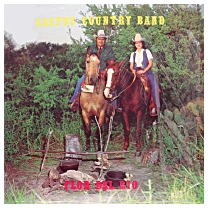 Cactus Country Band "Flor Del Rio" (Hacienda Records, 1979) (LP)
(Produced by James Lisenba & Jerry McCord)
Singers Janie C. Ramirez and Hilario Ramirez fronted this Tex-Mex-meets-twang band from Corpus Christi, Texas, along with lead guitarist Gilbert Salinas. They played a mix of classic country hits ("Paper Roses," "Pretty Fraulein," "Jambalaya" and "Margaritaville") and traditional Mexican folk and ranchera tunes. They recorded several albums, which hopefully I can track down soon.
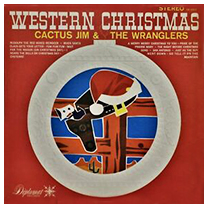 Cactus Jim & The Wranglers "Western Christmas" (Diplomat Records, 1960-?) (LP)
A pretty straightforward set of holiday-themed budget-label twang. The tunes are mostly Christmas standards, with a few secular western tunes tossed in as well (doubtless from random sessions left in the vault). The most promising (and original) title here is "Wait For The Wagon (On Christmas Day)." Anyone out there know more about the mysterious Mr. Jim?
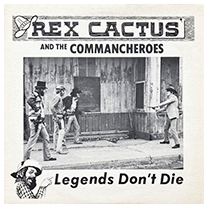 Rex Cactus & The Comancheroes "Legends Don't Die" (CGS Studios, 19--?) (LP)
(Produced by Kay & Rex)
A semi-anonymous band from somewhere in Wisconsin, the mis-spelled Comancheroes were identified only by their first names (or nicknames): Bruce, Ed, Gregg, Kathy, Kay, Kevin, Kris, Relan, and T. K. -- with no indication given regarding who played which instruments. Very mysterious. Rex Cactus was a local figure from New Richmond, Wisconsin, a tiny town situated more or less between Minneapolis and Eau Claire... Back in 1977, before he cut this album, he recorded a super-clumsy comedy single, "Jimmy's Press Conference"/"Roy Rogers Had A Ranch" which featured a Dickie Goodman-esque "break-in" sound montage of country music imitations and audio clips lampooning Jimmy Carter... It was pretty low tech: you can actually hear the tape deck buttons clicking on all the edits. The Roy Rogers B-side was a weird parody of "Old McDonald Had A Farm," with added comedic dialog, and a few more imitations. This later album is only slightly less clumsy, mostly because Rex Cactus just wasn't that strong of a performer: on the opening track he sounds quite a bit like "wild and crazy"-era Steve Martin, and it took me a while to realize this wasn't meant to be a parody-twang album; he just didn't have it in him to really belt the lyrics out, and sounds jokey when he was actually being sincere. The album is mostly cover songs, a mix of western-themed oldies like "Don't Fence Me In" and "South Of The Border" along with some bluegrass-y material ("Fox On The Run" and "Tennessee Stud") and honkytonk standards such as Buck Owens' "Crying Time" and the Hank Williams classic, "Honky Tonk Blues." Two songs, "Nothing To Say" and "Two Lonely People Don't Make A Right," may have been originals, though neither the jacket or the inner labels provide composer credits. (It's worth noting that the backing band seemed pretty competent, particularly the steel player who gets in some fine solos on a tune or two... I'd imagine these guys were in some Badger State band or another, but I don't know for sure...) Rex Cactus has enjoyed remarkable longevity as a regional performer, even recently hosting a Facebook page for his more current band, Rex Cactus & The Radio Rangers.
 Butch Cady "With Tender Loving Care" (Glacier Records, 1973-?) (LP)
Wallace Roy "Butch" Cady (1924-2008) was a country crooner from Montana's Flathead Valley who owned a family-operated construction company, but spent a lot of nights playing local gigs with his country trio. Though he definitely looked like a real-deal backwoods roughneck on the back cover photo, Mr. Cady had an almost improbably light voice, something in the Hank Snow/Bill Anderson territory, and a less-than-commanding presence, balanced by a lot of sheer enthusiasm. He's backed by fellow Montanan Bill Gress and his band (who also put out an album on the Glacier label around the same time) including gal singer Betty Lou Armstrong, with Don Cabitto, Larry Caldwell, Ronnie Luzon, Billie Steppe, Bob Trumble and Elaine Trumble. Although this record came out in the early 'Seventies, the request-heavy repertoire was mostly from the early 'Sixties, mainly ballads like Willie Nelson's "Funny How Time Slips Away," "Welcome To My World" and Ned Miller's "From A Jack To A King," though he was willing to tackle a little bouncier material, like "Hello Trouble" as well. There are almost all cover tunes, though the title track, "Tender Lovin' Care," was Mr. Cady's own tune, one he penned in '73. There's a lot of perky but amateurish musicianship, notably the out of control, note-happy guitar picking... a charmingly authentic set, though, if we're being honest, this falls more into the musically-iffy category, "real people" music, some folks like to call it.
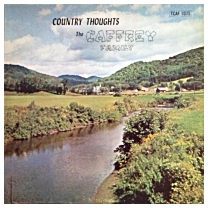 The Caffrey Family "Country Thoughts" (Century Productions, 1975) (LP)
(Produced by Bob Ligotino & Bob Miller)
Led by guitar picker Tom Caffrey, this family group was a mainstay of the San Francisco Bay Area bluegrass scene for many years, forming in the late 1960s and playing at numerous venues throughout the early and mid-'Seventies. The Caffreys were charter members of the California Bluegrass Association and played at the CBA's first concert back in '75, around the time they recorded this album, a pleasantly understated acoustic set mixing country and old-timey covers. They seem to have moved to the Delta town of Benicia in the early '80s, with Tom Caffrey playing dobro for a local band called the J Street String Band in 1984. I'm not sure how long the Caffrey Family band stayed together, or if they recorded anything else, but they were a fun, earnest group, and sound great on this disc. (Thanks to radio deejay Peter Thompson's venerable Bluegrass Signal for filling in a bunch of gaps about this band: check out this amazing timeline of the Bay Area bluegrass scene!)
 Buddy Cagle "The Way You Like It" (Imperial Records, 1966) (LP)
(Produced by Scott Turner Lanky Linstrot)
The first full album by Buddy Cagle, one of the lesser known members of the West Coast/Bakersfield Sound country scene. Originally from North Carolina, Cagle moved to California in the late 'Fifties, arriving just in time to catch the wave as stars such as Buck Owens and Merle Haggard emerged onto the national scene. A protege of Wynn Stewart, Cagle released a quartet of well-regarded but poorly marketed albums, and wound up retiring from show business within a few years, as his singles steadily slid into the Back Forty. He'd cut several singles before this came out, including a few for the bigger, better-connected Capitol label, but the rest of Cagle's career was played out on the Imperial label, an offshoot of Liberty Records. As with many albums of the era, there are no credits for the backing musicians, though the performances are pretty solid, as well as the repertoire. A lot of relatively obscure songwriters on here, including the album's producer, Scott Turner, who penned three of the songs; other notable contributors include Dave Burgess and Curtis Leach, who also got some fo their songs included in the set. Definitely worth a spin!
Buddy Cagle "Mi Casa, Tu Casa" (Imperial Records, 1967) (LP)
(Produced by Scott Turner)
Buddy Cagle "Longtime Traveling" (Imperial Records, 1968) (LP)
(Produced by Scott Turner & Dino Lippas)
The only musicians mentioned in the liner notes are hotshot guitarist Jimmy Bryant and multi-instrumentalist Neil LeVang, who was best known for his work in the house band on the Lawrence Welk Show... LeVang also played on some early Neil Diamond albums, so this might be considered more of an LA pop-studio concoction than a Nashville-style twangfest...
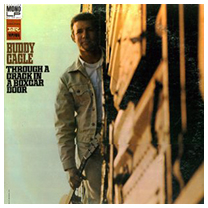 Buddy Cagle "Through A Crack In A Boxcar Door" (Imperial Records, 1968) (LP)
(Produced by Scott Turner)
This was Buddy Cagle's last album, although he did record a few more singles before hanging it up in the early '70s. It's a pretty soft set, a "traveling hobo"-themed folk-country set, the sort of stuff that young Bobby Bare struggled mightily to free himself from, but similar to a lot of the Nashville Sound crooning of the time... Indeed, on Side Two, Cagle sounds a lot like '60s-era Hank Snow, both in his choice of repertoire and in his vocal intonation. Not a very exciting record, but it stands up fine next to albums by big stars of the same era.
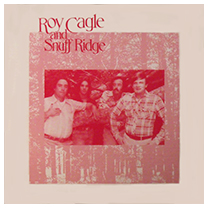 Roy Cagle "...And Snuff Ridge" (Chris Records, 19--?) (LP)
Louisiana's Roy Cagle was a country singer, but he sure loved that old rock'n'roll, as heard in the several Chuck Berry covers on this album. This session was recorded in Shreveport, though I don't know who was backing him in the studio. Other songs include stuff by Bobby Braddock, Buck Owens, and a version of Freddy Fender's "Wasted Days And Wasted Nights." This set is mostly cover songs, though there may possibly be a couple of originals in the mix.
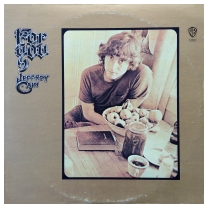 Jeffrey Cain "For You" (Warner Brothers, 1970) (LP)
(Produced by Rick Turner & Stuart Kutchins)
This is a little more folkie and maybe too hippie-dippy for our purposes here, but I gotta give this album a shout-out since the backing band is basically the Youngbloods -- Joe Bauer, Lowell "Banana" Levenger and Jesse Colin Young -- accompanying Marin County songwriter Jeffrey Cain, who plays guitar throughout. Now, don't get me wrong: I think this is actually a pretty cool record, particularly for those of you who are into the whole "folk freak" thing. On many tracks, Cain croons and noodles around in a spacey, Banhart-ian fashion, maybe a little Tim Hardin-y in his more cohesive moments. On a couple of the more overtly goofy tracks, he even sounds a little like John Prine, and of course he recalls Jesse Colin Young on a tune or two. This is an amazingly un-commercial album -- I'm sure Warner Brothers wasn't kidding when they placed a track on their "Loss Leaders" promo record -- and if you like hardcore, stonerdelic hippie music, this is the real deal. I dunno what they were smoking out in Point Reyes back in 1970, but you can definitely catch a little whiff of it here.
 Jeffrey Cain "Whispering Thunder" (Warner Brothers/Raccoon Records, 1972) (LP)
(Produced by Jesse Colin Young)
Another hippie-rock kaleidoscope, dipping into boogie-blues, cosmic folk and druggie twang... The album opens with a drifting folk-rock pop anthem, "Soul Train," which has a Jonathan Edwards-esque feel (or, alternately, sounds like producer Jesse Colin Young) The song was written by lead guitar picker "Fast" Eddy Ottenstein, a member of the Youngbloods cohort who adds a distinctly San Francisco-ish, Grateful Dead-derived sound to this album. That debt to the Dead is particularly palpable on the title track, "Whispering Thunder," a revolutionary folk-rock parable evoking the legacy of 1850's abolitionist John Brown, with SF Sound grooves backing Cain's resolutely normal-guy vocals. His plainspoken persona fits into the whole singer-songwriter vibe of the time -- for example, on the closing track, "Aurora Borealis," he sounds quite a bit like Loudon Wainwright... He's also one of those eclectic early 'Seventies artists who sounds eerily contemporary at times, though there is also a real fly-in-amber feel to this album: this is a hippie album, for sure. ("Peace Sign Blues," anyone?) Also on board are Richard "Earthquake" Anderson (harmonica), Eddie Ottenstein (lead guitar), Doug Trumbley (bass) and Jesse Colin Young singing harmony on a version of "Pack Up Your Sorrows," as well as drummer Tom Bischoff (who later was in the California country-rock band California Zephyr...) Overall, this is a pretty cool hippie album, a fine followup to his first solo set, and definitely of interest to Youngbloods fans.
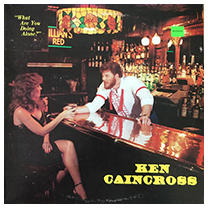 Ken Caincross "What Are You Doing Alone...?" (Ham Star Records, 19--?) (LP)
Oh, go ahead you would-be hipster taste lemmings, go on and loftily proclaim this some kinda "world's worst album cover ever!" Seriously. Don't you have anything better to do? For my part, I plan to perpetuate the myth that this artwork was the inspiration for Cheers. Because that's how the interwebs works. Anyway, Ken Caincross was an aspiring 'Eighties pop-honkytonker from Bloomington, Indiana, and he really went all-out on this one, singing all original material written by either Ken Caincross or Steve Mullinix, with a couple of additional authors on "Mama's Bible Left A Message" (Mullinix, with Ruth Brown) and "Last Laugh (I Just Wanta Fool Around)" which Caincross co-wrote with Scott Caltran. He only seems to have recorded this one album, though he also landed one track on some local compilation in 1988, and doubtless a single or two is floating around. Okay, I'll throw you cynics a bone: at least on that one compilation track, he called his band "Kenny Caincross And The Fingers," which is, well, heck -- let's just mad-lib the rest. Have fun. You're welcome.
Calcote Cousin Clan "Honey Come Back" (Crown Records, 1970) (LP)
Presumably this was a side-project of singer/producer Gordon Calcote (below), who worked up and down the Pacific Coast and recorded several earlier albums for the Custom (and Crown) cheapie label empire. As with so many of the records, the specific details are scant and hard to come by -- i.e., what musicians were involved and whatnot.
 Gordon Calcote "Going Home For The Last Time" (Custom Records, 1967-?) (LP)
Singer Gordon Calcote was one of the rare cheapie label artists who got proper credits on the budget-line albums he recorded... Like many country singers in the days of yore, Calcote had a day job in radio, at first as a deejay on stations such as KAYO-AM in Seattle (where he was on air in the early '60s) and later as a program director and station manager various stations in Southern California, where he was probably working when he started recording for the Custom label. And the thing is, he was also a pretty good singer - rugged, robust, but also working in the suave, sophisticated style being pioneered by Glen Campbell at the time. A good mix of manly honky-tonk and the nascent countrypolitan sound that was starting to come into vogue... and all on an under-the-radar, fly-by-night label. Definitely worth a spin!
 Gordon Calcote "Folsom Prison Blues" (Custom Records, 1968-?) (LP)
 Gordon Calcote "Galveston And Other Pop Country & Western Favorites" (Crown Records, 1969-?) (LP)
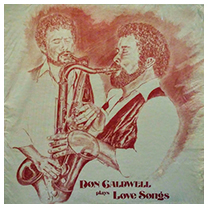 Don Caldwell "...Plays Love Songs" (Texas Soul Records, 1979-?) (LP)
(Produced by Bill Gammill, Lloyd Maines & Syl Rice)
Perhaps better known as a music producer than as a sideman or solo artist, saxophone player Don Caldwell started his own studio in Lubbock, Texas, way back in 1971, recording countless local and regional artists over the years, including nationally-known acts and Americana icons like Terry Allen and Joe Ely. Caldwell captured Texas twang at its height, and is best known for his long association with The Maines Brothers, an extended-family act that included steel player Lloyd Maines, who also became a prominent record producer. They helped get Lloyd's kid Natalie into show business, and recorded several Maines Brothers albums on the Texas Soul label. While Caldwell had deep country roots, his own solo set is more of a jazz kinda thing, heavily populated with standards such as "Blue Velvet," "Feelings," "Girl From Ipanema," and "Summertime," with a little bit of twang in at the edges. Caldwell also had a civic-minded side: in 1993 he purchased the Cactus Theater in his hometown of Lubbock, and worked to make it a hub for performing arts. After the studio closed, Caldwell's personal archives were donated to the University of Texas which also hosts an excellent biographical profile on its website.
 Larry Caldwell & Speedy Price "The Country Gentlemen" (Crown Records, 1962) (LP)
One of the early gems in the Crown Records catalog, a rootsy, rambunctious set of good-natured western-meets-roadhouse material by a compact quartet headlined by hotshot guitarist Larry Caldwell and steel whiz Vernon "Speedy" Price. Caldwell was originally in a Missoula-area band called The Snake River Outlaws, which played locally throughout the 1950s... He eventually headed for the bright lights of Los Angeles, where he and Price were working when they cut this brisk disc with bassist Don Hughes singing lead vocals and drummer Johnny Roberts keeping a low profile and a steady beat. According to some interwebs scuttlebutt The Saddle Tramps. were playing gigs around Oxnard, California, and while Caldwell later tried his luck in Las Vegas, Price and Hughes stuck around LA and became stalwarts of the late 'Sixties SoCal twang scene. (Don Hughes also recorded at least one other album for Crown, issued under his own name...) At any rate, this is a pretty fun record, even if it suffers from this cheapo label's shoddy production quality. Kinda like what Bob or Johnny Wills might have sounded like if Jimmy Bryant and Speedy West had been in the Texas Playboys...
J. J. Cale - see artist discography
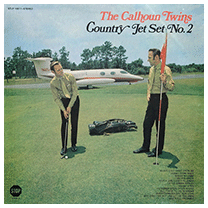
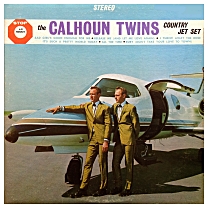 The Calhoun Twins "Country Jet Set" (Stop Records, 1967) (LP)
Twin brothers Jack and Jerry Calhoun were born in Ann Arbor, Michigan and developed their own spin on the "brother sound" harmony style. They had a nice, perky sound, rooted in traditional country, but pretty up-to-date for the times. In addition to making upbeat country twang, the Calhouns were also avid pilots, running an independent commercial air service that catered to showbiz clientele. (Hence the album title and the airplane pictured on the cover...) Their Florida airfield was the site of the 1982 plane crash that killed Ozzy Osbourne's guitarist, Randy Rhoads, but despite this tragedy they stayed in business well into the 21st Century, and also kept making music, releasing several CDs in addition to the LPs listed here. This was their first album, and it's pretty lively stuff, a mix of Buck Owens-y bounce and old-school hillbilly romp. They didn't get far in the national charts. but they sure made some fun music!
 The Calhoun Twins "Country Jet Set, v.2" (Stop Records, 1970) (LP)
The Calhoun Twins "The Calhoun Twins" (Prize Records, 1971) (LP)
The Calhoun Twins "Goin' To The Dogs" (Marathon Records, 1974) (LP)
(Produced by Doug Taylor & Shot Jackson)
 Calico "Calico" (United Artists Records, 1975) (LP)
(Produced by Allan Reynolds & Garth Fundis)
Second-string countrypolitan/country-rock from Fort Worth, Texas, with iffy vocals but a wealth of serious talent in the studio: Buddy Spicher on fiddle, Lloyd Green playing pedal steel, Bobby Thompson on guitar, adding a few extra licks behind the band. Top Forty fans will notice youngsters Allan Reynolds and Garth Fundis paying their dues as journeymen producers -- later they'd become two of Nashville's major heavy-hitters. Singer Jerry Oates seems to have been the driving force in this band -- he wrote most of he songs and sang some of the lead vocals, along with pianist Keith Impellitier. This is hardly a classic, but fans of '70s country-rock and soft-pop might want to check it out. The band often reminds me of less-fortunate (non-major label) acts like Greezy Wheels and Chuck Wagon who were also on the scene at the time... (Footnote: apparently steel player Tom Morrell was in an early lineup of the band, but he wasn't on this album... Anyone have more info about their history?)
Calico "Volume II" (United Artists Records, 1976) (LP)
(Produced by Larry Butler & Billy Sherrill)
A very odd follow-up to their first major-label offering -- to untrained ears this seems to have very little commercial potential in either the pop or country fields, mixing sluggish though grandiose pop ballads with just a couple of overtly twangy tracks. There is some residual twang, but overall this album leans heavily towards a 'Seventies soft-pop sound, pairing downtempo vocals with swelling (though lackadaisical) arrangements courtesy of Nashville studio honcho Bill Justis. The slow stuff dominates, and I guess we have to assume that Oates and Impellitier were consciously throwing it all away, choosing to make a doleful, contemplative album instead of aiming for the charts. Notably, the Nashville crew got completely switched up, with Dave Kirby on guitar, and Tom Morrell adding a lot of nice pedal steel licks; Morrell seems to have been the most fully committed of all the musicians on here, though I think the singers also were trying to make a real statement of some sort. Twangfans might dig "Suppertime Lovin'," a bouncy hippie-billy number in the mode of Commander Cody or the New Riders Of The Purple Sage, or possibly their dutiful cover of Waylon's "I Recall A Gypsy Woman." The album almost had one dazzling triumph, a version of the Hank Williams oldie, "Cold, Cold Heart," that starts out starkly with just vocals and piano, like something Joni Mitchell might have done in her Blue phase, but then they slowly layer in some steel guitar and more of Justis's rather indifferent countrypolitan-isms, and it slowly fades into mediocrity. I mean, this record could grow on you -- especially if you're into vintage soft pop -- but it mostly seems like a square peg, round hole kind of deal.
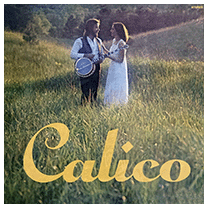 Calico "Calico" (Gateway Records, 1979) (LP)
(Produced by Danny Burton & Phil Burkhardt)
A folkie-acoustic duo from Rochester, Michigan made up of guitarist-banjo picker Vincent Sadovsky (1949-2018) and his wife guitarist Karen Sadovsky. They work their way through a mix of covers and originals: about half the tracks are Vincent Sadovsky compositions, complimented with classic twangtunes by Jorm Kaukonen, Mike Nesmith and Dolly Parton, as well as a version of Bob Dylan's "Nashville Skyline." Mr. Sadovsky was an accomplished, award-winning banjo picker, as well as the owner of the Rochester Folk Workshop, where he gave music lessons to several generations of budding talent, over a 45 year career. As far as I know this was their only album.
The California Band "California" (MCF Records, 19--?) (EP)
This six-song EP featured contributions from Bruce Crosby and Lisa Iskin, with pedal steel player Joe Goldmark playing on one track, "First Waltz."
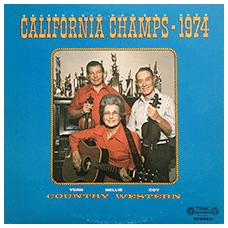 The California Champs "1974: Country Western" (Trac Records, 1974) (LP)
A swell all-instrumental set from three talented old-timers from California's Central Valley. Fiddlers Coy Daily and Vern Keathly are joined by rhythm guitarist Nellie O'Neal for a nice set of antebellum oldies, Irish and Appalachian tunes and country covers. Then calling themselves Coy's Group, the informal trio competed in -- and won -- the music competition at the 1974 Auburn State Fair, giving them the impetus to record this album on the Fresno-based Trac label. Coy Daily was probably the most experienced musician in the band -- born in Oklahoma, he came out West in 1940 and played professionally in some western swing bands before settling down in Salida, California, near Modesto. His son Ron plays bass on this record and on another Trac Records disc credited to Coy Daily alone. Other local musicians chipping in are steel player Ivan Ward, Don Hyland (also spelled Heiland) on piano and a nice lead guitarist, Vern Baughman. Sweet stuff! (Coy Daily also released at least one album under his own name, "Country Fiddling," which also came out on Trac Records.)
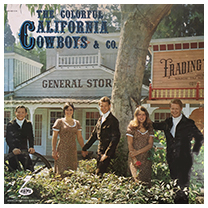 California Cowboys & Co. "The Colorful California Cowboys & Co." (American Heritage Music Corporation, 1974-?) (LP)
Though they seem to have been a struggling pizza parlor/fraternal club band, The California Cowboys nonetheless included several original songs into their covers-heavy repertoire. The band featured a trio of brothers -- David, Scott and Steve Preston, as well as Denise Preston, the wife of nineteen-year old Scott -- and was rounded out by a second "gal" singer, Donna Lynn Smith, who also played fiddle and wrote three of the songs on this album, "She Loves Me More," "Tomboy" and "Pretty Girl Hoedown." There's also a slew of covers, from a diverse range of sources, including some Hank Williams, a cover of "Phoenix," Tom T. Hall's "Ravishing Ruby," the Webb Pierce classic "I Ain't Never," and Terry Stafford's "Amarillo By Morning" which was later a big hit for George Strait, but was kind of a hip pick in the mid-1970s. Lead guitarist Steve Preston also offered an instrumental number, "Helmet Stomp." Unfortunately, the album neglects to tell us where the band was actually from, though they had a long-term gig playing a Nevada casino at the time of this album.
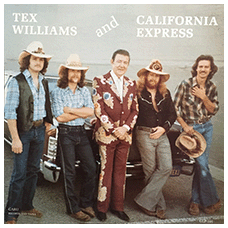 California Express & Tex Williams "Tex Williams & California Express" (Garu Records, 1981) (LP)
Yup, sure enough, it's that Tex Williams, a hilllbilly-era star in his twilight years, playing a bunch of classics and oldies, on what may have been his last album. The backing band were a bunch of shaggy 'Seventies longhairs, including his daughters Jenny and Sandi Williams, as well as Sam Aiello, who I believe was his son-in-law (married to Sandi). I'm not sure if California Express was primarily Williams' band, or if they had a career of their own -- at some point former child actor and roller derby queen Tammy Locke sang with the group -- the rest of the band included Russ and Dennis Orr, and Michael Reid. I think this may have been their only album, and I believe it was Tex Williams' last.
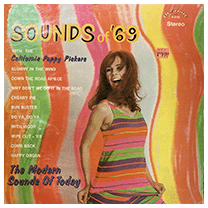 The California Poppy Pickers "Sounds Of '69: The Modern Sounds Of Today" (Alshire Records, 1969) (LP)
The Poppy Pickers was a made-up, prefab easy-listening exploitaband of unnamed, semi-anonymous studio musicians, thrown together by Southern California musical huckster Gary Paxton. They recorded several "greatest hits" knockoff albums, often resonant with Bakersfield twang, though the source material not always country-rock oriented, by any means. Going by catalog numbers, this appears to have been the band's first album, and it sets the template for the ones that follow: some rock-pop cover songs ("Why Don't We Do It In The Road" by the Beatles, an "update" of "Wipe Out," a random cover of Bob Dylan's "Blowin' In The Wind" and a zippy rendition of Dave Cortez's (snicker, tee-hee) "Happy Organ") and an admirable number of original numbers, generally slapdash, throw-it-at-the-wall filler tracks banged out by Paxton and his hired hands. These include a couple credited to Paxton: "Bun Buster, "Down The Road Apiece," two more from studio stalwart Ken Johnson, "Do Ya, Do Ya" and "With Vigor" and a couple bearing the stamp of Hugh Brockie and Dwayne Ford, who went on to found the rock group Bearfoot ("Come Back" and "Do Ya, Do Ya"). A lot of generic "sunshine pop" here, but that's not such a bad thing, is it?
The California Poppy Pickers "...Play And Sing Hair, Aquarius And Others" (Alshire Records, 1969) (LP)
Lots of cover tunes here -- the faux-hippie themes to Aquarius and Hair, a couple of Beatles songs, "Oh Happy Day," from Edwin Hawkins... and even a version of Desmond Dekker's "Isrealites"(!) just for the heck of it. Listeners on the prowl for Alshire originals will be thrilled by four songs starry-eyed, patchouli-soaked originals "Clean Up You Own Back Yard," "It's Written All Over My Face," "Narrow People" and "Sunshine Summer Days." These are all credited to Ken Johnson (1943-2022) who was apparently a real person and not a pseudonym, a studio regular in Gary Paxton's Bakersfield orbit who contributed to a whole slew of Paxton's "bands" and who also released a few country singles under his own name, including several collaborations with Dennis Payne.
The California Poppy Pickers "Today's Chart Busters" (Alshire Records, 1969) (LP)
Although, as advertised, this disc does include several covers of hits of the day (with one song by Bobbie Gentry and a couple of Beatles-related tunes, including a version of "The Ballad Of John And Yoko" as well as a stab at the Tommy James hit, "Crystal Blue Persuasion.") But for the most part this is a set of Gary Paxton-related knockoff material... and I mean that in a good way. Fans of the slapdash exploito originals on Alshire, Crown and similar labels might want to groove out to goofy numbers such as "Augie From Bakersfield," "Blues From Berkeley Street People," and "Poppys To Be Picked" (all credited or co-credited to Paxton.) There's also a track called "Horsefly" which is credited to Kathleen McCoy, a name that appears on a couple of other records around this time; this may have been a pseudonym used for copyright purposes...
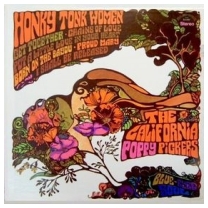 The California Poppy Pickers "Honky Tonk Women" (Alshire Records, 1969) (LP)
This album included covers of "Honky Tonk Women" by the Rolling Stones, The Youngbloods' "Get Together," CCR's "Born On The Bayou" and "Proud Mary," along with other pop and rock hits of the day. I'm not totally up on who was in this band when, but it's possible that guitarist Dennis Payne might have been in on these sessions.
 California Quickstep "Open For Bluegrass" (A-Major Records, 1987) (LP)
(Produced by David Houston)
The happy remnants of Sacramento's late-'70s/early '80s South Loomis Quickstep bluegrass band regrouped in the high country, recording this relaxed set, 'way up in Placerville, with Allan Hendricks on banjo, Tom Bentley on guitar and Ted Smith, mandolin... As ever, they mixed some country and roots material in with the 'grass, including Townes Van Zandt's Pancho and Lefty," J.J. Cale's "If You're Ever In Oklahoma" and the Grandpa Jones oldie, "Eight More Miles To Louisville" along with more overtly high lonesome material...
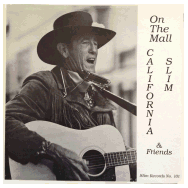 California Slim "On The Mall" (Slim Records, 1981) (LP)
(Produced by California Slim)
A self-released album by street busker Rob Rowe, aka California Slim, a familiar face on the Santa Cruz mall, where he performed starting back back around 1978 and all through the 1980s, including immediately after the big 1989 earthquake. Born in Ridgefield, Washington, Rowe grew up in rural Oregon, did a hitch in the Merchant Marines and then turned towards academics when he got out -- in addition to his busking, he had a sideline as a community college history professor in nearby Cupertino, teaching both American history and classes on the history of folk music. This was his first album self-released on a shoestring budget with only a thousand copies originally pressed, and it's a doozy, presenting a singular and deliberately eccentric artistic vision. He sings sparsely-arranged acoustic folk and blues tunes, in the style of Jimmie Rodgers and Woody Guthrie, with a mix of folk standards like "Strawberry Roan" and "John Henry," cowboy songs and old country blues. He's joined by a trio of Santa Cruzers, including bassist Karen Quick who was a singer in the local bluegrass band, Sidesaddle, and his son Patrick Rowe on second guitar, and local fiddler Noreen Tumminello. The album kicks off with a couple of his own original songs, "City Streets" and "On The Mall," topical/slice of life songs, and ends with "Ballad Of Mount St. Helens," which gives a nod to Slim's earlier years in the Pacific Northwest, lamenting the volcano's famous 1980 eruption. Bob Rowe passed away in 1991, pretty young at the age of sixty-six.
 California Slim "A Time Ago..." (Slim Records, 1982) (LP)
(Produced by California Slim)
A historically-minded tribute to the workers who powered America's great era of industrialization... Looks like Slim was again backed by some local NorCal folkie/bluegrassers... bass player Steve Larkin, Mark McCormack on banjo, his son Patrick Rowe on guitar, and California Slim pickin' and singin' in a variety of styles. Jimmie Rodgers and Leadbelly seem like the main touchstones, but he works his way through a range of folkloric and jocular material, a real throwback to a bygone era that spans before the Great Depression. One can only imagine the looks he'd get on the Santa Cruz mall, and the affection felt by the locals!
 California Slim "Wine, Women, Roses And You" (Slim Records, 1984-?)
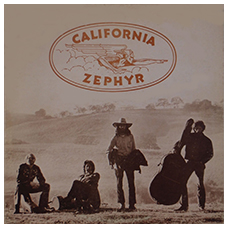 California Zephyr "California Zephyr" (Iron Horse Records, 1976) (LP)
(Produced by California Zephyr & Gary Boyd)
A far-ranging album from this longhaired twangband from Napa Valley, California... They make some nods towards their roots, with covers of "Cripple Creek," "Blackberry Blossom," "I Fall To Pieces" and -- more modernly -- of Steve Goodman's "City Of New Orleans," but mostly this disc is packed with original material credited to bandmembers Alan Arnopole (guitar, banjo), Doug Benson (mandolin, guitar) and bassist Mark Raus, with fiddler Mark Masarek adding some sweet licks, but sitting it out as far as songwriting goes. The group traverses a wide variety of styles -- bluegrass, honkytonk, dusty-road folk and even a bit of electric blues, with some licks added by their pal Tom ("T-Bone") Waldrop. You can look at this album critically and hear them hesitate and sound a bit stiff at times, though I think it's better to cut them some slack and just appreciate how eclectic and ambitious they were... The group made two albums in the 1970s that were fairly easy to find in Bay Area record bins, although later editions of the band, led by Alan Arnopole, also recorded a few CDs decades later...
 California Zephyr "In The Saddle" (Iron Horse Records, 1977) (LP)
(Produced by California Zephyr & Gary Boyd)
I dunno why I was charmed by their first album, but got all grumpy about the second one... It seemed like good musicianship was obscured perhaps by an overly jokey attitude. The entire first side is too broadly drawn and too nudge-nudge, wink-wink for me, from the dramatically twangy, bluegrass-tinged cover of "Back In The Saddle Again," to the overly-drawled versions of Ray Wylie Hubbard's "Up Against The Wall, Redneck Mother" and the Coon Elder Band's "I Ain't Really A Cowboy, I Just Found The Hat." Likewise, their gospel chorale arrangement of "Hallelujah, I'm A Bum" is a stylistic misfire... These are all great songs, and the choice of repertoire speaks well of the band, but at times their approach to the material feels too close to mockery or parody. Things pick up, though, when they start playing their own original material, solid songs mostly written by singers Doug Benson and Alan Arnopole, with Benson's "Empty Bottles" and "Tourist In The Land Of Love" being among the album's most durable tracks. This album made a big splash at the time -- pretty sure I remember hearing them played on KFAT a time or two -- but a lot of it doesn't hold up as well as it should.
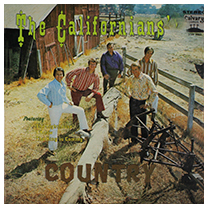 The Californians "Country" (Calvary Records, 19--?) (LP)
A gospel vocal group from Fresno, California, made up of Merv Martin, Don Nixon, Jerry Pearson, Dale Peters and Ken Williams. The backing musicians are not identified, alas, but this one probably has more legitimate twang to it than your average Calvary album.
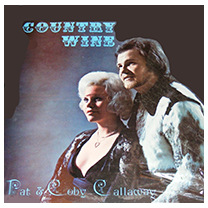 Pat Callaway & Coby Callaway "Country Wine" (Country Wine Records, 1976) (LP)
The Callaways appear to have originally been from around Lubbock, Texas, and played in the Corpus Christi area in the 'Seventies. At the time this record came out they were doing supper-club gigs at places such as Ray's Steakhouse, and had put together a revue called Pat And Coby Callaway's Donnybrook Show. This album includes eight originals written by Pat Callaway, including "Drunken Dusty Road" and "John Deere Foundry" which, along with several other tracks, appear to have been recycled on his solo album (below). There are also a bunch of cover songs, including "Delta Dawn," "Help Me Make It Through The Night" and "Let Me Be There," and even a Hank Williams medley. They seems to have split up as a duo act: the next album on this label was his solo release, while by the early 'Eighties, Coby Callaway was fronting a band called Coby & Spring, which included pianist Eric Lemons and guitarist Fender Tucker.
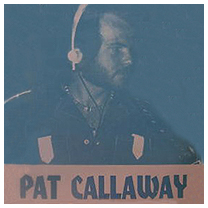 Pat Callaway "Pat Callaway" (Country Wine Records, 1976) (LP)
Okay, so I know Callaway has country bona fides, -- heck, he even covers a couple of Hank Williams songs -- but it's hard to ignore that gigantic Neil Diamond medley on Side Two. And not good, early Neil Diamond, but later stuff like "I Am I Said" and "Salvation Show." So, there's that.
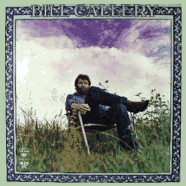 Bill Callery "Bill Callery" (Columbia/Lone Star Records, 1976) (LP)
(Produced by Bucky Meadows & Bill Callery)
Classic cosmic cowboy stuff, a mix of spacey folk and unraveling twang... Born in Indiana and raised in Kentucky, Bill Callery worked his way into the heart of the Texas singer-songwriter scene and is best known for having Willie Nelson include one of his songs on the Red Headed Stranger album, as well as for numerous songs of his that were recorded by Jerry Jeff Walker. Unfortunately he doesn't record his own version of "Hands On The Wheel" here, but Jerry Jeff fans will recognize a bunch of the other songs: "Leroy," "The Pot Can't Call The Kettle Black," and Callery's cover of Chuck Pyle's "Jaded Lover," also best known from Walker's classic version. Callery didn't have a super-killer voice or anything, but his songs are nice and the record's vibe is both earthy and mellow, the same kind of laid-back approach to country and bar-band music that will resonate with fans of Kris Kristofferson, Jerry Jeff Walker, or Rusty Weir. The backup band includes legendary fiddler Tommy Jackson; other than that, I don't recognize any of the names, although their performances are all rock solid, particularly the lead guitar from the album's co-producer Bucky Meadows, a veteran session musician who dropped out of the Nashville rat race and became a mainstay of the Texas indie scene. This album is definitely worth tracking down; I wouldn't be surprised if it doesn't get reissued... someday.
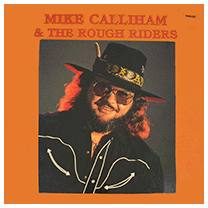 Mike Calliham "Mike Calliham And The Rough Riders" (Black Stallion Records, 1985) (LP)
(Produced by Johnny Elgin)
Outlaw/drinkin' man's country from a guy with a real Hank Junior vibe ...and the hat to prove it! Mike Calliham (1952-2018) was a lifelong resident of Greenwood, South Carolina who did some touring nationally, but mostly seems to have stayed in his hometown, playing local gigs. This disc is a mix of covers and originals, with three songs penned by Calliham: "Cold Morning Rain," Whiskey Take My Mind" and "I'll Stop Drinkin' When George Does." (Always nice to find another George Jones tribute song and add it to the list.) He also covers Bobby Bare, Guy Clark and Johnny Paycheck, along with two tunes from the Hank Junior catalog. The backing band includes Rusty Barkley (lead guitar), Dale Ledford (bass), Tommy Mooney (drums), Tommy Phillips (steel guitar) and Furman Watson (lead guitar), and while this was recorded in Nashville, I'm pretty sure these guys were all South Carolina locals. Although this may have been Calliham's only recording, there are occasional show notices for performances in the 1990s and as late as 2013.
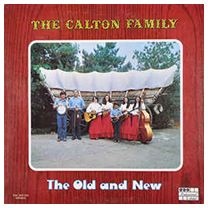 The Calton Family "The Old And New" (Professional Artist Recording Company, 1976-?) (LP)
(Produced by Parvin Tramel & Dick Grady)
A family band, with Charles Calton on fiddle and mandolin, joined by Jimmy Bunch on banjo... They play a mix of (mostly) bluegrass and country, including a Paul Craft song, one by Mel Tillis and a tune called "My Oklahoma" by Steve Young, along with bluegrass and old-timey tunes by Flatt & Scruggs, the Carter Family and others. There's one original, "Minor Repairs," composed by Jimmy Bunch. They recorded in Saint Louis, though I'm not 100% sure if they were from Missouri, but Mr. Bunch certainly was: he was a founding member of the Missouri-based bluegrass band, Cedar Hill, and also worked at Silver Dollar City and other regional Ozark venues.
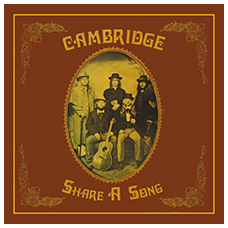 Cambridge "Share A Song" (Green Dolphin Records, 1977) (LP)
A super-twangy country-rock band from Cambridge Springs, Pennsylvania, with a wealth of original material firmly rooted in Grateful Dead-ish hippie rock as well as more contemporary country-rock ala Poco and Firefall. The group included bass player Lonny Bowersox, Charles Fischer (piano), Chas Gunther (guitar), Tom Stine (drums) and Dan Vogan on dobro and steel guitar. Although it's got a slightly jittery, unpolished feel, this is a pretty strong album with strong material, and was probably indicative of the energy at their live shows. The band was pretty popular regionally in the 'Seventies, though they never really broke out nationally; most of the guys in Cambridge went on to other bands, performing well into the 2000s.
Cameron "Cameron" (Home Groan Records, 1975) (LP)
This super-'Seventies outfit from Coral Springs, Florida was really more of a rock band, though perhaps with a bit of a southern rock edge... Still, they do cover "Mule Skinner Blues" on this debut album, so it's not like they were totally twang-averse. The group was named after lead singer/bass player/pianist/rhythm guitar Lane Cameron, who is joined here by Gary Dunne (rhythm guitar), Dave Gallagher (lead and slide guitar), Mike Idarola (drums) and Charles Sherrill who plays both synthesizer and saxophone...
Cameron "Keep On Movin' " (Home Groan Records, 1976-?) (LP)
(Produced by Tom Gallaher)
Pretty much the same lineup, with a little bit more of a southern rock/longhair/stoner vibe, but not too hippie looking, overall. That whole synths and saxophone thing is a bit troubling, if you ask me... but nobody ever asks me.
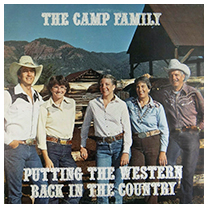 The Camp Family "Putting The Western Back In The Country" (Triple C Recordings, 1981) (LP)
(Produced by Chuck Camp)
A family-run dude-ranch band which also recorded under the name of the Triple C Chuck Wagon Stage Show.
The group was led by Charles R. Camp and his wife Mae Camp, along with three of their kids -- Bill, Cathy and Jim -- who set up shop near Tucson, Arizona. A Colorado native, Chuck Camp (1926-2003) was an educator by vocation, teaching electronics at various schools before retiring to run the Triple C full-time. Before moving to Arizona, Mr. Camp was a performer at the Flying W Chuckwagon, a well-known dude ranch in Colorado Springs; in 1969 the Camps moved to Tucson to replicate the Flying W model and go into business for themselves. Like many tourist ranch bands, the Triple C fostered a lot of talent over the years; in addition to the family members, other featured performers included singers David Bradley and David May. Traveling artists also were booked onto the Triple C stage and starting in 1984 the ranch was home to an edition of the Sons Of The Pioneers led by singer Dale Warren (d. 2008). The Triple C Ranch was part of a regional industry devoted to "wild west" nostalgia, and was often included in package tours of ghost towns and the like. The ranch remained local fixture for many years, run by Chuck and Mae until 1990, when they gave the reins to their son Bill, who ran it for over a decade before closing up shop in 2003. A charter member of the The Western Music Association, Mae Camp continued performing regionally for many years after the ranch closed and after her husband passed away. (Thanks to The Tucson Musicians Museum and local newspapers for providing some of the background info...)
Shawn Camp -- see artist profile
Billy Campbell & The Country Boys "Country And Western Instrumental Guitar Favorites" (Broadcast Records/ARA, 19--?) (LP)
A set of twangy guitar instrumentals with a bouncy '60s feel... I couldn't find much info on this one, but it's kind of a fun record.
 Billy Campbell "Make The World Go Away" (Crown Records, 1966-?) (LP)
More guitar instrumentals... I'm not sure if this is the same Billy Campbell as above, but I'd guess there's a good chance it is...
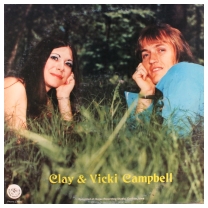 Clay Campbell & Vicki Campbell "Clay & Vicki Campbell" (Phone Records, 1975) (LP)
The Campbells were a country lounge duo from Bland, Missouri (that's a place, not a value judgment...) They were very young, although poking around online I couldn't determine whether they were they married or siblings. Anyone know for sure? This studio album was recorded at Kajac Studios in Carlisle, Iowa.
Clay Campbell & Vicki Campbell "Live!" (C&V Records, 1976-?) (LP)
(Produced by Clay Campbell)
This live album -- recorded at the Paddock Steakhouse in South Sioux City, Nebraska -- captures their country music stage show, complete with comedy skits and impersonations of Nashville stars such as Freddy Fender, Hank Snow and Marty Robbins. Backed by Lucky Lemire on piano and bass, and Al McKenney on drums, Clay sings and plays fiddle and guitar, while Vicki Campbell sings a version of Jessi Colter's 1975 hit, "I'm Not Lisa" as well as the "Girl's Medley."
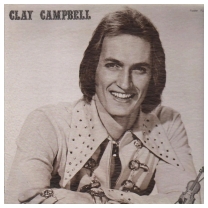 Clay Campbell "Clay Campbell" (Fiddler Records, 19--?) (LP)
He released two self-titled solo albums with different cover art on each one -- it's possible they're the same record, re-released, but I dunno for sure. Yet.
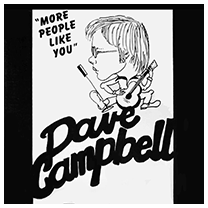 Dave Campbell "More People Like You" (Hombre Music, 1979) (LP)
A Maryland folk-country troubadour, singer Dave Campbell showcases five of his own originals on Side One of this album, while the flipside is all covers, ranging from 'Seventies country/countrypolitan hits such as "I Believe In Music" and "Help Me Make It Through The Night" and folkie material from Bob Dylan and Gordon Lightfoot to outright pop floss such as Bobby Hebb's "Sunny." The backing musicians include acoustic bassist Jim Bouton, Larry Bronson on acoustic lead guitar and Russell George Hughes on keyboards, who all seem to have been Maryland locals.
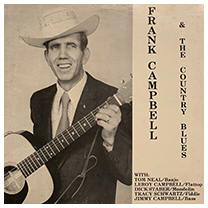 Frank Campbell "...And The Country Blues" (RMT Studios, 19--?) (LP)
Acoustic twang, harkening back to the Depression-era style of Jimmie Rodgers. Dunno much about Frank Campbell, though my attention was caught by the presence of Tracy Schwartz of the New Lost City Ramblers on fiddle. He joins Mr. Campbell, along with Jimmy Campbell (bass), Leroy Campbell (flattop guitar), Tom Neal (banjo), and Dick Staber on mandolin in a bluegrass-y/old timey set, recorded at RMT Studios, in Baltimore, Maryland. This was a pretty no-frills production, with just the front cover photo and a plain white back.
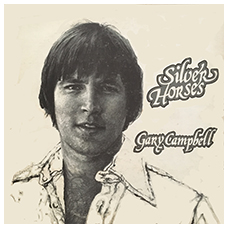 Gary Campbell "Silver Horses" (CP Studios, 1978) (LP)
(Produced by Lloyd Maines)
I dig this one! A nice, well-produced set of indie twang, with swell pickin' and a strong bunch of original tunes. Texas songwriter Gary Campbell sings with a slightly exaggerated imperfection and thinness to his voice -- he embraces it, and it helps him sound distinctive. The arrangements and production are definitely a notch or two above most private press albums, with bright, catchy guitars and uptempo tunes. This disc's a winner, with a classic mid-Seventies pop-twang feel, reminiscent of the house style at MCA/Decca.
 Jeff Campbell "Clawhammer Banjo And Old Time Fiddle Songs" (Vetco Records, 1973) (LP)
(Produced by Lou Ukelson & Rusty York)
Originally from Muncie, Indiana, banjo plunker Jeff Campbell became part of the 1970s Ohio bluegrass scene... As far as I know, this was his only solo album, though he also worked in several different bands over his career (as those bluegrassers tend to do...) He's joined here by Junior Bennett on fiddle and Ronnie Sizemore playing guitar.
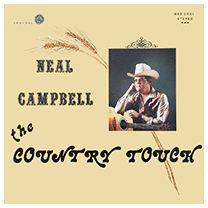 Neal Campbell "The Country Touch" (Maple Grove Records, 19--?) (LP)
(Produced by Paul Baker, Barry Hawkins & Joe Kozak)
Original northern twang by Canadian songwriter Neal Campbell, who penned most of the music on here, adding a few cover songs drawing on stuff by Merle Haggard, Bob McDill and Don Williams, and Mel Tillis. This appears to have been his only album, though he also released at least one single on the North Star label, which included two of his own originals, "My Home In The Cariboo" and "Free." The musicians include Neal Campbell on lead vocals, with Rick Brown (keyboards), Jim Hathaway (drums) Joe Kozak (bass), and producer Barry Hawkins playing guitar.
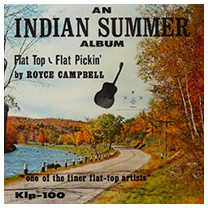 Royce Campbell "An Indian Summer Album" (Kay Records, 1970) (LP)
Instrumentals featuring flat-top guitar picker Royce Campbell, who was born in Oklahoma and learned his craft in the western end of the Ozarks, out in the Northern end of the state. This album was album recorded in Tulsa, with backing by Jerome Campbell, Bill Kay and Glen Mowery. Dunno if he's related to the jazz guitarist of the same name...
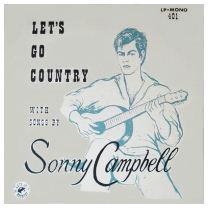 Sonny Campbell "Let's Go Country With Songs By Sonny Campbell" (SC/Let's Go Country, 196--?) (LP)
This was an older album, probably from the 1960s (?) with kind of a rockabilly feel. Campbell apparently played at a club called The Coral (I think they meant "Corral," but it's clearly and consistently misspelled...) and had some kind of traction at radio station WJRZ 970, a Newark, New Jersey AM station which had a country format in the late '60s... Other than that, this guy's a bit of a mystery... The album has a plain white cover, with no graphics on the back, so there's not much info to go on. (There's also a later edition with a photo of Campbell and his band playing live...) Feel free to contact me if you know more about this guy, or this album...
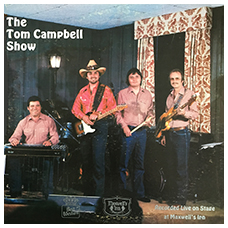 The Tom Campbell Show "Recorded Live On Stage At Maxwell's Inn" (Maxwell Records, 1982) (LP)
(Produced by Tom Campbell, Max Horkins & Steve Hembree)
Originally from Pacific Junction, Iowa, multi-instrumentalist Tom Campbell moved to Nashville in 1974 and found work as a backing musician for stars such as Roy Clark, Freddy Fender and Billy Walker. He toured on the road and in Vegas lounges, worked in radio and at least for a while led his own band, and had a gig at Maxwell's Inn, outside of Nashville, at the time this record was made... This small ensemble included steel player Doug Jernigan, bassist Don McGinnis and drummer Jan Jones, with Armstrong kicking in on banjo, fiddle, and guitar.
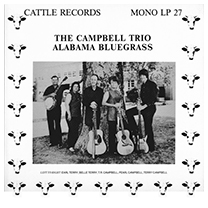 The Campbell Trio "Alabama Bluegrass" (Binge Disc/Cattle Records, 1982) (LP)
(Produced by R. C. Smith)
An all-gospel set, by a family band from Leighton, Alabama. The main trio -- T. R. Campbell (vocals, guitar), his wife Pearl Campbell (rhythm guitar, vocals) and their teenage son, bassist Terry Campbell -- started playing together in 1970, and performed local and regional shows, mostly at bluegrass festivals and the like. This session was recorded in March, 1975 at the Mrs. Campbell's family home, with a couple of her relatives chiming in, including her sister Belle Terry on harmony vocals and brother Earl Terry on banjo, with James Kimbrough dubbing in some dobro on one song in '77. This was literally a living room recording session, about as "down home" as you can get!
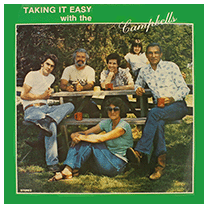 The Campbells "Taking It Easy With The Campbells" (Binge Disc/Cattle Records, 1982) (LP)
(Produced by R. C. Smith)
Rootsy Oklahoma bluegrass from Royce Campbell and his (sometime in the) 'Eighties cohorts. The group included Royce Campbell on guitar, Pat Campbell also on guitar, her sister Micki Mulcare on vocals, banjo plunker Gary Clark, bassist Kenny Glasgow, and teenager Theresa Glasgow on mandolin. Interesting repertoire, heavy on country material... The title track is a cover of the Lacy J. Dalton song; they also cover Asleep At The Wheel ("My Baby Thinks He's A Train"), Karen Brooks, Vince Gill, Bill Monroe, The Stanley Brothers, the Sons Of The Pioneers and Ricky Skaggs' 1981 hit, "You May See Me Walkin'." There are also a couple of originals, Gary Clark's "Silver Creek" and Patricia Campbell's "The Wind And Me." Years later, Pat Campbell and Micki Mulcare formed a group called the Making Memories Trio with their high school friend Sue Nell Shuck and were still playing gigs locally around their hometown of Vinita, Oklahoma well into the 2010s. Not sure about the exact date on this one, but I'd guess it was from the mid-1980s or thereabouts.
Ray Campi - see artist discography
 Bill Camplin "January" (Tool Room Records, 1973) (LP)
(Produced by Bill Camplin & Bob Schwartz)
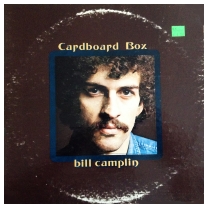 Bill Camplin "Cardboard Box" (Tool Room Records, 1975) (LP)
(Produced by Bill Camplin)
Wisconsin folkie Bill Camplin has made a bunch of records over the years, though I don't know if they are all as sweet and sweetly layered with country touches as this early gem. Fans of Jesse Winchester and Tim Hardin should love this record as well; it's definitely in that same range, with smooth vocals and deceptively simple acoustic arrangements, buoyed by Bob Knetzger on dobro, banjo and pedal steel... All but three of the songs were Camplin's own originals, with covers including Bob Dylan's "Positively 4th Street" and a jaunty rendition of Hank Williams' "I Can't Help It If I'm Still In Love With You." Really nice stuff... Yeah, he's really a folk singer, but with enough of a rich, country-tinged musical backdrop that I'm into it. Recommended!
 Bill Camplin "Bill Camplin's Latest Effort/Still Looking For The Cure" (Tool Room, 1976) (LP)
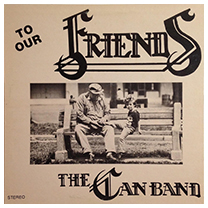 The Can Band "To Our Friends" (A & R Records/Moon Sound, 1971-?) (LP)
A folk/country foursome from Minnesota(?) whose repertoire is heavy on original material, ranging stylistically from Kingston Trio-ish earnest folk, to even more earnest bluegrass, as well as a little bit of Oak Ridge Boys-ish melodic country-pop. This was recorded at Moon Sound Studios, Minneapolis, with bandmembers Doug Larson, Bob Hoch, Dave Saving and John Williams joined by several other pickers, notably steel player Jeff Dayton. Heartfelt performances by earnest amateurs.
 Jack Cannon "Jack Cannon Country" (TIM Records/Tops In Music, 1975) (LP)
This guy lived in Milton, Florida, and was an amateur singer who went to Pensacola to record this album with a band that was at least partly session players. The repertoire is mostly cover tunes, including versions of classics such as "I Love You So Much It Hurts," "Night Train To Memphis," "The Wild Side Of Life" "I Thought I Heard You Calling My Name" -- real old-school stuff. The backing band was called the Stranders and appears to have been all locals, with steel guitar by Curtis Hall, Junior Colley on lead and piano by Vaughn Thacker. The album also includes a couple of original songs written by a guy named Wally Willette: "Come On In, Mr. Blues" and "I'm Over Here, My Heart's Over There." Willette wasn't in Cannon's band, but he seems to have been pals with Papa Ray Sims, who appears to have been the financial backer of this album, and contributed the liner notes.
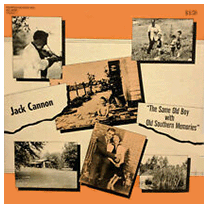 Jack Cannon "The Same Old Boy With Old Southern Memories" (Redwing Records, 1983-?) (LP)
(Produced by Doug Jernigan & Bruce Watkins)
I'm not 100% sure this is the same guy as the Florida fellow above... but it seems pretty likely. More cover songs, and the producer credits suggest this was a Nashville session.
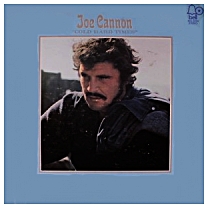 Joe Cannon "Cold Hard Times" (Bell Records, 1970) (LP)
Originally from Rhode Island, actor/singer Jean Peloquin headed out for California during the swinging '60s and lucked out in landing a role as "Gene, the singing ranch hand," on the western-themed TV series, The Virginian. He appeared in twelve episodes from 1968-69, and was able to parlay that gig into recording his first album, under the more butch-sounding "Joe Cannon." Under that name he kicked around with Lee Hazelwood for a while, then briefly moved up to San Francisco and made a living singing in bars. At some point in the early '70s he left California in favor of the even more frontiers-y locale of Pocatello, Idaho, where he became a permanent fixture on the local bar-band scene.
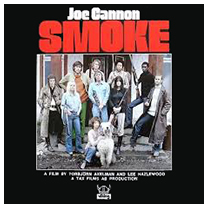 Joe Cannon "Smoke (Original Soundtrack)" (Viking Records, 1971) (LP)
This film had some kind of connection to Lee Hazelwood, as did Cannon, in his Hollywood days. I think Hazelwood directed or financed this film; Joe Cannon also recorded some of Hazelwood's songs early in his career... I haven't heard any of that stuff, though...
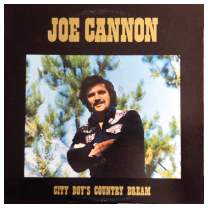 Joe Cannon "City Boy's Country Dream" (JDJ Records, 1974-?) (LP)
(Produced by Terry Brown & Donnie Owens)
Packed with original material, this is the record you could call Joe Cannon's magnum opus -- his live albums might be better indicators of what he was like as a performer, but he obviously really put his heart into this one. It's an ambitious set full of original material with lofty lyrics and sweeping, cosmic-country arrangements... There's also some relatively down-to-earth twang, but mostly this is a record that aims big and goes long, buoyed by sweet pedal steel from West Coast stalwart Jay Dee Maness. I'm sure it'd be easy for some of you out there to mock the pretensions of this album, but still, the guy was really going for it and stepped way outside the world of ski lodge lounge gigs that were his bread and butter. It's worth a spin, for sure.
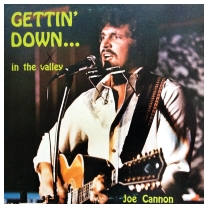 Joe Cannon "Gettin' Down... In The Valley" (JDJ Records, 1975-?) (LP)
To be honest, this one's a little hard to listen to... A live album with lots of rambling, drunken chatter by Joe Cannon, who's performing solo with an acoustic guitar, a harmonica and a lot of balls-out bluster. He trades good natured jibes with the audience and does his best to suck up to the locals, adapting a pop hit into "Please Come To Pocatello" and telling the long, long back story to his own local-pride song, "Sun Valley Sally." He also covers Jimmy Buffett ("Come Monday," though he teases the crowd with the promise of singing Buffett's "Why Don't We Get Drunk And Screw") and there's also a real trainwreck of a John Denver medley. The album closes with his version of "Up Against The Wall, Redneck Mother," where he one-ups Ray Wylie Hubbard in the crudeness quotient, and gives a hint of how wild his live shows actually might have been. It's a good, honest portrait of a sloppy bar-band country act, but it's not really that enjoyable to hear. Guess you had to be there.
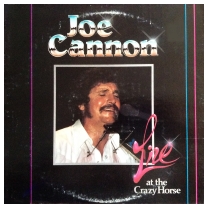 Joe Cannon "Live At The Crazy Horse" (JDJ Records, 197--?) (LP)
Cannon was a regular at the Crazy Horse Steak House, located in the wild, beige backwoods of Southern California's Orange County. I dunno when this album was recorded, but Cannon was booked at the club at least through the early 1990s. At that point, he had a finely honed comedy-country schtick, including lots of blue humor and general raunchiness. (A 1990 article in The LA Times makes it sound like a scene to be seen... with a highlight actually being when he opened the merch table and there was a buying frenzy for Cannon's "While You're Down There, Make My Day" belt buckles. Somehow, I don't think his version of "Sometimes When We Touch" was quite as chaste as the Dan Hill original...)
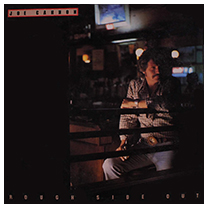 Joe Cannon "Rough Side Out" (White Rabbit Records, 1984) (LP)
(Produced by Seth Dworkin & Dick Grove)
A pretty sharp band backs Cannon on his final(?) full album, which has kind of a what-the-heck vibe to it. The song "Going Nowhere Hillbilly Band" has kind of a sad ring to it, but his romping, raggedy tribute to the SoCal country scene, "Palomino," is much more upbeat. Cannon is backed by some interesting folks, notably West Coast steel player Bobby Black and drummer Willie Cantu, from Buck Owens' band. Side One showcases five studio tracks, while Side Two is a live performance from a Palo Alto, California club called Chuck's Cellar, a fabled folk'n'rock venue that was a proving ground for acts such as Linda Ronstadt and The Eagles, as well as folkie John Stewart.
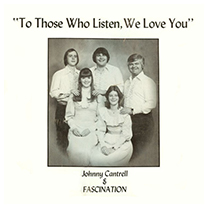 Johnny Cantrell & Fascination "For Those Who Listen, We Love You" (Telephone Records, 1978) (LP)
(Produced by John D. Evans & Bob Lancaster)
This one'll grow on you. Texas singer John D. Evans went by the stage name Johnny Cantrell, releasing numerous singles and a couple of albums on various local Lone Star labels. He had kind of an iffy, not super-polished voice, but he's one of those kinda country folk who win you over with their sincerity and lack of affectation. This disc was recorded at the Don Caldwell Studios, home of the Maines Brothers Band, with steel player Lloyd Maines sitting in to add his usual touch of class. Cantrell covers some eclectic country material -- stuff by Kris Kristofferson, Johnny Rodriguez and Kenny Rogers, and best of all (I'm serious!) Jimmy Buffett's "Margaritaville." The backing band, Fascination, seems to have been his own group, all West Texas locals, though Lloyd Maines gets in some nice licks as well. These are mostly cover songs, boldly kicking off with "Margaritaville" and working through a few other comfortable favorites, notably a cover of the old WebbPierce hit, "Wondering," and particularly effective rendition of the otherwise over-recorded "For The Good Times," in which Cantrell's low-key delivery brings the song to life in a way I've rarely heard. About half the album, though, is made up of his own originals, credited to John D. Evans, all of which are pretty good... The album ends with a zippy instrumental, with Maines and the other pickers cutting loose on a version of Al Dean's "Jalisco." Recommended.
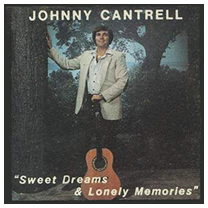 Johnny Cantrell "Sweet Dreams & Lonely Memories" (Challenge Records, 1982) (LP)
I'm not sure if this album was a cassette-only release -- that's the only format I've seen -- but several of the tracks came out as singles on the Challenge and Jador labels. Cantrell continued to record into the late '80s, and possibly beyond.
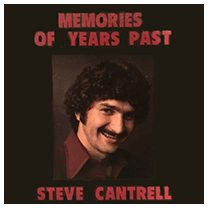 Steve Cantrell "Memories Of Years Past" (Ozark Records, 1978-?) (LP)
(Produced by Buddy Lane)
Homegrown honkytonk by a fella from Seymour, Missouri. About half the songs are credited to J. S. Cantrell, including tunes such as "A Year Ago Today," "Lonely Guitar Pickin' Country Music Lovin' Man," "Thinking Of You Again," and the title track, "Memories Of Years Past." Some other songs may have been originals penned by some of his pals, though he also tackles a few country classics, like "Break My Mind," "Springtime In Alaska" and Jud Strunk's "A Daisy A Day." The backing musicians were guys who worked in various local Ozark "oprys" as well as in the regional southern gospel scene, including drummer Jerry Dooley, fiddler Frank Ellis, Stan Friend (guitar), Mike McGee (steel guitar) and Gene Reasoner on piano. It's not clear whether Mr. Cantrell really ever pursued music full-time; he worked at a few different local "produce auctions," which seem to be like farmers markets on steroids... Other than that, not a lot of info.
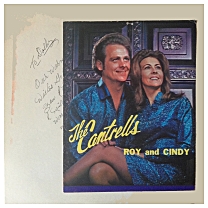 The Cantrells "Roy And Cindy" (Label Unknown, 19--?) (LP)
This one's a real DIY ultra-obscuro -- the husband-and-wife team of Roy and Cindy Cantrell were apparently a mainstream-oriented country duo from Waco, Texas, who toured throughout the South and Midwest, and had at least one appearance on the Opry stage. This is all according to the color-xeroxed pamphlet that was stapled to this bare-bones LP -- which otherwise it has no album art whatsoever, and no other information besides the song titles listed in the inner labels. According to the booklet, Roy Cantrell saw Johnny Cash play a show in Anchorage, Alaska and was inspired to try to become a country music singer himself... They first made a go of it in 1963 when a New York City club owner helped them cut some singles in LA, and they went to Nashville twice, in '63 and '66, but both times Music City crushed their dreams -- the pamphlet ruefully describes how they had to pawn their guitars just to get cab fare and money for food. There's a Billboard column from 1967 that mentions them as being signed to the Kash label, but I'm not sure if they ever released anything. They were still touring the Midwest as late as 1972, when their backup band was nicknamed Cantrell's Raiders. As for the date this LP came out, I'd guess anywhere from 1968-73, obviously self-released as a show memento, but done so cheaply that they decided to not even create any graphics at all. (Did this album actually come out with artwork? Anyone know for sure?) It's good music, with a few cover tunes such as "Hello City Limit" -- but it's mostly original material, as far as I can tell (there are no song credits, either...) The performances are generally pretty good, with twangy, old-school musicianship and vocals that remind me of Carl Smith and Loretta Lynn, though the vocals like the arrangements and the production values are pretty variable -- my guess is that these ten tracks were recorded at different times, over several years, possibly dating back to their first studio session in '63. If anyone has any info about this fine, forgotten duo, I'd love to hear more about them!
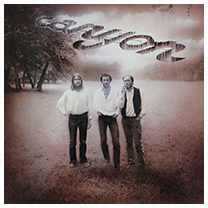 Canyon "Canyon" (Nature Records, 1978) (LP)
(Produced by Gerhard Kampfe)
A German band with fluid boundaries between country and rock, though with a definite country direction... The trio included Manfred Wetterich (guitar), Wolfgang Ronsch (guitar, mandolin) and Achim Dresch (keyboards and harmonica) with additional backing by a slew of musicians, ranging from trumpets to pedal steel. Songs include "Brother Hobo," "Cowboy Song," "Don't Join A Rock'N'Roll Band" and a cover of the Beatles' "I've Just Seen A Face." An earlier iteration of this band cut an album under in 1976 the name Itcheyfoot, as a more modest, bluegrass-y trio.
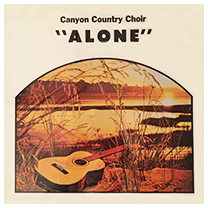 Canyon Country Choir "Alone" (Century Records, 1978-?) (LP)
(Produced by Ron Chancey)
This one's more of a warning than a review... Yeah, sure, they call themselves "country," but really this is a super-clunky set of Christian sorta-folk, sorta-rock, poorly recorded and clumsily executed, like one of those "talent show" discs the hipsters love to giggle over. "So bad it's good"? Well, that's up to you. But "country"? Nah, not really. I took one for the team, here.
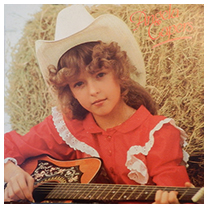 Angela Capers "Angela Capers" (Gulf Coast Sound/GCS Records, 19--?) (LP)
(Produced by Mark C. Purser & Michael Sheffer)
I have to confess that, in general, albums by child performers make me uncomfortable. Just on the face of it, they seem exploitative and hint at some kind of overbearing adult presence. Also, most kids, unless they're Michael Jackson or Brenda Lee, don't have their "real" voice until they're much older, so what's the point? This disc by young Ms. Capers is perhaps a case in point... The music is slick and glossy, and often over-mixed to the point it's hard to tell how good a singer she was, though basically you get the idea. She was a kid. She had a kid's voice. This undated album is a little shrouded in mystery -- it was recorded in Pensacola, Florida with what seems to be a local crew and is packed with original material, including a track by producer Mark Purser, one written by Ms. Capers called "Like My Daddy Did," which was an album highlight. I wasn't able to track down any information about Ms. Capers -- a lot of people out there have the same name -- though it looks like she was about nine or ten when she cut this disc, and the album looks like it was made in the late 1980s or early '90s. The musicians included Mark Purser on keyboards, along with Terry Blackwell on guitar, Robert Byrne (guitar), Mike Chapman (bass), Lamar Hall (steel guitar), Owen Hale (drums), Clayton Ivey (keyboards), Rusty Jones (bass), Paul Reinbo (guitar), and Karen Stone providing backing vocals. The presence of multiple people playing the same instruments suggests that it took a while to finish this album and that it was recorded in several sessions, and indeed there's an inconsistency from track to track, with some songs sounding thinner or more tinkly than others, though they all sound super-modern and poppy. Not a disc you have to run to go find, but a good example of very late-vintage "private press" country.
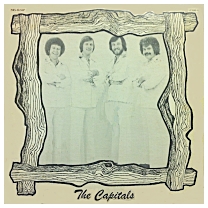 The Capitals "The Capitals" (Rising Star Records, 1977) (LP)
(Produced by Colonel Dave Mathes)
I think these guys were primarily a gospel group, although they covered country hits such as "Daddy Sang Bass" and "This Ole House," with backing by Nashville pros such as Buddy Emmons, Jerry Shook and Russ Hicks in the studio crew. The first track is a patriotic number, Barbara J. Anton's "Hot Dog! I'm American!"
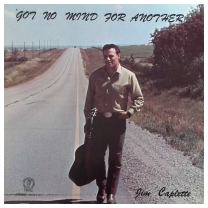 Jim Caplette "Got No Mind For Another" (Big Chief Records, 1970) (LP)
(Produced by Bruce Thomson & Joe Kozak)
A nice one by Canadian humorist and author Jim Caplette (1924-2015) who also turned his hand to music in the early 1970s. This is a really nice, low-key album of mellow folk-country... Reminds me quite a bit of George Hamilton IV's music of the same era. Recommended!
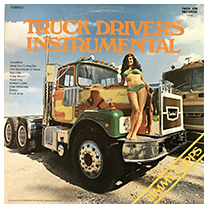 Jimmy Capps "Truck Driver's Instrumentals" (Papa Joe's Records, 1974) (LP)
(Produced by Jerry Smith & Walter Smith)
Breaker, breaker, good buddy! So, guitarist Jimmy Capps hailed from Benson, North Carolina and became one of the best-known, most in-demand superpickers in Nashville, playing on bazillions of sessions... On this trucker-themed LP, Capps plays a bunch of songs credited to producer Jerry Smith, who was also known for his work as a Nashville insider. In an interesting change of pace, this album also gives a shout-out to the cheesecake model posed on a semi hood on the front cover: turns out she was Carole Black, a columnist for Trux Incorporated and Overdrive magazines who, I guess, didn't mind also posing semi-nude (if you'll pardon the pun... Get it? Semi nude?? Well, I thought it was good... Um, anyway...)
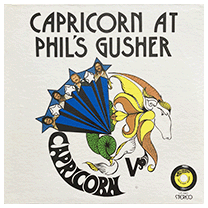 Capricorn "Capricorn At Phil's Gusher" (Phillip's Cash & Carry Records, 1976-?) (LP)
A mix of country, fifties-style rock and classic New Orleans R&B by a quartet from around Lake Charles, Louisiana... The band consisted of drummer Gene Adam, vocalist Everett Brady, bass player William Burton Gaar and pianist Glynn Guidry, guys who played in a variety of other bands, playing blues, rock and country over the span of several decades. (There may be a few unidentified studio players in the mix as well, such as the steel player(s) on the album's country-sounding tracks...) This is, in all honesty, an uneven album, moving not only from singer to singer and style to style, though overall you can sense the group's high talent level, particularly on the stronger tracks. Most of the songs previously came out as Cash & Carry singles a year or so earlier, but were released under the individual artist's names: the bandmembers each put out singles as "solo" performers, including several songs that were not collected here, as well as earlier and subsequent singles on other labels such as Adonda, Crazy Cajun, Goldband and Smash Records. The drummer, Gene Adam, was the weakest singer of the four, specializing in oldie rock ballads ("Sea Of Love," etc.) sung in a fairly tremulous voice, though with great gusto and sincerity. On the other hand, there are some real gems here -- the opening track, Glynn Guidry's own "Louisiana Bayou," showcases some dazzling piano plunking, and Burton Gaar's "Leona" is a groovy approximation of the breezy harmony vocals of contemporary country-rock pop bands like America or the Eagles. Going by catalog numbers, the Cash & Carry label seems to have put out at least nine singles, though several have yet to be tracked down; presumably they include a few "missing" tracks by the fellas from the Capricorn band... Of all the Capricorns, Everett Brady may have had the deepest career: decamping to Las Vegas for a while, he formed a casino band called the Louisiana Purchase, along with swamp-pop old-timer Johnny Giordano (aka Johnny Gee) and they released a few singles in the late '80s. Johnny Gee was a veteran of Clint West's band, the Boogie Kings, and Brady recorded with a later edition of that band as well, and remained active up through the 2010s when health problems slowed him down. It's worth noting that Burton Gaar (1942-2011) was no slouch either: he started out playing bass for Slim Harpo in the 'Sixties, also did some time in the Boogie Kings, and later worked with zydeco legend Rockin' Sidney... So this record was kind of an encapsulation of a lot of their far-ranging musical interests. Definitely worth a spin!
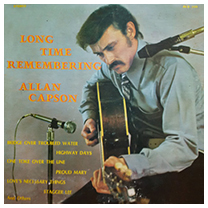 Allan Capson "Long Time Remembering" (Marathon Records, 1972) (LP)
(Produced by Doug Taylor)
This was the first album by Canadian country picker Allan Capson, a songwriter from Moncton, New Brunswick who broke through when his tune, "Alberta Country Soil" was recorded by Christian singer Marg Osburne and became a regional hit. On his debut, Capson is mostly given hits of the day to record, including a few dreary choices, like "Proud Mary," "Down in the Boondocks" and "Bridge Over Troubled Waters." A little more fun are tunes like "Loving Her Was Easier" and the hippiedelic "One Toke Over the Line," by Brewer & Shipley. There's a strong folk-pop tilt to this album, but definitely some twang in there as well, particularly with the sweet, cosmic, Garcia-esque pedal steel prominent in the mix.
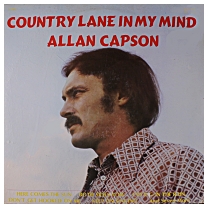 Allan Capson "Country Lane In My Mind" (Marathon Records, 1973) (LP)
(Produced by Doug Taylor & Ken Friesen)
This time around, it's mostly self-penned material, although he does sing a few cover songs, such as "Baby Don't Get Hooked On Me," "Here Comes The Sun," and Joni Mitchell's "Both Sides Now." Also, it's basically the same group of musicians on both albums, including Steve Smith on steel guitar.
 Captain Canada "...And The Legendary Sons Of The Golden West" (RSC/World Records, 1980) (LP)
(Produced by Rick Erickson, Cory Halverson & Garry McDonall)
Wow! Really? Well, yeah, I guess so... Apparently multi-instrumentalist Brian Sklar, who had been recording under his own name since the early 'Seventies, also had a superhero persona where he donned a red-and-white, fringed-leather cowboy suit emblazoned with a maple leaf chest logo -- looking half Vegas-Elvis/half-Captain Canuck -- and blazed away on a repertoire heavy on cajun, bluegrass and western swing fiddle tunes. I suppose this album, which packs in twenty-four separate tracks, is something of an "easy listening" set, although the performances are pretty dynamic and well produced. The compact comb includes Brian Sklar on fiddle and piano, alongwith Ron Jeffrey on bass, Tim Jeffrey (steel guitar), Daltn Rohn (guitar) and Gary Whitman on some rather feroicious drums... Solid music, with kitsch value set aside. (Note: some folks list this album under "Captain Canada," though Sklar's name is right there on the front cover, albeit in relatively small print... But I'm including it here anyway, since it gives me an excuse to steer you towards my Canadian Country section.)
Henson Cargill -- see artist discography
 Cliff Carl "The Montana Music Of Charles M. Russell" (SRC/Sound Recording Company, 19--?) (LP)
An elaborate musical tribute to fabled Montana pioneer and western painter Charles Marion Russell (1864-1926) a Saint Louis native who as a teen made the trek to Helena, Montana in 1880, and became one of the iconic figures in the state's historical lore. Russell worked in numerous trades -- as a cowboy, a fur trapper, a sheep herder and preeminently, as an artist. He produced thousands of paintings and drawings with western and rustic themes, and his work is the focus of a sizable museum located in Great Falls. The songs on this album are based on the imagery seen in a dozen of his paintings, with music composed by William J. May and performed by Cliff Carl. I'm not sure how "country" it is, but when I gat a chance to give this a spin, I'll let you all know. At least two of the tracks on this album were also released as an SRC single, "Fighting Cheyennes" and "Peek-A-Boo Moon," and Cliff Carl recorded some unrelated material of his own in the mid-1960s, working in the country genre.
 Paul Carie "Town And Country Steel Guitar" (TAC Records, 1977-?) (LP)
(Produced by Bill West)
The title pretty much says it all, a mix of pop and country covers by a young steel player from Vincennes, Indiana. He's backed by a bunch of locals: Bob Berry on rhythm guitar, Jewel Dukes (piano and vibraphone), Jack Little (fiddle), Scott McNight (drums, Larry Schmidt (bass), Dick Shelton (lead guitar), and Spider Rich on guitar, with vocals by Carolyn Wheeler and Geraldine Kowalskey. The more overtly country material includes versions of "Cold, Cold Heart" and "Mister Bojangles." No date on this disc, but it's certainly from the 1970s... dig that denim, baby!
 Carl & Frank "If The Phone Should Ring" (D&M Records, 19--?) (LP)
(Produced by Bill Huffman & Jack Clark)
A couple of old-timers from South Carolina playing sentimental and old-school country tunes. Carl (Dillard) plays piano while Frank (Martin) handles the vocals, with backing by an uncredited band called The Rhythm Masters... They cover a few oldies like "Born To Lose" and "Wild Side Of Life," though the brief liner notes mention that five of these tracks are their own originals, including (I'm guessing) the title track. A real mystery disc here... any info would be welcome!
 Carlen & Spencer "If I Had A Nickel" (1982) (LP)
(Produced by Wayne Sexton)
Hugh Carlen and Gregory Spencer were an acoustic duo from Buffalo, Kentucky who beefed up their sound with some zippy pedal steel licks, courtesy of Larry Williams... I guess technically this is twang, although their music had a predominantly gooey, strummy, naifish folk-funk vibe. The album was recorded at a studio sponsored by the Lincoln Jamboree, though I'm not sure if these guys were connected with the venue itself.
 Jim Carley & Johnny Adams "Dim Lights And Thick Smoke" (American Heritage Music Corporation, 19--?) (LP)
(Produced by Marty Martin & Loyd Wanzer)
A construction worker by trade, banjo picker Jim Carley grew up in Kansas and pursued his musical career first in the Sunflower State, then over in Missouri, where he was part of the Buster Jenkins troupe. Carley moved to Idaho in 1962 and met guitar picker Johnny Adams, himself a transplant from Pennsylvania. They are joined on this set of bluegrass and country oldies by "The Flint Hill Boys," including fiddlers Dallas Goff and Dwayne Youngblood, along with Youngblood's fourteen-year old son Ricky Youngblood on rhythm guitar. Not sure exactly when this came out, but it looks early 'Seventies-ish. The repertoire is pure oldies, though, including sentimental numbers such as "Don't Say Goodbye," "Kiss Me One More Time" and "Don't That Road Look Rough & Rocky," as well as raucous fling-ding numbers like Reno & Smiley's "Tally Ho," and a bunch of hillbilly stuff from the Merle Travis era. Sounds good to me!
 Tom Carlile & The Craftsmen "The Original Sounds Of..." (Cherry Records, 1968) (LP)
Originally from South Florida, songwriter Tom Carlile led a pop group called The Craftsmen which played gigs around Miami for several years, starting in the early 'Sixties. Sold locally at their shows, this custom-pressed souvenir album is definitely not a country record -- more of a mildly chaotic spin on the Tom Jones sound, complete with wild arrangements and big, bombastic vocals -- but it's worth putting on our radar because over a decade later Carlile had made his way to Nashville, and he scored several entries in the Country Top Forty, including a few from the album below. According to the folks at Waxidermy, there were two pressings of this album, the first with a text-only cover and the second with Tom Carlile's photo on the front, and an all-new layout on the back as well. He definitely "went country" later on, though, scoring several decent chart entries in the early 1980s.
 Tom Carlile "The Tom Carlile Feel" (Door Knob Records, 1981) (LP)
(Produced by Gene Kennedy)
Slightly jittery, perfectly prefab pop-country from Florida singer Tom Carlisle, formerly a (terrible) late-'Sixties pop artist who led a (terrible) band called Tom & The Craftsmen. A decade or so later, he was still a hammy singer, but his remarkably tinny voice was better suited to country material than to the kind of pop material he tried tackling back in 1968. Kind of a Bill Anderson-ish vibe, I suppose. Anyway, if you enjoy the late '70s/early '80s equivalent of soft-pop/AOR and you're looking for more obscure artist to fill that need, this is an album that might be considered a lost gem, of sorts. If you like the style, it's probably worth checking out.
 The Carlisle Family "The Carlisle Family Album: Old Time Great Hymns" (Old Homestead Records, 1982) (LP)
(Produced by Doug Taylor & Ken Friesen)
Fans of classic hillbilly blues will delight to find this archival recordings of the extended family of Depression-era icons Bill and Cliff Carlisle, two pioneers of Kentucky country who found widespread regional fame in the 1930s and '40s and -- in the case of Bill Carlisle -- national fame and a slot on the Grand Ole Opry. This set was a humbler offering, a back-to-basics religious set featuring family members Charlotte, Connie, Henrietta, Jerry, Louis, Marion, Milton, Regenia and Ronnie (whose exact relationships to the brothers are unknown to me). The tracks were originally recorded for the REM Records label, but went unreleased until a tape was provided to the folks at Old Homestead, many years later.
Thumbs Carllile - see artist discography
 Carlo (San Paolo) "My Raggedy Ann" (Lark Ellen Records, 1975) (LP)
(Produced by Arlene Buckner, Erwin E. Buckner & Fern Doral)
A questionable entry, though there are country threads... Multi-instrumentalist Carlo San Paolo (who also went by the simple mononym "Carlo") was originally from Saint Louis, Missouri and seems to have had a pop-oriented background, touring as a teen with a rock group called Illustrated Sounds, which cut a couple of singles circa 1969. He met his muse, lyricist Arlene Buckner, while performing in New Orleans and at some point they both wound up in Los Angeles, where Carlo joined Paul Foster's country band, The Hand Me Downs, which cut an album on Lark Ellen Records in 1974. Apparently he quit that group when they went on tour up in Alaska, stayed in LA and recorded this disc, which has a less overtly country tone than Foster's disc.
 The Carlton-Taylor Band "Indiana Lady" (Pinebrook Recording Studios, 1984) (LP)
(Produced by Steve Archer, Mark Aspinall & John Bolt)
An ambitious set of would-be country top forty tunes by a slick, smooth-sounding band out of Indianapolis, Indiana. This album is packed with all-original material most of it composed by lead singer Don Carlton (aka D. C. Ewigleben) who definitely applied himself to the smooth group-vocals style of the time. Stylistic touchstones include chart-toppers like the Bellamy Brothers, Dan Seals, Larry Gatlin, or the Desert Rose Band -- slick stuff performed very ably, though perhaps without the vigor of more robust bands such as The Oak Ridge Boys, et.al. All but one of the songs were written by Mr. Ewigleben, and they tend to be well structured though a little bit airy; the group sounds professional but tentative, never quite willing to let their hair hang down, and thus a little too controlled. Among Carlton/Ewigleben's songs, standouts include "You Don't Greet Me" and the slightly slower ballad "Caught Up In Love," while bass player Dave Coleman contributes what I would consider the album's best tune, "Gimme That Honky Tonk," a slightly earthier drinkin' song with a Moe Bandy-ish vibe. The group included lead singer Don Carlton, Dave "Taylor" Coleman on bass, a gal singer named Starr Reel Jones (who has a couple of solo numbers) Jim Benge (lead guitar), Don Daily (drums) and Joe Stout (keyboards). The band won a national talent contest sponsored by Marlboro cigarette company and did some national touring, though eventually fizzled out; Don Carlton later moved to Denver, Colorado where he started a new band called Renegade, which was playing gigs as recently as 2022. I'm not sure if any of the other folks were in other bands or had musical pursuits after this album, but this was a pretty good memento of their younger days -- even though this ain't quite my cup of tea, I would definitely recommend this album to anyone looking for off-the-radar early 'Eighties country-pop.
 Ken Carlysle & The Cadillac Cowboys "Live!! At The Black Stallion" (Carlysle & Kimbro Music, 1980) (LP)
(Produced by Ken Carlysle)
A raunchy live set recorded live in November, 1979 at a country club in Bettendorf, Iowa...
 Ken Carlysle & The Cadillac Cowboys "The Black Album" (Inglewood Records, 1981) (LP)
Another "blue" album of oh-so-naughty songs by Illinois-based songwriter Ken Carlysle, who is known for the infamous "Itty Bitty Titty Song..."
 Joey Carmon & Crossbow "Joey Carmon And Crossbow" (Crossbow Records, 1983) (LP)
Country-pop hopefuls from El Paso, Texas... Singer Joey Carmon was originally from Kentucky and met songwriter Dave DuChane while stationed in Hawaii on military service. They played together at NCO clubs and other similar gigs, and eventually wound up in Texas, where they started the band Crossbow in 1980. They recorded two albums, the first being a studio recording packed with original material and a few covers. Carmon had a soft, croony streak to his vocals, reminiscent of Don Williams, which is matched by the often synthy/tinkly arrangements which reflect the sound of early '80s Nashville. Most of the songs on here were written by Dave DuChane, including several written with Joey Carmon. This album also includes a banjo-driven cover of Billy Joel's "Travellin' Prayer," an early song from '74 that had a kind of country-ish feel, as well as a version of Jim Croce's "Time In A Bottle," which kind of gives you a sense of where these guys were coming from... Perhaps a little too soft-sounding for many twangfans, but still a nice indie album, with more of a Top Forty feel. (Note: a couple of years before this album came out, Carmon, DuShane and steel player Stan Welsh all played together on fellow Texan Qwinn Nelson's album, El Paso.)
 Joey Carmon & Crossbow "Live At Caravan East" (Crossbow Records, 1984) (LP)
A live set from a local El Paso club... Love the cover art showing the messed-up, partially burned marquee!
 Joey Carmon & Crossbow "Anthology" (1995) (CD)
(Produced by Paul Emory)
This CD gathers material from the band's 'Eighties albums, just ten tracks total, with several songs concentrated on Carmon's guitar picking and banjo plunkin'.
 B. J. Carnahan "You Ain't Never Had Lonesome" (History Records, 1974) (LP)
(Produced by Gordon Terry & Charlie Bragg)
Apparently Missouri native Billy Joe Carnahan was an old fishing buddy of Johnny Cash's -- that's what Mr. Cash says in his liner notes -- and they were stationed together in Germany when Cash was in the Army, before he came home and started his music career. So, they go back a ways. Carnahan recorded this album at Cash's studio, the House Of Cash, with his own local band augmented by studio pros such as Jimmy Capps, Charlie McCoy, drummer D. J. Fontana, Hargus Robbins and Earl Ball on piano, and hillbilly old-timer Gordon Terry playing fiddle, as well as producing the album. Terry also contributes one song to the album, "I Get Lonely Easy," though most of the songs are Carnahan originals, either written by him or by his relative Frank Carnahan. The band includes his brother Bob on bass, as well as several teenagers adding a youthful vibe, and gal singer Geri Whipple who is highlighted on a couple of duets, notably a version of "Jackson" which closes the album out. (Footnote: Cash also says that he used Carnahan's name in the song "Don't Take Your Guns To Town" when he recorded it years earlier... how's that for a little behind-the-scenes country music lore??)
Charley Carnelison & The Apostolic Faith "Bluegrass From The Heart" (Canaan Valley Records, 197--?) (LP)
Bluegrass preacher Charley Carnelison grew up in Hollister, Missouri, and was living in Springfield when he began his recording career. When he was eighteen, he joined Jack Keithley's band, the Ozark Country Boys, before forming a duo with Johnny Holt a few years later. Carnelison and Holt played on the radio locally in the Branson area, and recorded together over the course of several years. Carnelison's signature song is a gospel tune called "20-20 Vision," which bears a striking similarity to a secular heartsong recorded by Gene Autry way back in 1954 (and more famously in a bluegrass arrangement by Jimmy Martin) though he say he copyrighted his own version in 1967, first recording it in 1972. Mr. Carnelison cut several albums and published a collection of bluegrass gospel songs as well as a book of regional Ozark folklore. Eventually he quit performing due to hearing loss, but Carnelison his band 20-20 Vision were still performing locally well into the 21st Century, with a presence on Facebook and podcasting as well. These three albums seem to have dated back to the 1970s, though he also seems to have self-released a number of CDs, which are a lot harder to track down.
Charley Carnelison & The Apostolic Faith "America You're Drifting Away" (Canaan Valley Records, 197--?) (LP)
 Charley Carnelison "Presents The Gospel, Bluegrass Country Style" (Pine Tree Records, 1978-?) (LP)
On this album, Carnelison shares the spotlight with his pal Johnny Holt, as well as Ohio gospel singers J.D. Jarvis and Rose Jarvis, who hosted the sessions at a Cincinnati recording studio. They all sing lead on various tracks, with Carnelison in the spotlight for four of his own songs, a reprise of "20-20 Vision," another oldie called "I'm Longing To See That City," and two newer songs, "One Drop" and "Today I Started Serving My Lord Again." The liner notes indicate that this was Carnelison's third album, and I'm assuming the two above on Canaan Valley were the first two. In addition to Holt and the Jarvises, the musicians include banjo players Noah Holland and Carlos Jones; Junior Bennett and Jimmie Dutton on fiddle; Lucky Jarvis playing rhythm guitar and Bill Woolum on dobro and bass -- the overlapping personnel and the liner notes reference to "all four of the songs I recorded on this album" leads me to believe this was actually kind of a semi-compilation rather than strictly a Carnelison LP.
 The Carolina Chaparrals "Doyle Wilburn Presents..." (Car-Chap Records, 19--?) (LP)
(Produced by David Boggs & Jack Logan)
A boy band from Belton, South Carolina, the Carolina Chaparrals were kids ranging from ages eight to fourteen, and may have been brothers, although it's hard to tell, since none of them are identified by name on this album. They seem to have been proteges of the Wilburn Brothers, and made at least a few appearances with the Wilburns' road show. The liner notes also mention that they'd made some appearances with the Kendalls, which confirms this as a 'Seventies album, though the exact year remains elusive; they sang a parody of the Johnny Cash hit, "A Boy Named Sue" (in their version, "A Sioux Named Boy") to it was probably in the first half of the decade. Many of the songs appear to be originals, but alas, there are no credits, so that angle is a bit mysterious as well. Also, the clumsily-edited "live" sound of the album's opening track is pretty convincing, the kind of thing where the canned applause of the "audience" drops in pretty hot, and cuts out sharply, with the snip of a razor blade. Still, this is an entertaining album, with an awkwardly raw, pleasantly twangy sound... I also enjoy the plangent, young-kid vocals -- I normally don't enjoy kiddie country albums, but this one has an organic feel, and whichever one of these lads was singing lead was really into it, and sang his little heart out. I'm kinda curious: anyone know what happened to these kids later on? Any of them go on to work in other bands?
 Carolina Charlie "Welcome To Charlie's Country" (Lancers Records, 1976-?) (LP)
(Produced by Carolina Charlie, Bones Butler, Tom Williams, Cliff Williamson & Slim Williamson)
"Carolina Charlie" was the nom-du-twang of Charlie D. Wiggs (1931-1993) a North Carolina native who settled down in Virginia Beach, working in radio and in a wide variety of country bands, notably with this group, the Heavy Cowboys. This album appears to have been recorded in several sessions with different sets of Nashville pros... Possibly some of the tracks came out earlier as singles, and were later gathered for this LP?
 Carolina Charlie & The Heavy Cowboys "Live -- Featuring Slim Bryant" (Lancers Records, 1976) (LP)
(Produced by Carolina Charlie)
This is one of those old concert albums where the performances are clumped together in big, long, album-side sets, with no gaps between the songs, which makes for fine listening, though I doubt many radio deejays wanted to mess with it. Anyway, it's a lively country-meets-bluegrass set recorded in January, 1976 at Donk's Theater in Matthews, Virginia, an old movie house which had only months earlier been re-opened as a country music venue, soon to be nicknamed Virginia's Lil' Ole Opry. I'm fairly sure the names of the guys in the band were meant to be joke aliases -- Buck Rodgers, Muskrat Reames, Buddy Holiday, Billy Kidd and Gary Lovelace, but singer Thomas Hoyt ("Slim") Bryant was the real deal, a veteran of the pre-Nashville hillbilly scene, and had even backed Jimmie Rodgers on some of his later sessions in the early '30s. Alas, this live set was poorly recorded (or poorly mastered) and has muffled sound quality, which is really unfortunate since the musicianship is uniformly top-flight on each and every track, with a heavy western swing influence. I suppose it's possible someone out there has the master tapes and could try again?
 Bob Carpenter "Silent Passage" (Warner Reprise, 1975) (LP)
(Produced by Brian Ahern)
An obscura-holics country-folk dream record, this featured Canadian singer-songwriter Bob Carpenter, backed by an all-star cast gathered together by producer Brian Ahern... Rising stars Emmylou Harris and Anne Murray sing harmony, while Lowell George and Bill Payne of Little Feat play on several songs, along with bluegrass banjo whiz Bill Keith, and many other '70s roots music heavy-hitters. The truth of it is, though, that I didn't actually care much for this record... I didn't dislike it, but it wasn't really my cup of tea -- a little too folkie, I guess. But it's certainly a lost gem worth looking for and checking out if you're a tried and true hippiebilly fan... How could you resist??
 Buddy Carpenter "Buddy Carpenter" (Ripcord Records, 197--?) (LP)
(Produced by Blaine H. Allen)
Someday I'm gonna figure out the release dates of all these old Ripcord records... Until then, though, let's just say "sometime in the 1970s..." Not a lot of info on this Buddy Carpenter fella, though he must have been from around the Pacific Northwest, in Ripcord's general orbit. He's backed by Ron Stephens on guitar and steel, and Russ Boyk on fiddle, along with various Ripcord-affiliated musicians; Russ Boyk seems to have been a western music old-timer who'd recorded some stuff of his own back in the late 1940s. This album features a lot of cover songs, including tunes by Bob Wills, Liz Anderson and others, as well as two written by Carpenter, "I'm A Country Singer" and "Daddy Play Over The Waves." He also covers a Boxcar Willie song, and thanks him in the liner notes as someone who encouraged his career.
 Freddy Carr "Freddy's Favorites" (DEL Records, 196--?) (LP)
Originally from the Carolinas, Freddy Carr headed for Hollywood when he was young, and then backtracked to try and make it big in Nashville. I think he was in Nashville when he cut this record, which is mostly cover tunes by folks like Don Gibson, Buck Owens and Hank Williams, played in a fun, slightly manic style. There's no date on the album, but I'm getting kind of a 1966 vibe, if that helps.
 Marcy Carr "How Many Heartaches" (OL Records, 1988) (LP)
(Produced by Jerry Abbott & Overton Lee)
Not a lot of info about this one -- Marcy Carr may have been a Lone Star gal, as several singles from this album were recorded at the Pantego Sound studio in Arlington, Texas. She had a very big-hair 'Eighties look, although the music isn't as glossy as you might think, basically a stripped-down, small-band honkytonk sound framing a voice that teeters between a husky Patsy Cline-ish timbre and something closer to Tanya Tucker, with a sassy, bluesy edge. The production is pretty rough-hewn overall, though, and often has an intrusive feel. However, Ms. Carr's vocals also have a rough-enough feel that she asserts herself and comes through even on the clompiest arrangements. Lots of well-known songs, all given a peculiar spin -- clunky, but trying to sound posh. Producer Overton Lee clearly had high hopes for this singer, releasing at least a half-dozen singles by Ms. Carr, though apparently she faded out of sight not long after recording this set. She made at least one appearance on Ralph Emery's Nashville Now TV show, a 1989 episode headlined by Waylon Jennings, and was nominated for the "independent female vocalist of the year" in Cash Box magazine's Nashville Music Awards show that same year.
 Mary Carr "Many Moods Of Mary" (K-Ark Records, 197--?) (LP)
(Produced by John Capps)
A mystery gal, apparently from the Ozarks, who wrote some of her own material and had a nice, old-school sound. Mary Carr also recorded for a label in Georgia, but was playing gigs in Saint Louis around the time this album came out: the liner notes mention her performing at a night spot called the Country Ranch Room, which was owned by George Edick. This album includes a few cover tunes, hits such as "Help Me Make It Through The Night," "Me And Bobby McGee," along with the teenpop oldie, "Johnny One Time." The liner notes mention that several songs were composed by Henry Marshall, who also is credited as arranger, though unfortunately no individual song credits are provided. Also, no musician credits... alas. Mary Carr is probably the same gal who recorded some of her own tunes a few years earlier on a 1967 single for the Trepur label, in LaGrange, Georgia... This album doesn't have a release date on it, but references on the back cover comparing Carr to Lynn Anderson, Tammy Wynette and Peggy Little suggest that this came out sometime around 1970-72, when Little was still on the scene.
Vernon Carr "In Gospel Country" (Calvary Records, 1969) (LP)
(Produced by Stan Anderson)
A country gospel set with a Bakersfield twist, recorded by legendary Central Valley producer Stan Anderson. The band featured arrangements by pianist Bill Dalziel, conducting Ray Carlson on bass, Freddy Mannon (drums), Ray Riggs (bass), Jack Smith (steel guitar), a trio of violinists (Betty Iacovetti, Claudia Shiuh, and Virginia Tilton) and a fella named Johnny Russell picking guitar. Was that the same Johnny Russell who wrote "Act Naturally" and "Rednecks, White Socks and Blue Ribbon Beer"? I dunno, could be -- he did grow up in Fresno, even though he'd kinda "made it" by the time this album came out. Jack Smith seems to have had a background in the southern gospel scene, but made a solid foothold in Nashville, backing Bill Anderson through the second half of the 'Seventies.
Vernon Carr & Wanda Lou Carr "Railway To Heaven" (Calvary Records, 1970-?) (LP)
Not sure when this one came out, I'd have guessed around 1966-67 from the looks of it, though apparently it's much later: the closest adjacent Calvary catalog number is listed on Discogs as a 1970 release. Anyway, lots of local, Central Valley talent here, including Alvis Barnett on lead guitar, his rhythm man Densel Alvey, Jack Hardey (guitar), Mark Higgins (drums), Jack Medley (steel guitar), and Pete Smith on bass. The musicians were listed, but alas not the producer... One would assumes it was Calvary's production maestro, Stan Anderson, turning the knobs.
Vernon Carr "This Could Be The Year" (Calvary Records, 19--?) (LP)
 Vernon Carr "Roots Of My Raisin' " (Glory Barn Sound, 19--?) (LP)
(Produced by Bill Hargraves & John Moseley)
This custom label country-gospel album was recorded at the legendary Cavern Studios in Kansas City... Vernon Carr was an old-school country singer who grew up in Bakersfield, but moved to the Kansas City area later in life and became a prominent country gospel (as opposed to Southern gospel) performer. He also recorded at least one secular hard-country single in his youth ("Country Music Fever"/"Breaking Point") and includes an old Hank Williams tune on this album.
Vernon Carr "Happy Go Lucky Me" (Glory Barn Records, 1977-?) (LP)
(Produced by John Moseley & Sammy Samson)
 Carrie Lou (Woodall) "Carrie Lou In Nashville" (Nashville Country Records, 1974-?) (LP)
A teenaged gal from Phoenix, Arizona, Carrie Lou Woodall may have had a background in gospel music, though this album is almost entirely a secular set, packed with covers of current hits and country standards such as Hillman Hall's "Pass Me By," "Diggy Liggy Lo," and others. She seems to have had a particular taste for Merle Haggard's work, covering three of his hits, along with one by Willie Nelson ("Shotgun Willie") while on the poppier end of things, she also belts out versions of "Bad, Bad Leroy Brown" and "Good Time Charlie's Got The Blues." I'm not sure how old she was when this album came out -- the pictures on the back show her decked out in cowgirl gear but looking a few years younger than on the front cover, maybe anywhere between thirteen to fifteen years old, while she may have been a young adult when this came out. (If I had to guess, I'd say her parents helped her make this album when she turned eighteen, or something along those lines.) At any rate, the most striking thing about this album is how hard she digs into a hard country sound, going full twang on the vocals and even sounding quite masculine on some of the later tracks. The backing band was rock solid -- I would have guessed they were Nashville pros, though bandleader (and Phoenix-area radio deejay) Dick Harbold adds a blurb talking about backing her with his band Pony Express, so it's possible this was an entirely Arizonan project. But since there are no individual musician credits, it's hard to say who played on the album itself. There is a Nashville connection, though: the album includes one original, the lone gospel tune, "Those Old Time Hymns," written by Lou Hildreth who was a Christian music talent scout based in Music City. This seems to have been Carrie Lou's only record, which is a shame, because although a bit callow, she definitely had grit. (Notes: her stage name is given as "Carrie Lou" on the outside covers, but Carrie Woodall on the inner label... Also, assuming Pony Express are the backing band, this may have been the only recording by Dick Harbold and his band, although they seem to have played gigs at various Arizona venues throughout the 1970s.)
 Judy Carrier "From The Berkshires To The Smokies" (Grass Country Records, 1983-?) (LP)
(Produced by Robby Osborne)
Well-known on the East Coast festival scene, bluegrass singer Judy Carrier (nee Judy Ann Reed) was a veteran performer from the Massachusetts-based Pioneer Valley Jamboree, where she and her husband Whitey Carrier (1919-1976) were known as "the Bluegrass Sweethearts." She was also a talented and prolific songwriter, penning most of the songs on this album. The backing band includes some real pros, among them Tater Tate on fiddle, Wynn Osborne (banjo), Robby Osborne (guitar), Jack Tottle (mandolin), Gene Wooten (dobro, banjo), Terry Wehnt (pedal steel guitar) and Jim Brock on bass. I'm not totally sure of the date, but I think this was recorded in 1983, several years after her husband passed away.
 Vernon Carrier & Judy Ann Reed "Pioneer Valley Jamboree" (Jay-Vac Records, 19--?) (LP)
The Pioneer Valley Jamboree was a country variety show hosted weekends on radio station WREB, in Holyoke, Massachusetts... It was started in 1963 by a guy named Lee Roberts, and showcased numerous regional artists, including the husband and wife duo of Judy Ann Reed and Vernon A. ("Whitey") Carrier. They were featured performers in the late '60s, professionally nicknamed "the Bluegrass Sweethearts." This album featured mostly bluegrass-y/traditionally oriented material, tunes like "Nine Pound Hammer," "Ashes Of Love," and "Blue Kentucky Girl," with a hefty dose of sentimental mountain songs and gospel tunes such as "Where The Soul Of Man Never Dies." The original Pioneer Valley Jamboree fell apart at some point, but the name was revived in the early 1980s for a local folk/bluegrass festival. Whitey Carrier passed away in 1976, in his late 'fifties. [Note: Although the duo is actually identified as "Judy & Whitey" on the album cover, I'm adding this here under their full names as well... just to complete the picture...]
 Ron Carrington "Travelin' " (Sand Records/ECA, 197--?) (LP)
(Produced by Floyd A. Williams Jr. & Vincent S. Morete)
A real hometown hero, singer Ron Carrington hailed from Warren, Pennsylvania, a rural area in the Allegheny Mountains, roughly midway between Pittsburgh and Buffalo, NY. Carrington led a series of bands over several decades, specializing in country and rock oldies, while also showcasing his own original material. He cut his first singles in the early 1970s, and released this full LP sometime around '76. The album spotlights three Carrington originals: "Angels Please Listen To Me," "I Said Hello," and "Truckin'," along with country such as covers "Pass Me By," "Six Days On The Road" and Paul Craft's "Midnight Flyer." Carrington's band has had remarkable longevity -- the lineup on this album included Ron Carrington (guitar and vocals), Bob Lawson (bass), Larry Salapek (drums), and John Sidon on steel guitar; both Lawson and Salpek were still in his band, more than forty years later, playing local shows in 2020(!) As far as I know this was Carrington's only full LP.
 Holly Carroll "Holly Carroll" (Longhorn Records, 1983) (LP)
(Produced by Red Rowe)
Not a lot of info on this one, though it Holly Carroll seems to have been a Southern California artist... An unusually glossy-looking offering with new wave artwork, from the otherwise rather conservative western swing-oriented Longhorn label, which I gather had a short-lived stint in SoCal around the time. The backing band included jazz'n'twang bassist Red Wooten, as well as Al Vescovo on steel guitar and, um, some guy on saxophone among others. The set was partly recorded at Golden West Sound Studios, an independent studio based in Orange County, California. Obviously, more research is required.
 Milton Carroll "Milton Chesley Carroll" (RCA, 1972) (LP)
(Produced by Pete Spargo & Jack Maher)
An excellent debut from Texas native Milton Carroll, who mixes strong original material with soulful covers of songs such as Elton John's "Country Comfort," Jesse Winchester's "Yankee Lady" and "Love Of The Common People," a recent hit for Waylon Jennings. In the liner notes, Carroll cites Fred Neil as an influence, and you can definitely hear his funky-bluesy, husky vocal style in some of these songs, with a few tracks getting almost as swampy as a Tony Joe White, aided in no small part by strong musical backing that includes dobro and steel guitar from Eric Weissberg. Also notable are the contributions of songwriter Tony Lordi, who was a staff writer for RCA at the time, and whose "Sweet Country Music" is an album highlight. This is a really good record, and certainly deserves a little attention in the world of digital rediscovery!
 Milton Carroll "Blue Skies" (Columbia/Lone Star Records, 1976) (LP)
(Produced by Milton Carroll & Friends)
Another oddball gem from Willie Nelson's short-lived Lone Star imprint... Songwriter Milton Carroll croons in a bluesy, world-weary twang, often evoking the laconic Jerry Jeff Walker, but also harkening back to rugged, spacey folkies such as Fred Neil and Tom Rush. This includes some sweet licks from steel guitar players Jimmy Day and Buddy Emmons, although most of the other musicians aren't familiar to me. The Jerry Jeff-ish "Sweet Country Music" is a highlight for the twang-oriented among us, though he slips into a much bluesier mode by the end of Side One, particularly on the long, slow, doleful version of Percy Mayfield's "Danger Zone." Other notable numbers include the oddly morbid ".45 Slug" ("...falling in love's like a .45 slug/in your head/falling in love's like a .45 slug/bang you're dead.") as well as the cosmic cowboy vibe of "Life's Twisting Road," one of two more songs written by Tony Lordi, who apparently was a '50s/'60s rocker who penned a few nice twang tunes around this time... Another nice one from this little-known '70s twangster.
 Milton Carroll "Life Of Christ" (Blue Stone Records, 1992)
At some point, Carroll turned towards religion, and has composed several Christian music songs, including this born-again concept album, co-written with a guy named Don Potter. Apparently country elders Roy Clark, Barbara Fairchild and Ricky Skaggs were all involved with this record, though I haven't heard it myself, so I don't know how much they contributed... I suppose fans of Southern Gospel and contemporary Christian music might want to check this out.
 Jim Carruthers & Renegade "Song For The Outlaws" (Texas Records, 1980) (LP)
(Produced by Ron Morgan & Phil York)
An early edition of a group later known as Texas Renegade, this Dallas-area band featured lead singer Jim Carruthers, who wrote much of their material, as well as David Fox (piano), John Neilson (drums), Jerry Stark (steel guitar), Joe Velazquez (bass) and Carles Varner (guitar). Fox and Varner later took over the band after Carruthers left to pursue a solo career... That turned out to be a rocky proposition, and although he released a couple of solo singles in the early '80s, Carruthers later got religion and beginning in 1987 refashioned himself as a Christian recording artist. He was apparently pretty successful in that field, recording several albums and a string of duet collaborations with his daughter Jessica.
 Bill Carson "Bill Carson" (Alba Records, 1974-?) (LP)
According to the liner notes on one of his early 7" singles, singer Bill Carson was born in Glasgow, Scotland, raised in Galway, and at some point moved to America and carved out a niche playing folk music and drinking songs in Irish pubs across New England, mostly around Boston. Several of the bars he performed in are listed on the back of this otherwise mysterious album: The Village Pub (in Holliston, Massachusetts), King's Rook (Hopkinton), Century Club Irish Pub (Falmouth, Cape Cod), Liam's Irish Tavern (Framingham) and The Castle Arms (Fitchburg). Although his earlier records were pretty strictly Irish stuff, by the early 'Seventies he'd started mixing in country and pop material, in the classic showband tradition. The country tunes were all of pretty recent vintage -- "Country Roads," Charlie Rich's "The Most Beautiful Girl," Gordon Lightfoot's "Sundown," and even a run-through of "Johnny B. Goode" for the rock fans. No info about musical backing, or a release date, though 1974 seems like a pretty good guess, or maybe even '75.
 Bill Carson "So You Think It's Easy..." (Buffalo Records, 1979) (LP)
By the end of the decade, Bill Carson had gone in whole hog with the country vibe, even showing a bit of an outlaw flair on the album's opener, "White Line," a raucous, coke-fueled, Jerry Reed-ish trucker tune, or perhaps the kind of thing the Commander Cody Band would have recorded. To be honest, though, this might not be the greatest country record ever, and Carson himself had kind of an iffy voice. You can certainly hear his Irish roots, particularly on the slower songs, although he seems wobbly on the harder, uptempo tunes, where he slides into his lower register and sounds somewhat leaden. Carson did have a solid band behind him, particularly the steel player Carl Miller, who often rises above the flat, prefab arrangements to deliver some sweet, complex licks. The album drifts all too easily into questionable taste levels, as on the over-the-top rendition of the gospel oldie, "I'll Fly Away," and the saxophone sounds better suited to the Sha-Na-Na road show, rather than on a country album. Also, I was never a fan of Mickey Newbury's "American Trilogy" medley, and this is one of the most unbearable versions I've heard. Still, nice to fill in another gap in the New England country scene. "White Line" is probably the only track in here you need to know about.
 Tex Carson "Country Reminiscing" (Regimental Records, 19--?) (LP)
(Produced by Dave Wilson)
Nicknamed "the Smokey Valley Troubadour," Tex Carson was an old-school country singer from from Pennsylvania, here mostly covering country classics, stuff like "Candy Kisses," "The Green Green Grass Of Home" and "I Fall To Pieces." The album also includes one Tex Carson original, a holiday weeper called "Christmas Won't Be Coming (To Our House This Year)," in which the narrator tells Santa all he wants for Christmas is to have his parents back again... Mostly though, these are just good, old-fashioned heart-songs. Carson is an enthusiastic if not entirely robust ballad belter, a thin-voiced tenor accompanied by a modest band dominated by a plinky-planky "honky-tonk" piano; the elements don't always fit perfectly together, but the sentiments are fine. I couldn't find any info online to indicate if Mr. Carson had a performing career, although he did release several singles on the K-Ark label, and at least one on Regime Records, working with the same producer as on this album. Alas, no info on who the backing musicians were, although on the 7" they're identified as The Smoky Valley Troubadours.
 Tex Carson & The Smoky Valley Troubadours "Slippin' Away" (K-Ark Records, 197--?) (LP)
(Produced by Dave Wilson)
 Carter & Haywood "Carter And Haywood" (Associated Music, 1978) (LP)
(Produced by Don Johnson & Carl Warren)
An arguably wimpy album with soft-rock/AOR overtones, but overall pretty nice. This was the duo of songwriters Brad Carter and Kevin Haywood, who were hunkered down in Lubbock, Texas at the time... Carter wrote all of the songs on Side Two of the album, while Haywood wrote most of Side One, including a historical narrative called "Douglas County Raid," about the notorious Quantrill's Raiders and their razing of pro-abolitionist Lawrence, Kansas, during the Civil War. (Though they were headquartered in Texas, this track made me wonder if Haywood, at least, might have originally been a Kansan, though Brad Carter was for sure a Texan, born and raised in Midland before moving to Lubbock around 1977... Another odd offering was the album's closer, "Nightmare '78," which makes reference to people burning draft cards, which I'm pretty sure wasn't still happening after the Vietnam War ended... along with the draft. But, whatever...) This is a pretty strong album with a clear country-rock flavor, though perhaps more of a John Denver-ish soft-rock vibe. But if you like how that sounds, you will love this album. The Carter & Haywood performed regionally for a couple of years before splitting up in 1980, having made this one album... Not sure what else Kevin Haywood did, though Brad Carter released several other albums as a solo artist.
Bill Carter/The Carter Singers - see artist discography
 The Carter Brothers & Cheryl Lee "Proud Mary" (Talent Scout Records, 197--?) (LP)
(Produced by Dave Wilson)
A family band, featuring brothers Jimmy (no, not that one) Carter, and Gary Carter on steel guitar, along with Cheryl Lee Carter (their older sister?) on vocals. They seem to have been driven by their dad, Walter C. Carter, and released at least a couple of singles in addition to this album. The family band started in Anchorage, Alaska, though the family later moved to Maryland, which is where this act can really be said to be from. Though this is a 1970's release, there are publicity photos of a much younger edition of the band that date back to 1968 with just two brothers in the band; by the time this one came out, and even younger brother was added to the lineup. I gotta say, though, if I had been in Cheryl's place I'd be a little miffed that they kept pushing me out of the spotlight: she's not even pictured on the front cover! Just the boys!
Ernest Carter -- see artist discography
Fred Carter, Jr -- see artist profile
 Jenny Carter "Layback With Jenny Carter" (Carto Records, 19--?) (LP)
(Produced by Bill Glore)
This looks promising. I'm not sure when this self-released album came out or what it sounds like, but I sure am curious... Jenny Carter was a Memphis-area musician who entered a songwriting competition in 1978 and played on local radio and TV. This album includes a lot of original material, all of it written or co-written by Ms. Carter, including a couple of tunes co-written with Cordell Jackson, a local realtor who also dabbled in music and music publishing. Not a lot of info about this one online... Anyone out there have any more to add?
 Jimmy Carter & Dallas County Green "Summer Brings The Sunshine" (BOC Records, 1977) (LP)
(Produced by Jimmy Carter, Brad Edwards & B. J. Carnahan)
Indie twang from Missouri. Part of the sprawling network of local Ozark "opry" venues, Jimmy Carter's band included lead guitarist Bill Belky, Jerry Bell on bass, Mary Beth Lemons (vocals), Steve Lemons (rhythm guitar and keyboards), Steve Storey on drums, with a spotlight lead singer Elaine Fender, who later recorded an album of her own after moving through a few different bands.
 John Cody Carter "When It Rains It Pours" (Lone Oak Records, 1984) (LP)
(Produced by Jeff Newman)
Texas songwriter John Preston Privitt (aka John Carter Cody) worshiped at the altars of honkytonk elders such as George Jones and Merle Haggard... especially Merle. Other than a couple of cover songs, this album is packed with original material, including a tune called "Hag," which pays homage to his weatherbeaten West Coast idol. He's backed on this early album by a crackerjack Nashville crew that included heavyweights such as Buddy Emmons, Dave Kirby and Hargus Robbins, as well as fiddler Tigar Bell, who played with Merle when he was a little kid (at age eight!) and went on to be an in-demand session player and toured with folks like Merle, Rick Van Shelton, Pam Tillis and others. John Cody Carter's offerings to the gods bore fruit in the late '80s when he was signed to Haggard's own song publishing company, Inorbit, and in 1990 he scored his first Top 40 hit as a songwriter, soon moving to Nashville to work as a staff writer while continuing to release his own albums back home in Texas. On this album he pursues a pretty complex, sometimes flowery mix of styles, reminiscent of Chris Hillman's work with the folk-tinged country-pop Desert Rose Band, though John Anderson certainly comes to mind as well. Though he was originally a Lone Star lad, Carter seems to have been living in Chico, California when this album came out, self-releasing this disc on the Chico-based Lone Oak label, which was also the name of his own publishing company.
 Kim Carter "The Hits Of Tammy Wynette" (Buckboard Records, 1977) (LP)
(Produced by Tom Owen)
Not sure who Kim Carter was (or if that was her real name) but outside of these two soundalike albums for the cheapie label, Buckboard Records, Carter doesn't seem to have left much of a dent in the annals of the country canon. Still, recording a couple of LPs ain't bad...
 Kim Carter "The Dolly Parton Songbook" (Buckboard Records, 1978) (LP)
(Produced by Larry Walker)
And who doesn't wanna hear more versions of "Jolene"? I know I do. It's the greatest song ever written. Still this is kind of an odd selection of Dollysongs -- particularly "Muleskinner Blues," which Parton didn't write -- but maybe I'm expecting too much from my fly-by-night cheapo albums. Can't help it. Sorry.
 Tide Cartwright "Tide Cartwright" (Cartwright Records, 1972) (LP)
A honkytonker from Myrtle Point, Oregon, Tide Cartwright packed this album full of original material, writing all all but two of the songs on here... Cartwright was originally from Arkansas but moved to Oregon while still a kid, and recorded at least one late-1950's single in a band with his sisters, known as the Cartwright Family. He also recorded a regional-pride single, "Keep Oregon Clean," which sadly is not included here. A couple of tracks from this album, "Ballad Of Rouge River" and "First Prize For Suspicion," were also released as a single.
 Al Carvell "The Original Lone Star Cowboy" (Owl Records, 19--?) (LP)
(Produced by Al Carvell)
A real-deal country old-timer, singer Allen L. Carvell (1906-1996) set out as a professional musician at age 17, one of countless traveling pickers who looked for live gigs and radio shows in the decades to come. He played all kinds of venues, including regular appearances on WSM, the home of the Grand Ole Opry, dating back to the Great Depression. This self-released album appears to draw on multiple sources -- his Nashville home studio sessions, old demos and radio performances, including some pretty rough-hewn recordings. All the songs are credited to Carvell, although some, like "I Dreamed My Mother Called My Name," have pretty familiar themes, as well as the decidedly un-PC "She's My Black Faced Phelina Bobby," which is a thinly-disguised cover of Ernest Tubb's "Filipino Baby." Along similar lines, the novelty number "Married To A Tree" might not sit well with some modern listeners: in it, the singer laments having hooked up with a gal who has false teeth and a wooden leg... My how the times have changed! This album is poorly produced, but rich with history and authenticity... and for those of us who enjoy old-geezer records, this disc's a doozy!
 Casanova "It's Always Time For... Country Kick'n" (Hoctor Records, 1981) (LP)
(Produced by Danny Hoctor & Danny Abernathy)
Though "coordinated by" Dallas dance instructor Jimmie Ruth White, this album features music by a "band" called Casanova, which featured a bevy of vocalists backed by Jimmy Allen on fiddle, Lou Brockman (piano), George Chodorouv (guitar), Roger Coomes (drums), Tom Kenny (steel guitar) and Rich Marassee on harmonica. The album is, of course, an attempt to cash in on the whole urban cowboy fad, a boot-scootin' bandwagon Mrs. White jumped on at her Spotlight Dance Studio, in Cedar Hill, Texas. The back cover liner notes are almost exclusively about her and her career, while information about the musicians is amazingly scarce online: for most of them, this album represents the full extent of their online profile. Though produced for the Dallas marketplace, the disc was manufactured by a company in New Jersey, and it's not clear if it was also recorded back east, or down in Texas: at least one of the vocalists, Laryn Trammell, seems to have lived in both states. Anyway, the repertoire is interesting, with a hefty chunk of outlaw material, including classics by Ray Wiley Hubbard, Jerry Jeff Walker and Rusty Wier, some western swing and other oldies, a couple of contemporary hits ("Good Ol' Boys") and an anti-disco anthem (creatively named "I Hate Disco Music.") There are also some predictable instrumental choices, notably "Orange Blossom Special" and a version of "Cottoneyed Joe," which had been revived as a big regional hit by Isaac Payton Sweat around the same time.
 Danny Casanova "Hard Lovin' Man" (SR Records, 19--?) (LP)
Independent country, recorded in LA during the late 1970s... I couldn't determine if this was the same guy as Texas radio deejay Danny Casanova Alcorta, who passed away in 2018, though I think it may have been. It's also not entirely clear when this album came out -- some singles from 1977 overlap with this LP, but there are conflicting dates on various sites. Anyone with concrete info out there?
Danny Casanova "Once In A Lifetime Memory" (Brylen Records, 1982) (LP)
 Casanova Jack "...And The Stardusters" (Casanova Records, 19--?) (LP)
(Produced by Mary Alice Kirch)
A colorful personality and beloved figure in his hometown of Stanley, Idaho, "Casanova" Jack Kirch ran a bar called the Rod & Gun Club Bar, which his mother, Mary Alice Kirch, purchased in 1971. She apparently ran the cafe, while Jack ran the bar and performed nightly with the house band, the Tennessee Stardusters, which included his brother Johnny Ray on bass. Jack Eugene Kirch (1932-1990) was born in Oklahoma and is said to have played in several top country bands, including with Lefty Frizzell, Marty Robbins and Faron Young; he thanks Faron Young as well as Rusty Adams on the back of this album, having travelled back east to record this session at their Nashville studio. Backing him are Mary Kirch, Shawn Alata and Bill Williams (the notes don't say who played or sang what) with some in-studio help from pianist Bob Brown and pedal steel whiz Doug Jernigan. All but two of the songs are Kirch's originals, including many that extol the natural beauty and fishing opportunities of the Sun Valley. Kirch also wrote and performed his own material many years earlier, including his signature song, "Casanova," which he copyrighted in 1960 and recorded on a single for the Allied American label, possibly around then. Jack Kirch served as mayor of Stanley from 1974-76, with his brother serving in 1993-96; Casanova Jack ran the bar right up until he died, and over the years the bar also hosted a number of regional and nationally-known country stars. I think this was his only album, though he cut at least one single, "Casanova"/"Kissin' Kissin' (All Night Through)".
 The Cascade Mountain Boys "Loggin' And Lovin' " (Ripcord Records, 1979) (LP)
Not all the records made for the Ripcord label are related to the logging industry, but the ones that are can be a real hoot. This band, centered around songwriters Carl J. Klang III (1953-2019) and L.W. Looney, was much more youthful and outlaw-ish than Ripcord stalwart Buzz Martin, but judging from their lyrics, they also felled their fair share of timber. A lot of great forestry-themed tunes on here, including "Brute Force And Ignorance" (what you need to succeed as a logger), "The High Lead Loggin' Song," "Loggin' And Lovin'," and "Let's All Help The Logger Sing The Blues." There are also several tracks that delve into the economics of the logging life -- "That's When It's Unemployment Time" -- and about the lifestyle itself, as on "Monday Morning Hangover Blues." Side Two of the album kicks off with the rock-tinged "Paycheck To Paycheck," the only track written just by Klang rather than the duo... It sounds very different from the rest of the record and I suspect it came out as a single first, and was successful enough that Klang and Looney got the chance to record an entire album. Most of the songs are way more country, and there's plenty of nice, melodic twang on here -- it's a fun, funny record. Great novelty material, but a fun record musically, as well. Anyone know what year this came out? I'm guessing 1977, '78... somewhere around there. (Footnote: later on, Klang apparently became a radical, far-right, anti-federalist Christian libertarian, writing songs like "Wheresoever Eagles Gather (The Ballad of Randy Weaver)" in honor of the 1992 Ruby Ridge shootout, "Get A Grip On Immigration" and -- I kid you not -- "It's All An Evil Rotten Conspiracy." I think I liked his stoner-logger days better...)
The Cascade Sweethearts "Love Our Country" (Garland Records, 19--?) (LP)
A humble country covers band from Oregon... This group included singers Joe Keener and Judy Keener, along with Clay Ashley and a fellow named Gene Keyes... who I assume is the same as pianist Geno Keyes, a stalwart studio musician at Ripcord Records. This may be one of the few bands where he could be considered a bandmember and not just a session player: along with all the classic country tunes is an original called "Geno's Boogie." Not sure of the date on this one, but late 'Seventies/early 'Eighties seems like a good bet.
 Mike Cascio & Justus "Live At 327 Bourbon St., New Orleans, LA" (Justus Records, 197--?) (LP)
A souvenir of a late 'Seventies club gig in New Orleans... Not a lot of info out there about this group, although I believe Mike Cascio was a Louisiana native. He's joined here by Nanette Streble on bass, Randy Weeks playing drums and Ray Wood on guitar; this group is not to be confused with the Nevada bar band, "Just Us," which was led by Clifford Kay and Rick Warren. The set list includes country classics like "Ruby" and a medley of Bob Wills oldies, but also a ton of more modern outlaw material, including "Long Haired Country Boy," "Texas When I Die," "South's Gonna Do It Again," "Tulsa Time," and "Willie, Waylon And Me." This album is one of many custom pressings using generic "wood" cover art, and unfortunately doesn't include a lot of info about the band, or where they were from.
 Jimmy Case & The Cherokees "Play Requests" (Sondy Records, 1964-?) (LP)
(Produced by Pete Kuykendall)
Not a ton of information about this guy, although Jimmy Case appears to have been a hillbilly bopper/rockabilly guitarist popular around Washington DC back in the early 1960s. He released a couple of singles under his own name, and also provided backup for some members of the Stoneman Family, as part of a Stonemans side gig called The Bluegrass Champs. This undated LP appears to have been Jimmy Case's only full album, with co-billing given to female vocalist "Miss Dale Turner," who is an equally elusive figure, and backing by a local band that included Jimmy Case on guitar, along with Roy Irvin, Herbie Jones, Jack Ledbetter, Carl Nelson, though sadly the liner notes provide no specifics about who played which instruments.
This album is an intriguing mix of confident and amateurish musicianship... I suspect that some lackadaisical studio production may have undercut the band somewhat, as there's plenty of hot picking on here, though the record often sounds a bit low-rent. Of particular interest are some jazzy/bluesy instrumental flights on a tune or two that suggest some of these guys may have had backgrounds in western swing... The weakest link here is probably Dale Turner; she has an appeal as a not-too-slick performer, but she's definitely not at the same level as the instrumental soloists, which gives the record an uneven feel. [Details, details: the Sondy Records label (which I assume was Jimmy Case's own imprint) gives an address in Falls Church, Virginia, and I'd guess all these folks were from around there as well.]
 Jack Casey "Rural Rhythm Presents Jack Casey" (Rural Rhythm Records, 1968) (LP)
(Produced by Jack Unteed)
A stripped-down set of older, Depression-era mountain music and sentimental songs that fits more broadly into the bluegrass end of the spectrum. Born in Virgie, Kentucky, singer-guitarist Alfred Jack Casebolt (d. 1999) played in several high-profile bluegrass groups, notably with bandleaders Hylo Brown and Jimmy Martin, who had a blues-flavored, country-ish bent. Casey is of particular interest here because he operated the Rome Recording Studios, in Columbus Ohio and helped record countless regional and amateur artists, including numerous country and gospel musicians on Casey's own labels, Rome Records and Starr Records. Backing him on this old-fashioned, back-to-basics set are Howard Aldridge (mandolin), Ross Branham (banjo), Tommy Boyd (harmony vocals), Wayne Mendor (bass), and Danny Wilmon on dobro; some of these guys also did session work for Casey and recorded with him on many high-profile bluegrass recordings.
 Jim Casey "Blue Oasis" (Prairie Wind Records, 1980) (LP)
(Produced by Garth Fundis & John Donnegan)
A twangy set from Jim Casey, a songwriter from Nebraska who used to be in a rock band called The Smoke Ring, and went on to record several albums as a solo artist... This album is all original material, with Casey definitely aiming for an outlaw vibe on songs like the opening track, "Pass That Joint (And Play That Song Again)." This album was recorded partly in Nashville, and partly at Westminster Sound in Otho, Iowa... Interestingly enough, Casey seems to have worked with his own, all-local band, either traveling with them to Music City, or bringing them on tape, but either way, there's nary a Nashville studio pro in sight.
Eddie Cash "Eddie Cash" (19--?) (LP)
(Produced by Bob Lentini)
This album was more or less the swan song for singer Eddie Cash, a Memphis native who scored a regional hit in the late 1950s with his first single, a chunky rockabilly tune called "Doing All Right." Nash's later 45s didn't make much traction, though, and he never broke through like Elvis or Eddie Cochran, et. al. Eventually he made his way out to Vegas, where he headlined his own musical revue, and by the time he cut this album, Nash was working in sort of a Mac Davis white-soul-meets-country mode, an approach that works better at some times than others... These sessions also dovetail the career of his relative, Tennessee-born Jay Ramsey, a true musical chameleon who also skirted the edges of national fame. Ramsey started his career in the early '60s as a pre-Beatles teenpop rocker, moved onto Nashville and did quite well as a professional songwriter, then in later years decamped to Las Vegas, where he settled down to become a songwriting coach and artist manager. Along the way he played all kinds of stuff, including Beach Boys-y teenpop, white soul, and a wide range of twang. All the songs on this album are credited to Ramsey, including one tune, "The Saddest Song," which was previously recorded under his name on a 1973 single. Oddly, there are two different publishing companies involved, and two different styles: Side One of the album showcases five country-oriented tracks from Billy Bob Music, while Side Two is more pop oriented, and published through Surety Songs; Jay Ramsey is also listed as a background singer on this album. You can sort of struggle your way into appreciating the country stuff, but the pop side is pretty terrible, full of bombastic, brassy arrangements and overly-emotive vocals. Worth a spin for obscuro fans (you're reading this website, for a start...) but the second side of the album is honestly pretty bad. Sorry fellas, nothing personal, but I gotta call 'em like I see 'em.
 Eddie Cash "Live: A Concert In Tribute, Concert One" (Rainbow Records, 19--?) (LP)
(Produced by Eddie Cash & Dick O'Shea)
You'd be forgiven for not realizing this album art graced several different discs (and thanks to Discogs for sorting it all out...) One of a surprisingly long series of tribute-album LPs which were presumably souvenirs of Eddie Cash's Vegas lounge act. These were apparently all banged out at the same time, with all the volumes sharing the same cover art and with backing by the same small group of musicians: Garry Hudson on bass, guitar picker James Hunt and Roger Vanscoyk on drums. This first volume includes homage/impersonations of Buddy Holly, Conway Twitty and Elvis Presley, who Eddie Cash dutifully imitated back in the early 'Sixties. I'm not sure which came first, these homage albums or the self-titled album above; also possibly worth checking out are his early teenpop/faux rockabilly singles from the late 1950s and early '60s, which remind me quite a bit of Stan Freberg's parodies of the genre...
Eddie Cash "Live: A Concert In Tribute, Concert Two" (Rainbow Records, 19--?) (LP)
(Produced by Eddie Cash & Dick O'Shea)
Here Eddie Cash covers Nat King Cole, Tennessee Ernie Ford, Jerry Lee Lewis and Johnny Mathis... same backing band.
Eddie Cash "Live: A Concert In Tribute, Concert Three" (Rainbow Records, 19--?) (LP)
(Produced by Eddie Cash & Dick O'Shea)
An all-country set, covering Glen Campbell, Roger Miller, Marty Robbins and Kenny (Sauron) Rogers.
Eddie Cash "Live: A Concert In Tribute, Concert Four" (Rainbow Records, 19--?) (LP)
(Produced by Eddie Cash & Dick O'Shea)
This one digs into the blues: Ray Charles, BB King, and a medley of "gut bucket" blues. Hep, daddy-o.
Eddie Cash "Live: A Concert In Tribute, Concert Five" (Rainbow Records, 19--?) (LP)
(Produced by Eddie Cash & Dick O'Shea)
Almost all rock and pop on this one: other than some Jim Reeves impersonations, there are tributes to Bobby Darin, Fats Domino and The Platters
Eddie Cash "Live: A Concert In Tribute, Concert Six" (Rainbow Records, 19--?) (LP)
(Produced by Eddie Cash & Dick O'Shea)
Another all-country set, with imitations of Eddy Arnold, Merle Haggard, Charlie Rich and Hank Williams...
 Georgie Cash "Local Boy From Mersey" (Liverpool Sound, 1973) (LP)
(Produced by Georgie Cash & Charles A. Weston)
The first and possibly only(?) album by Liverpudlian cowboy Georgie Cash, an amiable fellow with fairly pedestrian vocal skills, offering three-and-a-half original songs for country fans to enjoy, amid a deluge of cover songs that span uber-oldies by the likes of Jimmie Rodgers to more contemporary fare from the likes of Kris Kristofferson and Dolly Parton. The half-song is the title track, a parody of Merle Haggard's "Okie From Muskogee," peppered with local references as well as shout-outs to other UK country singers. Also included are Jim Fearon's "Ring A Ding," Bob Scott's "Country Singer" and Cash's own creation, "Cash vs. Cash," which refers of course to the fabled Man In Black. This is an adequate country album, though not likely to set the world (or your turntable) on fire. Not a lot of info about Mr. Cash to be found... On this album he led a band called the New Men, who, sadly, were identified only by their first names: Dave (bass), "Smokey" Jim (drums), Roy (steel guitar) and Terry on lead guitar. Cash's main stomping grounds were Northern England and Ireland; he went onto record several more albums under the name George C. Smith, though I think this was his only "Cash" LP. [Note: this record was also released under the same title on the Stag label, although I think this version was the original.]
Johnny Cash - see artist discography
June Carter Cash - see artist discography
Rosanne Cash - see artist discography
Buzz Cason - see artist discography
Wayne Casper "Tomorrow" (Nashville American Records, 1979) (LP)
Bass player Wayne Casper was part of a group later known as the Sligo Studio Band, an ensemble centered around the trio of drummer Ernie Bivens, vocalist Beverly Taylor, and Casper, along with a core group that only changed slightly over the course of several LPs. I believe they were from North Carolina, although they seem to have played some long-term gigs in Virginia, including a stint at the Lido Inn in Norfolk, where they recorded a "live" album in 1980, billed as The Country Allstars. After a couple of albums in 1981, the trio seems to have called it a day; Ernie Bivens later recorded a string of singles, but I'm not sure if Casper or Taylor stayed in the music business.
 Cass County Boys/Dave Dudley "Lonely Corner/I Feel A Cry Coming On" (Crown Records, 1966) (LP)
This in an archetypal bait-and-switch LP from the California-based el cheapo Crown Records label... The title track(s) are two random, leftover tracks from the career of trucker-country icon Dave Dudley, licensed or salvaged from Mercury Records, while the rest of the tracks are by an anonymous studio crew purporting to be the Cass Country Boys, a band that in its original incarnation as a cowboy trio was part of Gene Autry's Melody Ranch show in the 1940s and '50s. Whether any of the original members were in any way connected to these recordings is anyone's guess at this point... I'll defer to the uber-experts on this one, although my best guess is that they were actually a pickup band including bassist Glenn Cass and his guitar-pickin' brother, Norman Cass, who at the time were doing sessions with Crown's in-house bandleader Jerry Cole. Anyway, this album was supposed to look like a Dave Dudley record, and while there are two tracks on here that really were him, the rest of it's just filler from one of the countless fly-by-night sessions at the Crown studios.
Glenn Cass "Country Christmas" (DBL Enterprises, 1973-?) (LP)
A brisk, eight-song holiday album by Oconto, Wisconsin native Glenn Cass, (ne Kastner) who was the brother and musical partner of guitarist Norm Cass (Kastner). The siblings moved out to LA together in the 'Sixties and were part of the SoCal country-rock cheapo-label demimonde, notably working as the backup band for budget-label bandleader Jerry Cole, in "groups" such as The Id, The Spacemen, and The Stone Canyon Rock Group. Glenn Cass seems to have returned to Wisconsin in the early 'Seventies and found work at the local TV station, WFRV-5, Green Bay, where he worked with singers Jerry Lakes and April Walker, who are on this station-sponsored album. There are four original songs, written by either Cass or Lakes, bracketed by chestnuts such as "Here Comes Santa Claus," "Winter Wonderland" and "Silver Bells"; Cass and Lakes co-wrote tunes called "A Very Merry Christmas" and "Christmas At Grandma's" and were the solo authors of "Thank You, Lord" (by Cass) and "Christmas Without You" (by Lakes). Glenn Cass's career is less distinct after this , though at some point he was inducted into the Rockabilly Hall Of Fame; Walker and Lakes simultaneously recorded a "solo" album on this same label, 1973's All I Ever Wanted Was You, but don't seem to have done much other than this.
 Linda Cassady "Just Bein' Me" (Cinkay Records, 1977) (LP)
(Produced by Jack Logan)
The late '70s were kind of the last gasp of true-indie labels making it onto the Country charts, with the scrappy CinKay label being a prime example. Illinois-born singer/composer Linda Cassady wriggled her way onto Billboard's radar several times, but always 'way back in the Back Forty. At one point, Cassady was a member of the WWVA Jamboree, and had some success as a songwriter, with some of her stuff being recorded by second-tier stars such as Barbara Fairchild and Loretta Lynn's sister, Peggy Sue. This album is notable for its abundance of original material, with over half the songs written by Ms. Cassady and several other credited to Jim Hurley... Pretty good stuff, too!
Linda Cassady "Just Bein' Me" (Amigo Records, 1981) (LP)
 Summer Cassidy "Lone Star" (Track Records, 1989) (LP)
(Produced by Buzz Cason & Joe Funderburk)
Not a lot of info about this one... It looks to be a Nashville songwriter's demo set up by producer Buzz Cason, who contributes a couple of songs along with folks like Lee Roy Parnell and Freddy Weller. Ms. Cassidy also penned a couple, including "Texas Hoedown" and "Want You To Be." Most of the studio musicians were unfamiliar to me, though a few folks caught my eye, most notably Doyle Grisham on steel guitar, fiddler Mark O'Connor, and bass player Glenn Worf. At least one single was released off this album, "My Mama Was A Rodeo Queen" released as a single in 1989, and Cassidy got a few plugs in trade mags such as Cash Box in the early part of 1990. Other than that, a complete mystery!
 Castlemen's Run Country Grass Band "Live From Capitol Music Hall" (Mad Hatter Productions, 1980) (LP)
A longhair grass band from the Wheeling, West Virginia/Steubenville, Ohio area, performing live at the Capitol Music Hall in Wheeling. The set includes several original songs, along with covers of stuff like "Rocky Top" and other standards.
Hadley J. Castille & Le Cajun Grass Band "Going Back To Louisiana" (Swallow Records, 1985) (LP)
Nice, straightforward set of French-language cajun tunes; nominally bluegrass-y, but sounds pretty swampy to me. Hadley is a distinctive fiddler, with an idiosyncratic "voice" that comes through his expressive bowing... He's joined for fiddle duets on several tracks by Doug Kershaw, and by Louis Darby on one track, "Payou Pon Pon," while Ann Davoy sings harmony on another. The basic backing is Castille's own small, five-member band who stick pretty close to a traditional acoustic sound (with a mildly jarring foray into more modern moods, when a synthesizer kicks in for a bar or two...) If you dig cajun fiddle music, this disc's a doozy!
 Jess Castro "Jess Castro Sings Jesus Q. Castro" (Charter Records, 197--?) (LP)
(Produced by Ray Elldred & Ellis Miller)
Jess Castro started his musical career as a teen while growing up in Guam... He moved to the mainland in order to pursue his dreams though he found it hard to get a foothold. The liner notes inform us that he first moved to Arizona, where he did agricultural field work, and later moved to Washington state, which is where he was living when he cut this set at Ripcord Studios. It's mostly a set of country covers, though he also sings a Chamorro-lyric song "Hafa Adai," by fellow Guamian Johnny Sablan. Unfortunately, they don't tell us about the musicians backing Castro on this album, though doubtless they were part of Ellis Miller's regular studio crew for the Charter projects.
 The Casuals "You Belong To My Heart" (SRS International/Sensational Records, 1976-?) (LP)
A covers band from Fort Lauderdale, Florida, doing rock, blues and country oldies with more of a country tilt than anything else -- they cover "Ghost Riders In The Sky" and "Top Of The World" as well as "Johnny B. Goode," "You're Sixteen" and "Big Boss Man." There are also a couple of originals, "Truck Stop, USA" and "Again Tonight," which were both cowritten by guitarist Butch Watts and lead singer Mike LaHair and credited to Audio Architects Publishing, with copyright claimed in 1976... The band was still together at least as late as 1978, playing a gig in Palm Beach at a place called the Town Tavern, with the addition of a gal singer named Diane Fowle. Other than that? Total mystery.
 Bill Caswell "Oklahoma Backroads" (Flying High Records, 1980) (LP)
(Produced by Slim Richey & Bill Caswell)
A very strong set of understated but finely crafted country ballads -- soulful, contemplative and quietly compelling. Songwriter Bill Caswell hailed (not surprisingly) from Oklahoma, but he cut a fairly wide swath for himself in Nashville, helped in part by his friendship with Rodney Crowell... He wrote several songs covered by major artists such as "Kentucky Homemade Christmas," which Kenny Rogers included on one of his holiday albums. The songs on this album are sturdy, finely-crafted bones of potential hits -- you can easily imagine Randy Travis or Merle Haggard digging into these rough-hewn gems, and Caswell himself accepts his own limitations. He's not a great singer, but he is a true craftsman, and he keeps things simple throughout, with modest though rich acoustic backing. Caswell also had deep folk and bluegrass bona fides, with liner notes by fiddler Byron Berline, who recalls playing in a band with Caswell back in his college years. His song, "Sweet Allis-Chalmers" -- a love song to a tractor -- has been adopted as a bluegrass standard, notably by Country Gazette. The band recorded several more of his songs on their early '80s albums, though Caswell's own versions are quite rewarding. Recommended!
 Bill Caswell "Love Lost And Found" (Flying High Records, 1980) (LP)
 Willis Caswell & The Crimson Cowboys "Willis Caswell And The Crimson Cowboys" (Par Music International, 1975) (LP)
(Produced by Mickey Moody, John Patterson & Huey P. Meaux)
An oddball album of so-bad-it's-good(ish) country comedy spoofs by a fella named Bob Carr (d. 2008) performing in the guise of uber-Bubba persona of Willis Caswell. Throughout most of the 1970s, Mr. Carr was a drive-time "morning zoo" radio deejay on WQXI-FM in Atlanta, Georgia, and created the character of Willis The Guard (an opinionated, redneck-y security guard) back in 1973. This album was built around the parody song "Drive My Truck," and was originally pressed as a souvenir of the WQXI radio show, although it got enough traction during the CB-radio craze that he made appearances on country-themed TV shows and elsewhere. Most of these half-spoken songs have trucking themes, including the single, "Drive My Truck," as well as "Great Biloxi Back Up" and "Buford Triangle," as well as his cover of Dave Dudley's "Six Days On The Road." Other gems include tracks such as "You Scarred My Soul," "PBR's & Peanuts," and "Redneck." This has its moments, but the guy was no Earl Pitts.
 Cat Mother & The All-Night Newsboys "The Street Giveth... And The Street Taketh Away" (Polydor Records, 1969) (LP)
(Produced by Jack Adams, Tony Bongiovi & Jimi Hendrix)
The Cat Mother band originated in New York but eventually gravitated to the San Francisco/Northern California hippie-rock scene... An eclectic band with a healthy dose of folk-country roots, they have enduring fame due in part to having Jimi Hendrix as a co-producer of their first album, but also because of their distinctive sound, which they continued to experiment with over the course of several albums...
 Cat Mother & The All-Night Newsboys "Albion Doo-Wah" (Polydor Records, 1970) (LP)
(Produced by Cat Mother)
Although still very much an acid rock album, there is a strong sense of twang as well, particularly with the inclusion of old-timey musician Jay Ungar, who plays fiddle and mandolin, and contributes a couple of songs as well, including the wistful "Last Go Round," an album highlight. The more acoustic-based, country-sounding songs have a distinctly Grateful Dead-ish feel, which is understandable given the place and times... But this album has an even more dropped-out feel to it: while the Dead were gigging and touring and sometimes retreating up to Marin Country, the Cat Mother band had full-on retreated to the forests of Mendocino, and this record has a very relaxed, insular feel... Comfy, too. About half of the songs were written by pianist Bob Smith, with other contributions by Ungar and bassist Ray Michaels, and a couple of jam tracks credited to the band. A fine hippie rock album, with a curious, distinctive style. And for all you stoners out there, the song "Strike A Match And Light Another" is certainly a pothead country classic!
 Cat Mother "Cat Mother" (Polydor Records, 1972) (LP)
 Cat Mother "Last Chance Dance" (Polydor Records, 1973) (LP)
 The Cates Sisters "The Cates Sisters" (Caprice Records, 1977) (LP)
(Produced by Bobby Bradley, Joe Mills & The Cates Sisters)
Originally from Independence, Missouri, sisters Marcy and Margie Cates performed and recorded as a country duo 'way back in the early 'Sixties, but they found their real niche as session singers in the Nashville studio system. They sang on countless gospel and secular sessions, including a number of albums on the Ovation label, which signed them in the late 'Seventies.
 The Cates "Steppin' Out" (Ovation Records, 1979) (LP)
(Produced by Brien Fisher)
A fairly tepid countrypolitan-meets-disco production, with sisters Marcy and Margie Cates harmonizing over mediocre pop-country arrangements. They seem caught between the future and the past: although there are hints of the synthy, new wave-ish style that groups like the Judds would perfect in the early '80s, these gals fall short of the sound and fall back on the sort of flowery sunshine-country/AOR that Donna Fargo and Anne Murray were singing about five years earlier. I guess these two had been singing together since the early '60s: the Praguefrank discography shows them releasing singles as early as 1963(!), assuming it's the same gals, and their names frequently appear in liner notes throughout the '70s as backup singers for both country and pop bands. Anyway, this isn't really a "bad" album, just kinda bland and a little behind the times. But if you're a fan of '70s soft pop and country-pop, this could be worth checking out.
 Catoctin Mountain Boys "Rock The Mountain" (Stonehouse Records, 1985) (LP)
(Produced by Rick Hannon)
An album of all-original material from an indie twangband out of Smithsburg, Maryland... The group included bassist Bob Brown, Joe Brown on rhythm guitar, Gordon Connor (drums), Shane Swope (mandolin), and Dave Lingg playing lead guitar... Lingg was the bands primary songwriter, penning all the songs on Side One, while Side Two has a mix of composers including Joe Brown and others, and seems to be all original material as well. Songs include tunes like "Cowboys Never Cry," "Rock The Mountain" and "One Heartbreak Short Of Love" -- a lot of songs about love and heartbreak, actually, doubtless capturing the songwriters at a certain stage in life... Not a ton of info about these guys online, though the band seems to have kept together over the years and was doing local shows in the 2010's, with basically the same lineup along with a new member or two. This appears to be their only album, but ya never know, right?
 Peggy Caudill "I Met The Master" (Cabut Records, 1969) (LP)
Fierce, rootsy country gospel by Ms. Peggy Ruth Caudill, who according to the liner notes was born in 1939 in Portsmouth, Ohio. At some point Mrs. Caudill had a religious awakening -- the liner notes to this album say she had "been a Christian" for a year or so before recording this set, although I think that means she had converted to whatever evangelical denomination she had joined later in life. I'm not sure if she was part of the same Pentecostal network as other gospel artists in the area, but she certainly had a strong sense of true twang, as did other Dayton and Cincinnati-area singers who used the Rite Records custom company to release their work. Although she was originally from Ohio, I think Caudill later moved to northeastern Kentucky, though still inside the Cincinnati vortex.
Peggy Caudill "If I Can Make It Through The Valley" (Kingdom Records, 19--?) (LP)
(Produced by John Caudill)
According to the liner notes, this was Mrs. Caudill's third album, with backing by local musicians Herman Bowen (bass), Lloyd Dean (steel guitar), Joan Gearhart (bass) and Chuck Morrison (electric guitar). They sound great. I haven't been able to track down the title of her other album, but I assume it's of an equal musical calibre to these two. Any additional info would be welcome!
 Steve Cauthen "...And Steve Cauthen Sings Too!" (Bareback Records, 1977-?) (LP)
An odd celebrity album recorded by teenage jockey Steve Cauthen, a kid from Kentucky who was at the height of his fame as a rider, having dominated American horse racing in 1977, and winning the Triple Crown in 1978 on the champion colt named Affirmed. Musically, this isn't really any great shakes -- it's basically tinny, treble-heavy country-meets-bubblegum tunes, with nondescript pop arrangements framing Cauthen's light, fairly inexpressive vocals. He sounds young, but not very expressive. This has kind of a Partridge Family/Osmonds feel to it, though there is a persistent country undercurrent, with bluegrass banjo on the opening track and some pretty sweet pedal steel throughout the album. (Anyone know who was the steel player on this album, or any of the other musicians?) Anyway, fans of 'Seventies pop-rock kitsch might dig this, though country fans won't have much to sink their teeth into... Cauthen was a wildly successful rider, though he moved into European competition starting in 1979, riding in the UK and on the Continent up into the early 1990s.
 Cayenne "Cayenne" (Bucksnort Records, 1975) (LP)
(Produced by Rick Stanley)
This San Francisco-based foursome had some interesting post-psychedelia going on in the guitars, but they were also definitely a twangy band, making harmony-laced country-rock, with more Southern-rock and boogie-rock influences than the stuff that slicker bands with major label connections were coming up with in Southern California at the time. This is a very interesting record, and definitely a candidate for reissue. Some of the songs are kind of amorphous, but the mellow, melodic vibe is nice throughout, and there's a sincere, real-people charm as well, with nods towards folks like Norton Buffalo and maybe even Dan Hicks. There are some real gems, too, like drummer Ajay Avery's kooky novelty number "Reject The Record," as well as the outright hippie-dippy fuzziheadedness of "Things Get Better"; on the uptempo "The Long-Awaited Escape Of Crazy Houston," they evoke the sound of (early) Eagles albums... and I mean that in a good way. A very charming, and very pleasant record... definitely worth tracking down!
 C.C. Express "C.C. Express" (Shadow Records, 197--?) (LP)
A Charlie Daniels-like mix of rock and country material, with a cover of Daniels' "South's Gonna Do It Again," as well as several originals by the band's own fiddler, Jack Little. Some unusual pop covers as well, such as "Killing Me Softly" and Shuggie Otis's "Strawberry Letter #23." I'm intrigued.
 Bob Cecil "The Original Bob Cecil Album" (Derrick Recording Studios, 1972) (LP)
This guy sure got around... He grew up in Santa Cruz, California but was living in Sapulpa, Oklahoma when he cut this album, which includes covers of "Country Roads," "You've Got A Friend," "Never Ending Love For You" and "The Night They Drove Old Dixie Down," as well as several of his own original songs. Several were co-written with a guy named Jim Carey, including "Blue Friday," "The Gypsy Told Me," "That's How Lonesome Feels" as well as the patriotically themed "Good Ole U.S.A.," which he dedicated to the troops in Vietnam. Cecil was backed by the Arkansas Smokehouse Band, which included John Johnson, Harold Britton and Art Matthews -- a nice all-locals set with decidedly stripped-down arrangements and a very folkie, coffeehouse feel -- lots of acoustic guitar strumming with modest backing on banjo and bass. Not earthshaking, but nice, and awfully sincere.
 Cedar Creek "In The Wind" (Arthur Smith Studios, 1976) (LP)
(Produced by Chuck Owens)
One of several groups using this name, this Cedar Creek was a folk/bluegrass crossover band that first formed in 1966 and went through several phases, including forays into rock and pop, but returned to its acoustic roots on this album. The musicians included Brad Martin (bass and banjo), Clayton Smith (guitar), Sam Stafford (bass and dobro), Steven Wyrick (dobro, guitar and lead vocals), with Martin and Wyrick as the lead singers and principal songwriters. Not sure where this band was from, though the album was recorded at Arthur Smith's studio, in Charlotte, North Carolina. Anyone know more about these folks?
 Cedar Creek "After Tonight" (Acclaim Records, 1981) (LP)
(Produced by Andy DiMartino)
Looks like this was a mainstream Canadian country band, although the studio crew was packed with Nashville heavies such as Charlie McCoy, Russ Hicks and Ray Edenton, although there are also a bunch of unfamiliar names, presumably some of them were actual bandmembers or Canadian sidemen. One song, Rory Bourke's "Took It Like A Man, Cried Like A Baby," had been a hit for Vern Gosdin and was also released as a single by Cedar Creek. Dunno much more about these guys, though.
 Cedar Creek Society "Cedar Creek Society" (Dessa Disc, 1971) (LP)
(Produced by Jim Sutton & Jim Lockert)
This is more of a warning, danger Will Robinson! review, at least for readers who are twangfans... This group from Odessa, Texas was more of a starry-eyed folk-rock project, with what I think was a crypto-Christian subtext on several songs, with hippie-eque numbers such as songs like "Bring The Light," "Free Soul" and "Gemini." This really falls under the slightly-painful, amateur rock side of the private-press spectrum, not the country kind. The group included Bruce Bunston, Mike Clanton, Gordon Gilstrap, Gordon Kelly and Billy Rowland; it's worth noting that (if it's the same guy) Gordon Gilstrap later played on Christian rocker Larry Norman's album, "Only Visiting This Planet."
 Hank Cee "When Love Comes To An End" (BeVal Records, 1972-?) (LP)
(Produced by Dougal Trineer)
A set of almost all-original material by Canadian expat Hank Cee, who worked as a radio deejay on Waterbury, Connecticut's country station, W-104, and worked frequently with country star Dick Curless, who contributes to the liner notes. This is an album that will slowly win you over: on the opening notes you may find Cee's voice a little weak or uneven, but he steadily gathers momentum, and his passion for the music is clear and compelling. There's a strong influence from the more poetic side of the Bakersfield Sound, with Cee covering Merle Haggard's "The Bottle Let Me Down" and "The Fugitive" and sounding a bit Buck Owens-y from time to time. With that as his foundation, he offers a lot of strong original material to the country canon, with solid picking behind him. A hidden gem.
 Cee Jay "Pure Country" (Amoura Records, 1980) (LP)
(Produced by Nelson Shaw, Olen Bingham & Kevin McManus)
A very-indie set from songwriter Carolyn June Hester, who wrote all the songs on here, with all but two being co-composed with producer Nelson Shaw. Not to be confused with the 'Sixties folk-scene icon Carolyn Sue Hester (who came from Texas) Cee Jay was a Kentucky gal, and claims to have been "kin" to fiddler Hubert ("Hoot") Hester, although the relationship isn't made clear. He plays on this album, along with several other Nashville A-listers -- guitarist Jimmy Capps, Steve Chapman (guitar), Buddy Harmon (drums), Billy Linneman (bass), Charlie McCoy (harmonica), Weldon Myrick (steel guitar), and Jerry Whitehurst on piano, as well as a later edition of the Sound Seventy Singers vocal group. At least two singles were broken off this album and distributed by the NSD company, including "Truck Drivin' Mama" and "Take Your Love And Shove It," although as far as I know, this was the sum total of her work, at least under the Cee Jay alias.
 Larry Cee "Ceeing The Country" (Gilbert Productions, 19--?) (LP)
(Produced by D. Trineer)
Larry Cee was affiliated with the Illinois Country Opry, one of the many faux-"opry" regional variety shows spread throughout the the country in the 1970s... The show was founded in Petersberg, IL, back in 1968 by Gilbert Perkins, though Larry Cee doesn't seem to have been part of the show's early lineup... I'd guess that this LP came out a little bit later, maybe mid-to-late '70s. Regardless, this album is packed with original material, including tunes like "King Of Lumberjacks," "Lonely Helpless Feeling," and "She Know How A Honky Tonk Sounds ," including several that are credited to Larry Cee (without his full name given...) A nice slice of independently-produced Midwestern twang, with no-nonsense pedal steel, and confident, Faron Young-ish vocals.
The Centennial Four "Favorite Country And Gospel Songs" (Jomar Records, 1984) (LP)
Well, it don't get much more local than this... These fellas named their band "the Centennial Four" in honor of the hundredth anniversary of their home town, Napoleon, North Dakota, a tiny village roughly an hour outside of Bismarck. According to Wikipedia, Napoleon was founded in 1886, though the locals seemed to have thought it was 1884, commissioning this disc in 1984 (even though it looks totally 'Seventies!) At any rate, it's straight-up country, with secular classics on Side One and gospel material on Side Two... The quartet are identified not by instrument, but by profession: there's Randy Hall (a music director), Wayne Lucht (high school principal), Jerome Schwartzenberger (editor-publisher) and Tony Welder (pharmacist) apparently taking their cues from the quartet vocals heard on the Hee Haw TV show (which they reference on the back cover...) They were definitely into harmonizing, as this set is heavy on hits by folks such as The Gatlin Brothers ("All The Gold In California") and the Oak Ridge Boys ("Elvira" and "Fancy Free"). I'm gonna go out on a limb and guess that this was just a one-off outing for these guys...
 Central Park Sheiks "Honeysuckle Rose" (Flying Fish Records, 1976) (LP)
(Produced by Michael Mantler & Michael Melford)
This string-swing ensemble from New York was a popular act on the East Coast coffeehouse and college circuits, mixing country, folk and acoustic jazz, with a high level of musicianship and precision. Among the group's many talented members was violinist Matt Glaser, who went on to do session work with a wide list of artists, in addition to working on Ken Burns' documentaries The Civil War and Jazz, and also became a tenured faculty member at the Berklee College of Music in Boston. This is a lovely little record, with a light, lilting feel and a great sense of confidence from the band. Fun stuff, and plenty classy, too.
 Everett Cessna & The Country Rebels "This Is Rebel Country" (Ulrich Productions, 1973-?) (LP)
(Produced by Marion Ulrich)
This was the first album by rust-belt rebel Everett Cessna, a singer from Bridgeport, Illinois who led his band through the late 1960s and early '70s, playing a lot of shows in rural Illinois, as well as across the state line in Indiana. He also cut a 1968 single which had some original material, as well as this album, which includes covers of Terry Fell's "Truck Driving Man," Merle Haggard's "Silver Wings," Mel Tillis' "I Ain't Never" and the classic steel guitar instrumental, "Remington Ride." I'm not sure exactly when this LP came out, but there were a bunch of a bunch of newspaper notices about shows he played in 1973. Mr. Cessna is joined by his wife, Ardith Cessna on vocals, Bill Ellison (lead guitar), Gordon Ellison (rhythm guitar), Jim Hunt (drums), Gene Piper (steel) and Marion Ulrich on bass; the album was also recorded at Ulrich's home studio.
 Everett Cessna & The Country Rebels "Country Sounds, Rebel Style" (Ulrich Productions, 19--?) (LP)
(Produced by Marion Ulrich)
Not sure when this one came out, either, but it is Cessna's second album, and features a lot of cover songs, notably a version of "Jackson" a duet with Everett and Ardith, as well as an original tune, "It's A Cold Night In Chicago," written by lead guitarist Bill Ellison. Side Two has a medley track called "Songs Of The South," which unfortunately builds on the band's "rebel" image, which uncomfortably enough includes photos of them gathering around a Confederate flag in someone's basement den. (I'm confused here: wasn't Illinois a Union state?) This is basically the same lineup as the previous album, with one Gordon Ellison being replaced by Terry Ellison on guitar... Still keeping it in the same family, though! [Note: although there's not much information about Mr. Cessna online, I did find a show notice for gig he did as recently as 2016(!) so he definitely kept at it!]
 Bobby Chaffin "The Bobby Chaffin Album" (Trebor Niffahc Records, 1978) (LP)
(Produced by Bobby Chaffin & Lee Soloman)
A couple of fellas from Pulaski, Tennesssee (due south of Nashville) singer Bobby Chaffin and pianist N. C. Thurman anchor this album of indie-label twang. There might be some other Pulaskians on board, though there are also several ringers in the lineup, which included songwriter Bobby Chaffin (on rhythm guitar, harmonica, and vocals), along with Mike Alderson (drums), Wayne Bridge (steel guitar), Harvey Davis (drums), championship fiddler Clyde Hartman, Guy Higinbotham (saxophone), Barry Rogers (rhythm guitar), Lee Solomon (bass, rhythm and lead guitar), and N. C. Thurman on piano. Notable musicians include Wayne Bridge, who went on to play in a late-Eighties edition of the Flying Burrito Brothers, sax player Guy Higinbotham (1954-2006) who did a fair bit of studio work in Nashville, and finally Chaffin's fellow Pulaskan, N. C. Thurman, who later moved to Muscle Shoals, doing studio work and collaborating with the likes of Scott Boyer, Donnie Fritts and Spooner Oldham. As far as I know, this was Bobby Chaffin's only solo album... and it seems to be quite a doozy!
 The Challengers "Country" (Owl Records, 1976) (LP)
(Produced by Larry Riley)
A mid-1970s country covers band from Columbus, Ohio, not to be confused (methinks) with the California-based surf/frat rock band of the '60s... This record appears to have been issued at least twice, once with full album art, and once with a plain white cover... And it seems to be relatively common, popping up fairly frequently, so I guess these guys were pretty active and successful on a regional level. The driving force seems to have been producer (and lead singer?) Larry Riley, who wrote or co-wrote all but three of the songs on this album. The aim is clearly in a then-contemporary Top-40 direction, with the Oak Ridge Boys as their clearest influence, a bit poppier and more expansive than your usual custom-pressing country disc... I suspect that, like the Oak Ridge Boys, these guys were originally a southern gospel group; a few tracks in, the jubilee vibe takes ahold on an otherwise secular-themed song, but they go full gospel-chorus on a version of "Troubles Are Gone," complete with a low, low, baritone lead vocal. Not entirely my kinda twang, but an ambitious and well-produced album, albeit a bit slick and commercially oriented.
 Bob Chambers & Phil Welch "Mama's Bible" (Vision Records, 19--?) (LP)
A couple of middle-aged guys from Lodi, California who played secular county music in their youth, but later settled down and got religion... They're pretty crude, musically, but man, do I dig their vibe, which is deeply rooted in the 1940s/50s country-bluegrass tradition. The title track was written by Bob Chambers, while another ("Faith In God") was composed by his son Bobby; the album also includes two originals by Modesto's Jerry Short, along with several from the Louvin Brothers canon ("Born Again," "The Family Who Prays," "Just Rehearsing," "Make Him A Soldier") as well as "I Like The Old Time Way," an oldie from Jim & Jesse McReynolds... My kinda gospel! The ensemble included Bob Chambers on rhythm guitar, Bobby Chambers on bass, some excellent steel playing by Barry Thomas, with Phil Welch playing some fine Chet Atkins-inspired lead guitar. Their vocals are pretty rough-hewn, but super-authentic, and the accompaniment is straightforward, back-to-basics twang... Definitely a keeper, though maybe other folks might find it hard to get into.
 The Chambers "...And The Country Gentlemen" (Bunkhouse Records, 1987) (LP)
A folkie, western-cowboy set by the husband-wife team of Tom and Becki Chambers, originally from Colorado but living in Tucson, Arizona when they made this album. The music is mostly a jaunty mix of bluegrass and western swing, though they occasionally drift into more folk-oriented territory with slightly saccharine arrangements, a little too cutesy and smooth for me at times... though western music enthusiasts might disagree. They both sing lead, while Mr. Chambers also plays guitar, with extra backing by John Dawson on mandolin, fiddler Gail Gowing, and bass player Rick Skiff. (Not sure if the mandolin player is the same John Dawson who was in the New Riders Of The Purple Sage, though it seems like a good possibility...)
Bud Chambers - see artist discography
 George Chambers "...And The Country Gentlemen" (Renner Records, 1969) (LP)
A great set of simple, understated twang, delivered authoritatively by singer George Chambers and his (sadly unidentified) backing band. Chambers was a stalwart of the country music scene in San Antonio, playing statewide throughout Texas where he was fondly remembered as a ubiquitous figure who gave a helping hand to a young Willie Nelson, as well as with countless other Lone Star twangsters. On wax, Chambers had an un-prepossessing persona, with a thin-timbered voice that may remind listeners of Bill Anderson or George Hamilton IV... Still, he grabs your attention, and the material is pretty compelling, peppered with a few cover tunes, but mostly spotlighting a wealth of original material, including several tracks penned by James W. Foster, who may have been a member of the band. This album opens with a jaunty country-rock instrumental take on the Simon & Garfunkel hit, "Mrs. Robinson," then segues into one of Foster's songs, "The Ribbon," a clunky yet country prototype of "Tie A Yellow Ribbon Round The Ole Oak Tree," then into a series of more folk-flavored tunes, including the local pride song. "San Antonio." Side Two kicks off with a pair of dance songs that were super-popular in the area, "Cotton Eyed Joe" and "Schottische," which would later become staples of the late 'Seventies line-dancing scene. It also includes a somewhat fumbling topical tune written by Aaron Allen called "Children," which seems to have been an attempt to bridge the so-called generation gap of the era, and closes with a fine cover of a lesser-known Marty Robbins song, "The Hands You're Holding Now." There's only one number written by Mr. Chambers in the mix, "These Things You'll Never Know," a fine little weeper which makes you wonder why he didn't write more of his own material. This seems to have been the first full George Chambers album, although he had been cutting earlier singles dating back at least to 1966, including a version of "The Ribbon," which might be the same version included here. It's amazing he never sued Tony Orlando. Truly.
 George Chambers & The Country Gentlemen "Feelings" (Renner Records, 1971) (LP)
(Produced by Doyle Jones & Mike Leming)
Another excellent album, with a richer, more robust production style and a more relaxed feel from Chabers and his band. Indeed, this edition of the Country Gentlemen -- Jerry Blanton (steel and lead guitar), Burt Mund (guitar), Randy Reinhart (piano), Larry Roberson (drums) and Terry Yarborough on bass -- may well have been an entirely different lineup than on his previous album, for as Willie Nelson jokes in his laudatory liner notes, Willie was famous for poaching talent from the Chambers band, most notably David Zettner, who helped anchor Nelson's band in the mid-'Sixties, as well as bass player Bee Spears, who toured with Willie for many years. Speaking of Willie, two of his songs are included here, "Bloody Mary Morning" and "Within Your Crowd," a lesser-known number that Nelson recorded back in 1965. Other notable tracks include a hip cover of the then-current CSNY tune, "Teach Your Children," an instrumental version of Gordon Lightfoot's "Ribbon Of Darkness," and even a Kenny Rogers/Kin Vassey ("A Stranger In My Place") song that does not suck, at least not in this rendition. There are also a couple of songs from Chamber's pals Aaron Allan and Jerry Blanton, who worked with the Country Gentlemen over a course of many years. All in all, a pretty cool album.
 George Chambers & The Country Gentlemen "Who IS George Chambers?" (Joey Records, 1979) (LP)
(Produced by George Chambers, Mike Leming & Joey Lopez)
Another fine, bare bones country album from George Chambers and his large cast of Lone Star pals... Longtime collaborators Jerry Blanton, Bert Mund and Larry Patton are on board, joined by a slew of Texas pickers, including folks like fiddler Ron Knuth and piano player Randy Rinehart, and the return of prodigal sidemen Bee Spear and David Zettner, who famously were poached from Chambers' band back in the 1960s to work for the up-and-coming Willie Nelson. Though the tempo and feel doesn't vary much from track to track, this is a pretty solid set, particularly in the song selection. Chambers makes a few nods towards the country upper crust, with a version of Merle Haggard's "Shelly's Winter Love" and Wynn Stewart's "Wishful Thinking," a song uniquely suited to his vocal range, and places him squarely in the tradition of thin-voiced country balladeers. He also sticks with some of his favorite composers, including a version of Alex Harvey's "I've Got To Pay The Piper," and a nice tune from Jerry Blanton, "Lady, I'm Calling From Houston," as well as a reprise of J. W. Foster's "The Ribbon." Perhaps the album's biggest surprises are a couple of great songs penned by Ron Knuth, who is best known as an instrumentalist, "Tomorrow We'll Do It Again," and the achingly sweet "Marie." Several tracks, including the uncredited "No Use Runnin' (If You're On The Wrong Road)," came out earlier as singles on the Joey label, and this album may have been at least partially a compilation drawing on several years of stray releases from the late 'Seventies.
 George Chambers & The Country Gentlemen "Dance Time In Texas" (Axbar Records, 19--?) (LP)
George Chambers & The Country Gentlemen "Privileged Audience" (Axbar Records, 2002) (CD)
George Chambers & The Country Gentlemen "The Journey Continues" (19--?) (CD)
The Champlain Valley Fiddlers "The Journey Continues" (Green Mountain Records, 19--?) (LP)
(Produced by Robert Hurley)
A bunch of different Vermont fiddlers, members of the Champlain Valley Fiddlers club, backed by two bluegrass/old timey bands with overlapping membership, Maple Sugar -- with Wendy Barach (mandolin), Hank Bush (guitar), David McLeod (guitar), and Tim Gray (piano), and Jim Warren (dobro) and several different fiddlers -- and The Home Comforts, made up of Wendy Barach (mandolin), Hank Bush (fiddle), Nota Bush (piano), and Tim Gray (dulcimer). There are too many individual fiddlers to mention by name, though the album is dedicated to Thelma Laplante, a founding member of the club; she plays on one track here, as does her husband Dominique.
 Gene Champlin "Teardrops" (Lookout Records, 19--?) (LP)
(Produced by Gary Duggan)
Country covers by a clean-cut young man from Springdale, Arkansas... This album features cryptic liner notes by Bill Banner, program director at radio station KFAY, in Fayetteville, who tells us that Champlin cut these sessions as a joke, but he doesn't elaborate much beyond that. My guess is that Champlin also worked at KFAY, and the guys in the office were like, c'mon man, you can make a record! Amid tunes by Harlan Howard, Kris Kristofferson and Eddy Arnold are two originals written by Bill Banner himself, "Teardrops" and "Wall Of Sorrow," which may help to explain why the record was so popular (according to Banner) around the station. Alas, there's no real info about Mr. Champlin or the musicians backing him, though they crossed the state line and went all the way to Oklahoma City to record at the Benson Sound studios, and it seems likely the band was drawn from Benson's in-house stable. There's no date on this album, though the inclusion of Bob McDill's "Amanda" and Kristofferson's "Sunday Mornin' Coming Down" indicate an early 'Seventies release, probably 1974 or thereabouts. Champlin may also have recorded a single in 1981, under the band name Hambo And The Moonshiners, though I'm not 100% sure it's the same guy.
 Chance "In Search" (Paradise Of Bachelors, 1981/2013)
Wow - this is totally not what I would have expected from a private pressing album by a guy who was part of the 1970's Johnny Cash entourage. Chance Martin was "in" with the outlaw country elite, a roadie and drinking buddy who recorded his own music over a period of several years and cobbled together this bleak, dense, bizarre, rock-oriented album, which was originally released in a run of about 200 copies. This is a really weird record, kind of like an unreleased Waylon Jennings-meets-Captain Beefheart hippie-rock album, with the avant-rock, sub-prog side of the equation clearly winning out. The guitars are jagged and wild -- plenty of egregious treble and fuzz; the same is true of the keyboards, which are equally crushing and blunt -- this ain't no Yes album, that's for sure, more like the country Fugs, a super-stoned good old boy pounding out psychedelic rock modeled after those old Iron Butterfly albums. One of the most interesting aspects is Chance's sludgy, outsider-art vocal style, a tonally flat baritone growl that is oddly reminiscent (or anticipatory) of Joy Division's Ian Curtis, which forms a curious bond with the sledgehammer psychedelia of the band. How high were these guys? And on what??
 Bob Chance "Rock Country!" (Morrhythm Records, 1982) (LP)
(Produced by Robert Wahlsteen & Mike Dorough)
A childhood star on the East Coast, Bob Chance recorded pop/rock singles for Atlantic and Decca while still in his teens. After a Vietnam War-era hitch with the Marines, he moved out West to Los Angeles and produced several records on his own label, Morrhythm Records. On this one, Chance "went country," though still kinda rock. Some of the more promising song titles include "Mr. Doormat," "Another Twentieth Century Fox" and "My Heart Has Been Sentenced To Jail." In all honesty? This was pretty cheesy, with fairly primitive, pop-rock production. Not really my cup of tea.
 The Chance Brothers "Don't It Feel Good?" (King-Tenn Records, 1983) (LP)
(Produced by Bill Haynes & Norbert Stovall)
As it turns out, none of the three guys officially in the Chance Brothers are last-named "Chance," nor were any of the guys in the Last Chance Band who back them. Go figure. Still, I think I get where the name comes from: vocal trio of Ron Allgood, Ron Ferrell and Ron Garner... all have the same FIRST name, so hah-hah, it's almost like they were brothers or something... These guys were looking for a hit in the tinkly-piano era of early-'80s Nashville, and though this album has the look of a songwriter's demo set, the band did tour in '83 and made several TV appearances as well. There's a wealth of original material on this disc, with several tracks credited to "K. Robbins," including one co-written with "G. Harrison" (though I doubt it was George...) as well as one by Vince Gill. One one song was credited to the Chance trio, the album's lead track, "Lord It's Killing Me." Top Forty back-bencher Ronnie McDowell adds liner notes, so perhaps they were in his orbit somehow?
 Ray Chaney "I've Already Been Here Too Long" (Eagle Records, 1973) (LP)
(Produced by Durwood Haddock)
An excellent album by a hardcore Texas honkytonker. Ray Chaney (1928-1972) had been playing in hard country bands since the 1940s, playing with guys like Jerry Jericho before trying to make it as a solo artist. He kicked around for over a decade, rustling up club dates and recording a few singles before going into business as a nightclub owner: Chaney opened a joint called the Stagecoach Inn in 1961, and established the venue as a prime spot for Texas honkytonkers to get their groove on... Apparently he passed away in 1972, so this record may have been released posthumously. It's a shame, 'cause the disc is a doozy. The album was produced by his pal, Durwood Haddock, who also wrote most of the songs (with Chaney adding a few of his own...) It's pure, boozy honky tonk music, with songs about sad sacks, party animals and barflies -- basically, one would assume, the hard-drinking clientele of the various bars that Chaney worked at over the years. The backing band is pretty strong -- no-nonsense, straight-up hard-country with chunky electric guitar, solid rhythm and not-too-flashy pedal steel -- while his vocals are also pretty plainspoken. Though admittedly a bit limited as a vocalist, he sounds confident and relaxed, with sort of Dave Dudley-esque low growl sliding sideways into sly, drunken, bluesy curl, ala Mickey Gilley. If you're looking for the real deal, Ray Chaney had it. (Thanks to hillbilly-music.com for their info about this artist!)
 The Changing Times Band "Almost Alive" (Prestige Productions, 1980-?) (LP)
(Produced by Charlie Hill)
An acousticky band from Birmingham, Alabama doing country, bluegrass and rock oldies covers...
 Carol Channing & Webb Pierce "C&W" (Plantation Records, 1977)
Get it? C&W... like "Carol & Webb"? Clever, eh? Anyway, this is a really, really weird collaboration between seen-better-days honkytonk legend Webb Pierce and musical theater actress Carol Channing (1921-2019) best known for her lead roles in Hello Dolly and Gentlemen Prefer Blondes. For some reason she got onto a country kick in the late 'Seventies, and it was a weird choice, though perhaps one that demonstrated that country music really isn't a genre that is as forgiving of "bad" singing as many might assume. Anyway, it's no coincidence that one of the tracks off this album made it onto a volume of Rhino Records' Golden Throats compilations (which collect horrific vocal performances...) Channing sounds like a psychotic understudy for Eartha Kitt's Catwoman role on the Batman TV series. She really sounds bizarre, in typical Channing fashion. What inspired this collaboration may remain a mystery for generations to come, but this LP will doubtless keep its novelty status for an equally long period. Doesn't hold up musically, but it is an interesting footnote to Webb Pierce's legacy.
Carol Channing "...And Her Country Friends" (Plantation Records, 1978) (LP)
(Produced by Leroy Duncan & Shelby Singleton, Jr.)
Channing continued along country roads for a while, and apparently staged her own country-themed cabaret show sometime around 1977-78. The revue is commemorated by this album, which features contributions by country old-timer Hank Locklin, Gordon Terry and Jimmy C. Newman, Newman's longtime sideman cajun Rufus Thibodeaux, and soundalike singer Rita Remington, all of who were in the late 'Seventies orbit of Shelby Singleton's sometimes-shaky Plantation label. Several odd choices in repertoire, though one hopes her that during her opening number of "Hello Dolly" she wore a huge blond beehive wig and a ginormous padded bra, in homage to Ms. Parton.
 The Chaparral Show Band "The Chaparral Show Band" (19--?) (LP)
(Produced by Clyde Orten)
The very epitome of a country bar band, these guys actually took their name from the bar they played at, a local bar in Caruthersville, Missouri called the Chaparral. The bar apparently sponsored this record, and naturally there are lots of pictures of the bar -- which looked pretty dismal -- as well as the band. Gal bandmember Linda Countess sings "I'm Not Lisa," among a mostly-covers set that included a couple of relatively obscure songs, such as "Has A Cat Got A Tail" (a Tanya Tucker song recorded by Billy Crash Craddock) and Johnny Burnette's "Big, Big World." The album kicks off with one original tune, "I Ain't In A Long, Long Time," written by the band's saxophonist, Jerry Tuttle.
 Bill Chapman & The Border Wranglers "Death Of A Country Music Singer" (Border Records, 19--?) (LP)
(Produced by Bill Chapman & Ralph Osborn)
This is one of those odd albums where the band couldn't quite decide what to call themselves. The front cover is emblazoned with the Border Wranglers band name, but on the back it's Bill Chapman who gets the top billing. He wrote the liner notes and refers to the Wranglers as his band; both names are used on the inner label... So if you ask me, this is an album by Bill Chapman And The Border Wranglers. Chapman had kicked around the Arizona country scene for years and cut a few singles under his own name sometime in the 'Sixties, including one with a band called the Rustlers, whose members are unknown. The musicians on this album include Mr. Chapman on vocals and guitar, Dennis Chipley (bass), Joe Ingram (drums), and triple-threat Dennis Martin on lead guitar, fiddle and mandolin. All but two songs were written or co-written by Bill Chapman, several with Bill Fraley. The only cover song is a version of Kris Kristofferson's "Sunday Morning Coming Down." There's also one other non-Chapman tune, "It's Up To You," penned by Dennis Chipley. Not quite sure when this came out, but it looks like an early-to-mid 1980s release.
Chec Chapman "By Request (Echo Records/Sunshine Records, 197--?) (LP)
(Produced by Chec Chapman & Dale Shelnut)
Originally from Tulsa, Oklahoma, singer Chec Chapman moved to Hemphill, Texas and worked in the Dallas area, notably performing at the Longhorn Ballroom, although he was holding down a gig at The Depot Lounge in Pensacola, Florida when this record was made. Lotsa Elvis covers on this one -- "This Time You Gave Me A Mountain," an Elvis medley, "Proud Mary," and some other Presley-related tunes, as well as some other country and pop songs. Chapman's band was called The Checkmates, and had a lineup drawn from both Texas and Florida musicians: Billy Bass (bass guitar and organ), Joe Beliga (drums), Laddie Cain (bass and lead guitar), Johnny Hopkins (lead guitar), Randy Shelnut (piano), and Danny Stonecipher on drums.
Marshall Chapman - see artist discography
 Charlee "Standing In Your Shoes" (Amerama Records, 1977) (LP)
(Produced by Henry Strzelecki)
A pretty grim story behind this one... A perky young blonde very much in the 'Seventies style, Charlee was the stage name for a gal named Linda Hise Scott (1950-1978) who grew up near Overland Park, Kansas, just outside of Kansas City. Not to be confused with the 'Sixties teen beach movie actress Linda Scott, Charlee was a country singer who started out working in local clubs such as Don Dee's Steak House and Lounge in Olathe, though at some point she made her way to Nashville and was signed and produced by Music City insider Henry Strzelecki. She cut this album which provided a few modestly successful singles, and was on tour nationwide and making television appearances in November, 1978 when she was found dead, brutally murdered in her home in New Rochelle, New York, at age twenty-eight. Apparently her chauffeur was eventually convicted of the murder, though honestly I'm not into the whole true crime genre, so I couldn't tell you why he did it, just that it was an awful, tragic crime. Although this pop/countrypolitan oriented album didn't really make much of a dent chartwise, it is noteworthy as a change of pace for bassist Henry Strzelecki, one of the most ubiquitous session players of the era. Here, Strzelecki steps into the producer's booth and also contributes several songs for the fledgling artist to perform: "Hand Me My Guitar (So Long Song)," "I Hate Me (For Hurting You)" and the title track, "Standing In Your Shoes." Much of the album's sound is shaped by arranger Bill Pursell, who adds strings and whatnot into the mix. A second album was put together and released posthumously, though neither album yielded any chart hits. Tanya Tucker fans might like this one!
Charlee "Midnight Madness" (Amerama Records, 1979) (LP)
Bobby Charles "Bobby Charles" (Bearsville Records, 1972) (LP)
(Produced by Bobby Charles, Rick Danko & John Simon)
A real jewel of the eclectic early 'Seventies roots music scene... Swamp pop pioneer Bobby Charles Guidry (1938-2010) made his first big splash as a teen rocker in the early 1950s, penning hits such as Bill Haley's "See Ya Later, Alligator" and Fat's Domino's anthem, "Walking To New Orleans." Though he penned some of the era's most iconic hits, own solo career foundered and he was pretty much of out of the game by the early 'Seventies when, according to Colin Escott's liner notes on the CD reissue, Bobby Charles moved to upstate New York while on the lam from the law (and God knows what else). Apparently by chance he stumbled into the orbit of Rick Danko and The Band, who had set up camp around Woodstock, and when they hit it off, Danko offered to help Charles cut an album, with backing from luminaries such as The Band and other folks in their orbit, such as Jim Colgrove, Dr. John, Amos Garrett, Ben Keith, Geoff Muldaur and sax player David Sanborn. In this case, an impressive lineup led to an outstanding album, with Charles's sly, laid-back Louisiana style and rural funk vibe beautifully amplified by the loose-limbed musical diversity of the Woodstock crowd. Not surprisingly, many tracks bear a strong stamp of the Band's own sound, but others hint at a jazzy, jive-talking white blues/hipster sound that anticipates '70s stars like Tom Waits and Rickie Lee Jones, who were coming up just around the corner. There are also some topical, hippie-era lyrics, notably on one of the album's best, funkiest tracks, "Save Me Jesus," where the singer bemoans a world gone sideways, and looks to religion for a pathway out. Also noteworthy is the alluringly low-key "Small Town Talk," a wistful gem co-written with Rick Danko... But really, the whole album is quite rewarding. Like a lot of Charles's business deals, this one went south -- he had a falling out with East Coast record mogul Albert Grossman, and the album quickly faded from sight, though it remained revered by folks in the know and eventually got reissued on CD. Need I say it? It's worth tracking down.
 Brian Charles "Brian Charles" (L.W. Hawkey Productions, 19--?) (LP)
(Produced by Bob Hindson & David Wright)
Well, your guess is as good as mine. Singer Brian Charles would appear to have been a not-entirely convincing Elvis imitator from whereabouts unknown. A fun, un-fancy band and committed vocals, though he slips in and out of Presley-ish-ness, sort of like one of those Irish actors doing an American accent, though overall this seems like a pretty fun album. The backing group featured a lot of blues and soul musicians, including lead guitar player Donnie Sanderson, pianist Chuck Mayo (who played with some electric blues band in Dallas, Texas), Mike Weisz on organ, and backup singers Margret Branch and Brenda Bryant, who were part of a soul trio called the Sweethearts Of Soul. Steel player Reagan Greenwood may have played on the Southern California country-rock scene centered around the Palomino Club, which makes me wonder if Brian Charles could have been a Los Angeles-area artist. The repertoire spanned funky rock tunes like Tony Joe White's "Polk Salad Annie" to country weepers such as Marty Robbins' "This Time You Gave Me A Mountain." Not sure when this undated disc came out; the set list has a 'Seventies tilt, but for some reason I'm getting an early to mid-'80s vibe from the record itself. Any info would be welcome.
The Charles Brothers "Wilderness Of Wine" (Big Whiz Records, 1971) (LP)
 The Charles Brothers "The Charles Brothers" (Lemco Records, 1973) (LP)
(Produced by Lou Zechella & Cecil Jones)
These three Ohio siblings -- Billy, Dallas and Phillip Charles -- were a rock-solid bluegrass combo holding down a gig with the Continental Inns hotel chain in Lexington, Kentucky at the time this album was recorded. The hotel's manager, Lou Zechella, produced the album and contributed liner notes as well. The repertoire is all cover songs, with a few country tunes in the mix, including Merle Haggard's "Daddy Frank" and "Roll On Buddy" from the Wilburn Brothers, as well as a nice version of Tony Hazzard's "Fox On The Run," which was part of the progressive bluegrass canon at the time. This is more straight-up bluegrass than most of my locals-only listings, but I can't resist: I'm a sucker for a lounge-music twang LP. Not sure what happened with his brothers, but Billy Charles kept plunking the banjo, with various gigs over the years, most recently playing in a bluegrass gospel group called Three Rivers, with singer Brien Charles.
 Pete Charles "Rockin' The Country" (Ridin' High Records, 1985) (LP)
(Produced by Pete Charles)
SF Bay Area guitar picker/multi-instrumentalist Pete Charles, who did a lot of local session work in the early '80s, prided himself on his mastery of a variety of styles, and dips into rock, country and cajun on this self-produced album... Sounds good on paper, but unfortunately this album was a bit of a dud. A lot of it has to do with the bland '80s production -- flat, mechanical, compressed to an artificial-sounding fare-thee-well, with an MTV-ish soullessness heard particularly in the drums. Also, I'm not a fan of bar-band R&B that gets all filtered, processed and slicked-up, as heard on about half the songs here. Still, there are a couple of nice country tunes and some sweet steel playing courtesy of Dan Tyack, with Charles adding some nice fiddle licks on the cajun-flavored tunes. Nothing on here really wowed me, but I think this disc includes a few good songs buried in unexciting production -- I know this was re-released on CD a few years ago, and possibly the remastered mix is better. Anyone know for sure?
 Charlie Red "Mother Lode Minstrel" (G&J Motherlode Productions, 1980) (LP)
A comedic folk'n'country troubadour from the gold country around Sacramento, California, "Charlie Red" was a singer and storyteller working in much the same vein as U. Utah Phillips, and indeed he covers Phillips's locomotive classic, "Daddy What's A Train," along with a couple of Dick Feller novelty numbers -- "Money, Trouble And Love" and "Uncle Hiram And The Home Made Beer" -- and several regionally themed old-west folk songs, like "Snow River," "The Saga Of The Hotel Ledger," "The Miner," and "Historical Landmark #143." He even throws in a cover of "Streets Of Laredo," just for good measure. Not to be confused with the Sacramento-area aviator Charlie "Red" Jensen, this fella's real name was Chuck Rovenstine, a ginger-haired Kern County native who quit his food industry day job in 1980 to become a folk singer, a passion he pursued for the next ten years, moving up to Calveras County and playing at county fairs and whatnot, while recording and self-releasing at least four albums. Mr. Rovenstine later opened the Ranchos Cafe, near Madera, CA, though he continued to play music informally for churches and local civic groups.
 Charlie Red "Skinny Dippin' " (Carco Records, 1983) (LP)
(Produced by Mark Welborn, David Houston & Charlie Red)
More emphasis here on original material: Charlie Red claimed composer credit on over half the songs on this album, including the on-so-naughty title track and others such as "Diggin' Again" and "Downieville Ghost," while also nodding towards the past with covers of old-time chestnuts like "Wreck Of The Old '97" and "Big Rock Candy Mountain." A 2011 newspaper profile mentioned his having made four albums, though I haven't found hide nor hair of the other two... yet.
Charlie's Band "Old Favorites" (Timber Records, 1987) (LP)
(Produced by Mike Cogan & Art Peterson)
Musical saw music is, well, an acquired taste. But then again, I like yodeling, so who am I to criticize? Hailing from the distant island of Alameda, California, bandleader Charlie Blacklock not only played the saw, he designed and sold his own custom-made models and recorded at least one album (this one) with a lively blend of old-timey tunes, accompanied by various family members and Bay Area locals, including backing vocals by Dawn Blacklock, Ken Blacklock (clarinet), Ken Blacklock Jr. (fiddle), David Garelick (mandolin), Tony Marcus (guitar), John Moore (tuba) and Sue Walters on bass. It's a lively, loopy set, with affectionate renditions of various polkas, waltzes, old-timey tunes and country standards. And the saw! Don't forget the saw!
 Billy Charne "Billy Charne" (Sussex Records, 1972) (LP)
(Produced by Sam Goldstein & Carl Walden)
An early album by Billy W. Chernoff, aka Billy Charne, a Canadian country singer and former rodeo clown who later became a Christian music artist. Under the patronage of Gary Buck and producer Ronnie Light, Chernoff recorded a string of singles in Canada and Nashville during the late 1960s and early 'Seventies, including "To Ma Ray, Tom O Ray," which topped the Canadian charts, and "Fresno Rodeo," which became one of his best-known tunes. Versions of both songs are on this album, which I believe was his only major-label release. It's a pretty groovy, rootsy record, dancing on the edges of the rock scene, but with a solid country core. Recorded with LA session player Jerry Cole on guitar, this is an underrated hippie-era gem, similar to Bobby Charles's album of the same era. Chernoff worked steadily through the '80s and '90s in a series of partnerships and bands, though in 1998 he switched his focus towards religious songwriting (though still with a country feel) and has self-released numerous albums over the years.
Billy Charne "Fresno Rodeo" (ATI Music, 1995) (LP)
(Produced by Ronny Light)
Oh, but how could I resist...?
Chasers "Out Of Control" (Mr. Kite Records, 1986) (LP)
(Produced by Rob Matson & Steve Wall)
A pretty terrible alt-country-meets-top-forty set with participation from a few of the remnants of Idaho's 1970's country-rock scene which had spawned acts such as Tarwater and Pinto Bennett. This kicks off with an awkward, insincere-sounding cover of Rodney Crowell's "Leavin' Louisiana," which deducts several points right off the bat, and puts us on notice for just how weak the vocals on this album would sound... The second track, paradoxically, is more compelling, a would-be top-forty country tune called "Reason For A Heartache," which also features bad vocals, but at least is a reasonably well-crafted prefab twangtune. In general, this seems to be a pattern for this band: decent originals and truly appalling cover songs -- their version of Dylan's "I Shall Be Released" is so bad it's probably prosecutable under the Geneva Conventions. Their rendition of "Suite: Judy Blue Eyes" isn't nearly as awful, but it does seem kind of pointless. On the other hand, a couple of their country originals sound fine: probably the album's strongest moment is a song called "Whispering Pines," which has a slightly Lyle Lovett-like feel, and is probably the only track I'd save off this disc. In between are a bunch of dreadfully mediocre poppy blues-rock songs, including several with a retro-oldies feel and plenty of tacky mid-'Eighties production touches, like if maybe Sha-Na-Na merged with A-Ha. I mean, I'm not big on snarky, sarcastic dissing of indie twang artists, but I honestly don't understand how no one in these guys' orbit tried to put the kibosh on some of these tracks; it's all just so tacky-sounding and strained. I'm not sure what Chasers' history was like, if the band actually played local gigs or whatever, though the core members seem to have been synth player Dave Brunn, Harry Dial (guitar and vocals), Phil Garonzik (saxophone and vocals), Curt Gonyon (piano and synthesizer), Barney Southard (drums and vocals) and Steve Wall on bass and vocals. Pinto Bennett chimes in on jews harp -- a welcome break from the saxophones and flute -- and veteran fiddler Teddy Ray Jones also makes an appearance, a longtime collaborator of producer Rob Matson. This one's pretty skippable.
 J. R. Chatwell "Jammin' With J. R. And Friends" (LA Records & Films, 1986) (LP)
(Produced by Willie Nelson & Doug Sahm)
A fabled Texas fiddler whose career began at the dawn of western swing, in the 1930s and '40s J. R. Chatwell recorded with legendary artists such as Bill Boyd, Cliff Bruner, Adolph Hofner and the Light Crust Doughboys. Chatwell's dynamic, inventive fiddling helped set the standards for an oncoming wave of young Texas fiddlers, notably influencing Johnny Gimble, who went on to become one of the preeminent fiddlers of his generation. In the 1960s, Chatwell was hit by a stroke which impaired his ability to fiddle, but when this album was cut, over a decade later, he was still able to sing and play piano. Joining him are outlaw luminaries such as Doug Sahm, Johnny Gimble, Augie Meyers and Willie Nelson, getting into some groovy, bluesy jams... It's a funky, informal set, full of affection for the music, and the artist. (Originally released in the United States and reissued on the UK-based Edsel Records a couple of years later.)
 Vic Chavez "I've Had Too Much Of Not Enough You" (LRJ/Little Richie Johnson Records, 198--?) (LP)
(Produced by Little Richie Johnson)
A solid hard country-meets-countrypolitan set from a fella in the orbit of New Mexico's great country entrepreneur, Little Richie Johnson. Dunno much about Mr. Chavez himself -- he may have been from New Mexico as well, but the LRJ label recorded and represented artists from all over the country, so it's hardly a sure thing. Regardless, Vic Chavez was a solid country singer, working very much in the slick-but rootsy style prevalent in the late 1970s, including an unapologetic debt to Freddy Fender, particularly on the album's Spanish-language and bilingual tracks. Like many LRJ albums, this features several tracks that were penned by other artists in Johnson's fold, with a few tunes penned by Albert Young Eagle, among others, as well as a pair of songs by Ben Peters, including the title track, "I've Had Too Much Of Not Enough You." The musical backing is rock-solid and easy on the ears; I'd guess Johnson recorded this one in Nashville, though unfortunately the liner notes don't provide any information about the musicians involved. Oh, well. No release date, either, though it seems to have been from the early 1980s. At any rate, this is a pretty good record, definitely worth tracking down.
 Chinga Chavin "Chinga Chavin's Country Porn" (Country Porn Records, 1976) (LP)
Crude sexual comedy and an even cruder parody of country music, with songs such as "A**hole From El Paso," "Dry Humping In The Back Of A Fifty-Five Ford" and "Sit, Sit, Sit (Sit On My Face)" -- and those are the polite ones. These smutty, silly songs might appeal to a few juvenile-minded listeners, but the music isn't that compelling and the joke grows old, quick, like old Don Bowman albums; might also appeal to fans of Kinky Friedman's work. Apparently this album was distributed by Penthouse magazine... anyone out there know much else about Nick Chavin, like for instance if he as a real person, or just a made-up persona? The vocals remind me of Chuck Wagon & The Wheels, but I doubt there was a connection other than maybe a shared regional accent? Anyway, everything's so jokey with this album that, although he had a full band behind him, the album's credit's are all silly, and only two musicians are credited by name, guitar picker Forrest Berry and Bob Hermann on bass; Mr. Hermann also played on the second album, where "Chavin" had gone all mononym.
(Chinga) Chavin "Jet Lag" (Jet Lag Records, 1978) (LP)
(Produced by Don Oriolo & Ed Stasium)
 Cheapshot "Biggestits" (Biggestits Records, 1979) (LP)
(Produced by Chris Darrow & Richard Bennett)
This loose-knit California band played mostly frat rock cover tunes ("Wooly Bully," "I Got You/I Feel Good," "Who Do You Love") done country boogie style, with plenty of pedal steel and drunken twang... This LA-area band seems to have been an outlet for multi-instrumentalist/session player Chris Darrow and his pickin' pal Max Buda to get a little dumb and have a little fun. The liner notes include extensive thanks/no thanks shout-outs, with the band calling out various clubs that wouldn't book them and other folks what done them wrong. Among all the R&B oldies are a few newer or original tunes, notably Darrow's own "Time Will Tell" and a version of Tom Waits' "Heart Of Saturday Night."
 The Cheap Suit Serenaders "R. Crumb And His Cheap Suit Serenaders" (Blue Goose Records, 1974) (LP)
(Produced by Nick Perls)
One of the all-time great retro-revival bands, The Cheap Suit Serenaders was a hippie-era stringband formed by several avid collectors of obscure old 78s -- gatherers of arcane old blues, jazz and novelty records from the pre-WWII decades. Because underground cartoonist Robert Crumb was one of the original members , the Serenaders enjoyed instant cult-favorite status that brought this delightful music to a wider audience than might otherwise have been the case... At a time when acoustic blues revivalists such as Norman Blake and Bob Brozman were delving into similar material, the Serenaders brought a more playful, anarchic sensibility to their nostalgic noodlings -- like David Bromberg, they indulged a love of novelty songs and comedy, and also explored a wider range of genres, including what were once called "ethnic" styles, such as Hawaiian and klezmer music. Most importantly, they were fun. That's particularly true on this zippy debut album, where the founding trio of Robert Crumb, Allan Dodge and Robert Armstrong were joined by Richard Oxtot, a San Francisco Bay Area trad-jazz bandleader who lends a little extra punch on some songs. This is a true classic, and a landmark album for this kind of revivalism... Tons of great music here, notably novelty numbers such as "I Had But Fifty Cents," "Laughing Rag," "I'm Gonna Get It" and even the sentimental "I See You In My Dreams." If you're looking for a record that will put a smile on your face every time you drop the needle down, then this one's for you.
 The Cheap Suit Serenaders "R. Crumb And His Cheap Suit Serenaders, #2: Chasin' Rainbows" (Blue Goose Records, 1976) (LP)
(Produced by Nick Perls)
Another fine set of kooky stringband revivalism, with retro gems from a variety of styles -- some early mountain music, jug band blues, a few Hawaiian tunes and some faux-foreign exotica, such as the oriental-themed "Persian Rug." To be honest, this is the least memorable of the three Cheap Suit albums, but they set the bar pretty high, so it's still a pretty great record. More must-have jugband/string-swing mayhem from the masters.
 The Cheap Suit Serenaders "R. Crumb And The Cheap Suit Serenaders, #3: Singing In The Bathtub" (Blue Goose, 1978) (LP)
(Produced by Oliver Dicicco)
I love, love and have always loved the title track on this album, as fine a bit of goofy retrodelic musicmaking as you'll ever hear... The rest of the record lives up to that song's promise, mixing smart-alecky vocals with zingy mandolin, hot Hawaiian steel guitar, squeaky accordion and an irresistible, tootling tuba. The blend of sincerely sentimental nostalgia and a giddy embrace of pure retro corn s a winning formula... Other tracks that were often played back in the days of "free form" radio include "Pedal Your Blues Away," "Shopping Mall" and a sizzling, slam-bang cover of Sol Hoopii's hapa haole classic, "Hula Girl." Great stuff... the Serenaders at their finest! (By the way, you might also take note of the change from "his" to "the" in the band's name; Crumb mostly quit the band after this, though they continued playing off and on over the decades. And, I might add, continued collecting old 78s...)
 Gay & Lois Cheatham "The Workers Of The Vineyard" (Jalyn Records, 1975-?) (LP)
(Produced by Phil Mehaffey & Tim Norris)
Homegrown hillbilly gospel from Lodi, Ohio, with almost all the songs written by Arna Gay Cheatham, who is joined by her sister Lois, along with Elmer Huff on steel guitar, Phil Mehaffey (piano), Dick Ryan (drums), David Salyer (lead guitar), and Charles Watson playing bass.
 Harold Cheek "I Gotta Sing My Song" (Tom Tom Records, 19--?)
(Produced by Harold Cheek & Chuck Thompson)
There's no real info included on the album art, but I believe this singer was Harold Dean Cheek (1937-2015) of Middlesboro, Kentucky -- he also released a single on the Tom Tom label, billing himself as "the Singing Kentuckian." That single included two original songs, "Big Brite Moon" and "Love I Can't Forget," though sadly neither are included here. Mostly this is a set of covers, although there are a couple more Cheek tunes, "Heaven Came Back To Me" and "If Time Can Heal Pain," along with covers of country standards such as "Big Iron," "Green Green Grass Of Home," "I'm So Lonesome I Could Die" and the classic saucy cheatin' song, "Lonely Women Make Good Lovers." Nice, jaunty arrangements, and a definite affinity for the old classic Marty Robbins sound. No musician credits, either, but Cheek is pictured on the front and back with a gal identified as Jackie Cheek, and he's also seen feeding a couple of cows, so he may have had a ranch or kept a few animals. Other than that, a complete mystery.
 Eva Lena Chenault "Country Love" (Mount Vernon Music, 1963-?) (LP)
A charming album by a hillbilly second-stringer... Born in 1938, "Sweet" Eva Lena Chenault came from Memphis, Tennessee and played in various country shows, including with stars such as Texas Ruby & Curly Fox, as well as a regular gig with the Jimmy Dean Show, in Washington DC's fabled Turner's Arena. I think this was her only album, although she later recorded a handful of singles for Starday and a couple of smaller indies, then apparently she retired in the late '60s. This is a nice record with pleasant though minimal backing from an anonymous band built around some sweet, old-fashioned steel guitar, very reminiscent of the sentimental style of late '40s heartsongs and early honkytonk. Chenault's vocals are pretty discrete and restrained -- it's hard to tell if she just wasn't that strong a vocalist, or if she wasn't able to gather up much steam with the band. Regardless, it's nice music -- slightly lackluster performances, perhaps, but classic sentimental twang. Definitely worth checking out, particularly if you're a devotee of "hillbilly filly" country gals.
 Teenie Chenault "...And The Country Rockers" (Alear Records, 1970-?) (LP)
Singer John "Teenie" Chenault was one of the younger-generation members of the WVVA Jamboree USA stage show... A Virginia native, Chenault started his musical career in 1964 by winning a local talent show, and worked his way up to a regular spot on the WVVA program. In 1969, just before this album was released, he went on a four-month USO tour of Vietnam, where the Country Rockers played over a 150 shows, and in later years Chenault kept doing armed forces gigs, playing military bases, along with local clubs and other venues around Richmond, VA, before he finally retired and moved to Florida in 2009. Back when this record came out, he was leading a slightly-longhaired band that included bassist Cliff Ashburn, lead guitarist Chuck Parsons, steel player Tommy Cass and drummer Bubba Underwood, many of whom previously played in rock bands. The repertoire included a lot of original material, including five songs written by Jean Alford, and a couple others credited to "Reynolds," although I couldn't determine who that writer was. It's fun stuff: Chenault had a bouncy, twangy sound inspired by Buck Owens, and a voice that was a bit like the young George Jones. This LP may have been a collection of earlier singles, though I don't know for sure.
 Cherokee "Cherokee" (ABC Records, 1971) (LP)
(Produced by Steve Barri, Phil Kaye & Roger Nichols)
A rootsy rock album by a band from Oconomowoc, Wisconsin, originally known as the Robbs, who are perhaps best known as being the "house band" for Dick Clark's teen beat TV show in the late 1960s. They cut one album and a bunch of singles as the Robbs, but "went country" and changed their name in '71, cutting this album with some in-studio help from some of LA's country rock elite, folks such as Chris Hillman and Sneaky Pete Kleinow. Despite all their showbiz connections, they never quite clicked on the charts, and wound up having better success opening a recording studio which had a booming clientele in the 1980s and '90s.
 (Ray Price's) Cherokee Cowboys "Western Strings" (Columbia Records, 1965) (LP)
(Produced by Don Law & Frank Jones)
An instrumental set by the backing band. of Texas honkytonk legend Ray Price... Charlie Harris and Wade Ray are credited as lead vocalists on a couple of tracks, but as is too often the case with these band albums, the full lineup of musicians remains a mystery.
 (Ray Price's) Cherokee Cowboys "Reunited" (ABC-Dot Records, 1977) (LP)
(Produced by Jim Foglesong, & Denny Purcell & Jim Williamson)
In contrast to the earlier Cowboys album from 1965, the musicians here are all listed by name, though I'm not sure how many of them were actually in Price's band, and how many were simply studio pickers hired for the sessions... At any rate, the lineup included Harold Bradley (guitar), Jim Buchanana (fiddle), Ray Edenton (guitar), Buddy Emmons (steel guitar), Buddy Harman (drums), Grady Martin (guitar), Tony Migliore (piano), Bob Moore (bass), Leon Rhodes (guitar), Harold Rugg (steel guitar), Pete Wade (guitar) and Jerry Whitehurst on piano... Quite a talented group!
 Brenda Cheryl "Ten Country Flavors" (Parsec Records, 198-?) (LP)
(Produced by Bill West)
A modern-day country filly from Madison, Indiana with a gal-centric set that includes several of her own originals, as well as a Loretta Lynn medley, along with covers of Emmylou Harris, The Judds, "Satin Sheets," and "Somebody's Knockin'." There's also a guy named Cousin Lew sings a song on Side One, "Sugar Blues," which leads me to believe Ms. Cheryl was connected to one of the local "opry" venues, such as the Little Nashville opry. There is also a bunch of original material on here, including four songs penned by Ms. Cheryl. Alas, I could find few details about her online... any info is welcome!
 The Chestnut Grove Quartet "The Great Beyond" (Pine Mountain Record Company, 1970) (LP)
An absolutely gorgeous set of pure a capella harmony vocals by a group from the tiny towns of Abingdon and Holston, Virginia. Though they had been together for many years and performed on the radio for over a decade, this was apparently the group's first album, with a lineup that included James Nunley (soprano), William Nunley (tenor), Ray Roe (baritone) and Gale Webb (bass). Although there are no pickers on here, this album and those that followed are said to have had a profound effect on a number of musicians in the bluegrass tradition, notably Ralph Stanley and Ricky Skaggs, who took up the banner of this emotive, heartfelt vocal style, which seems to have grown out of the regional shape-note tradition. You can hear why this group was so well received: this is just "one of those records," a captivating musical gem that should enchant any listener with open heart and open mind. A quiet masterpiece.
 Jay Chevalier & The Louisiana Longshots "...At The Golden Nugget" (Cotton Town Jubilee Records, 1964) (LP)
(Produced by Gene Williams & Ness Sechrest)
Born in Forest Hill, Louisiana, Jay Chevalier (1936-2019) was a first-generation 'Fifties rocker and country bopper, cutting his first single around 1957, with more to follow through the early 'Sixties, tunes that have popped up on innumerable rockabilly collections over the years. In 1959 he cut a politically themed single, "The Ballad Of Earl K. Long," in honor of the Louisiana's outgoing Democratic governor -- the song was a big regional hit and gave his band its name. Starting in 1962, The Longshots landed a longterm gig at the Golden Nugget casino, and scored a huge, nationwide hit as the band behind Dale Houston and Grace Broussard's chart-topping version of "I'm Leaving It All Up To You." Eventually Dale & Grace left the band, as outlined on this album's liner notes, and the Longshots forged along, with Gene Dunlap and Sonny McCready as its core members. Although Chevalier's early discs often dipped into topical novelty material -- songs like "Castro Rock" and "Khruschev And The Devil" -- by the time he cut this live album, he'd settled down into a mostly straight country mode, full of weepers and drinking songs galore... and, well, a novelty tune or two, like "American History" and "Satan's Ground." Chevalier seems to have been associated with the Cotton Town Jubilee, a short-lived mini-opry run by Gene Williams in the early 'Sixties, though in the late 'Sixties he ran a couple of different nightclubs before zeroing in on a career in state politics, working on several campaigns, including his own unsuccessful attempts at getting elected to state office. In addition to these two albums, many of his singles have popped up on various compilation albums, including an import album collecting his work for the Cotton Town Jubilee label.
 Jay Chevalier & The Louisiana Longshots "A Tribute To Hank Williams" (Freedom Records, 1971) (LP)
(Produced by Jack Dittman & Marge Mathieson)
On this live set, Chevalier and his band pay an album-length homage to Hank Williams -- maybe not the most original idea ever, but still a lot of great songs to choose from. Between some medleys and songs are narrations about Hank's career, which gives this record an extra little bit of oddball charm. Unfortunately all the musicians are not identified, though cajun fiddler Amos Moses gets a special shout-out on the front cover, and back cover band photos include Al Harris, Trapps Thomas (drums) and a gal singer named Marjanne (no last name given). The real story here, though, is the venue: The Dutchess Outpost, located in Port Huron, Michigan was a fabled country music bar that started life as just a plain old neighborhood watering hole. That all changed when the original owner, Harvey Johnston, passed away in 1963 and his widow, Marjorie Johnston Mathieson (1928-2018) decided to turn it into a twang tavern. She made a pilgrimage to Nashville to ask the owner of Tootsie's Lounge, Ms.Tootsie Bess, for advice, and Tootsie also helped out by telling her many friends about this new joint up north. The Dutchess Outpost became a regular stop for numerous national artists, as well as more obscure bands like the Louisiana Longshots, who seems to have been the house band there around the time this record came out. Jay Chevalier kept chugging away and released singles at least as late as 1979, though things definitely tapered off over the years -- as far as I know these were his only full LPs.
 Cheyenne "The Balladeer" (Crystal Records, 1980) (LP)
(Produced by Bob Lashley, Johnny Henderson & Eric King)
A very nice, independently produced set of '70s soft-pop/country rock, roughly in the range of John Denver-meets-Poco, by a confident, relaxed band from Edmond, Oklahoma. This is mostly a set of original material written by written by singer Bob Lashley and bassist Johnny Henderson, with just three cover tunes in the mix, a Dan Seals song ("Dust On My Saddle"), John Denver's "Take Me Home, Country Roads" and the comedic chestnut, "The Preacher And The Bear." Their own songs are pretty solid -- a few are slightly gooey, but not overly so, and for the most part this is good, solid 'Seventies country-rock, more strummy guitars and sweet harmonies, and not much in the way of big power chords or rock-god posturing. Definitely worth a spin!
Cheyenne "Recorded Live" (Jewel Records, 1983-?) (LP)
(Produced by Rusty York)
This twangband from Cincinnati was one of several groups using the name Cheyenne... In this case, it was the reincarnation of an earlier group from Ohio called Badlands, a late-'70s outfit that also featured lead singer/guitarists Bob Catron and Chuck Foster. Here they're joined by drummer Joe Clooney, bassist Larry Heuser, and David Morris on keyboards. Around 1983, Cheyenne was the house band at Bob Bowery's country bar, The Silver Saddle, which is where this album was taped. They also released a single, with two songs by Bobby Borchers, "Brass Buckles" and "Buffalo Rug," both penned by songwriter Bobby Borchers, a guy from the Cincinnati area who Foster backed in Nashville. Chuck Foster worked regionally around Ohio for most of the '80s and '90s before moving to Indiana, and later retiring to Florida, where he continued to perform at local venues.
Cheyenne "Cincinnati On My Mind" (Fraternity Records, 19--?) (LP)
The Cheyenne Stampede "Church Street Station Presents The Best Of The Cheyenne Stampede" (Church Street Station Records, 198-?) (LP)
Yeesh. A truly dismal live album that was a souvenir of a faux/retro "saloon" called the Cheyenne Saloon & Opera House, a western-themed steakhouse/music hall tourist trap that was part of Orlando, Florida's Church Street Station development. I mean, I guess on paper this band of hired hands could have been cool, but they really go out of their way to make things cheesy. The album opens with several Willie & Waylon covers -- "Good Hearted Woman," "Georgia On My Mind" -- where the dude lead singers slavishly imitate the then-godlike outlaw legends, but add an extra couple of layers of schmaltz and insincerity that are a real turnoff. A gal singer named Patty Stone chimes in with a cover of the Gram Parsons/Emmylou Harris classic, "Ooh, Las Vegas," and you get the sense that she may have had more devotion to the music, and more willingness to play it straight, but for some strange reason her vocals don't seem to have been as well recorded (or mixed) as the two cheeseball dudes. What's really weird, though, is the presence of twangtune oddball Zeke Sheppard, who takes charge on most of Side Two -- turns out that Sheppard recorded most of his own 1980 solo album at Church Street as well, though apparently the faux saloon hadn't been thought up yet. There's some overlap in the musicians as well: piano player Robert Allison, bassist Sam Allison and guitar picker Forrest Rodgers were all originally in Sheppard's band. For some reason the cornball singer Kenny James was brought in to be the star of the show, though when Sheppard takes the mic, things rapidly improve, even though his attempt at generating a country-pop novelty hit ("The Hat Song") doesn't quite pan out. Wonder whatever happened to him...?
 Nesbit Chhangur & My Sons "Jo-Anne" (Gretnes Records, 1980) (LP)
(Produced by Nesbit Chhangur)
Well, this album certainly has more backstory than I expected. Although in his cheery liner notes Canadian citizen Nesbit Chhangur says that this was his first album, he neglects to mention that he also had a music career spanning back to the Second World War and that he had been a radio star (and recording artist) in his youth. Though he emigrated to Canada, Chhangur was born and grew up in the Berbice region of what at the time was known as British Guiana (now simply Guyana) on the Caribbean coast of South America. He first encountered country music on the radio, and initially modeled himself after Depression-era icon Jimmie Rodgers, yodeling as a teen on the airwaves of programs beaming out of the regional capitol, New Amsterdam. At night he would tune into distant AM radio signals that -- amazingly -- brought the sounds of country variety shows such as The Grand Ole Opry and the WWVA Jamboree, nearly three thousand miles away(!) His first records were 78s, some of which have been collected on CD and digital-only formats such as Bandcamp. He recorded a string of singles in the 1950s, the most famous of which is an ode to his hometown, "Sunny Corentyne." In the 'Sixties he recorded other regional songs, most notably a single which included the devastating political song "Guianese Lament," which was inspired by the civil unrest of the early 'Sixties which led to British military intervention in 1964 and addressed some of the complex racial politics of Guyana's colonial history. He also sang lighter-hearted material including numerous country love songs and, on a sojourn to Trinidad, topical novelty numbers like "Rock Around The Moon" and "Santa Samba." Chhangur emigrated to Canada in 1967, settling in Ottawa, where he worked as a school teacher and civil servant, and continued to perform, mainly at charitable events, though also on television and other venues. This album was made with backing from this three sons, Brian Chhangur (bass and percussion), Tony Chhangur (drums), Rohan Chhangur (keyboards), and Mr. Chhangur on lead vocals and guitar... It includes one song, "Together Let Us Give" sung by Sean Chhangur, a tribute to Texas called "Fort Worth I Love You," and an Elvis Presley tribute which was also released as a single. All three of his sons pursued musical careers, some in rock, others in jazz, though this humble country LP was where they got their start. A cultural hero in Guyana, Nesbit Chhangur has been the focus of several remarkably detailed online profiles, the most personal of which was the a lengthy Facebook post from around 2002 and a similar but slightly more circumspect profile on a Guyanese cultural website.
 Chicken Clark's Road Apple Rodeo "Chicken Clark's Road Apple Rodeo" (Baldwin Sound Productions, 1979) (LP)
(Produced by Kent Baldwin)
Chicken Clark's Road Apple Rodeo "Rodeo Dreams" (Baldwin Sound Productions, 1982) (LP)
(Produced by Bill Mueller)
 Chicken Hot Rod "Chicken Hot Rod" (Old Oblivion Records, 1973) (LP)
(Produced by Jim Scancarelli)
A progressive bluegrass band from Charlotte, North Carolina, known for its humor-filled performances... The group included Thom Case on guitar, Darrell Grey (bass), Mark Wingate (fiddle) and Jim Whitley on banjo... Although this album came out in the shagadelic 'Seventies, the band's roots go back the late 'Sixties, when several members met at college in Winston-Salem. The group was popular on the college concert circuit and at various venues, recording this lone, live album which is mostly packed with original material, as well as a few nods to Flatt & Scruggs and Bill Monroe.
 Chicken Wired Band "Chicken Wired Band" (Cathexis Records, 1986-?) (LP)
An exceptionally primitive, lo-fi album, poorly mixed, though definitely with a country flavor... This group was from the tiny town of Wayland, New York, way up in the northern end of the state, not far from Buffalo. I'm not sure who all was in this band or on this record, though the main musicians seem to have been singer-guitarist Bill Kramer and singer Donna Sabo; other members included drummer Jim Shaver (1960-2005) and possibly a fella named Tom Kuch. Bill Kramer was a farm kid and the son of Howard J. Kramer, a local square dance caller who recruited his son to play in a band called The Misfits; after graduating from high school, Bill Kramer kept working on the family farm while also pursuing his musical dreams. Donna Sabo apparently volunteered as a music teacher and soloist at a Catholic church in nearby Conesus, the next town up the road on the way to Rochester. The Chicken Wired Band played locally for a while, including gigs at a place called The St. James Tavern, though this seems to have been their only album. And an odd album it is. Poorly produced, yes, and the musicianship is perhaps a bit threadbare, with amateurish guitar work that dovetails in an odd way with the lo-fi indie rock of the same era... (Meanwhile the light, distant, dimly-audible steel guitar is tantalizing for twangfans...) One imagines snarky hipster bloggers of bygone years making fun of this album... if they'd had a chance to hear it. But this remains one of the more obscure and elusive private-press releases, even among all the other obscure and elusive records reviewed on this site. Nonetheless, there's a purposefulness and passion to these performances that's endearing, Kramer and Sabo might not have had a lot of resources to work with, but they took their songs seriously and wanted them to be heard. [Many thanks to the "I Was Raised in Wayland, NY" Facebook page, which was sponsored by the Steuben County Historical Society, for providing a few crucial breadcrumbs to help figure this one out...)
 Chief Powhatan "...Sings Rosie And Other Bluegrass Favorites" (Homestead Records, 1972-?) (LP)
Although the feather headdress was maybe a bit much, Floyd Powhatan Atkins was indeed a member of the Chickahominy tribe of Virginia, and was named after Wahunsenacawh, the Algonquin leader who met the first settlers at Jamestown. Whether Atkins was a "chief" himself, I can't say, but he was a popular performer on the WWVA Wheeling Jamboree show, and led his band, the Bluegrass Braves for several decades, dating back to the early 1960s, when his best-known single "Rosie" came out. According to a profile in the Richmond Times-Dispatch, Atkins started writing songs while in the military, and began his performing career while working as a truck driver throughout the South. He continued performing throughout the 1990s despite declining health, and passed away in 2000 at age 73. This first album was packed with original material -- other than one song by bluegrasser Jim Eanes, all the songs were composed by Atkins, including a reprise of "Rosie." He's backed by a compact band featuring David Deese on banjo, bassist Johnny Eagle, Craig Wingfield playing dobro and Atkins on vocals and guitar. A pretty classic high-lonesome sound, overall, with echoes of the sentimental old-timey style of Roy Acuff, Brother Oswald, et al.
 Chief Powhatan "More In '84" (Mountain Laurel Records, 1984) (LP)
(Produced by David L. Kline & James K. Hodgkins)
Floyd Atkins was still plugging away in the 'Eighties when he cut this disc, backed by a new band but still working in the same vein, straight-up old-school bluegrass with the dobro used as the central lead instrument. The "Braves" backing him included his longtime bassist, Mel Hughes, along with Rodney J. Hill (fiddle), P. J. March (mandolin), Pete Smith (dobro) and Carlton Stell plunkin' on the banjo. Side One of the album is secular, sentimental material, while Side Two showcases gospel songs. Unlike his first album, most of these songs are covers, with a couple of originals by Atkins, "Love Me Darling Just Tonight" and "Mustang Country."
 Larry Childers "Maybe Tomorrow" (Jewel/Penguin Records, 1979) (LP)
(Produced by Charles Miracle & Harry Unchel)
Twang and southern rock by a fella from Cartersville, Kentucky... Singer Larry Childers headed for the bright lights of Cincinnati and booked time with a bunch of the A-listers at Jewel Studios, with what seem to be some of his local homies in the mix as well: the lineup included Junior Bennett on fiddle, Vic Clay (guitar), Shannon Fontaine (bass and lead guitar), Everett Hollingsworth (drums), Bryan Rice (drums), Dumpy Rice (piano), Chuck Rich (steel guitar), Roger Siebel (bass), Roy Stivers (bass and lead guitar), and backing vocals from Shannon Fontaine, Elisa Goserud and Kay Roebuck... Some names familiar, some names not. Speaking of names, Larry Childers -- whose day job was wrecking cars at a junkyard -- was an aspiring country auteur, writing or co-writing over half the songs on this album. The title track, "Maybe Tomorrow," was one of his originals, and previously came out as a 7" single, with a cover of The Marshall Tucker Band's "Can't You See" on the flipside. The liner notes inform us this was Mr. Childers' first LP, and while it was his only full album as Larry Childers, it was hardly his last record: he soon changed his professional name to Josh Logan, self-releasing another album ("That's How Angels Lose Their Wings") before briefly being signed to Curb Records in the late 'Eighties. But this is where it all begins... Of additional interest is session picker Shannon Fontaine, who went on to play on some albums Earl Thomas Conley; I suspect she did a lot more studio work for Jewel Records that I'm just not aware of.
 Lyn Childress "A Different Shade Of Country" (Step One Records, 1984) (LP)
(Produced by Ray Pennington)
This was Top 40-oriented stuff, though ultimately Lubbock, Texas's Lyn Childress didn't make any dents in the charts... It's an odd assortment of songs, though it includes three written by Childress: "Dallas To Odessa," "Honey You" and "I've Done All I Can." There's a later release from 2011, when Childress was having some health problems, which has a lot of the same material -- not sure if it's a reissue, or re-recorded versions of her old songs. Backing her on this set are a Nashville studio crew that included Joe Allen, Gene Chrisman, Buddy Emmons, Bunky Keels, Dave Kirby, Wade Kirby, Gary Prim and Dale Sellers, along with backing vocals from The Cates Sisters and the Laverne Moore Group.
 Andy Childs "Andy Childs" (Maverick Records, 1984) (LP)
(Produced by Larry Rogers & Bob Tucker)
A Top Forty demo set recorded in Memphis, Tennessee with a fairly obscure studio crew that included Ronny Scaife on guitar, and a bunch of other guys I didn't recognize. Pretty boy singer and Memphis native Andy Childs, who also plays guitar and keyboards on this indie album, seems to have worked in the wings of the Nashville studio scene for a long time... He released a major label album on RCA fully a decade later, in 1993, and a decade after that we was in the band Sixwire, which released a lone album on Warner Brothers, and participated in some kind of reality-show battle of the bands a few years later. Way before all that, Andy Childs cut this album, which seems to have been a songwriters demo set, spotlighting Childs and others signed to the Lyn-Lou Music publishing company. Also of note are a couple of early songs by neotradder Mark Collie, who would break through himself as a Top Forty star years later in 1990. Neither of these songs, "On The Edge Of Getting Over You" and "She's On Top Of The World," were recorded by Collie on his own albums, so fans might want to check these versions out... The album ends with one of Andy Childs's own songs, "My Hometown" which likewise was not revived by Childs when he got his shot at the charts, so this is also a unique track on this album.
 Chisai Childs "Chisai Country" (Aunt Susie Records, 1979-?) (LP)
(Produced by Bill Walker, Ronnie Reynolds & Phil York)
A pioneering figure in Missouri's country tourism industry, Chisai Childs (d. 2017) got her start in the Lone Star state back around 1974 when she and singer Johnnie High took over a music hall near Dallas-Fort Worth and started up the Grapevine Opry. They enjoyed financial backing from oil heiress Susie Slaughter, who bought the building and poured money into it for several years before they all three had a mutual falling out. By 1981 Childs had set roots in Branson, occupying the Starlite Theatre and bringing in seasoned performers from Texas to wow the locals. There were other mom'n'pop mini-oprys already there, but Childs pumped up the volume and injected some Vegas-level glitz, setting the course for the rest of the area. She sold the Grapevine, left Johnnie High in the rearview mirror, and went on to become known as "the Belle of Branson."
Although she was a performer and made a few records herself, Childs really legacy was as a producer, talent scout and entrepreneur, boosting the careers of Boxcar Willie and countless other artists. She recorded a number of singles and at least two LPs, as well as appearing on various Grapevine Opry souvenir records. This album was recorded in Nashville with a studio crew that included Hal Rugg and Ray Austin on steel, Johnny Gimble (fiddle), Jimmy Capps (guitar), Leon Rhodes (bass), and producer Bill Walker playing piano. Not sure exactly when this came out, but the original Grapevine Opry was still going strong, and Childs pays homage to Aunt Suzie in the liner notes, as well as Babe Wes, who wrote most of the songs.
 Chisai Childs "The Many Faces Of Chisai Childs" (Aunt Susie Records, 1981) (LP)
(Produced by Phil York)
Designed to show her stylistic range, this album highlights Chisai Childs singing weepers and novelty numbers, as well doing comedic bits such as "One's On The Way"; the cover shows her onstage at the Grapevine Opry in a variety of getups, including her country clown persona, which seems to have had a Minnie Pearl vibe. Unfortunately the studio musicians aren't identified, although they were probably members of Grapevine cast... There's also no release date on the album or the singles that were broken off from it; folks assume is was released in 1981 based on the LP's catalog number, though it may have come out earlier, as the liner notes mention that "the Grapevine Opry has been on the radio for the last five years." At any rate this album, which is packed with original material, is a fine showcase for a tenacious and groundbreaking Lone Star country gal.
Chisai Childs "Let 'Em Talk!" (Starlite Records, 19--?) (LP)
 Chisholm "Chisholm" (Chisolm Productions, 1985)
(Produced by Billy Arr & Elroy Kanahek)
An independently-produced, would-be Top 40 band from Plano, Texas, Chisolm featured a quartet of young pretty-boy frontmen -- Tim Darnell, Skip Headen, Jeff Jordan and Mark D. Smith -- singing a bunch of original material, with most of the songs written by the duo of Warren Robb and Dave Kirby. Kirby also plays guitar on the sessions, but isn't an official member of the band; also in the studio is Terry McMillan on harmonica. This seems to have been a project of producer Elroy Kanahek's publishing company, Joyna Music -- Kirby's songs are all credited to that house, as is one contributed by Kanahek. They seem to have been shooting for a Restless Heart/Lonestar '80s pop vibe, though I dunno if any of this went anywhere in the end.
Chisholm "On A Better Road" (Chisolm Productions, 1985)
(Produced by Gary Scott & Phil York)
A locally-produced gospel set from the Texas quartet Chisholm (Tim Darnell, Skip Headen, Jeff Jordan and Mark D. Smith) who also cut an album in Nashville the same year, with clear hopes of Top Forty success. They seem to have been part of Lone Star bandleader Johnnie High's opry-style revue show held each Saturday in Fort Worth... Indeed, High's liner notes inform us that Side One of this album was taped live on stage, while Side Two was recorded in the studio. The backing musicians included steel player Maurice Anderson, Warren Dewey (drums), Ron Diulio (keyboards), Joey Floyd (guitar) and Ron Jones on bass. The fact that they made a gospel album suggests that this vocal quartet had a background in the southern gospel scene, though clearly they nurtured hopes of following folks like The Oak Ridge Boys out of the churches and into the charts. Not sure which of their albums came first, though they both came out in 1985; a third album came out on cassette in 1989, so I guess they stayed together for a while.
 The Chisholm Brothers & The Country Squires "Country Music Our Style" (Banff Records, 1965) (LP)
An awesome early '60s hard-country set from brothers Charles and John Chisholm, a duo from New England who really kept it real as far as old-school country twang went. Beautifully backed by steel guitarist Ed Cunningham and bassist Charles Hodgdon, they pay allegiance to Hank Williams, Tex Owens and Elvis Presley, adding several songs of their own to the country canon, including originals such as "Blue Side Of My Heart," "Blues Coming In" and "I Walk Around," all fine examples of pure, old-school honky-tonk. Around the time they cut this album, the Chisholms were playing steady gigs at places like the Domino Club in Dedham, Massachusetts and a bar called Maxine's, in their hometown of Brockton, MA. This album strongly harkens back to the hillbilly bop/rockabilly era of the 'Fifties -- their later recordings had a more modern early '60s sound.
 The Chisholm Brothers "The Country Sound Of America In Concert" (Rustic Records, 1969-?) (LP)
Nice! Here, in the late 'Sixties, the Chisholms channel Johnny Cash, Buck Owens and the twangier end of country, a region where rockabilly riffs still echoed in defiance of the poppier trends down Nashville way. This is a nice little record with a pleasantly rugged feel -- if these guys had been around for the 1990s Americana boom, they'd have the same kind of fans that were drawn to folks like Dale Watson or the Derailers. Equally at ease on uptempo tunes as on sentimental songs such as "Green Green Grass Of Home," "House Of Gold" and "Today I Started Loving You Again." Some nice, twangy guitar and plainspoken vocals -- Johnny Chisholm had the deeper, more Cash-like voice, though they both excelled at bringing lyrics to life. Nice stuff! By the way, old-timer Elton Britt describes them in his lofty liner notes as "two vocal magicians as master projectionist of the new Country spirit" -- whatever that means! -- but his flowery praise makes it sound like they were fancy-pants Nashville Sound-ers, though nothing could be further from the truth. This album also was apparently also released under the title "Both Sides Of The Chisholm Brothers," with a nice photo of the guys in matching blue suits. (By the way, Charlie Chisholm's daughter, Melodye Buskin, was a musician as well, playing drums for Lou Miami's late-'70s punk band Kozmetix, and was interviewed in a 2015 documentary film called "Women Who Rocked Boston." One would hope her dad was proud!)
 The Chisum Family & Devoe Campbell "The Chisum Family And Devoe Campbell" (John's Recording Studio, 19--?) (LP)
This family band was led by patriarch James Lester Chisum (1923-2012) a banjo player and ordained Pentecostal minister from the unincorporated, deeply rural Ozark hamlet of Ben Hur, Arkansas, along with lead guitarist Devoe Campbell, a fellow pastor who lived in nearby Mount Judea. The group included a whole passel of family members, notably Mr. Chisum's song Donnie, who also became a minister. This may have been their first album, though the occasion was tinged with sorrow, as the liner notes inform us that four of the family's teenage boys had died in an auto accident on March 1, 1969, probably not long before this album was pressed. Good stuff here: raw, rural, amateurish in just the right way, unpretentious and very heartfelt, with dips into both bluegrass and country stylings. Fans of Porter Wagoner might really dig these folks.
The Chisum Family & Devoe Campbell "The Sun Will Shine" (John's Recording Studio, 1971-?) (LP)
The lineup on this album includes Jim Atkins on piano, Paul Blalock (bass), Devoe Campbell (lead guitar), Don Chisum (rhythm guitar), Lester Chisum (banjo) and steel guitarist Zane Beck, who played on numerous album by local artists. Although there are no composer credits, this appears to be packed with original material; there's also no date written on the album, but I'm guessing that this came out around 1971 based on the catalog number.
The Chisum Family "The Church In The Country" (Spin-Chek Records, 19--?) (LP)
This disc also includes steel guitar from Zane Beck, along with Terrell Brashear on bass, Devoe Campbell (lead guitar), Donnie Chisum (rhyhm guitar), Lester Chisum (banjo), Gene Gasaway (sp?) on violin, and drummer Gary Nichols, as well as Chisum's daughters, Rosetta and Ruth.
 Roy Chounard And His County Pride "Country Western And Old Time Favorites" (Chmielewki Records, 1973-?) (LP)
Roy Z. Chounard and his wife Beverly were from Detroit Lakes, Minnesota, and formed the Country Pride band in the 1970s, playing locals shows for over two decades and later in life they ran several small convenience stores in the area. I think this was their only album, released some time in the 'Seventies.
 Randle Chowning "Hearts On Fire" (A&M Records, 1978) (LP)
(Produced by Ron Bacchiocchi & Paul Leka)
The first solo album by Randle Chowning, a founding member of the Ozark Mountain Daredevils, and one of the pillars of the 1970s Missouri rock and country-rock scene. Methinks this is more of a pop/soft-pop set, but still worth having on our radar because of the Daredevils connection. Chowning plays guitar and mandolin (see? there is some twang!) and is backed by guitarist Ken Shepherd, a fellow Missourian returning the favor from when Chowning played on Shepherd's album of the previous year, Ken Shepherd And The Kenfolk. Randle Chowning apparently also performed and recorded under a couple of aliases, including "Ozark Joe" and "R. C. And The Keys."
 Carole Christensen "God Made A Country Girl" (Luv Records, 1974) (LP)
(Produced by Ron Simpson)
A housewife from Taylorsville, Utah, Carole Christensen self-released this album, which like many vanity albums had a pretty small run, somewhere in the hundreds of copies... Most of the songs were Ms. Christensen's own originals, with the exceptions being a version of Lynn Anderson's "It Don't Do No Good To Be A Good Girl," as well as "Please Don't Talk About Me When I'm Gone" and "Heartbreaker's Hall Of Fame." The title track, "God Made A Country Girl," is a Christensen song, as are "A Woman Is A Very Fragile Thing," "Gypsy Camp" and "The Way My Man Is." Several of her songs share co-credits with Ron Simpson, who also composed "Heartbreaker's Hall Of Fame."
 Charkie Christian "Run For The Border" (Smiling Dog Records, 1984) (LP)
(Produced by Charkie Christian, Michael Brewer & Peter Nichols)
The Christian Troubadours - see artist discography
 Christine (Gentry) "Swinging Gentry" (197-?) (LP)
(Produced by Neil Hemphill & Esther Johnson)
It might be a bit of a stretch lumping this one in with all the country records -- lounge organist Christine Lovelace Gentry (1920-2009) had a lot of old-school pop music in her quiver, chestnuts like "Sweet Georgia Brown," "Somewhere My Love," Earl Grant's "Swinging Gently" and the perky pop-gospel tune, "Put Your Hand In The Hand Of The Man From Galilee." But there are an awful lot of country tunes as well: "For The Good Times," "Green Green Grass Of Home," Hank Locklin's "Send Me The Pillow That You Dream On," even a hillbilly oldie from Zeke Clements called "Just A Little Bit Of Loving," all performed on the Baldwin Pro-200, with accompaniment by drummer Sonny Harris and Lloyd Honeycutt on guitar. According to the liner notes, Ms. Gentry put in her hours in Vegas, in New York City, San Francisco and abroad, but Birmingham was her hometown, where she hosted a weekly TV show and played the local dinner clubs. This album also includes one of her own originals, a gospel number called "I'm Talking To Jesus." She had several other albums, including some which may have recycled material off this album, and others. This is certainly one of her more "country" records, though... Apparently she was one of Sam Phillips's cousins as well!
 Anne Christine "Gold Coast Country" (CME Records, 1972-?) (LP)
(Produced by George Daye Jr. & Charlie Tallent)
A pretty strong singer making her way in the countrypolitan era, Anne Christine Poux was born in Meadville, Pennsylvania, but had migrated to Miami to form her own band, claiming the Florida "gold coast" as her base of operations. This album opens with her original song, "Summer Man," an ornately arranged countrypolitan number which hit the middle rungs of the Back Forty in the summer of '71. This album sought to build on that momentum, showcasing Christine on several other original tunes (all published on Tail Feathers Music) as well as cover tunes such as "Silver Threads And Golden Needles" and Ben Peters' "It's Gonna Take A Little Bit Longer." As I said, she had a really good voice -- maybe a little too imitative of Joan Baez, but still able to get out of folkie mode enough to tap into a legit country vibe. The weird thing about this disc is that all the songs are interrupted by banal interviews with the CME label's amiable owner George Daye, Jr., who was Anne Christine's husband as well as the band's manager. Still, as odd and intrusive as these spoken segments are, they are also pretty revealing, giving us both the sound of Mr. Daye's slightly desperate hustle and Christine's calm forbearance as a "chick" working in a man's world. Also interviewed is the band's bassist/fiddler, Bobby Buttonwood, who sings lead on a couple of tunes, and was a rock-solid performer. (Although several of her songs were previously released as singles, as far as I can tell, Buttonwood's were not.) Overall, the music is pretty good and one wonders how things might have panned out had they'd packaged her more conventionally, without all the "radio interview" hype. If you dig early 'Seventies countrypolitan gals, you might want to track this disc down.
 Chris Christy "The Country Style Of Chris Christy" (Luv'ae Records, 197-?) (LP)
(Produced by John Dobies & W. Nelson)
Mr. Christy was apparently a former bandmember of country star Hawkshaw Hawkins, who died in 1963... So he'd been around for a while before recording this late-'70s solo set, which was recorded in Glendale, California. Backing him is a longhaired trio of younger pickers -- John Dobies, Ben Main and Don Regis -- going by the name of the Country Road Band. I'm not sure, but I think the songs are originals...
Chuck Wagon & The Wheels - see artist discography
 Chuck's Family Three "Memory Makers" (Country Clef Records, 1975-?) (LP)
(Produced by Nick Kuzulka & Carl Weinberger)
You really gotta dig accordions for this one... There are three accordionists in this quartet, along with two drummers and four vocalists! Chuck's Family Three was a family band from West Bend, Wisconsin, a small town just north of Milwaukee, and they definitely played country songs, though in the "old time" regional style with plenty of polka instrumentation. The group was comprised of husband-and-wife accordionists Chuck Roethke and Joyce Roethke (1933-2015) with their daughter Lynn on drums, as well as odd-man-out Gib Osmus (1934-2013) on accordion and drums. The Roethkes first formed their band back in the mid-1960s as a trio called the Country Clefs, with drummer Joe Fell; they later changed the name when their daughter Lynn came on board, replacing Mr. Fell. According to the liner notes, Gib Osmun joined the band three years before this album was recorded, though he had been an active country music for many years, recording at least one single for Cuca Records in the late 'Sixties. The notes also mention that this was the Three's second album, but I haven't been able to track down that first one yet, possibly it was a single(?) There's a whole slew of country oldies on this one, but also a few newer tunes as well, notably "Funny Face" and "Could I Have This Dance," which both feature Lynn Roethke singing lead.
 Cindy And The Country Playboys "Cindy And The Country Playboys" (Custer Records, 1976-?) (LP)
(Produced by Dennis Rogers)
A hyper-local band from the towns of Custer and Scottville, Michigan, just north of Grand Rapids. Mainly a family band, the group was led by singer-guitarist Roger Purchase, with backing by his brothers, Buck Purchase (1934-2016) on dobro and Leon Purchase playing rhythm guitar, as well as drummer Dale Swanson, and Buck's daughter Cindy Purchase Gleason on bass, mandolin and vocals. Although she's billed as the star, it's actually her uncle Roger who sings lead on most tracks, though she sings backup and occasional lead on a few tunes; she had a nice voice, but seemed shy around the microphone and for some reason her vocals come out sounding a bit muffled while his are quite clear. She was, however, one of the group's strongest musicians, and her mandolin leads add heft to otherwise plodding performances -- not that I mean this as a slam: I often prefer amateurish bands, and that's certainly the case here. The band had a strong traditional country orientation, with Roger Purchase delving deep into an idolization of Merle Haggard, which allows a lot of space for slow-paced delivery which both underlines the band's limitations and allows him to bring out a lot of emotional coloring, particularly on songs like "Blue Eyes Crying In The Rain," "I Never Go Around Mirrors" and the Kenny Rogers hit, "Lucille" (which helps date this disc to 1976, along with the rest of the early 'Seventies repertoire...) The all-too-brief liner notes inform us that the band had been playing together for fifteen years before cutting this disc; as far as I know this was their only album. They also thank a guy named Johnny Urban for helping them out, a tantalizing reference which opens a delightful side path: Johnny Urban (1930-2012) was a regional legend in western Michigan, the owner and operator of a roller rink called Johnny's which was one of the main sources of entertainment for countless kids and parents in a multi-county area. Mr. Urban didn't just host nightly rollerskating, but also threw his doors open to live concerts, hosting touring stars as well as aspiring local bands, ranging from pop and rock artists to, obviously, country singers galore... (Someone made a short documentary about Johnny Urban and his venue, which I would dearly love to see, but haven't been able to track down yet... I'll keep you posted.)
 The Circle B Cowboys "A Cowboy Has To Sing" (Circle B Records, 19--?) (LP)
A western (cowboy) themed band from a dude ranch near Rapid City, South Dakota... The quartet on this album included Jay Baldwin (lead vocals), Jim Lovell (baritone), Rick Baxter (guitar) and C. W. Anderson on fiddle. Anderson, Baxter and Lovell each recorded "solo" albums under their own names -- I suspect Jay Baldwin must have as well, or maybe since he was the main vocalist on the Circle B albums, that was good enough? I dunno. Anyway, these dude ranch cowboy albums are better than you think they are.
The Circle B Cowboys "Circle B Cowboy's Best" (Circle B Records, 1981-?) (LP)
A bunch more cowboy classics and a fiddle tune or two. A really mainstream, less folkloric selection on this one, with chestnuts like "Cool Water," "Pinto Pal," "How Great Thou Art," "Streets Of Laredo" and the like. No date on this one, but they mention with pride getting "a national award for the preservation of the music of the Old West," in 1980, so I'm guessing '81, maybe even late 1980, since that's the kind of thing you wanna brag about right away. This early 'Eighties lineup included Jay Baldwin, Cliff Anderson and Jim Lovell, and a fella from LA named Bob Wright joining on bass vocals. Also, for anyone keeping track, he's another version of "Orange Blossom Special..."
 Circle B Chuckwagon Suppers And Western Show "South Dakota" (Circle B Records, 19--?) (LP)
This edition of the group included Jay Baldwin (lead vocals), Jim Lovell (baritone), John Raderschoot (bass) and Ken Wilcox (bass).
 The Ciszek Brothers Band "Long Time Coming" (Music Fall Records, 1983) (LP)
(Produced by Sergio Bandera, Dave Ciszek & Ken Ciszek)
I found this one in the quarter bin of my local Record Hut and thought it looks kinda groovy... Not one hundred percent sure, but I think these fellas were from California... They recorded this album in Hollywood and, plus... just look at that fabulous hair! Fresh-faced and clean-cut, siblings Dave Ciszek and Ken Ciszek were clearly hoping for breakthrough commercial success, emulating the mellow, poetical Eagles-y, Firefall-ish country-rock vibe of the 'Seventies. Unfortunately their material was a bit bland and sometimes drifted into generic pop-rock of the kind that only indie studios in LA could produce (complete with bad early 'Eighties guitar...) Also, this album is definitely hampered by poor audio production, recorded and mixed weakly, giving a needlessly thin sound to what otherwise might have been a more robust-sounding record. It's honestly a bit hard to assess the potential these guys might have had... But also, this was a long time ago, and they don't seem to have made any other records, so overall we just have to chalk this one up as a disappointment, and move on.
 Jed Clampit "Mississippi To Arizona" (My Own Records, 1985) (LP)
(Produced by John Minick & Skip Shimmin)
A country-folk auteur from Monticello, Arkansas, songwriter Jed Clampit eventually released seven albums in his career, though I believe this one was the first. Recorded in both Little Rock and Nashville with mix of Music City pros and a string section drawn from the Little Rock Symphony, this is an all-original set, including songs like the title track and one called "Everybody Wants To Go To Heaven," which apparently was not a cover of the Ellen McIlwaine classic. Clampit continued to record and perform well into the 1990s and 2000s, though his website is now dormant or kaput.
 Darrell Clanton "Alive" (Audiograph Records, 1982) (LP)
(Produced by Ron Demmans)
For a few brief years, the Audiograph label served as both a haven for faded Nashville stars as well as hopeful unknowns such as Mr. Clanton. Born Darrell Puckett, the Florida singer made his way to Nashville and had a promising career in the early '80s which was cut short when the advocacy group Mothers Against Drunk Driving launched a boycott against one of his songs that they felt made light of alcohol abuse. (How's that story for an idea for a country novelty song...? Oh, the ironies.) Anyway, this album was pretty solid, all things considered, a good set of not-too-poppy country music that fit in well with the early 'Eighties vibe, sorta half Waylon, half Don Williams, though really more on the neo-trad side of things. This was at least partly recorded at The Cannery, in Nashville, and there's some applause mixed in on a few tracks, but I suspect that some of this record was studio-produced, and not live. The set has a bright, almost aggressively commercial sound, with seven out of the ten songs being Clanton originals. It was one of the cover songs that was his biggest -- and really, only -- hit, an understated, straightforward rendition of Justin Tubb's "Lonesome 7-7203" that made it into the Top 30, though his later efforts on Warner Brothers pretty much tanked. Overall it ain't bad. My heart kinda goes out to the guy: the country music industry was kinda lined up against him at the time, in one of those too-slick musical phases that made it hard for a good ole boy to break through. Worth checking out, for sure.
 Eric Clapton "Eric Clapton" (Polydor Records, 1970) (LP)
(Produced by Delaney Bramlett & Bill Halverson)
Although he's a founding member of the Dino-Rock Legion, guitar god Eric Clapton deserves an honorable mention when looking at the roots-twang scene of the 1970s. After extricating himself from the hyperbolic acid rock of his band, Cream, Clapton drifted a bit, going hippie-zonko-psychedelic with Blind Faith and hanging out with the Beatles. On his first proper solo album, he dipped back into the blues, with a dollop of then-cool boogie-rock and a few spacey, Big Star-ish, George Harrison-esque psych-folk outings. This also includes a coked-up version of "After Midnight," recorded along with Delaney & Bonnie, a rootsy duo who figured prominently in most of Clapton's subsequent albums. The twang comes in later, but Clapton does show how diverse and old-school he could be, even after all those years plugged in and playing loud.
 Eric Clapton "461 Ocean Boulevard" (RSO Records, 1974) (LP)
(Produced by Tom Dowd)
Again, still mostly a rock/blues record, but with a few Americana-ish hints of things to come, notably a washed-out but still-acoustic cover of "Please Be With Me" and his hit version of Bob Marley's "I Shot The Sheriff," a track that helped bring reggae into the American pop mainstream. Mostly too "dino rock" for me, but it's still worth a spin. A big hit, back in the day.
 Eric Clapton "There's One In Every Crowd" (Polydor Records, 1975) (LP)
(Produced by Tom Dowd)
Clapton went to Jamaica to get stoned and record this laid-back album... Includes several reggae-flavored tracks, balanced by sedate, sleek blues-pop... Not much country-wise on here, other than "Pretty Blues Eyes," and also no real hits. It's mellow, but forgettable.
 Eric Clapton "No Reason To Cry" (Polydor, 1976) (LP)
(Produced by Rob Fraboni)
Another negligible album, especially from an alt-country perspective. The production is a little edgier and more shrill -- more coke-influenced, one would assume. Anyway, there's hardly any twang on this album, even with all the guys from The Band jamming with him... So for our purposes here, this is pretty skippable.
 Eric Clapton "Slowhand" (RSO Records, 1977) (LP)
(Produced by Glyn Johns)
As far as hippiebilly and Americana go, this is probably Clapton's most relevant record. It's packed with roots-music goodies, notably "Next Time You See Her," "Lay Down Sally" (which hit #3 on the charts), the languid, romantic "Wonderful Tonight," and Clapton's fine rendition of John Martyn's "May You Never." Oh, yeah, there's also his version of JJ Cale's "Cocaine" which, although I really never need to hear it again, was deservedly a monster hit, an arresting rock anthem with a huge rhythmic hook and an unfortunate relevance to the drugged-out era it came out in. This was one of Clapton's best and most popular records, and made him a permanent fixture of disco-era pop culture. Recommended, particularly for the twangy stuff.
 Eric Clapton "Backless" (Polydor, 1978) (LP)
(Produced by Glyn Johns)
Flowery, formulaic and somewhat lethargic, this echoes the musical themes of Slowhand, but not the album's vigor. I'm sure many Clapton fans will disagree. I do like "Promises" and "Tulsa Time," though!
Eric Clapton "Another Ticket" (RSO Records, 1981) (LP)
(Produced by Tom Dowd)
Not exactly the most subtle Clapton set ever, but I kind of dug it at the time... In fact, I still dig it, giving it another whirl forty-four years later. Seen as a comeback album from the perennially troubled pop star, this is a rigorously uptempo record, with Clapton digging deep into melodic pop-blues as well as more aggressive (though slick-sounding) hard-rock jams with co-guitarist Albert Lee, who'd recently played lead guitar for Emmylou Harris. Also joining them are bassist Dave Markee, Henry Spinetti on drums, and keyboardists Gary Brooker and Christ Stainton... A tight, compact combo that really delivers the goods. Some of these immaculately produced tracks might be interpreted as Clapton trying to contend with the New Wave vibe of the times, though his rootsy roots are still evident; what seemed so glossy at the time isn't really that far out of step with his country-tinged material of years gone by. This is really the last Eric Clapton album I paid any attention to -- other than his megahit 1992 Unplugged album, of course!
Eric Clapton "Unplugged" (Reprise/Duck Records, 1992) (LP)
(Produced by Jim Barton, Alex Coletti & Russ Titleman)
Both a career-defining and genre-defining album, this was one of the first MTV "Unplugged" records, and a huge commercial success for Eric Clapton. The altier-than-thou indie contingent may have sneered at the time, but the truth is, this was a pretty good record, with Clapton and company bringing a super-relaxed, laid-back vibe to the show, and while later "unplugged" albums fudged the parameters of the exercise, this really was a simple, all-acoustic outing that broke through the era's ever-increasing layers of dense studio production. And Clapton, who had been melodramatically proclaimed "God" in his youth, who was undisputed rock royalty throughout the 'Seventies, was re-deified and rediscovered by literally millions of new listeners when this record swept both the airwaves and the '93 Grammys: chances are if you asked someone today to name a Clapton album, this would be the first thing that'd come to mind. Overplayed? Well, sure -- I got my copy through the Columbia Music Club -- but it holds up well and is still worth a spin. After this, though, I have absolutely no idea where Clapton's career went from here.
 Clark & Andy & X-Rated "Throwin' A Party" (Ancor Records, 197--?) (LP)
(Produced by Andy Rucker & Paul Osborne)
A comedic "party" album recorded live at an informal session in Winchester, Kentucky by the duo of Andy Rucker and Clark Whitt. They cover a lot of fun stuff -- three Shel Silverstein songs, a version of John Prine's "Please Don't Bury Me" and yet another rendition of Ray Wylie Hubbard's "Redneck Mother." There's also stuff by Red Lane and Jim Stafford, and one original song written by Clark Whitt, "Irma Jean." Not sure exactly when this was recorded, but late '70s/early '80s seems like a good bet. Andy Rucker also released at least one album under his own name...
 Connie Clark "Connie Sings Country" (Clark Records, 1980) (LP)
A housewife from Madison, California (a microscopic village just northeast of Sacramento) Connie Clark explains in her all-too-revealing liner notes that she decided to make a country music record in 1977, after seeing Leroy Van Dyke play a cabaret show at a Reno, Nevada casino. She and her husband had gone to Reno to patch up their marriage (hmmm...) and she was so impressed by Van Dyke's music, it became her big ah-ha! moment. This is admittedly a super-amateurish album, poorly recorded with an unidentified local band, possibly including Jerry McClendon (who she thanks) as well as Joe Hobson, who wrote or co-wrote most of the songs on this album, including several written with Dewey Boyd, a local musician who had himself recorded a few singles in the early '60s. (Clark also says that Sacramento country deejay Paul Westmoreland helped write some of the songs, though the credits inside don't mention him on any of the songs...) Clark's voice can charitably be compared to that of Skeeter Davis, with kind of a keening, flat, girl-groupish flair... She wasn't gonna bust out and pack 'em in at Vegas herself, but if you're into authentic recordings by "real people," this one, with liner notes that spend more time talking about her family life and her three pregnancies, is about as real as it gets.
 Doyle Clark & The Sundowners "Always Country" (IGL Records, 1970-?) (LP)
A no-frills, back-to-basics, country covers band from Des Moines, Iowa which included bandleader Doyle Clark and his son Dick Clark, along with Jack Devers (lead guitar), Bobby Dunn (steel guitar) and drummer Jerry Walker. The album kicks off with one of Clark's own aching original, "Am I Wasting My Tears," then veers into coversville with a wonderfully rural rendition of the pop-soul oldie, "Hang On Sloopy," and includes at least one other Doyle Clark tune, "Nothing," which was released as a single. The set is mostly contemporary covers -- stuff like "Good Hearted Woman," "Gwen (Congratulations)," "Mama Tried," The Statler Brothers' "Monday Morning Secretary" and "Linda On My Mind," which places this probably coming out around 1974 or '75. There's also an instrumental version of "Greensleeves" by their steel player, who was probably the group's most accomplished musician, as well as (groan) yet another cover of "You Gave Me A Mountain." It's all sung with great sincerity which ultimately transcends the relatively clunky vocals. They really get into the more carnal side of cheating songs, notably on their versions of "Linda On My Mind" and "She Went A Little Bit Farther," as well as the pathos embodied by "Minds Of Lonely Men," a misery-and-suicide ballad worthy of Porter Wagoner. The back cover includes liner notes from local KSO Radio program director Perry St. John, who says the band had played on the station's "KSO Country Music Show." Doyle Clark also released a Christmas single on the Ven-Jence label, with vocal backing by the otherwise-unknown Mielke Sisters; a few years after this album came out, Doyle Clark apparently joined Don Muzney's band, The Country Bells, though I'm not sure if he played on any of their records.
 The Clark Family Gospel Singers "I Wouldn't Miss It, Would You?" (Ripcord Records, 197--?) (LP)
(Produced by Ellis Miller)
A family band from the Cottage Grove, Oregon singing an interesting selection of gospel tunes, including some definitely country stuff, covers of Kris Kristofferson, The Stanley Brothers(?) and T. Texas Tyler, as well as the Gospel Light Trio and Betty Edwards. Lead vocals are by Mom and Dad -- Jeanette Clark and Junior Clark -- with Mr. Clark playing banjo and guitar, along with Janet Clark on bass and Vermelya Clark on guitar. This was recorded at Ripcord Records' Vancouver, Washington studios; not sure if there are any original songs in the set.
Gene Clark -- see artist profile
Guy Clark -- see artist profile
 Jo Jo Clark "New Hound In Town" (Allegiance Records, 1983) (LP)
(Produced by Kim Fowley & Jim Kovarek)
The proto-Americana duo of Chris Darrow and Max Buda do a lot of the heavy lifting here, backing Hollywood-based singer Jo Jo Clark on an album that starts out pretty strictly as a thudding, neo-rockabilly set, ala Shakin' Stevens, but eventually drifts into softer, more nuanced territory. Clark proves a better rock singer than country vocalist, so while songs like "Just Stephen Foster" are more thematically interesting than the uptempo tunes, you might be distracted by the performances -- the best track probably being the cajun-flavored "Down Home Days." Darrow co-wrote a couple of tracks -- the country-themed "King Of The Cowboys" and "Goin' Back To Texas" -- while rock'n'roll weirdo Kim Fowley, who is credited as producer, apparently co-wrote the rest along with Clark, and one song is credited to LA-area DJ Rodney Bingenheimer, probably in hopes that he would promote the album. Mostly this album is negligible, though it is an interesting footnote to the pre-Americana days of the early '80s... As far as I know this was Clark's only album.
 Johnny Clark "Here's The Key To My Heart" (Ripcord Records, 19--?) (LP)
(Produced by Gene Breeden & Ray Eldred)
An early offering on the Washington-based Ripcord label... I'm not sure where singer Johnny Clark was from, but it's a fairly safe bet he lived somewhere up in the Pacific Northwest. Clark wrote all but two on the songs on this album, including one co-written with Paula Miller, another Ripcord artist who also penned one of the two holdouts, a cheerful ditty called "The Penitentiary." Clark's songs include the title track, "The Key To My Heart," "Swingin' Ladies," "Bad Luck Town" and "Doctor, Lawyer, Psychiatrist." The album also includes an old Mel Tillis song, "Snakes Crawl At Night" which was a hit for Charley Pride in 1966. There are no liner notes about any other musicians involved with this one, but any info is welcome!
Kirby Clark "Rodeo" (Freddy Records, 1979) (LP)
(Produced by Richard Courtney & Robert Vernon)
An almost all-original twangtunes set from Alexandria, Louisiana, featuring singer/guitarist Kirby Clark, backed by Travis Doyle (organ), Johnny Giordano (piano), Mike LaCroix (slide guitar), as well as several different bassists and several different drummers, most notably drummer/producers Richard Courtney and Robert Vernon, as well as New Orleans R&B/funk legend Zigaboo Modeliste(!) Dunno much about this guy; apparently he and Robert Vernon were also in a band called The Sound Doctor, which made a few recordings as well. All the songs are Clark Kirby originals, except for a cover of Frankie Ford's "Sea Cruise," a song he had previously released as a single many years earlier...
 Lolly Clark "...And Something Country" (Shelgate Records, 19--?) (LP)
Born in Hawaii, singer Lolita ("Lolly") Clark grew up listening to country music, though in the late '60s after she moved to the mainland, she became a fan of Joan Baez and the folk revival. Clark taught herself to play guitar and eventually wound up in Cape Cod, where she was living when she cut this disc, her first (and probably only) album. Clark wrote one of the songs on here, "Memphis City Lights," though the other nine tracks were written by a guy from Taunton, Massachusetts named Sheldon "Zeke" Westgate, who apparently recorded some stuff of his own before this venture ("with no great success" as the liner notes glumly admit...) Backing them are various assorted locals, including fiddler George Kay, Tom Hughes on banjo, Dick Covel on pedal steel and Frank Furlan playing electric. Not sure when this album came out, but it looks late-1960s-ish...
 Merrill Clark "Hold On And Love Her" (Expand Records, 1975) (LP)
(Produced by Gene Breeden, Gradie O'Neal & Andy Thompson)
I'm not entirely sure I've got this guy's biography straight, but he has a pretty light online profile... Merrill Clark appears to have been a stage name for Merrill Galenski Jr., who was born in Northampton, Massachusetts but moved around a lot and was a jack of all trades -- the back cover on this album describes him as having worked as a logger, a fisherman, a military MP, a "dredgerman," and ultimately as an operating engineer, which was the theme of his entire second album (which is reviewed below). He also pursued a passion for music, and by the time he cut these mid-'Seventies albums Mr. Clark seems to have been living in San Jose, California, although he recorded this album at Ripcord studios up in Vancouver, Washington, and was probably backed by producer Gene Breeden and his studio crew. He seems to have had ties to folks in Eugene, Oregon: three of the tracks were written by Doug Kindred -- a guy from Eugene who cut an album of his own -- although all the others songs are Merrill Clark originals. Mr. Clark was born in 1938, but the year he passed away is given variously as 2002, 2003, or 2006, varying from website to website, again reflecting the shortage of information about this idiosyncratic twang auteur. Any additional information is welcome.
 Merrill Clark "I'm An Operating Engineer" (Expand Records, 1976) (LP)
A kooky, outsider-art album from this California country indie... It's a theme record about "operating engineers" -- the folks that drive big construction vehicles like Caterpillar tractors and other heavy equipment -- with a slew of original songs mostly written by Merrill himself, along with a couple of Merle Haggard songs and a union tune by Woody Guthrie. In the liner notes, Merrill says her has "worked alongside these men of the Operating Engineers for many years," so I guess he was a construction worker who self-financed a couple of albums, and maybe came up with the idea of producing this one as a benefit for his union, the International Union of Operating Engineers (IOUE), as a way to subsidize his musical moonlighting(?) But I'm just speculating, really -- anyone know more about this guy? And wouldn't a duo album with him and Buzz Martin, the singing lumberjack, be totally awesome?
 Michael Clark "Free As A Breeze" (Capitol Records, 1977) (LP)
(Produced by Jay Senter)
Hey, check it out: it's the guy who wrote "Slow Hand" for the Pointer Sisters! A little bit "iffy" in the 'Seventies country spectrum, but worth a spin if you're into rootsy AOR of the era. I'd place Clark somewhere between Mac Davis and Larry Jon Wilson -- somewhere in that vicinity, though ultimately on the less-cool side of the equation, including a few traces of late-'70s dance music in the mix. Grumbly, manly, Elvis-y vocals wed to fairly indistinct songs, with a production style that teeters between rugged and bland -- a lot of LA pop-scene heavyweights in the studio crew, folks like Lee Ritenour, Steve Luthaker and Lee Sklar, though the names that caught my attention were Greg Liesz on pedal steel and James Burton on electric guitar. I'm not sure what the story was with this guy, though Capitol did give him a fair shot, releasing two albums and a handful of singles during the disco era. Worth checking out if you like bohunk pop ballads, but twangfans shouldn't get their hopes up too high. Apparently Michael Clark was originally from Bloomington-Normal, Illinois... His first single for Capitol, "Sweet Louise"/"Busted Down In Houston," was definitely country, but that didn't last long... His next record, 1979's Save The Night, is simply awful.
 Michael Clark "Save The Night" (Capitol Records, 1979) (LP)
(Produced by Dain Eric)
Truly dreadful late-vintage disco-era soft pop, with a very synthesizer-y feel and plenty of Michael McDonald-esque vocals. Pedal steel whiz Weldon Myrick and kinda-country gal Pam Rose are in the lineup, but don't let that fool you: this is about as bland, soulless and un-twangy as 'Seventies pop could get. Pass.
 Mickey Clark "Late Arrival" (Evergreen Records, 1987) (LP)
(Produced by Turley Richards & Johnny McRae)
This album's title (and the label name) are testaments to Mickey Clark's long, long musical career... In his expansive liner notes, Jerry Jeff Walker remembers meeting him in 1964 when Clark was a member of the Kentucky-born but New York-based folk trio The Village Singers, and recounts various times over the years when they reconnected, including a stint in the late 'Seventies when Clark had moved to Texas. Somewhere along the line, Mickey Clark tried his luck in Nashville, and managed to score a few successes as a songwriter, including a few tunes recorded by the Oak Ridge Boys. One song, "She's Gone To LA Again," is included on this album, along with others that Clark released earlier as singles. A native of Louisville, Clark moved back to Kentucky in the '80s and became a local icon known for penning several anthems for the local University of Louisville men's basketball team, most notably one called "Cardinal Cannonball." Clark passed away in 2018 in Louisville, at age 78.
 Mickey Clark "Winding Highway" (Ear-X-Tacy, 2009)
(Produced by Jim Rooney)
A thoroughly charming outing with a warts-and-all cragginess, with plenty of dusty country wit and grit, and a slew of high-power guest performers. Swapping verses with Clark on the delightful "Don't Piss On My Boots (And Tell Me It's Raining)" are three alt-twang luminaries: Kinky Friedman, John Prine and Jerry Jeff Walker, who all take great and obvious delight in the song's raunchy good humor. Walker also sings on "Goodnight Loving Trail," which was written by the late, great U. Utah Phillips, and is one of the few songs on the album not written or co-written by Clark. Other highlights include the bittersweet "Sarah," and the robust "Tijuana Tequila." Another nice record for those who are looking for an earthier alternative to the pop slickness of the Nashville charts, particularly those country fans who enjoy Jerry Jeff's brand of relaxed, ribald tunesmithing. Good stuff.
 Old Joe Clark "...With Guest Star Jimmie Skinner" (Vetco Records, 1974-?) (LP)
A souvenir album of old-school country comedy from banjo player Manuel Dewey Clark, Jr. (1922-1998) a Tennessee native who played in a series of cowboy bands during the Great Depression, then shifted into the comedic persona of "Old Joe Clark" after serving in World War Two and getting back into show business. Clark was most closely associated with the Renfro Valley Barn Dance, starring as a cast member for the remainder of the 1940s and most of the 'Fifties. He also went into radio, hosting a show on the Renfro Valley show's station, WRVK, for nearly twenty years, and even started his own bluegrass festival; his son, Terry Clark, joined the Renfro Valley cast as well. Old Joe Clark is joined here by hillbilly hero Jimmie Skinner, who he probably shared the stage with on more than a few occasions.
 Sanford Clark "The Fool" (Bear Family Records, 1993)
Sanford Clark "Shades" (Bear Family Records, 1993)
Singer Sanford Clark (1935-2021) was a prototypical one-hit wonder... The vocal talent for producer Lee Hazelwood's first commercial success, 1956's "The Fool," Clark never came close to matching the success of that runaway Top Ten pop hit. He started out as a sorta-billy singer, his plain, half-spoken vocals bringing in a folk-ish feel atop a slick production style. When the chips were down, this slowly settled into a more country feel, although the overall sound of his work never changed that much. I picked up the Shades album a while ago, and was pretty surprised at how much I liked it... These are the recordings Sanford did late in his career, when the possibility of another big hit was years behind him, and he was struggling just to find labels that would sign him. In 1960, he cut a single for Jamie Records; several years later he cut a few tunes for Ramco, and then he was basically out of the studios until the early 1980s, when he self-produced an album's worth of material, most of which went unreleased until this Bear Family set came out. When possible, Clark worked with Hazelwood, but in the late 'Sixties, Waylon Jennings was one of his producers (Waylon also played guitar on these tracks) and it's this period that gave us some of Sanford's best material, oddball songs like "The Big Lie" and "Where's The Door," where the soft-voiced Clark sang of drunken stupors and barroom brawls. One of his cult classics is Leon Payne's "It's Nothing To Me," in which a sociopathic drunk threatens, then kills the listener, and expresses no remorse when he faces the death penalty. It's an extremist novelty song along the lines of Porter Wagoner's "Rubber Room," and there are several songs of equal calibre on this album, including "Black Jack County Chain," which goes to similar extremes. The thing of it is, Clark is a perfect vessel for this kind of material, and the songs are just kooky enough and just country enough that it's really pretty charming. I liked it... it was listenable and the kind of thing I'd hang onto to play on the radio someday...
Yodeling Slim Clark -- see artist profile
 Stormy Clark "One More Time" (Hurricane Records, 1985) (LP)
(Produced by Stormy Clark & Mike Harbin)
Not a ton of info about this very clean-cut, '80s-lookin' fella from South Carolina... I thought at first "Stormy Clark" might have been a stage name for multi-instrumentalist Frank Carlier (who plays bass, flute, guitar, harmonica and mandolin on this album) but it seems like he was actually Harold Harvey Clark, Jr., a lifelong resident of Charleston, who may have actually legally changed his name to Stormy. Most of the songs on this album were his own originals, including several co-written with a guy named Lou Weber (who was not in the band) as well as one by bassist Rodney Stone, and one co-written with drummer Richard Lee Morse. A few tunes make regional references -- "Salkehatchie," "Seagram Seven Queen," "Take Me Back To Carolina" -- and Side Two of the LP includes covers of John Denver's "Leaving On A Jet Plane," Merle Kilgore's "Ring Of Fire," and the Leroy Van Dyke oldie, "The Auctioneer." Stormy Clark & The Hurricanes were one of innumerable groups that took part in the 1986 International Battle Of The Bands talent contest; they also released at least one single on the Hurricane label before cutting this album, a holiday-themed 45 with two songs that were not included here. Clark seems to have recorded this record locally with a hometown crew led by Frank Carlier, along with Art Benton on accordion, Dickie Benton (steel guitar), Mike Bond (bass and guitar), Randy Lucas (banjo), Richard Lee Morse (drums), Andy Norman (steel guitar), George Pearce (mandolin), Edwin Porter (synthesizer) and Rodney Stone on bass and piano. Some of the guys seems to have played in various local rock, country and R&B bands both before and after this album, but as far as I can tell, The Hurricanes, per se, didn't do much in the way of actual live shows.
 Terry Lee Clark "Almost Home" (HPI Records, 198--?)
(Produced by Roger King)
A mystery man from Tucson, Arizona. This undated disc from the late 1970s/early '80s pictures a lanky, jeans-clad Terry Lee Clark hitchin' a ride outside the city limits, in full 'Sixties Waylon mode. The album features a slew of cover tunes, some cool, some kind of standard-issue. It kicks off with "The Devil Went Down To Georgia" and "Behind Closed Doors," while Clark also touches on stuff by Jim Croce, Jerry Lee Lewis and Wayne Kemp, as well as chestnuts like "Foggy Mountain Breakdown" and "Danny Boy." Clark's band seems to have been all-local, with Terry Lee Clark on banjo, piano and guitar, Tom Demer (violin), Bobby Jenkins (guitar), Garry Skinner (drums), and Rick Skinner playing bass, though I couldn't find any record of Clark or the band playing any live gigs. The album features two or three original songs, including Terry Clark's "Sadness Hurts The Heart" which had been previously released as a single (and recorded by a different producer) back in 1969, and one called "Shattered Glass," written by Bobby Jenkins. A third track, "A Damn Good Man" by Gary W. Allen shares the same publisher (Hit Kit) as the Jenkins tune, but I wasn't able to track it down much further than that. Though there's no date on the album, the Charlie Daniels cover pegs it as 1979 or later. Any info is welcome!
 Tom Clark "The Untold Story: Nam/Tribute To Nam" (Pageboy Records, 198--?) (LP)
(Produced by Frank Evans)
A bit of a mystery disc. I don't know the full story behind this set of original songs about the Vietnam War... Nor have I heard it yet; the title just floated to my attention when I was looking up information about the Shawnee Recording Studio, which seems to have catered to military-related sessions (such as Chris Holloway's Americana album). I assume Tom Clark (aka Willie Clark, 1951-2018) was a Vietnam vet, although judging from song titles like "Our Flag" and "Be Proud Of The Red, White & Blue" he retained his patriotic idealism over the years. The songs are all his own compositions, with musical backing from Dirk Johnson (keyboards), Mark Johnson (bass), Mike Johnson (steel guitar), Les Singer (guitar) and Mike Streeter on drums, several of whom seems to have been members of Bill Anderson's band in the early 1980s. Mr. Clark lived in Soddy-Daisy, Tennessee (just north of Chattanooga) at the time this album was recorded, and seems to have stayed in that general area his entire life... He worked at a Chattanooga-based company that specialized in storage equipment such as "palletizers," and doesn't seem to have been a professional musician, possibly only writing the lyrics, but not the music on this album.
 Claudette "I'm Depending On You, Lord" (Heartstone Records, 1976) (LP)
(Produced by Renie Peterson, Fred Cameron & Wayne Hilton)
Though mononymic on the front cover, gospel singer Claudette she reveals her full name -- Claudette St. James Dykstra -- on the back. At least... I think that's her full name: she also recorded as Claudette Dykstra Sterk on other albums. Anyway, Mrs. Dykstra hailed from Bellingham, Washington and recorded several records over the years. This one was recorded in Nashville and kicks off on a relatively twangy note before settling into a more sedate southern gospel style. There's a tiny hint of Loretta Lynn in her voice, but it doesn't last for long. The studio band was not all usual-suspect A-listers, though it includes lead-and-steel guitar picker John Rich, who did a lot of session work for various studios. All the songs were written by Irene (Renie) Peterson, also of Bellingham, who in addition to owning Heartstone and several other indie labels was also the president of the Jimmy Murphy Fan Club (which if you ask me, is about as cool as it gets!) Not much here for country fans, though a perfectly respectable gospel album.
Claudette (Dykstra Sterk) "Country Gospel Gold And New" (Heartstone Records, 197--?) (LP)
 Barbara Clawson "...And The Nashville Beats" (C/B International Pro-Talent Records, 1970-?) (LP)
Described in the liner notes as "the Vicki Carr of the country music world," Barbara Clawson was a country gal from Corpus Cristi whose main gig was playing military shows at bases and posts throughout South Texas, backed by her band, the Country Beats. They are introduced by their first names only and they have the world's most perfect collection of Texas monikers: Al, Billy, Bob, Bubba, Gary and Johnny, which parses out to be her husband Bob Clawson and their son Bubba, along with Al Nelson, Billy Proctor, Gary Carriger and Johnny Mitchell, most of whom get a solo of some kind or another on this album. This disc is packed with original material penned by various B. Clawsons, along with covers of a Mundo Earwood song ("Not Lookin' For A Home") along with some Harlan Howard, Ned Miller, and Ms. Clawson singing Bob Dylan's sultry "I'll Be Your Baby Tonight." I'm not sure when this super-self-released LP came out, though its notable that she used her own local guys on this one, but went for the Nashville pros when she cut the Stop Records LP below... The Clawsons also owned a music store Corpus Cristi -- Clawson's Music -- which they opened in 1963, and was still being run by Bubba Clawson as recently as 2021, pandemic be damned.
 Barbara Clawson "One In A Million" (Stop Records, 1970) (LP)
(Produced by Pete Drake)
The Clawsons first passed through Nashville in the late 'Sixties and crossed paths with steel guitarist and producer Pete Drake, who gave them an open invitation to record for his Stop label, which they took him up on a year or so later. Apparently the royalty checks from this album -- which included the single "One Mr. Budwiser" -- helped finance the expansion and relocation of their family-owned music shop. At least that's the family story... I'm not sure if it's Pete Drake or any of his Music City cohorts backing Mrs. Clawson on this disc, or her own Country Beats band, but there's definitely a bunch of original material on here, with most songs credited as "B. Clawson" originals (though it's not clear whether "B" stands for Barb, Bob or Bubba...) Interestingly, she also sings a couple of tunes by the songwriting duo of Jack Rhodes and Billie Jo Spears -- "Old Molly Brown" and "The Right To Love What's Left," which also appears on her other album, as do a couple other of these tracks. Not sure which album came first -- originally I thought it was the one that came out in Texas, though I might have that backwards.
 Clay And Sally "United We Stand" (Ragamuffin Records, 1973-?)
A bunch of cover tunes (and possibly some originals?) sung by the husband-wife duo of Clay Hart and Sally Flynn, who were both regulars on The Lawrence Welk Show in the early 1970s. This folk-country album has a curiously low-rent, uber-indie look and sound, and was presumably pressed so they'd have some private merch to sell at their live shows. It features very stripped-down arrangements, often little more than him playing acoustic guitar, and many of the tracks have a sluggish, stilted folk-song feel. Clay Hart seems to have been challenged by uptempo material (as heard on their manic rendition of "Only Daddy That'll Walk The Line") although Flynn was pretty nimble and hits a nice, Dolly Parton-esque groove on the perky "Everlovin' Truckin' Man," which appears to have been an original (though sadly uncredited) composition. The album also includes several late-'60s/early-'70s staples such as "Love Of The Common People," "Little Green Apples," and Tony Orlando's "Tie A Yellow Ribbon." For me, what redeems this fairly square album is the amateurish production style and slightly panicky sound in their voices -- even though they were nationally known performers, the Harts still had a small-town feel. (Clay Hart was originally from Rhode Island, Sally Flynn from Oregon.) Worth a spin, with a couple of fun songs. Anyone know what year this came out?
 John Clay & The Lost Austin Band "Drifting Through The Seventies" (Mockingbird Records, 1979) (LP)
I haven't heard this one, but I'm eager to check it out. John Clay was apparently one of the earliest outsider musicians to move to Austin, back in the early '60s, and he had his share of strong opinions about how the "outlaw" scene grew. Anyone have more info about this guy, or know if he recorded more than these two albums?
John Clay & The Lost Austin Band "Bad Boy Come Home" (Hi-Fi Nance Records, 1983) (LP)
 Stewart Clay "Live At The Ice House" (Rutbru Records, 1966-?) (LP)
(Produced by John Bruton & Richard Turrill)
A folkie set by a banjoman and guitarist from West Virginia, with a mix of folk-pop (Gordon Lightfoot's "Early Morning Rain") mountain music ("Cripple Creek"), country covers ("The Auctioneer," "Long Black Veil") along with comedic material such as "If I Could Just Go Back And Know What I Know Now" and "The Ironic," a parody tragedy-ballad about an ironically-named ocean liner meeting with disaster in the "Specific Ocean." Clay started his career back in 1958, playing in the Perkins Family Square Dance Band, and here performs solo at a place called the Icehouse, in Pasadena, California. As far as I know, this was Clay's only album. (Reissued in 2012 on CD as Banjo! Live At The Ice House.)
 Vic Clay "...And His Guitar" (Cathedral Recordings, 1962-?) (LP)
Best known as a gospel and country producer working on innumerable albums, Vic Clay started out as a performer himself, singing and playing guitar. This is a gospel set with Mr. Clay, an unidentified organist and bassist Leona Jones backing the gospel songwriting duo of Hazel and Henry Slaughter, although the album was released under Vic Clay's name. According to the liner notes, Clay was born in Lamar, Colorado back in 1937 and devoted himself to "full time Gospel work" after leaving the Army in 1958. When this album was made he was associated with the Akron-based Cathedral Of Tomorrow, a church with its own radio and TV programs, which frequently showcased his guitar work, often as part of the congregation's Weatherford Quartet. And in case you're wondering: yes, this has some really pretty guitar picking, including several instrumentals that were heavily influenced by the Chet Atkins style. Nice stuff!
Vic Clay "Here Today And Gone Tomorrow" (DoViNe Records, 1965) (LP)
Another gospel set, with a mix of styles dipping back into oldies like "Life's Railway To Heaven," and newer material as well. He's backed by locals including longtime collaborator Leona Jones on bass, pianist Danny Koker, drummer Jerry Sanders and a vocal trio comprised of Bobby Clark, Glenn Payne and George Younce.
Vic Clay "Guitar Plain And Fancy" (Hymntone Records, 19--?) (LP)
(Produced by Gene Eichelberger)
This one was recorded at Baldwin Sound studio, in Mechanicsburg, Pennsylvania, with help from the Goss Brothers, James Goss, Lari Goss and Roni Goss, prodigious recording artists who at the time may have been part of Vic Clay's local crusade organization.
 Roy Clayborne & The Alamo "First Edition" (Roy Clayborne Enterprises, 1974) (LP)
(Produced by Louis Lofredo)
Originally from San Antonio, singer Roy Clayborne was the epitome of an upbeat but struggling third-tier country lounge artist. He worked all over, in Nashville and throughout the Southwest and Midwest, as well as touring Europe a time or two. He led a variety of bands and much of his material was original. The exact details of where and when his records were recorded are a bit hard to track down: as far as I know, this was his first album, although I'm not sure when it came out. Clayborne was in show business at least since the late 1960s, with professional management as early as 1970, although he didn't have a record deal until later. At any rate, this disc is also notable for being one of the many vanity LPs pressed with the identical beach landscape photo -- they all had different "label" names but obviously came from the same manufacturer... More on this later.
 Roy Clayborne & The Alamo "Second Edition" (Alamo Village Records, 1975) (LP)
This live album is one of Clayborne's strongest releases -- it was recorded at the Sahara Motor Inn, which I believe was located in Tucson, Arizona. As always, Clayborne had one foot here, one foot there -- there are a couple of Arizona pride songs, notably "Son Of Arizona," where he explains that he wasn't born there, but that the state had opened its heart to him, and he now felt like a native son. Still, there's a mailing address on the back of the album for his manager, Happy Shanan, in Brackettville, Texas, so Clayborne seems to have been a pretty nomadic fellow. Oh! And the music? Pretty good, actually. The uptempo country stuff is fun, though balanced by some melodramatic, cornball numbers like the Spanish-flavored "Malagena" and his uber-earnest cover of "Please Come To Boston." There's also a perky live version of "Mary Gets Around," a song that was also released as a single on the Libbi label a couple of years later. Overall, this is a pretty strong effort, and even the flaws are kind of charming. On the track entitled "Medley," Clayborne says he's doing classic country impressions -- of honkytonkers like Lefty Frizzell, Hank Williams, etc., although really all the impersonations just sound like Clayborne singing in his usual voice, which is fine, just a little funny that he billed it that way. The only really weak moment comes on the last track, "Wouldn't It Be Something," an inspiration ballad sung by one of the younger members of Clayborne's band (unidentified on the album jacket) which is kind of a terrible song, but also the guy couldn't sing on key. But hey, that's how you know they're real people, right?
 Roy Clayborne "Roy Clayborne" (Guinness Records, 1977) (LP)
(Produced by Louis Lofredo)
Very odd looking LP on a label widely said to have been a "tax scam" company -- i.e., a phony business set up for the sole purpose of writing off losses inside the U.S. tax code. Still, to write off a record, you gotta have an artist, so Roy Clayborne got to squeeze out one more LP, even though the cover art is unbelievably weird and visually very un-country. Also, the song titles overlap with his previous releases; I'm not sure if these are re-recordings or if this is kind of a de facto "best of" collection. Anyone know for sure?
Roy Clayborne "Arizona Highways" (Libbi Records, 1978) (LP)
(Produced by Bobby Borchers)
 Roy Clayborne "Roy Clayborne" (Libbi Records, 1978) (LP)
(Produced by Bobby Borchers & Larry Baker)
Clayborne was apparently doing lounge gigs in Nashville around the time this album was recorded... Although it's a studio set, I'm sure it reflects his stage show pretty well: there's some robust country stuff, like his cover of Dallas Frazier's "The Devil Ain't A Lonely Woman's Friend" (an awesome, over-the-top novelty number about an unwed teenage mother who goes to Nashville trying to make it in the music business, and winds up a drug-addicted prostitute who jumps off a bridge at age 43... They don't write 'em like that anymore!) Clayborne also covers a couple of Mickey Newbury songs (as sluggish, Elvis-esque ballads) and two by songwriter Gary Sefton, as well as two Clayborne originals. According to the liner notes, Clayborne was known as a "country western imitator," but other than the vague Elvis-iness on a few tunes, I couldn't really place any distinct likenesses. But there are some okay performances; also of interest is the producer, Bobby Borchers, a distinctive singer who cut a couple of records himself a few years earlier.
 Roy Clayborne "Live At The Landmark" (Contempo Records, 19--?) (LP)
Not sure when this live album came out, although while trying to find out more about Clayborne, I did learn that he died in 1996 while on tour in Europe. Clayborne's most notable contribution to country music is probably his song, "Put Me On A Train Back To Texas," which was covered by Willie Nelson on his 1991 album, Clean Shirt. Other than that, I think he was mostly known regionally, particularly in Arizona, where he wound up hanging his hat.
 Billy Joe Clayton & The All-American Band "From All Of Us To All Of You" (197--?) (LP)
(Produced by Bennie Kennerson & Billy Joe Clayton)
I'm not 100% sure (yet) but I think this was actually a solo record by Randy Ingrim, the longtime bass player in Merle Haggard's band, The Strangers. This album was a fundraiser for United American Heroes veterans aid group, with a band comprised largely of Vietnam vets, mostly playing standards (lots of songs by Merle Haggard, along with one by Leona Williams, and some from Mel Tillis, Ernest Tubb, etc...) The studio crew included high-powered session players such as Dale Sessions, Doyle Grisham, Doug Jernigan and Leon Rhodes - producer Bennie Kennerson was also the piano player... This also includes one Clayton original, "Dixie," as well as Tom T. Hall's "Mama, Tell 'Em What We're Fighting For." I wasn't able to track down the release date, but I'm guessing mid-to-late '70s -- sounds about right, plus some of the typeface looks suspiciously like that used by MCA Records around that time. Just sayin'.
Lee Clayton -- see artist profile
Stew Clayton -- see Canadian Country
Clean Living "Clean Living" (Vanguard Records, 1972) (LP)
(Produced by Maynard Soloman & Jeff Zaraya)
This Boston-based folk-rock band came out of an earlier, harder-edged psychedelic group, opting in the early 'Seventies to go for a mellower, more humor-filled sound, including a few tracks such as their big hit, "In Heaven There Is No Beer," which were just waiting for a little airtime on The Dr. Demento Show, or any number of late-night free-form radio shows. The group's shofting membership included steel player Paul Lambert, rhythm guitarist Robert "Tex" LaMountain, bassist Frank Shaw, and singer/guitarists Norman Schell and Rick Tiven, They had a playful vibe, with plenty of good-natured, post-jug band eclecticism, in the same general impish wheelhouse as, say, The Holy Modal Rounders, though perhaps a little less interested in looking "weird" for the sake of being weird. Definitely worth a spin... (Also of interest: Tex Lamountain had a second (or third?) act in the late 'Seventies as an earnest coffeehouse folkie, most notably as a politically conscious, anti-nuclear eco-troubadour singing songs about Karen Silkwood, power plant meltdowns, unicorns and gardening. But it all starts here with the absence of alcohol in the promised land...)
 Clean Living "Meadowmuffin" (Vanguard Records, 1973) (LP)
(Produced by Danny Weiss)
Nice record. I'd say these guys just barely missed the boat, as songwriter/songwriter Norman Schell sounds an awful lot like Jonathan Edwards, who'd broken into the Pop Top Forty a couple of years earlier with a musical brew that's a lot like what you hear on this record. They open with a fluid country-rock tune called "Far North Again," which features some sweet guitar work from guest artist Al Anderson, of NRBQ fame. The gentle but earthy cosmic-country vibe is reprised throughout the album, and though there are a couple of way-too-gooey, twee folk numbers, mostly this is quite nice. I'm sure curious to hear their first album now!
 The Clearwater Jamboree Show "The Clearwater Jamboree Show" (Mel-Ran Records, 1969-?) (LP)
This group was an early version of The Plummer Family revue, a family-based "opry" show from Knob Lick, Missouri, that was one of the staples of the Branson-area country tourism scene. The Plummers are notable for the high percentage of original material written by one of the kids, Randy Plummer, and this disc was no exception. He contributes two songs of his own, as does lead singer Harley Clements, with additional tunes by Darrell Plummer, Bruce Watkins and his dad, Glen Watkins. The band members include Harley Clements (lead vocals), Ray Elders (lead guitar), Bill Haggard (steel guitar), Bruce Watkins (banjo and fiddle), Randy Plummer (drums), Darrell Plummer (guitar), Melody Plummer (lead vocals, bass) and Rosie Plummer (accordion) -- the liner notes say that this was the first recording by any of the artists, which is particularly noteworthy since fiddler Bruce Watkins later moved to Nashville and became a prolific usual-suspects studio musician who has played on countless recordings. (A Missouri native, the teenage picker later had a stint performing at nearby Silver Dollar City, moving to Nashville sometime on the late '70s, touring with southern gospel groups such as the Hemphills as a day job until the studio musician gig fell into place...) There's no date on the album, but since it includes a cover of the 1968 hit, "Harper Valley PTA," I'd guess this disc came out around 1969 or thereabouts.
 Don Cleary "Sings Traditional Cowboy Songs" (Palomino Records, 1966-?) (LP)
Western music old-timer Don Cleary was a singer and entrepreneur from Fair Lawn, New Jersey, although he seems to have moved to Fort Lauderdale, Florida sometime in the '70s. Cleary was owner of the Palomino record label, best known for releasing numerous albums by Jersey yodeler Slim Clark. Clark, along with Elton Britt and Jimmy Skinner, was a member of Cleary's short-lived "Palomino Country Western Show," aka the Palomino Country Jamboree, an East Coast country revue which made a go of it in the mid-1960s. Mr. Cleary also started his own label -- Palomino Records -- which put out a compilation album called PALOMINO COUNTRY JAMBOREE, showcasing well-known performers such as Rosalie Allen, Kenny Roberts and Texas Jim Robertson. As this album demonstrates, Cleary was a singer himself, mostly mining traditional oldies, tunes like "Bully Of The Town," "Cowboy Jack," "Down In The Valley" and "Big Rock Candy Mountain." No info on the musicians involved here; the album's back cover was blank, and the songs all appear to have been in the public domain. As far as I know this was his only LP, although he put out a bunch of albums on Palomino, and contributed to some as a musician. Also worth noting: Mr. Cleary's sizable collection of regional music memorabilia inspired a lively academic paper about the New Jersey country scene of yesteryear, published by Rutgers University.
 Alice Clemens "Fiddlin' Fun" (Osceola Records, 19--?) (LP)
One of several recordings by Alice Colvin Clemens (1923-1999) a championship fiddler from upstate New York who learned music from her family and began performing when she was just seven, later forming her own band around 1949. Ms. Clemens was a three-time state champion in the "ladies" division, retiring from competition after her third consecutive win. Along with her cousin, Ray Cronk, she co-founded New York State Olde Tyme Fiddlers Association in the 1970s and in 1981 helped set up the North American Fiddlers Hall Of Fame in her hometown of Osceola, NY. She's backed on this album by Hank Bisner (piano), Mac Claflin (bass), Diana Clemens (guitar) and Brian Hatfield on drums.
Jack Clement -- see artist profile
Vassar Clements -- see artist discography
 Jim Click & Sue Click "My Lord Is A Mountain High" (Rimrock Records, 19--?) (LP)
Classic country/gospel bluegrass... The Reverend Jim Click provided two addresses on this album -- one in Joppa, Maryland and another in Dayton, Ohio, though I think he was an Ohioan, one of the many bedrock gospel artists from the Dayton area. Most of the songs on this album were originals written by Jim Click and his wife Sue, with some traditional tunes and other contemporary originals in the mix. I'm not 100% sure but I believe the Clicks settled down in Galion, Ohio, north of Columbus. It's possible Rev. Click was the same guy who recorded some secular honkytonk country in the early 'Sixties as "Jimmie Click," but then again, Jim Click seems to have been a surprisingly popular name in that neck of the woods.
Jessie Clifton "The Jimmie Rodgers Story" (Mercury/Cumberland Records, 1964) (LP)
This budget-line tribute album was the only record credited to Jessie Clifton, who remains a cipher and in all likelihood was a pseudonym for some random artist in the orbit of Mercury Records during the time the label cranked out their Cumberland series. At any rate, hard to complain about someone singing those great old Jimmie Rodgers tunes.
 Kevin Cline "Rumor Has It" (BOC Records, 19--?) (LP)
(Produced by Brad Edwards)
All-original honkytonk from the heartland... Native sons of Weston, Missouri, Kevin W. Cline and his brother Ted cut their teeth performing at Buddy Boswell's Union Mill Opry in nearby Edgerton, starting 'way back in 1974. Later on, as seasoned veterans of the local country scene, they opened their own mom'n'pop opry, hosting live shows at the New Deal Tobacco Warehouse in their hometown of Weston, a tiny suburb on the north end of Kansas City. The brothers pursued various projects over the years, but rejoined forces and were still running a version of Cline's Opry well into the 2010s. This album is a a fine example of locals-only country... Kevin Cline wrote or co-wrote all of these songs, including a few writing partners such as Glenard Stephen Crowell, Darrell W. McClung and Henry Daniel Sage. The musicians were also all locals, including members of Cline's own band as well as folks from the AudioLoft studio in Mack's Creek: J.R. Bradford on drums, Kevin Cline (fiddle and guitar), Lisa Cline (vocals), Perry Edenburg (drums), Brad Edwards (bass and guitar), Monty Laffoon (steel guitar), Gene Reasoner (piano), Myron Smith and on steel guitar.
The Clingman Clan "At The Baboquivari" (Trey Records, 1960-?) (LP)
This was a live folk album featuring Arizona auteur Loy Clingman on guitar, along with fellow guitarist Henry Claibourne and Jerry Music on banjo. This set was recorded in the early 'Sixties (?) at a coffeehouse folk club in Scottsdale called The Baboquivari, which was apparently named after a local mountain range. Mr. Clingman, who had quite an interesting bio, may have owned the Baboquivari (I'm not 100% sure...) but for more info about him and his career, see below.
 Loy Clingman "Grand Canyon Country Sweet... And Sour" (Rimrock Records, 1971-?) (LP)
Native Arizonan Loy Clingman (1923-2011) was a twang auteur often tagged as a rockabilly artist, which is kinda true, though that label doesn't quite capture his oddball charm... Possessed of a distinctive voice with hints of Buddy Holly, Clingman might seem like an unlikely recording artist, though it didn't hurt that he put out a bunch of stuff on his own label, the Phoenix-based Viv Records, which he purchased in the late 1950s after cutting a few singles for its original owner, Lee Hazelwood. The label became a minor regional powerhouse, nurturing local talents such as Jessi Colter, and various rockers, while also allowing Clingman to indulge his own pursuits, which took him down some pretty idiosyncratic pathways, ranging from off-kilter rock to western-oriented folk tunes. He really found his calling with his devotion to cowboy songs, folkie material that he delivered with emphatic intensity, particularly the songs with Arizona-specific themes. This low-key, acoustic set tilts towards western themes and was a fine showcase for Clingman's unique style. Not 100% sure when it came out, but it seems to be an early 'Seventies set.
 George Clinton "The George Clinton Band Arrives" (ABC Records, 1974) (LP)
No, no, no... not that George Clinton. A Tennessee native, this guy was half of the creative team in an early-'70s Southern California country-rock band called Timber, which later briefly re-formed as "Volunteers," but never got much traction in either incarnation. Clinton was more of the "rock guy" in the band, with his partner Wayne Berry being more into twang. Still, this solo debut is certainly worth keeping track of here...
 Clinton River Road "Travelin' On" (Secord Records, 1984) (LP)
(Produced by Dave Staub)
A six-song EP of perky country-rock by some fellas from Michigan. They used to play at a bowling alley called The Peach Pit, but I don't know where or when that was... The group included Tim Boshaw (lead vocals and guitar), Richie Kanan (bass), Bob Monteleone (lead guitar), Greg Poullard (12-string guitar)
and Vince Provenzano (vocals and drums), with some fine harmonies by Greg Poullard, Vince Provenzano and Randy Richard. Poco would be proud.
Clinton River Road "Clinton River Road" (Secord Records, 19--?) (LP)
(Produced by Milan Bogdan)
Hurshul Clothier "The Jam Session" (Music Research, Inc., 1982) (LP)
(Produced by Ashley Alexander, Jim Rooney & Jerry Wood)
One of those legendary western swing bandleaders that they always forget to teach you about in country music school, fiddler Hurshul Clothier (1921-2006) hailed from Chester, Oklahoma and put together his own band, The Oklahoma Travelers, way back in the early 1950s, and played live and broadcast gigs around Oklahoma City while touring regionally and throughout the state. He later opened his own club, the Belle Starr Theater, in Eufaula, Oklahoma, a lakeside town just next door to Muskogee; the club was named after the famous outlaw, who was buried outside of town. Mr. Clothier is joined here by a host of Texahoma western swing revivalists, including Jack Bailey on fiddle, former Texas Playboy Gene Crownover on steel guitar, Tiny Duncan (piano), Benny Garcia (guitar), Pat Jacobs (bass), Curley Lewis (fiddle), Frankie McWhorter (fiddle), and various and sundry others. Also an eye-catcher is the presence of Ed Walunas and Mary Ann Walunas as backing vocalists: they were a couple of kids from Utah who had previously put out an album as "Wrangler & Jean," and were part of a musical family led by accordionist Art Walunas... And a bunch of the musicians on this album also backed the Walunas clan on a 1983 album where they called themselves the Coors Cowboy Band. Now you know.
 Clover "Clover" (Fantasy Records, 1970) (LP)
(Produced by Ed Bogas)
This Marin Country country-rock ensemble is perhaps best known as the launching pad for '80s pop star Huey Lewis -- though Lewis wasn't actually on Clover's first two releases, only joining the group after the second album came out. Nonetheless, Clover also made its mark as an influential hippie twang band, playing country-flavored tunes alongside boogie-blues tunes which shared a distinctive "Bay Area" sound with contemporary outfits such a Moby Grape and the Dreadful Grate. Fronted by lead singer Alex Call and guitarist John McFee, the initial lineup included Ed Bogas on fiddle, Alex Call (lead vocals and rhythm guitar), John Ciambotti (bass), Mitch Howie (drums) and John McFee playing lead guitar and pedal steel... Notable on this debut disc are insouciant, curiously lackadaisical covers of blues and soul standards such as "Stealin'," "Wade In The Water" and Junior Walker's "Shotgun" which show a certain brazenness in choosing to abandon any pretense and rocking out on these well-known numbers. It's an amusing musical stance, though their tongue-in-cheek originals are the real standouts, particularly rambling novelty numbers like "Lizard Rock N' Roll Band" and "Monopoly," and the louche hippie sexual vibes on songs like "Could You Call It Love" and "Come." Though the stoner music moves may turn some folks off, this boogiedelic debut album is consistently surprising and eclectic, and definitely worth a spin. Might take a while, but it could grow on you. No Huey -- not yet -- but this is where it all began.
Clover "Fourty Niner" (Fantasy Records, 1971) (LP)
(Produced by Ed Bogas)
Still pretty twangy, and still lots of adenoidal hippie vocals, and still with echoes of the SF sound, though in this case their second album finds them, paradoxically, sounding both a bit more commercially-oriented and more closely aligned with the counterculture country sounds of bands such as The New Riders Of The Purple Sage than the tinny, plangent hard-rock boogie of Big Brother & The Holding Company, et.al. There's a sense of the band professionalizing and taking itself a little too seriously, but twangfans will still want to check this one out. Minor changes in the lineup, mostly the addition of banjo player Bruce Campbell, but other than that this is still Clover 1.0.
Clover "Unavailable" (Mercury/Vertigo Records, 1977) (LP)
(Produced by Mutt Lange & Pat Moran)
Several years before becoming known as a new wave-era pop star, Marin County, California's Huey Lewis joined the band Clover, whose first album is considered a pioneering country-rock record, though as this album's disco-pop opening number, "Love Love," shows, by 1977 times had changed, and the group was actively shedding its redwoods-and-birkenstocks rural roots in favor of a more modern, slicker sound. It's really pretty terrible, although you can hear the skeletal remnants of the dorky band that was amid the ornate, late-'Seventies, desperate-for-a-hit gloss. Clover released two albums in 1977, both of which tanked, although they still managed to cement their place in rock history that same year when they traveled to the UK as guests of Nick Lowe and landed a gig backing an angry young man named Declan MacManus (aka Elvis Costello) on his first album, My Aim Is True. (One of the great surprises of rock history is discovering that it was Clover, and not the Attractions, which provided the punchy, precise, super-perfect backing on that album...) And, yes, Huey Lewis is in the band by now, recognizably crooning on several songs, even though Alex Call is still on board as a co-lead singer. By the time the '80s rolled around, though, Huey needed a new drug, and he found one by pursuing a solo career... Neither of these Mercury albums did very well, though Lewis's partnership with producer John "Mutt" Lange lasted through Clover's breakup and into Huey's early '80s breakthrough; Lange later moved to Nashville and became one of the hottest Top Forty country producers of the 1990s and '00s. Talk about your unlikely origin stories!
Clover "Love On The Wire" (Mercury/Vertigo Records, 1977) (LP)
(Produced by Mutt Lange, Bill Price & Ted Sharpe)
Gary Clute "Back Roads" (Cookhouse Records, 197--?) (LP)
(Produced by John Calder & Frank Hall)
Not a ton of information about this fellow... Originally from Las Cruces, New Mexico, singer-songwriter Gary Clute had moved to Milwaukee and was working a Midwestern musical circuit by the time this record was recorded in a Minneapolis studio. Though not strictly country, the album certainly taps into the regional twang scene and makes a few intriguing interconnections with other odd, off-kilter artists, perhaps most notably musical polymath Dale Menten, formerly of the Twin Cities '60s garage-pop group, The Gestures, and later the short-lived country-rock band Comfort Station, which put out one album in 1976. Menten plays keyboards and synthesizer on this album; also of interest are a couple of songs contributed by psychedelic folk-popster Paul Parrish, "Cello Song" and "Pink Limousine," both of which also appeared on Parrish's 1971 album, Songs. The full musical lineup includes Gary Clute on guitar and vocals, backed by producer-guitarist Frank Hall, Bill Barber (piano), Bill Berg (drums), Mark Darling (fiddle), Dick Hedlund (bass), Dave Karr (saxophone), Bruce Kurnow (harmonica), Dale Menten (synthesizer and guitar) and pedal steel player Dale Strength... (Probably worth mentioning for twangfans that Dale Strength was the son of 'Fifties hillbilly honktonker Texas Bill Strength, who moved up to Minneapolis later in his career.)
Coats & Carlson "The Coats & Carlson Demo Album" (Smoggy Valley Records, 197--?) (LP)
(Produced by Dale Batchelor, Dennis Coats & Gary Carlson)
 Dennis Coats "Country Love" (Smoggy Valley Records, 1973-?) (LP)
Banjo player/multi-instrumentalist Dennis Coats started out playing in various alterna-bluegrass/folkie groups in Idaho and the Pacific Northwest, and wound up playing on an awful lot of indie records in the West Coast and Southwest. Around the same time he made this album, he was also in a group called The Bluegrass Band, which also had a record out on the Smoggy Valley label. This disc has a lot of original material, including the regionally-themed "Idaho National Anthem"; his song "Sweet Surrender" was recorded by John Denver in '74.
 Bobbie Coats & Smoky Coats "Folks Songs We Love" (Sims Records, 1963) (LP)
(Produced by Russell Sims)
Though officially a "folk" record, this one has plenty of country roots... This husband-wife duo included multi-instrumentalist Smoky Coats (1923-2018) a country old-timer who started out way back in the late 1940s and early '50s in a trio with future Nashville star Billy Walker, an old pal who contributes the liner notes to this album. According to Walker's timeline, Smoky Coats married his new partner, piano-playing Bobbie Coats, in 1952, and they worked for a while with fiddler Wade Ray until eventually the couple whittled the act down to a duo. Smoky had a few one-man-band tricks up his sleeve, and she could switch from piano to bass, so they formed a novelty act that played lounges in Vegas and elsewhere... In later years they had a long association with the Wort Hotel, in Jackson Hole, Wyoming, where they settled down in the 1960s and '70s, though I'm unsure where Coats was from originally. Recorded at Nashville's fabled Bradley's Barn studio, this album was an attempt to fit in with the then-booming folk revival, and they cover oldies such as "Rovin' Gambler" and "Sweet Betsy From Pike" alongside western-themed tunes like "Ghost Riders In The Sky," "Red Headed Stranger" and "They Call The Wind Maria." (Though let's not mention "My Pretty Quadroon," shall we?) The set features modest studio backing from a few Music City stalwarts: Willie Ackerman, Walter Haynes on banjo and guitar, and hillbilly old-timer Autry Inman on bass. Maybe not quite a rip-roaring honkytonk album or a true-blue, hootenanny shindig, but certainly an intriguing intersection between the two worlds... Plus, you gotta love that little beret he's wearing.
Ray Cobb "Ray Cobb" (Silver Star Records, 1986)
(Produced by Ray Cobb)
Not to be confused with the Michigan-based bluegrass picker Roy Cobb (leader of Roy Cobb & The Coachmen) South Carolina-born honkytonker William Ray Cobb was a country singer with a string of singles stretching back to the early 1970s. He made regular treks to Nashville for his various recording sessions, with the sole exception being a 1978 "industrial" single he cut for the International Harvester company, recorded along with Colorado's Lee Sims, and he may have spent some time out in the vibrant Colorado/New Mexico bar-band scene. Anyway, this seems to have been his only full album, packed with original material, much of his with an outlaw-ish bent. According to his YouTube and Facebook accounts, Mr. Cobb ran a music venue called Cobb's Corner, located in rural Camp Branch, SC, though I think that may now be long gone.
 Cobble Mountain Band "Cobble Mountain Band" (Singlebrook Record Company, 1979) (LP)
(Produced by John Pilla, Jesse Henderson & Les Kahn)
An excellent album by a very accomplished band out of Tyringham, Massachusetts, in the west end of the state... The main band was made up of pedal steel player Pete Adams, Ray Cuevas on drums, Glenn Ferrell (lead guitar), Amasa Miller (fiddle and piano), Richard Thornburg (fiddle) and bassist Chris Tuttle, with most members taking a turn at singing lead on a track or two. There are also a slew of guest artists, the most notable being folkies Arlo Guthrie and Fred Hellerman. Anyway, these guys mixed modern twang with bluesy western swing and a smidge of bluegrass, crafting a style very reminiscent of early Asleep At The Wheel, with a little bit of the rowdy good-time vibe of bands like Commander Cody, although they don't get into the rock sound. The picking is unusually high-calibre, with lots of inventive, playful riffs embedded in every song, particularly the impish pedal steel improvs that don't overshadow the rest of the band. This group was apparently a regional New England powerhouse, though this appears to be the only album they recorded... Distributed and apparently pressed by Rounder Records, this album reminds me a lot of the Rio Grande Band (who were officially on Rounder) twang revivalists who stuck with a jazzy western swing vibe even as Ray Benson was about to lead the Wheel into a more trimmed-down, strictly-country sound. Recommended!
 Ray Coble "Memory In My Mind" (Ron-Dale Records, 197-?) (LP)
(Produced by Ray Coble & Johnny Durham)
Singer Ray Coble (1934-2019) started out in the late 'Fifties, leading a rockabilly-era band called the JazzKatz, down in Jonesboro, Arkansas. In the early 'Sixties he cut a string of singles for a local label and eventually moved up to Iowa where he was a well-known country performer throughout the 1970s, '80s and '90s, mostly working around Des Moines. This album was released on a label from Jonesboro, but directs us towards a fan club in Cherokee, Iowa, and the band backing him seem to be locals from the upper Midwest, including Gary Vern on lead guitar, Becky Anderson playing bass, and Tom Grim on drums. They mostly do cover tunes, although there is some original material, notably the title track, "Memory In My Mind," which was penned by Coble. There's no date on the disc, but one of the songs they cover is Merle Haggard's "Old Man From The Mountain" which was originally released in 1974, so sometime in the mid-'70s is a fairly safe bet.
 Ray Coble "Ray Coble Sings" (Ron-Dale Records, 198--?) (LP)
(Produced by Brad Mercer & Rob Turner)
I'm not entirely sure when this one came out, though in his back cover liner notes, Leon Everette identifies himself as a "RCA Recording Artist," which means this came out some time at least as late as 1981... The backing band isn't identified, though Coble does thank his management and producers, and particularly songwriter Don Singleton, who penned five of the eight tracks, with the rest of the album filled out by a cover of Eric Clapton's "Wonderful Tonight," one from Brad Mercer, and the album's opening track, "Memory In My Mind," which was a Ray Coble original.
 Tiny Cochart "The Best Of Tiny" (Coulee Recording Corporation, 1972-?) (LP)
A straight-up country singer from La Crosse, Wisconsin. This album includes covers such as "All For The Love Of A Girl," "Bottle Let Me Down," "Your Cheatin' Heart" and "Green Green Grass Of Home." Alas, no info about the musicians or producer.
 Jack Waukeen Cochran "Swamp Fox" (Rollin' Rock Records, 1974) (LP)
(Produced by Ron Weiser)
Born in Georgia and raised in Mississippi, Jack Cochran (1934-1998) was a rockabilly pioneer who originally went by the name Jackie Lee Cochran. This Southern boy worked on radio and at country gigs like the Big D Jamboree and like a lot of kids in his generation, Cochran first played honkytonk and hillbilly bop, but really caught fire when rockabilly music came around. And like a lot of other guys, he rode the wave for a while but found it rough going when the rockabilly scene died down. Cochran got a day job and retired from music for over a decade, though he lucked out and caught the ear of the rockabilly revivalists in Europe, and made several albums in the '70s and '80s. This disc was recorded in Hollywood, California, with stripped-down backing from fellow revivalist Ray Campi on bass and drums (love the sound of his primitive, un-textured percussive slaps!) as well as Campi's pianist Jimmie Lee Maslon tickling the ivories on a version of "Money Honey." There may be some other folks on here as well, though they aren't mentioned in the liner notes... The songs are almost all Jack Cochran originals, though there are several nods towards the classic Black blues scene with covers of Arthur Crudup, Richard M. Jones, Jesse Stone and Muddy Waters. Although writing about rockabilly isn't one of my big career goals, I do dig the minimalist, lo-fi rural vibe on this mega-back-to-basics set. Pretty groovy.
 Jack Waukeen Cochran "Rockabilly Legend" (Rollin' Rock Records, 1977) (LP)
(Produced by Ron Weiser)
Another down-and-dirty, no frills set, with Jack Cochran playing multiple instruments, though Ray Campi is on board playing bass once more, along with drummer Steve Clark and Steve Fodor on piano, both members of Campi's late 'Seventies/early 'Eighties band. All the songs are Jack Cochran originals, and the vibe is pretty darn DIY.
 Jack Waukeen Cochran "The Lonesome Drifter" (Rollin' Rock/Rondelet Records, 1981) (LP)
(Produced by John Goines & Dusty Wakeman)
Once again, the songs on this album are all Cochran originals, except for two written by hillbilly bopper Dub Dickerson... This appears to be Cochran's last collaboration with Ray Campi, who's sitting in on bass, along with Jim Durbin on drums, steel player Dave Pearlman, and Rip Masters on piano. Cool, daddy-o!
 Jack Waukeen Cochran "Jack Waukeen Cochran" (Sunshine Records, 1983) (LP)
(Produced by John Goines & Dusty Wakeman)
Mostly a rockabilly set, but the kind of country-based rockabilly that includes a pedal steel player in the mix... The lineup on this album includes Jack Cochran (lead vocals and guitar), Dan Freedman (bass), Charles Kobrinsky (piano), Dave Pearlman (steel guitar), Rick Reynolds (drums) and Mark Weller on lead guitar, and a whole slew of backup singers. Cochran also cut an album in '85 for the folks at Ace Records, but that one looks a little too slick for me...
 Ronnie Cochran "...Sings A Tribute To A Old Friend: Mel Street" (Vista Records, 1983) (LP)
(Produced by Ronnie Cochran & Nelson Larkin)
A longtime resident and musical stalwart of Bluefield, West Virginia, Ronnie Cochran was best friends with Mel Street, a charismatic local singer who finally broke through to national fame after about a decade as a hometown hero in a group called the Swing Kings. The band included Mel Street as lead singer, along with Ronnie Cochrane on bass, drummer Donnie Goins (a member of the Goins Brothers bluegrass family), fiddler Ray Morgan, and steel player Buddy Pennington. They worked together for about a decade, including stints on local TV and radio shows, including as the house band for Cecil Surrett's long-running Country Jamboree, as well as Mel Street's own show, which he hosted for a few years before breaking through and moving to Nashville. Cochran backed Mel Street locally and on the road, though he was apparently was sidelined by a tour bus accident, and settled down back in Bluefield, where he continued to record and to help other aspiring singers in the studio; he also sang harmony vocals on several of Street's albums. This tribute was recorded in Nashville at an off-the-radar studio called RC Demos, with backing by Glenn Barber Jr. (drums), David Greely (fiddle), Vic Jordan (rhythm guitar), Stuart Keathly (bass), Roger Morris (piano), Gene O'Neil (steel guitar), and Cliff Parker (lead guitar). Ronnie Cochran also recorded some singles around this time, including one dedicated to the local West Virginia coal miners. As far as I know this was his only solo album
Sherman Cochran "Wrap It In Pieces" (Fireside Studio, 19--?) (LP)
(Produced by Louie Swift & George Clinton)
This appears to be some sort of "song-poem" album, with Haven, Montana-based gospel singer Sherman Cochran (1938-1995) crooning two of his own songs, as well as six written by producer (bankroller?) Louie Swift, and one called "Why," composed by Irene Kannberg of Chandler, Arizona. (Mrs. Kannberg dedicated the song to her late husband, though years later she was described as Cochran's "special friend and companion" in his obituary, so I guess there's a little back-story here...) Anyway, Mr. Cochran was best known as a gospel singer and recorded several contemporary Christian albums in addition to this disc... But when he "went country," he did it in a big way, booking studio time in Nashville with a studio crew that included steel player Jim Baker, Doyle Grisham on guitar, bassist Rick Maness and piano by the legendary Hargus Robbins... I'm not sure if engineer George Clinton was the same guy who was in the early 'Seventies country-rock band Timber, though it does seem likely...
Coco & The Lonesome Road Band "Coco & The Lonesome Road Band" (Green Mountain Records, 1981) (LP)
(Produced by David Levine)
Carolyn "Coco" Kallis started out in musical theater and Boston's fabled folk scene before moving to Vermont where she established herself as a country-roots bandleader. In 1975 the Green Mountain Records sponsored a regional talent contest which Coco & The Lonesome Road Band won with her original tune, "New England Song," which was subsequently released as a single, and later included on this album. Popular in New England, the Lonesome Road Band stayed together for over twenty years before Kallis moved on to other projects, including the duo Coco & Lafe, who recorded several albums. As far as I know, this was the Lonesome Road Band's only full album... The lineup included Tim Glasgow (pedal steel), David Levine (electric guitar), Gary Lobspeich (bass and dobro) and Paul Miller on drums.
Cody "Song I Learned At My Mother's Knees And Other Low Joints" (Dickinson Records, 19--?) (LP)
(Produced by Howard E. Dickinson)
Consider yourself warned. It's not like the signs weren't there to begin with... I mean, what can we expect from an album where the cover art features a cartoon of the artist dressed as a guitar-wielding man-baby... in diapers and everything. Anyway, you know I'm not big on making fun of iffy artists -- anyone who made an actual record has already done something that I'm never going to do -- but the truth is this is a pretty awful record. Allentown, Pennsylvania folk singer Dave Cody was one hundred percent the guy who shows up at your potluck, guitar in hand, and starts banging away in the living room, sending most of the guests out into the back yard. Rushing the tempo, relying on brute force to bring attention to his guitar playing, laughing at his own jokes... it's all there. Also, this isn't that much of a country record (though he does cover "July You're A Woman" and "Texas Highway," which is what caught my attention) but rather a solo-acoustic folk-comedy set, which isn't really what I was looking for. If anyone needs me, I'll be hanging out next to the grill.
 Alias James Cody "UFB: Unidentified Flying Burrito" (Sourdough Records, 1978-?) (LP)
(Produced by James Cody & Cal Woods)
Well... okayyyyy, then... Let's just start by quoting the liner notes. "James Cody (Alias) true name unknown... Raised in Montana. Not a member of the Flying Burrito Bros (except in his heart and in his music)." So, suffice it to say Mr. Alias James Cody had a very specific course of action in mind, and was probably unreasonably stoned when he came up with (and executed) his plan. Even odder than his using "Alias" as his first name, or him trying to sneak into the Burrito Brothers fold by donning country-rock camouflage, is the minor detail that this album sounds very little like the Burrito Brothers to begin with. The first few tracks are just plain bad rock music, of the late-1970s variety -- not catastrophically or legendarily bad like the Shaggs, or even intentionally bad like the Fugs, but more like generic-rock-guitar-and-toneless-vocals bad. To be fair, there's a case to be made that he wasn't much worse of a singer than Gram Parsons, so perhaps he's undeserving of my teasing on that account, but I would still caution twangfans about this one -- other than the languid, Byrds-y "Yukon Rose," the country stuff isn't all that compelling. While some country touches do kick in -- a banjo, some pedal steel -- for the most part this disc lands smack dab in mediocre-DIY-rock territory. Alias Cody can be credited for his perseverance and his apparent awareness of his own musical limitations, but he wavers between full commitment to trying to get some Doctor Demento-style novelty-song traction or having his songs taken seriously. I suppose this is historically interesting and probably has some kind of legendary, so-good-it's-bad, uber-ironic hipster collector-nerd reputation (especially since it was recorded in late-'70s Seattle) but this is just a little too wobbly-sounding to hold up to sustained inquiry. Definitely an only-in-the-'Seventies kinda thing, though!
 Betty Cody "Singing Again" (EAB Records, 1979) (LP)
(Produced by Edward A. Boucher, Bob Herne & Nick Knowlton)
A late-career indie outing for former New England hillbilly star Betty Cody, a pioneering 'Fifties female country singer who recorded both as a solo artist and in a duo with her husband, Hal Lone Pine. Cody's early classics have been reissued by the Bear Family and Binge Disc labels, but this album picks up where those left off... She retired from show business in the late 1950s, but cut this record in the late '70s at a regional studio in Lewiston, Maine with backing from sons Denny Breau and jazz guitarist Lenny Breau, along with Nadine Anderson, Ed Boucher, Kathy Gay, Jeff Joseph and Nick Knowlton (in unspecified roles). A lot of original material, including a couple of tracks credited to Ms. Cody -- "Hopeless Woman" and "I Yodel All Day Long" -- along with others by R. Couture, E. Fournier, G. Deaton and others. A cover of Leon Payne's "The Selfishness In Man" seems to be the only real "oldie" on here, making this album a real trove for folks in search of "new" songs to add to the country canon.
 Buck Cody & His Brazos Valley Ranch Hands "...Plays Western Swing" (Wizard Records, 1960) (LP)
An early 1960's western swing band led by Texas music promoter/singer/magician Buster Doss, who also went by the name Buck Cody, a name taken from a character he played on a children's television show in Texas. Doss put together an entire music variety show built around the Buck Cody persona, and at the time this album came out the group included his wife, singer vocalist Kay Arnold, a young Larry Butler, fiddler Johnny Gimble, Jimmy Jay, Jerry Jericho, and the Pickard Brothers, all of whom perform on this album. Although originally based in Texas, Doss spent most of the '60s in Nashville, where he managed several artists and started his own record label. When he returned to the Lone Star state, Doss focussed more on show promotion and publicity, including working with Willie Nelson during the time Willie ran his own, short-lived Lone Star label. In later years, during the digital era, Doss continued to promote numerous unsigned but aspiring country hopefuls, issuing CDs in what seemed like a kind of song-poem type arrangement, a few of which I still have and more that I wish I'd kept...
 Bronco Buck Cody "...And His Brazos Valley Ranch Hands" (Binge Disc/Cattle Records, 1990) (LP)
This European archival set is a straight reissue of the 1960 LP listed above, although the folks at Binge Disc jiggered things around a little and switched around to song order... Other than that, it's the same old, pure 1959-60 Lone Star twang.
Commander Cody -- see artist profile
 John Paul Cody "Reflections" (Ironside Recording Studios, 1985-?) (LP)
(Produced by Bob Millsap)
Early 'Eighties mega-hunk John Paul Cody had a gig at Branson in the early '80s and recorded this album with a crew that looks like all locals, including Greg Bailey on rhythm guitar, David Evans (piano), Mitch Kiersey (electric guitar), David Milligan (bass), Craig White (drums), and backing vocals by Johnny Long and Jake Nicely. Two hefty chunks of time are taken up by a pair of medleys -- one a tribute to Elvis Presley, the other for Marty Robbins. There are some regular country songs on here, too, though I'm not sure if any were original to this album.
David Allan Coe - see artist discography
 Nudie Cohen "Nudie And His Mandolin" (Nudie Recording Company, 1974) (LP)
A souvenir album featuring the musical stylings of celebrity tailor Nudie Cohen, a Ukranian emigre who moved to Hollywood and created the some of the most famous, dazzling, outrageously baroque western-themed cowboy outfits worn by country musicians and film stars alike. This record features an extensive booklet of snapshots with Cohen posing with various clients he's tailored for, including big-name stars like George Jones and Dale Evans, as well as lesser lights like "recording artist Ned Doheny," and others. One family photo is dated 1973, and this appears to have come out the following year.
 Marshall Coiner & His Deputies "Singing The Most Requested" (Princess Records, 1971-?) (LP)
Earnest though klunky country material...Bandleader and primary vocalist Marshall Coiner lived in Waynesboro, Virginia and seems to have been part of the same local country scene that spawned Lew Dewitt and the Statler Brothers. He's joined by singer Gay Baldwin, Ron Fischer on drums, Barry Kelley (steel guitar), Don Lawhorne (guitar), and Richard Shull playing bass. Mr. Coiner was an uneven vocalist with a Merle Haggard-like vibe; he sings lead on almost all the songs, though the equally wobbly Ms. Baldwin takes the spotlight for a rote version of Patsy Cline's "Crazy" and a song called "Wild Honey," one of several here credited to composer Bennie Caudill, whose songs were recorded on other regional albums around this time -- a few years later he placed songs with legit stars such as Razzy Bailey and Mel Tillis. Overall, this is a pretty iffy production, with the steel guitar the most solid musical element, with the rest of the band sounding a bit chaotic. It's not that bad, really, but it's also not super-great. Mr. Coiner had been performing publicly for a long time, though earlier he may have been more into bluegrass music -- the liner notes mention club dates, and he was also mentioned in the Virginia Chronicle way back in 1964, plugging "Marshall Coiner and his mountain banjo." And, while I generally disapprove of those who mock the "worst album covers ever," it must be conceded that this record has an exceptionally unflattering cover photo... Oh, well. At least their hearts were in it!
 Marty Colburn "Hard Timing" (SM Records, 1983) (LP)
(Produced by Leroy Wilkes, Jr., Will Riley, Marty Colburn & Robby Turner)
A set of all-original material by a band from Jonesboro, Arkansas. All the songs were written by Will Riley and Leroy Wilkes, Jr., with Robby Turner playing steel guitar, dobro and piano while also engineering the album. And if that ain't local enough for you, the record is dedicated to country station KFIN-108FM as well as to the Aycock Pontiac dealership in Jonesboro.
 Cold Blue Steel "Cold Blue Steel" (Mr. Lucky Records, 1976) (LP)
(Produced by Ronald J. Watkins)
Outlaw bar-band twang from a shaggy, longhaired group recording for a label in Ogden, Utah... This group included Conrad Berglund on keyboards, Gary Bodily (bass), Bob Holman (harmonica), Brook Langton (steel guitar), Gary Nicolaides (lead guitar), Tim Pomer (lead guitar), K. W. Turnbow (drums) and perhaps most notably, Jack Quist on rhythm guitar and vocals. Quist went on to record several albums as a solo artist, though he is one of several lead singers on this album. As far as I can tell, the Mr. Lucky label had no connection to the fabled Mr. Lucky's nightclub, which was located in Phoenix, Arizona.
 The Cold Cash Band "The Cold Cash Band" (CCB Records, 1984) (LP)
This was the lone album by an East Coast twangband, led by Mrs. June L. Naylor (1930-2018) and her husband Marvin Naylor, of Havre de Grace, Maryland. According to her obituary, Mrs. Naylor had sung in local bands at American Legion and VFW halls for several years before forming her first country group, The Time Piece Band, which apparently also recorded an album, on a trip to Nashville. Local newspaper plugs show the Cold Cash Band playing small local shows in the early 1980s, and it's possible that a band in the 2000s with the same name was a continuation of this group. Though this was definitely a country band, Mrs. Naylor switched gears to become a gospel singer in 1987, and recorded a CD-era album under her own name, titled Songs Of Praise.
 Cold Steel "Cold Steel" (Ariola Records, 1974) (LP)
A short-lived, LA-based ensemble featuring pedal steel wiz Sneaky Pete Kleinow and fiddler Gib Guilbeau, jamming together just before the late-1974 regrouping of the Flying Burrito Brothers...
 Brenda Cole "Country Lover" (Melody Dawn Records, 1987) (LP)
(Produced by Brenda Cole)
A concise set of would-be mainstream Top Forty country, with backing by Glen D. Hardin on piano and other top-flight studio musicians. The song list is about half originals, along with covers of classics such as "These Boots Are Made For Walkin'," "Stand By Your Man" and "You Gave Me A Mountain." Born and raised in in Biloxi, Mississippi, Ms. Cole started her country career early in life, performing at Brenda Smith at NCO clubs while under the watchful eye of her dad (who was in the Air Force.) She came to the attention of legendary Nashville producer Billy Sherrill, and cut a handful of tracks with him while she was just thirteen years old, back in 1974. One of her singles was a version of Kinky Friedman's song, "There Is A Place," while she also recorded one of her own songs, "Midnight Flight To Frisco," the following year, in 1975. Although she eventually moved into Christian music, she was still working in a secular, commercial mode in the late '80s when she cut this disc.
 Jerry Cole & The Country Boys "Crazy Arms... And Other Country & Western Instrumental Favorites" (Crown Records, 1966) (LP)
A hotshot guitarist in the LA studio scene, Wisconsin-born picker Jerry Cole (aka Jerald Kolbrak, 1939-2008) played on numerous top pop sessions along with the A-list "Wrecking Crew" of the mid-to-late 1960s, while also working side gigs for various TV shows. For years, his main day job was as a bandleader at Crown Records, the uber-granddaddy of West Coast cheapo-exploito labels, where he cranked out innumerable albums under a wild proliferation of made-up band names. In addition to surf/rock, pop and blues recordings, Cole cut tons of country records, including a few like this one that came out under his own name. Plenty of twang on here, although as with most Crown releases, the identities of the other musicians weren't listed on the liner notes, and are lost to the tides of time. Alas.
 Jerry Cole "By The Time I Get To Phoenix" (Custom Records, 1968-?) (LP)
 Patsy Cole "Patsy Cole" (Tra-Star Records, 1989) (LP)
(Produced by Mark Carman)
Singer Patsy Cole was from Maquon, Illinois, which is a long ways from Nashville, but she did make a few light ripples at the back of the country charts with this album. A fairly generic-sounding indie-label attempt at hitting a Top Forty sound, late '80s style, it kinda sounds like early stuff by Kathy Mattea or Holly Dunn or one of those reasonably rootsy gals out in Nashville. Not very original, but very professionally produced and musically solid... She sounds fine for the style.
 Stan Cole "Favorite Hits" (Rawhide Records, 1986-?) (LP)
(Produced by Dick Waibel & Ken Carleton)
A square-dancing album from Fresno, California... Mr. Cole was himself from Mariposa, CA, up in the Sierras around Yosemite, but came down from the mountains to nearby Madera this record. The album features half-instrumental versions of a bunch of country oldies (with added "harmony" vocals) and backing by local pickers, including Rick Blake, Ken Carlton, Terry Cristofferson, John Fisher and Art Hoge, I'm not sure if these guys were neighbors of Cole's up in Mariposa, or whether they lived down in the Valley. At least two tracks off this album were also released as calling singles on the Buckskin label, backed by a band called the Buckineers, circa 1986, each with one side calling, one side instrumental, with Dick Waibel listed as producer.
 Trilly Cole "Live In Printers Alley" (LSI Records, 1975-?) (LP)
(Produced by Scotty Turner & Lee Hazen)
"Applause to an entertainer is like warm hands to a cow on a cold morning..." This is a mere snippet of the stage patter on this live album, recorded during Trilly Cole's long-running stint as the headliner at the Captain's Table nightclub in Nashville's Printer's Alley, where she worked for fifteen years. A talented multi-instrumentalist, Trilly Cole (1951-2020) was a child prodigy from LaPorte, Indiana who learned the banjo when she was just six years old and set off on a professional career as a teen. She's best known for her Captain's Table gig, but she also toured and played Vegas, mixing country covers with flashy instrumental numbers from pop, ragtime and old-timey sources. Cole wasn't strictly a "country" artist, but she definitely played a lot of country stuff... several of her backing musicians also went on to work other professional gigs in Nashville. I'm not sure, but I think this was her first album. The set is fun and far-ranging, though it has to be said Ms. Cole wasn't a terribly commanding vocalist, and she often rushes through songs that should be a little bit slower... She was a skillful crowd-pleaser, though, and this record gives a great picture of how she worked the room. High points include her giving a shout-out to the local policemen's association, her disavowal of "women's liberators," a zippy rendition of "Foggy Mountain Breakdown," a terrible (but very 'Seventies!) version of Kiki Dee's "I Got The Music In Me" as well as a super-misguided and completely disjointed medley of Kris Kristofferson's "Lord Help Me Jesus" and George Harrison's "My Sweet Lord." And, of course, the cow joke. More cowbell!!
 Trilly Cole "Just Trilly" (LSI Records, 1975) (LP)
(Produced by Scotty Turner & Lee Hazen)
This one has a lot of country covers, including hits of the day like "You Can't Be A Beacon," "Country Roads," and "Another Somebody Done Somebody Wrong Song," as well as instrumentals like the theme to "Exodus" and hillbilly oldies like "Old Joe Clark." Plus, omigod, you gotta love those awesome purple crocheted yarn pants... So 'Seventies!!
 Trilly Cole "Doin' The Crawdad" (LSI Records, 1975) (LP)
(Produced by Scotty Turner & Lee Hazen)
I guess playing a big goofball was part of her act, as seen on this album art... At least it looks like she was a good egg, and could take a joke. A variety of material here, including a lotta uptempo tunes and a bunch of patriotic stuff rounding off Side Two, including yet another version of the oft-covered "American Trilogy" medley, which I still don't understand how it's considered a Mickey Newberry composition when he just strung three old songs together. But I digress. Again. Anyway, the back cover features a bunch of pics of Trilly working the room at one of her shows, and I guess she had a mildly naughty, flirtatious thing going on with the guys in the crowd. It was a swingin' scene back then, I guess. No info about the backing band, though we do see them onstage in a couple of photos.
 Trilly Cole "Trilly Cole" (LSI Records, 1975) (LP)
This one includes several country songs, including "The Auctioneer," "Oh Lonesome Me," "Detour," and more contemporary countrypolitan numbers such as Donna Fargo's "Funny Face," a big hit for the gals at the time. There are also a lot of old-fashioned pop standards like "The Impossible Dream" and instrumental showcase pieces such as "Tiger Rag" and "The William Tell Overture." I'm not 100% sure about the release dates on these discs, but I think she really did just bang 'em out one after the other, so they must have been selling well.
 Trilly Cole "Trilly In Nashville" (Waco Records, 1980-?) (LP)
Here Ms. Cole hits a perfect trifecta of unnecessary country lounge standards... By 1980, did anyone really need to hear more souvenir album renditions of "Rocky Top," "Orange Blossom Special" and "The Devil Went Down To Georgia"? Maybe not, but at least we know what her act sounded like at the time. A lot of pop stuff here as well, with covers of "Blue Bayou," "Those Were The Days," Gloria Gaynor's "I Will Survive" and "Heartache Tonight" from The Eagles, as well as "William Tell Overture" and am "Al Jolson Medley." Also a cover of Neil Sedaka's "You Never Done It Like That" which was a hit for Captain & Tennille in 1978. Yikes. The backing musicians include bassist Jamie Hines, Steve Samuels (keyboards), Ray Von Rotz (drums) and Joe Wright on steel guitar. There's no date on the disc, but judging from the contemporary covers, this most likely came out in 1980, since "Heartache Tonight" didn't top the charts until November of '79.
Trilly Cole "Keep On Believing" (Waco Records, 1986-?) (LP)
(Produced by George Lewis)
Despite the title, this is not a gospel album... Nor is this the same Waco Records that put out all those bland southern gospel albums down in Texas rather, it's Trilly's own private label, with "Waco" standing for "Walsh-Cole." The repertoire is about what you'd expect, though it anything, this one is more pop-oriented, with overt country stuff limited to chestnuts like ""Are You From Dixie," "Ghost Riders In The Sky," "Louisiana Man" and, I guess, "The Tennessee Waltz." Then there's the pop material, which includes chestnits like "Grenada" and "Alexander's Ragtime Band Medley," as well as a cover of the Nicky James song, "Every Home Should Have One," which had recently been covered by Patti Austin. The title track, "Keep On Believing," was written by producer George Lewis. Cole's backing band includes former Buckaroo Willy Cantu on drums, Robert Boulin (fiddle and piano), Don McGinnis (bass) and Andy Reiss on guitar, with Ms. Cole playing banjo, fiddle, guitar harmonica and mandolin. And she makes it look so easy!
Coleen & John "Coleen & John" (UA Recordings, 1972) (LP)
(Produced by Bill Van Dusen)
Coleen Carter and John Carter were from somewhere in South Dakota, and whether they performed together at local lounges and whatnot, I am not sure... But they sure had the right repertoire! About half this album is country stuff, with versions of "Dark As A Dungeon," "Green Green Grass Of Home," "Snowbird," "Me And Bobby McGee,: while the rest of the record showcases pop vocals hits such as "Danny Boy," "I Don't Know How To Love Him," etc.
Coleen & John "Movin' On!" (UA Recordings, 1974-?) (LP)
(Produced by Bill Van Dusen)
Like their previous album, this one's about one-half early 'Seventies soft-pop -- songs like "El Condor Pasa," "Sounds Of Silence" and "Sunshine On My Shoulder" -- and the other half, sunshine-country of the same era, including hits such as "Happiest Girl In The Whole USA" and "The Most Beautiful Girl In The World." As far as I know, these were their only two LPs, though a couple of years later they released a single, also produced by UA's Bill Van Dusen. But that seems, as they say, to be all she wrote.
 Jim Colegrove "Panther City Blues" (Flying High Records, 1978) (LP)
(Produced by Jim Colgrove & Mike Talmage)
Guitarist Jim Colegrove had been a key member of Ian & Sylvia's short-lived country-rock band, Great Speckled Bird, and its spinoff, Hungry Chuck, which he formed with pianist Jeff Gutcheon and some other guys from the Bearsville label scene in upstate New York. Later Colegrove headed off to Texas, where he got more into blues and bar-band music, as heard on this album, with Jeff Gutcheon sitting it... Colegrove also was part of the Juke Jumpers band, formed with Stephen Bruton, and recorded several retro blues-a-billy albums with that group.
 Lonnie Coleman "From Giddy-Up To Whoa" (Verla Records, 1972-?) (LP)
(Produced by J. Andy Thompson)
Songwriter Lonnie Coleman worked for years under the radar as a staff writer for Pamper Music in Nashville, cutting several singles along the way for a variety of labels, with many of his songs covered mostly by lesser-known artists. He was born in Plunkettville, Oklahoma and may have been living in the Pacific Northwest when he cut this album for the Oregon-based Verla Records label, which was a spinoff of Ripcord Studios. No info, alas, about the musicians backing him on this album, although it's worth noting a couple of songs were co-written with Don Fister, a gospel composer whose "Precious Moments" was recorded by The Blue Sky Boys and The Lewis Family. Coleman also covers "Ballad Of Rogue River," a song by Tide Cartright, which (perhaps) definitively places him up in Oregon. Apparently Coleman passed away in 1987 following a struggle with emphysema. (Note: this is not the same Lonnie Coleman who wrote the "Beulah Land" and other historical novels, who was from Georgia.)
 Mark Collier "Summer Wine" (Audio Creations, 197--?) (LP)
(Produced by Ben Harris)
Good, robust neotrad honkytonk in the same wheelhouse as Merle Haggard and Gene Watson... Collier appears to have been from Paducah, Kentucky, and led his band at least through the early 'Eighties. This album features four originals by Collier: "Go On Girl," "Heart, It's Over," "Little Things," and "You Took Me Back Again," along with covers of Lee Hazelwood, Waylon Jennings and Willie Nelson, as well as providing yet another version of Marty Robbins' "You Gave Me A Mountain." He's backed here by Ed Glass on drums and guitar, Wade Hamlett (bass), Mike Kellough (piano), Howard Walker (steel guitar) and Stanley Walker playing lead. Information on Collier was surprisingly scant online; he retired from show business in the 'Eighties, but (assuming its the same guy) later became a producer and promoter, starting his own label in 1999, the now-defunct MMG Records.
 The Collins Coins "The Collins Coins" (Cherish Records, 1975-?) (LP)
(Produced by Dan Hoffman, Neil Wilburn, Gary S. Paxton & Mort Thomasson)
An odd album, pretty terrible actually, and not necessarily all that country but very instructive when it comes to the power of a good producer. The "Collins Coins" (strange name!) was a family-band lounge music trio from Billings, Montana who made their way to Nashville and somehow swung a deal with local radio deejay Don Hoffman, whose fledgling Cherish label was trying to break in some new talent, one way or another. This album was put together from two entirely different sessions, one helmed by Hoffman and the other by Gary S. Paxton, who also provided a few songs for them to perform. Despite the goofy white funk of "TWA," Hoffman's session lacks imaginative oomph, and did little to boost the group out of its third-tier lounge roots, particularly on lethargic version of pop hits such as "I Got You Babe," "Listen To The Music" and "Don't Pull Your Love Out." In contrast, Paxton is adept at obscuring flaws and boosting the sound of mediocre singers, keeping the band focused on the downbeat in a way that bolsters the leaden delivery of the Collins brothers, and adding perky vocal chorus and sunshine-pop arrangements that further blur the lines. To be honest, there's really nothing all that great on this record, especially if you're a country fan (they cover Mickey Newberry's "American Trilogy," but that's about it for overt twang.) Maybe the one noteworthy novelty number is "Get Your Ship Together," which had a semi-naughty chorus... But still, you could skip this one and not miss much.
 Earl Collins "That's Earl: Collins Family Fiddling" (Sierra Briar Records, 1975) (LP)
(Produced by John Delgatto & Tom Sauber)
Born in Missouri but raised in Oklahoma, old-timer Earl Collins came from a long line of traditional fiddlers and was schooled in both the Ozarks and Texahoma styles... He's backed here by two enthusiastic members of the West Coast bluegrass/old-timey scene, bass player Bill Bryson and Tom Sauber (on banjo, guitar and mandolin). Sauber, who was teaching at UCLA at the time, contributes glowing and lavishly detailed liner notes, as well as plenty of hot licks, though obviously it's Mr. Collins who was really in the spotlight. As far as I know, this was his only full album.
 Jeanne Lee Collins "At Home With..." (Jester Records, 1978-?) (LP)
(Produced by Jeanne Lee Collins & Bill Long)
As a teen, Montana native Jeanne Lee Collins won several regional fiddling championships... Apparently she liked to sing as well, and on this uber-indie private pressing she sounds quite a bit like Skeeter Davis (though, obviously, not quite as good...) The repertoire is straight-up country, mainly standards by folks such as Harlan Howard, Kris Kristofferson and Marvin Rainwater, along with a couple of public domain tunes and one she wrote herself -- "You've Got It All Wrong" -- which kind of makes you wish she'd recorded more of her own stuff. It's fine hearing her cover a few classics, but this disc was her one shot at immortality, and who knows? maybe she had more to offer. Anyway, this isn't a dazzling record -- the backing band is okay, and she was okay, too, for an amateur -- but it's another nice slice of some anonymous local people making music just for the love of it, without any Nashville glitz or any real hope of success. Wonder what she did after this? Well, apparently she married one of the musicians on this album, Fred Buckley, and settled down near Roundup, Montana. The Buckleys remained active in traditional music, forming a family band and helping organize the yearly Montana Fiddle Camp. They self-released a couple of albums as a family, and mentored their son, Taylor Buckley, who became a championship fiddler as well, and recorded an album of his own.
Jimmie Collins & Tex Rogers "...And Western Gospel Crusaders" (Songs Of Calvary, 1964-?) (LP)
A gospel duo from Oakland, California, who sang both as a duo and individually on this album, Collins and Rogers had previously worked in secular country, notably with western artists such as Ken Maynard and a band called the Pals Of The Purple Sage. Though born in Pennsylvania, Rogers got his nickname because he grew up near East Texas, Pennsylvania, an oddly-named dot on the map near Allentown; Jimmie Collins was originally from Chilicothe, Missouri, though apparently they produced this disc by way of a church group in California. They are backed on this album by fellow believers Gene Shelby (on "electric Hawaiian guitar"), Effie Shelby (guitar), Mary Lou Stewart (vibraphone), Royce Collier (bass), and Judith Collier (piano). More than that, I cannot tell you.
 John Collins "Minstrel Man" (Northwood Way Records, 1978) (LP)
A solo set from one of the guys in the oddly-named Minnesota twang band, Podipto... Haven't heard it, but I gather this is in more of a singer-songwriter '70s mode....
 Mike Collins "Montana's 1971 Junior Champion Fiddler" (1971) (LP)
One of the countless albums commemorating a championship win by some fiddler somewhere... Seventeen year-old Mike Collins was a cattle ranching kid from Northeastern Montana who took up the fiddle only a few years before he went on to clinch the 1971 statewide fiddling contest, held that summer in Polson, MT. This album was a family affair, with backing by his sister Jeanne Collins on bass and their father, Walt Collins, on guitar. Interesting song selection, which is surprisingly light on well-worn standards (such as "Old Joe Clark") and includes some lesser-known tunes, like "Green Valley Waltz," "Dreamers Waltz," and "Ozark Moon," as well as several bluesy and western swing-styled oldies including "Don't Let The Deal Go Down," "Faded Love," and "Florida Blues." I assume that the gal named Jeanne Lee Collins who recorded a private press album in 1978 (see above) was the same gal who plays on this disc, but I don't know that for sure...
 Micki Collins "Don't You Know?" (Twinkle Records, 1974-?) (LP)
(Produced by Dennis Collins & Frank Stearns)
An uber-indie early-'Seventies outing by a cheerful-looking young gal from Spokane, Washington... The liner notes indicate that Collins came from a family of musicians, though no solid details are provided... Possibly the album's producer, Dennis Collins, was her dad? Anyway, the album is packed with not-quite-country material penned by Mr. Collins and various family members, with about half the tracks being originals... And, well, look, I'll be honest with you guys: this is pretty terrible. It's the kind of record that the make-fun-of-other-people people fantasize about when they go crate-digging in the private-press scene. I mean, sure, there's much worse to be found, but nonetheless there's an undeniable Florence Foster Jenkins vibe going on here, mostly around Ms. Collins husky middle-aged sounding vocals, as well as her half-spoken delivery, yielding cringeworthy results on covers such as "My Way" and the old Stevie Wonder hit, "For Once In My Life," delivered in an odd blend of coffeehouse folk and throaty bad lounge singing. Other covers include early 1970s hits such as Gene McClellan's "Snowbird" and "Tie A Yellow Ribbon," which was a huge hit for Tony Orlando & Dawn in 1973... The album's originals teeter on the edge of acceptability, though the record's real gem may be "Dreams That Die," with a concluding chorus that strongly parallels Lily Taylor's "Joe Lies," from the movie Say Anything. Anyway, you know I'm not big on making fun of the people who actually summoned the wherewithal to make one of these records, but this particular disc does seem maybe a little, I dunno... exploitative? Misguided? There's no date on this album but despite her super-'Sixties miniskirt-and-gogo-boots clothing ensemble, the cover songs probably place this recording around 1973-74. A guitarist herself, Ms. Collins is backed by Dennis Collins and on guitar, Larry Collins playing bass and Tom Kelly on drums. Schadenfreudelic.
 Sam Collins "Alimony Blues" (CVS Records, 1981) (LP)
(Produced by Don D. Sheets & Marti Mae)
I'm not sure if this fella from Bloomington, Indiana was part of the state's Little Nashville Opry, but he did record on one of their labels, working with producers Marti Mae and Don Sheets... Mr. Collins was a local country singer with a SuperBubba look who headed to Nashville for a while to pursue his love of country music. He first went to Tennessee in 1973 to cut a couple of singles, including several songs that are included on this LP -- I'm not sure if these are the same versions or re-recordings, but either way, they sure sound good. I dig his vocals and the band was pretty hot, especially the lead guitar and steel player(s). Doubtless on at least some tracks he was backed by members of the Little Nashville Opry's house band, though unfortunately the liner notes don't identify any of the studio band, outside of the Marti Mae Singers, who provided backing vocals. Great how 'Seventies this sounds, even though it was recorded just as synth-driven country was coming into vogue... Track after track of solid, soulful honkytonk. (Many thanks to picker Jeff Foster, who posted a great webpage detailing Sam Collins' career. Much obliged!)
 Johnny Collinsworth "Just Like You" (Barnel Records, 1984-?) (LP)
Born and raised in West Virginia, singer Johnny Collinsworth headed for New Mexico after getting out of the Air Force in the early 1950s, where he played with the Dick Bills band before starting his own group in Albuquerque. Eventually he moved up north -- to Alaska! -- where he was living when he cut this album. The band is small, just a trio with Collinsworth on vocals and guitar, his son Buddy playing bass and Gene Burrill on drums. There's a wealth of original material on here, including five songs written or co-written by Collinsworth, and three by his cousin, Frank Buckland, who the liner notes say was recording an album of his own at the time.
 Johnny Collinsworth "My Country" (Barnel Records, 19--?) (LP)
(Produced by Rob Olds & Dave Signs)
Though this looks strictly like patriotic kitsch, most of this album is straight honkytonk country stuff, with just a few religious and patriotic songs, such as "Bible On The Table" and "Freedom's Flame." Dedicated to VFW in Anchorage (where Collinsworth had moved to at some point) this was recorded at Gene Breeden Studios in Nashville, with backing by Gene Breeden on guitar, Ed Glass (drums), Doug Jernigan (steel guitar), Ed Newsome (bass), Dave Signs (piano and synthesizer), and backing vocals by the Callaways, which I assume was Sudie Callaway and friends...
 Colorado "...Sing Country Music" (Big R Records, 19--?) (LP)
(Produced by David Baker)
This band from Inverness, Scotland clearly had strong American affinities, and an ear for relatively obscure material. The group included Gordy Davidson (lead and rhythm guitar), Davy Duff (steel guitar), David Duncan (bass), Geordie Jack (rhythm guitar and fiddle), and Sandy MacKay on drums -- working in the breezy style of late '70s harmony-vocal country-pop, the group featured all the lads singing lead or harmony (except for drummer MacKay) and had a light, airy feel that was in line with the country style of the time. It has to be said that they had some odd, mousy vocals which may initially be a bit off-putting, but they'll probably win you over. The repertoire is all cover tunes, though spotlighting a surprisingly diverse set of album cuts and lesser-known singles -- the set includes a pair of Roger Bowling songs, a couple by Eddie Rabbitt, others by Max Barnes and Bob McDill. They cover Merle Haggard's "Bottle Let Me Down" and Ed Bruce's "Texas When I Die," as well as "All I Have To Offer You Is Me," which is an album highlight. No date on either of their albums, though they look like early 'Eighties offerings...
 Colorado "Tennessee Inspiration" (Big R Records, 19--?) (LP)
(Produced by Ian Grant & Jimmy Tarbutton)
This album was recorded in Tennessee when the band was booked to play at Nashville's big Fan Fair convention (though apparently the promise to make an appearance onstage at the Opry didn't pan out...) It's the same group as on their first album, though naturally augmented by several Music City pros, including guys like Greg Galbraith, Leo Jackson, Bunky Keels and Bruce Watkins, as well as steel guitar legend Lloyd Green (playing on the folk tune, "Green Fields Of France").
Colorado "Colorado" (Trim Top Records, 1984) (LP)
 Colorado Kenny "Colorado Kenny" (Frogg Records, 1984) (LP)
A professor at the University of Illinois in Chicago, Dr. Kenneth Krauss taught courses in social work for nearly twenty years before his country-music-crooning folksinger alter-ego of "Colorado Kenny" took over, and he resolved to abandon academia in order to sing, full time, as a living. Before deciding to drop out, he sang at nursing homes and other charitable locales, as well as a well-placed bar or two, and self-released this album, making five hundred copies to sell at shows. I'm not sure how long he rode the cowboy trail, but it sure is a colorful story!
 Colorado Sunshine Company "You Only Live Once In A While" (1978) (LP)
(Produced by Wes Lewis & Bruce Bunson)
This group from Wellington, Colorado was mainly the duo of Linda Rinaldo (bass, vocals) and Charlie Butler (guitar, vocals), with Thom Wade playing steel guitar on a couple of tracks. It's really more a folkie kinda thing, although they include some country stuff, too, like a couple of songs by Mickey Newberry and a version of John Prine's "Please Don't Bury Me." The group originally consisted of Linda Rinaldo and pop singer Arden Fennell, who cut several tracks together at Norman Petty's studio, back in 1969; Charlie Butler was brought in to replace Fennell a few years later.
Colorado Sunshine Company "Colorado Sunshine Company" (1981) (LP)
(Produced by Charlie Butler, Linda Rinaldo & Rich Pierceall)
An odd amalgam of pop vocal standards and light pop-country from this Colorado crew. The album includes some pop vocals stuff, as well as country covers ("Crazy," "I Fall To Pieces" and "San Antonio Rose") A little too precious for my tastes, perhaps, but there's certainly a country component, so it's on our radar. Charles Butler and Linda Rinaldo are backed on this album by guitarists Bard Hoff and Steve Owen, recording at a studio in Fort Collins.
Barbara Colson "How Long Can I Wait" (REM Records, 1967-?) (LP)
I wasn't able to pin down any biographical info on Ms. Colson, but I have a strong suspicion that she and songwriter Elizabeth Thorn may have been one and the same person... Thorn is credited as the composer on almost every original song Colson recorded, including "I Lie Too," a track that's included on this album. The other tracks are mostly covers -- country standards such as "Crying Time," "I Can't Help It," "Walking After Midnight," "Pick Me Up On Your Way Down" and "Wildwood Flower." Backed by Bill Blanchard, Colson headlines one of the few secular album on Robert E. Mooney's REM label; the label was from Kentucky, but Colson's origins remain obscure for now. She recorded a string of at least a half-dozen singles on the Voice Of Country imprint, and several of the Elizabeth Thorn tunes were covered by other artists on VOC and its parent label, Stop Records. Any other info about Ms. Colson would be greatly appreciated!
 Colt .45 "Colt .45" (Fanfare Records, 1981) (LP)
(Produced by Colt .45 & Dave Kingland)
Outlaw country from the plains states heartland... This band from Des Moines, Iowa split their album between original songs (mostly on Side One of the LP) and cover songs that include entries from Bob Seger, Vince Gill and Kris Kristofferson's "If You Don't Like Hank Williams..." Seems like all the guys in the band got a chance to contribute a tune or two, though one of the more notable numbers has gotta be bassist Ron Carlton's "Weed And Whiskey," which certainly captures the mood of the time... Despite the low-rent, uber-indie graphics, there are several tracks that are pointedly Top-40 oriented, and tinny-sounding synth/keyboards noodle their way throughout the album, as well as a Skynryd-esque Southern Rock undercurrent... While this disc definitely has the feel of some local bar-band rockers trying on country for size, it still has its moments, and ain't bad for the genre. Definitely worth a spin, though it gets a little too lead-guitar-driven rock'n'roll for my tastes.
Jessi Colter - see artist discography
 Bob Coltman "Before They Close The Minstrel Show" (Minstrel Records, 1975) (LP)
(Produced by Jerry Epstein & Don Wade)
A mix of traditional old-timey stuff and original tunes, with a stringband from Jackson Heights, New York that includes Jay Ungar, Ed Trickett and Lorainne Lee. The title track was recorded by Ed Trickett a couple of years earlier on one of his earlier Folk-Legacy albums.
 Whitey Colyer "Sings His Favorite Songs" (Zap Records, 19--?) (LP)
(Produced by Ken Alexander)
Bluegrassy covers of honkytonk oldies, from Wayneboro, Pennsylvania bandleader Whitey Colyer, a mason and housebuilder by trade who played country music while in the Army during WWII, and dreamt of playing professionally when he returned to civilian life. He fulfilled a longtime dream making this album a few decades later with his band the Blue Ridge Partners.
 Comanche Gap "Comanche Gap" (Sting Records, 19--?) (LP)
(Produced by Reg Brundish)
Despite the rugged, frontiers-y band name, this was actually an English country rock band, with an album recorded live at the Sundowner's Club in Hindhead, Surrey. It looks to be a late '60s session -- mostly straight country covers, as well as some pop/rock material like Sonny Bono's "Bang Bang" and Buffy St. Marie's "I'm Gonna Be A Country Girl Again." The band included lead singer Robbie Fowler, Jane Fowler on bass, Kevin Saville playing guitar and banjo, and John Standen on fiddle and drums. No date on the album, but I'm guessing this one was about 1968-69(?)
 Comanche Gap "The Gap" (Sting Records, 19--?) (LP)
(Produced by Reg Brundish)
It looks like the band really tried to revamp their image on this one, at least visually: they have a much hipper, more Carnaby Street "rock" look to them, and bandleader Robbie Fowler seems to have hired a new lead guitarist and drummer. Their repertoire is still pretty durn country, though, with covers of "Abilene," "Delta Dawn" and the like... They also offer up about a half-dozen original songs, written by Fowler and company. Still British, though! 1971-ish?
 Donald 'Cotton' Combs "My Fiddle And I, Volume One" (Rooster Records, 19--?) (LP)
(Produced by James C. Simons)
A pretty snazzy, lively album by an old-timey fiddler living in Fayetteville, Arkansas, a veteran regional performer whose career dates back to the Great Depression. In the 1930s, Combs was part of the Happy Hanks Show, and traveled with the band out to California, where Combs was part of the SoCal western swing scene in its prime; later, he played with regional bands such as the Ferguson Family and other Ozark-area artists, including gigs at some of the local "oprys." On this album, he pays tribute to his western swing years with versions of several Bob Wills songs, along with a bunch of squeeky-fiddle rural old-timey tunes. Backing Mr. Combs on this album were Loy and Euna Sisemore on guitar, along with his cousin, Eldon Combs, on bass -- the same group was performing with him at a gig in Branson, Missouri's Silver Dollar City country music theme park. Apparently the Sisemores pressed and sold their own version of this album, under the title Versions Of Old Time Fiddling, clarifying that it was recorded in Arkansas, at the Gospel Melody Recordings Studios, in Fort Smith. The liner notes promise a second volume soon to come -- anyone know if that other album came out as well?
Donald 'Cotton' Combs "Parkin' Lot Jammin' " (John's Records, 19--?) (LP)
(Produced by Russell Gillian, Steve Gillian & Phillip Slowey)
Another laid-back acoustic session from this Arkansas fiddler, with accompaniment by bassist Monte Avery and J. J. Curry on guitar. Combs and Curry were both old-timers, though Mr. Avery was a much younger fella.
 Comfort Station "Comfort Station" (Dusty Boots Records, 1976) (LP)
(Produced by Dick Hedlund & Dale Menten)
Witness the country-rock mellowing of the 'Sixties garage rockers: this groovy combo featured several veterans of the Minneapolis, Minnesota rock scene, notably Doug Reynolds (formerly of the band C.A. Express) and Dale Menten (of the softer-edged Gestures, a personal favorite). The full lineup included Mike Cass on dobro, Jon Garon (guitar and vocals), Gordy Knudtson (drums), Mark Lee (pedal steel), Bill Lindquist (harmonica), Dale Menten (guitar and piano), Bernie Pershing (drums) and Doug Reynolds playing bass... Notably, steel player Mark Lee also played on the Daisy Dillman Band album, as well as some other late 'Seventies projects, while Dale Menten had recently taken a shot at major label solo fame with the odd and idiosyncratic album, I Really Wanted To Make A Movie, which he recorded for MCA in 1975. This is a more humble affair, a nice, relaxed (though occasionally flowery) country-rock set, with lenty of original material and some AOR overtones that might appeal to the soft-rock set.
Commander Cody - see artist discography
 The Commodore Express "Kansas City Southern" (Jewel Records, 1978) (LP)
(Produced by J. D. Enterprises)
A country-and-rock covers band from Lexington, Kentucky featuring three brothers -- Glenn Tucker (lead guitar), Jerry Tucker (rhythm guitar), Larry Tucker (bass) -- along with Randy Burchfield on drums and keyboardist Roger Drake... No original material, but an intriguing repertoire with several entries from the country/country-rock/southern rock side of things, including Charley Pride's "Amazing Love," Eddie Rabbitt's "We Can't Go On Living Like This," "The End Is Not In Sight" (from the Amazing Rhythm Aces!), Freddie Hart's "While The Feeling's Good" (a 1974 single for Mike Lunsford), "Fire On The Mountain," an early Razzy Bailey song ("Nine Million Tears") and the title track, "Kansas City Southern," from erstwhile Byrds member Gene Clark. On the flipside, though, are some solidly pop-chart selections, such as Fleetwood Mac's "Don't Stop" and ZZ Top's "Tush." As far as I know, this was Commodore Express's only album, though Randy Burchfield was later in a Lexington new wave band called The Strangerz, who were signed briefly though their 1981 album was shelved; Roger Drake seems to have some modest success as a country songwriter... Less successful were my attempts to track the paths of the Tuckers, though if anyone knows more about their story, I'm all ears.
 Common People "A Path With Heart" (Viking Studios, 1977) (LP)
(Produced by Mell Jackson & Wade Williams)
A Colorado quartet that included Greg Charles on guitar, Richie Dell (pedal steel), Mel Jackson (bass), and Nancy Lynn (synthesizer), with additional backing by fiddler Joe Gwinn and Bill Kennerly on piano. Given the album title, you'd be excused for assuming this was a gospel record, though actually it's a secular set, filled with oldies and contemporary pop-country hits of the era -- "I'm Looking For Blue Eyes," "Fire On The Mountain," and "Blue Eyes Crying In The Rain," which Willie Nelson had just resurrected a few year earlier. No background info about these folks, but any information would be welcome!
Common People "By Request" (Red Hill Records, 1977-?) (LP)
(Produced by Jerry Maness & Clarke Rohn)
Amazingly, this was an entirely different "Common People" band than the Coloradans who put out an album out at right around the same time. This Southern California combo featured Bob Butler on drums, Bunny Butler (tambourine), Gary Crow (bass) and Jerry Maness (guitar), along with Johnny Davis (pedal steel), and Billy Meyers on piano. I've no idea if guitarist Jerry Maness was related to fabled pedal steel player J. D. Maness, though it does seem possible -- J.D. was born in Loma Linda, California, and this was recorded by SoCal indie-twangster Clarke Rohn, who lived in La Mirada, about twenty miles away. Anyway, a bunch of well-known cover tunes on this one, though also several tracks that could have been originals; unfortunately there are no composer credits, so there's no easy way to tell.
Companie "Companie Is Comin' " (Curtain Call Enterprises, 1985) (LP)
(Produced by Bobby Reed & Marty McReynolds)
Dunno much about these folks, who appear to have been a short-lived local band from Carmi, Illinois. The group had three singers -- Mike Gott, Vickie Janette and bassist Scott Kittinger, with backing from Larry Spivey on lead guitar, and Larry Dolan playing pedal steel. The album includes a cover of "Help Me Make It Through The Night" (add it to the list!) along with other twangy tunes. Few of these folks seem to have done much else musically, although Kittinger also played in a band called Hometown News. Anyone out there able to fill in the blanks?
Dusty & Ray Concho "You Gave Me A Mountain" (Ripcord Records, 1977) (LP)
(Produced by Gene Breeden)
 The Concrete Cowboy Band "The Concrete Cowboy Band" (Pickwick-Excelsior, 1981) (LP)
(Produced by Steve Vining & Ed Keeley)
You wouldn't think it to look at it, but this is quite a good album... It's an offering by the Pickwick label, of all people, gathering together a bunch of high-powered "usual suspect" superpickers such as Hal Rugg, Mark Casstevens and Buddy Spicher to work their way through a set of western swing and honkytonk oldies, punctuated by some tasty newer tunes, such as Bobby Borchers' "Texas When I Die," "Country Is The Closest Thing To Heaven (You Can Hear)" and "Thank God I'm A Country Gal" (a gender-flipped version of the John Denver hit...) as well as "Concrete Cowboys," one of two songs written by producers Ed Keeley and Steve Vining. Fronting the band are two fine female singers, Donna Hazard and Nancy Walker, who for whatever reasons were not showcased as the stars of the band (there are no photos of any of the musicians) but who bring a lot of ooomph to the recordings. The production is slick, but the music is soulful... This album only yielded one super-minor hit, way in the Back Forty (and Hazard enjoyed similar success with several singles released around the same time...) Fans of Dawn Sears and the Time Jumpers, perhaps, might really enjoy this one!
 Jay Conder & The Sundowners "Live At The Panhandler" (RPJW Productions, 1981) (LP)
(Produced by Richard Prospero)
This live album captures a couple of shows recorded at the Panhandler nightclub, located in Dana Point, California, along the Pacific Coast Highway, way back on December 20th and 21st, 1980. It's a typical longhair country bar-band set -- not the greatest band ever, but devoted to the music and having a good time playing. Mostly it's covers of pop-country and outlaw hits, stuff like "Mamas, Don't Let Your Babies Grow Up To Be Cowboys" and "On The Road Again" on the outlaw side (and of course a version of "Up Against The Wall, Redneck Mother") along with Top Forty tunes such as "Eastbound And Down" and "Lucille." Mostly it a plunky-twangy set, though on a few tracks things grind to a halt with some dreadful slow ballads that highlight the iffy covals of bassist Barney Powers; also rather iffy was Ruth Conder's solo on "Somebody's Knockin'," though Jay Conder himself had a pleasantly rugged voice. Not earthshaking, but authentic... I guess their home base was in Sparks, Nevada... at least that was the band's mailing address.
 Jay Conder "Something Old, Something New" (Let It Flo Records, 1982) (LP)
(Produced by Gene Breeden, Chad Heasley & Ed Glass)
 T. C. Condra "Live... At The Hilton Inn Central Nashville" (1978-?) (LP)
(Produced by Willie Carroll Reinen & T. C. Condra)
An outlaw album with a lot of cover tunes, including "Are You Sure Hank Done It This A Way," "Blue Eyes Crying In The Rain," "Take This Job And Shove It" and of course, one more version of "Up Against The Wall, Redneck Mother..." In the mid-1960s, Florida singer Tom Condra was in a Beatles tribute/ripoff band called the American Beetles which toured widely throughout the US before changing its name (and artistic direction), becoming the Razor's Edge in 1966. I guess later on he got twang fever and went a little Waylon-y with this record, a session that I'd guess is from around 1978. He also recorded a single on the Mariner label in 1981, though I dunno if he's done more than that, or what became of him since then.
 Wanda Conklin "Hush" (Norm Records, 1969) (LP)
(Produced by John Sands)
Originally from Glen Falls, New York, singer Wanda Conklin found herself down in the Lone Star State after following her husband Jack Conklin, an active US Air Force sergeant, to his post at Denison, Texas, just north of Dallas. She started singing at NCO shows at the nearby military bases and word about her talent got passed to songwriter and record producer John Sands, who was corralling local talent to record a few of his songs. They originally planned to just cut a single, but things went so well the project expanded into this album, which was recorded in Nashville with arrangements and pedal steel by session great Lloyd Green. Fort Worth country deejay Bill Mack was impressed and subsequently recorded a few duets with Conklin for the nationally-distributed Hickory label, circa 1970-71, with a few more singles to follow on less prominent indie labels, though as far as I know this was her only full LP. Along the way she sand backup for Jerry Lee Lewis when he came through town, and apparently performed at local beerhalls such as The Stagecoach, which was owned by hardcore honkytonker Ray Chaney, who later sold the bar to Bill Mack. Conklin also apparently recorded a TV pilot in Oklahoma City for an aspiring country music host Dale Ward. After that, the trail grows cold, with some sources speculating that she went back to singing gospel music. She got a few brief plugs in Billboard, but the most in-depth profile was an article in The Amarillo Globe-Times, which is the source of most of the biographical info above.
 Larry Conley "Let Me Sing A Song" (Brylen Records, 1982) (LP)
Couldn't find out much about this guy... The album includes four songs credited to Larry Conley, along with some Willie Nelson and Hank Williams covers added for good measure. But as far as where this guy was from, or where he might have performed? Your guess is as good as mine.
 Donny Conn & The Playmates "Come Alive" (Sinerama Sound Studios, 196--?) (LP)
(Produced by Tony Simonetti)
More of a warning flag for country fans. This live folk/comedy album featured a rejiggered, latter-day, possibly bootleg edition of the 1950s pop group The Playmates, which originally hailed from Waterford, Connecticut, and was best known for the novelty song "Beep, Beep." That song hit #4 on the national charts in 1958, and lived on in infamy as a staple of The Dr. Demento Show, though they also had several lesser hits on the charts as well. This particular album's lead singer and emcee Donny Conn (ne Donald Claps, 1930-2015) started out as the group's drummer, but seems to have taken the act over at some point, possibly after their dissolution in 1965. At any rate, the original lineup was no more, and founding members Chic Hetti and Morey Car were replaced by the otherwise obscure Jimmy Martinez and Al Valentino. The album opens with a plodding, belabored parody of the Jimmy Dean hit, "Big John," which kind of puts this album in a country-adjacent space, as does a cover of Don Gibson's "Oh, Lonesome Me," and, I guess, a version of "Sweet Betsy From Pike." Much of Side One is taken up with a medley of the original band's old hits (including "Beep, Beep," along with "Jo Ann," "Don't Go Home" and "Wait For Me.") Honestly, the humor's a bit strained, but that's to be expected for this era... and Donny Conn's takeover of the franchise may or may not have been completely on the up-and-up. I don't know; I wasn't there.
 The Connells "True Country" (Jack O' Diamonds Records, 1987) (LP)
(Produced by Alex Zanetis & Jon D'Amelio)
Honkytonker Roger Connell and his son, Shawn Connell (1969-2020) were originally from around Fayetteville, North Carolina, performing together for several decades with their band Southern Pride, mostly local gigs in the Piedmont region. Roger Connell seems to have recorded some material earlier around 1982, though I think this disc from 1987 was the first record they made together as a father-son duo. They headed over to Tennessee to cut this album, with backing by Nashville cats including steel player Weldon Myrick and some younger players such as Randy James, Jimmy Young and Michael Young. The songs are all Roger Connell originals, and he definitely had a penchant for cheating songs, penning titles such as "There's Something Missing In Our Nights," "Lying Here, Lying Again," "I'm Locking Up My Memories For Tonight," and "My Heart Just Can't Take It Anymore." The production vibe is a bit slicker and more modern than I prefer, but it's country for sure. Not sure if they made other records, but the Connells performed together for years, playing local North Carolina gigs at least as recently as 2015-16.
 Connie & Ed "Introducing Connie And Ed" (Pearce Records, 1974-?) (LP)
The Pearce label was a custom recording service that pressed albums for a number of artists in the greater Kansas City area, including a high proportion of country or country-ish artists... Connie and Ed Shaw were a hopeful duo from the area who went into the studio and gave it a shot, even though neither one of them were particularly strong singers. She had an okay voice, but weak phrasing, so despite the band being kind of decent, the songs turn out sounding clunky and awkward. More's the pity since the original material on Side One is actually pretty good -- some well-crafted country songs that maybe could have gotten some traction, given the right setting. The Shaws had their own publishing company, Limestone Music, and packed their own material on the first half of the album, filling out Side Two with covers of songs such as "My Music" (a hit for Loggins & Messina in 1973), "Proud Mary" (of course), Bread's "I Want To Make It With You" and "Honeymoon Feeling," which was a hit for Roy Clark in 1974. The cover songs, interestingly enough, are loungier and less satisfying than the originals... I'm gonna go out on a limb and guess the release date on this album was 1974, possibly '75, based on the Roy Clark tune, which was a country hit in 1974. This ain't a great record, but it is one of those self-released vanity albums that has a certain sincerity and charm, and certainly a unique feel that takes you to a place and time all its own. It's worth checking out, particularly for their version of "Wichita Waitress" (credited to J. Schweer) which is one of the songs on here that could maybe stand to be revived by someone with more solid musical chops...
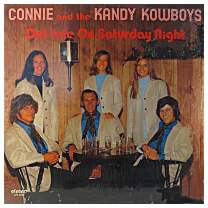 Connie & The Kandy Kowboys "Out Late On Saturday Night" (Borgerding Music/Benson Sounds, 1976-?) (LP)
Produced by Larry Benson & Gary Duggan)
Sort of an oddball one here -- this was an amateur band from Marysville, Kansas -- near Topeka -- that went all the way down to Benson Studios in Oklahoma to record this album. The group was led by Henry W. Borgerding, a middle-aged guy who met some "setbacks" in his "music career" (as his liner notes put it) and at the urging of his wife decided to record an album of his own. All but one of the songs were written by Borgerding, although they were sung by a local teenager, 13-year old Connie Richter, with backing by several other "young people" from Marysville and environs: Patty Moser (piano), Dolores Pilsch (bass), Dick Smalley (drums), and Kevin Vering on rhythm guitar. Smalley added one song of his own, "The Way I Think Of You," while all the others were Mr. Borgerding's vision. Outside of this album, the only mentions I could find of the group were a handful of show notices in local papers, including shows they did in nearby Beatrice, Nebraska and Manhattan, Kansas. These shows spanned 1971-75, though there was no information about the band itself -- if the same musicians also played live shows, or which end of this spectrum the LP was made. Looking at the cover photos, and in particular the guy's hair, I'm gonna guess that Mr. Borgerding played local gigs for a few years under the "Kandy Kowboys" name and after he gave up the band (around 1975?) he decided to make an album to memorialize those efforts... Judging from how the teens appear in the album photos, I'd guess this came out no earlier than 1976, though '77-'78 seems more like it. Anyone who knows more about this disc, feel free to get in touch!
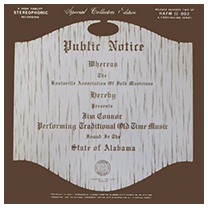 Jim Connor "Alabama Old Time Music" (Huntsville Association Of Folk Musicians, 1974) (LP)
(Produced by Doug Crosswhite)
A back-to-basics old-timey twang album from banjoist Jim Connor, who grew up in Gadasen, Alabama and found national fame as part of the Richard & Jim folk duo, along with guitarist Richard Lockmiller. Connor learned his trade in the late 1950s, worked the folk circuits on the East Coast, then returned home in 1967 and made a name for himself on the local folk scene in Birmingham. This album was underwritten by the Huntsville Association Of Folk Musicians, and showcases Jim Connor playing oldies on a variety of vintage instruments. He also provides pleasantly chatty commentaries on the individual tracks, including some explanation of his apprenticeship with banjo-plunking elder Arthur Kuykendall, of Albertville, Alabama, who he also gave a nod in the title of his solo "debut" the following year.
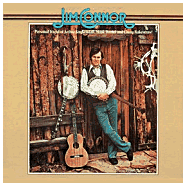 Jim Connor "...Personal Friend Of Arthur Kuykendall, Monk Daniel And Cluny Rakestraw" (RCA, 1975) (LP)
(Produced by Milt Okun & Kris O'Connor)
Love the album title. (The three names refer to an old-timey banjoist who mentored Connor, a fiddler who played on his early albums, and the fictional(?) Cluny Rakestraw, which was apparently a made-up name that guitarist Clarence White used as a faux songwriter credit for traditional material...) Anyway, in the early 1960s, banjoist Jim Connor was part of the Richard & Jim folk duo, which had a major paying gig as performers on ABC's nationally-broadcast "Hootenanny" TV show, where they mixed genuine old-timey music with a smoothed-out version of old country variety shows. A pretty hot banjo player, Connor was a master of the Appalachian "frailing" style whose technique was praised by none other than Earl Scruggs; later in the decade he joined the New Kingston Trio, and in the early '70s he became a sideman in John Denver's band. This was a solo record that Connor made after Denver recorded one of his songs -- "Grandma's Feather Bed" -- on his 1974 gold album, Back Home Again. Denver also appears on this record, singing lead vocals on the first track, "Banjo Song," and sings harmony on some other tracks. It's a far-flung, kooky album, with kind of a similar vibe to John Hartford's '70s records, though maybe not quite as relaxed and funky. There's plenty of hot, fast banjo plunking, though, with backing by hot pickers such as James Burton, Emory Gordy and Connor's longtime friend Steve Young, who plays guitar and gets several shout-outs in the liner notes. Some of this material seems a little forced, but it's still a noteworthy album that's emblematic of the eclectic vibe of the '70s.
Stompin' Tom Connors -- see artist profile
 The Contenders "The Contenders" (Moonlight Records, 1978) (LP)
(Produced by The Contenders & Dave Robert)
An in-between project formed in Nashville by two members of South Carolina's cult-fave, Uncle Walt's Band... Walter Hyatt and Champ Hood worked with Steve Runkle and other musicians in the Music City orbit to record this album, though they reunited with David Ball later that year to re-form Uncle Walt later that same year, so this album wound up being a one-off event.
 Connie Converse "How Sad, How Lonely" (Squirrel Thing Recordings, 2015) (LP)
(Produced by Gene Deitch)
I freely admit that I am a latecomer to the cult of Connie Converse, but I sure am grateful to have gotten my invitation, via The NY Times. And indeed, Ms. Converse is the very stuff of legends. Originally from Laconia, New Hampshire, Elizabeth Eaton Converse (1924-19--?) moved to New York City after dropping out of college, and lived a bohemian life in Hell's Kitchen and the Village, where she hung out with folk musicians and fellow travelers while building up her own catalog of uniquely off-kilter compositions. A few of these songs were miraculously recorded and preserved back in 1954 by fabled animator Gene Deitch (father of underground cartoonist Kim Deitch) who had a radio show at the time, and played her ditties on the air. She made the scene for a while, including a few TV appearances and whatnot, but eventually abandoned New York for the chillier climes of Ann Arbor, Michigan, where she lived and worked until the day in 1974 when she packed all her belongings up into a VW bug, and drove off, never to be seen or heard from again. Period. Her biography is intriguing by itself, but paired up with her music, it's immensely compelling -- for some, to the edge of obsession.
Comparisons abound, but they are all made in hindsight, as Ms. Converse was so unique and so far ahead of her time that there are few contemporaries to contrast her to, at least in the music world. Her quick wit, self-possession and clipped poetic form bring to mind poet and raconteur Dorothy Parker, while her playful musical persona had a bit of Blossom Dearie's scampish tone, but it is as a harbinger that Converse makes her mark on the modern listener. This album, which collects all her known works, is beautifully programmed, opening with several tunes such as "John Brady" and "The Clover Saloon" that press up against the conventions of the folk revival, slyly warping the edges of cowboy humor and folk balladry in a puckish fashion that reminds me of Scottish avant-folkie Alasdair Roberts -- clearly in command of traditional form, but creating something new, off-kilter and perhaps a bit perverse. The set subtly moves into more experimental forms, such as the fantastical "Father Neptune," and then into more internal, contemplative material, songs such as "Honeybee" and "There Is A Vine," which have their own internal logic, wholly independent of traditional folk ballad forms. And then of course, there's her great gem, "We Lived Alone," a compact, clever nugget singing the praises of solitude and self-containment, which contributes greatly to her reputation as a "sad" artist.
These songs are alluring, and they stand alone, remote on an island of the past. In retrospect, and perhaps by the power of suggestion, we can hear similarities to the great, canonized singer-songwriter pioneers who would emerge decades later... Nick Drake and Joni Mitchell hover on distant horizons, as well as deliberately comedic entertainers such as Loudon Wainwright or the Roches. Dylan is perhaps the closest to her immediate path, being more or less the first folk revivalist of the 'Sixties who truly broke the mold, with the rest of the Village troubadours struggling first to mimic his style, and much later to emulate his iconoclastic spirit. Yet Connie Converse was about a decade ahead of Dylan, albeit with a musical vision that seems more suggestive and inferred than realized and complete. All of the tracks on this album are simply her and her guitar, and while at first blush it sounds like standard-issue folkie strumming, in song after song there's an embedded sense of hidden density and musical complexity, borne perhaps of the same sort of inventive bedroom noodling and naifish introversion that propelled generations of solipsists to come. One track in particular stands out in this regard, the sorrowful but seemingly blithe "Playboy Of The Western World," a carefully structured pop-folk number about a friendship/affair spent with a charismatic bon vivant who passes away too soon. As her guitar strumming and vocals seem to diverge in much the same way as the protagonists, one may start to wonder, "is she actually playing in tune?" Finally, though. a light went off in my head, and I realized that what she was doing was playing guitar and singing in a parallel though complementary fashion, hitting a rarified harmonic space amazingly similar to the airy early explorations of Brazilian legend Joao Gilberto. Even here, though, Converse was coursing ahead of history: Gilberto meticulously developed his style throughout the 1940s and '50s, but didn't officially debut the bossa nova sound on wax until 1959, five years after Gene Deitch made these home recordings of Ms. Converse's work. I'm not saying she invented bossa nova, but she certainly dipped her toes in similar waters. Connie Converse was certainly one of the great what-ifs of obscuro pop culture: if she had toughed it out and stayed in New York back in 1961, who knows what might have happened?
Lee Conway - see artist discography
 Cooder Browne "Cooder Browne" (Lone Star Records, 1978) (LP)
(Produced by Paul Hornsby)
I remember this Texas-based Southern-rock/hippie-country band being played all the time on KFAT radio, but the song they loved to spotlight was the awesome, fiddle-driven novelty number "Swinging With The Armadillo," which sadly isn't on this album. (It can be found on the Six Pack sampler for Willie Nelson's short-lived Lone Star label...) Recorded at Capricorn Studios with guest appearances by the Marshall Tucker Band's own Toy Caldwell (on steel guitar) and Jimmy Nalls of Sea Level, this album has more of a rock/funk vibe, evoking Little Feat as well as Charlie Daniels, with slight dips into more rough-edged boogie-rock material. Mostly this is too note-heavy and aggro for me: it being the 'Seventies and all, maybe they were a little coked-up? Anyway, this is one of those archetypically disappointing albums that I sought out years ago because of the whole KFAT thing and wound up not liking anything on it. Decades later, it's still the same: just not my cup of tea. But if you're into bands like, I dunno, The Outlaws or the Charlie Daniels Band, you might like this.
Ry Cooder -- see artist profile
 Bob Cook "North Country" (The Great Western Gramaphone Company, 1971-?) (LP)
(Produced by Grant Bowen)
I'm not sure if this Canadian-issued album is by the same Bob Cook as the Iowan listed below... The repertoire looks about right, a mix of folk and country material, including songs such as "Early Morning Rain," "Everybody's Talkin' At Me," "Me And Bobby McGee," "Green Green Grass Of Home" and "Louisiana Man," but the liner notes say he was from Winnipeg.
 Bob Cook "Tonight: No Live Entertainment, Just Bob Cook" (Devilish Sounds, 1973) (LP)
Midwestern folkie Bob Cook was a local media celebrity in Des Moines, Iowa, who hosted a TV program called Cross Country on TV station KCCI, and performed live gigs while hosting and opening for national artists... Around 1975, he and his wife Carole Cook opened a nightclub in Des Moines called the Waterhole, where they recorded the album below.
 Bob Cook "You've Heard My Voice: Recorded Live At The Waterhole, Des Moines, Iowa" (1979) (LP)
Like his other albums, this 2-LP set is a mix of country and folk, notably including songs such as "Coal Tattoo," "Me And My Uncle" and Guy Clark's "Desperados Waiting For A Train," as well as some originals by Bob Cook.
 Bob Cook "We Love Iowa" (United Federal Savings, 1979) (LP)
(Produced by Eric Holtze & John Bartle)
 Don Cook "I Never Got Through Lovin' You" (Guinness Records, 1977) (LP)
(Produced by Wilbur Snider)
A fairly elusive artist on a fairly elusive label... New York-based Guinness Records certainly had the hallmarks of a "tax scam" label, one that was set up primarily to lose money and thus create opportunities for business write-offs. Lots of odd and unknown artists, minimal liner notes, a general aura of mystery and slapdash production. Nonetheless, they put out a few dozen records, including several by country artists. This one is packed with covers of classics by Waylon Jennings, et.al., bout half the songs are Don Cook originals, so he may be traceable through the publishing info... Alas, other than song titles and composer credits, there are no liner notes to speak of, so no info about where Mr. Cook was from, or about any of the musicians backing him. If I learn more, I'll let you know.
 The Doug Cook Band "Late Nights And Bar Fights" (Rocking Horse Records, 1977) (LP)
(Produced by Greg Deutsch & Moira Pomeroy)
Originally a trio, The Doug Cook Band beefed up with the help of a slew of New York session players, to realize this set of all-original country/country-rock material. Perhaps most notable is veteran 'Sixties folkie Sandy Bull on pedal steel guitar, along with songwriter Doug Cook on guitar and vocals, Greg Deutsch (percussion), Bob Hogan (harmonica), Colin Joseph (bass), Olive Joseph (vocals), Neil Sarfati (saxophone), Charlie Scibetta (drums), Ben Tirado (lead guitar), and Peter Weinstock (keyboards). Worth noting: Doug Cook and Ben Tirado later played on folkie Bob Zorn's 1982 album, Lookin' For A Home, which Cook also helped produce.
John Cook & Margie Cook "Down At The Tavern: 12 Songs Bluegrass Style" (Wizard Custom Series, 19--?) (LP)
The Cooks were a couple from Arkansas who started performing together after getting married in the late 1940s, moving around and performing on various radio stations such as XERF, in Del Rio Texas, and XERB San Diego. They also appeared on the Smiley Burnette and Arthur Smith shows, and cut at least one major-label single for Dot Records, as well as a couple of singles through Starday's custom-label service. Settling down in Memphis, they started their own label (including the Wizard imprint, as well as Blake Records and Marble Hill) and released several albums of their own, as well as recordings of other local and regional artists. I think this was their first album, though I'm not sure what year it came out... It's a very old-timey outing, recalling the rougher edge of the same pre-Nashville era that the Carter Family and Jimmie Rodgers came from... Neither of the Cooks have what you might consider "great" voices, but they do have conviction and authenticity galore... Fans of odd-angled old-time stringband music might get a kick out of this one, though others might find it rough going.
The Cooke Duet/The Singing Cookes - see artist discography
 James Curley Cooke "Gingerman" (First American Records, 1980) (LP)
(Produced by Bruce Buckner & Doug Schauer)
Originally from Wisconsin, James Curley Cooke (1944-2011) started out as a bluesy rocker, most notably as a founding member of the Steve Miller Band back in 1967 (later playing guitar on a few tracks on some albums during Miller's mid-'Seventies creative peak.) Curley Cooke also co-founded a Milwaukee-based white blues/hippie boogie band called A. B. Skhy, which recorded a couple of fairly solid major-label albums in 1969 and '70, then broke up a few years later. Cooke eventually made his way out to Tacoma, Washington and like many of his plaid-clad contemporaries he drifted into country and country-rock territory, as heard on this solo set, which featured contributions from local folks like singer Annie Rose and steel player Chris Middough, as well as keyboardist Ben Sidran, another former Wisconsinite and Steve Miller alum. Though there's a definitely country vibe on this album, Curley Cooke became best known as a blues player, and established a blues-based music program for kids in the Seattle school system. The country stuff sounds great, but there's too little of it -- the blues and southern rock numbers do much less for me. This was his only solo album, though he recorded several collaborative records in years to come.
 Shep Cooke "Shep Cooke" (WWC Records, 1976)
Check it out: another twangy hippie weirdo from Arizona! A veteran of the Southwestern garage rock scene, Shep Cooke moved to LA and joined the Stone Poneys when Linda Ronstadt was emerging as a folk-rock star, and was in her orbit for a couple of years, until "the label" decided to groom her for solo stardom, and fired the band. For a while Cooke bopped back and forth between Tucson and LA, playing with the local band Dusty Chaps, recording an album with the Floating House band (a trio with two other ex-Stone Poneys) and playing on Tom Waits' first album. This was the first of two solo albums recorded in the '70s, it's mostly a spacey freak-folk set but there are glimmers of country twang in there as well, along with the acoustic rock and Tom Rush/Gordon Lightfoot-ish folk. Not as much of a "hippiebilly" album as others included here, but it's worth a footnote due to his lengthy history in the same scene that fostered folks like Chuck Wagon And The Wheels, and also because his next album is a little closer to what I'm talking about. Besides, there's lots of nice guitar picking on here...
 Shep Cooke "Concert Tour Of Mars" (Sierra Records, 1977) (LP)
Although most of this album is dewy-eyed singer-songwriter folkie stuff, the album is bookended by a couple of wacky, Bonzo Dog Band-ish tracks about jamming on the tunes with the little green guys on Mars, tailormade for airplay on Dr. Demento. There are a couple of other oddball songs that have an only-in-the-'70s feel: on "Tomcat Boogie," Cooke sings about singing hippie music in biker bars, and "Backstage Rock'N'Roll Star" is an interesting lament from the vantage point of the many, many talented musicians who can never quite grab the brass ring, but know a famous person or two, nonetheless. The album's cult status is confirmed by its reissue in non-vinyl format, including a Japanese import version, no less! I wouldn't say this is dazzling, but it's cute and has novelty appeal... worth knowing about, for sure.
Shep Cooke "Forever" (Bandolier Records, 1978) (7") (EP)
This four-song EP is an odd, slightly deflating, coda to Shep Cooke's tumultuous career... After all that kooky cosmic cowboy stuff, he got all mellow and made this short set of gentle, Greg Brown-ish/Dan Fogelberg-ian folk-pop...Some really pretty acoustic guitar picking, though the songs themselves are a bit cloying and unmemorable.
 Wess Cooke "...Sings Mother Nature" (GCRS Records, 19--?) (LP)
(Produced by Wess Cooke & John Biehl)
Originally from Midland, Virginia, singer-songwriter Wess Cooke was a longtime member of the Carolina Opry, and later moved to Lancaster, PA to join the American Music Theatre, where he enjoyed a longtime residency. He had a regional hit with the song, "The Wind Keeps Whistling Dixie," though later he turned to spiritual themes, recording a couple of religious albums, such as the Church In The Wildwood CD, which is covers of standards such as "Unclouded Day" and "I'll Fly Away." Backing him on this album are Tommy Lee Brooks (lap steel), Jay Jessup (pedal steel), Jeff Wisor fiddle, along with some flute and saxophone... (ulp!)
 Cooker " 'Bout Time" (Scepter Records, 1974) (LP)
(Produced by Dick Monda & Jon Deviran)
Not entirely a "country" record, but definitely one of those "only in the 'Seventies" albums. Songwriter Norman "Cooker" Des Rosier had a strong background in late '60s hard rock, as a member of the crash-and-burn New York band, The Groupies, who fizzled out and disbanded after blowing their shot at fame when their wild behavior alienated their patrons at Atlantic Records. A few years later, Des Rosier made an attempt at a solo career, and managed to get one song into the lower rungs of the Pop Top 100, "Try (Try To Fall In Love)," which is on this album. Anyway, so much for the history lesson. So what about the album? Well, it's a weird record. Primarily it's weird because Des Rosier is such an improbable lead singer: his voice has a raspy feminine feel, sort of a mix between your chain-smoking great aunt Gertie, and Gabby Hayes from the old cowboy movies. The music is a mix of bluesy folk-rock and weirdo country, but it's hard to focus on the songs themselves because the vocals sound so thin and bizarre. You're continually asking yourself, how the heck did this album get OK'd?? But here it is, an artifact of the experimental, eclectic '70s, a bit less twangy than the other records I've reviewed, but peculiar and rootsy enough to mention.
 Blackie Cool "Back Memories From Webster-Randolph Counties, West Virginia" (Augusta Heritage Records, 1984) (LP)
(Produced by Michael Kline & Sam Rizzetta)
A delightful set of acoustic guitar instrumentals from slick picker Blackie Cool, a grizzled old-timer from Webster Springs, West Virginia whose musical career dated back to the Great Depression, and intersected with a wide variety of local and regional artists, including old-timey icon Clayton McMichen, who once offered him a slot in his band. Eventually Cool drifted away from show business, got married and landed a factory job as a welder at the Bethlehem Steel shipyards in Baltimore, but he continued to play guitar and learned several different musical styles from various pickers over the years. His wide range is shown in this richly pleasurable set, showcasing Blackie Cool's sweet, light touch and fondness for hitting harmonic notes on the fretboard. His style is strongly reminiscent of Elizabeth Cotten's -- very old-timey in feel, but modern in its virtuosity. Anyway, if you like her records, or anything by Doc Watson, you oughta dig this as well. Includes additional backing from co-producers Michael Kline and Sam Rizzetta, as well as one non-instrumental track, "Annalee." It's very nice. Highly recommended.
 Cool Breeze "Shoot The Breeze" (LP)
(Produced by Bubba Henderson, Leonard Henderson & Don Lee)
An amiable family band led by brothers Bubba Henderson and Leonard Henderson, who seem to have traveled to Nashville to cut this album, along with their drummer Bobby Watson and some help from studio musicians such as steel guitarist Mickey Fortune and piano player Roy Pylant, who also contributes one of three original songs on the album. As heard on their cover of Dallas Frazier's "Elvira," they seem to have been shooting for a round-toned, harmony vocals-based sound, modeled on bands like Alabama and the Oak Ridge Boys, and while at this level of the music biz, there was no way they were going to get the kind of big sound they needed to really pull it off, they still sound friendly and sincere, and like they were having fun. No indication where they were from or when this album was made, but they thank their parents, Earl and Effie Henderson, and one of the songs they recorded was written by their dad. Not an earthshaking album, but a nice, no-muss/no-fuss private recording. Probably from the early 1980s.
 Billy Cooper "Country" (Eagle International Records, 19--?) (LP)
(Produced by Billy Savage)
 E. J. Cooper "Country Cool: Just Call Me EJ" (E. J. Productions, 1983) (LP)
(Produced by John Ham & Gene Rice)
Well, shucks, I've heard of ersatz Elvis imitators, of course... But Willie Nelson imitators? That's a thing? Apparently Canadian country singer E. J. Cooper kept having people tell him how he looked and sounded so much like Willie that eventually he gave in and started a new career as a half-Nelson... That wasn't until the early 1990s, though, and this early album was just a regular old record, with Cooper traveling down to Nashville from Ontario to book a session with a bunch of Music City A-listers... Backing him here are Greg Galbraith on lead guitar, Sonny Garrish (steel guitar), Dave Hausinger (piano), Jerry Kroon (drums), Steve Schaffer (bass) and Bruce Watkins (who might be a little bit of an overachiever) playing banjo, fiddle, guitar and mandolin... The set is packed with original material, including songs from producer John Ham, as well as Tim Body, Ernie Rowell, and others... (Though nothing from Willie!) As far as I know, this was the only album by Mr. Cooper, who passed away in 2004 at age 72, although I'd like to imagine he did a whole album of Willie Nelson covers... And who knows? Maybe he did!
Larry Cooper "Sharing Dreams, Lovin' Times And Things" (Ripcord Records, 197--?) (LP)
(Produced by Gene Breeden, Ray Eldred & Ellis Miller)
This Seattle area artist wrote all but two of the songs on this album, accompanied by a version of John D. Loudermilk's "Indian Reservation" and one called "The Morning Of Our Lives," which seems in keeping with his own poetically-titled tunes. In addition to recording at the Ripcord label Vancouver, WA, Cooper seems to have signed with their publishing company, Ripcord Music, which is credited on all his songs.
 Marty Cooper "A Minute Of Your Time" (Barnaby Records, 1972) (LP)
(Produced by Ken Mansfield, Ed Abner & Marty Cooper)
Songwriter Marty Cooper was born in Colorado, but had moved to California and started a recording career while still a pre-teen. As a composer, he scored a few pop hits in the early 'Sixties, including co-writing "Peanut Butter" by the Marathons, and Jack Nitzsche's "Lonely Surfer." Like many rocksters in the early 'Seventies, as the dust was settling after Woodstock and Altamont, Cooper entered an introspective, singer-songwriter mode, and "went country" a little ahead of the pack in LA's pop scene. This album paired Cooper up with fabled producer Ken Mansfield, who was shifting his own attention towards the outlaw scene bubbling up from Texas, and who applied his own twang-itude to Cooper's tunes. The project pulled in arranger Larry Muhoberac and guitar picker James Burton, from Elvis Presley's TCB Band, bluegrasser John McEuen, and some top session players such as Larry Carlton and Al Casey... There's some real twang in the mix, though overall, I gotta say Cooper's vocals (and lyrics) feel a bit strained. Interesting, but mostly from a historical perspective.
Marty Cooper "If You Were A Singer" (Emily Records, 1979) (LP)
(Produced by Al Capps, Larry Muhoberac & Marty Cooper)
Cooper's second album came out just before the decade's end, though for whatever showbiz-politics reasons, it only came out in Europe, and didn't see release in the States until a digital-era reissue (below).
 Marty Cooper "I Wrote A Song: The Complete 1970's Recordings" (Ace/Big Beat Records, 2012)
This generously-programmed reissue CD includes the songs from both of Cooper's solo LPs, along with bonus material.
 Tommy Cooper "Country Dreaming" (Celestial Records, 19--?) (LP)
(Produced by Art Benson)
Born in Springfield, Illinois, lounge/cabaret singer Tommy Cooper "went country" on this album of original material. Most of the songs were written or co-written by jazz/blues producer Art Benson, with others from composers sharing the same publishing company, Grosevoner House, which was connected to the Celestial label. The album wraps up with one cover song, Bobby Goldsboro's "With Pen In Hand," though otherwise this is a fairly legit attempt to generate some action with some brand-new country-styled material. Cooper was clearly a pop-oriented performer, a struggling club singer who split his time between Chicago, Vegas and southern California, where he also got booked on television variety shows hosted by the likes of Steve Allen and Woody Woodbury. In the liner notes, he namedrops every celeb he can think of, from squares such as Jan Garber and Art Linkletter to burlesque performer Babette Bardot, who he toured with; pop arranger Jimmy Haskell was booked for these Hollywood recording sessions. There's no release date anywhere on the album, but given some of the references, it's no earlier than 1968-69; I would have guessed somewhere between '70-72, given how Cooper looks in the photos. (Note: several sites online (circa 2020) have this Tommy Scott mixed up with the more famous Welsh comedian Thomas Frederick Cooper (1921-1984) though this hunky young fella was much younger, with an explicitly distinct biography laid out on the back cover.)
 The Coors Cowboy Band "...Play And Sing Wesern Cowboy Songs" (Srooc Records, 1983) (LP)
(Produced by Jerry Mahler & Richard Markowitz)
A decent though hardly electrifying set of western tunes and sentimental oldies, recorded by the Walunas family, of Parowan, Utah. Presumably they were hired by the folks at Coors beer to play at local picnics, parades and whatnot -- the album gives a corporate address in Amarillo, Texas, so this may have been a Lone Star-centric project. The Walunases certainly had an interesting history: accordionist Art Walunas was originally a polka bandleader from Detroit who was famous for translating "In Heaven There Is No Beer" into English. At some point he pulled up stakes and moved out to Utah, and may have set up shop playing in some kind of dude ranch arrangement. His kids, Ed Walunas and Mary Ann Walunas made a go of things as a country duo called Wrangler & Jean, and recorded an album together in 1980, with backing from Loretta Lynn's road band. They're all on this album, along with Joe Walunas on bass, Benny Garcia on guitar and twin fiddles by Benny Garcia and Frank McWhorter. This album is immaculately produced though a bit sedate, and definitely in the same tradition as the many dude ranch albums of the 1970s and early '80s. Along with standards such as "Nobody's Darlin'," "Red River Valley" and "Tumbling Tumbleweeds" are a couple of originals by Ed Walunas, "It's Cold In North Dakota" and "Song Of Montie Montana," sung in honor of actor and rodeo rider Owen Harlen Mickel (aka Montie Montana) whose son, Montie Junior, led a band called The Wranglers and recorded an album back in the 'Sixties. (Was Ed Walunas possibly in that band as well? I dunno, but if so, he was pretty young...) Anyway, this album is pleasant if unsurprising, one of those humble private press cowboy albums that will grow on you, if you let it... Amazingly it was also reissued in the digital era, with "Ed Montana" listed as the lead artist. Dunno what happened to Mary Ann, though a larger version of this same band, with Ed and Mary Ann, also recorded earlier on western swing leader Hurshul Clothier's 1982 album, Jam Session album.)
 The Copas Brothers "Copas Bros." (CoBro Records, 1982) (LP)
(Produced by Sherman Bernard, Jr.)
Kind of a concept album, I guess... a mix of bluegrass, swamp twang and country-rock from this "family" band out of New Orleans. Apparently first formed around 1974, the group took its name from the non-du-twang of bassist and lead singer Pat "Copas" DeCuir, whose musical siblings included pianist Sherman Bernard, L. J. Dimaio (guitar), Hokie Gjertsen (dobro and steel guitar), Dickie Knickerbocker (fiddle, guitar and mandolin) and Jude Lerette on drums. If nothing else, they definitely deserve a nomination for the most colorful names contained within a single band... and I didn't even include most of their nicknames! The repertoire spans straight bluegrass classics such as "Fox On The Run" and "Uncle Pen" to freeform oldies like Terry Allen's "New Delhi Freight Train," as well as a few Louisiana-centric regional tunes, such as Hank Williams' "Cajun Baby," one called "Going Back To Louisiana" (the flipside of the album's earlier "Going Back To Texas.") and several originals written by various bandmembers. They kinda remind me of the New Riders Of The Purple Sage: a mellow, low-key, longhaired country bar-band with an eclectic, unhurried vibe. Worth a spin!
 Leon Copas "Truck Driving Man And Other Truck Driving Favorites" (Crown Records, 1969) (LP)
Though born and raised in Texas, Leon Jerdon Copass (1932-2017) spent his adult life in Southern California, where he worked on ranches near Santa Barbara while moonlighting in hillbilly musical groups and soon became a proficient guitar picker and bassist. His musical career picked up after he was discharged from the military following a stint in the Korean War, and he became an in-demand player on the booming Los Angeles-area country scene, performing on high-profile radio and TV programs such as KTLA's Cal's Corral and Cliffie Stone's Hometown Jamboree. Like a lot of SoCal musicians, he found work playing anonymously at recording sessions for the Crown Records cheapie/soundalike label, a gig that led to this solo album recorded under his own name. Unlike many Crown albums, this disc offered little int he way of original material, leaning heavily on well-known (and perhaps slightly altered) hit songs with several popular trucker tunes such as "Diesel Smoke," "Giddy Up Go," "Six Days On The Road," and "Truck Driving Man." A couple of tracks may have been originals, although it's not clear if anythings was written by Mr. Copass; one of the more obscure tunes was a version of Casey Anderson's "Thirty More Miles To San Diego," which had just been recorded by Dean Martin. Mr. Copass eventually settled in Oxnard, where he joined Toby Rean and steel player Frankie Hardcastle to form Toby Rean & The Common People, a group that played country bars such as the Stallion Club and The Crow's Nest, and embarked on a 1971 USO tour at the height of the Vietnam War. The Common People also recorded another album for the Crown label, though the band broke up after Mr. Rean passed away in 1976.
 Jimmy Copeland "Back To Basics" (Pa-Paw Records, 19--?) (LP)
Honkytonk singer Jimmy Copeland (1932-2014) was born in Marquez, Texas and after completing his military service worked as a radio deejay and bandleader in the Houston area. In the early 1970s he settled in nearby Conroe, and late opened a couple of nearby car dealerships and became a local celebrity both for a TV show he hosted and for his colorful TV ads, including one where he posed with his grandchildren and told viewers to "come see Pa-Paw," earning the nickname he used for his own record label. This album draws on Mr. Copeland's string of singles which date back to the 1960s, including solo recording such as "I Wouldn't Lift A Finger," "For Sale (Rent Or Lease)" and "That's What Sells The Wine," as well as several duets he cut with fellow country deejay Mary McCoy, a gal from Conroe who'd been working in local radio since the early 1950s. I've only seen the CD version of this collection, not sure if there was an LP that preceded it... Jimmy Copeland also recorded several singles that are not included here.
Leon Copeland "...Sings The Big Hits Of Merle Haggard" (Alshire Records, 1970) (LP)
An excellent tribute album recorded by singer Leon Chase Copeland, a Bakersfield local whose biography remains elusive, but who was quite good, and quite twangy. According to Deke Dickerson, Copeland was a childhood friend of Merle Haggard who had a couple of brief stints as the bass player in The Strangers, and worked in the Southern California budget-label demimonde, recording an unknown number of uncredited songs for Alshire Records before getting his shot as solo artist with his own name on the front cover. He recorded two albums for Alshire, and also recorded a 1968 single with two of Merle Haggard's lesser-known songs, "I'm Out Of My Mind" and "Gotta Go See The World," with Gary Paxton as producer and some groovy guitar work by Clarence White. Haggard doesn't appear to have recorded the songs himself, though it's worth noting that "Gotta Go See The World" was also recorded by another Bakersfielder, Harold Cox, on a single whose flipside, "I'll Never Be A Man," was penned by Leon Copeland. That song, like much of Copeland's original work, was buried in the morass of Alshire's shady business practices, where the identities if composers and performers were routinely hidden in order to maximize the label's ability to recycle the same old stuff under brand new names, or, most often, under no name at all. Copeland had a great voice, though, with an uncanny ability to imitate 1960s-era George Jones, and it's fun to spot him providing vocals on various no-name releases, though impossible to confirm it was actually him doing the singing. Even more unfortunate is the lack of credit on whatever songs he sold to Alshire, especially given his later success as the composer of "Lead Me On," a song he originally wrote for Bonnie Owens that became a chart-topping duet by Loretta Lynn and Conway Twitty in 1971, right after these two LPs came out. For whatever reasons, Leon Copeland seems to have faded from sight in the early '70s. It sure would be nice if someone could track down and document his "lost" work and put together some kind of retrospective, including some of these Merle Haggard covers. He was a rock-solid country singer who never quite got the recognition he deserved.
Leon Copeland And Friends "Today's Country Hits" (Alshire Records, 1970) (LP)
A typical cheapo-label Alshire bait-and-switch set: although there are some soundalike cover songs, this was not quite the collection of "hits" the title implies. No big surprise there. But the fun part is really in the album's slipshod originals, including including four tracks credited to "E. L. Jefe": "Mary Jane," "The Same Train Never Came," "The Right Way To Live," and "This Ol' Lonesome River." (The E. L. Jefe composer persona was used on a few other Alshire releases, and may have been a stand-in for more that one person's work... All four songs were copyrighted together as part of a big batch of music copyrighted by D. L. Miller's Chesdel Music, but individual composer credits were not provided... So these could have been Copeland's own tunes, or given to him by the label.) As was standard for most Alshire releases, there are no musician or producer credits, and no release date as well, although a plug in Billboard helps date this one to June 1970.
Tony Copeland "Nighttime Gamblers" (Playgirl Records, 1981) (LP)
(Produced by Bruce Balk, Chet Bennett, Steve Herbert & Steve Moore)
A mystery disc, so far. I'm not sure where Tony Copeland, and nothing in the liner notes helps much... This was partly recorded at LSI Studios in Nashville, but also in other sessions in Alabama, Florida, and Georgia. There are several overlapping sets of musicians, so there are multiple sets of bass players, guitarists, steel players, etc., with most of them pretty obscure, to me at least. Included in their ranks are steel player Jeff Allen, Bruce Balk (bass), Ken Bell (guitar), Roger Clark (drums), Tony Copeland (guitar), Billy Day (bass), Judd Holley (slide guitar), Karky Karkalitas (keyboards), Lonnie Ledford (bass), and Jerry Wallace on keyboards. A bunch of these folks worked in the Muscle Shoals scene -- notably Ken Bell and Jerry Lee ("Jay") Wallace, who had been in the soft-pop band Bama, and several others, including Bell, Clark, Ledford, Wallace, Storm and Wyrick who did a lot of session work together.
 Copperfields "Copperfields" (Sunstorm Records, 1972-?) (LP)
(Produced by Terry Freund, Jeff Moore & Zane Rudolph)
Groovy, spacey longhair country-rock stuff recorded in Seattle, though released on a label from Vancouver, Canada. I'm not sure if these guys were from the States or British Columbia, and information about this band is surprisingly scarce on the interwebs... so for now I'm gonna file them on both sides of the border. The group centered around the duo of Terry Freund and Jeff Moore, who wrote all the songs and are the lead singers and guitarists. Additional guitars (and overall guidance) come from co-producer Zane Rudolph, along with Jim Bethel (banjo), Jery Roan (drums), Mike Sullivan (bass). Perhaps of interest is that this was recorded at the Havaniceday Recording Company in Seattle, which was best known for producing elevator music, and was at one time a competitor of the better-known Muzak company.
 Cops, Ltd. "Cops LTD Play Old New" (Tell International Records, 1975) (LP)
(Produced by Jerry Merritt & Larry Merritt)
According to the Northwest Music Archives (and the back cover) this was a band made up of members of the local police department in Yakima, Washington, doing a nostalgia-soaked rock-and-pop oldies show, roughly styled along the same lines as the Sha-Na-Na "greaser" revue. The group included Bob Broyles on bass, John Crimin (guitar), Terry Rosenberry (drums), Mike Schreiner (organ and guitar) and Joe Smith (guitar), with all five members singing and conducting traffic stops and giving breathalizer tests. This isn't that country-oriented an album, but it came out on a label run by Yakima's hometown king of rockabilly, Jerry Lee Merritt, and has some slight crossover into twang, such as their cover of Dylan's "Knocking On Heaven's Door." Besides, I'm a sucker for these cop-musician records. Alas, I have no idea what ranks any of these guys held, though the driving force behind the band seems to have been officer Crimin, who worked in several other local bands over the years.
 The Coquettes "Swingin' At Harrahs" (Sims Records, 1963) (LP)
An odd amalgam of musical styles, with some country material, but generally drifting into Kennedy-era pop, with traces of rock, teenpop and polka in the mix. This edition of the Coquettes included Karen Chanda, Ruth Ross, Sandra Smith, Carole Schneider, and Jo Ann Bongiorno, who rebranded herself as Joann Bon, and stepped into a leadership role on later releases. I was drawn to this album because it was on Sims Records, which I see as mostly a country label, though they were clearly aiming at a broader marketplace here, the sort of suburban nuclear family types that watched The Lawrence Welk Show or Ed Sullivan. The overtly country tunes include covers of "Send Me The Pillow You Dream On," "Under Your Spell Again" and -- to a lesser extent -- "Stop The World And Let Me Off," from the Patsy Cline songbook, though these are all recast into more mainstream pop-vocals arrangements, with precious little twang left to be heard. There's also a fair amount of pop-novelty material, goofball novelty stuff like "Quack Quack Jack" and "Gremlin In The Kremlin. It's kind of a cute record, though maybe not that rewarding for twangfans.
 The Corbin/Hanner Band "For The Sake Of The Song" (Alfa Records, 1981) (LP)
 The Corbin/Hanner Band "Son Of America" (Alfa Records, 1981) (LP)
This is one of those albums that really looks like an old, mainstream country-rock gem, but it isn't. The Pennsylvania-based duo of Bob Corbin and David Hanner assembled in the late '70s and cut two albums as the The Corbin/Hanner Band, meeting with minimal success on the Top 40 country charts. Partly that may have been because they didn't really sound all that "country" to begin with -- to my ears more of an overly slick, bland, AOR pop group. (But then again, it was the early '80s, so how could you tell?) At any rate, if you're looking for twang -- and indie twang in particular -- this album probably won't do much for you. It's way too belabored and artificial-sounding, if you ask me. They never quite cracked into the Top Forty, and broke up for a few years, returning as, simply, Corbin/Hanner in the early 1990s. Along the way, they made some ripples in Nashville as songwriters... David Hanner scored a big hit with his masterpiece (and one of my personal favorites) "Lord, I Hope This Day Is Good," a song that Don Williams took to the top of the charts in 1981. I might not be too into this particular album, but that one song is certainly a great legacy!
 John Corbin "Let Me Sing A Song" (BOC Records, 1982) (LP)
(Produced by B. J. Carnahan & Roger Wealand)
An oddball album of Appalachian-inflected dulcimer music by a guy who performed at the Silver Dollar City theme park in Branson, Missouri, which explains his recording on the normally country-oriented BOC label. John Corbin Goldsberry started playing hammered dulcimer at a park booth in the 1970s, and continued his residency for over four decades. He's backed here by a full band, including Steven Carter on mandolin, Jay Goumer (percussion), Don Jones (keyboards), Ron Meier (guitar), and Shawn Pittman on fiddle. In later years his act expanded to include his wife, Janice Marilyn Goldsberry, who he met in the late '80s. They recorded numerous albums together, though I think this may have been his first album. Not to be confused, methinks, with the Arkansas honkytonker below.
 John Corbin & The Sundowners "John's Presents..." (John's Recording Studio, 197-?) (LP)
(Produced by John Corbin)
Real-deal amateur honky-tonk by a buncha middle-aged good ole boys from northeastern Arkansas... These guys had some rough edges and imperfections, but they're earthy and enthusiastic, and sure love the music. Lead singer John Oran Corbin (1937-1998) cheerfully channeled Merle Haggard, with a hint of Roger Miller, and while he wasn't a super-great singer, he also ain't bad: you could tell he really felt what he was singing about. There are a bunch of cover songs, including versions of "Good Hearted Woman" and Amazing Rhythm Aces' "The End Is Not In Sight," although the real gem on here is Corbin's lone original, "I Had Everything Going My Way," which is a truly great barroom ballad that sticks in your mind. Other highlights include "Sweet Mental Revenge" and the goofball novelty song, "Haunted House" (in which Corbin uses the word "haint!") This disc was recorded at John's Recording Studio, in Russelville, Arkansas (which I'm willing to bet was Corbin's own place) and features the following Sundowners: Andrew Frye (piano), Bernie Geels (drums), Gene Haugh (pedal steel), O. D. Lewis (rhythm guitar), Dean Porter (lead guitar), Will Schmitz (bass) and Ivan Smith (fiddle). The liner notes mention a previous LP, though I haven't been able to track that one down yet. Anyway, I like this album -- it's the real thing.
 Jerry Corbitt "Corbitt" (Polydor Records, 1969) (LP)
(Produced by Charlie Daniels)
The first solo album by Jerry Corbitt, co-founder of the folk-rock band The Youngbloods... There's some twang in here for sure, but this is definitely a hippie rock record, with special emphasis on the "hippie" and the "rock" parts... Some lyrics get prophetic and countercultural (more like pro-hippie cheerleading, rather than preachy) and some of it's pretty spacey and oblique, though some songs are fairly focussed. The musical end is uniformly strong, mixing thumping, grungy, plangent blues with Memphis-style R&B and an undercurrent of old-fashioned country... Listening to this, you can really pick out which elements of the Youngbloods sound came from Corbitt, as opposed to his folkier cohort, Jesse Colin Young. Given his own solo set, Corbitt really indulges his inclination towards heavy rock and electric blues, though with some creative production twists that give this an acid-soaked feel on a tune or two. Charlie Daniels, who was Corbitt's closest collaborator for many years, is mostly in the background on this one, though there are parts where you can spot his signature sound, particularly when he plays some funky country riffs of the mandolin. If you're looking for country-rock, there's not a whole lot on here, but if you're generally just into hardcore hippie music, this is a pretty solid record.
 Jerry Corbitt "Jerry Corbitt" (Capitol Records, 1971) (LP)
(Produced by Charlie Daniels)
A funky, rootsy rock album with Georgia-born Jerry Corbitt delving into a heavy Muscle Shoals vibe, with strong influences from CCR, Van Morrison and The Band... The studio crew included fiddler Buddy Spicher who, through the magic of multi-tracking, provides his own little string section on a couple of tunes, Corbitt's Youngbloods brother Jesse Colin Young plays on a couple of songs, and producer Charlie Daniels chimes in on various instruments. The most country-sounding track comes courtesy of Lloyd Green, who adds typically flawless pedal steel on "Till You Come Back Home Again," while "John Deere Tractor" takes sort of a tongue-in-cheek look at rural themes. I suppose the most interesting aspect of this album is the participation of country-rocker Charlie Daniels: he had produced one of the Youngbloods albums in '69 and went on to record several albums with Corbitt. This disc tilts back towards boogie-rock and swampy Southern rock territory, but mostly in a good way -- maybe more for classic rock buffs than country fans, but worth checking out either way.
Dallas Corey "The History Of The American Revolution" (Chart Records, 1973) (LP)
(Produced by Bill Huffman & Cliff Williamson)
A gimmicky songwriter with a penchant for theme albums and topical tunes, Dallas Corey cut a few singles for the Chart label in the early 'Seventies as well as this patriotic/historical album which put him a couple of years ahead of the Bicentennial celebrations that swept America in 1975-76. (Mr. Corey also self-released a vinyl re-pressing in 1976 when the Bicentennial was in full swing and later reissued the album on CD in 2000, marketing it once again through the Sons Of The American Revolution, as well as the DAR...) The songs are mostly devoted to specific military battles ("The Battle Of Bunker Hill," "The Battle Of Brandywine," "The Battle Of Saratoga," et.al.) as well as to specific historical figures, such as military hero Francis Marion, who was the focus of Corey's single, "The Swamp Fox," which came from this album. No information about the musicians playing on this album -- a studio band, apparently -- although Nashville Edition vocal group is credited on the back cover. Dallas Corey was actually the stage name for Adolph Haven Connard III, which seems like an equally improbable -- though apparently real -- monicker, according to both the Library Of Congress and family records in West Virginia. In addition to this all-American album and the pothead epic listed below, Corey also cut some Christmas music and a few topical tunes, like his rather odd 1979 single pairing novelty songs about Jimmy Carter and John Wayne. Perhaps not surprisingly, he seems to have become "born again" at some point and wrote several books devoted to apocalyptic evangelical Christianity, though he may have given up his music career by that time. I couldn't track down Mr. Corey's full biography, but a sibling's obituary noted that he had already passed away some time before 2019.
Dallas Corey "Dealer's Dream" (IMMCO, 1980) (LP)
(Produced by Dallas Corey)
I saw the album title and thought of gamblers and card sharks, but it turns out he was talking about the other kind of dealer, the kind with rolling papers and bong pipes. And thus, an album packed with songs with such subtle titles as "Columbian Gold," "Sinsemilla Sally," and "In Search Of The Ganja." Pictured on the back cover with surprisingly short, early '80s hair and a well-groomed Kenny Rogers beard, Mr. Corey tells us in his rambling liner notes how he and his co-composer Bobby Welch "interviewed" several pot dealers and gathered "research materials" from them while making this album. Yeah, I bet. Anyway, this might not be the most country-sounding album ever, but it sure is 'Seventies! ...er, actually 'Eighties, I guess.
 The Corillions "Double Album" (The Corillions, 1981) (LP)
(Produced by Marlin Wallace)
This legendary oddball album is a favorite of obscuroholic record collectors worldwide, and deservedly so, both because of the musical content and the truly impressive kookiness of the presentation. The Corillions, both band and record label, was the brainchild of "outsider" artist Marlin Wallace, a Springfield, Missouri resident who self-released numerous seven-inch singles and a few highly-sought after LPs, of which Double Album is clearly his magnum opus. The songs range over a dizzying array of topics -- romance, reverence of Nature, politics, war, trucks, animals, monsters, religion and the apocalypse -- and frequently circles back to Mr. Wallace's enduring obsession, the existential threat of Russian communism. What really attracts "fans," though, are the completely insane liner notes, Marlin Wallace's artlessly-presented, incomprehensible, paranoid ramblings, which are so nutty one cannot help but suspect a hoax: the uber-obscure, small-town Midwesterner Wallace starts out by telling us how "the reds" had been stealing his musical ideas for use in their TV shows... Not only that, but the commies are using space satellites, computers and laser beams to tap into his brain and steal his thoughts, including his song ideas, which then somehow wound up on the TV shows he was watching back home. (And of course he equates the East Coast and West Coast entertainment industry with the communist conspiracy...) And that's just the beginning. This album art text has justifiably been called the "Liner Notes of the Gods" though, alas, listeners hoping for an endless succession of songs building on these themes may be disappointed by the predominance of relatively normal tunes such as "Heart Full Of Pain," "Georgia Corn Liquor Man," and "Little Orphan Girl." On the other hand, tracks such as "Mark Of The Beast," "The Russian Bear," "Mekong," "The Planet Mars" and "Abominable Snow Creature" may more than make up for it. And, yes, some of his music could be considered country. I don't know Marlin Wallace's whole story -- was he really a nut, or was he just putting on a show? Or was he right, and was what we call "mental illness" really just a communist plot? You may have to decide for yourself. At any rate, decades before the commercial exploitation of Wesley Willis, there was Marlin Wallace. Make of it what you will.
 Steve Cormier "Black Bart" (A&R Record Manufacturing, 1976) (LP)
(Produced by Jim Strattan)
A longhaired acoustic-folkie set from singer-guitarist Steve Cormier, along with fiddler Greg Allen, who played together in Wichita, Kansas. The repertoire's a mix of older traditional tunes, some country stuff from sources as diverse as Wilf Carter, Ted Daffan, The Delmore Brothers and Steve Fromholtz, as well as a couple of originals by Cormier -- "Black Bart" and "Closing The Bar" -- closing things out with the ever-singable Kansas state song, "Home On The Range." Cormier apparently spent some time as a real-deal cowboy and eventually moved from a generalized coffeehouse folk persona (like his friend Dakota Dave Hull) into a more concentrated focus on western (cowboy) material, eventually settling down in Sandia Park, New Mexico, as a resident cowboy poet. Around the time this album was made, Cormier was apparently involved in the Wichita-based Market Street Forum during its early 'Seventies nonprofit days, and gives the Forum a shout-out on the back cover.
Corn Bred "It's Hot" (Sierra Briar Records, 19--?) (LP)
 The Cornbread "The Cornbread" (Mega Records, 1971) (LP)
Not to be confused with the progressive bluegrass band (above) or the Louisiana hippie jugband (below), The Cornbread was a hippie rock-blues kinda thing, with a slight leavening of rural twang in there for a tune or two. Apparently from Arkansas, the group was formed by lead singer Bobby Don and songwriter R.C. Gamble, backed by electric guitars and plenty of brass: their lineup included Bobby Dan (lead vocals), Tom Dowty (bass and trombone), R. C. Gamble (guitar, organ and saxophone), Jim King (guitar, organ and trombone), and Donnie Tanksleary on bass and drums... Years earlier the band's primary songwriter, R. C. Gamble was in the rock novelty band, B. Bumble & The Stingers, while Tom Dowty was in a short-lived psych band called the Brotherhood, and seems to have been a session player at Ben Jack's studio in Fort Smith, Arkansas, Bejay Studios, where this album was recorded.
 Cornbread "Cornbread" (Sum Of Us Records, 1976) (LP)
(Produced by Randle Chowning & Pat Shikany)
An eclectic, playful set from this latter-day longhaired hippie jugband... It's a little hard to pin down where this group was "from," as the album was recorded at Dungeon Studios, in Springfield, Missouri, and the label gave an address in Norman, Oklahoma... But at least two key members, fiddler David Greely and washboardist Leo Thomas, were from Louisiana, and that seems to have been a primary part of the band's wide regional stomping grounds. The full band included D. Minor Bennett (banjo, dobro and steel guitar) David Greely (fiddle and mandolin), Ray Lilly (bass), Leo Thomas (washboard and drums) and Gary "Red" Weaver on guitar, with Bennett, Thomas and Weaver each contributing to the album's deep wellspring of original material. Produced by Randle Chowning, co-founder of the nationally famous Ozark Mountain Daredevils, this proved to be their only album, though Chowning also worked with Leo Thomas on a couple of solo projects -- their collaborations help explain the connection to Missouri, though, and indeed several members of the band later found work in the Branson-area "mini-opry" demimonde, playing gigs at Silver Dollar City and elsewhere. Perhaps the most notable member of the group was fiddler David Greely, who decamped to Nashville right after this album came out, later moving to Texas for the first half of the 'Eighties, before meeting cajun music star Steve Riley back in Louisiana, with whom he co-founded The Mamou Playboys, one of the most successful modern-day cajun country bands. (And by the way, if anyone tries to tell you where weren't any hippies in the deep South, just take a gander at Leo Thomas's super-shaggy beard and dangling hairdo... There definitely were longhairs there, back in the day!)
The Corn Dodgers "Cotton Eyed Joe" (Rooster Records, 1976-?) (LP)
(Produced by Ahmet Baycu & Hillaire Hennssey)
The Corn Dodgers "Nobody's Business If I Do..." (Rooster Records, 1980) (LP)
(Produced by The Corn Dodgers, Sid Blum, Eric Taylor & William Wright)
More of an old-timey kinda sound by this trio from Vermont -- Ahmet Baycu on banjo, George Ainley on fiddle and William Wright playing guitar. (Note: decades later, Ainley and Baycu were profiled in a 2008 film, Music For The Sky, a documentary about New England old-timey music.)
 Jon Corneal "...And The Orange Blossom Special" (Auburn Orange Records, 1974) (LP)
In his high school years, way back in 1962, Florida-born drummer Jon Corneal formed a frat rock band with future '70s country-pop star Jim Stafford and the later-legendary Gram Parsons, the self-annointed demigod of hippiebilly country-rock. That first band broke up, of course, but they all kept in touch and in 1967, Parsons tapped Corneal to play in his International Submarine Band, a short-lived project that fell apart when Parsons jumped ship to (briefly) join the Byrds. For a while, Corneal ping-ponged between Nashville and LA -- he did session work for country stars and hippie bands, everyone from Loretta Lynn to the Dillards, and in went on the road with the Glaser Brothers for a couple of years before finally moving back to Florida and setting up shop as a regional musician. This was his first solo album, recorded in Florida and featuring original music by Corneal.
Ron Cornelius "Tin Luck" (Polydor Records, 1971) (LP)
(Produced by Ron Cornelius, Robin Cable, Neil Wilburn)
A solo set from West Coast folk-rocker Ron Cornelius (1945-2021), who started out in an influential but ill-fated country-psychedelic band from the SF Bay Area called West, and later worked as a sideman for Bob Dylan and later for Leonard Cohen. (Notably, he co-wrote the song "Chelsea Hotel #2" on Cohen's legendary album, New Skin For The Old Ceremony.) Included on these sessions is one of his West bandmates, Joe Davis, on bass, as well as drummer Paul Distel. At the decade's end he moved to Nashville, where he continues working as both a session player and producer.
Lloyd Correll "...With Lorraine And Her Band" (Mark Customs Records, 197--?) (LP)
(Produced by Ron Cornelius, Robin Cable, Neil Wilburn)
A singer-guitarist from Moorhead, Minnesota, Lloyd Correll worked with a few different bands over the span of several decades... A construction worker by trade, he played mostly in the "off season," starting back in the 1950s, playing mostly at local bars and VFW halls around Fargo, North Dakota, and in later years devoted himself to entertaining in local retirement homes. This appears to have been his only album, and polka bandleader Lorraine Martin seems to have gotten the short end of the stick here -- she backs him, but he gets top billing... But it's a man's world, so what are you gonna do? (Actually, I suspect Ms. Martin may have actually been a pseudonym for Lloyd Correll's sister, Eileen VanDame, a local polka accordionist who passed away in 2012, and who Mr. Correll credits with teaching him to play guitar when he was a teenager.) Anyway, Lorraine Martin's polka band was headquartered around Fargo, ND, just on the other side of the state line , though they recorded this set at a studio in Moorhead. The group included Mr. Correll on vocals and rhythm guitar, Ms. Martin on accordion and piano, along with Dave Bergquist (lead guitar), Les Fairbanks (bass), Harlan Johnson (drums) and steel player Dave Olson. The repertoire showcased a slew of country tunes, mainly honkytonk numbers like Rex Griffin's "Call Me Lonesome From Now On," Wynn Stewart's "It's Such A Pretty World Today," Tony Booth's "The Key's In The Mailbox," "My Shoes Keep Walking Back To You," and "That's What Makes The Jukebox Play," as well as a Hank Williams medley. There's also plenty of dance material, various polkas and waltz instrumentals, including an original called "Lorraine's Polka." Other than this album, I couldn't find any references to Lorraine Martin or the band online, though the liner notes clearly indicate that she had a band of her own; again, I suspect a family connection of some sort.
 Cortland Country "The Cortland Country Music Album" (Cortland Records, 1977) (LP)
(Produced by Michael Ocello)
A charming though slightly clumsy album, with a very DIY feel... This group from Cortland, NY, in the center of New York state was clearly a local, amateur rock group that also kinda wanted to become an amateur, local country band... Nobody in the band played fiddle, or banjo, or steel and their instruments were echoes of the late '60s garage rock scene, notably keyboards used as a lead instrument, but even though they have a Remains/Turtles vibe in the background, they definitely were playing the piano and guitars with intentional twang, and infusing their songs with a wistful country vibe. The vocals aren't great, but they do have real-folks charm, and all in all this is a nice relic of its time. Indeed, this is one of those gangly, self-released records where your first impulse is to be dismissive, but then maybe you wind up humming a song or two in your head after you've listened for a while.
 Troy Cory "The Country Doctor Prescribes City Music" (Cinema Prize Records, 19--?) (LP)
(Produced by William Robinson & Jerry Wallace)
Buyer beware. I mean, yeah, all this "country doctor" stuff sounds promising, but the reality is this is straight-up a bland, mundane pop-vocals album, in sort of a sub-Jack Jones mode -- no twang in sight. Apparently Mr. Cory was born in Colorado, but made his name in Southern California, working with Sonny Bono in the 'Fifties, and briefly hosted his own TV show in the early 'Seventies. Anyway, I suppose it's possible fans of Jim Reeves or late-vintage Ray Price might dig this disc, but it's not a country record. It kept popping up in the country bins at my local Record Hut, so eventually I had to give it a spin. Now we know. I have no idea what kinda doctor Troy Cory was, or where he got his degree... Doctor of love, I'd assume. He made a ton of records, including singles dating back to the late 1950s... This undated album seems to be a late 'Sixties, early 'Seventies kinda thing.
Troy Cory & Priscilla Cory "Easy Love'n" (Cinema Prize Records, 197-?) (LP)
Hi, there! You may remember Troy Cory from such chart-topping albums as... well, umm, uh... Anyway, Mr. Cory released a ton of records. but this is the most legitimately country-sounding one I've found so far. It's an offshoot of his work with his daughter, Priscilla Cory, a former child model who co-hosted the Los Angeles-based Troy Cory Evening Show with her dad between 1974-82. Personally, I find this album cover's iconography of a grown woman in a midi outfit piggyback riding on her father's shoulders a little disturbing, but maybe that's just my problem. At any rate, Mr. Cory's choice of material on this set is fairly spot-on: I wouldn't say he was any great shakes as a pop crooner, but he did have an affinity for the slightly louche sub-genre of middle-aged, sensitive-male countrypolitan hunks who dotted the landscape in the early 'Seventies, and hits from stars such as Charlie Rich ("Behind Closed Doors," "Most Beautiful Girl In The World"), Freddy Hart ("Easy Lovin'," "Togetherness") and Charley Pride ("Kiss An Angel Good Morning") are a much better fit. Not to say these are great recordings -- hardly -- but it sounds much better than him trying to be the next Jack Jones, or whatever. Priscilla Cory also sings lead on a couple of tunes, and is credited as the author of one as well... Alas, no information was included about the backing musicians, although the liner notes cryptically inform us the record was made "in the Deep South," but whether they meant Nashville or San Diego is anybody's guess.
 John Corzine & Peggy Corzine "The Bramble And The Rose" (Blossom Bar Records, 1981) (EP)
I'm pretty sure this folkie pair did not include the 2006-2010 New Jersey governor (John Corzine) although they had an illustrious destiny of their own... The Corzines were both natives of Orange County, California, childhood sweethearts who formed a duo and played countless folk and bluegrass gigs in SoCal, particularly in their late '70s stomping ground in the city of Tustin. They were friends with another California duo, Mary McCaslin and Jim Ringer, and were thanked on their 1978 album, The Bramble And The Rose for introducing McCaslin and Ringer to the title track, which was written by Barbara Keith; John Corzine also played guitar on one of Mary McCaslin's later albums. This four-song EP includes their version of "Bramble And The Rose," as well as a Dusty Owens song, "Once More," and a Corzine original, "White Lines And Road Signs." The Corzines performed together for years billed as John Corzine & Peggy Odom, her given name. Much, much later, in the 2000s, they joined a SoCal bluegrass band called the Blade Runners.
 Cottonwood "Camaraderie" (ABC Records, 1971) (LP)
(Produced by Duane Scott & Greg Venable)
I'm listing this one mostly as a warning -- I've seen it described as a "country-rock" album, but I think that's really kind of a stretch. Yeah, I guess there's some twang in their sound, but it's mostly in the context of plain-old, generic, semi-psychedelic '70s boogie-rock-meets-AOR. Lots of electric guitar, some groovy harmony vocals and echo-y production, but not really much that I'd call country. Also, just in the context of 1970s guitar rock, not a lot here that I'd say you have to go nuts to track down. These California-based pickers were eclectic, but maybe not that listenable... the lineup included Rick Allen, David Farrell, Doug Phillips, Gary Rowles, David Weyer (alas, no info on who played which instruments...) and most of these guys payed in a few other bands, but mostly not groups you'd readily recognize. The big exception, though was California native Gary Rowles, who was an erstwhile member of Arthur Lee's band, Love (playing on 1970's False Start album) and was later in Richard Torrance's backing band, Eureka.
 Cottonwood "Cottonwood" (Magic Records, 1979) (LP)
(Produced by Keith Brown & Cottonwood)
Not to be confused with the hippie-era rockers above, this Midwestern, disco-era trio were aiming for a Poco-meets-Eagles country-rock sound, but along the way they plowed their way through some truly horrible musical ideas. Matters are complicated by the weak vocals of two bandmembers, bassist David Spier and drummer Bob Rolens, although their lead guitar player Larry Rolens cuts loose on a few hard-rock anthems ("Movin' On," etc.) and his voice is fine, as are his bar-band rock instincts. But honestly, a lot of this album is pretty torturous, particularly the more AOR-oriented numbers, with chunky power chords and grandiose pop-schmaltz arrangements that were meant to mimic the pop music on the radio. Oh, well. It's still a good example of the music being made by "real folks" in the '70s, but it's one of the more painful indie-twang albums I've come across. Nonetheless, the band has a pretty interesting story. The trio was from Saint Louis, and in the early '70s had a band called The Nashville Enterprise, which also included "girl" singer Vonna Faye. That band toured regionally, but apparently didn't last too long. Then there was Cottonwood, which later re-formed as the more overtly rock-oriented, late-'80s bar band, Bay Wolfe, which is notable for helping start the career of Top Forty redneck country queen Gretchen Wilson. After this hair-band folded, the Rolens brothers went deeper into the country music mainstream, with Larry Rolens joining the Bellamy Brothers and Bob Rolens helping anchor Wilson's band, after which he became part of the Well Hungarians indie-twang band. Anyway, this early work is an iffy record, at best: the bar-band rock numbers and the twangier tunes are okay, but the pop-oriented numbers are a bummer. But from humble beginnings...
Al Couch & The Nashville Fever "Pickin' On Country" (Kerston Records, 197-?) (LP)
(Produced by Al Couch & Fred Kerston)
According to the liner notes, singer Al Couch was an American military serviceman who was stationed in Germany during the Cold War and led country band called The Rebels, which entertained troops for several years, between 1967-71. Al Couch left Rebels when he was discharged from the military and returned to the States. The country gig must have been pretty good, though, and Couch returned to Germany as a private citizen and formed a new band called The Nashville Fever, which went through a few lineup changes before cutting this album. The set is mostly, if not all, country covers, performed by Couch and a compact band made up of Al Couch (vocals and rhythm guitar), Shelley Barnes (bass), Roger Byington (lead guitar and vocals) and John Foreman on drums. Not sure where in the States Mr. Couch was from, but this is a fine example of a serviceman band working the military circuit, back in the Vietnam War era... Plenty of familiar hits on here, of course, including songs such as "Crystal Chandeliers," "The Key's In The Mailbox," Conway Twitty's "Hello Darling" and Merle Haggard's "Silver Wings."
 Jesse Couch & The Feather Canyon Band "All Of The Reasons" (Country Club, 1982-?) (LP)
(Produced by Louis Owens)
According to his website, singer Jesse Couch was a Kentucky native who hit the West Coast after getting out of the (Vietnam War-era) US Air Force. He started doing gigs in LA, where he stayed for five years, playing the Palomino Club and other venues, at the dawn of the California country-rock scene. He later moved to Michigan, where he set up shop as a club owner, playing gigs around Detroit in the late '70s and launching his own brief recording career. Working with songwriter David Daniel III (possibly a pseudonym?) Couch released several indie singles, including some original material that seems to have been gathered on this LP. The backing band included lead guitar Marty Campbell, John Cook on organ (... and vibes, daddy-O!), keyboard player Dean Goodman, bassist Ron Mullens, and drummer Woody Vioers. Half the songs were credited to David Daniel including the title track, which closes the album. The other songs are covers of hits, old and new: "Statue Of A Fool," "When A Man Loves A Woman," and "You Were Always On My Mind" (which sort of suggests that this was recorded around the time Willie's Stardust album came out...) as well as a Kinky Friedman song, "Highway Cafe," which was also released as a single. Couch later became a "total Christian" evangelical, and has released several CDs with patriotic and religious themes, and hosts a politically-oriented Christian radio talk show.
Jesse Couch "A House Divided" (C & C Records, 1988-?) (LP)
(Produced by Les Ladd)
Sam Coughenour "We Need A Whole Lot More Of Jesus And A Lot Less Rock 'N' Roll" (Jewel Records, 196--?) (LP)
Hard not to be charmed by this clean-cut, earnest young fella, especially since he's dusting off that great old hillbilly anthem, Wayne Raney's novelty classic, "We Need A Whole Lot More Of Jesus (And A Lot Less Rock 'N' Roll)." Nice touch. He later became, I believe, the Rev. Sam Coughenour, co-founder of a church in rural Pennsylvania. This is really more of a Christian folk album, but deserves recognition here for his version of the title track.
Buzz Coulson "...Plays Country Music To Win Your Heart #2" (B & R Music, 19--?) (LP)
A hometown son of Longdale, Oklahoma, fiddler Christopher ("Buzz") Coulson played at a place called the Little Opra House, aka The Longdale Country Op'ra, a venue founded in 1967 with Coulson as a founding member. He also had gigs at The Burns Flat Jamboree (held at a cafe in town) and at the local Kiwanis Club, which sponsored this LP. Coulson had a really nice tone and a bluesy feel that probably comes from Panhandle western swing... This album's repertoire is solid traditional country and western swing, mixing fiddle tunes and classics by Bob Wills, T. Texas Tyler and others. It's mostly instrumentals, although two tracks showcase an older female singer (his mom, I'm guessing?) crooning perfectly imperfect, heartfelt renditions of "Remember Me" and "Blue Kentucky Girl." She's uncredited, alas, as is a mandolin picker who adds some sweet licks in the plangent, old-timey style heard on early recordings by Jim & Jesse and others. Presumably there was a Volume One, though I've never laid eyes on that one -- maybe it came out on cassette?
Dennis Coulson "Dennis Coulson" (Elektra Records, 1973) (LP)
A "solo" set by the ex-keyboard player for the steadily-dissolving McGuinness Flint band... This is essentially the McGuinness Flint crew, though with additional backing from a bevy of English brass players. This includes versions of several Gallagher & Lyle songs; more of a rock thing, really, but a still a worthy footnote to an officially "country-rock" band from the UK.
Bo Coulter "Meet Bo Coulter" (Gold Sound Records, 1982) (LP)
(Produced by Tommy DeVito & Bill Shostak)
A bunch of original material by Boyd "Bo" Coulter, recording on an indie label from Las Vegas, Nevada.
Bo Coulter "Champagne Country" (Caprice Records, 19--?)
 The Coulters "Cool Down" (Dolphin Records, 1983) (LP)
(Produced by Winslow Stillman & Quitman Dennis)
Rarely do you see an album veer off course and go so far downhill so quickly. The sense I get is that these folks were aiming to break into the synth-influenced early 'Eighties pop-country scene, but they just couldn't help hedging their bets and adding a few straight pop-vocals songs in as well... and those songs are dreadful. Things start out strong with "Take A Ride On A Riverboat," which sounds glossy but presents a tantalizing mash-up of Fleetwood Mac-style male/female harmony vocals and a slick but robust contemporary country sound, ala Alabama, or The Oak Ridge Boys. You think, hmmm, okay, maybe... And then things immediately go south with deep dives into excruciatingly bland, strained pop material which seems unlikely to have had much marketplace allure, even given how bad mainstream pop was at the time. It takes a while for the record to recover. The trio of John Coulter, Nancy Coulter and Sandy Coulter were originally from Chicago, Illinois, though they recorded this set in Nashville. They had a good family-harmonies sound, with backing by a mix of Nashville A- and B-list studio players, ranging from Mark Casstevens and Buddy Spicher to percussionist Farrell Morris, drummer Tommy Wells, keyboard player Shane Keister and horn player Quitman Dennis... An earlier edition of this group, performing as The Stillman-Davis Band, cut at least one custom-made college football souvenir album, which was kind of a country subgenre in the late '70s/early '80s, and one presumes this studio group were eager to bust into the more prestigious world of the country Top Forty... and they almost made it! A few later songs on this album revive the Fleetwood Mac vibe, and there's maybe a hint of the Judds (or rather, the future Judds) as well as some male solo vocals on songs that, again, might have had a chance in the Country charts, if only they'd narrowed their focus and recognized their strengths. John Coulter had much greater success in the music business as a photographer and graphic designer, producing album covers for a string of well-known pop and country records through the rest of the decade.
 Country "Country" (Atlantic/Clean Records, 1971) (LP)
(Produced by Michael O'Bryant & Ahmet Ertegun)
This early in the game, it's hard to be sure just how "country" a '70s band named Country might actually be, but after a gooey, electric guitar-stuffed cosmic rock opening number ("Beverly Glen") these SoCal rockers do deliver the goods, with a sweet if somewhat amorphous set of spacey, mellow, country-folk-rock tunes. With plenty of pedal steel and dobro to draw twangfans in, this is largely a spaced-out, folk-ish outing, at least in terms of the lyrics -- a set of songs that never quite cohere into anything memorable, but have a pleasant, slightly narcotic effect. Songwriters Michael Fondiler and Tom Snow seem sincere enough in a zoned-out hippie-dippy kinda way, and the lead vocals (Snow, I think...) remind me of Jerry Jeff Walker, while there's a slightly swampy, Muscle Shoals-ish feel to some of the music. Worth checking out, but maybe a little further into the rock side of things for me. [Historical stuff: Fondiler was in a series of mid-'60s bands with Jay Ferguson, who went on to found the Top 40 rock band Spirit. Tom Snow, whose origin story includes a stint in the International Submarine Band with country-rock avatar Gram Parsons, went on to be a frighteningly successful mainstream '70s-'80s pop songwriter, although chances are the only one of his songs you've heard of -- or remember -- is "Let's Hear It For The Boy," from the movie Footloose. Trust me: this hippie folk-rock stuff was better.]
 Country Aire "Take One" (Kopperhead Productions, 1982-?) (LP)
An early 'Eighties country cover band from Canton, Ohio, featuring Connie Dingler (keyboards and vocals), Rod Dingler (guitar), Bill Hullihen (bass), Ray Lashley (guitar) and Ken Rowland (drums). The repertoire is strictly drawn from their live act, mostly newer stuff by the likes of David Frizzell, Terri Gibbs, Vince Gill, and Charlie McClain, with hits of the day such as "Somebody's Knockin'," "Who's Cheatin' Who" and "You're The Reason God Made Oklahoma." There are a few nods to an earlier era, like their version of Bobby Austin's "Apartment #9" and one by Willie Nelson, albeit his 1980 hit, "On The Road Again." The album is closed out by a version of John Denver's "Back Home Again," dedicated to a friend of the band, Cal Emerick, the organizer and emcee of the North Country Bandstand, a live show held weekly in the Akron suburb of Barberton. Emerick passed away in 1981, and was lauded by many local musicians.
 The Country All Stars "Country All Stars" (GBS Records, 19--?) (LP)
Great record by a lively but low-key band from Pennsylvania... Lead singer Jeff Knight reminds me strongly of country-era Ricky Skaggs, both in his vocal tone and phrasing -- the liner notes say he tried his luck in Nashville but came back to Pennsylvania and was apparently the leader of this band. The rest of the group included a fine steel player, Ronnie Eyler, and championship fiddler Roy Ingram, who used to tour with Tex Ritter; also on board are lead guitarist and piano man Donnie London, and drummer Marlin Madison, who all had varying degrees of showbiz experience. This really is a striking record, not like in a dazzling way, but more of a "hey, these guys were good" kinda way, with a funky, comfortable sound that dips a bit into western swing. There are several good originals on here, including three penned by Jeff Knight -- "The Lady's In Love With Me," "Sandy" and "Things Aren't Funny Anymore" -- as well as a tune called Printer's Alley, credited to Donnie London. Also notable is a cover of the song "Pure Love," composed by John Schweers, the guy who wrote "Day Dreams About Night Things." Not sure when this disc came out; the artist bios mention various dates of earlier gigs, with the most recent being Mr. Madison's stint in Nashville, which started in 1975. It's possible this is actually an early '80s release, but there's no release date given; also the producer/engineer is no identified. Anyway, I found this album pretty appealing.
The Country Allstars "Live At Lido Inn" (GBS Records, 1980) (LP)
(Produced by Ernie Bivens & Vince Chory)
Not to be confused with the Pennsylvania combo above, this group (later known as the Sligo Studio Band) was centered around the trio of drummer Ernie Bivens, bass player Wayne Casper and vocalist Beverly Taylor, a gal who had been recording since the late 1960s, and recorded several LPs with this group. I believe they were from North Carolina, though they seem to have played some long-term gigs in Virginia, including this set at the Lido Inn, located in Norfolk, Virginia. It's a pretty solid set, with plenty of traditionally-oriented twang and some nice harmony singing on thumpy covers of tunes like Rodney Crowell's "Ain't Living Long Like This," "Crazy Arms," "I Ain't Never" and "Blue Kentucky Girl" (one of several tracks with Ms. Taylor singing the lead). It's billed as a concert album, but the crowd noises sound pretty darn pasted-in, and their performances a liiitle too smooth for a live setting.
 A Country Band "Music By A Country Band" (Golden Eagle Records, 1973-?) (LP)
Behold: the most generic country record ever made! I couldn't resist. I mean, yeah sure, it cost me fifty-one cents and I was sure it wasn't going to be very good, but how could I pass this one by? This seems to have been a souvenir album made by the Golden Eagle label, which produced several albums in the 1970s which I believe were part of a tourist attraction related to the old steamboat industry... Anyway, turns out this album is actually pretty good -- two young guys picking and singing banjo and guitar in robust, salty renditions of golden oldies from the Antebellum and pre-bluegrass eras, as well as the cowboy-western and white gospel traditions... There's no information at all about who played on this record or when it came out, just the picture on the front (an anonymous group portrait from the 19th Century) and the song titles on the disc -- other than that, it's literally a blank slate. A little diligent research, though, and one discovers that this was the recording debut of guitarist Orville Johnson, who at the time was working on a tourist paddlewheel steamship, the SS Julia Belle Swain, and was an up-and-coming artist in the St. Louis music scene. I still dunno who was playing with him, but when I find out, I'll let you know. It's a nice record: thanks in advance if anyone has any additional info to add!
 Country Bear Jamboree "Walt Disney World's Country Bear Jamboree" (Disneyland Records, 1972) (LP)
(Conducted George Bruns)
A souvenir album from Walt Disney World, in Florida. Now, okay, I get that this was a decent paying gig for some struggling musicians who needed a day job... But, jeez, can you imagine being stuck in one of those bear suits, playing the banjo all day, or whatever? Or were these bears all animatronic? Inquiring minds want to know. Oh: they were robots, after all? I guess that makes more sense... Anyway, on the musical side of things, there's a distinct West Coast/Bakersfield tilt to the repertoire, with songs by Tommy Collins and Buck Owens, as well as some Homer & Jethro comedy tunes and a few original pieces penned by Country bear Jamboree conductor George Bruns and Tom Adair. The bears themselves are identified as Buff, Henry, Max, Melvin Sammy, Trixie and Wendell, as well as Bunny, Bubbles and Beulah, not to mention Big Al, or the Five Bear Rugs. In reality most of the musical heavy lifting was being done by the folk-pop crossover group The Stonemans, so there's a distinctly bluegrass feel, with plenty of banjo, but also a lot of shifting between styles. Highlights include a great girl-groupish novelty number, "All The Guys Who Turn Me On, Turn Me Down," a revamp of a Stonemans tune originally recorded in the late 'Sixties, credited here to a trio called The Sun Bonnets. The album also features a bunch of humorous country songs, including chestnuts such as "Bile Them Cabbage Down," etc., and a mild parody or two such as "Bearless Love." It's actually kinda funny (and fun) with some cornball Kitty Wells-style vocals (with a weird hint of girl group pop) and novelty numbers like the Stan Freeberg-esque schtick on their "Blood On The Saddle/Davey Crockett" spoof medley. And no, I'm afraid the answer is that there isn't any country record I won't review. But sometimes it's worth it! (Thanks to the Disney blog, Passport To Dreams for shading in some of the backdrop.)
 The Country Bells "Our Very First" (Renee Records, 19--?) (LP)
(Produced by Bud Comte & Ernie Kucera)
A later album by Iowa bandleader and guitarist Don Muzney (1937-2015) who used to be in a '60s band called the Country Boys, that played regularly on the "Star-Lite Jubilee" TV show, as well as various radio and live gigs in and around Des Moines. Around 1969, after a few years touring on the road and trying his luck in Nashville, Muzney returned to Jefferson, Iowa and formed the Country Bells, a family band that included his wife Carol as singer and son Hank on drums. As far as I know, despite the optimistic title this was their only album and the finer details are still pretty elusive... There are several cover songs -- Merle Haggard's "White Line Fever," Charlie Daniels' "Long Haired Country Boy," versions of "Don't Touch Me" and "Fox On The Run" and even Ronnie Reno's "Boogie Grass Band" and "Luxury Liner," whose most popular renditions came in the late '70s, placing this (undated) album probably somewhere around 1979-81. There are a few tracks that might have been originals, but unfortunately there are no songwriter credits, so I'm not totally sure. To be honest, although the musicianship is solid, this album is poorly recorded and the vocals sound a bit unrehearsed, but still there's soulfulness and sincerity galore, and their obvious love of and appreciation for a wide variety of country styles carries the day.
 The Country Bluegrass Revue "The Country Bluegrass Revue" (Now Records, 19--?) (LP)
A very nice album by a couple of older fellas from Davenport, Iowa. Rather than the standard-issue high-lonesome trad-grass you might expect, this disc tilts more towards the more rugged string-band styles of old-school Depression-era country, more Brother Oswald, perhaps, than Bill Monroe. Either way, it's a pretty solid set, with sincere, energetic performances and lots of original material by the duo of Bobby Fischer and Harry Vaughn. An enjoyable, rather striking record, well worth checking out.
 The Country Boys "Little Jimmy Dickens Presents: The Country Boys" (National Sound Corporation, 197--?) (LP)
Not to be confused with the Arkansas ensemble below -- or any of the numerous other Country Boys combos -- this was actually the touring group for 1960's Nashville headliner and longtime Opry member Little Jimmy Dickens, who was still out on the road in the 'Seventies, although his star had fallen a bit by the time this disc came out. This particular lineup included Bob Anderson, Cecil Johnson, Ernie Miller and Bill Pitcock, each of whom gets a number or two in the spotlight. Like many band albums, this leans a little heavy on older stuff, including chestnuts like "There Goes My Everything," "Another Bridge To Burn," "For The Good Times" and "Streets Of Laredo," although there might be some original material on here as well. I'm not 100% sure it's the same guy, but Bill Pitcock seems to have released a solo album and a few singles of his own; the other guys are a little harder to track down.
The Country Boys "The Best Of The Country Boys" (Camaro Records, 19--?) (LP)
(Produced by Style Wooten)
Pretty much a strictly-locals band with guys from Arkadelphia and Malvern, Arkansas, singing a mix of covers and original material. The group consisted of Clyde Bolt (harmonica), Junior Helms (lead guitar), Raymond Ray (lead guitar), Wayne V. "Hap" Roberson (bass, emcee), Jody Stiles (rhythm guitar), and Lincoln Wilson on drums. Apparently they traveled to Memphis to record this album, though they were all Arkansas lads as far as I can tell. The album includes several originals, including a number of instrumentals, as well as songs written by various bandmembers: "I'll Be Obliged To You" by Hap Roberson, "Freight Train And A Model T Ford" by Clyde Bolt, and "Love Letters" by Raymond and Wilson.
 Country Breeze "The Gentle Sound Of Country Breeze" (Nevis Records, 19--?) (LP)
(Produced by Jim McLean)
 Country Breeze "Country Breeze" (Lismor Records, 1977) (LP)
(Produced by David Sinclair & Ian Sinclair)
To be honest, this country-covers band from Dumfries, Scotland falls pretty short of the mark. Formed in 1972, Country Breeze was led by singer Doreen Duncan and her husband, drummer Bob Duncan, backed on this album by Ian Mitchell on rhythm guitar, Alan Sesford playing lead. One can force oneself to find things to appreciate here (I tried) but the truth of it is they were an underwhelming group, even as show bands go, and had a somewhat tenuous feel for American country music. Mrs. Duncan has a stylistically flat affect, at time a bit churchy, but mainly too detached and remote from the lyrics. The guitar work is also not great, sounding at times inept though more often noodly and inattentive, possibly like a rock-oriented picker who simply doesn't have a feel for the concision and economy of good country music, and doesn't know what to do with himself as the songs progress. The band recorded several albums, and I'm not sure where this disc fits into their chronology; the undated Nevis album above may have been an earlier release.
 The Country Briars "Presenting The Versatile Country Briars" (Studio City Records, 19--?) (LP)
(Produced by John Michaelson)
A twangy trio from around Minneapolis, Minnesota, led by "girl" singer and multi-instrumentalist "Buckshot" Bebe Allen, along with her husband, bassist Rick Allen and flattop guitarist Duane Carter. At the time they recorded this album, they were the house band for a country bar called the Flame Cafe, where Bebe's sister Betty often joined her in a duo. About half the songs here are Allen originals or co-compositions, augmented with tunes by Jack Clement, Harlan Howard and the like. Apparently Rick and Bebe "Allen" were the stage names for a husband-wife couple whose real surname was Svenddal -- the Svenddals were successful regional artists, backing Dave Dudley for a while and playing on TV programs such as North Country Shindig, an Opry-esque weekly variety show based in Cloquet, MN which they founded and ran until 1976. Bebe Allen later devoted herself to singing gospel music, and passed away in 2013, followed by Rick Allen in 2014. Their son, Albert Svenddal, became a proficient pedal steel player, performing under the name C. T. Allen.
The Country Briars "Originals" (Delmarti Records, 1970-?) (LP)
The Country Brothers "The Heart Of The Country Brothers" (Music City Records, 1976-?) (LP)
Not a lot of info about these fellas... They seem to have been from Batavia, New York, and liked secular country as well as religious. Side One of this album includes oldies such as "Brain Cloudy Blues," as well as trucker tunes and more recent hits such as "We Could," which was a hit for Charley Pride in 1974. Side Two is all gospel: not sure if any of this material is original, or if it's all covers.
 The Country Bugs "Walk Me In The Sunshine Of Your Love Love Love" (Country Bugs Records, 1973-?) (LP)
(Produced by Gene Breeden)
Not a ton of info on this early '70s band, other than that they were from the Pacific Northwest, and did a weekly show on radio station KABM, in their hometown of Longview, Washington. They also worked with singer Roosevelt Savannah, at least on a few live gigs around 1973. The Country Bugs were a family band made up of four siblings, fourteen-year old Shanna O'Connor, her younger brother Shawn (who seems to have been the group's lead guitarist) and two other boys who went unnamed in the liner notes. Their dad, William O'Connor (1928-2011) seems to have been the driving force behind the group, co-composing a couple of the instrumental numbers with Shawn, and helping to get the album produced. Mr. O'Connor played a variety of instruments in local country and bluegrass bands, though I don't think he was a recording artist himself. . It's worth noting this LP's connection to the Ripcord Records studio: in addition to Gene Breeden producing the album, his right-hand man Ellis Miller is credited as co-composing the title track, "Walk Me In The Sunshine Of Your Love," which was also released as a Portland Records single under Shanna O'Connor's name, along with "You Got What It Takes To Be Sunshine," which is included here as well. Ms. O'Connor later moved to Nashville, where she owned and operated her own beauty salon for many years before retiring in 2018
 The Country Bums "The Country Bums" (Camel Productions, 19--?) (LP)
(Produced by John Pimm)
A bunch of Canadian guys from Vancouver Island, probably sometime in the early 1980s... I'm not sure how much of a "band" this actually was, though I'm not entirely sure you could call it a compilation album, either... The songs seem to involve various configurations of over a dozen musicians, including several different guys who sang lead on various songs; some of the musicians seem to have had bands of their own, but the sessions were done as collectively as "The Country Bums." Anyway, these Bums included producer John Pimm on bass and electric guitar, along with Al Bulmer (lead guitar), Thom Cray Croft (vocals and guitar), Jerry Francis (vocals), Dave Gallant (acoustic guitar), Terry Murray (bass), Bill NuGraeff (dobro, steel, and slide guitar), John Payne (vocals and guitar), Frank Terpestra (vocals and guitar) Blaine Waldbauer (fiddle and piano), Bill Weldon (bass), Graham White (drums), and Wayne Wicks on drums... There's also a gal who's pictured in the group photo, who presumably sang harmony or something, but she's not identified by name. Anyone out there with insight into this albums, I'm all ears.
The Country Busters "Super Hits C&W" (Music Trends Records, 1973) (LP)
A super-duper, ultra-sketchy budget-line album with soundalike "impressions of" various early 'Seventies country hits and artists... including a lot of material that wasn't even that big in the charts, such as Tom T. Hall's "Water Gate Blues." The back cover lists several other LPs of similar caliber and scope by equally fictitious groups such as The Aces High, The Kings High, The Full House, The Country Spurs, The Night Raiders and Leather Thongs. And all of the records even have the same title: "Super Hits C&W." Honestly, the whole thing smacks of a bunch of coked-up con artists in Los Angeles trying to figure out how to launder a bunch of illegal cash, sitting up late one night spitballing the silliest names they could think of for their fake bands... I would hypothesize that none of these albums ever actually came out, but I have seen a Leather Thongs LP out in the wild, so they do exist. Just to complicate things further, the inner label tells us this disc was pressed by Cadet Records, with typeface which looks a lot like the earliest early 'Seventies K-Tel albums. Doubtless someone somewhere knows the full story, but they'll never tell. Never!
 Country Butter "Country Butter" (Faniork/Denim Records, 1978) (LP)
An endearing mix of styles from this obscure trio from Mendocino, California... Band members include Bobbie Brittain (banjo & dobro), Eric Brittain (lead guitar) and Carmon Brittain (bass) who were presumably siblings, Bob being billed as "Buffalo Bob" on the inner sleeve. They played some bluegrass, but also pre-Nashville country oldies by Jimmie Rodgers, acoustic versions of Bob Wills ("New San Antone Rose," sung in the style of Hank Snow) and a slew of original tunes, including instrumentals that dip into Delmore Brothers-ish bluesiness and a hint of "new acoustic" guitar music, and several with Northern California-themed names, such as "Petaluma Express" and "Mendocino Waltz." No trace of the outlaw style of the times, but a nice, amateur effort by some traditionalists from the rural backwoods of the West. Interestingly, old-timer Cliffie Stone contributes brief liner notes, mentioning their performances at festivals -- dunno if they ever played with him, though.
 Country Caravan "On The Move" (Ranger R Records, 19--?) (LP)
(Produced by Forrest Green)
This DIY band from Detroit, Michigan featured three lead singers, Glen Mahnke, Phil Wilson and Rodger Yoder, along with drummer Doug Briggs. The songs are mostly originals (all published by Big Willie Music-BMI) with composer credits for Lee Mahnke, Patsey Shaw, Farrel Tatum, Phil Wilson, Joe Weatherly, and also one song ("Memories") from producer Forrest Green. There are only a few covers: a version of Willie Nelson's "Night Life," and a couple of more obscure tunes from Buck Owens and Nat Stuckey.
The Country Caravan "Proud To Be An American" (Major Recording Studio, 1985) (LP)
(Produced by Buddy Weddle)
A fairly subpar country road show from Frederick, Maryland, a later edition of the band previously known as Jeanie C & The Country Caravan, then led by Buddy Weddle's sister Jeanie Class. He took the band over after she left, and brought in singer Ralph Gann, who recorded an earlier album under his own name, using some of the same musicians who back him here. Okay, so, don't get me wrong. I don't want to sound mean or anything, and I will say that the musicians in the band were pretty solid... It's really the two main vocalists, Ralph Gann and Lana Gladhill, who I find a little difficult. They're both kinda showboaters, and this causes problems... On duets they either try to one-up one another -- which leads to embarrassing excess -- or they harmonize really poorly. On their solo numbers there's a similar lack of restraint, with each of them over-emoting like nobody's business. The height of these horrors is their dueling vocals on a horrendous rendition of "House Of The Rising Sun," which pop-culture mockers on the interwebs will want to check out, and the closing version of Lee Greenwood's "God Bless The USA" is also pretty terrible, but it's a pretty terrible song, so that's not totally their fault. Several tracks seem to be originals , including "Leave My Man Alone (Devil Woman)" which is basically a remake of Dolly Parton's "Jolene," as well as "Our Forbidden Love" and "The Love You Gave To Me." This last one is an old-school country song featuring lead vocals by another guy in the band, producer Buddy Weddle, who sounds maybe a bit older than the other musicians, and is a much more enjoyable singer. Bassist Dave Durkovic sings a tune called "It Never Hurts To Hurt Sometime," which is actually an okay song as well. Mostly, though, this is a record you can safely skip, unless you're into the whole ironic-hipster schadenfreude thing.
 Country Cargo "Get It On The Road With Country Cargo" (Cargo Records, 19--?) (LP)
(Produced by Jerry Rhinehart)
Absolutely no idea who these guys were, but this trio -- Jerry L. Davis, Scott LaBouef and Jerry Rhinehart -- appear to have just been some buddies who made an album together just for the heck of it. They cover a couple of Eagles songs, "Midnight Rider" and "Tequila Sunrise," along with some rock'n'roll oldies like "Boney Maronie," "My Girl" and "Solitary Man," as well as "If I Were A Carpenter," so I'm guessing these guys just liked to sing, maybe while they were working together on a ranch or a logging job or something like that, maybe around 1974-75. And, guys? If you're out there, feel free to get in touch and let me know more about where and when you made this album. I'm all ears!
The Country Cavaleers "Presenting The Country Cavaleers" (JBJ, 1974-?) (LP)
These longhaired Jesus-freak country-rockers hailed from Tampa Florida, though they went to Music City to make it big around 1971, and didn't quite click with the conservative vibe of a pre-outlaw Nashville. The Cavaleers (sic) were ex-rockers Buddy Good and James Marvell, who started out as Nuggets-style mid-'60s garage rockers playing in a variety of little-known bands, including a psych-pop group called Mercy that had a short-lived major-label contract in 1969. But being Southern boys, they also moonlighted in a country band and when the rock gig fell through, they decided to make a go of it as twangsters, combining a shaggy, hippie-esque look with a down-home, moralistic Christian philosophy, spiced up with some pop-rock hooks. They were square pegs in a world of round holes, but a case can be made they were groundbreakers as well, at least as far as their image went... For a couple of years they were in the orbit of the Wilburn Brothers, touring with the old-timers and appearing frequently on their TV show. The Cavaleers made a few waves and got a couple of nibbles from MGM and other labels, but by the time they made this LP, they were deep into the indie/custom label vortex. The duo worked together up until around 1977, with a posthumous live album coming out sometime around 1980. James Marvell, whose real name was Carlos Zayas, went solo for a few years and even recorded some Freddy Fender-esque bilingual twang, but he met with limited success, and later worked as a Christian country artist. (Many thanks to Edd Hurt for his informative article and interview on Perfect Sound Forever, which also includes a discography that includes the Cavaleers numerous singles...)
 The (Country) Cavaleers "Live On Stage: A Special Tribute To Elvis Presley" (Versha Records, 1978-?) (LP)
(Produced by Vic Gabany)
Though billed as an homage to Elvis Presley, this album is actually more of a 'Fifties-era nostalgia fest that includes oldies by Chuck Berry and Hank Williams, as well as several Elvis tunes. Most of the tracks are live, though the record seems to have been padded out with some studio recordings as well. The Cavaleers had pretty much given up by the time this supposedly-live concert album was recorded in 1976 at the Tri-County Club in Morganton, North Carolina, though it seems to have sat in the can for at least a year after it was recorded: the Elvis angle implies that this came out around 1977-78, though Edd Hurt's discography places it around 1980.
 The Country Choir "...Sings Gospel Favorites" (Elliott Records, 197--?) (LP)
(Produced by Charlie Elliott & Roy Ward)
An all-gospel set from a charmingly unpretentious community church group from San Pablo, California, in the heart of the San Francisco Bay Area. The musical backing is pretty minimal: bass, banjo and guitars behind a modest chorus of seven or eight people (though some tracks feature a larger choral group, presumably drawn from the flock of MacArthur Community Baptist church). There don't seem to have been any virtuosi players here, though the larger choral tracks sound pretty sleek. The musicians credited on the back include the husband-wife duo of guitarist Jim and Norma Crank, their nine-year old daughter Kimberly, her aunt, Betty Bickham, a choir leader from Vallejo who was apparently the choir's arranger, and who penned one of the songs, "Praise God," which closes the album out. Also on board are alto Marie Daniels (from San Pablo), banjo plunker and label owner Charlie Elliott, tenor Ruth Maddox (of El Cerrito) and a guy named Joe Reading singing bass. Nothing electrifying, but a very sincere and straightforward group working vaguely in the Carter Family tradition.
 The Country Class Band "Texas Girls Have Country Class" (Country Class, 1981) (LP)
(Produced by Michael Henry Martin)
 The Country Class Band "Good Feelin's" (Country Class Records, 1984) (LP)
(Produced by Michael Henry Martin)
A band from Wichita Falls, Texas with just the band name on the album jacket, but lead singer Joe Brumley's name also listed on the inner label. Guess they couldn't decide how democratic to be about this one, and how much Brumley wanted to be the "star" of the show(?) Anyway, they try really hard to get into the synthy sound of contemporary, early-'80s Top Forty country. It doesn't really work, but it's still a good example of a regional indie band trying to play by Nashville's rules... (Misplaced apostrophe in the album title, by the way. Not my fault.)
 The Country Classics "Outstanding In Their Field" (197--?) (LP)
These beard-y, semi-longhairs from South Dakota were devotees of outlaws like Waylon and redneck libertarians like Charlie Daniels... A rock-solid working class twang band, they thank the folks at the Stauffer Chemical company (where doubtless they worked) as well as fans in Sioux City and Oakdale... They cover lots of attitude-heavy twang classics, like "Long Haired Country Boy" and "Up Against The Wall, Redneck Mother," though oddly enough some of the best tracks are heartsongs, like their cover of Conway Twitty's "I've Never Been This Far Before." To be honest, the Classics weren't really a very skillful band, and their performances are kinda workmanlike and clunky, although they were clearly into it and their repertoire is kind of a hoot. At any rate, if you're not too picky about musicianship and stuff like that, this is one of those old '70s records that's a very honest snapshot of bar bands of the time -- it's the real deal, even if it ain't exactly Waylon & Willie. One minor mark against them for leaving the n-word in their cover of David Allan Coe's "If That Ain't Country," though maybe I'd have to give the point back to them for staying true to the source material.
 Country Coalition "Country Coalition" (ABC-Bluesway, 1970) (LP)
(Produced by Bob Todd, William Schnee & Don Gallese)
A country rock/pop group that included Pennsylvania-born songwriter John Henry Kurtz, who later became known for recording the original version of the pop hit "Drift Away," although here was in more of a twangy mode. The band first came together in 1968 and briefly included bluegrass pioneer Doug Dillard, though when it came time to make a record, Dillard peeled off and returned instead the Dillards during their ground-breaking psychedelic phase. Kurtz was doing his part, though, for the country-rock cause, though the influences were often separated out into separate tracks on this album, which opens with a fuzz-guitar hippie-boogie freakout ("Your One Man Band") and has a few tracks that stand out as more-country than others. Still, there's a cool mixing of styles, with a white soul undercurrent that brings folks like Don Nix and Leon Russell to mind, and a number of standout tracks, such as the impassioned working-man ballad, "Poverty" and a groovy, soulful version of Charlie Rich's "Life's Little Ups And Downs," as well as a number of would-be-hit sunshine-pop songs, with group vocals reminiscent at time of the Mamas & Papas. Among the notable side musicians is Kurtz's pal, Kenny Loggins, who he formed a duo with in the early '70s, and the group's "girl" singer Peggie Moje has a couple of noteworthy moments, including some solo vocals where she sounds a bit Ronstadt-esque (and I mean that in a good way!)
Country Coalition "Time To Get It Together" (ABC-Bluesway Records, 1970) (LP)
(Produced by Bob Todd, William Schnee & Don Gallese)
This would appear to be a straight-up, song-for-song re-release of the self-titled album above. Guess the original title or album art wasn't deemed to be hip and groovy enough for the hippie scene? I dunno. Anyway, people say that the band cut three albums, although I don't know if they're including this disc in that headcount... They also contributed to various one-off projects -- soundtracks for movies and TV -- before the original lineup fizzled out. John Henry Kurtz left the group not long after this album came out and in 1973 released a solo album, Reunion, also for the ABC label. The other three members, Dick Bradley, Peggie Moje and Tom Riney, recorded at least one other album in the '70s, although I don't know if they actually kept together as a formal band the whole time. After doing some session work as a violinist, Moje moved to Portland, Oregon and switched gears artistically, dedicating herself to painting, with some occasional music gigs, including backing cowboy folkie Rich Mahan.
 Country Coalition "Potato Pickers" (White Cloud Records, 1976) (LP)
(Produced by Richard Bradley & Tom Riney)
 Country Coalition "Country Coalition" (Sagegrass Records, 197--?) (LP)
A nice unassuming country-covers set by a just-plain-folks ensemble out of Florence, Kentucky, one of several groups to use this band name Led by multi-instrumentalist John Stone and his wife Irene Pierce Stone, this particular Country Coalition was a completely unpretentious local group mainly singing classics, in particular "girl" songs originally sung by the likes of Patsy Cline, Wanda Jackson and Dolly Parton, tunes like "I Fall To Pieces," "Silver Threads And Golden Needles," "It Doesn't Matter Anymore" and "Apple Jack." They also dip lightly into more contemporary, outlaw-ish stuff such as "Luckenbach, Texas," David Allan Coe's "Jack Daniels If You Please" and Susanna Clark's "I'll Be Your San Antone Rose," which had been showcased on an early Emmylou Harris album. Though there are a few male vocals, Mrs. Stone was the band's star performer, and while she didn't project a lot of vocal power, she had a decent voice, with strong undertones of that little willowy rasp that Dolly had in her early years. The band sounded okay, and may have had more chops than can be heard on this thinly-produced set... The lineup included Irene Stone on lead vocals, her husband John on lead vocals, banjo, fiddle and lead guitar, with backing from drummer Ken Brewer, Jim Gillum (bass), Dennis Hensley (guitar), Rich Morris (pedal steel) and Jim Thacker on rhythm guitar. As is often the case with small local bands, the steel player is a standout, and one wonders if Rich Morris's sleek, complex riffs were ever featured on other indie albums... Indeed, as the album closed with a version of (eye roll) "Foggy Mountain Breakdown," I was caught off guard by his steel work creeping in and taking over: they actually managed to make a distinctive version of a highly-overplayed old chestnut. This wasn't a great record or a jaw-dropping band, but they were nice and heartfelt, and I enjoyed hearing them play. Recommended.
 Country Colman "In The Arctics" (Arctic Circle Records, 19--?) (LP)
Colman Loftis was an Alaskan country singer, originally from Missouri but a resident of Kotzebue, Alaska when this was recorded... The material was all originals, with Loftis joined by Speedy Price on steel guitar, along with Nick Burris (bass), Doug Harner (drums), Tex Housden (rhythm guitar) and Frank Hutchison (lead guitar).
Not sure when this came out, either in the 1960s or '70s...
 Country Comfort "Meanwhile Back At The Farm" (Upwright Records, 1976-?) (LP)
(Produced by James M. Devine)
Great stuff. To my way of thinking, this is exactly what you'd want a private-press country record to sound like: a plunky, amateurish, heartfelt, sincere and twangy. This country covers trio from Seattle, Washington, featured brothers Larry Wright (on guitar and banjo), Rick Wright (drums, piano, guitar and pedal steel) and Larry's wife Trudy, on bass. I'm not sure if they multi-tracked these sessions so they could play all the instruments, or whether they had some studio musicians to fill things out, but the song selection is great -- a ton of singalong songs such as "Day Dreams About Night Things," "Rainy Day Woman," "Somebody Done Somebody Wrong Song," "Honky Tonk Man," and of course yet another version of "Me And Bobby McGee" (in case anyone's keeping track...) The liner notes inform us that the Wright brothers had been performing together for years -- since 1957 -- before cutting this album. They worked in their family band as kids on local SeaTac TV and radio venues, namely KTNT's "Bar-K Jamboree" and KOMO's "Evergreen Jubilee" -- and the Wrights thank "Jubilee" host Jack Roberts as one of their patrons. Not sure if they made any other records, though this one was pretty groovy.
 Country Confusion "Country Side Of Heaven" (Westwood Recordings, 1975) (LP)
(Produced by Gordon Davies' & David Whiteley)
An odd name for a band, to be sure, but an intriguing album, nonetheless. Formed in 1974, this twangband from Edinburgh backed an American gal named Suzanna Harris on a UK tour, and went on to make appearances on several BBC radio programmes. The group included Bobby Boyle (bass), Doug Rothnay (rhythm guitar), Dave Smith (lead guitar and steel), and George Wilkie on drums. Their repertoire included a couple written by Dave Smith, an ex-rocker gone country, "Girl In A Million" and "Only You, Only Me." Dunno how long these guys were together, or if they recorded any other albums.
 Country Cookin' "Front Burner" (Country Cookin', 1980) (LP)
(Produced by Country Cookin' & Charlie Strickland)
Not to be confused with the Tony Trischka/Kenny Kosek bluegrass band of the early '70s, these dudes from Florida look like some real good old boys... The group was led by singer Leonard Blackwelder, who had previously recorded a single around 1974-75 with his old band, the Break Timers. On this album, he was joined by Harold Floyd on rhythm guitar (and lead vocals on three songs, including his own "This Time She's Gone"), Skip Ellis on steel guitar, Ron Moody playing bass, Bob (any relation to Lyle?) Lovett on drums, and Tom Murphy playing piano. The album includes several original songs; Blackwelder wrote "I Need Someone To Talk To Tonight" and "Why Did I Have To Be The One" as well as one by Tom Murphy, "Time Is My Best Friend." They also play a bunch of cover songs, including David Allan Coe's "Jack Daniels If You Please," "Tulsa Time," "Rockin' My Life Away," as well as some tunes by Merle Haggard and Larry Gatlin... Blackwelder, who was born in Florida, apparently moved to Athens, Tennessee later in life, but I don't think he pursued much musically after this.
The Country Corporation "The Country Corporation" (Karma Records, 19--?) (LP)
(Produced by Billy Teague?)
Straddling the line between country and bar-band rock, this band from San Angelo, Texas was led by songwriter Billy Teague, although various members took turns singing lead, including Dian Allan, Mike Allan, Frank Markwood and Billy Teague. (There's a fifth bandmember pictured on the cover, but no credits to identify them.) Although some songs have a rock vibe, there are also familiar themes for country fans, on tunes such as "Cheatin' Turns Her On," "Funky Little Fiddle" and "You Don't Have To Go Overseas To Marry A Broad." There's no date on the disc, though it looks late '70s, possibly early-to-mid '80s. I'm not sure if any of these folks worked in other bands; this seems to be their only album.
The Country Cougars "The Country Cougars" (Paragon Records, 19--?) (LP)
The Country Cousins "Nashville's Golden Hits" (Premier Records, 196--?) (LP)
A super-generic double-LP set of late 'Sixties country covers recorded by... um... someone, I guess. One of those anonymous budget line offerings, with no indication of who these "country cousins" were or where they came from, none of that stuff. It's quite possible these tracks were issued elsewhere, possibly under different band name(s) or even on multiple albums. I have no idea... and it's all part of the fun!
The Country Cousins "Big Country Hits" (Windmill Records, 1972-?) (LP)
Once again, no idea. The Windmill label was a budget-line operation based in the UK, but who knows where these tracks first appeared, or who the artists actually were. It's all shrouded in the mystery of time and corporate shell games. This early 'Seventies LP is probably a reissue of some earlier record or records, though, since the songs are mostly covers of late 'Sixties country hits, stuff like "By The Time I Get To Phoenix," "Gentle On My Mind," "Little Green Apples" and "Ode To Billie Joe." Your guess is as good as mine.
_0000_best-of-bluegrass_208.gif) The Country Cousins "The Best Of The Country Cousins Bluegrass" (A & R Record Manufacturing Corporation, 197-?) (LP)
The Country Cousins "The Best Of The Country Cousins Bluegrass" (A & R Record Manufacturing Corporation, 197-?) (LP)
A truegrass band from North Carolina with a whole passle of Lunsfords... The lineup featured Bernard Fogleman on guitar, Earl Link (fiddle), Charlie Lunsford (guitar), Lynwood Lunsford (banjo), Sherwood Lunsford (mandolin) and Jimmy Walker on bass. Not sure if any of these folks were directly related to folk legend Bascom Lamar Lunsford -- they lived over a hundred miles east of his home near Ashville -- but it seems likely there was at least some kind of connection. The album's repertoire is pretty swell, packed with singalong classics such as "Don't Give Your Heart To A Rambler," "I Wish You Knew," and "If That's The Way You Feel."
The Country Cousins "More Bluegrass From The Country Cousins" (A & R Record Manufacturing Corporation, 1983-?) (LP)
_first-time_208.jpg) Country Cousins "First Time Around" (A & R Record Manufacturing Corporation, 197-?) (LP)
Country Cousins "First Time Around" (A & R Record Manufacturing Corporation, 197-?) (LP)
(Produced by Richard Halverson)
An uber-indie release by some young musicians from Sturgis, South Dakota, who went to Dallas to cut this album. The band includes brothers Lars and Lynn Aga, on lead guitar and lead vocals, along with drummer Sam Hilmer, and his sister Denise, who also sings lead. All but one of the band members were teenagers when this album was produced. Honestly? It's not a great record, although it is quite enjoyable. This is the very definition of a vanity album made by amateur musicians just for fun: they sound unrehearsed and like they just learned to play their instruments, but they also sound like they were having fun, and that they enjoyed playing together. The production values are minimal, basically a flat mix around an unfiltered microphone, and several tracks don't even include all their instruments. And I gotta say, of all the bazillion versions of "Proud Mary" recorded on private albums during the 1970s, I think this one -- mostly just ragged group vocals around a single acoustic guitar -- is my all-time favorite. Plus, they cover Waylon Jennings's "Amanda" and Johnny Russell's "Rednecks, White Sox & Blue Ribbon Beer" -- nothing to complain about there. I also love the liner notes, where they say they don't know what they're gonna do after they graduate high school, but they kind of wish they could just stay at home, working on the ranch. Now, that's country!
 The Country Crusaders "Crusader Ride" (Blue Ash Records, 19--?) (LP)
A mix of rock oldies like "Roll Over Beethoven" and country classics such as "Crazy" and "Room Full Of Roses." Not sure when this was recorded, or where the band was from, though it was definitely sometime in the mid-1970s, judging by how scruffy the younger members of the band look.
 Country Current "Goin' Country With The Current" (1974) (LP)
One of the more unusual bluegrass bands of the '70s, to be sure! Country Current was a twang band made up of active members of the United States Navy, playing traditional and progressive bluegrass. They played numerous concerts and recorded several albums that were used as promotional recruitment tools... Sort of like the Marines marching band, but with banjo and fiddle. And one of their secret weapons? A nuclear-powered Bill Emerson, co-founder of The Country Gentlemen, on banjo... He joined the band in 1973, and stayed with them for two decades! Who knew??
 Country Current "We Pick The Navy" (1979-?) (LP)
(Produced by Jerry Gilmore & Bill Emerson)
A pretty cool set, all things considered, and way less bluegrassy than you might think... Bill Emerson picks some sweet banjo but he keeps a relatively low profile, blending in with the rest of the band, with a few big solos on a tune or two. On the opening tracks of Side One the band pays explicit homage to the armed forces, starting with the jovial, anthemic title track, "We Pick The Navy," written by lead singer Jerry Gilmore, followed by "I'm A New Man," a Red Lane song about getting into bar fights and other trouble after signing up... The rest of the record pursues a more "secular" approach, with country novelty songs, including two Charlie Daniels songs, a version of Buzz Cason's "Emmylou," a pretty good rendition of "The Gambler," and even a Billy Joel song(!) The musicianship is uniformly solid, although if the truth be told, the vocals are kind of weak... sincere, and fully committed to the material, but Gilmore is a bit wobbly as a frontman. Overall, this one's worth tracking down and giving a spin -- they were definitely smack dab in the swing of things as far as the outlaw and redneck rock scenes go, and the set list is consistently engaging.
 The Country Cut-Ups "Corn Shuckin' Time" (Cumberland Records, 1965) (LP)
What looks like an ultra-generic cheapo album by an anonymous non-band was actually a cheapo album by a later incarnation of a California-based country group that featured West Coast steel player Bobby Black, his brother Larry Dean Black on lead guitar, Hoyet Henry playing bass and Mel Larson on keyboards. The Black brothers had already been in a variety of bands, playin doo-wop, surf and pop, as well as cutting some earlier country singles with Henry's help. Bobby Black went onto be an in-demand session player and a key figure in the West Coast country-rock scene, playing with Asleep At The Wheel, The Commander Cody Band, New Riders Of The Purple Sage, and others... Hoyet Henry also became a session musician, known for his guitar picking, while Mel Larson appears to be the same guy who wrote a bunch of tunes for Motown in the 'Seventies. Quite a talent pool for some dumb quickie country album!!
 The Country Daze "Heavy Country" (Studio Seven Custom Recordings, 1970-?) (LP)
A super-ultra mystery disc, possibly from Dallas, Texas. A very garage-y set of mostly country laid down with bare-bones simplicity by the trio of Jim Marsden(?) on bass, lead guitar Jim Massey and drummer Rix Yates. There seems to be one copy of this album floating around in the collect-o-sphere, with the same tears and smears on the cover, posted on Discogs, eBay and YouTube at a price that precludes my ever handling it. The YouTube clips are pretty groovy, though, particularly their version of the Beatles oddity, "The Ballad Of John And Yoko" Along with all the other gaps in information, there's no release date on the LP, but 1970, possibly '71 seems just about right. Anyone know more about these guys?
The Country Docs "Live At Crow's Mill School" (1981) (LP)
This bluegrass-y band included Illinois State Champion fiddler Ellis Schweid...
 The Country Drifters "Country The West Coast Way" (Trio Club Records, 1982) (LP)
(Produced by Jerry Abbott & Joe Bielinski)
Drummer Joe Bielinski sold this record from his home address in Mingus, Texas (and presumably a few live shows) It's a tribute to the robust West Coast country sound associated with Buck Owens and his compatriots. The Drifters were together for at least four decades, though as far as I know this was their only LP. This edition of the band includes famed steel guitarist Ralph Mooney, who helped shape the hits of Bakersfield Sound stars such as Wynn Stewart, Buck Owens and Merle Haggard. The rest of the band were Fort Worth-area musicians, including fiddler Merle David, piano player Mike McClain, bassist Bill Gilley and guitar picker Tommy Spurlock, with vocals by Bob Pritchard, Randall Branscum and Royce Turney. Nice, down-to-earth twang and pickin' from some Lone Star locals.
 The Country Earth "Volume One" (Old Hickory Records, 197--?) (LP)
(Produced by Garey A. Wheatley)
An all-original set from this progressive 'grass band out of Dayton, Ohio... No date on the disc, but it's probably from around 1975 or so... This disc and their second record from '76 seem to be the band's only albums.
 The Country Earth "Strictly Progressive" (Sagegrass Records, 1976) (LP)
(Produced by Dennis Hemsly)
While their first album showcased a wealth of original material, here the Earthers dig into the progressive tradition of grassing-up pop, rock and country hits, with propulsive renditions of classics such as "Feelings," "Good Hearted Woman," "Sweet Caroline" and "Take It To The Limit." Personally, I was most jazzed by their cover of "Third Rate Romance" by the Amazing Rhythm Aces. Great song. The lineup on this second album included drummer Paul Burton, Ray Bushbaum (piano), Ted Hartman (bass), Frank Myers (lead guitar), and Melvin Myers on rhythm guitar. As far as I know this was the group's last record.
 The Country Express "Live At The Sli-Lou Club" (M&L Records, 197--?) (LP)
(Produced by Byran J. Johnson)
A pleasantly rough-sounding live record by a seedy-looking band whose lead singer/emcee Gary McKean had a pretty abrasive approach which included a few odd, inappropriate comments that might raise an eyebrow or two. These fellas from Picayune, Mississippi were definitely good ole boys, though a few were show-biz vets who'd played regionally in New Orleans and environs. The set was recorded at the Sli-Lou Club, a mid-sized country dive in Slidell, Louisiana that was opened in 1974 by Donna and Jack Catlett, but doesn't seem to have been open very long (there's no trace of it online, as far as I can tell...) The label address, however, was in nearby Picayune, Mississippi, just a few miles across the border, where most if not all the bandmembers resided. The band included Sid Brady on steel guitar, brothers David McKean (lead guitar) and Gary McKean (bass), Jerry Slade (lead guitar) and Bill Suckow (drums), and Wayne Varnado on bass. Steel player Sid Brady was an old-timer who had been in rockabilly star Joe Clay's band, while Wayne Varnado appears to be related to hillbilly-era musicians Charles Varnado and "Smilin' Eddie" Varnado, who fronted a band in the 1940s called the Red Wagon Boys, and later started a mini-opry called the Pearl River County Hay Ride. located in Picayune. Sid Brady also released a single or two under his own name back in the early 'Sixties, though I'm not sure if any of these other guys -- or this band -- made any other records. Anyway, this is a nice snapshot of a real-deal, hyperlocal country bar-band with a very redneck feel... Definitely worth a spin!
 The Country Express "In The Name Of Freedom: Original Soundtrack Album" (Genesee Records, 1984) (LP)
(Produced by Junior A. Cole, Albeo Levesque & Alex Bankers)
This purports to be a soundtrack album, although info on the film itself is scant... Anyway, the band called Country Express chugs through a set of all-original material, including seven songs by producer Junior Cole, along with three by bandmember Danny Pack. The other guys in the group were Eddie Dee Deroshia, Scott Hamilton, and Gregory Rokicak. The group appears to have been from Michigan, though there's not much (any?) info about them online...
Country Fever "Beer Drinking Music" (RCA Records, 1975) (LP)
Yet another Country Fever! This Australian twangband showcased singer Petra Keating, along with Ashley Keating on bass, Mark Moffatt (dobro, guitar and pedal steel), Barry Mulholland (drums) and Terry Widdowson (piano). Dunno much about these folks... This was recorded in Brisbane and seems to have been their only album, although Petra Keating worked with a few other artists.
 Country Flyers "...Featuring Shorty Sacks" (Virtue Records, 1977-?) (LP)
(Produced by Frank Virtue & Maryann Virtue)
"You can sing along with all these great tunes that everybody knows," proclaim the all-too-brief liner notes on the back cover... And indeed, this is a mostly-instrumental set of classic country cover songs, showcasing steel player Shorty Sacks playing both dobro and steel guitar, backed by a full (though anonymous) band and "vocal background" singers who are also not identified. Not a lot of info online about Mr. Sacks, outside of this lone album, which seems to be the only record he released in his career. No indication of his first name, or where he was originally from, although the liners also tell us that Sacks played with Philadelphia-based TV personality Sally Starr -- that. and Virtue Records also being from Philly suggests that his main stomping grounds were inside the Pennsylvania country scene. He also mentions working with the likes of Stonewall Jackson and Gene Autry, though those may have been just one-off performances, with Mr. Sacks working in some house band that backed touring stars -- I haven't been able to spot him in either artist's discographies, though you never know. [Note: several sources list this as a Shorty Sacks album, but he was clearly pitching Country Flyers as the band, and I think it's more accurate to list this under "Country Flyers." I'm sure the debate will continue to rage for decades to come.]
 Country Folk "Down To Earth" (Mugtime Records, 1976) (LP)
(Produced by Turley Richards)
This album was a collaboration between Louisville, Kentucky songwriters Bill Clark (who also played fiddle and guitar) and John Gage (dobro and guitar) with over half the songs being original material. They cover Woody Guthrie, the Beatles, the Byrds and do a version of Ray Wylie Hubbard's "Up Against The Wall, Redneck Mother," though twangaholics might be even more drawn to the band's own songs, such as "Tennessee Mountain Hideout" and "Small Town Waitress." Gage went on to record several cassettes -- and later CDs -- in the 1980s, '90s and '00s, as well as doing community theater with the Kentucky Theater Project... I think this was his first album.
 Country Funk "Country Funk" (Polydor Records, 1970) (LP)
This Massachusetts rock band had a "country" feel in the same way as the Byrds, Youngbloods or Moby Grape -- hippiefied twang was part of their overall musical mix, one stylistic thread in a tapestry of harmony-laden psychedelic boogie rock. They probably sound most like Buffalo Springfield, although they occasionally bop along over into some pretty perky sunshine-pop. A pretty tight band, though, and the twang vibe is definitely there... If you're a fan of this type of experimental, eclectic hippie rock, you'll probably want to check these guys out... They are one of the great "lost" twangbands of the era.
 Country Gamblers "Country Gamblers" (Recorded Publications Company, 1974-?) (LP)
A mystery band from upstate New York... They only gave their first names -- Ben (bass), Bill (banjo), George (drums), Jim (steel guitar), and Tony (guitar) -- and no indication of what town they were from. The songs are all covers, a nice mix of well-chosen oldies ("Cannonball Yodel," "Slowly I'm Fallin'," "She Taught Me To Yodel") and newer hits, including a few from 1973 (like "Lovin' On Borrowed Time" and Conway Twitty's "You've Never Been This Far Before") which help date this disc to perhaps 1973 or '74... They thank a local couple, Bob and Sally Knorr, who ran a place called the Hideaway Lodge, though the name of the town they give doesn't seem to be on the map; perhaps it was a typo from the New Jersey-based custom house that pressed the album?
 The Country Gospel Singers "Country Gospel Singers" (Mel-Tone Records, 19--?) (LP)
One of many groups to use this name, this family band from Murphysboro, Illinois is identified by their pastor 's liner notes simply as "Floyd, Vickie, and their children." Their last name seems to have been Mayberry, though, as the credits include Floyd Mayberry on rhythm guitar, Bobby Mayberry (bass), David Mayberry (lead guitar) and a Mr. Charles Mason adding some pretty nice licks on steel guitar. (Meanwhile, the full ensemble, pictured on the front, includes eight people total... Hmmm.) The album really is a glorious mess, with family members singing in various modes, barely meshing together despite some pretty good picking from the band, including some fine Chet Atkins-style chicken-pickin'. Lead singer Floyd Mayberry was super old-school: a croaking, gravel-voiced hillbilly singer in the 1920s style; his wife, Vickie, had a nice high voice with a slight hint of Kitty Wells, but she can't always figure out how to squeeze herself in to harmonize with her more primal hubby, and the kids -- well, they just sound like kids, singing in the background. The whole ensemble could sound reasonably okay, particularly on the uptempo tunes, though the record's one true disaster is a solo vocal by their unnamed daughter, who really sang flat, and also stands out in the family chorus. Still, I find it charming, especially since they're so devoted to older, classic country styles. Not 100% sure, but I think Floyd Mayberry might be the same guy who owns Mayberry Music, a retail store in Jonesboro, which is just about fifteen miles north of Murphysboro, in the far southern end of the state.
 Country Grass "Country Grass" (Opus Records, 1978) (LP)
(Produced by Tony Pettinato)
They mighta been 'grassy, but these guys from Columbus, Ohio covered a lot of country stuff, including outlaw classics by Waylon Jennings and Jerry Jeff Walker, as well as Jerry Reed's "East Bound And Down," along with stuff by Flatt & Scruggs, and some Johnny Cash, for good measure. The band featured four guys from the Eastridge family: Al, Ed, Larry and Randy Eastridge, along with lead guitarists Phil Frenz and Ron Humes, and a few more guest singers and pickers. On the back cover they thank Merl and Bonnie Johnson, owners of a bar called Bonnie & Betty's Place, with a photo of the band lounging outside, so doubtless they played some gigs there. Now, to tell the truth, the vocals and picking are on the amateurish side, maybe even more than your average vanity album, but they give it their best, sounding very much in the New Riders Of The Purple Sage, hippie twang style... They weren't musical virtuosi, but they were pretty plucky and a good example of their times and the genre.
 The Country Grass "Don't Forget To Care" (1978-?) (LP)
(Produced by Curt Britton)
A different band, but still from Ohio... Springfield, in this case. These guys were more into straight-up bluegrass, with a taste for older, more traditional material. The group included bassist Johnny Carroll, Bob Ferguson (banjo), Wayne Horsley (lead vocals and guitar), Earl Huff (dobro), and Ted Wallace on mandolin.
The Country Hearts "Home Grown" (Major Label Records, 19--?) (LP)
This family-based band from Stephen City, Virginia had been around for about ten years before they recorded this, their first (and only?) album... Bassist and bandleader Bland Ritenour taught his sons guitar and recruited a few friends to play local shows.
The Country Hustler Band "The High-Flyin,' Low Ridin' Country Hustler Band" (Montagne Records, 1981) (LP)
(Produced by David Kalmbach)
Mostly country covers from this band outta York, Pennsylvania, including a lot of chestnuts such as "Fox On The Run," "Good Hearted Woman," "Orange Blossom Special" and "Rocky Top," but also a few more recent country hits such as "Old Flame," Alabama's "Why Lady Why" and Rodney Crowell's "An American Dream," which The Dirt Band had recently taken into the Top 15. There are also three originals from the band, all published through Dancing Bear music, although no specific composer credits are provided in the liner notes, so they could have been written by any of these guys: Dick Fogle (drums), Gary Pearce (bass and pedal steel), Jeff Price (keyboards), or Jeff Sechrist (guitar). The driving force behind the band seems to have been guitarist Jefre S. Sechrist (1961-2024) who started out playing in his father's band, The Rejections (great name) and formed this group in 1980. In the late 'Eighties he shortened the name to The Hustlers, though I don't know if he also changed their sound" was this a move to become more of a rock band" I dunno.
 Country, Inc. "...Plays Country Hits" (Country Incorporated Records, 1971) (LP)
(Produced by James Spider Rich)
A cover band from Evansville, Indiana running through 'Sixties and 'Seventies hits by Kris Kristofferson, Ray Griff, Merle Haggard, Mel Tillis and others. The group was the house band at a place called the Corral Club and included Buddy Hall (steel guitar), Murel Gregory (lead guitar), Paul Lynch (bass) and Danny Erkmann (drums), with Lynch identified as the group's leader. There's no date on the disc, although the liner notes say the band had formed a year and a half earlier.
 Country, Inc. "When Lightning Strikes" (Shadow Records, 1978) (LP)
(Produced by Ben Harris)
The same band, apparently, though with a radically different, much larger lineup... Indeed, it looks like the only person playing on both albums was steel player Bud Hall. They seem to be going in more of a southern rock direction on this one...
 The Country Jans "Baby It's You" (Jomar Records, 1978) (LP)
This album was recorded by two marvelously beehived gals from South Dakota -- Jan Tchida of Lake City, SD and Janet Iverson from nearby Hazel, two tiny towns firmly located left of the middle of nowhere. They're backed on this album by the Tibor Brothers, a North Dakota musical family who supported a lot of regional artists over the years and also owned the Jomar label, acting as its house band. The Jans cover some classics by Don Gibson, Lefty Frizzell and Eddy Raven, and also recorded a couple of originals written by Tchida, as well as some others that look like they might have been written by other locals. They also include Ronnie Milsap's 1975 hit, "Daydreams About Night Things," which is the most contemporary hit on here. Amazingly enough, the title track is not cover of the girl group oldie, but rather one of Tchida's own songs. I wouldn't say either of these gals were great singers, but they wrote some decent songs, and were definitely "into it" when they made this record...
 Country Judo Jim "Long Stemmed Red Roses" (Country Bugs Records, 19--?) (LP)
(Produced by John Hull & Mark Snider)
This is sort of outsider-art country music, from Columbus, Ohio's Jim Moss... To be honest, Moss was not a great singer, but he had a certain joie de vivre that enlivens these kooky tunes, despite the sometimes iffy vocal phrasing and whatnot, and it's always nice to hear an album of all-original material. There are several songs about the country music biz ("Stetson Hats And Cowboy Boots" and the self-mythologizing "Country Judo Jim"), some romantic stuff, including "I Get High" -- where he tells his true love he doesn't need pot or booze when snuggling is more than enough -- and a fair number of songs about drinking and whatnot. There's also a Doctor Demento-able novelty number, "Beep Beep Beep," about a guy in love who makes funny noises when they're fooling around... This disc skirts the edges of the whole so-bad-its-good thing, but it also has some genuine nutball charm, and I think Moss was pretty sincere in his aspirations. The band's pretty solid, too - local guys as far as I can tell -- with fiddle, steel and plenty of twang.
The Country Kings "Just Playin' Country" (Bright Productions, 19--?) (LP)
It's hard to find any info about these guys... The album was recorded in New Glarus, Wisconsin, though I'm not sure where the musicians themselves lived... the band members are only identified by first names: Al, Apple, Gary, Mark, and Paul. I recognize some of the more obvious cover songs, stuff like "Tumbling Tumbleweeds," "Cattle Call" and "San Antonio Rose" but there are a few songs on here that might have been originals, such as "Cowboys Ain't Supposed To Cry" and "Honky Tonk On Loser's Avenue."
The Country Lads "The Country Lads At Music Mountain" (Music Mountain Productions/Sound 16 Records, 19--?) (LP)
(Produced by W. A Madsen & Ron E. Riley)
A souvenir album of an early 1970s country quartet playing gigs around Jefferson City, Missouri, possibly at a venue called Music Mountain, though that part's a little unclear. The band itself is of interest to "private press" fans, as their seventeen-year old drummer was Mike Schrimpf, a guy who later set up shop as a record producer and engineer who worked on countless custom pressings (including any written about here...) including some work in Nashville and environs. The band was led by lead singer and guitarist and Ron Mahan, along with Ralph Mueller on fiddle and bass, and steel player Don Riley, who might have later formed his own band down in Texas. Though the liner notes definitely place these guys playing in Jeff City, the Music Mountain thread is harder to pin down -- it may have been the name of the studio (in Kentucky!) where they recorded this album, though there is also a Music Mountain venue near Hot Springs, Arkansas, and it's vaguely possible they might have had a gig down there at the time. No date on this disc, though it had to have been early, early 'Seventies or possibly late, late 'Sixties. The younger fellas look pretty clean-cut, though with a slight trace of counterculture creeping in around the edges -- the hit song covers are older stuff, tunes like "City Lights" and "Release Me," though overall this album features some pretty obscure material, including a slew of originals. There are two songs written by Mr. Mahan, and a couple others credited to J. Abernathy, who could have been Ab Abernathy, a guy who cut an album of his own several years later... (This is pure speculation on my part, though.) Anyway, nice snapshot of a local Midwestern band that had a few little ripple effects in years to come.
The Country Lancers "Solid Country" (Tornado Records, 198--?) (LP)
(Produced by Dale McCoy & Carl Warren)
The Lancers were the house band at rodeo roper Kenneth Lance's sports arena in Ada, Oklahoma, a regional venue that hosted a lot of top country talent, with visiting stars often backed by Jim Napier, Dusty Rhodes and the rest of the band. Perhaps their main claim to fame is having backed an unknown local gal, named Reba McEntire, way before her rise to mega-fame in Nashville. Reba's brother, rodeo rider Pake McEntire, also sang there and probably tackled a steer or two as well... Not sure what year this one came out, but it's certainly sometime in the early 1980s -- in her liner notes, Reba mentions that she and Pake performed with the group ten years earlier, well before she went nationwide.
 The Country Legend Band "Deadlines" (Blue Ash Records, 1981) (LP)
(Produced by Bob Lowe)
Not a lot of info on these guys... The group included John Dalyrimple (lead guitar, keyboards), Steve Quinn (guitars), Tim Quinn (bass), and Mike Tolliver on percussion... They were from a cluster of small towns east of Columbus, Ohio -- Crooksville, Roseville and Somerset -- though the sessions were recorded in town at Kingsmill Studios. Though they had the rural-sounding band name and wore big, old cowboy hats and 'Seventies-style fringe jackets, apparently the band later mostly played classic rock at their live gigs.
 The Country Liberation "The Western Lounge Presents..." (Nashville North Records, 1973-?) (LP)
The only record (I think) by the curiously-named Country Liberation, which was the house band at a Saint Louis nightclub called The Western Lounge. The group included steel player Tommy Brooks, bass player Ronnie Gill, lead guitar Bob Johnson, Danny Steig on drums and a couple of gals known as the Parkerson Twins (Laveada and Lavina). There's no date on the disc, but almost all the songs are covers of country and pop hits from 1971-72, which makes me think this came out around 1973... maybe late '72. The tracks include versions of Mac Davis's "Baby Don't Get Hooked On Me," "City Of New Orleans," "This Much A Man" by Marty Robbins, Bob Luman's "Lonely Women Make Good Lovers," "Teddy Bear" (the Barbara Fairchild single, not Red Sovine's) and some pop stuff like "Sweet Caroline" and "You've Got A Friend." The last track, "I'll Be Standing There," appears to be an original by a local fella named Ron Figiel, apparently a relative of Saint Louis music critic Dot Figiel, who wrote the liner notes. Anyone know more about these folks?
 Country Limit Band "Introducing..." (Starr Records, 1976) (LP)
Not a lot of info about these guys. A band from Ravenswood, West Virginia with a plunky honkytonk piano and slightly geefy vocals, these fellas traveled to Columbus, Ohio to record at Jack Casey's Starr Records studio... They cover some oldies but goodies, such as Jim Ed Brown's singalong classic, "Pop-A-Top" and Red Sovine's "Phantom 309," and even mess around a bit with the surfin' standard "Wipeout." There may have bee a coupe of originals on here as well, though I'm not sure about that. Thanks to Waxidermy for hepping me to these guys.
 The Country Masters "...First" (Rite Record Productions 1973-?) (LP)
(Produced by Phil Burkhardt)
A local country covers band from Perry, Ohio led by Billy Kuhn and his wife, bassist Nancy Kuhn (1938-2010), along with guitarist Corky Simmons, banjo picker Randy Stone, and Don Wilkerson on drums. The set list includes a couple of songs by Raymond Smith, "Gotta Find A Place In The Sun" and "Sea Of Broken Memories," though all the others are well-known country hits. Not a big online footprint for this group, a couple of local show notices from 1973 and '74, but that's about it. From the songs covers, I'd guess this album was from the earlier end of that spectrum; the most recent ones are from 1972.
 The Country Misfits "The Country Misfits" (Wyncote Records, 1965-?) (LP)
(Produced by Marc Cohen)
A bit of a mystery band the Country Misfits released at least one local/regional indie single up in Michigan ("Cute Little Youdler" (sic) backed with "Hello There Mister") which prompted the folks at the East Coast cheapo-label Wyncote Records to put together this oddly pleasant, loose-limbed album. As with many Wyncote albums, the liner notes aren't terribly informative: they mention "four guys" in the group, but don't give their names, nor does the album include composer credits. Both songs on the original Contrast Records single are included here, though, and on that seven-inch they are credited to Roger LaRue, who was apparently the same guy as Massachusetts rockabilly singer Roger ("Roc") LaRue who had a band called The Three Pals, which recorded a few singles for labels in New England and New York during the late '50s. Some of the tracks on this album have a surfy/teenpop feel, which could be influenced by LaRue's rock'n'roll past, although it should be said that this is definitely a twangy country set, with the Misfits excelling at various styles. It's possible that, as with other Wyncote releases, there's actually more than one set of musicians on here, and that the Misfits are only on some tracks, although I like to think this is all the work of one very eclectic band. Several of these Country Misfits tracks also appear on an album put out by the Contrast label, though that contains other LaRue originals that do not appear on here. The mystery persists!
The Country Misfits "The Country Misfits" (Misfit Productions, 1967-?) (LP)
(Produced by R. F. DeLisa & W. A. Kalouch Jr.)
A pretty down-to-earth country quartet from Wethersfield, Connecticut, your basic guitar-bass-and-drums kinda combo. The songs have generic themes, though several are credited to bandmembers... the group included Bob Branch on drums, Roger Hart (bass), Rocky LaRue (rhythm guitar), and Red Shea (lead guitar), playing both instrumentals and vocal numbers. They were twangy though not particularly choppsy... just a bunch of friends having fun, from the sound of it.
 Country Music USA "Country Music USA" (Opryland Records, 1981) (LP)
(Produced by Porter Wagoner)
The house band for one of the Grand Ole Opry's side-stage venues... At first glance you might assume this was a "various artists" album, like all the mom'n'pop "opry" LPs out of Branson and elsewhere, and that the cast members -- Larry Beaird, John Chessor, Mel Deal, Tom McBryde, Gene Merritts, Mark Morell, David Patton and Wayne White -- were being showcased individually. But it looks more like this was similar to how the Kasenetz-Katz bubblegum bands were run: Country Music USA was the "band," with musicians cycling through, hold down the day-job gig, and occasionally getting to make a record. Not sure how many of these guys had other projects or bands they were part of... I'd imagine most of them played in various road bands, or possibly on early TNN TV shows, like a lot of folks in the Opry's orbit.... It's also possible that this David Patton was the same guy who cut a couple of albums in the early 'Seventies and later worked in Nashville as a session player, but I'm not 100% sure about that.
 The Country Parson & The Golden West Gospel Singers "...With Songs On Praise Of The Lord" (Golden West Gospel Singers, 19--?) (LP)
A delightful set of pure, resonant country gospel, with echoes of the Louvin Brothers and family-harmony groups such as the Browns and the Everly Brothers. According to the liner notes, The Golden West Gospel Singers was formed in 1966 by a close-knit group of musicians in Tulare County, California, just north of Bakersfield. Most members immigrated as children from various Ozarks and lower plains states: Ms. Ozell Davis was born in Freer, Texas, while her sister Ramona Lyles was born in Arizona; Ramona's mandolin picking husband Louis Lyles was from Oklahoma, while the group is rounded out by Arkansas-born Rev. Gene Nunly, his wife Essie, and their children June and Larry, who also perform on this album. The cover art is, charmingly, a set of xeroxed pages, hand-pasted onto a plain white jacket; my copy includes hand-written notes that give two other addresses other than the original P.O. Box in Tulare, on in nearby Farmersville, and another in Cororan, in neighboring Kings County. The updated addresses suggest that the group performed live and may have sold these albums as part of Rev. Nunly's ministry, though there's very little trace of Mr. Nunly online, literally only a couple of mentions of his name, and nothing about this band.
Country Persuasion "This Time From The South" (Venture Records, 1987) (LP)
(Produced by Johnny Howard & Robbie Wittkowski)
A hyper-local band from central Iowa, led by singer Barry T. Barkley of Knoxville, a tiny hamlet midway between Des Moines and Oskaloosa... The rest of the group included guitar player Joseph D. Kendall, Donald E. Peterson (keyboards), Stephen Robert Waters (guitar), and Rodney Lee Wharton on drums... The repertoire is a mix of country covers and oldies ("Silver Wings," "Young Love," "Johnny B. Goode," etc.) and a trio of original tunes written by Kendra S. Barkley: "Dream Girl," "Little Whispers" and the provocatively titled "Nasty Boy." This disc has one of the most charming back covers I've come across, with a list of "friends and fans" thanked on the back cover that seems to encompass about half of Iowa... I'm not sure how much live performing these folks did, though -- I couldn't find any record of the band online, other than the album itself.
The Country Playboys "Nervous Breakdown" (CPL Records, 197--?) (LP)
A bluegrass(y) band from North Carolina, featuring lead singer Tony Atkins on banjo, Everette Miller (guitar), Billy Smith (rhythm guitar), and Craig Southern playing bass. The back cover gives Southern as their contact person, with an address in Dobson, NC; since all the guys in the band were seventeen or eighteen years old when they cut this disc, I'd guess that's where they all were from, having met in high school or something like that.
The Country Playboys Show "Waltz Of New England (My Home)" (Country Playboys Records, 1974) (LP)
(Produced by Don West)
Not a lot of info about this compact country crew from New Hampshire... The group was led by songwriter Brad Robinson, who wrote eight out of eleven songs on the album; there are two more originals by Milton Humpfus, who wasn't in the band but who shared Robinson's publishing company, Kinfolk Publishing... The album is rounded out by a version of Santo & Johnny's "Sleep Walk," which is the only cover tune. Robinson is the only band member identified by his full name -- Jim (drums), Ted (lead guitar) and Tony (bass) all get their pictures on the back cover, but not their names, which makes researching a bit difficult. The album was recorded at Don West's studio in Farmington, New Hampshire, and other than that the trail grows cold... The group was plugged by a couple of ads in the Portsmouth Herald in August, 1974, when they had a gig playing at a place called Driftwood Manor; an obituary for a guy who joined the band later indicates that the Country Playboys stayed together for over twenty years, though this was apparently their only album.
 The Country Ramblers "Ramblin' South" (RCA, 1981)
This album features a later edition of a late-'70s Iowa band originally named the Ozone Ramblers, which was also intertwined with the regionally successful Poker Flatts band. They self-released a 45rpm EP before landing a major-label deal, and despite RCA changing the band's name on the LP, they continued performing under their original name. Oddly enough, they toured extensively in Mexico (where this album as recorded) and for a while the band featured a young Suzy Bogguss as their female singer for a few months in early 1982. (She's not on this album, but it's still an interesting aside. This disc features singer Sally Weisenburg who was with the band earlier...) All this info comes courtesy of a website maintained by one of the original bandmembers.
 Country Ray "Songs By Country Ray" (1983-?) (LP)
Man, it's hard to get more obscure than this... The back cover of this album is blank; the only information inside or out is a photo of Ray (no last name) and the song titles... Country Ray was obviously not a professional, or even semi-professional, performer, just some guy who had a passle of favorite songs and probably always wanted to make a record, just for kicks. The material is heavy on sentimental oldies, the kind of material that artists such as Gene Autry, Elton Britt and Jimmie Davis recorded back in the Depression era. There are ballads, gospel tunes, patriotic songs, delivered a capella (!) by Mr. Ray in a croaking, halting voice -- he often hesitates or falters, apparently remembering the lyrics, and he introduces each track by saying "requests by Country Ray" then gives the song title... Several tracks Side One are harmonica solos, of an equally unpolished, unvirtuosic nature. It all has a stark, Library Of Congress kind of feel, and you may diving faint echoes of Ernest Tubb or Johnny Cash in Ray's plainspoken monotone... At any rate, this is about as unfiltered and completely amateur a private vanity album as you're ever likely to hear. Any info about this album is welcome.
Country Reign "Specially For You" (Sound Hut Records, 1978) (LP)
A large, seven-person country ensemble from Wilson, North Carolina, Country Reign's members look like they were all tilting in the direction of middle age and didn't have big, bold show-biz aspirations beyond a few regional shows, including a weekly Saturday night gig at their local American Legion hall. All seven of the official band members were listed as vocalists, in a lineup that included drummer Buster Dawson, Bruce Edwards (guitar), Jerry Jackson (piano), Sandra Millard (vocals), Carl Pittman (bass), Donnie Rogers (guitar), and Joyce Vick (harmonica) and additional picking from Clyde Mattocks, on guitar and pedal steel. Their repertoire seems to have been all cover tunes, though the lead track, "Cheating Overtime," was a lesser-known song from hitmaker Peggy Forman. As far as I can tell, this was their only album.
 The Country Revolution "Live At Nashville West" (Trac Records, 1974) (LP)
This Fresno, California bar band, featuring lead singer Billy Bryant, plays all covers on this fake-live album, and although there's no original material, they do sound pretty darn good. Lively, stripped-down musicianship with heartfelt performances of countrypolitan hits by Mac Davis, Freddy Weller and Kenny O'Dell, with a slight nod towards Bakersfield with one Wynn Stewart song. I'm guessing at the 1974 release date, based on their flared pants, muttonchops and medium-length hair, as well as their repertoire and a couple of mentions in the Fresno Bee newspaper in the winter of '73-74. The "Nashville West" was a bar on Fresno's sprawling Blackstone Avenue (and whose name was an echo of the nickname of an earlier music venue, the Big Fresno Barn, which was host to countless top-name country and western-swing artists in bygone years.) Anyone know more about these guys?
 The Country Revolution "Live At Jim's Place" (Nashville West Records, 1976-?) (LP)
(Produced by Mark Moseley & Billy Bryant)
Another live album, this time recorded at Jim's Place, a once-fabled bar in Clovis, California... The record is dedicated to bandmember Gene Staggs (1944-1976) who sings lead on three of the tracks, including versions of Gary Stewart's "Flat Natural Born Good Time Man" and Jerry Jeff Walker's "Mr. Bojangles."
 The Country Revolution "This Is Country Revolution Country" (Nashville West Records, 19--?) (LP)
(Produced by Mark Moseley & Billy Bryant)
 The Country Revolution "First Endeavor" (GDS Records, 1981) (LP)
(Produced by Richard Mitts)
This Country Revolution was an entirely different group, a twangband from Galesburg, Illinois that was active around 1977 though they seem to have only done local shows. The band featured singers Jim Cahill and Jerry R. Johnson, along with Tom Benge on bass, Greg Chockley (drums), J. D. Thompson (steel guitar) and producer Richard Mitts providing a few synthesizer riffs. There's no date on the album, but it looks very late 1970s, and semi-outlawish in feel. The set list is almost entirely cover songs, though singer Jerry Johnson did copyright some original songs in 1981. Also worth noting that the photo on the back cover shows a sign on a bandstand calling the group "Jim Cahill and The Country Revolution," which was the name the band used throughout the fall of 1977 when they played a series of regular gigs, mostly at the Galesburg Eagles Club and a now-defunct steakhouse called the Kozy Inn, on the north side of town. The band recorded this album at a studio on the other side of Peoria, though as far as I can tell they only played hometown gigs in Galesburg.
 Country Rhoads "In The Back Of Pappy's Truck" (Roymac Records, 1982) (LP)
(Produced by Vern Deaton)
Marge and Debby Rhoads were a mother-daughter duo from Paradise, Kentucky who brought a wealth of original material with them to this Nashville session, cut with bluegrass legend Jesse McReynolds at the helm and on mandolin; also in the studio band are Josh Graves on dobro, Tim Crouch playing fiddle, and Mike Lattimore on banjo. About half the songs are Rhoads originals, alongside covers of oldies by Bradley Kincaid, the Everly Brothers and a version of Dolly Parton's classic, "To Daddy." As you might expect, they had a very sweet, sincere, old-timey feel, reminiscent of the Carter Family and other country artists from a more gentle, acoustic-based era. This might not quite knock your socks off, but it's a very soulful, authentic album nonetheless. Worth a spin, if you go for old-fashioned, sentimental material.
Country Road -- see artist profile
 The Country Road "Our Very Best" (Renee Records,19--?) (LP)
(Produced by Charlie Hall & Bobby Ernspiker)
This longhair lounge band from Lexington, Kentucky was playing a place called the Bonanza Inn when they cut this album. It's a mix of covers and original material, ranging from bluegrass oldies like "Banks Of The Ohio" to R&B warhorses such as "Susie Q." The band was led by guitarist Bill Lester, backed by brothers Frank Curtis, on piano and organ and Larry Curtis on bass, Joe Weber playing fiddle and Jim Boggess on banjo. They were also in the orbit of Ward Darby, another longhair bandleader who put out a few records in the late 1970s -- he's listed as a "technical advisor" on this album. The main vibe is bluesy white soul, though there is a Charlie Rich-ish country feel as well. They were a little sluggish in their delivery, but it's a charming album nonetheless because this is so clearly the kind of music they liked, played the way they wanted to play it.
 Country Roads "Country Roads" (Central Records, 1981) (LP)
(Produced by Delbert Barker, Jr.)
A thumpy country bar band from around Dayton, Ohio, featuring Jay Combs on bass, Jack Harper (drums), John Humphrey (lead guitar), Brian Via (lead vocals and rhythm guitar), and Bobby Worley (lead guitar and banjo). First things first: these guys maybe weren't the most musically adept band in the world; most everything they played was at the same galloping, hammering beat, with the lone exception of a cover of Johnny Lee's "Lookin' For Love." But they were spunky! They also seem to have dug Charlie Daniels' shaggy redneck vibe, covering two of his songs, "Long Haired Country Boy" and "South's Gonna Do It Again," along with country classics like Terry Fell's "Truck Driving Man," "Folsom Prison Blues," etc. Perhaps the most surprising selection is a novelty number that appears to be an original, Paul Boyd's "Jesus Is My Insurance Man," a perky faux-gospel song which that closes the album out. I couldn't find much information about these guys, and suspect they were a short-lived group inspired by the Urban Cowboy boom of the early 'Eighties; banjo picker Bobby Worley may have kept at it in the local bluegrass scene, but that thread also proved a little tough to track down.
The Country Roads Band "More Work Ahead" (Ocean Records, 19--?) (LP)
(Produced by Jim Maxwell)
 The Country Rock Edition "The Country Rock Edition" (Tarot Records, 197--?) (LP)
A clunky though semi-charming set of country covers -- mid-'70s outlaw stuff, some Top Forty hits, and a smidge of rockabilly -- including odd selections such as "Plastic Saddle," "Third Rate Romance," "Seeds And Stems," a couple of Waylon Jennings tunes ("Cedartown, Georgia" and "Hank's Song") and even a version of Glen Campbell's "Country Boy (You've Got Your Feet In LA)". This one's a mystery record -- no idea where these folks were from, though I assume they were an aspiring, would-be lounge act from somewhere in the South. They recorded this album at the Nashville Central Recording Studios, under the supervision of Jerry Sparks, who also provided some modest string arrangements on some tracks. Basically, though, this was the stripped-down trio of guitarist Ron Carpenter, drummer Sherry Jenkins and lead singer Donnie Jenkins, who had a good voice, although he could have been better framed than he is on this album. They all deliver fairly sluggish though heartfelt performances, the very epitome of amateur musicmaking, but also with the kind of earnest, hopefulness that can make these "private" albums so endearing. No meanies or sarcastic hipsters need to pick up this album: we already know what you're going to say!
 Country Roland "Rancho Grande" (ARV International Records, 1978) (LP)
 Country Roland "Las Margaritas" (ARV International Records, 1979) (LP)
(Produced by Arnaldo Ramirez Jr. & Marco A. Ramirez)
 Country Rovers "Making An Album In Nashville" (Globe Records) (LP)
(Produced by Jim Maxwell)
The husband-wife duo of Ginny and Joe Baker hailed from Wooster, Ohio and headed down to Nashville to cut this disc, which I believe was their only album. It's all cover songs, except for the presumably autobiographical title track, "Making An Album In Nashville." Ginny Baker also recorded a single of "Columbus Stockade Blues"/"I Wanna Be A Cowboy's Sweetheart," for the local indie label United Audio in 1972, and this LP looks like it's from around the same era, possibly a few years earlier. The personnel included Bill Phelps on fiddle, Terry Goad on drums and Buddy Edgell on guitar, with Joe Baker playing bass... Locals, all!
 The Country Score "Live At The Handlebar-J" (Handlebar-J Records, 197-?) (LP)
This live set was recorded at a Scottsdale, Arizona country bar and steakhouse that first opened in 1960 and was originally was called "Wild Bill's" until it got sold to George Lautz in 1966, who renamed it the Handlebar-J. Lautz and some buddies formed a country group, The Country Score, which was the Handlebar's house band for several years. They recorded at least two albums there sometime during the 'Seventies. Country Score included "Lonesome George" Lautz on vocals and guitar, along with Bob Love pickin' and singin', fiddler Ted Haff, and bass player Brick Herndon, who bought the bar from the Lautz family in 1975, and ran it with his wife Gwen. Their kids -- Ray, Rick, and Ron Herndon -- played together in rock and country bands as kids, and Ray Herndon went professional in the late '80s, touring with Lyle Lovett and as one of the original members of the 1990's top forty band, McBride & The Ride. Although Brick Herdon passed away in 1981, his wife Gwen Herndon (1924-2017) kept the restaurant open, and the Herndon Brothers played there on a regular basis, along with many other bands. On this old LP, Haff, Herndon, Lautz and Love cruise through a mix of old-fashioned western (cowboy) material, sentimental country classics and honkytonk tunes like Merle Haggard's "Mama Tried" and George Jones' "White Lightning." They stuck to this formula on their followup record, which is also heavy on the cowboy tunes; unfortunately neither album includes a release date, although the mid-to-late '70s seems about right. (Thanks to Ray Herndon's website and to the Arizona Music Hall Of Fame for their background info, and for connecting some of the dots.)
The Country Score "More Country Score: Live At The Handlebar-J" (Handlebar-J Records, 197-?) (LP)
This second live album has the same lineup as above, and a similar mix of honkytonk, western swing and western oldies, including classics such as "Silver Bells" and "San Antone Rose," "Four Walls," "For The Good Times," "Cimmeron" and "Tumbleweeds." There's also one original, a tune called "Drifting Apart," which is credited to singer Bob Love. The back cover of the album is blank and neither the disc or the jacket includes a release date or any information about when the show was taped. Oddly enough, the front cover has the wrong track listing, showing the set list for their first album -- maybe they were just recycling some old copies?
 The Country Sessions "Beans" (Lark Records, 1977-?) (LP)
A private-press outing from Spotsylvania, Virginia, featuring a mix of country and pop/R&B covers, recorded at the Major Recording Company... The country stuff includes tunes such as the Marty Robbins oldie, "Singing The Blues," along with newer, outlaw-ier tunes like Billy Joe Shaver's "Old Five And Dimes, and even a cover of "Lucille." On the other hand, do we really need to hear anyone covering Frankie Ford's "Sea Cruise," or "Whiter Shade Of Pale"? Probably not. This informal band included guitarist Joe Bayliss, a veteran of Roy Buchanan's electric blues band, as well as vocalist Marvin Burrell, Sonny Burnell on drums, and bass player Larry Eubanks. As far as I know this was the group's only album.
(Denny Hilton's) Country Shindig Gang - see artist discography
 The Country Sounds "The Country Sounds" (1976) (LP)
(Produced by Bob Sullivan)
A Texas-based country covers band made up of former members of Smokey Montgomery's band, including picker Howard Reed and steel player Tommy Bollinger, as well as a female vocalist only identified as "Mary Ann" and bassist Marc Jaco, who also worked as a session player on numerous indie recordings in the Dallas area. They apparently played as a house band for the Cowtown Jamboree, a live venue held in Forth Worth's Panther Hall. Montgomery backs them here on piano and banjo... As far as I can tell, these are all cover tunes, including some western swing and hillbilly oldies, as well as several instrumental showcase tunes such as "Pan Handle Rag" and "Orange Blossom Special."
 The Country Sounds "Memories #1" (Cracker Records, 1980) (LP)
(Produced by Gary Link)
A superb set of 100% local country. All cover tunes by this lean, stripped-down band out of Naples, Florida , and every tracks is a gem of true-twang sincerity and concision. There's nothing about this album that I don't like, but the group's lead singer, Mike Hodge is for-sure their real secret weapon, a plainspoken, fully committed vocalist with kind of a gangly, cheerfully un-slick sound who manages to put his personal stamp on every single song. The album opens with his take on "Dreams Of A Dreamer," an over-the-top honkytonk loser ballad recorded by Darrell McCall back in 1977, though in all honesty, this version blows McCall's out of the water, freeing the song from the tight, larger arrangements and leaving the gloom-and-doom lyrics fully exposed to the light of day. Mike Hodge had a real knack for summoning emotional accessibility, giving each songs a sense of personal immediacy, while at the same time giving just enough of a little wink to let you know he's also in on the joke with the more maudlin tunes. Likewise, the Country Sounds band plays these songs with just the right level of muscularity and laid-back twang, they sound like longhaired hipsters who actually had a deep understanding of the country genre, and play these tunes with exactly the level of finesse they aimed for. The group included Sam Bass (rhythm guitar and fiddle), Dave Bolser (drums), Stoney Brooks (lead guitar), Mike Hodge (bass), and steel player Jiggs Lemley, whose unusual approach also deserves special mention. Lemley steel work largely skips the broad, shimmering, singing style of most pedal steel, in favor of a scrappier, more note-by-note approach, helping to anchor the album in the band's minimalist style. These guys weren't trying to mimic the bigger sounds emanating out of Nashville, but rather chose to master the level they were already at, picking authenticity over aspiration. The group formed in 1975, but if you ask me, they were about two decades ahead of their time: just fill in the name of your favorite back-to-basics, traditional country Americana band from the 1990s, and these guys would fit right in. When I win the lottery, this is one of the records I'll reissue and hand out for free outside my local Record Hut. I'm a fan.
 Country Soup "Country Soup" (DSN Productions, 19--?) (LP)
(Produced by Dick St. Nicklaus & Velton Ray Bunch)
This looks like some kind of kooky orchestral bluegrass concept album, with both stringband and brass musicians, including some input from country-rock pioneer Herb Pedersen, along with Velton Ray Bunch, a prolific film and TV composer. Pretty much a mystery disc, though.
Country Spectrum "...With Terry R. Jones" (Sensation Records, 1976) (LP)
(Produced by Terry R. Jones, John Loper & Jeff Rockel)
_0000_ST_208.gif) The Country Squires "The Country Squires" (Sound Trax Records, 19--?) (LP)
The Country Squires "The Country Squires" (Sound Trax Records, 19--?) (LP)
A sextet from Raleigh, North Carolina, mostly covering old-time folk, gospel and bluegrass standards... The group included included Al McConnell and Frank Avery, and covered classics such as "Orange Blossom Special," "I'm Using My Bible for a Roadmap" and "Uncle Pen."
 The Country Squires & Betty Lee "Moods Of The Country Squires And Betty Lee" (Moon Records, 19--?) (LP)
(Produced by Bob Richison)
There sure were a lot of bands called the Country Squires... These one was from Minneapolis, Minnesota, although they recorded in Nashville with session player Al Udeen on steel guitar. Bandleader Bob Richison wrote and arranged all their material, also playing keyboards and cordovox, while lead singer Betty Lee provided a little oomph in the front line... This was a curious group, something of a throwback to the eclectic world of 1940s radio and club acts -- Ms. Lee's vocals had a smooth, sultry ballads style reminiscent of old-school pop vocalists like Peggy Lee, while the guys generally handled more comedic material, such as the topical "Panty Hose," in which drummer Pudge Likes laments the popularity of newfangled pantyhose -- he prefers to ogle women wearing nylons or socks -- or "Burnett County Fair," where they make fun of their own "fame" and the kind of gigs that local bands headline, and "Put It Where The Sun Don't Shine." which is kind of self-explanatory. There are also a couple of gospel songs, including "Friendship" and "Brotherhood," which has an uber-sincere vibe that tilts it into the unintentionally hilarious. All in all, a fun country record, and unlike most that you'll hear.
 The Country Squires & Hurricane Barb "The Very Best Of..." (Jimbo Records, 1977) (LP)
(Produced by J. D. Van Buskirk)
This was a later edition of the Country Squires band from Minneapolis, still led by songwriter and cordovox king Bob Richison, along with guitarist Lee Larsen and drummer Pudge Likes. However, the group's female vocalist Betty Lee has been replaced by a new gal named Barb Huber or, more colorfully, Hurricane Barb. At the time, they were playing gigs at a place called Archie's Bar And Lounge, located in Hopkins, Minnesota, which commissioned this album. The record features liner notes by Marvin Rainwater, who probably played a few gigs with them at some point. The album includes "The Interstate Is Coming Through My Outhouse" and a few medley tunes, including one called "Barb's Favorites." The song, "Love Is The Answer" which is included on this album was also released on one of the singles Barb Huber managed to record under her own name as well (though still featuring material written by Bob Richison.) The two singles I know of were "Rags Upon My Shoulders/Love Is The Answer To This World" and "Now I Lay Me Down To Sleep"/"I'm Really Sorry," from 1978.
 The Country Stars "Star-Club Show 8" (Star-Club Records, 19--?) (LP)
No indication of who there musicians were in this late-'60s German budget-label, country-covers knockoff band, though the set list is an interesting mix of honky tonk weepers, rockabilly and some stringband-era oldies, such as "Bile Them Cabbage Down" and "Golden Slippers," with one lone German-titled tune, "Doppeladler." Other albums in this series seem to be more rock-oriented, including several collections of non-Euro pop artists such as Little Richard and the Yardbirds.
The Country Strings "Partners Up" (Asterik Records, 19--?) (LP)
(Produced by Regis J. Lutz, Ralph Cominio & Pat Wallace)
Bluegrass -- or "hoe-down music," as they preferred to call it in the liner notes -- by an informal band from the suburbs of Pittsburg, Pennsylvania. The group met at jam sessions held at a place called Strickler's Barn, in Uniontown, and played together at Al's Tavern, in the South Park township. They were sponsored by auto mechanic "Wimpy" Lutz, who owned a body shop in Bethel Park; I'm not one hundred percent sure, but I think he was also album producer Regis J. Lutz (1918-1986) whose address is given on the back cover. The group centered around the twin fiddles of Mark Crossland and Pinkie Shoemaker; Shoemaker's brother John played banjo, while guitarist Nevin Kuhns sang lead. The group was rounded out by bassist Rocky Rockwell and Al Brunetti on harmonica... The repertoire was heavy on old fiddle tunes and stringband standards, although "Wimpy's Super Service" would appear to be an original penned in praise of their backer... Also, yet more versions of "Green, Green Grass Of Home" and "Orange Blossom Special," for those of us keeping track.
_1976_ST_208.gif) Country Sunshine "Country Sunshine" (Ten Album Group/TAG Records, 1976) (LP)
Country Sunshine "Country Sunshine" (Ten Album Group/TAG Records, 1976) (LP)
One of several group to use this 'Seventies catchphrase as their band name... Though in this case, it's quite possible that there was no real "band" at all, as this appears to have been a generic, anonymous budget-label covers band, in this instance on an album from an otherwise unknown label from Warrington, England, near Liverpool. I'm guessing these were local musicians, though without any artist or producer information, anything is possible: given the habits of European budget labels at the time, this even could have been material relicensed from labels outside of the UK. But, regardless of provenance, here's one of many "Country Sunshine" albums, with a set list entirely made up of cover songs, with some fo the more recent entries including mid-decade hits such as the Bellamy Brothers' 1975 single, "Let Your Love Flow" and "Lyin' Eyes," from the Eagles, as well as earlier like "Cracklin' Rosie," "The Night They Drove Old Dixie Down" and other country faves.
_1980_still-friends_208.gif) Country Sunshine "Still Friends" (T. P. Records, 1980) (LP)
Country Sunshine "Still Friends" (T. P. Records, 1980) (LP)
(Produced by Terry Peterson)
One of several 'Seventies/Eighties bands bearing this name, this particular Country Sunshine was from teenie, tiny Chenoa, Illinois, a little hamlet just East of Peoria. The group included rhythm guitarist Scotty Arnold, Jack Hays on lead guitar, Wally Rakoczy playing bass, and Lorri Rodino on drums with all four of them either singing harmony or lead on various tracks. According to the brief liner notes, the group first formed in 1974, though this was their first album. Arnold and Hays were the founding members, with Rodino joining in '76 and Rakoczy in '79. Their repertoire was heavy on covers of contemporary hits, fun novelty material such as "Good Ole Boys, "Lonesome, Onry And Mean," "If I Said You Had A Beautiful Body," "The Key's In The Mailbox," and the like.
_1981_now-&-then_208.jpg) Country Sunshine "Now And Then" (1981-?) (LP)
Country Sunshine "Now And Then" (1981-?) (LP)
(Produced by Brad Thrower & Roger Pirtle)
This early '80s offering comes from a band from Flint, Michigan, headed by songwriter Pat Levely who had a '60s gig as a staff writer for Buck Owens, and who penned Susan Raye's 1971 hit, "I've Got A Happy Heart." Levely recorded a couple of singles in the 'Sixties, but I think this was her only full album, made with a hometown band she formed in the late '70s. The group included Levely on keyboards and vocals, Marzine Yarbrough (vocals, drums), Bill Hill (guitar), Mike Back (bass) and Mike Kile (pedal steel) with a few licks added by producer-engineer Brad Thrower and a few other locals. She sings lead on most tracks, with a kind of Lynn Anderson-ish feel, while the guys add some robust though less professional-sounding vocals on several other songs. There are a couple of cover tunes, but a lot of original material credited to Levely and (I think) some friends that weren't in the band. The covers include Johnny Lee's 1980 hit, "Looking For Love," the Four Seasons oldie, "Sherry" and of course Dottie Lee's "Country Sunshine." Not the greatest indie country ever, but a good example of a local band aiming for a Top Forty sound, in the style of the urban cowboy era.
Country Sunshine "Singing Your Favorites" (Jewel Records, 1981) (LP)
(Produced by Junior Bennett)
This Ohio band featured Don Brandenberg on rhythm guitar, Cheryl Berry (drums), Marion Berry (lead guitar), and bass player Jay Faulkner, augmented on this album by some of the Jewel label's studio pros, including Junior Bennett (fiddle) and Denny Rice on piano. They seem to have had a foundation in uptempo bluegrass and stringband music, combined with an interest in more country-sounding stuff, so we get versions of "Blue Moon Of Kentucky" and "Mountain Dew" alongside Rodney Crowell's "Ain't Living Long Like This" and "Even Cowgirls Get The Blues" as well as the western swing oldie "Faded Love" and even a cover of Anne Murray's richly saccharine "Could I Have This Dance," which was a hit in 1980. Not a lot of info on these folks, but they sounded pretty solid.
_ST_208.gif) Country Sunshine "Country Sunshine Sings At Chief Logan's Gap" (Jewel Records, 1981) (LP)
Country Sunshine "Country Sunshine Sings At Chief Logan's Gap" (Jewel Records, 1981) (LP)
(Produced by Jack Casey)
This album was a souvenir of the Country Sunshine band's gig at a place called Chief Logan's Gap Campground, located in a rural area on the Ohio River, about twenty-five miles outside of Cincinnati. The venue apparently had a Native American theme to it, with tipi tent artwork, and folks wearing head-dresses, the whole deal. (The campground still exists in the 2020s, albeit with less emphasis on the faux-Native American schtick; the new owners still posted pix of themselves in "Indian" drag, but the "Chief" name was dropped at some point... Anyway, this album offers a similar blend of bluegrass-y stringband music, with honkytonk instrumentation layered on top, as heard on their version of "Fox On The Run," for example. Other well-known songs on here include covers of "Rocky Top," "Elvira," Jim Reeves's "Four Walls" and Merle Haggard's "Silver Wings." There are also a couple of lesser-known mystery tunes which might have been originals, "Lake Of Love" and "Eighteen Wheeler Gal"; unfortunately there are no composer credits, to it's hard to know where these songs came from. The lineup of musicians is largely the same as the album above, with the welcome addition of Jewel Studios picker Chuck Rich on steel guitar, adding a few nice, fat licks. The liner notes inform us that the group had formed three years earlier, though neglect to tell us what year this came out. D'oh.
 The Country Sunshine Band "Livin' And Lovin' " (Rome/Starr Records, 1981-?) (LP)
(Produced by Jack Casey)
A fairly shaggy-looking outfit from Delaware, Ohio (near Columbus...) They formed the band in 1970 and played local gigs throughout the state. I think this was their only album: they devoted Side One to original material by singers Dick Jackson, Tom Boggs and Larry Stidham, while Side Two is packed with songs from outlaw artists such as Charlie Daniels, Waylon Jennings and Willie Nelson... They definitely had a major Waylon wannabee jones, which works well on several songs. Unfortunately, they were kind of democratically-minded, so they took turns singing lead vocals, and not all of the guys in the band were top-flight singers. Overall, though, this is good country bar-band material - they were authentic, and reasonably good. Rough around the edges, but worth a spin.
The Country Sweethearts "The Country Sweethearts" (Shadow Records, 1979) (LP)
A plunky little set of mainstream country covers -- mostly oldies from the 1950s and '60s -- by a modest trio led by American-born singer Joy Russell, who previously released at least one single, the mega-primitive, Wanda Jackson-esque "Woman," back around 1963. She's joined by two otherwise-obscure pickers, Canadian steel player Orv Merry and East Coast bassist-guitar player Tex Paul, who also sings lead on the few tunes. Joy Russell may have moved to Canada herself, though that's not entirely clear; she is vaguely described as "the song bird of the South," though they don't go the extra step and tell us where she was originally from. To be honest, neither Ms. Russell or Tex Paul were the greatest singers, nor was Orv Merry the most accomplished steel player, though their clunky amateurism may be a selling point for those of us looking for real-people authenticity. Side One of the album is dominated by cover songs, "Does My Ring Hurt Your Finger," "I Overlooked An Orchid," "Steel Guitar Rag," and the like, while Side Two seems to showcase several of Joy Russell's originals, and Side One kicks off with a new version of her song, "My Little Honey Bee," which was originally on the same single as "Woman." The liner notes also mention that some of her songs had been recorded by Nashville stars such as Rex Allen and The Wilburn Brothers, though I haven't tracked that information down yet. Anyway, this is definitely a flawed record, but charming as well.
 The Country Three "The Country Three" (Louisiana Division Of The Arts, 1986) (LP)
(Produced by Patrick A. Flory)
Old-timey stuff by the trio of Dink Burkdall, Elaine Burkdall and Bob Lambert (mandolin), a folkloric project sponsored by the Louisiana Division Of The Arts. Pretty darn down-to-earth and back-to-basics.
 The Country Time Jamboree "Comin' At Ya" (19--?) (LP)
An Ozarks mini-opry based in in Harrison, Arkansas, led by a fella named Mike Bishop and his wife Angela Marie Bishop, who was the show's booking agent. Not sure when this album came out or who was in the cast, but the venue opened in 1983 and seemed to have been in business at least through the 1990s, possibly as late as 2019. In addition to running their own venue in Harrison, the Jamboree was also a touring act, with a multi-state range that included gigs in Kansas and Missouri. I'm not sure of the year this album came out, or if they produced any others.
The Country Traders "Tradin' A Little Country" (197--?) (LP)
(Produced by Patrick A. Flory)
This youthful quintet from Lipan, Texas (just west of Fort Worth) included brothers David and Jimmy Bass, drummer Alan Wimberly, lead guitarist Clyde Harwell and Steve Howard on rhythm guitar. They play a bunch of cover songs, including some stuff by Merle Haggard ("Branded Man," "Swinging Doors"), Waylon Jennings ("Just Pretend I Never Happened") and other oldies such as "Mental Revenge," "Six Days On The Road" and "The Race Is On." There's no date on the album, but judging from the fashion choices, hair length and song repertoire, I'd say this was recorded around 1974-75, though the only references to the band I could find online were show notices from 1976. I think these guys were all in high school when they cut this disc -- Alan Wimberly was a local basketball player, and went off to college in Memphis in '77, so I'm guessing that might have been the end of the band.
The Country Travelers "Especially For You" (Crusade Enterprises, 1975) (LP)
(Produced by Ray Harris)
This group from Indianapolis was originally a male vocal quartet called the Mello-Tones, consisting of Don Allison, Leo Fisher, Ben Kemp and Jim Schmedel. They mainly volunteered their time singing in retirement homes and hospital wards; later a couple of their wives -- Phyllis Fisher and June Kemp -- joined the act, and sang either in a mixed group or as a female duo nicknamed the PJs. (Adorable. right?) Also included in the lineup are the Kemp's son, Dave, on drums, pianist Mike Smith was also a relative, as well as Phil Fisher on bass, and guitarist Walter Seale, a transplant from Alabama. Despite a vigorous indie-label scene in Indiana, they traveled to Crusade Studios in Flora, Illinois to cut this disc -- although the material is mostly covers of secular country Top 40 hits, perhaps their volunteer work had them in the orbit of the gospel scene(?) There are a few originals as well, "I Remember It All," "Just Die" and "Everytime You Cross My Mind," all written by Ben and June Kemp. I'm not sure how consistently they performed or for how many years, though the Country Travelers Sing For You album below looks to be of a much later vintage, at least from the early '80s I would think.
The Country Travelers "...Sing For You" (Country Pride Of Indiana, 19--?) (LP)
By now the core of the band had been pared down to the Fishers and Kemps -- Leo and Phyllis Fisher, with Ben and June Kemp -- and they were working at a venue called the Little Nashville Opry, in Brown County, Indiana. They had folded gospel standards into their repertoire, along with country oldies and contemporary hits. Not sure of the year this came out, but I'd guess sometime in the early 1980s.
The Country Travelers "Loves A Comin' " (Nashville Records, 1977) (LP)
(Produced by Rex Allen Jr., Curt Allen & Harold Lee)
Not to be confused with the vocal group from Indianapolis (above), the trio of singer Joe Holcomb, drummer Denny De Marco and lead guitarist Bill McCullough seem to have been proteges of '70s Top Forty star Rex Allen Jr., recording this album on an uber-indie Nashville vanity label, with Allen producing and contributing liner notes. It's nice stuff -- low-key, commercially oriented country-pop with simple arrangements and sparse, simple production which nonetheless nicely frames their vocal harmonies. Each of the three sings lead, including on their own original songs: Holcomb wrote three songs "Love's A Comin'," "Statues Without Hearts" and "Beautiful Morning" while De Marco adds "The Painter" and "Sleepless Nights." They also cover '70 standards such as "Fox On The Run," "Never Ending Love," and "White Line Fever," and close the album out with "Tumbling Tumbleweeds," perhaps in honor to their patron, Mr. Allen, who started out as a western singer like his dad. The best songs on here are Holcomb's trio of originals, which have a distinctly poppy sound, probably modeled on the Statler Brothers, as well as contemporaries like the Bellamy Brothers and the Oak Ridge Boys, who were going secular at the time. With bigger, more robust production (and a better band name) they could have made it as a solo act, but as it was they worked for several years as Allen's backup singers... If you like his soft-country sound, this album's worth tracking down.
The Country Trend "Keepin' It Country With The Country Trend" (Shadow Records, 1979) (LP)
(Produced by The Country Trend & George Cumbee)
Mostly country covers from this Paducah, Kentucky-adjacent band, with a trio of original tunes, including two by steel player Jerry Burkeen ("I Keep Wonderin'," "I Told You So") and one by lead singer Kathy Reid ("I'm To Blame"). The group also included singer Dianne Clark, lead guitar Jeff Dowdy, drummer Don Housman, Dale Reid on guitar and bassist Neil Vick. I'm not sure how professional of a group this was, though the back cover shows them performing on a pretty fancy-looking bandstand; as far as I know this was their only album.
 The Country Troubadours "Live In The Far East" (B-A-B Records, 1971-?) (LP)
(Produced by "Flip")
Bob Cammidge and Ben "Smoky" Davidson were a couple of Canadians playing country covers for the US Air Force personnel stationed at Ching Chuan Kang air base, in Taiwan, in October 1970. They called themselves "the cowboy and Indian show," though I think they were both first-nation members, though they never specify in their what their tribal affiliations may have been. Their stage patter touches uncomfortably on the issue, though, slinging around some amiable stereotypes, notably on their intro to Jim Chesnutt's "Running Bare," which was a parody of an already-problematic songs. Anyway, these guys were pretty good -- robust and confident, and backed by a pretty solid band, plunking along in a Bakersfield-y style. They played a lot of recent hits and classics, stuff by Johnny Cash, Creedence Clearwater Revival and a big Buck Owens medley, along with contemporary hits like "Games People Play" and "Is Anybody Goin' To San Antone." Not sure where exactly in Ontario these fellas were from, but they were definitely a long way from home when they did this NCO club gig at the height of the Vietnam War. Other than this album, there's no trace of this band online, so I dunno if they made any other records or played any other gigs...
The Countrymen - see artist discography
 The Countrymen "Country Feelin's" (RCM Sound Studio, 197--?) (LP)
(Produced by Bill Martin)
One of several "Countrymen" bands, these fellas appear to have been one of the house bands at the Renfro Valley Gathering, and probably backed guest star performers such as Pee Wee King, who contributes fairly a bland liner note blurb for this album. The group included Terry Benge on piano, Ron Drake (rhythm guitar) Jack Lewis (steel guitar), Roger Stephens (drums), Glenn Thompson (lead guitar) and Louvon Whitaker playing bass. Mostly cover songs, though there may have been a couple of originals in the mix.
The Countrymen "Just For You" (Split Rail Productions, 1980) (LP)
(Produced by Don D. Sheets, Marti Mae & Judd Kelly)
Not to be confused with the Stockton, California evangelicals of the same name, this Countrymen band was a large, far-flung twangband from southern Indiana, centered around the vocal quartet of Jerry Abram, Natt Abram, Ron Freeman and Steve Hamm... the backing band included Tom Kinser (lead guitar), Dave Jackson (steel), Dan Jackson (drums), Doris Maners (rhythm guitar, vocals), and Chet Maners (bass). Their repertoire spanned from gospel tunes and George Jones oldies such as "She Thinks I Still Care" to more contemporary material drawing on the vocal group style of the Statler Brothers and the Oak Ridge Boys, with covers of tunes such as "Bed Of Roses," "Better Than I Did Then" and "You're The One." Now, to be completely honest, these fellas were not top-flight musicians (although steel player Dave Jackson gets in some nice licks) and the vocals in particular fall flat -- but overall it's a charming performance, at least for those of us drawn to "real people" records. Dunno if the Countrymen played many gigs, but they sure threw themselves fully into making this album.
The Countrymen "Traveling Country Roads" (Rite Records, 1973-?) (LP)
(Produced by Allen Brown, Don Barnes & Richard Kunc)
Oh, but wait: there's more! Yet another Countrymen band, this time from the great state of Maryland... This group featured Don Barnes and Allen Brown, both on guitar and lead vocals, Junior Blank (pedal steel), Mike Kelly (organ), Freddie Spellman (drums), and Steve McCoy and Bill Holley playing bass. It's a straight-up set of late-'Sixities/early-'Seventies country classics, stuff by Merle Haggard. Conway Twitty, Freddie Hart, and Kris Kristofferson, including the inevitable renditions of "Me And Bobby McGee" and John Denver's "Country Roads." Slightly off the beaten track are covers of Neil Diamond's "Red Red Wine" and "Haunted House," a novelty number that was an a modest hit for The Compton Brothers in '69. These guys were pretty rough-cut -- in particular the steel guitar is a little loopy, the sort of undisciplined, erratic playing you'd hear from rock bands such as the Rolling Stones or the Dreadful Grate when they were "going country." I find it all quite charming and unpretentious.
The Countrymen "And For Our Next Request..." (Strings Records, 1974) (LP)
(Produced by Don Barnes & Junior Blank)
A whole bunch of cover tunes here, crowd pleasers all, I'm sure. Stuff by Tom T. Hall, Marty Robbins, Mel Tillis, yet one more version of "Orange Blossom Special," a medley of old rock'n'roll hits and, perhaps most intriguing, a cover of the Steeler's Wheel rock song, "Stuck In The Middle."
The Countrymen "In Concert" (Strings Records, 197--?) (LP)
(Producer not listed)
This was the third album by Maryland's bar-bandish, county fair-friendly Countrymen... A slightly different lineup, but basically the same approach: this edition featured Don Barnes on lead vocals, Junior Blank (pedal steel), Ron Free (guitar), Ralph Gann (also guitar), Dave Michael (drums), and Steve McCoy (bass) playing a very straightforward, rollicking, thumpy bar-band style. They open with a cover of the Mel Tillis/Webb Pierce oldie, "I Ain't Never," then move onto "Ramblin' Man" and standards such as "You Gave Me A Mountain" and "Statue Of A Fool." The inclusion of Billy Crash Craddock's "Rub It In" and Joe Stampley's chart-topping "Roll On Big Mama" place this undated disc most likely in the vicinity of 1975-76 or thereabouts. The otherwise-uninformative liner notes tell us that this was their third album, though I have no information about the first two... yet. Good stuff!
 The Counts "Meet The Counts: Clay, Red & Joe" (Count Records, 1970-?) (LP)
A trio from New Hope, Minnesota who covered a lot of country stuff, but with unorthodox instrumentation... Joe Tishmack played lead on a Cordovox electric accordion, with drumming by Clayton Pickles and rhythm guitar by singer Red Johnson, who also contributed a couple of original songs, "I Took Your Memory For A Walk" and "Running Bare #2" (sic). The rest of the stuff is covers, including a Hank Williams medley, "Blue Moon Of Kentucky," "Louisiana Man," Green Green Grass Of Home" and the like. Not sure where they played, or if they were in any other bands, though Mr. Tishmack recorded several albums under his own name, with a similar mix of material... Anyone out there have more info about these folks?
 The Counts "Album Two" (Count Records, 1971) (LP)
On this follow-up album the guys found a gal to sing with them, Joe Tishmack's wife, Violet, and also beefed up their quotient of original material, showcasing a half-album's worth of tunes penned by singer-guitarist Red Johnson. He seems to have been aiming for a conversational, Buck Owens-ish tone, especially on the delightfully clumsy topical tune, "Right Is Right," which decries political extremism of all brands, and has some remarkably blunt lyrics. It was also released as a single with the goofy go-go rocker "Get It On," a disc well worth tracking down, especially with them copping some groovy licks from the early Neil Diamond catalog. While their first album was kind of hard to get a bead on, this one's a doozy. Clunky musicianship wed to deliciously artless songwriting which includes the duet "I Forgot What I Meant To Say," which showcases Vi Tishmack's ultra-rural, Kitty Wells-ish vocals. I dig it.
 (Joe Tishmack &) The Counts "...Play Old Tyme" (Count Records, 1979) (LP)
Alas -- no country stuff on here, just polkas and waltzes, the stuff they called "old time music" up around the Great Lakes and upper Midwest. Slightly different lineup with Johnson and Tishmack anchoring the band, along with a tuba player named Jolly Jay, drummer Mike Wagner, and Vi Tishmack on piano. (Possibly she was the female singer on their earlier album?) Mr. Tishmack also released a few albums under his own name, though these were mostly dance material as well, while Red Johnson recorded a slew of stuff, dating back from early 'Sixties singles to several digital-era CDs.
 County Line "Sweet Prairie Hay" (Grass Mountain Records, 1978) (LP)
Pretty much a straight-up progressive bluegrass band from Springfield, Missouri, with a repertoire spanning from Merle Haggard to Bill Monroe, along with a few traditional, old-time instrumentals and some newer tunes as well. Most notable are some gems penned by a couple of guys from Oklahoma: two songs, including the title track, are from singer-songwriter Bill Caswell (whose own albums are definitely worth tracking down) along with two more by "J. Hadley," who I think might have been John Robert Hadley, who worked on the Smothers Brothers TV show, and had a songwriting and music publishing side-hustle that became his full-time work. I'm partly mentioning this album just to separate these Ozarkians out from Carmol Taylor's group, The County Line Band, in Nashville, who are listed to below... Though it's also a cool, if understated album. County Line included bass player Pat Jackson, Dale Hopkins (fiddle), Deanie Murphy (mandolin), Dudley Murphy (guitar) and Kenny Richardson on banjo... As far as I know this was their only record.
 The County Line "Best Of Country, Volume 1" (TiL Records, 1977) (LP)
No way to be 100% sure, but I'm fairly certain that this anonymous, budget-label "band" is not the same group as The Country Line outfit that put out an album on Iola Records a couple of years later. To begin with, this album came out on a weird, tax-scammy 'Seventies label whose other releases were mainly children's records credited to equally anonymous Terrytowne Players, and no individual artists are listed, while on theother album they are, and the later album seems like more of a standard-issue private-press record, where a local band paid to have their own record made. Anyway, this set is all country cover songs, including a few fairly hip, or at least contemporary, selections on here such as Merle Haggard's newly-minted "Ramblin' Fever," Billy Craddock's "A Tear Fell" and "Rollin' With The Flow," which was one of Charlie Rich's late-decade singles. Some older stuff, too... I mean, who doesn't want to hear (or sing) bouncy classics like "Oh, Lonesome Me" and "Six Days On The Road"? And I admit I am won over by them covering my theme song, Hank Thompson's "Sixpack To Go," although oddly they chose to retitle it "Hey Mister Bartender," which is the song's first line, but not its name. Anyhoo, this is one of those odd anony-bands on an odd, fly-by-night budget label. Those can be fun sometimes.
The County Line "The County Line" (Iola Records, 1979) (LP)
Again, there's no way to know for sure if this group is the same as The County Line anony-band above, on TiL Records, although I'm guessing not. Sure, both bands mostly sang cover songs, but one big difference is that this album lists the musicians by name -- Roger Bland (drums), Steve Dillman (synthesizer), Phil Mitchell (keyboards) and Pete Troxel (lead guitar) -- whereas the other album is more of a rando mystery disc. On the other hand, who knows? Maybe these fellas from Kansas were so psyched after their experience recording for a shady New York tax scam label, they decided to pay to make another record of their own. I dunno. Anyway, This group was made up of some dudes from East-central Kansas, guys who named their label after the town of Iola, which was pretty much midway between their various homes in LaHarpe, Gas City, and other tiny towns. A strictly hometown affair here. The set is packed with cover songs, most of them 'Seventies-vintage country stuff originally from the likes of Moe Bandy, Billy Crash Craddock, Freddy Fender, Eddie Rabbitt and Marty Robbins, though the album's first track, "Pillow Talkin' Friends," may have been an original. It must be mentioned that the album is dominated by Phil Mitchell's slightly janky keyboards -- whatever kind of rinky-dink console he was using, it didn't have a very muscular sound, or a lot of dynamic range... I suppose the same could be said of both his and Pete Troxel's lead vocals, which, while paper-thin tonally still exert a strange fascination over our twang-attuned ears. These guys were very much an amateur band, but in a very charming way. And they remained hometown heroes for many years: Roger Bland was still playing a local gig at a grocery store-gone-dancehall in Mildred, KS in the spring of 2023, just months before he passed away that fall.
 The County Line Band "Honky Tonk Two Steppin' Beer Drinkin' Saturday Night" (Password Records, 1987) (LP)
(Produced by Gary Lumpkin & Carmol Taylor)
The driving force behind this Nashville band was lead singer Gary Lumpkin (1952-2012) although personally I was drawn by the presence of co-producer Carmol Taylor (1931-1986) an underrated honkytonker who I know mostly as a 1970s secret-sauce songwriter, a guy whose work a decade earlier I really admire. Taylor sings lead on a few tunes, and strums guitar, but just having him in the room signals that this was my kinda party. The County Line Band issued a handful of singles several years earlier, though interestingly enough they don't include any of those songs here -- I guess they had plenty of good ideas to spare. Like Carmol Taylor, Gary Lumpkin was primarily known as a songwriter, and shared a preference for good-natured, hard-drinkin' novelty numbers. The title track, Lumpkin's "Honky Tonk Two Steppin' Beer Drinkin' Saturday Night," was covered by a guy named Larry Jackson, a few years later in '91. This was, sadly, Taylor's last album, posthumously released after his death in 1986 after a battle with lung cancer, and seems to have been released exclusively in the United Kingdom.
The County Line Band "Mississippi Memory" (Ragged But Right Records, 1992) (LP)
(Produced by Ronny Light)
The Couriers "Kinda Country" (Tempo Records, 1975) (LP)
(Produced by Frank Kejmar & Jesse Peterson)
Yeah, well, kinda. But hey, they made the effort to say they liked twang, so this southern gospel group gets a shout-out here... Not sure where this vocal group was from: the Tempo label was located in Mission, Kansas, though it recorded (and relicensed) records by gospel artists all across the country, notably from Southern California. Some tracks on this album were recorded in Glendale, CA, others in London, England, presumably because the group was on tour. The members aren't identified, making the group harder to pin down. The recorded several Phil Enloe songs, though I'm not sure if there was any direct connection.
 Cal Courtney "Cal Courtney" (Gnome Records, 19--?) (LP)
(Produced by Jack Jeup, Betty Jeup & Ron Truski)
A set of acoustic folk, pop and country covers, recorded in Detroit, Michigan with second guitar by Joe Kelly... Courtney may have been considered more of a folk musician: a few years later, circa 1981, a show listing in the Detroit Free Press described him as playing "Irish and contemporary songs."
Cousin Jake & Uncle Josh "Bluegrass Hits: Just Joshing" (Cotton Town Jubilee Records, 1964) (LP)
A full album by a group fronted by dobro whiz Josh Graves and bass player Jake Tullock, who were old-timers and veterans of the classic Flatt & Scruggs band, The Foggy Mountain Boys. This disc -- which has been reissued on CD -- really belongs more in the bluegrass world, but is of interest here because of the connection to the Cotton Town Jubilee, a short-lived concert venue and record label operated by Gene Williams in Memphis, during the early 1960s. At some point I might write more about these regional mini-oprys, but for now will point you to this extremely helpful blog. Some real slam-bang pickin' on this one!
 Cousin Merle "True Country With Cousin Merle" (K-Ark Records, 1968-?) (LP)
An excellent album of buoyant, old-school country from Riceville, Iowa singer Merle Kessler (1923-2011) who was a regional star from the 1940s onward, first playing in a band led by Happy Jake (who nicknamed him "Cousin Merle") and then as the leader of his own band, the Maple Leaf Cowboys. Kessler and his brother Leonard led the Maple Leaf Cowboys throughout the 1940s, until Leonard left the band to concentrate on his farming, and Cousin Merle continued on as a "solo" act, including a gig on the radio in nearby Mason City. This album was recorded in Nashville in the 'Sixties, and while Kessler is a sometimes iffy singer, the backing band is rock-solid and the songs -- which seem to be all originals -- are uniformly great. Kessler had a high, thin voice, roughly comparable to Hank Locklin, and he mined a similar territory of heartsongs and weepers. It's good stuff! Too bad the liner notes don't say who was backing him on these sessions... alas!
 The Cousin Wilbur Show "Recorded Live At Vandenburg Hall" (19--?) (LP)
Comedian Wilbur Westbooks, aka Cousin Wilbur, was one of a dying breed of hillbilly performers who cut their teeth on the vaudeville-ish cornpone "barn dance" variety shows that faded away as the more streamlined Nashville business model took over modern country music. A veteran stage and radio performer, Westbooks rode the tide and in the 1950s hosted an early country-themed TV show -- a sort of Hee-Haw prototype -- while also running his own traveling road show. This album documents his live concerts, with a group that included singer Blondie Brooks, as well as Jim Webb on ShoBud steel, Bobby Braddock(!) on piano, and Dick Meis playing lead guitar. The show was recorded at Kessler Air Force Base in Biloxi, Mississippi, though I'm not sure what the date was... The LP looks to be from the early-to-mid 1960s. (More info about Cousin Wilbur can be found in his autobiography, Everybody's Cousin which is edifying, though long out of print...)
 Dave Covert "Loving You" (American Sound, 19--) (LP)
This is a weird one... You wouldn't think it to look at the young, Gram Parsons-y guy on the cover that this would be such a baritone-fest of an album, but Dave Covert was definitely working in a schmaltz-friendly, post-Elvis country crooner mode, similar to Billy Crash Craddock, Narvel Felts and Charlie Rich. There was some more overt country twang on here as well, including a few novelty songs, but the core of this album is big, beefy ballads, albeit with a sometimes-shaky musical backing. (One question for you all out there: several tracks on the copy I have sound mis-mastered, like the azymuth or the playback speed was off... Anyone else hear the same thing? Or does my turntable just need a new drive belt?)
 The Cowan Brothers "Live At The Iron Horse" (Iron Horse, Inc., 1970) (LP)
(Produced by Keith Schrock & Tom Webb)
An earthy live album with a mix of lounge-friendly pop/folk material ("La Bamba," "Malaguena," "Norwegian Wood," et. al.) along with a slew of country stuff, including chestnuts such as "Orange Blossom Special," "Rocky Top" and "Me And Bobby McGee." There are also a few blues tunes and more esoteric material such as a cover of Hoyt Axton's "Snowblind Friend," which had been recorded by the hard rock band Steppenwolf earlier the same year. Chuck and Roger Cowan were musical siblings from Garnett, Kansas, a tiny town dead south of Lawrence, vaguely in the orbit of Kansas City. Chuck Cowan was a hotshot picker who had recorded rock singles way back in the late 1950s, and hit the road to tour with various national acts, including the latter-day orchestras of big band leaders like Woody Herman, Les Baxter, the Glenn Miller Orchestra, and even Bob Wills' Texas Playboys... (At least that's what he said on the back of one of his singles in 1978...) Cowan came back to Kansas, however, and contented himself with local legend status, adopting a don't-give-a-hoot attitude and gruff vocal style that reminds me of Jim Dickinson, just without the artsy inclinations. Although he later settled into purposeful sloppiness, this album is more focussed, with an alluring, evocative feel -- still a little loosey-goosey, but with a deep reservoir of talent bristling beneath the surface. The brothers are joined by drummer Skip Switzer (who went on to do a fair amount of studio work) and their pal, Don Kile, playing cello on one track. There's mention of a second Cowan Brothers album, Draggin' The Gut, though I've never actually seen a copy of that one. Both Cowan brothers were recruited by Les Baxter to play on Yma Sumac's 1972 album, Miracles, and Chuck Cowan did an undetermined amount of studio work over the years; he eventually settled down in Overland Park, outside of Kansas City.
 Chuck Cowan "Chuck Cowan's Generic Phonograph Record" (Uncle Al's, 19--?) (LP)
(Produced by Don Kile, Don Blaylock & Violet Cowan)
Full-out nuttiness on this one. A few straight covers, including country numbers like "Roll, Truck, Roll," but mostly this is packed with odd ditties that reflect Cowan's what-the-heck attitude towards the whole show-biz racket, also seen in the hyper-minimalist album art. Recording (at least partially) in a local studio in Emporia, Kansas, he's backed by Ron Jackson on harmonica, percussionist Kim Kirk, Don Kile of bass, and Duane Proctor on acoustic guitar. The insouciant, goofy liner notes drop references to a couple of Northern California towns -- Concord and Walnut Creek -- so Cowan must have spent some time out in San Francisco at some point in the 'Seventies. The overall impression is of a guy who knows he's talented, but doesn't give a flying hoot about making it it in the music business, and recorded a whole album of unmarketable music, just to drive the point home. Which isn't to say this record is "bad" in any way, just that Chuck Cowan was going out of his way to thumb his nose at success, and possibly to get all the folks who were pestering him to join their band to go pester someone else. I'm not sure when this album was recorded -- my copy has a personal inscription on the back cover that was dated sometime in 1985, but even at that late date it could be perhaps suggested that Cowan was working a little bit ahead of his time: if he'd recorded a similar album a few years later, he might have been championed inside the "Americana" scene, which allowed for more introspective, post-folk material similar to some of the songs on here. Also, a lot of the lightly electrified material on Side Two reminds me quite a bit of John Martyn's later recordings. An odd album, definitely worth checking out.
 Cowboy "A Different Time: The Best Of Cowboy" (Polygram Records, 1993)
The group known as Cowboy was a showcase for session pickers Scott Boyer and Tommy Talton, who worked extensively with the Allman Brothers crew and other folks in the early Southern Rock scene... They're perhaps best known through Eric Clapton's cover of their sweet, yearning ballad, "Please Be With Me," although roots-rock connoisseurs might prefer the original version -- included here -- featuring sweet, lazy slide guitar from Duane Allman... As talented as the band was, though, fame remained elusive and their albums sold poorly and remain perennially out of print. This is partly due to the square-peg, round-hole quality of their work: the spacey whiteboy cosmic soul songs often had a sarcastic, dissolute edge, which along with Talton's airy Florida accent and choppsy superpicker vibe made them come off like an odd blend of Todd Rundgren and Tom Petty, and sometimes a little like a mean Jackson Browne after a four-day bender. I always found them hard to get into -- their albums seemed uneven and self-referential, but this excellent best-of retrospective cuts out a lot of the iffy stuff and paints a convincing picture of them as a country-rock band decades ahead of their time, particularly how their eclectic, uncommercial rock vibe anticipated genre-bending '90s twangbands such as Son Volt, Chuck Prophet or Wilco. Lots of cool, laid-back picking and unusual songwriting that may take more than a few listens to really be appreciated... A strong collection, well worth checking out.
 Cowboy "Reach For The Sky" (Capricorn Records, 1970)
(Produced by Tommy Sandlin)
 Cowboy "Five'll Getcha Ten" (Capricorn Records, 1971) (LP)
 Cowboy "Why Quit When You're Losing?" (Capricorn Records, 1973) (LP)
 Cowboy "Cowboy" (Capricorn, 1977) (LP)
 Cowboy "Boyer & Talton: Reunion 2010" (Kid Glove, 2011)
 The Cowboy "Album 1" (Dead Rabbit Records, 1976) (LP)
(Produced by Rick Sutton)
Not to be confused with Tommy Talton's better-known band, "Cowboy" (listed above), these longhaired country-rockers were the houseband for a Durango, Colorado restaurant and bar called, appropriately enough, the Cowboy Bar-B-Que. They recorded at least three souvenir albums between 1976-81, with a core lineup that featured guitarist Phil Ceglia and brothers John and Jim Shields, who both played a wide variety instruments, notably pedal steel and piano. This first album is all cover songs, some of them from the more modern fringes of the '70s country-rock scene, such as "Luckenback, Texas" and "Glendale Train," along with more standard-issue C&W material (Hank Williams, etc.) and several bluegrass breakdowns. The band's chops and the production values are both pretty impressive for pretty high for this kind of private pressing album... Worth a spin!
 The Cowboy "Album 2" (Dead Rabbit Records, 1979) (LP)
(Produced by Rich Sutton, Alan Kirk & Tod Andrews)
This is probably the Cowboy band's most interesting record, with the musicians traveling to California to record a studio album that spotlights original material on more than half the tracks. The Shields brothers contribute most of the originals, and some of the strongest songs. Phil Ceglia pens one track, "Through The Eyes Of A Child," while rhythm guitarist Jim Stowell contributes a folk-tinged Western number, "Conchita." There are rough patches (particularly the rugged vocals of Betsy Clark, which are reminiscent of some female vocals on the early Asleep At The Wheel albums...) and nice mix of mellow country-rock and zippy bluegrass such as "Fox On The Run." Overall, though, this is a pretty strong effort, showing the Cowboys (as they called themselves) to be a competent, capable band, and though they probably hoped this set of original music might propel them to bigger and better things, as souvenir albums go, this one makes a nice legacy.
 The Cowboy "Live" (Dead Rabbit Records, 1981) (LP)
(Produced by Richard Simpson & Jim Takeda)
Somewhere between albums, the Shields brothers left the band, as did the impulse to write new material... This live album is strictly made up of cover tunes, with Phil Ceglia anchoring the band for one last time. California's heavy gravity tugged at him as well: after recording part of Album 2 in Atascadero, CA, Ceglia migrated there and moved out of the music business. But these guys seemed like they were probably a pretty fun, hot band, back in their day.
Cowboy Bob "On Stage With The Burris Family" (Keene Records, 1976) (LP)
(Produced by Robert Glaze & R. Burris; Bill Schuler, engineer)
A set of country covers by Indianapolis TV personality Bob Glaze, who played the character Cowboy Bob (aka"The Ham On The Range") while hosting the Chuckwagon Theater, an after-school cartoon show on station WTTV-4. Glaze started the show in 1970, and kept at it until 1989, along with his canine companion Tumbleweed... He's backed here by the Burris Family Band -- Glaze sings and plays rhythm guitar, along with Bob McNabb on drums, D. D. Sheets (bass), Joey Burris (electric guitar) and Buzz Keene (lead guitar). Most of the songs are covers of standards by Buck Owens, Loretta Lynn, and the like, though they also cover a Linda Hargrove song, "Let It Shine" and one track, "Sing Me A Sad Song," is credited to Kim Burris Sheets, who I think was married to the bassist. Previously, Glaze recorded a 1968 Christmas album along with another WTTV host, Janie Hodge, whose show he worked on before creating his own Cowboy Bob program.
Cowboy Jazz "That's What We Like About The West" (Rounder Records, 1981) (LP)
(Produced by Bob Dawson)
Cowboy Jazz "That's What We Like About The West" (Rounder Records, 1981) (LP)
(Produced by Kent Armiger & Bob Dawson)
 The (Original) Cowboy Drifters "For A Cowboy Has To Sing" (Longhorn Records, 1983) (LP)
(Produced by Ju Wray)
A reunion album from three old-time western singers who met while serving in World War Two, where they performed in a series of groups, with the final edition being the Cowboy Drifters. The trio included Robert Love Dunn (originally from Tennessee), Texas-born Jimmie "Zeb" Robinson, Jim Bob Tinsley, who was born in North Carolina but settled down in Ocala, Florida. While serving in the Air Force, Zeb and Jim Bob were in a hillbilly band called the Smoky Mountain Ridge Runners, though they eventually moved into a more exclusively western-themed repertoire, drawing on the work of groups such as the Sons Of The Pioneers. They kept at it, and following their military service they found some success, notably when pop bandleader Horace Heidt showcased them on this nationally broadcast television show in 1949. At some point they each went their own way, although in the early 'Eighties they reconvened in Austin, Texas to record this nostalgic set, with backing from Donny Dolan (drums), Dick Gimble (bass), John Haddad (guitar) and Danny Levin (fiddle and piano) and Jim Bob Tinsley credited on guitar. Most of the songs are singing cowboy standards -- Riders In Sky," "Tumbling Tumbleweeds," et.al., though there are also a couple of originals, such as "The Prairie At Night-time" and "Ghost Town," both composed by Bob Dunn and Zeb Robinson, along with a third tune, "The Ballad Of Bone Mizell," which was originally a poem about a notorious Florida outlaw that was put to music by guitarist Jim Bob Tinsley.
Mike Cowdery & Marvin Rainwater "Country Music Is Alive And Well North Of The Mason Dixon Line" (Hoky Records, 1981) (LP)
A curious album with songs mostly written by Minnesotan Mike Cowdery, though half the album is sung by veteran country music star Marvin Rainwater, whose career was revived in the '70s by the European rockabilly scene... Many of the songs are about places in or near the Great Lakes region... Michigan, Minnesota, Wisconsin, Manitoba, Ontario and the Dakotas... There are also a couple of oldies written by Rainwater, including a new version of his big hit, "Gonna Find Me A Bluebird." Anyone know more about this Cowdery fella? Apparently he came from Lakeview, Minnesota...?
 Billy Cox "The Dixie Songbird" (Kanawha Records, 1967) (LP)
Charleston, West Virginia's old-timey troubadour Billy Cox (1897-1968) was a hillbilly radio performer whose style (and career) harkened back to the pre-honkytonk era of the Great Depression. Cox began singing professionally in 1928, and he worked on a variety of regional radio stations, including WOBU, Charleston. The front cover of this album features two photos of Mr. Cox: first, he's pictured in 1940 at the microphone of AM station WSEN, although this photo may be from near the end of his music career -- apparently he lost his mojo during the Depression, and retired from show business, later drifting from one job to another. The other photo is of a taciturn Mr. Cox in 1966, after he had been rediscovered by folkie musicologists and brought into the studio for these stripped-down sessions, which feature Mr. Cox accompanied only by harmonica and acoustic guitar. He'd been down on his luck for years, and living in poverty at the time, passing away in 1968, the year after this LP came out. It's a nice set of rugged, unpretentious recordings that echo the primitive twang of the 1920s and '30s, with humorous ditties about nagging women and alimony, boozing and prohibition, and even a few politically-themed songs, including a couple sung in praise of Franklin Delano Roosevelt, who helped lift the country out of economic ruin during the prewar era. Billy Cox was credited with writing about 150 songs, including many that were re-workings of traditional or public domain themes. He's perhaps best known for popularizing the song "Filipino Baby," a tune that dates back to the Spanish-American War, but was revived as a WWII hit for honkytonkers such as Cowboy Copas and Ernest Tubb. (Although Billy Cox is sometimes cited online as a co-author with publisher Harry Von Tilzer, the original version was by C. V. Clark, with Von Tilzer's company giving Cox co-credit for the more modern version...) "Filipino Baby" is included here, along with other rough-cut gems such as "Alimony Woman," "Wino's Last Prayer," "The Jailer's Daughter" and "Rolling Pin Woman." Modern-day listeners may find this style too musically remote, but aficionados of chunky, declarative, old-timey music will find a wealth of history and authenticity in this disc.
 Don Cox "The Crazy Gringo" (CMR Records, 1976) (LP)
(Produced by Hoyt Henry)
Texas-born country singer Don Cox (1934-2012) was a longtime fixture on the San Jose, California country scene, both as a performer and as a nightclub owner. He ran two venues, the Cowtown and the Three Flames restaurant, where he continued his residency for many years, and performed his last show in 2011, at the ripe old age of 76. This first album includes his single, "The Crazy Gringo," which was a regional hit, although most of the other songs are covers of country hits such as "Statue Of A Fool," "Crazy Arms," and "Before The Next Teardrop Falls."
 Don Cox "On The Line" (ARC, 1979) (LP)
This album includes the song, "Smooth Southern Highway," which cracked the Billboard Top 100 (peaking at #94...)
 Tommy Cox "Take Her Deep" (Omega Recording Studios, 1978-?) (LP)
(Produced by Billy Brady & Sharon Shapiro)
An oddball album, but a good one. G. T. ("Tommy") Cox was a so-called submarine "spook" in the US Navy during the Cold War, a communications specialist trained to monitor Russian military transmissions from his post in a silent-running sub. I'm not sure where Cox grew up, but for much of his naval career he was stationed in Groton, Connecticut, where he began penning his unique ouvre of country-flavored songs detailing life as a "bubblehead" aboard a nuclear submarine. This album is, simply put, legendary among submariners, and has been for several generations. Also, it's really quite good. The arrangements are pretty bare-bones, but it's Mr. Cox's vocals that really make this disc a doozy. He sounds quite a bit like Johnny Cash, although not the hard-driving Johnny Cash of the 1960s and '70s so much as the later-vintage, stark, solo balladeer of the American Recordings era. It's not just the vocal tone: like Cash, Tommy Cox conveyed gravitas and confidence, and while the subject material might be a little esoteric, his delivery is compelling. With authentic accounts such as "Boomer Patrol," "Gitmo Blues," and "Torpedo In The Water," Cox endeared himself to his fellow sailors, both on record and in his regular live performances, notably at Norm And Annie's Lounge, where he was a regular headliner. He also wrote a memoir, Tango Charlie, about his twenty-plus years in the secretive Naval Security Group, and many of the missions and patrols he pulled, and discusses his music at great length.
 Slim Coxx & The Cowboy Caravan "Lake Compounce Proudly Presents..." (Coxx Records, 197-?) (LP)
One of several souvenir/vanity albums by classic country bandleader Slim Coxx, a Connecticut cowboy who was once in a regionally famous band called the Down Homers, circa late 1940s, '50s. I think in his later days Coxx led a family band that played at New England resorts and country fairs. This album seems to be from the early 1970s and is all cover tunes, with some pretty interesting selections. Not sure how many other records he made, though he did play on other artists albums as well...
Paul Craft -- see artist discography
 Dave Craig & The Country Blazers "Dave Craig Sings Your Requests... Plus" (Central Records, 1979-?) (LP)
(Produced by Delbert Barker & Delbert Barker Jr.)
A country music fan and full-time trucker from Middletown, Ohio, Dave Craig was most likely not a professional musician, though he put together a pretty interesting crew of country pickers to back him on this album. With their far-flung membership, the Country Blazers were probably an ad hoc group that mostly existed in the studio -- producer Delbert Barker was a hillbilly music old-timer who'd recorded his own stuff years earlier, and bass player Steve Lake had a band of his own called The Swingmasters, though he and steel player Dave Zornes did session work at Barker's studio, and played together on an unknown number of private-press albums similar to this one. The other guys, drummer Dennie Brooks, Bill Harp (lead guitar), Tom Hollon (drums) are less familiar, and may have been Dave Craig's pals. Anyway, the music is almost all cover tunes, with some interesting selections, ranging from Lawton Williams' "Farewell Party" and Clyde Beaver's "Drunk Again" to the goofy Billy Crash Craddock hit, "Rub It In." There's also one track credited to Mr. Craig, a recitation number called "The Most Precious Christmas Eve," which he says was based on a dream he had in 1976. Clearly Mr. Craig was a fan of neotrad twangsters like Moe Bandy, etc., and this is a nice slice of amateur-hour Midwestern hard country. Heck, I'm in!
_1978_ST_208.gif) Craig (John) "Craig" (Ranger Records, 1978) (LP)
Craig (John) "Craig" (Ranger Records, 1978) (LP)
(Produced by Forrest Green)
Okay, yes, I do see that they were trying to sell this guy as a mononymic artist -- "it's just Craig, man... one word." -- but they kept putting it in quotation marks and also they gave his full name in the band credits, so I'm just gonna go ahead and say it... The guy's name is Craig John. I'll still file this under "C," but we all know the truth. Anyway, this was recorded at the Forrest Green Recording Studio, in Clio, Michigan, and I'm gonna assume Craig was a Michigander as well. He's backed by a bunch of locals (his band, or the studio's crew?) which included Craig John on rhythm guitar and vocals, Cliff Garrow playing lead guitar, Doug Hendrick (drums), Mike Kile (steel guitar), Tom McDaniels (bass), Phil Messerli (keyboards) and Lafayette Yarborough on lead guitar and piano. The repertoire is almost all country covers and rock oldies, though a couple of tracks seem to be originals -- the last song, "Next To You," is credited to producer Forrest Green. If anyone has more info about these folks, I'm all ears.
 Cranberry Lake "Old-Time And Jugband Music" (Swallowtail Records, 1977) (LP)
(Produced by Ken Coleman & Phil Shapiro)
An upstate NY jug band... As typically kooky as expected of the genre, this band included bassist Brian Burns, Lewis Cutler on banjo, Sally Cutler (autoharp, percussion and kazoo), Henry Jankiewicz (fiddle), Harvey Nusbaum (guitar) and Rich Sobel on fiddle and mandolin... Mr. Sobel maintained a website that covered some of the band's history, but alas that site is now kaput.
Cranberry Lake "Lowdown Symphony" (Swallowtail Records, 1980) (LP)
(Produced by Ken Coleman & Phil Shapiro)
Cranberry Lake Jug Band "If This Ain't Genius" (Kicking Mule Records, 1986) (LP)
The same group as above, just making their artistic scope a little clearer with a slight tweak to their name...
 The Crandall Brothers Quartet "Sing, Brother, Sing!" (Vision Records, 19--?) (LP)
(Produced by Leon Harris)
The first album by this family band from Campbell, California, a vocal quartet featuring David Crandall, Leland Crandall and their 12-year old little brother, David Crandall, along with Ed Scrivenor singing bass. They're backed by instrumentalists John Adamson (guitar), Leland Crandall (piano), Dale Durant (bass), and Wayne Hunt on steel guitar. Honestly, even though there's some intriguing Chet Atkins-style guitar picking laced throughout the album, these guys are just a little too genteel and stilted for me; very much in the tradition of awkward, prissy, churchy southern gospel vocals. Later on, the Crandall Brothers moved to Benson Sound Records, recording several albums that were pretty popular among evangelical fans.
Paul Crane "Old Shep" (Jam USA Records, 1976) (LP)
(Produced by Paul Crane)
West Virginian singer-guitarist Paul Crane was a real man out of time, a countrypolitan-era twangster with an affinity for really old, Great Depression-era material, as heard here on this album which includes songs from the likes of Doc Hopkins, Guy Massey and Carson Robison. Indeed, the title track, a cover of Red Foley's sentimental favorite "Old Shep" (a hit in 1941) may be one of the newer songs on here, other than a version of Dallas Frazier's "There Goes My Everything" (recorded by Jack Greene in 1966) as well as some of the gospel tunes, such as "Wait A Little Longer, Please Jesus," which the Louvin Brothers popularized in the 1950s. Mr. Crane's day job was working at a Westinghouse factory, but he found time to play at numerous venues -- on TV, at various oprys and "jamboree" shows and whatnot. The Jam USA record label was appended to the sputtering 1970s incarnation of the WWVA Wheeling Jamboree, though it's not clear if Paul Crane was a cast member at some point, or just used the label as a custom service to make this album. At any rate, if you like the old stuff -- the really old stuff -- you might want to give this one a whirl.
Paul Crane "Walking In Your Footprints" (QCA Recording Studios, 1983) (LP)
(Produced by Paul Crane)
More oldies but goodies. This album includes tunes from the likes of Jenny Lou Carson, The Carter Family, Jimmie Davis, Jimmie Rodgers, Jim Eanes and other old-timers. Mr. Craft, who was born in 1919, had retired by the time this came out, but he was still a vigorous fan of old-school, pre-honkytonk twang. He's accompanied here by a QCA studio crew, including Danny Burton (piano), Ray Cummins (lead guitar), Chuck Rich (steel guitar), Tim Short (drums), and Dennis Whitaker on bass. Alas, I don't have any info about what he did later in life... but I'd welcome any additional details!
 Tommy Crank & The Golden Strings "...Sing Their Most Requested Hymns" (Jessup Records, 1968) (LP)
 Tommy Crank "...Sings Revival Songs" (Pine Tree Records, 197--?) (LP)
(Produced by Roy Hensley)
A straight-up bluegrass gospel set featuring raw, unfiltered rural vocals and primitive guitar picking by Rev. William T. "Tommy" Crank (1926-2007) a real-deal, old-school bluegrasser born in the backwoods of Jackson County, Kentucky who worked with Ralph Stanley, The Isaacs Family and others, and who settled down in Trenton, Ohio, where he worked as a radio deejay for several years, and as a Pentecostal preacher. He's backed here by Buddy Blaylock on banjo, Eddie Carroll (guitar), Tom Rains (mandolin), John Sullivan (bass), Virgil Shouse (fiddle) and backing vocals by Juanita Carpenter and Mr. Crank's daughter, Shirley Crank. There's no date on the album (though it precedes the ones below) and also no composer credits, although I believe there's a lot of original material on here... Mr. Crank is said to have released at least two dozen records, though it's unclear how many were singles as opposed to albums, etc.
Tommy Crank "Sings Bluegrass Mountain Gospel" (Pine Tree Records, 1975) (LP)
(Produced by Roy Hensley)
Rough-edged, deeply authentic bluegrass music with a truly striking, distinctive sound. Trenton, Ohio's Tommy Crank wrote all the songs on this album, with several co-written by Carl Kinder, and one with Syndia Norvell. He's got an all-local band as well: Bruce Andrew and Bill Lyon on banjo, Ray Hall (fiddle), Bob McNeely (flattop guitar) and Eugene Turner (bass), Reggie Wallace (dobro), and Chuck Walton on mandolin. They provide solid, lively, true-twang backup in the high lonesome style of Ralph Stanley's Clinch Mountain Boys, while emphatic, unruly Crank's vocals are feral and foreboding -- the bluegrass equivalent, perhaps, of Howlin' Wolf or Hasil Adkins. Crank's raspy, explosive delivery is really quite striking, a remnant of mountain music's primeval past, or the Alfred Karnes school of white gospel singing, bristling with a rock'n'roll-ish restlessness. Certainly worth a spin if you've ever thought, oh, all modern bluegrass sounds the same, all slick and melodic...
 Tommy Crank "Best Bluegrass Gospel" (Pine Tree Records, 1976) (LP)
(Produced by Tommy Crank & William M. Jones)
Where his first album was all originals, this one is mostly cover songs. It includes an original by Hattie Crank, "Weighed In The Balance," along with songs from the Carter Family, George Jones and Bill Monroe... He's working with a completely different band this time: The Gospel Mountaineers included Vernon Bowling (mandolin), Ernest Wells (banjo), Ralph Murphy (fiddle), Alvin Ison (dobro), Jeff Morgan (bass), and Joe Isaacs (from the Isaacs family gospel band) on flattop guitar, with Lily Isaacs adding some harmony vocals.
 The Crawdads "Recorded Live At Billy Bob's" (Mud-Bug Records, 1983) (LP)
(Produced by Larry Osier & The Crawdads)
A pretty solid live album by a pretty polished country/southern rock band out of Shreveport, Louisiana. The group included cajun fiddler Buddy Chamness, Robert Davis (drums), Dikie Guice (bass), Bill Parish (lead guitar) and Rod Rasberry on keyboards. This set was recorded in concert May 9, 1983, at Billy Bob's Texas dancehall, with far better quality sound than many live albums of the era. The songs are mostly crowd-pleasing covers such as "Diggy Liggy Lo," "Honky Tonk Man," "Midnight Flyer," "Big Mamou" and "Jole Blon," with an obvious tilt towards Louisiana-centric material, including a dreadful version of LeRoux's "New Orleans Ladies." There are also three originals by the band, including "Playin' In The Crawdad Band," Rod Rasberry's "Little By Little" and an album highlight, Bill Parish's "The Billy Bob's Song," a rollicking tribute to the venue they played at for a few years before cutting this disc. These guys may have made some other records, though I haven't tracked 'em down yet so I can't say for sure.
 Colleen Crawford "The Man Behind The Wheel" (Special Records, 19--) (LP)
(Produced by Marvin Montgomery & Ray Winkler)
A gal from Dallas, Texas, demo-ing some new stuff and singing a few classics. Although this is pitched as a trucker album, it's really just the title track, an original written by Libby Winkler, that's semi-specific. The rest of the record isn't necessarily about white lines and lonely highways, though there are a several originals along with a slew of country oldies. Covers of "Drinking Champagne," "Help Me Make It Through The Night," "I Fall To Pieces" and others provide a backdrop for newer, would-be hits such as "John Hathaway's "Somebody Mentioned Your Name," "The Longest Day Of My Life" and "That's The Way It Is." Unfortunately, the musicians are not listed, but since this was recorded at Phil York's studio, with Marvin Montgomery organizing the sessions, we can assume they were mostly Dallas locals.
 Big Jim Crawford "...Sings Big Mama" (Cottonwood Records, 196-?) (LP)
Not a lot of info from this Utah honkytonker, whose private label sported an address in Salt Lake City. This set from the late 'Sixties showcases mostly original material, including one song, "Think It Over," written by Crawford. Most of the other tracks -- six of 'em -- were composed by Joe Van Seters, a SLC real estate agent and aspiring songwriter who also contributed the liner notes; these are sadly somewhat uninformative, basically telling us that Crawford liked to sing, though doesn't give any specifics about his career. One supposes this is because he didn't really do that many gigs, and perhaps this is because opportunities for hard-drinkin' honkytonk country dudes were limited in Utah at the time. The bigger story seems to be that of Mr. Van Seters, who owned the Cottonwood label and used it as an outlet for his music hobby... He also got into herbalism (due to a troubling back injury) and wrote a book on herbal cures, as well as a long-running column for a local newspaper in St. George, where he retired. So... here's the verdict: Crawford is an okay singer, and he's certainly game to try selling these tunes to we the fans... and he's got an odd mix of Jim Reeves suave and Hank Thompson-ish bounce. The songs themselves? Well, they start out okay, but tend to be a little amorphous and open-ended... which is just another way of saying they tend to have sort of a stream-of-consciousness quality and, well, ramble on a bit. Mostly, though, a nice, unpretentious set, with a decidedly local feel.
 Crawpatch "Trailer Park Weekend" (Peabody Records, 1979) (LP)
(Produced by Sid Selvidge)
A bluegrassy, longhaired hillbilly jugband from Memphis, Tennessee that wore its hick music bona fides on its sleeves. Along with the banjo, dobro and mandolin, these folks mixed in piano, washboard and drums, with a super-cool set list to match. From hippie-era twang faves like "Jug Band Music" and "Satan's Jewel Crown," these guys dipped into a deeper well of old-school honkytonk and hillbilly hits such as "Hadacol Boogie," "Picture From Life's Other Side," and Reno & Smiley's "A Dime Looks Like A Wagon Wheel," as well as barroom ballads such as Clyde Beavers's "Here I Am Drunk Again," an old Webb Pierce hit that helped propel Moe Bandy's late 'Seventies neotrad insurgency. There's even one by cult-fave swamp rocker Bobby Charles... That's my kinda eclectic! Crawpatch was a loose-knit confederation of local roots music freaks that had its origins in the late 1960s, playing together for years both before and after this disc came out. I also dig the inner label's visual homage to the old Bluebird label 78s, though its unfortunate that not all the songs are credited on the back cover. Were songs such as "I Wanna Go Country" original to the band? I suppose I could always write to the group's website and ask: that's also where you can also purchase a copy of the CD reissue. Tell 'em Joe sent you.
 Crazy Ed "Live From Crazy Ed's" (Chaton Records, 1973-?) (LP)
A souvenir album from "Crazy Ed" Chilleen, a legendary character from Arizona who ran a string of colorfully-named restaurants across the state, starting in the early 1960s with the original Crazy Ed's, and also venues such as The Horny Toad and the Satisfied Frog. This is a mega-indie "private" album, with a plain white, no-art jacket and a "Crazy Ed For Governor" sticker attached on the front... The repertoire is a mix of country songs, pop-vocals oldies and Dixieland tunes, reflecting the perky music played at his clubs. There's no info about the musicians, or a release date on the record, though I'm gonna shoot for 1973, since it includes a version of Steve Goodman's "City Of New Orleans," which was a hit for Arlo Guthrie in '72. Maybe sometime if I work up the nerve, I'll contact Mr. Chilleen and ask him if he remembers anything about making this disc. It could be a long conversation!
 Crazy Elmer "The Other Side Of Crazy Elmer" (Dollo Records, 19--?) (LP)
Though the front cover shows a picture of country comedian Crazy Elmer in full clown makeup, we also see him in his civilian garb, as singer ClenRoy Geist. Mr. Geist (1935-2021) was born in Longswamp, Pennsylvania and started his career at age thirteen, singing in the chorus of a traveling minstrel show. A year later, he was promoted to become one of the show's solo-act comedians, and was still working the vaudeville circuit when he was recruited by country bandleader Shorty Long to join Long's band, The Santa Fe Rangers, where he took on the cornpone persona of Crazy Elmer, often performing his skits in regional Dutch dialect. This album is a straight country tribute to Jim Reeves, with backing from Shorty Long, Dolly Long and their band, a souvenir of the many years he worked at the Longs' entertainment venue Ontelaunee Park, near Allentown. In 1977, Crazy Elmer left Shorty Long's orbit and started his own group, The Outlaws, which also included Geist's grandson Kyle Isamoyer on lead guitar. He worked with the Outlaws well into the 21st century, and the band continued on after Mr. Geist's passing in 2021.
 The Crazy Horse Band "Jus' Horsin' Round With The Crazy Horse Band" (19--?) (LP)
(Produced by Joe Blasingame & Rich Brown)
A good-timin' alt-honkytonk band from Sullivan, Missouri, a rural town about twenty miles west of Saint Louis. The group included fiddler Gene Bouse, Greg Klousek on lead guitar, Jeannine Leeker (keyboards), Dale McCanless (lead vocals), Glenn Richards (saxophone), Len Slankard (bass), Jerry Thurmond (lead guitar and pedal steel) and Mark Wooley on drums... They were mostly St. Louis locals, though Gene Bouse apparently had previously been working in a band from Indianapolis called Nashville Sounds, who were the original backing band for top forty hopeful Tom Grant. There's an obvious affinity for Charlie Daniels at play, both with the prominence of the fiddle, and with Dale McCanless's chunky, old-man vocals, which sometimes drift into pretty questionable territory. (Jeannine Leeker, by contrast, was a pretty solid 'Seventies countrypolitan gal, sort of a slightly rootsier version of Crystal Gayle...) I'm not sure when this album came out, but early 'Eighties is my best guess, maybe around 1981-82.
 The Crazyhorse Bunch "Nice 'N' Country" (19--?) (LP)
(Produced by Joe Blasingame, Rich Brown & Tom Johnson)
A country covers band from Kankakee, Illinois that was first formed in 1975 to provide entertainment for some social events at a local Methodist church, and soon took on a life of its own. Several members of the band were drawn from the choir at Aroma Park United Methodist Church, and while the band was closely associated with the congregation, they also played regionally and their repertoire was mostly secular stuff, as heard on this album which included hits of the day from folks such as Bobby Bare, Johnny Cash, Johnny Paycheck and Merle Haggard, as well as singalong tunes such as Tompall Glaser's "Put Another Log On The Fire" and the early Oak Ridge Boys hit, "Y'All Come Back Saloon." They also tucked in a couple of gospel tunes, including one by the country-rock group Brush Arbor, called "Old Fashioned Few." Not sure how long the group was together, but through the end of the 'Seventies at least -- there's no date on the album, but this probably came out around 1978-79 or thereabouts.
 Crazyville Hill "Life Is Just A Carnival" (Crazyville Hill, 1979) (LP)
(Produced by John Hill, Laurie Hill & Leon Turner, Jr.)
A Texas country-rock outing featuring the work of songwriter Leon Turner, Jr., with backing that included bass player Ronnie Leatherman, a founding member of the legendary psychedelic rock band 13th Floor Elevators, as well as guitarist Terry Penney and drummer Bobby Rector, who both also played in a later editions of the Elevators. Also on board are drummer Pete Davis and guitar picker Steve Yeargan... The album was recorded at Loma Ranch studios in Fredericksburg, Texas, where both Blaze Foley and Nanci Griffith recorded some of their stuff(!). Terry Penney (1947-2007) was a Kerrville native who played in some Austin-area bands including JellyRoll and others; he and his wife tragically died in an auto accident caused by a head-on collision with a drunk driver, as they were coming home from one of their gigs. As far as I know, this was Crazyville Hill's only record, and Leon Turner's career is a bit opaque as well...
 Papa John Creach "Papa John Creach" (RCA/Grunt Records, 1971) (LP)
(Produced by Papa John Creach & Mike Lipskin)
Violinist John Henry Creach (1917-1994) was a blues-and-jazz based fiddler whose long career spanned back to the 1930s when he worked in a wide variety of clubs in Chicago, and later to a fling in Hollywood where he appeared onscreen in several films. Creach is probably best known for his work with various San Francisco-based hippie bands such as Hot Tuna, Jefferson Airplane and the Dreadful Grate... he was still out on the West Coast when Jorma Kaukonen recruited him to join Hot Tuna, and Creach soon became a favorite among the authenticity-hungry long-haired roots revivalists. Steady work among the hippie rock elite allowed him to pursue a successful parallel solo career, with this being his first solo album, recorded on on the Airplane's own boutique label. The backing musicians comprise a real who's-who of the SF dino-rock scene: it would probably be easier to tell you wasn't on this album rather than list them all... Jorma Kaukonen, Paul Kantner, Jerry Garcia, Grace Slick, Carlos Santana, et.al. Not exactly "country," but rootsy as all get-out.
Papa John Creach "Filthy!" (RCA/Grunt Records, 1972) (LP)
(Produced by Papa John Creach)
Papa John Creach "Playing My Fiddle For You" (RCA/Grunt Records, 1974) (LP)
(Produced by Al Schmitt)
Papa John Creach "I'm The Fiddle Man" (RCA/Grunt Records, 1975) (LP)
(Produced by Ed Martinez)
Creedence Clearwater Revival -- see artist profile
 Red Creech "Back Home" (Clark Country Records, 1977-?) (LP)
(Produced by Delbert Barker & Delbert Barker, Jr.)
Born in Kentucky, Bill "Red" Creech grew up listening to the Grand Ole Opry and idolizing hotshot guitar heroes like Chet Atkins and Merle Travis... After years of pickin' locally, he landed a gig as a cast member of the Renfro Valley Barn Dance, performing onstage in the house band and in their gospel group, The Home Folks Quartet, as well as on the Barn Dance's Morning Gatherin' radio show. He did session work on several albums, including this solo set which features Red Creech on lead guitar and vocals, Roy Cook (drums), David Creech (piano), Chubby Howard (steel guitar), Steve Lake (bass), Pam Temple (backing vocals), and Billy Thomas playing fiddle. The repertoire was mostly country classics, though there's one original, "Sunday Dreamer's Fool," penned by Gary Mobley. Mr. Creech also released at least one single on the Clark Country label, a 1977 release featuring Bill Anderson's "That's What It Takes To Be Lonesome," backed by an old Merle Travis instrumental, "Cannonball Rag," which might be the same version heard on this album. Red Creech settled down in Loveland, Ohio, though he seems to have moved out of show business in later years.
 Joe Creslo, Rose Lee & Don West "Our Way" (Interstate Records, 1976-?) (LP)
(Produced by Timothy Sprawl & Don West)
 Dale Crider "Pioneer Ethics: A 200 Year Review" (Anhinga Music, 1975) (LP)
On the opening track, Florida environmentalist Dale Crider takes up the mantle of earnest patriotism to lament the how the forces of expedience and greed had degraded America's natural landscape... Backed by members of the bluegrassy combo Red And Murphy & Co., Crider growls his lyrics out in an untamed yowlp worthy of old-timey icons such as Grandpa Jones, Charley Patton and Alfred G. Karnes, an antiquated, anachronistic style that certainly sets him apart from his country (and folk) contemporaries. An idiosyncratic album with some truly oddball lyrics.
 Dale Crider & Linda Bittner "Natural Cycles" (Anhinga Music, 1978) (LP)
This might not be very country, but it sure is "Seventies"! A set of environmental folk songs about the Florida Everglades, with titles like "Stainless Steel Palm Trees," "A Swamp Is A Natural Systems Machine" and "Sea Oats" -- there's some dobro and fiddle in the mix, but this is more of a political folkie album, one of several that Crider recorded...
 The Cripple Creek Band "Introducing The Cripple Creek Band" (Cripple Creek Records, 19--?) (LP)
(Produced by Al Clauser)
Not to be confused with the more modern band by the same name, these guys from Collinsville, Oklahoma were seasoned road warriors, including several veterans of Rodney Lay's band, the Blazers, who had side gigs touring with national stars such as Wanda Jackson and Jerry Lee Lewis in the early 1960s. Rodney Lay led Freddy Fender's backing band in 1975-76, and then went on to work for Roy Clark -- I think these guys were the ones who stuck with Fender after that, with former Blazers guitarists Sam Beck and Dennis Winton now fronting a group that also included local players such as Robert Hoffman, Rick De Armond and steel player Billy Hogue. Freddy Fender contributes liner notes, praising the band's "funkiest, straight from the dirt floor sound," and on this album they get their moment in the sun, playing some outlaw-y stuff like "Good Hearted Woman" and Merle Haggard's "Ramblin' Fever," as well as a tune or two of their own.
Steve Crisp "We Could Be Together Tonight" (Fourteen Carrot Music, 1986) (LP)
(Produced by Billy Stull)
Indie twang from Dumas, Texas auteur Stephen Wayne Crisp (1951-2022) a truck driver by trade who cut this one lone album at the uber-indie Fourteen Carrot studio in Amarillo. All the songs are his own originals, and though Mr. Crisp was a multi-instrumentalist -- playing banjo, fiddle, harmonica and piano -- he's backed here by Don Bristow (guitar and steel guitar), Woody Key (bass and guitar), Mike Whisenhunt (drums) and Jonathan S. Willis on keyboards... Woody Key was a Fourteen Carrot regular, having recorded a country rock set there a couple of years earlier as part of the trio Anderson-Flesher-Key while others, such as steel player Bristow, had been kicking around Texas for a while. Steve Crisp's obituary informs us that after he made this album, he headed for Nashville, and is said to have been signed by Warner Brothers, but if any singles, etc. came out as a result, I haven't been able to track them down... yet.
Terry Crisp "Burnt To A Crisp" (Gene Breeden Studios, 19--?) (LP)
Like a lot of country folk, pedal steel whiz Terry Crisp came from a musical family: originally from South Carolina, he was related to fiddler Ray Crisp, who worked with Ray Price and Kitty Wells, as well as Brett Crisp, who was also a steel player. Terry Crisp started his professional career in 1969 and steadily worked his way into the Nashville elite, backing mega-stars such as George Jones, Reba McEntire, Ricky Skaggs and Travis Tritt. He also did a lot of small-time, private-press session work, as a go-to picker at the Gene Breeden Studios in Nashville, where he recorded this LP. It's an instrumental showcase album, with stuff like "Kitten On The Bar" (his own take on the classic "Kitten On The Keys") "Orange Blossom Special," a Buddy Emmons tune ("At Ease") and a twangified version of the Jimi Hendrix adaptation of "Somewhere Over The Rainbow." Not sure when this came out -- early '80s, perhaps?
 The Critters "On Country Time" (Interlude Productions, 1981) (LP)
(Produced by Don Smith & Sal Moristere)
Also known as the Country Critters, this was a group of American military personnel stationed at Lackland AFB, outside of San Antonio, Texas which performed regionally at 4H clubs, state fairs and other events, in part as recruiters for the Air Force. A couple of cover tunes bookend this album, but mostly it's a conduit for original material written by lead singer/guitarist Bobby Ivie, as well as fiddler Julie Schembre. They are supported by Dwayne Farrow on rhythm guitar, Tim Gullick on bass, drummer Tom Harris, and steel player/multi-instrumentalist Mel Parish. Several bandmembers had been in other military groups, notably Julia Rae Schembre, who was accepted into the prestigious Air Force Band of the West not long after she enlisted in 1976, and who toured with the band in the West European and Asian theatres for several years before also joining the Critters. The group was led and founded by Parrish as an adjunct to his work in other military bands, and several of the musicians had classical or jazz backgrounds before they took up twang. This record appears to be a souvenir album produced outside the chain of command, with no mention of their Air Force duties in the liner notes... As far as I know, this was their only album.
Cleveland Crochet & The Sugar Bees "Cleveland Crochet And All The Sugar Bee's" (Goldband Records, 1968) (LP)
(Produced by Eddie Schuler)
Rootsy, unruly Cajun swamp-rock and twang, with chunky drumming and a heavy sound. I'm not that big a fan of Cajun music or zydeco, but this disc's a doozy. A wild collision of country, blues and Louisiana dance music, this has enough rough edges and stylistic imperfection that it catches my ears better than many more polished records in the same genre. Fiddler Cleveland Crochet formed his band in the 1950s and recorded a string of regional hit singles in the early 'Sixties, with the most notable being their signature song, the backbeat-heavy "Sugar Bee," as well as "Sweet Thing," had a vaguely John Lee Hooker-ish vibe, really "primitive" sounding, explosive stuff. There's a hefty does of country twang in there as well, as heard in the loopy steel guitar that laces through tunes such as "Country Women." This old LP gathers a bunch of songs that fist came out as singles on the Goldband label -- if you dig it, you can get a bunch mose of this stuff on the Bear Family collection below.
Cleveland Crochet & The Sugar Bees "Cleveland Crochet And All The Sugar Bee's" (Bear Family Records, 2021) (LP)
(Produced by Eddie Schuler & Jame Floyd Soileau)
This expansive 2-CD set tracks the history of Cleveland Crochet's band, The Sugar Bees, collecting their wild early singles as well as a string of solo projects and subsequent bands led by singer Jay Stutes and accordionist Vorris ("Shorty") LeBlanc, who passed away at the height of their fame. This set may dip a little too deep into less-accessible, more traditional cajun dance music and/or swamp blues, but that's also a matter of personal preference. It's definitely a comprehensive look at a pretty distinctive Louisiana band and its many offshoots...
 Bobby Crocker "E.T.A. Now" (Raven Records, 1981) (LP)
(Produced by Perry Jones)
Indie twang from Rio Linda, California, near Sacramento... This is an earnest attempt at contemporary, early '80s style, Top Forty country, complete with tepid overtones of classic 'Fifties rock and fairly bland production... Joe Stampley, Conway Twitty and/or the Oak Ridge Boys come to mind... Although Crocker found distribution through the Nashville-based NSD company, this was an all-locals, Northern California product, recorded in Sacramento with local musicians. Honestly, it's not my cup of tea, though there are a few songs that sound a little more rootsy than the others... Notably, the disc is packed with original material: Bobby Crocker wrote over half the tracks, with producer Perry Jones penning several more, and guitarist Mark Welborn contributing "Goodbye Lady Goodbye," a pedal-steel drenched twangtune that's the album's main highlight. Worth a spin, though it's really more of a commercially-oriented album, rather than an indie-twang nugget.
 Jack Crocker "Pictures And Mirrors" (Rimrock Records, 1980) (LP)
(Produced by Johnny Phillips)
The only album, apparently, by Memphis native Jack Crocker, who was working as a literature professor at Mississippi State University For Women, a small liberal arts college in Columbus, Mississippi. Not surprisingly this has a fairly artsy look to it, with a series of short poems tacked onto the end of Side Two, though Professor Crocker did have an earthy side as well, including ditties such as "Don't Try To Fake It," "She Ain't Heaven But She Ain't Hell," and "The Fire Is Burning And The Meat Needs Turning." I haven't heard this one yet, but as soon as a decent-looking copy pops up in the quarter bin at my local Record Hut, I'll give you all a full update.
Mickey Crocker "Hard Time Life" (Deltron Records, 1979-?) (LP)
(Produced by Arthur Thomas)
Rangy outlaw country and roots rock from Tulsa, Oklahoma. Shaggy-looking singer Mickey Crocker was a contemporary of Leon Russell and JJ Cale, a bandleader and longtime figure on the Tulsa scene who owned a nightclub called Mickey's Country Darlin', where the house band, Oklahoma Thunder, backed him in the late-'70s. Blues guitarist Warren Haynes was in one of Crocker's bands at one point, along with piano player Rocky Frisco, who was known for his long tenure with JJ Cale. Crocker fell out of sight in the 1980s, following a conviction on a big drug bust in 1984: he was apparently on the bottom rung of a local cocaine ring, and got a two-and-a-half year sentence. Crocker dropped out of the music world and is said to have moved to Kansas (I think his family was from around Coffeyville) and though I'm not 100% sure, I think he passed away in 2002... As far as I know, this was his only album, though he also recorded a single in '78, and the Oklahoma Thunder band released at least one album of its own. They may have been backing him here, though no musicians are credited in the liner notes... Anyway, it's great stuff: pure, beer-soaked twang, with Crocker sounding like Waylon and Willie, with a few dips into more modern, pop-tinged disc-era country, though still on the rootsier end of the spectrum. Fans of the "outlaw" sound will find a lot to love about this lost late-'Seventies gem.
 Crockett "Crockett" (Wild Horse Records, 1983) (LP)
(Produced by Dave Campbell & Woodie Cockrum)
Also known as the Crockett-Newsom Band, these guys from Summit City, Michigan included Dennis Armstrong on bass, Jim Crockett (guitar and vocals), Dave Newsom (lead guitar), and percussionist Warren Harris. The set list is all original material penned by Jim Crockett who, from the looks of things on the album cover, had a truly amazing beard, and though he's considered more of a folk musician, maybe a beard like that is all it takes to get listed here.
 The Dick Crockett Band "Just For You" (D. C. Productions, 1982) (LP)
(Produced by Dick Crockett)
Ozark locals from Eldon, Missouri... This looks like more of a western swing thing, with a horn section led by trombonist/arranger Ron Anson, and additional vocals from singer Carolyn Smart. The band covers songs by Bob Wills, Hank Williams and others
 Howard Crockett "Out Of Bounds: The Johnny Horton Connection" (Bear Family Records, 2007)
Songwriter Howard Hausey is best known as the guy who gave Johnny Horton some of his biggest hits -- I'm A Honky-Tonk Man," "Ole Slew Foot," "Whispering Pines," and several others. He took the stage name Howard Crockett and tried to make it himself as performer, but his legacy was mostly one of obscure singles and a few "soundalike" recordings (when an otherwise anonymous singer tries to cash in on the success of a more famous artist by copping their sound; Hausey specialized in Johnny Cash-ish numbers...) Naturally, he's got a cult following in Europe, and they've finally given their hero his due, with this generously-programmed set of demos, one-offs and oddities. There's lots of material here in the cornball "historical" and folk-country vein that was popular during the Kennedy era, and some catchy honky-tonk as well. I wouldn't say Hausey was a great singer, but on some of the straight-ahead country tunes he does sound pretty rugged and nice. This is a fairly ephemeral release, mainly of interest because of the Johnny Horton connection, but for folks who groove on the obscure, it certainly has its charms. As with all Bear Family releases, it's got the best sound quality and copious archival documentation.... Certainly worth checking out.
 Howard Crockett "The Many Moods Of The Mysterious Howard Crockett" (Brownfield Recordings Incorporated, 19--?) (LP)
(Produced by Dick Crockett)
 Howard Crockett "Featuring His Texas Rednecks" (Texas International Records, 19--?) (LP)
(Produced by Sonny Christopher & Phil York)
This late-vintage set finds Mr. Crockett living in Fort Worth, Texas and fully embracing the outlaw vibe of the times... Almost all the songs are Howard Hauset originals, probably including a lot of re-recorded material.
Rob Crosby "Rob Crosby" (Guru Records, 1979) (LP)
One of those folks who plugged away for a long time in Nashville, South Carolina-born singer Rob Crosby found more success as a composer than as a big Music City star. Although this self-released record was cut way back in the disco era, Crosby didn't release his major-label "debut" album until over a decade later, in 1990(!) That set yielded several songs that made the Top 20, but chart success became more elusive with his later work... Still, as a songwriter Crosby was a whiz: his songs have been recorded by superstars such as Brooks & Dunn, Andy Griggs, and Martina McBride, to name a few. Nice work if you can get it.
 Cross Creek "Up The Creek" (Echo Sound Studios, 1975-?) (LP)
(Produced by Reg Hunter)
Not a lot of info about this laid-back Florida-based country/folkie/rock band, which included drummer John Bell, Ronnie Davis (guitar), Mark Husbands (drums), John Kizirian (pedal steel and slide guitar), Jim Lewis (keyboards) and Del Suggs on bass and, um, flute... There were some rural themes on songs like "Arkansas Cowgirl" and "Highway Song," but there's also a geeky 'Seventies rock vibe at play (the flute... and the synthesizer!) and the most motivated of the group, Del Suggs, cheerfully calls his music "trop rock," sharing the brand with pop pirate Jimmy Buffett. While I wasn't able to track down much work by the other guys in the band, Mr. Suggs kept plugging away for decades, playing gigs and self-releasing several albums, sometimes calling his music (and his label) "saltwater music." I think this was his first album, though.
 Don Cross & Ginny Cross "We Love Each Other" (NRS Records And Tapes, 19--?) (LP)
(Produced by Col. Don Mathes)
This private-press album was so private, according to the liner notes, that the Crosses didn't plan on releasing it at all, but got talked into pressing up a bunch of LPs by producer Dave Mathes. The original plan was just for Mr. Cross to record a few tunes as a thirtieth anniversary present for his wife Ginny, but eventually they went for the whole package, printing up extra copies for family and friends. The core of the album seems to be several romantic pop and country ballads that were probably Cross family favorites -- Felice Bryant's "We Could," Sammy Cahn's "It's Magic" and "If," by David Gates, as well as a country classic, Leon Payne's "I Love You Because." These are augmented by several songs that were probably added in as demos by the Nashville crew, including four songs by Jim Weatherly, one by Glenn Sutton, and a tune by Gary DeWitt, who was signed to Mathes' publishing company, House Of David. Alas, the studio musicians aren't identified, though Mathes probably had a bunch of regulars that he worked with... For added charm, the back cover also features liner notes by "super psychic" David Hoy, a psychic phenomenon researcher who uses the word "ESPecially" (twice) in his blurb and whose book gets a little plug as well. I'm not entirely sure, but I think Mr and Mrs. Cross lived up in Gorham, Maine.
 Gary Cross & The Cedar Creek Band "Minnesota Lights" (Homestead Records, 197-?) (LP)
(Produced by Brian St. Louis & Lee St. Louis)
Great Lakes-y twang, recorded in West Bend, Wisconsin, though apparently a Minnesota band(?) ... The group included Gary Cross on acoustic guitar, with Brian St. Louis on lead guitar and bass, and Gary Wiener on drums. There are two Gary Cross originals, "Minnesota Lights" and "Joan," along with covers of Jimmie Rodgers's "Muleskinner Blues," a couple of John Denver hits, "Yesterday" by the Beatles, the Eagles' "Desperado" and "Ruby, Don't Take Your Love To Town."
 Gary Cross & The Cedar Creek Band "That's Country Music" (Homestead Records, 1983) (LP)
(Produced by Brian St. Louis & Lee St. Louis)
This concert album was recorded live on December 14, 1980 at a place called Bell's Barn, in West Bend, Wisconsin... The Cedar Creek Band -- Dan Beulen (keyboards), Gary Christiansen (bass), Brian St. Louis and Gary Wiener (drums) -- takes a driving, unrelenting approach to the task at hand, can-do instrumentals and a ham-fisted vocals that kind sound like what you imagine a bar band would sound like... The band thumps along amiably, but it's Gary Cross' vocals that really define this set: plainspoken, blunt, sledgehammered phrases with a thick, upper-Midwestern rural drawn, kinda like Johnny Paycheck waking up in a lousy mood. Some nice cover tunes (including an amazingly rough-hewn rendition of "Amie," an airy song that's meant to glide lightly) along with standards such as "I Gotta Get Drunk," "Coal Tattoo," and "San Antonio Rose," and they close the album out on a pure outlaw note, with Commander Cody's "Lost In The Ozone" followed up with "Up Against The Wall Redneck Mother. Mr. Cross notably penned almost half the songs, including "Joan," "Fourteen Years," "Terminal City," and "That's Country Music," which was co-written with Kathy Cross, and these originals are pretty decent. Now, I may be painting too grim a picture of this record... It's not a bad performance by any means, just kinda, well, rough around the edges. The audience seems to have enjoyed it: they cheer and hoot in the background and are pictured on the back cover rising their Dixie cups in salute. And who am I to argue? Gary Cross kept plugging away for years, forming bands or hiring out as a one-man band right up through the 2020s, though I think this may have been his last album, at least in the vinyl age.
Mike Cross "Born In The Country" (Ghe Records, 1980) (LP)
(Produced by Steve Gronback)
 Mike Cross "Rock 'N' Rye" (Ghe Records, 1985) (LP)
(Produced by Steve Burgh)
An uneven album that kicks off with a couple of fun country tunes, "Rocky Top Bar & Cafe" and "Not A Good Woman To Love," then veers into pop/folk crossover, with disastrous results. A couple of songs, such as the acoustic reggae tune, "The Groove," and a bland soft-rock song, "Start Drawing The Lines," are just plain dreadful, and in general his attempts at Harry Chapin-esque folk/AOR philosophizing are kind of a drag. Things pick up on Side Two, though, with the uptempo title track and its echo, a version of "Whiskey Before Breakfast," as well as the Leo Kottke-ish "Carrboro Crossing." The album closes with another sentimental-poetic folk-pop number, Mike Williams' "Catch Another Butterfly," which is a nostalgic look back at childhood's simple pleasures, and works better than similar material on Side One. A mixed bag, but the good stuff is kinda fun... Worth a spin, for sure. Backing musicians include bluegrasser Jesse McReynolds on mandolin, studio pro Weldon Myrick on dobro and steel, and even Irish folkie Triona ni Dhomhnaill pitching in on a tune or two(!)
 Cross Fire Country Ltd "I've Got My Dreams" (Phyte Brothers Recordings, 1989-?) (LP)
(Produced by Larry Phyte & Randy Phyte)
A little-known twangband from Sautee-Nacochee, Georgia, with all original songs by lead singer Paul Reed Lovell... The band also included Harold Allison on bass, Nick Beatty (drums), Linda Blackburn (vocals), Ricky Blackburn (lead guitar), Stanley Lovell (keyboards), and Ricky Thomas on guitar. Anyone know more about these folks?
 Crossfire "Caught In A Crossfire: Wild Turkey Country Band Of The Year" (Jerry Free Records, 1985) (LP)
(Produced by Ansley Fleetwood, Jerry Free & Frank Green)
You'd think, being the winner of a big "battle of the bands" contest and all, that these guys would at least put their names on the album, or at least have some kind of blurb about how they are hometown heroes and giving us some sense of where they were from... But, no. No such luck. Of course, the album graphics seem to have been dictated by the company running the promotion, which recycled the graphics and layout of this 1985 release for a nearly identical album by the next year's winner, The Red River Boys, although those guys got their names listed on the back cover. Alas, poor Crossfire -- we barely knew thee. The only mention of this band I could find was in an article in a South Dakota newspaper announcing the next year's contest... the one those Red River guys won... and while it tells us that this album was slated to come out in June, it also provides little information about the band itself. The songs look like they were all originals, though, again, no idea who wrote them, whether they came from the band, or perhaps from the contest promoters.
 Crossfyre "Crossfyre" (1985) (LP)
(Produced by Bobby Thomas & Crossfyre)
A country-rock band from Illinois, led by songwriter Wayne Douglas, with pedal steel by Rich Koc, banjo by Bobby Thomas and fiddlin' from John Frigo... These guys were pretty good, although the album skips around from style to style and while the old-school outlaw material and novelty twang are nice and straightforward, there are several would-be Top Forty country ballads that fall flat. The band had been playing around Chicago for a number of years, and several members were also the backup group for a gal name Sharie Lynn, performing on her album as The Show-Fers. Although they really seem to have wanted to break into the big time, it wasn't really gonna happen, and the more down-to-earth, low-rent material is a lot more fun than the would-be pop hits. Songs like "Last Call" and "Jukebox Memories" are worth a spin, and though a little clunky in the delivery, there's a nice Moe & Joe-ish novelty number called "Husbands In Law," which is about two guys who were divorced by the same woman who now they both have to take care of the kids while she goes off with her new boyfriend. Kinda weird, but memorable. Anyway, these guys were okay... definitely worth checking out!
 Al Crossland/Various Artists "Al Crossland's Table Rock Opry: Country Music Ozarks Style" (Dungeon Records, 197--?) (LP)
Another family band from some micro-opry located in Kimberling City, Missouri, near the Silver Dollar City/Branson, Missouri musical axis. This troupe was led by Al Crossland and his wife Linda, along with their teenage daughters Kim and Tammy, with six-year old "Little Lee" Crossland adding a little bit of comedic relief onstage. Kim Crossland sang and played bass; the house band also included Everett Glenn on harp, drummer Harley Israel, pedal steel player Jack Musgrave and Steve Plank on fiddle, as well as cornpone comedy from Warren "Jughead" Wade, who also sang gospel numbers. There's no date on the album, but judging from the girl's lightly feathered hair, I'd guess somewhere around 1976-77.
 Crossrode "Crossrode" (Strawberry Jamm Records, 1980) (LP)
(Produced by Bob Curlee & Crossorode)
Independently produced southern rock by some young dudes from Columbia, South Carolina. This four-piece band included Ken Bolen on bass, Jay DeVine (drums), Barry Keel (lead and rhythm guitar, slide guitar), and Ricky Turner playing lead and rhythm guitar... It's probably not very country, though apparently it is rare and collectable.
 Jill Croston "Jill Croston" (Harbor Records, 1978) (LP)
(Produced by Wayne Nelson)
The independently-released debut of the artist who would become known as Lacy J Dalton. This album was a regional favorite in Santa Cruz, California, and shows Dalton's folkie/bluesy, Janis Joplinesque roots... The record has a comfy, informal, down-home vibe that reflects the hippie-billy vibe of the time... But her voice is so powerful -- a bluesy blast that pushes up against the sweet acoustic backing -- that in retrospect it's clear that she was destined for something bigger, bolder and more robust. And why begrudge her her successes? For every ten thousand earnest, striving, coffeehouse/open mic singers, there's one Lacy J. that'll make it to the top, and I'm sure the folks who remember her from 'way back when still have their copies of this disc tucked away somewhere and think fondly of her success. Anyway, here's where she started -- it went from zero to 60 after that.
 Hondo Crouch "Luckenbach Daylight: The Back Porch Tapes" (Muddobber Records, 1986) (cassette only)
(Produced by Dow Patterson)
Based on all those old 'Seventies outlaw anthems, non-Texans might imagine the tiny town of Luckenbach as some sort of mythic, Lone Star outpost, a cowtown Shangri-La that loomed large in the state's cultural consciousness. In reality, it was an empty, dust-strewn, microscopic ghost town, a real nowheresville backwater -- at least that was the situation in 1971 when local landowner John Russell Crouch (1916-1976) bought the entire town (population three) along with his wife and a neighboring family, then refashioned it into a hippiebilly oasis where country rebels like Willie Nelson and Jerry Jeff Walker could kick back and let their hair down. Hondo Crouch was particularly tight with Jerry Jeff, who recorded his 1973 live album Viva Terlingua! in Luckenbach and who wrote about Crouch in his liner notes and songs. This cassette-only album was released posthumously, a decade after Crouch died of a heart attack in 1976. I'm not sure of the provenance of the tapes, if it was recorded all at once, or over the course of years, and who may have been playing with Crouch on the sessions. A lot of it is spoken-word stuff, including a lot of Spanish-language material, and several cuts with "Luckenbach" in their titles. Anyone know who has the rights to this record? And does it need to be revisited? [Note: probably the best thing written about Hondo Crouch was this extensive profile in Texas Monthly, published back in 1984, which details how the quixotic vision for the lost city of Luckenbach took shape way back in the goodle days of the outlaw era...]
 R. W. Crouch & The Bum Steers "If You Divorce Me Baby, Who'll Get The Truck?" (D Records, 1976) (LP)
(Produced by Wayne Schuler & Lonnie Wright)
A truly oddball offering by Houston country music deejay R.W. Crouch, whose on-air nickname was "Catfish," although I guess he chose not to record under that name as well. While working on radio station KILT-FM, Houston, Crouch fell into the orbit of label owner Pappy Daily, and published his original songs through Daily's Glad Music company. At any rate, this is kind of a cool record, one of those sassy, mess-with-the-genre offerings along the lines of Terry Allen or Kinky Friedman, where solid musicianship is wed to an anarchic artistic vision, replete with purposefully "bad" performances and unruly, tangential songwriting. The backing band included, notably, guitarist Danny Epps, along with Jim Black on keyboards, Bobby Bowman (pedal steel), Sammy Bundrick (drums), Owen Cody (fiddle), Burt Fannette (keyboards), Stan Randall (lead guitar) and Dana Smith on both keyboards and fiddle. Though this album is not in the outlaw/outsider twangfan canon, it should be -- it's packed with weird, surprising songs and amiable, goofy performances. No idea if he was related to Jerry Jeff Walker's old buddy Hondo Crouch, though I imagine it's possible.
Alvin Crow -- see artist profile
The Crowe Brothers Band "The Crowe Brothers Band" (TCB Ltd., 1981) (LP)
(Produced by Allen Samuels)
Not to be confused with the bluegrass band of the same name, these Crowe Bros were rock-flavored outlaw twangsters from Pearl River, Louisiana, just across the lake from New Orleans... The nexus of this group was keyboard player Gary Crowe and lead singer/songwriter John Crowe (the brothers), with backing by Steven Borgen (harmonica), Dave Boyet (lead guitar), Mark Brooks (drums), Jonathan Kirvan (fiddle and guitar) and Garland Polk on bass. Most of the repertoire was original material written or co-written by John Crowe, along with covers of J. J. Cale's "The Breeze" and a Hank Williams oldie, as well as a couple of tracks credited to a guy named Lonnie Brooks (presumably a relative of the drummer, and not the electric blues guitarist...?) Although this disc looks ultra DIY, they also released a single on the Nashville-based NSD label, with two songs, "Smoke Filled Bars" and "One Night Stander" peeled off of this album, so they were probably hoping for more than hometown acclaim. Other tracks include titles such as "I Was A Redneck Once" and "Partyin' Time," which might give you an idea where these guys were coming from... I'm not sure if the band has been together continuously over the years, but they had a presence online as recently as 2019, where they continued a longterm gig as the house band at a shrimp shack in Pearl River.
 J.D. Crowe And The New South "My Home Ain't In The Hall Of Fame" (Rounder Records, 1979)
An alumnus of one of the early '60s top bluegrass bands, Kentucky-born banjo player Crowe set out in the '70s as a newgrass traditionalist, skirting the border between bluegrass and country in much the same way as his mentor, Jimmy Martin. This is my favorite of the New South albums (though the rest are all good, too)... It features a gorgeous version of the title track, Jonathan Edward's classic alterna-country anthem, as well as upbeat versions of "Gone, Gone, Gone" and "My Window Faces The South." The band also included fiddler Bobby Sloane, bluegrass whizkid, Jimmy Gaudreau, and the late Keith Whitley (who went on to briefly become a Nashville Top 40 guy). Lots of fun, and highly recommended.
Rodney Crowell -- see artist profile
 Gene Crownover "Gene!" (OK Productions, 1984) (LP)
A good-natured, mellow, country gospel set spotlighting Oklahoma steel guitar player Gene Crownover (1925-1986) who moved from the Johnnie Lee Wills' western swing band in 1958 over into Bob Wills' Texas Playboys, and remained with the Playboys until 1964, when Wills decisively broke up the band following his second major heart attack. Crownover also worked with Merl Lindsay and other bandleaders, including some 1970s jam sessions with the kids in Asleep At The Wheel. Here he's joined by several veteran western swing players, including a number of Johnnie Lee Wills alumni, such as pianist Clarence Cagle, bassist Bob Kiser, vocalist Curly Lewis and guitarist Bennie Garcia. Other guests include fiddler extraordinaire Johnny Gimble and singer Glenn Duncan, younger brother of Playboys legend Tommy Duncan. If you're interested in a slightly different take on the classic country gospel sound, maybe these jazzy renditions were made just for you!
 Gene Crownover "Gene! Gene Crownover, That Is!" (OK Productions, 1985) (LP)
(Produced by Gene Crownover & Mike Hughey)
Another mellow, mostly instrumental set with Gene Crownover hosting much the same ensemble as on his previous album. Of particular note is singer Curly Lewis, who also plays fiddle on several tracks, and pianist Clarence Cagle, who adds a particularly laid-back feel to the sessions. This is a very un-rushed, jazz-oriented album, sweet music played with rich feeling by a bunch of Texas and Oklahoma old-timers. Nice.
 The Crownsmen "Back To Basics" (Manna Records, 1981) (LP)
As the title implies, this was a more country-oriented album from the southern gospel group The Crownsmen. The California-based band first formed in the early 1970s and self-released their first album before signing to the Manna label. Like many Christian recording artists in the 'Seventies, they tried out a variety of musical styles, but this album is notable for its rootsy feel, which was a little ironic given that it also featured one of the largest lineups of the band's career, nearly ten musicians, which was twice their normal complement. The group dissolved in the mid-1980s but reformed the following decade.
The Cruisers "Just Making Music" (Solar Records, 197--?) (LP)
(Produced by Jessie Cruz & Joe Cruz)
Houston's
 Ernie Cruz "Recorded Live On The Big Island" (Big Island Records, 19--?) (LP)
(Produced by Chip Douglas Hateleid)
Hawaiian songwriter Ernie Cruz, Sr. was nicknamed "the Waimea Cowboy," and was the father of several notable musicians. This album features country-pop with a Hawaiian tinge, mostly cover tunes with songs by Kris Kristofferson, Creedence Clearwater Revival, Buck Owens and Merle Haggard, along with a couple of Hawaiian-language songs to round the album out. There are some originals including "Molokai Cowboys," "Green Rolling Hills Of California" (by Cruz) and Hawaiian-themed songs such as "Nanakuli" by Jesse Kalima and "Kamakani Ka Ila Aloha" by Matthew Kane... In the 1990s, Cruz's son -- Ernie Cruz, Jr -- formed a Hawaiian pop band called the Ka-au Crater Boys.
 Crystal Blue "Changing Seasons" (Crystal Blue Records, 1977) (LP)
(Produced by Shelley Abbott & Paul Birch)
This Maryland twangband was a showcase for songwriter Shelley Abbott, who penned all but three of the tracks, the exceptions being instrumentals composed by her steel player Darcy Harding. Abbott had cut a couple of singles before going all out and recording this album, and had built up a strong regional following that kept her doing live shows well into the 21st century. (Note: the songs from her first single, back in 1975, are not included on this set, so don't forget them when you do the reissue!) The lineup here includes Shelley Abbott (rhythm guitar), Pete Collins (drums) Frank Hughes (bass), Darcy Harding (steel guitar), Dean McNew on lead guitar. Harding was a highly regarded picker on the East Coast scene, and apparently later led a band called Cherokee; I'm not sure if Dean McNew was the same guy that led a band called Country Gold in Des Moines Iowa. Shelley Abbott was a popular performer who kept plugging away for years, doing gigs in Delaware, Maryland and Virginia. A profile in a local newspaper mentioned several other albums following this one, but I haven't been able to track any others down yet.
(Joe Cruz &) The Cruisers "Just Making Music" (Solar Records, 197--?) (LP)
(Produced by Jessie Cruz & Joe Cruz)
Mostly county covers from these Texas honkytonkers, who were a popular act on the Houston-Fort Worth country scene for much of the 1970s/'80s "urban cowboy" scene... and were even signed up by Mickey Gilley's sprawling entertainment organization. They took their band from lead singer Joe Cruz and his brother Jessie Cruz, who was the band's bassist along with Andrew G. Apodaca (guitar), Victor Espinoza (guitar, keyboards and vocals) and Daniel R. Reyes on drums. This set includes one Joe Cruz original, "Daddy Of My Child," alongside covers of classics from Merle Haggard (Tommy Collins's "Carolyn"), Willie Nelson, Johnny Rodriguez and Hank Williams, as well as the seemingly-inevitable early 'Seventies covers of "Statue Of A Fool" and "You Gave Me A Mountain." This album seems to have been recorded around 1973-74; around 1976 the group changed its name from The Cruisers to Joe Cruz and the Cruisers, and by the early 'Eighties Joe Cruz was releasing records simply under his own name. (See below.) He also started recording much more of his own material, though on this album there's one lone Joe Cruz original, "Daddy Of My Child."
Joe Cruz "Loved And Lost" (Astro Records, 1981) (LP)
(Produced by Joe Cruz & Bert Frilot)
An ambitious all-original set from Houston's Joe Cruz, with Cruz fully embedded in Mickey Gilley's musical empire, recording at Gilleys' studio and releasing this album on his Astro Records label. A couple of songs -- "It Happened To A Friend Of Mine" and "Love's On The Way" -- were co-written with Jessie Cruz, along with one penned with keyboard player Victoriano (Victor) Espinoza, one of the few holdovers from the original Cruisers band. There were a whole slew of local Lone Star pickers on board here, some of whom may have been in Cruz's own band and others, like fiddler Robert Herridge, who were in the Gilley studio's orbit. Guitarist Andrew Apodaca was another old-timer from the Cruisers, helping anchor a band that also included Freddy Biano on bass, J. R. Deweghe (steel guitar), Robert Herridge (fiddle), Vince Hiller (bass), Larry Lehmann (steel guitar) and Leo O'Neil on synthesizer, as well as a whole slew of guest players, notably Johnny Gimble playing fiddle and mandolin on a couple of tunes, and steel player John Ely. Mr. Cruz dropped out of the full-time music life later in the decade (though he continued to play in local bands) and recorded new music well into the CD era.
 Crystal Creek "Read My Lips" (El Segundo Records, 1981) (LP)
(Produced by Jim Booth & Obie O'Brien)
Progressive bluegrass from what seems to be a Delaware-based(?) band, though the whole project seems to have had a long, confusing history. This is one of those locals-only albums where the liner notes are plagued by an insider-joke mentality -- the back cover shows two lineups of the band, and informs up that the album was recorded in two separate sessions, one in 1980 at a studio in New Castle, Delaware, the other at a studio in Wayne, Pennsylvania the following year. What they don't provide, sadly, are the full names of any of the musicians, other than fiddler Ted Wilby, who was apparently a guest performer, or a clear declaration of where the band was from. Several tracks seem to be band originals, but again, the credits are vague: apparently "N. Fallon" was Nick Fallon, portrayed as the band's leader in a New York Times show review reprinted on the back, but what about the "K. Meyle" who also penned a few of the tunes? Was that the Keith pictured in both lineups, or the Ken, who was only in one? I suppose I could do some online forensics and figure it all out, but y'know, today I just don't feel like it. It's only bluegrass, for Pete's sake. Why'd they have to make it so darn hard? By the way, for anyone keeping track, here's another cover version of that John Phillips "Me And My Uncle" song that the Grateful Dead made famous a bazillion years ago... Have at it!
 The Crystal Mountaineers "...Visit McNeil Island" (Stacka Records, 1971-?) (LP)
(Produced by Shelley Abbott & Paul Birch)
For some reason, the authorities thought it would be just dandy for a bunch of teenagers to come and sing for the convicts at the Washington state prison on McNeil Island. I mean, nothing bad happened, and I'm sure everyone had a hoot, but it still seems a little odd. In the wake of Johnny Cash's Folsom Prison record, playing at McNeil became kind of a rite of passage for country singers in the Pacific Northwest, and this is one of several concert albums made at the notoriously grim facility. The Crystal Mountaineers was an all-teen from Enumclaw, Washington, with siblings Dale Bates and Holly Bates as the lead singers, and drummer Mark Hotton singing on "Bad Moon Rising" and "Tiger By The Tail." The bass player, Roger Johnson, was the only non-singer in the band, though he could hold a beat, and that's all that matters. The repertoire is all pretty standard late 'Sixties/early 'Seventies stuff, cover songs like "Almost Persuaded," "Okie From Muskogee," "Snowbird" and "You Ain't Woman Enough." The album kicks off with an original written by Dale Bates, "Little Boy Blues," but other than that, it's all about respecting their elders. The Stacka label also put out a lot of country singles, as well as an album by Butch Paulson; from the typography it looks like it was one of several imprints associated with Ripcord Records, although sadly there are no producer credits, so I can't pin it down for sure. There's no date on the disc, either, but Holly Bates' version of "Snowbird" places this as most likely a 1970 or '71 release.
 The Crystal River Band "Top Of The Mountain" (Jetisson Records, 1984-?) (LP)
(Produced by Fred Martin & Larry Prater)
This casually conceived, sometimes clumsy acoustic album is tailormade for folks who cherish weird old records for obscurity alone... Now, these guys weren't bad by any means, but they also weren't top-flight studio pickers either. The record itself is rather mysterious... my copy doesn't have real album art - the front and back are xeroxed sheets glued to a plain white cardboard jacket, which is in keeping with the music within. There are a few cover songs -- "Ghost Riders In The Sky," Ian Tyson's "Summer Wages," Doc Watson's "Deep River Blues" -- and some bluegrass breakdowns (though their limitations really come out on these instrumental tunes) It's exactly the sort of stuff you'd expect mellow '70s dudes with guitars to strum along to at a barbeque party or whatever. There are also a fair number of original tunes by mandolin picker Russ Rueger, operating in a raggedly folkie vein. (Mr. Rueger spotted my original review and generously added a few details: indeed, though I imagined it was a memento of a summer some friends spent smoking pot together in the Rocky Mountains, it turns out the group had a gig as the house band at the Medicine Man Saloon, near Golden, Colorado, though otherwise he wrote to tell me I'd "captured the essence of our band perfectly." Phew! Also, he says only about a hundred copies were made, so how random is it one fell in my lap? Anyway, although unlikely to be reissued any time soon, this is a charming artifact, an authentic record of a particular moment in time, kind of like one of those self-made home singles people etched themselves back in the '40s and '50s, in the era before magnetic tape hit the market. It's just a real record made by real people... sort of an audio polaroid, if you catch my drift.
 The Crystal River Trio "I've Never Been This Homesick Before" (Star Studios, 1979-?) (LP)
A Tarheel gospel trio with country backing by a modest ensemble... The group from Hayes, North Carolina -- Shirley Hulte (alto), Betty Shores (soprano) and Jae Shores (tenor) -- took their name from the lyrics of a Dottie Rambo song that was the title track of this album. They cover several songs by the Rambos, as well as other contemporary gospel and southern gospel tunes from the likes of The Listers, The Speers and Andrae Crouch. Mr. Shores anchored the band on piano, with accompaniment by David Johnson on guitar, steel and violin, bassist Steve McKinney, and Anthony McNeil on drums. The liner notes say this group came together in 1979, and I imagine this record came out right around that time... As far as I know this was their only album.
 The Crystalaires "First Edition" (Major Recording Studios/Lark Records, 1980) (LP)
(Produced by John Major)
A covers band from Annapolis, Maryland, featuring Bobby Bales on lead guitar, Billy Barber (drums), Oden Cullender (lead vocals), Earl Lutz (saxophone), John Oldfather (bass), and Olen Whisman playing rhythm guitar. They were mostly into country classics like "Four Walls," "Statue Of A Fool" and "Rocky Top" along with rock'n'roll oldies such as "Pretty Woman," "Runaround Sue" and "Wipeout," as well as yet another version of "Proud Mary." Given the retrodelic set list, you'd thing this was an early 'Seventies offering, though it actually came out in 1980.
 Frank Cain Csaki "Frank Cain Csaki" (C & G Productions, 1981) (LP)
(Produced by Frank A. Csaki, N. Gregoire & Bob Kearney)
Not sure how country this is, overall... There are some country covers, such as Hank Williams' "Jambalaya," but also pop covers like "Under The Boardwalk," as well as several Csaki originals. This album was recorded in New Orleans, though Csaki seems to have been from St. Petersburg Beach, Florida... Unfortunately none of the musicians are listed on the album art, so I don't know who was backing him.
 Carol Cuff "Time" (Accent Records, 1983) (LP)
(Produced by Scott Seely & Nick Mandola)
I think songwriter Carol Cuff was from the Pacific Northwest, although this early '80s album was recorded in California and gives no information on her whereabouts at the time. At any rate, back in the 1970s, a few of Cuff's songs turned up on albums by artists in Washington state, which is why I think she was from around there. And they are well-crafted songs... The trouble with this album, though, is that while she was a good tunesmith, Ms. Cuff was not the world's greatest singer -- indeed, she had trouble keeping in tune most of the time, which may be one reason that she didn't make a record of her own until she'd been on the scene for over a decade. It's a pity, too, because there really are some good songs on here, notably the country weeper "It Really Doesn't Matter," though sometimes it's hard to tell because the musical flubs can be distracting. The liner notes are entirely devoted to her lyrics, with no info about who was in the studio band... And their performances are a mixed bag as well -- sometimes they're pretty solid (particularly the pedal steel) though much of the time they seem to be just going through the motions, if not playing fairly broadly in a half-joking manner. On the whole, though, this is a credible and heartfelt effort by a true amateur -- Ms. Cuff was definitely dedicated to her music and had a feel for old-fashioned country heart songs. I'd be hard pressed to really recommend this record, but I still admire the spirit in which it was made.
 Cullowhee "One More Song" (Cullowhee Records, 1980) (LP)
(Produced by Cullowhee)
A rootsy rock band from Blowing Rock, North Carolina, with songs that include "Bayou Woman," "Ganga" and "When You're Happy," which sort of gives you an idea of where these guys were coming from. The band included Mike Clark, Terry Edwards, Sandy Flynn, Fred Hubbard, Thom Jenkins and Woody Jenkins, all of whom seemed to share in the songwriting... According to the group's well-curated website, the band was together for about a decade, from 1974-84. They started out at Western Carolina University as a trio called "Edwards, Clark & Flynn" which expanded to "Edwards, Clark, Flynn & Jenkins" by 1977, releasing a previous LP under that name.
 R. W. Culpepper "R. W. Culpepper Sings" (World Wide Revival Crusades, 19--?) (LP)
Oh, so good. There are few things I like better than finding a truly twangy, soulful country gospel album, and this disc's a doozy. According to Randall Herbert Balmer's Encyclopedia Of Evangelicalism, Richard Weston Culpepper (1921-1983) was a Texas-born Pentecostal "holy ghost" preacher who converted while serving in WWII, then set up his own ministry following the war. Like many evangelists of the era, he seems to have moved around a lot and took part in several shifts and movements inside the Pentecostal movement. His initial postwar ministry was based in Los Angeles, where he was living at least through the early 1970s, though he later moved to Milwaukee, where he passed away in 1983. I don't know the full contours of his career, but the music on this album speaks for itself: with his fervid, slightly froglike, old-man vocals and manic true-believer enthusiasm, Culpepper recalls the musical glories of Depression-era gospel pioneers such as Albert E. Brumley and Alfred G. Karnes, whose emotionally explosive, rapturous style held an uninhibited, slightly nutty edge that many fans find so compelling. This is the sound of country preachin' music before the sleek, stuffy southern gospel movement took all the fun out of everything. Culpepper is ably backed by the Dallas, Texas group known as Bob Wills and the Inspirational Quartet, who I've always been leery of due to the obvious brand-name confusion with western swing legend Bob Wills... But they provide suitably primitive backing, often punctuated with some sweet, sly Chet Atkins-y guitar. Other musicians include David Hollis and Rachel Sherrell, who I'm guessing were backing singers., and who also backed him on his subsequent album, below.
 R. W. Culpepper "...Sings Let Go And Let God Have His Way" (World Wide Revival Crusades, 19--?) (LP)
I was so enraptured by the wildness of Mr. Culpepper's previous album that when I heard this one -- which is way more restrained -- at first I was pretty disappointed. But after giving it a few good listens, I got into it. The sincerity is there, and he's still an unruly vocalist, at least in comparison to the blandness of the mainstream southern gospel scene. This was probably recorded and released at basically the same time as R. W. Culpepper Sings, using the same backing band, who still sound twangy, although they don't cut loose in quite the same way. The back cover includes photos of David Hollis and Rachel Sherrell, who both appear to have been teenagers, and gives a mailing address in Dallas, Texas, so "Brother Culpepper" doesn't seem to have moved to LA yet. If you like old-school, fundamentalist country gospel, you're gonna wanna check this guy out.
The Cumberland Boys "Presenting Opryland's Gospel Quartet" (Opryland Records, 1982) (LP)
A modern-day gospel group playing one one of the Grand Ole Opry's amusement park/side-stage venues... There are surprisingly few usual-suspect Nashville session players here, though Terry McMillan plays harmonica amid the otherwise lesser-known musicians.
 The Cumberland Mountain Boys "Nashville Bluegrass Opera" (Do-Ra-Me Records, 1963-?) (LP)
(Produced by Murray Nash)
Oh, I had such high hopes. I mean, this is perfectly fine bluegrass music and all, but as far as I can tell the "opera" mentioned on the cover was more of an idea, and not an actual venue. The musicians in this group -- lead singer Jimmy Maynard on guitar, with Johnny Montgomery (bass), Bill Thomas (mandolin), Bruce Weathers (banjo) and Earl White on fiddle -- appeared on the WSM Opry a time or two, although an opry of their own seems to have been more of a dream, or even just a metaphor. Nonetheless, this disc is notable for the wealth of original material, with songs written by the various bandmembers, as well as three tunes credited to the songwriting team of Norman Blake and Hal Culpepper. And, yes, I believe that it was that Norman Blake, who was still more or less a kid at the time.
 Rick Cunha "Cunha: Songs" (GRC, 1974) (LP)
(Produced by Ken Mansfield)
The solo debut of country-rock guitarist-songwriter Rick Cunha, who moved from the psychedelic folk-rock band Hearts & Flowers into a career as a session picker in the LA music scene. Although he grew up in Southern California, Cunha also had family roots in Hawaii and in Hawaiian music, being the grandson of Sonny Cunha, a popular composer known for penning several classic hapa haole pop songs in the early 1900s. Cunha lived in Hawaii at various times in his life, and the mellow, relaxed vibe of island music and slack key guitar is hinted at in some of these songs, particularly the loftier, spacier rock ballads; there are also some plunky twang tunes, including a fine cover of the old Hank Thompson hit, "Wild Side Of Life," as well as the more novelty-oriented "Jesse James (Is An Outlaw Honey)" and the more conventional "Mr. Lonesome (Party Of One)," a Cunha original which could easily have been a '60s country hit. Waylon Jennings, who Cunha backed on a few sessions, sings harmony on "Chain Of Lonely People," a windswept, eleven-minute cosmic folk epic that closes the record... Gary and Randy Scruggs, Weldon Myrick, the Cates Sisters and a slew of LA and Nashville musicians are also in the studio crew. A nice, mellow album that doesn't have a lot of "catchy" tunes, but holds up well to attentive listening.
Rick Cunha "Moving Pictures" (CBS-Sierra Briar Records, 1980) (LP)
Apparently this album was recorded in 1975, but sat around in the can for a while... It's a shame, since Cunha had Waylon Jennings and Jessi Colter sitting in on the sessions!
 Jim Cunningham "Songs For Lovin' Cheatin' And Truckin' On" (Ripcord Records, 1978) (LP)
(Produced by Gene Breeden & Blaine Allen)
Excellent album. It doesn't take long to place Jim Cunningham's understated, discursive style of singing: he was a major Merle Haggard devotee, though he puts his own spin on the style. He also wrote all his own material, at least on this album, and if you dig Merle's classic early 'Seventies ballads, you're gonna want to track down this album, because Mr. Cunningham really nailed it. Unfortunately the musicians aren't listed, though I assume it was a standard assortment of pickers from the Ripcord studios, Gene Breeden, Ellis Miller and the rest. They slow down the tempo, eschewing the fast, flashy stuff and let the songs speak for themselves. I'm not exactly sire where Cunningham was from: the liner notes are from his manager, Robert Schaub, who gives an address in Willamina, Oregon, so I assume Mr. Cunningham was from that neck of the woods as well. Like many Ripcord offerings, this one's a standout.
 Truitt Cunningham "...Sings With The Red Garter Trio" (Thanks Records, 1968-?) (LP)
A country stalwart from Northern California, Truitt Cunningham (1930-2014) was a western swing bandleader and TV show host who performed throughout the Central Valley and Northern California. As a teenager he was recruited by Bob Wills in the early 1950s to play in the California edition of the Texas Playboys, and later worked with Billy Jack Wills band before starting his own group, the San Antone Rose Band. Born in Texas but raised in Modesto, California, Cunningham hosted a local TV in Sacramento where he fostered the career of Lynn Anderson in the mid-1960s. Cunningham's day job was as a land surveyor, but he led his band for years, recording numerous singes and albums while also taking part in various western swing revival shows. This disc was a souvenir of Cunningham's stint working as the house band for the Red Garter Club in Folsom, California. The trio was rounded out by rhythm guitarist Duke Brown and Jody McCauley, a steel player who stayed in the SF Bay Area and released at least one album of his own... The trio also had a regular show on radio station KRAK, and performed live on KXTV, Sacramento. The liner notes are provided by country deejay Walter Shaw (aka Cousin Walt) who was also the emcee of their KRAK radio program.
 Truitt Cunningham "To Each His Own" (Thanks Records, 1976) (LP)
This album is packed with original material, with about half the songs written by Cunningham, including "When Jimmy Makes His Move To Washington," a goofy topical song about the election of Jimmy Carter, wherein the singer imagines the southern President flying Confederate flags over the White House, planting peanuts on the lawn, and setting up an outhouse out back. Hmmm. Not quite. There are also covers of oldies like Hoagy Carmichael's "Up A Lazy River" and Floyd Tillman's "Slippin' Around." A nice slice of old-school California country!
 Truitt Cunningham "...And His Western Swing Hall Of Fame -- Live" (1998) (CD)
A later recording, made with The San Antone Rose Band, featuring several former members of the Texas Playboys... This was recorded live at the Sacramento Jazz Jubilee in 1998.
 Curly's Hat Band "Sure Havin' Fun" (N.E.W. Records, 1981) (LP)
(Produced by Jim Hendrick & Curly's Hat Band)
An amiable twangband from Appleton, Wisconsin, up near Green Bay... Led by drummer-vocalist Audrey Hendrickson and keyboardist Roger "Curly" Hendrickson, they recorded an album chock full of original material penned by the Hendricksons and lead guitarist Gary Shaw (1954-2020), with backing by Mike Verboten (bass), Tom Winch (guitar) Steve Becker (pedal steel), and Dee Pearson on fiddle. Not sure when the group formed, but they seem to have mostly performed around Appleton and the town's Lawrence University, as well as a few shows in Madison around 1980-81. They later did a thirty-year reunion gig in 2012, so I'm guessing the band broke up not long after this album came out. As musicians do, these folks played in various other bands and were active in the local music scene: both Gary Shaw and Audrey Hendrickson worked in local music shops, and she was active for many years organizing a local outdoor musician festival. Curly Hendrickson also played with the Rose Canyon Band, over in Oshkosh, while Tommy Winch left the band in '82, moving to Florida where he worked as a lounge musician for almost thirty years before heading back to Wisconsin. Not, like, tons of information about these folks online... As far as I know this was their only album.
 Bob Currie "Where Have All The Average People Gone" (Crown Records, 1970-?) (LP)
One of the many, many Crown label cheapo discs that lack composer credits or musician names. The title track is a Roger Miller song, apparently enough of a hit in 1969 to merit a soundalike cover version. The rest of the record seems to be packed with original tunes, probably jam-session filler material as on many Crown releases. F. R. ("Bob") Currie is a mysterious figure; it seems unlikely he was the same guy as the 1950s hillbilly singer from Maine, although he did release several singles, dating back as far as 1961 or '62. He seems to have originally been an East Coaster, recording for two labels -- Strand and Arlingwood, from New York and Florida, respectively -- before popping up in LA around 1970 and self-releasing a couple of seven-inches with songs that also appear on his second LP (below). One songs off this album, a manic rockabilly-pop knockoff called "Reap The Wild Wind," came out on an Arlingwood single from 1964, and it seems probable that other tracks on here might have been singles as well. Anyone know more about this fella?
 Bob Currie "My Woman, My Woman, My Wife" (Crown Records, 1971-?) (LP)
The title track is a soundalike version of the big Marty Robbins hit, a popular cover song for country acts in the early 'Seventies. A couple of these songs, "Sing A Happy Song" and "Where Does The Time Go" were also released as a single on Arlingwood, with composer credits for F. R. Currie, while the schmaltzy teen ballad, "Count Seven Stars," originally came out on his 1961 Strand single. I'm not sure if these are the same versions, or re-recordings. As with many Crown LPs, there's no info on the backing musicians or producer, though it's worth noting that a 1971 single released on the LA-based Sparta label lists Bill Pierce as producer, and included two songs also on this album.
 Jim E. Curtin "A Touch Of Presley" (Curtin/Condo Corporation, 1980) (LP)
(Produced by Jim E. Curtin & Dave Kenny)
One of the 43,083 officially licensed, state bonded Elvis Presley imitators in the United States of America in the year 1980. Because, yes, that was a thing. Jim Curtin was an Elvis acolyte from Pennsylvania, performing live on August 17, 1979 at a club called Palumbo's, in South Philly, with backing by two different groups, Astrix and Graceland. Alas, no details of who the actual musicians were, though it looks like a good time was had by all. Uh-uh-huh!
 Cary Curtis "Mackinaw Valley Boy" (GDS Records, 1979) (LP)
(Produced by Cary Curtis, Chris Curtis & Mike Grimm)
A solo album from one of the members of the Illinois twangband Mackinaw. or perhaps just a guy who was in their orbit? Recorded on a four-track deck at Cary Curtis's home studio, this set pays homage to cosmic cowpoke Gram Parsons, both in a tribute song, "Jesus, Gram And Me," and in a cover of his classic "In My Hour Of Darkness." He also covers Michael Nesmith, and offers some new songs of his own, albeit in a pretty florid folk-pop style with vague jazz undertones. Maybe not super-twangy, but it still fits into the mosaic, particularly with a slate of musicians who pop up on several other indie albums in the Illinois and Indiana scenes. Included here are Cary Curtis on vocals and guitar, along with Ben Curtis (vibraphone), Chris Curtis (drums, guitar and piano), Moe Abbott (fiddle), Howie Golub (harmonica and recorder), Mike Grimm (drums), Tony Lomelino (bass), Harold Sliger (banjo) and Bernie Watruba on pedal steel. Also check out the self-titled album by Mackinaw, which has a lot of overlap.
 Dean Curtis & The Music Men "On The Road" (Music Mill, 1970-?) (LP)
(Produced by Mickey Moody)
Born in Tucson, Arizona, honkytonker Dean Curtis settled in Texas after a stint in the Navy then led his band The Music Men through the late 1960s and '70s. He cut a string of singles as well as this full album, which appears to be a souvenir of his frequent performances at Panther Hall in Fort Worth, where Curtis and his band are pictured playing onstage at the weekly Cowboy Jamboree program. Backing him are locals Casey Dickens on drums, Kenny Norman (steel guitar), Johnny Patterson (lead guitar), Sonny Rister (bass) and Bobby Zellner on fiddle. Some of these guys had played in bands with stars such as Jimmie Davis, Tex Williams and Bob Wills -- Sonny Rister also recorded at least one single of his own, back in the 'Sixties on the microscopic Ebony label. Mr. Curtis was associated with the Dallas-Forth Worth scene, though his real center of activity was nearby Longview, Texas, where The Music Men were the house band at a club called the Rio Pall Mall. They also played local rodeos and charity shows throughout the early 'Seventies, and Curtis cut at least one single for the Stop label in Nashville, though wider fame eluded him. Later in the decade he cut a few singles for Fort Worth country promoter Major Bill Smith. As far as I know this was Dean Curtis's only full album... From the title you'd think is was a live album, though it's definitely a studio set; producer Mickey Moody also worked with Curtis on some tracks cut for Paula Records around the same time.
 Dick Curtis "Well, Now..." (Dick Curtis Records, 1980) (LP)
(Produced by Doug Gilmore & Randy Sharp)
A country comedy album featuring "Trooper" Dick Curtis, an actor who became a regional celebrity up in Oregon when he starred in a series of TV ads sponsored by Blitz Weinhard beer, in which Curtis the state trooper stops a big truck full of out-of-state Schludwiller booze and tells them to turn them wheels around, we don't need any of that foreign stuff here... The ads played on the cheerful proto-isolationism of Oregonians in the '70s and '80s, which was particularly aimed at Californicators coming up from the South. This is an odd album. Spinning the momentum of his celebrity into a music/comedy career, Curtis enlisted the aid of country-AOR writer/composer Randy Sharp, who wrote over half the songs on this album and presumably plays on it, too, as well as producing the sessions. Curtis is, in all honesty, a pretty awkward, ungainly vocalist, but he reminds me of other humorous singers with iffy voices, such as Don Bowman and Dick Feller, and the songs are generally fairly funny, certainly better than most of Bowman's stuff, which can be pretty blunt at times. Curtis mines similar territory, though, with songs complaining about automated vending machines, deadbeat ex-husbands and the like, but Randy Sharp and Doug Gilmore provide lively arrangements, and Curtis really gets into his performances, recitations and all. I wouldn't recommend this album for everybody, but folks who get into this style of cornpone humor -- as well as pro-Oregonian, regional pride webfoot types -- might get a real kick out of it.
Cary Curtis "Mackinaw Valley Boy" (GDS Records, 1979) (LP)
(Produced by Cary Curtis, Chris Curtis & Mike Grimm)
A solo album from one of the members of the Illinois twangband Mackinaw. or perhaps just a guy who was in their orbit? Recorded on a four-track deck at Cary Curtis's home studio, this set pays homage to cosmic cowpoke Gram Parsons, both in a tribute song, "Jesus, Gram And Me," and in a cover of his classic "In My Hour Of Darkness." He also covers Michael Nesmith, and offers some new songs of his own, albeit in a pretty florid folk-pop style with vague jazz undertones. Maybe not super-twangy, but it still fits into the mosaic, particularly with a slate of musicians who pop up on several other indie albums in the Illinois and Indiana scenes. Included here are Cary Curtis on vocals and guitar, along with Ben Curtis (vibraphone), Chris Curtis (drums, guitar and piano), Moe Abbott (fiddle), Howie Golub (harmonica and recorder), Mike Grimm (drums), Tony Lomelino (bass), Harold Sliger (banjo) and Bernie Watruba on pedal steel. Also check out the self-titled album by Mackinaw, which has a lot of overlap.
 Jim Curtis "Arms Around The Past" (Jester Records, 1977) (LP)
(Produced by Bob Hale)
A lanky lad from Byers, Colorado who was apparently once a cast member of the Rocky Mountain Jamboree, Jim Curtis started his own band while in high school, and kept entertaining while stationed abroad in the Army. Looks like this album is all cover tunes -- while there are a couple of tracks credited to "unknown," the rest are tunes from established artists such as Terry Fell, Don Gibson, Merle Haggard and Mel Tillis, while the title track is one of two Tommy Overstreet covers on this album. The backing band included Manny Anderson on steel guitar, Red Austin (bass), Harley Brendall (steel guitar), Grace Fillmore (drums) Randy Landers (lead guitar), Jimmy Nichols (lead guitar), and Randy E. Sage on drums... The overlap in musicians suggests that some of these folks were studio ringers provided by the Jester Sound Studio, while Anderson, Landers and Sage seem to have been Curtis's own core bandmembers. It's not clear where Curtis was living when he cut this album, though Byers is pretty far from Billings, Montana, where this was made.
 Mac Curtis "Sunshine Man" (Epic Records, 1968) (LP)
 Mac Curtis "Early In The Morning" (GRT Records, 1970) (LP)
(Produced by Tommy Allsup)
Like many 'Fifties firebrands, rockabilly pioneer Mac Curtis tried his hand at "going country" and making it big in Nashville... This was his last major-label album, and it was reasonably successful, with the title track cracking into the Top 40 and staying on the charts for a couple of months. Overall, though, this is a pretty flat-sounding record -- not unpleasant, but not particularly energetic or soulful. The picking is nice, with an anonymous studio crew turning in a pretty good performance while Curtis more or less croons his way through a bluesy set of R&B oldies, vintage rockers and a few of his own songs, sort of in a Charlie Rich/Mickey Gilley style. It never really catches fire, though... Worth a spin, definitely worth checking out, but maybe it was for the best that he went back to his rocker roots and hit the retro-billy circuit during the rest of the '70s and '80s.
 Clint Curtiss & The Clintsmen "Nobody's Foolin' Me" (Dominion Records, 1972-?) (LP)
(Produced by Jury Krytiuk & Peter Houston)
A singer from Toronto, Canada... Mostly cover tunes, with a perceptible Bakersfield bent -- stuff by Merle Haggard, Buck Owens and Tommy Collins -- as well as several Canadian regional pride from songwriter Roy Payne. There are also two originals by Clint Curtiss: the title track, "Nobody's Foolin' Me" and "Stand By Me Your Man," a rather awkwardly phrased answer to the Tammy Wynette hit, "Stand By Your Man." The album also includes "The Lady Let Her Hair Down," a song by Nevada bar owner Lenny Nast, who was a colorful but obscure figure in the country music demimonde. The Clintsmen included lead guitar and steel player Peter James, Bruce Easter on bass, and Mike Shane playing drums.
 J. W. Custer "Journey's End" (Cardinal Records, 1979-?) (LP)
(Produced by Joe Whitaker, Elden Stielstra & Greg Stielstra)
Outlaw honkytonk from the Great Lakes... Songwriter Joe Whitaker took his stagename from his hometown of Custer, Michigan, a postage-stamp hamlet about fifty miles north of Grand Rapids. This album showcases three of his original songs, including the title track, "Journey's End," along with "Tear Drops And Memories" and "Vaughnita" (all credited to Joe Whitaker.) He also covers a couple of Waylon & Willie tunes, one by Billy Joe Shaver, an obscure Harlan Howard song ("Grey Eyes") and a few real oldies, such as Rex Griffin's "Last Letter" and Jimmie Rodgers' "T For Texas." The album was recorded in nearby Scottsville and features all-local talent, with backing by multi-instrumentalist Tex Galvan, Ray Dempsey (keyboards), Gerry Hendrix (steel guitar), Rusty Petersen (lead guitar), Dave Reinoehl (drums) and Bob Verne on bass. There's no date on the album, but since it includes Waylon's "Lookin' For A Feeling," it's at least from late 1978 or 1979.
 Custer's Last Stand "The Last Stand" (Cardinal Records, 1977) (LP)
(Produced by Rick Smedberg)
This is an album by the same fella listed below, Joe Whitaker, aka J. W. Custer, (1948-2016) a jack of all trades who hailed from Custer, Michigan. The band, Custer's Last Stand, was formed around 1975 and recorded two albums; this one was recorded in the spring of '77 and mostly features covers of oldies such as "The Auctioneer," "Faded Love," and "Mule Skinner Blues," as well as more contemporary numbers such as Dick Feller's "Shelly's Winter Love" and Tompall Glaser's infamous "Put Another Log On The Fire." The inclusion of a Louvin Brothers tune, "When I Stop Dreaming," also speaks well of Mr. Whitaker's sensibilities. The liner notes mention a music venue called the Custer Jamboree, though I think that was more of a local jam session than anything else. Additional info is always welcome!
 The Cuz Band "Eatin' Out" (Arrowhead Records, 1983) (LP)
(Produced by The Cuz Band & George Cumbee)
A somewhat rough-edged, what-the-heck kinda local band from southern Illinois, featuring brothers Darrell and David Cooper, along with regional country-rock veteran Gary Jones (1948-2015) , previously of the Jones/Stanley Band. On the band's twangier side, they had a moderately grungy southern rock sound (heard on the Gary Stewart-ish "Pork Chop Band") while other tracks are more Top Forty country-ish, and further down the spectrum it's more of an AOR feel. There are some intriguing collisions, like "Southern Boys," which sounds like a mix of Rossington Collins and The Raspberries, while the Top Forty-ish "Going To Nashville" sounds a little like early Lyle Lovett(!) The Arrowhead label seems to have been a rebrand of Shadow Records, where lead singer Gary Jones had recorded a string of albums in the late '70s with his partner Joe Stanley.
 Cuzzin Eth "Eatin' Peas & Honey" (GDS Recrds, 1975) (LP)
(Produced by Spike James)
Danny Etheridge, aka Cuzzin Eth, had a "hick comedy" hillbilly persona that was a throwback to country's vaudeville days, a style that was still alive in the 1970s thanks to various mom'n'pop opry shows and of course to the Hee Haw TV show. A resident of Yorktown, Virginia, he must have been attached to some local opry venue, although I'll have to track down more info to make sure. He's backed by a band called "the Eth Hicks," including Jimmy Krebs on steel guitar, George Mooney (guitar and mandolin), Fido Stephens (bass) and Dave Triplett on banjo, fiddle and guitar. The songs are all credited as co-written by Ethridge and producer Spike James, though you can take that with a grain of salt: some of these are gags that date back a few years, including a version of "Good Ole Mountain Dew." There are also plenty of originals, such as "Country All The Way," "A Country Boy For Jesus," "Love Is Like A Nanner Pie" and "Teardrops On My Grits."
C. W. & Company "Saturday Night Live At The Wickenburg Inn" (The Wickenburg Inn, 19--?) (LP)
(Produced by Tim Ramsey)
I'm not very into making fun of bad records, but I gotta be honest about this one... This is not a very good record. A souvenir of the Wickenburg Inn, a now-defunct dude ranch in Arizona, this features a quartet of two gals and two guys, singing a potpourri of novelty songs, country hits and oldies. The first thing you'll notice, pretty much the moment the needle hits the vinyl, is that there's only one of these four people who can stay in tune. So, their vocal harmonies leave something to be desired. Overall, the feel of this album is pretty low-energy, as in, "why bother trying hard?" and it feels like it has more in common with talent show albums than with most dude ranch records. But if you're into so-bad-it's-good kitsch, this record might offer a few giggles, notably their versions of "Okie From Muskogee," "Me And Bobby McGee" and "Redneck Mother." Also, I like the back cover photo of one of the gals goosing C.W. while they stand up on stage. Hee hee hee.
The C-Weed Band "The Finest You Can Buy" (Hawk Records, 1980) (LP)
This country-oriented Canadian jam-band from Winnipeg was led by singer Errol Ranville, who played in garage bands since the early 1960s, and finally struck gold with his chart-topping 1980 hit version of Robbie Robertson's "Evangeline," which established him as a bona fide country star. A Native American, Ranville also became a prominent first nations activist. In 2010, after decades of touring and recording, Ranville survived a horrific car crash which killed his wife... He recuperated and returned to the studio -- Ranville and The C-Weed Band have made about twenty albums, racking up numerous hits in Canada's Aboriginal and Country music charts.
The C-Weed Band "High & Dry" (Hawk Records, 1982) (LP)
 The C-Weed Band "Going The Distance" (Hawk Records, 1983) (LP)
(Produced by Craig Fotheringham & Errol Ranville)
 Cymarron "Rings" (C & G Productions, 1971) (LP)
(Produced by Chips Moman)
Though often remembered as a "soft rock" band, this harmony vocal group from Memphis clearly had country roots, and fits pretty squarely in the country-rock continuum of the early 1970s, as well as the burgeoning "sunshine country" trend happening in nearby Nashville. Indeed, their biggest hit, the twee title track "Rings," has a countrypolitan undertone that wouldn't have seemed out of place on a Donna Fargo or Don Williams album. Cymmaron's main trio was made up of lead/harmony singers Richard Mainegra, Sherrill Parks and Rick Yancey, augmented by a studio crew assembled by Chips Moman that included percussionist Hayward Bishop, Gene Chrisman (drums), Johnny Christopher (rhythm guitar), Bobby Emmons (organ), Mike Leech (bass), Bobby Wood (piano), and Reggie Young on lead guitar. Penned by Alex Harvey, "Rings" was one of several originals on this album, along with a couple of songs by Sherrill Parks: "Across The Kansas Sky" and True Confession," as well as two from Richard Mainegra, "Valerie," and one called "A Good Place To Begin." They covered some country oldies, like "Break My Mind" and "The Tennessee Waltz," and drew on contemporary country songwriters such as Wayne Carson for material as well. Okay, so they covered a Bee Gees song, too... but I'm not sure that's enough to really write these guys off as a soft rock act. Also worth noting: two decades later, Mainegra and Yancey formed the Top Forty country band, The Remingtons, which had a brief fling in the Top Ten, though they broke up after recording just two albums.
 LOCALS ONLY: This is a guide to independent and off-the-radar country musicians from the 1960s, 1970s and early 'Eighties, including hometown performers working in regional oprys, jamborees, dude ranches, casinos, pizza parlors and lounges. They included longhaired country-rockers, red-dirt outlaws, Nashville hopefuls and earnest amateurs, as well as the more country-oriented artists in the bluegrass and southern gospel fields. Many of these musicians toured nationally or regionally while others were strictly hometown folks. These are the people who are often overlooked in the history books but who contributed their talents, hopes and dreams to the country music world, and the aim of this guide is to keep their memories and their work alive. Comments, corrections and suggestions are always welcome.


